

Commentary on the text “Yoga Vasistha. Chapter 6. On Liberation”
“All this is nothing but a momentary delusion that arose in the wanderer’s consciousness, although it appeared to exist independently of his consciousness. Thus, the birth and death of countless beings seemingly occur within the one infinite consciousness. They imagine multiplicity in this apparent world and then seek unity in the infinite consciousness. At the moment of death, they imagine within themselves another state of existence, and it seems to be outside them! Until liberation is realized, the embodied being passes through incalculable suffering.”
Birth and death are the state in which consciousness manifests in the gross body, the state in which consciousness manifests in the subtle body, and the manifestation of consciousness in the causal body. In all these states, there is one consciousness, but when the one consciousness leaves the causal body, it becomes enveloped in astral matter, clothed in subtle astral matter, subtle air, subtle space, subtle water, and other subtle elements; then the sense arises that I live in an astral body.
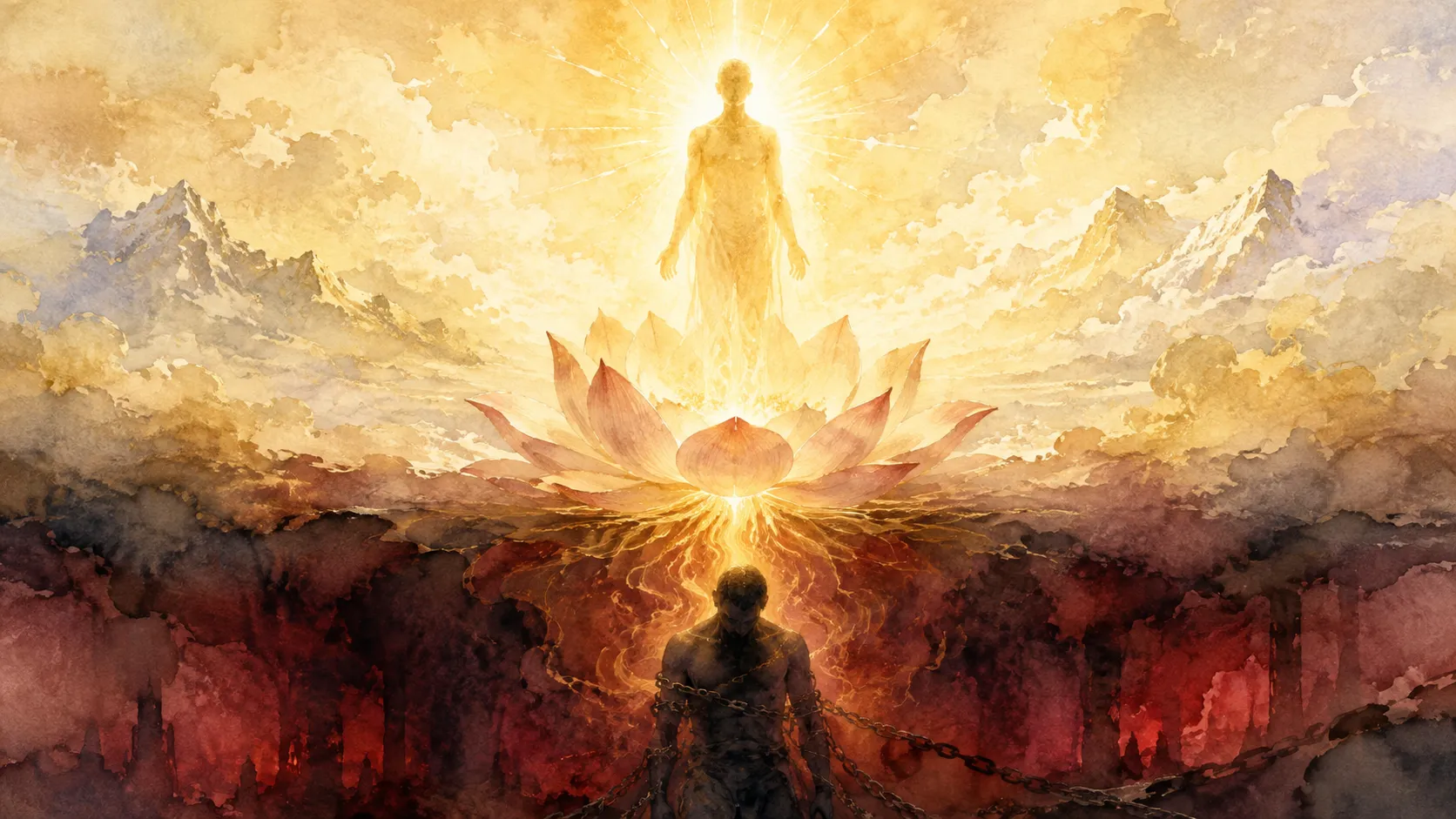
For example, in the world of the gods, gods appear instantaneously, already fully grown, with all their body parts fully formed, emerging from lotus flowers. Lotus flowers personify the energy from which divine energy is born; they are a kind of portal, which is why this birth is called miraculous. Likewise, in the hell realm there is miraculous birth: a hellish body arises instantaneously, and a person simply finds himself in some strange, heavy body entangled in chains, or lacking limbs, or surrounded by crimson hues and a kind of gloomy world, or approached by some sinister beings. He finds himself there instantly, and all of this is called miraculous birth.
In other worlds, such as the animal realm, the realm of the asuras, and the human realm, birth occurs somewhat differently. For example, in the human and animal realms, it occurs through a womb, through an egg, or through generation from moisture, from a combination involving the water element. In fact, this means that the subtle body has become enveloped in even denser matter; then it is said to have been born. But primordial consciousness is neither born nor dies; it becomes wrapped in denser forms of matter or is unwrapped again, becoming wrapped and unwrapped.
It becomes wrapped and unwrapped in various forms of matter strictly in accordance with the law of karma, and the law of karma is determined by our way of thinking; thus, it becomes enveloped in one kind of body or another. In every body, a certain proportion of tamas, rajas, and sattva is maintained. For example, in the bodies of holy gods, their proportions contain a great deal of sattva, very little rajas, and little tamas; in the human realm, there is much rajas, a considerable amount of tamas, and a little sattva; in the hell realm, there is a great deal of tamas, a great deal of rajas, and no sattva at all; in the realm of the asuras, there is a great deal of rajas, a little tamas, and a little sattva. It is precisely the proportions of the three gunas that determine the configuration of the elements composing bodies, as well as the bodies themselves.
But consciousness is separate from the three gunas, from bodies, and from the sheaths. This is precisely why, on the path of Advaita, we must cultivate discernment—the ability to distinguish the sheaths, the gunas, and consciousness itself. The body may act; for now, we cannot change the body or its tendencies, but we can discover the consciousness that is separate from the sheaths and the gunas, and we can cease to regard ourselves as the body and its tendencies and become established in regarding ourselves as infinite consciousness—this is pancha-kosha-viveka. We can develop detachment from the sheaths, the gunas, the body, and its manifestations; we can treat them with indifference or humor, knowing that they have nothing to do with us. Yes, for now this is how the body manifests—what can one do? I do not create galaxies or travel from one universe to another; I have to brush my teeth.
The gods, however, have no toothpicks; their teeth are always clean. They do not even have teeth; the body continually renews itself, is always youthful, always sixteen years old, and always filled with light. Their teeth do not need treatment or dentures; that is, the tattvas never deteriorate. The body consists of such pure sattvic matter that there is no need to care for it the way humans do.
But if consciousness is discovered to be independent of the sheaths and the body, then you are no longer this body; you are consciousness temporarily wrapped in this body, while you yourself are separate from these sheaths. Then you do not envy the gods or demean yourself because of your physical body; you accept it with humor: it is fine, no problem. You do not strive for heaven or fear hell, because only a real tiger can devour you, whereas a painted tiger cannot. Suffering can be caused only by things that are real; unreal things cannot cause suffering—at most, they can be a little bothersome. Therefore, one who possesses viveka (discriminating wisdom) ceases to suffer and regards their own body, the bodies of others, and the surrounding world with boundless humor, becoming more and more established in pure consciousness.
Becoming established in pure consciousness leads to an unshakable, indestructible conviction in the spirit of Advaita Vedanta: I am Shiva, the gunas do not affect me, the world is an illusion, the world is Shiva, and the gunas are the play of Shiva’s pure energies. From this arises pure vision; therefore, one who has mastered viveka becomes established not only in awareness but also in pure vision—this is not difficult.
“I have told you this story to illustrate this truth. Such is the fate not only of this wanderer, but of all beings. A being that has forgotten its inseparability from the Supreme Essence imagines its own concepts to be separate, entirely real, and material. It passes from one such dream to another until it abandons the notion ‘I am the body.’
Rama said:
What a remarkable story! O holy one, you said that all objects thought of as real become real and are experienced as real. I beseech you, tell me: does this wanderer exist somewhere?”
Thus, living beings are those who have forgotten their unity with the Supreme Essence. At the moment they forget their unity, the flow of grace—the flow of Anugraha—from this one Supreme Essence ceases, and living beings are then compelled to seek a source of energy in the external material world, in coarse worldly desires. This inevitably leads to entanglement and dependence; raga, dvesha, and abhinivesha gain strength. That is, the first process, in which a living being forgets its connection with the one Consciousness and that it is part of the one Consciousness, is called avidya (ignorance) and asmita, while the second part—raga, dvesha, and abhinivesha—means the arising of desires, duality as a consequence of desires, and a persistent craving for worldly existence. As a result, the living being experiences suffering and begins to reflect, contemplate, and analyze the surrounding world, eventually concluding that it wants to attain freedom and liberation; then it begins to practice.
Mantra Yoga
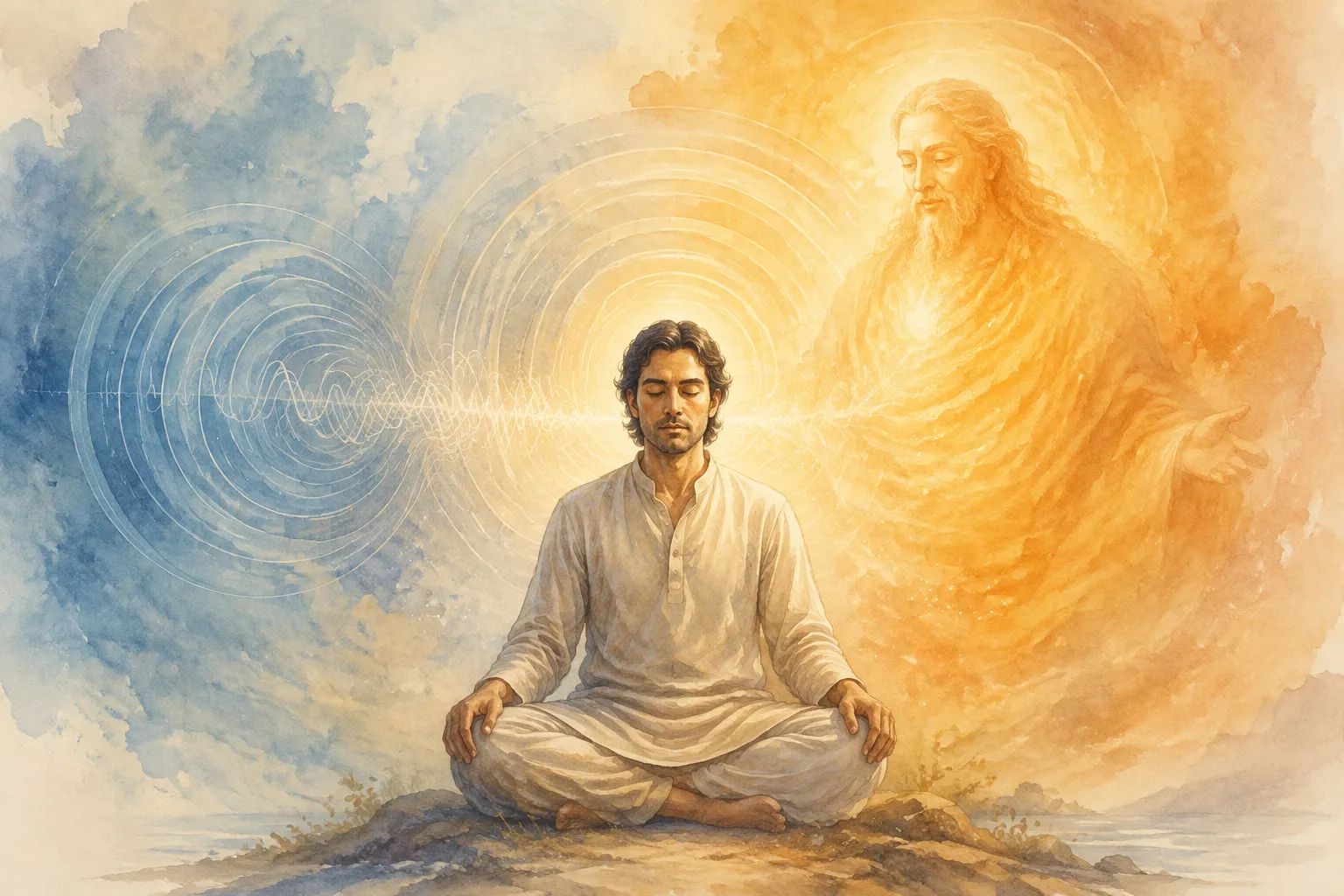
For many people, practice is initially performed at the level of the mind. For example, you recite a mantra and feel only its sound vibration, and it provides no inspiration, but you train your mind, knowing that the mantra must be recited, that the mind must be trained, and that you must practice concentration on the mantra. With the help of the mantra, you develop mindfulness, pratyahara—the ability to withdraw the mind from the sense organs—and concentration. The mantra resounds, the mind concentrates, and you are satisfied with this—this is the first stage of mantra recitation.
After this, you begin to penetrate the essence of the mantra and understand that the mantra is the sound body of the deity. Suddenly an insight comes to you: the mantra signifies a connection with Dattatreya; I must seek Dattatreya within the mantra—he is sealed within it, hidden inside it. It also contains the inspiring power of the rishi (the seer of this mantra), and the deity of this mantra is Dattatreya, which means that through the mantra I am addressing Dattatreya. You become interested, realizing that it is not merely a sound, not merely the mechanical sound of repeating a name; otherwise, it would be no different from repeating any other word.
Prabhupada once said to Western hippies in America: “See how the ‘Hare Krishna’ maha-mantra works. Try repeating the mantra ‘Coca-Cola.’” They sat there and repeated it for five minutes, and everyone grew tired of it. “Now repeat ‘Hare Krishna.’” They repeated it over and over: “Oh yes, this feels different.” No one wanted to repeat “Coca-Cola” anymore—it was far too mechanical.
When we repeat the mantra “Om Namah Shivaya,” Shiva is concealed within it; in the mantra “Om Dram Dattatreyaya Namaha,” Dattatreya is concealed; and in the mantra “Om Sachchidekam Brahma,” Parameshvara (the Absolute) Himself is concealed. As soon as we realize this, we become deeply inspired: “Wow, I am reaching the One Himself.” You know how they say in politics, “He reached the top man,” referring to the president or the head of some large corporation; but we are reaching the very Lord of the Universe, before whom all kings are nothing. This realization is the second level of the mantra, when, within the mantra and japa, we begin vichara (inquiry). We become interested in what resounds in these syllables, what their vibration is, how the deities reveal themselves, how intonation reveals the deity, and what each syllable corresponds to. It turns out that a great many mysteries are concealed within the single mantra “Om Namah Shivaya,” or the mantra “Om Dram Dattatreyaya Namaha,” or the Brahma mantra, and we begin reciting the mantra with enthusiasm.
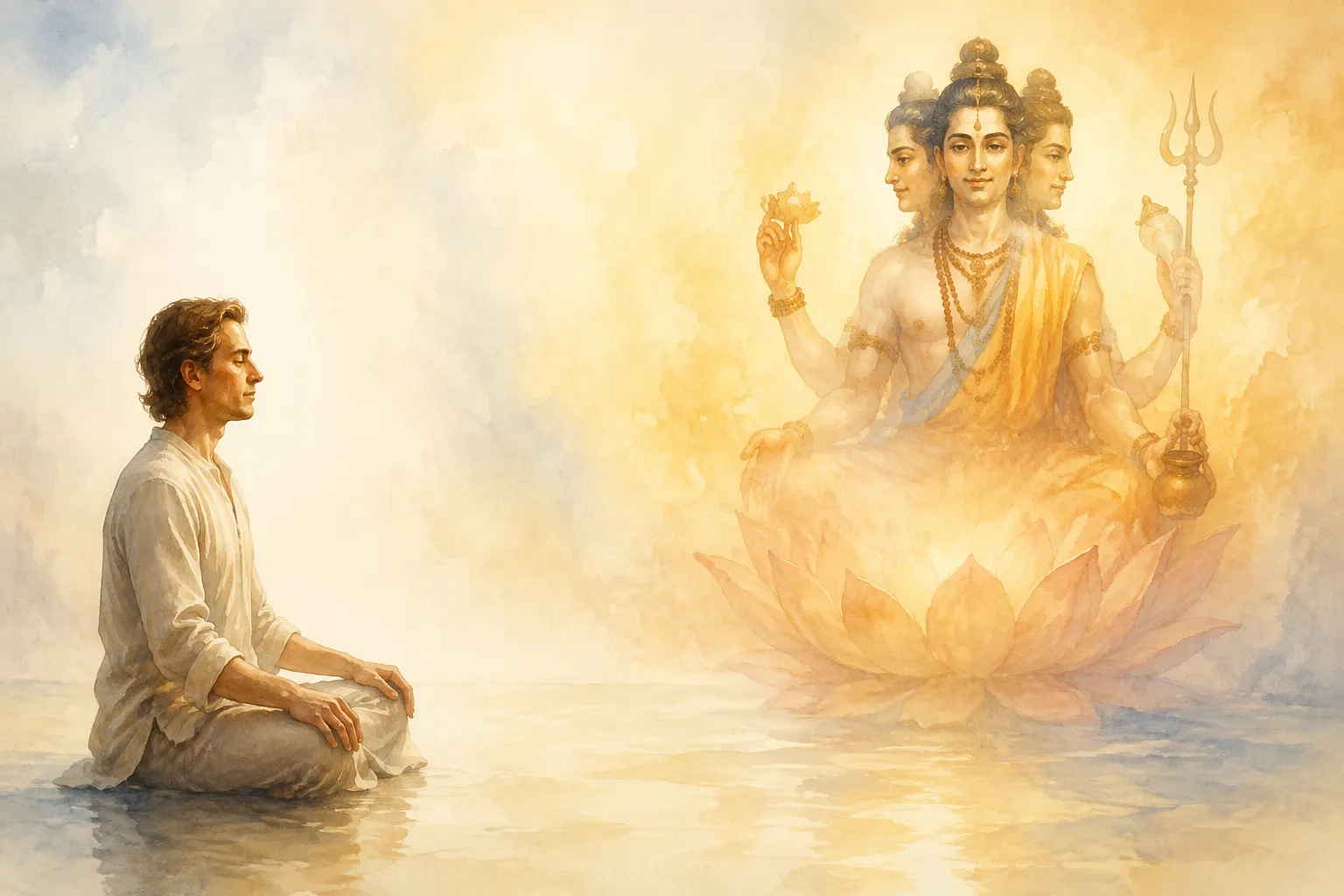
Finally, at the third level, our visual association comes into play: the mantra evokes the image of the deity and its bhava. When we recite the Datta Gayatri or any other mantra in pure, empty space, Bhagavan Dattatreya appears—perhaps indistinctly—in the radiance of glory, upon a lotus petal and with all his attributes, emanating an astounding bhava, and we think, “Wow, Dattatreya.” At first, this happens very subtly. One should not think that it occurs visually: you do not see it with your physical eyes, nor even with your astral eyes; you only feel as though Dattatreya has given you the slightest wink. At first you think, “I must have imagined something,” but then this inspiration grows and grows, and you genuinely begin to feel it. Following the inspiration, an image may arise, but this image is empty in nature. The most important thing is the depth of the bhava, and then you recite the mantra and feel that, yes, Shiva appears in response to the invocation of this mantra. Moreover, it would be surprising if he did not appear, for it is he who is concealed within this mantra; he is simply revealing its essence. He has always been in it; we were simply deaf and did not understand this.
Shiva has always been in the mantra “Om Namah Shivaya,” Dattatreya has always been in his eight-syllable mantra, and Brahman has always been in “Sachchidekam Brahma,” but somehow we did not hear this and did not really understand it. Now, however, we recite the mantra, and he appears, he reveals himself. The four quarters of Brahman have always been present in the mantra “Om,” permeating all three dimensions, and when we recite it, the deity of the mantra begins to appear and bless us, and we feel this blessing. It is enough to recite the mantra even once, and we begin to think, “Ah, so the acharyas were right.”
You know, some texts speak of the greatness of the mantra “Om Namah Shivaya,” the greatness of the mantra “Om,” and the greatness of the Guru Mantra, saying that even one who has recited it only once will attain liberation. We thought this was an exaggeration, probably said to inspire us. But when you recite in this way, even if you recite it only once, Shiva appears in response to your mantra, Dattatreya appears in response to your mantra, and you feel that even a single second of this manifestation is a tremendous source of the energy of grace. It is as though a whole bucket of grace has been poured over you, and you feel that your subtle body has been purified in a single second, in one instant; all your problems are gone, all your illusions are gone, all ignorance is gone.
There it is again—grace: you recited the mantra once in a state of devotion and openness. This is how the secret of unlocking the mantra’s blessing power, blessing itself, mantra yoga, and japa is revealed. And when you recite constantly, you constantly abide in the light, abide in grace; then the inner channels begin to vibrate and respond, and the deities simply unseal the channels and burst forth. They say, “We too want to receive this grace and take part in this mystery.” All the deities, dakinis, and rishis concealed within us—the inner Brahma, Savitri, Saraswati, the inner Durga—are also within us; we simply do not understand where they are. They are sealed deep within the channels of the subtle body; we simply do not understand our subtle physiology very well. But the mantra, by invoking the deity externally and initiating the flow of grace, unseals the deities. Then these deities surge out of the channels, emerge, resonate, and come into contact with the body of the mantra, with the body of the mantra deity. Their union and merging occur, and we say, “There, wisdom has opened, the chakra has opened, grace has come—wow!” Then various powers and various forms of wisdom awaken.
Spiritual Evolution
“Vasistha replied:
I will think about it and answer later. (At that time, the assembly rose for the afternoon prayers.)
Vasishtha continued:
O King, O Rama! With the help of my eye of wisdom, I tried to find the wanderer. I entered a state of deep meditation in order to see him. I searched for him in this Universe but could not find him. How can someone's imagination manifest outwardly and appear to be real?
Then I proceeded north to the land of the jinn. Atop an anthill stands a castle inhabited by people. There, in his own little house, was the wanderer named Dirghadrisha, whose head was yellow. He was in deep meditation; even his servants did not enter the house for fear of disturbing his meditation—it was the twenty-first day of his meditation. Fate had ordained that this would be his last day. Although from one point of view he had been meditating for only twenty-one days, from another point of view thousands of years had passed, for such was the notion that had arisen in his mind. I know that the same kind of wanderer lived in another age, and even in that age he was already the second such wanderer. With all my wisdom and abilities, I entered the very heart of this being, searching for this third wanderer.”
Brahma's primordial sankalpa gives rise to living beings; in accordance with this sankalpa, these living beings have their destiny and surroundings, and at certain intervals this sankalpa repeats itself, reproducing the same beings again and again. In India there is an ashram where Brahmins make an exact prediction for any person. To do so, they need to know the person's name, and they have a book: one simply needs to provide the name, year of birth, and certain other details. This book is written on papyrus, on ancient leaves, and when a person comes, they find their entry, where that person's entire destiny has already been recorded: what their name is, what they will do, when they will be born, what events will happen to them, and which people are connected with them. They simply take it out—everything has already been written—and read it to the person. This is called a prediction.
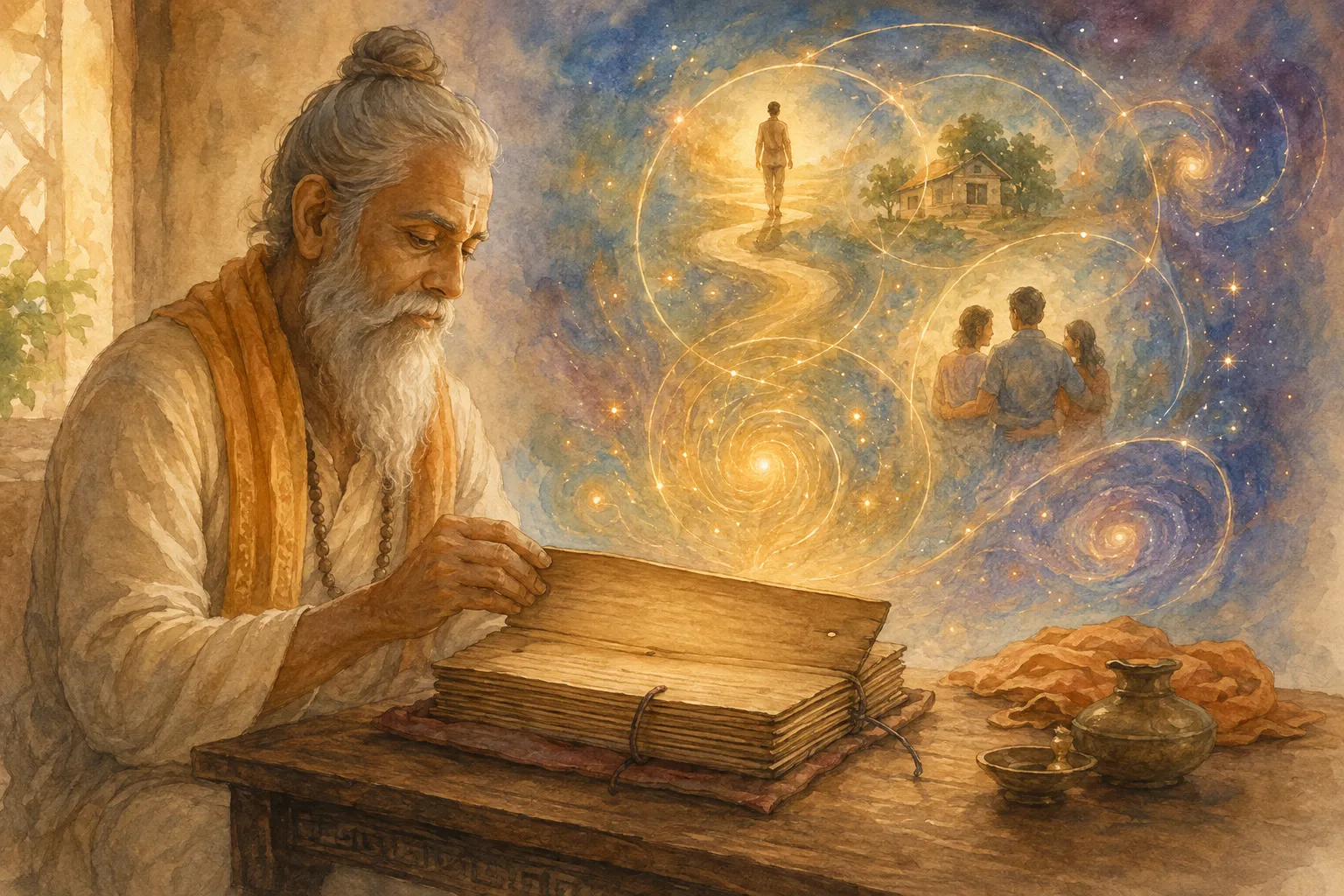
All these matrices of the universe are designed according to this principle. At certain intervals, Brahma creates various living beings, and their destinies repeat. In the same way, the characters of the Mahabharata are born periodically, and their destinies are reproduced again and again, because such is Brahma's sankalpa. Sometimes even on Earth there are people with identical names and identical destinies, and when they meet each other, they are simply shocked. Nowadays there is even a fashionable trend of taking photographs of people who have somehow happened to meet by chance and who look exactly alike.
One man had a family and a job; he had a first and last name, and when he was forty years old, he learned that in a neighboring city there lived a man who looked exactly like him. He had the same name, his wife had the same name, his children had the same names, he had the same kind of job, he was the same age, and he had been born on the same day. He was simply astonished, and they met each other—this means that they were born from the same matrix of Brahma's sankalpa. Brahma sometimes plays such jokes: what is it to him to produce a dozen or a quintillion such beings and populate the Universe with them? Such things happen sometimes.
Question: I also studied with a prabhu who resembles one of our students; he has the same first and last name and the same appearance, as if he were his twin brother.
Because that which is established in the subtle world can be projected into the physical world repeatedly and duplicated. For example, if a master creates some form, draws something, or casts some kind of mold, he can then simply reproduce that form many, many times. Thus, the matrix of a particular person—Brahma's sankalpa—is created at the level of the causal body, and then it is reproduced many times. But to avoid complications and much disturbance, it is reproduced at certain intervals—using the method of statistical dispersion. All of this is mixed together, and then souls manifest and incarnate—the same is true of this wanderer.
“In the end, I found him, but not in this Universe. He was in another universe, which, however, is very similar to this one, although it was created by another Brahma.”
Alternative Universes and Travel Between Worlds
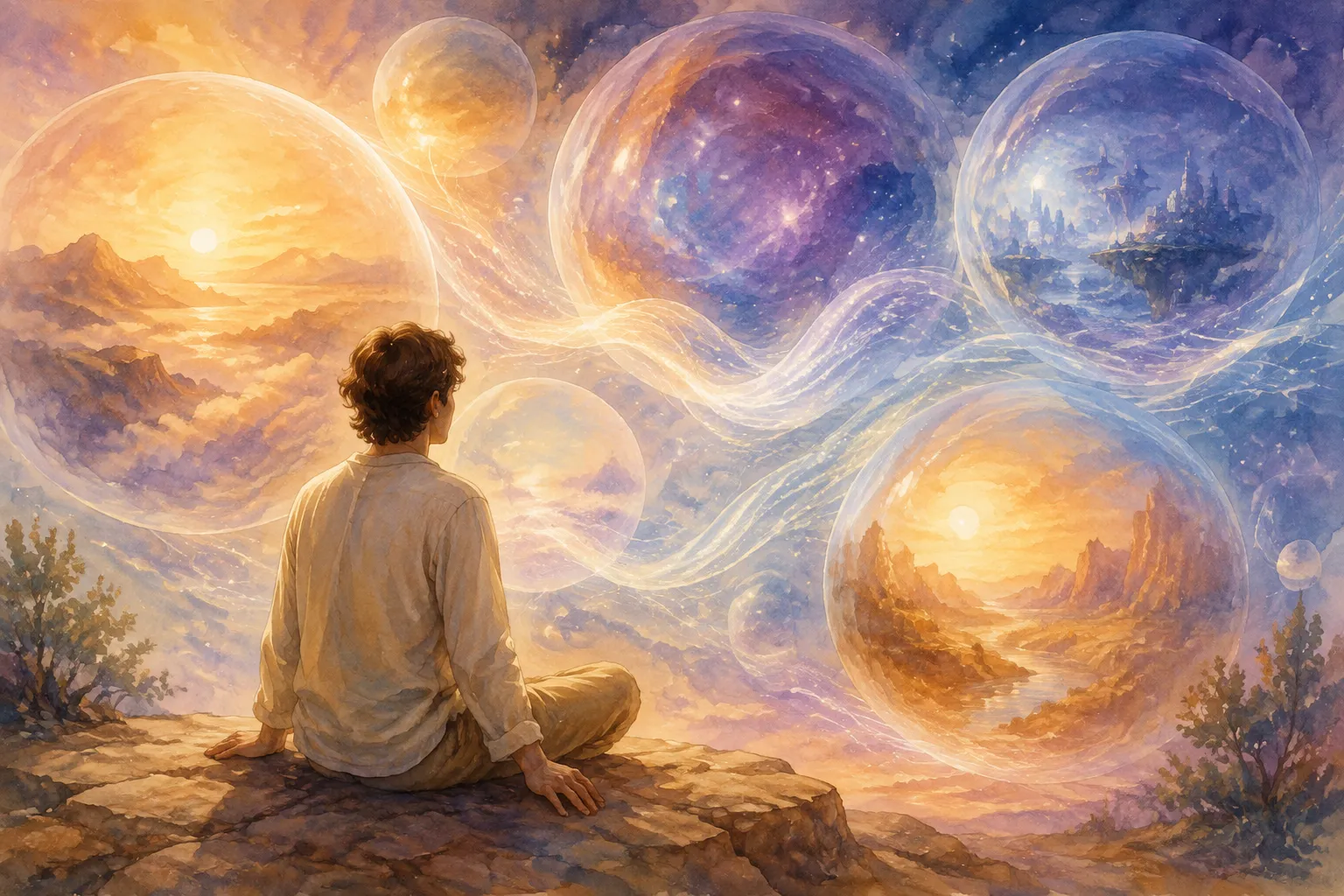
Besides our Universe, there is another Universe nearby, and these Universes were created by their respective creators. We live in a fan of universes; by changing the spectrum and frequency of perception, one can transition into an alternative Universe. This alternative Universe was created by another creator god, but even our creator god has not just one Universe, but an entire fan of them. In another Universe, time flows at a different angle. By changing the frequencies of perception, one can move from one Universe to another, even within the material world; however, going beyond the spectrum of the fan of worlds—the Universe of our Brahma—is considerably more difficult, though still possible.
Weak yogis cannot travel either within their own frequency spectrum inside the Universe of their Brahma, much less into another Universe belonging to a different Brahma. It is like a person who has little money and can live in their village, occasionally travel to the district center, but generally does not travel. Someone with more money can travel throughout the country; someone with even more money can travel all over the world, fly to the Maldives, Bali, and the Seychelles, go scuba diving in Egypt, and stay at six-star hotels in Turkey—this is what worldly people call a vacation. It is the same here: if a sadhu is stronger, they can travel to other worlds and other Universes within Brahma’s sankalpa simply by shifting the frequencies of their perception slightly. This requires more energy: one must awaken kundalini and saturate the upper chakras, and beginning with the manipura chakra, all exits can provide experiences of other Universes.
In these other Universes, they may encounter various beings. Some Universes will resemble ours, some will differ, and some will simply be different worlds. That is, there are other worlds, such as the world of hungry spirits, the world of the pitris, the world of the gods, and the world of the gods of the causal body; and there is also a spectrum of Universes connected to our world, meaning that there are people just like us there, and it is the same kind of material world, but these Universes are slightly shifted, like an alternative reality or an alternative history.
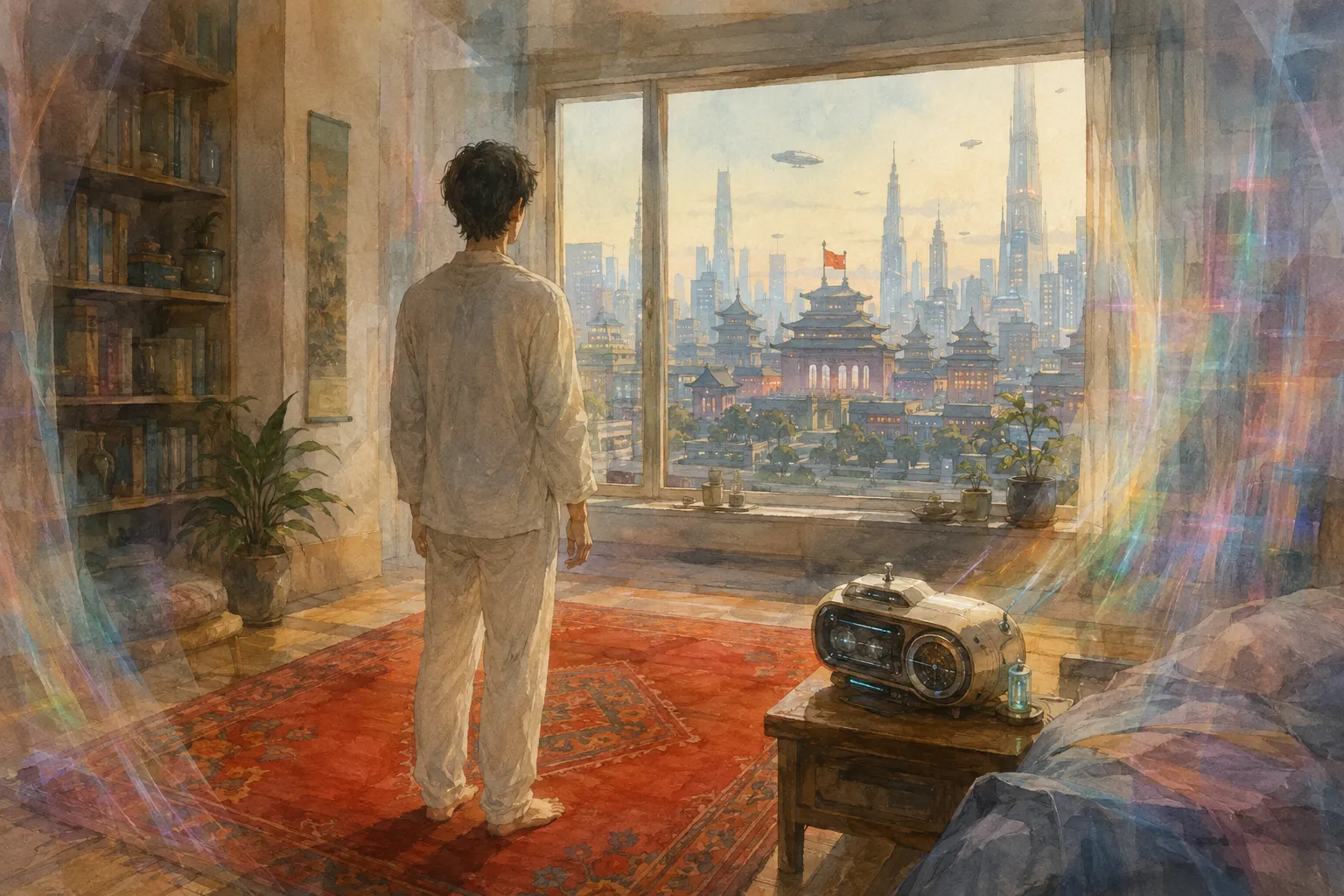
For example, once I sat down to meditate, and when I entered the subtle body, it seemed to me that I was in the ordinary world and in the physical body. I entered my house, which at the time was in Divya Loka and was called “Blossoming Lotus,” but there was a different rug on the floor. I thought, “Well, Ananda Lila bought a carpet in Nizhny Novgorod without me; it is red, such an unusual color, and she laid it down.” Then I came closer and saw some new iPhone there. I thought, “Some kind of new iPhone.” Instead of a display—it was 2007 or perhaps 2006—it had only a speaker and a radio. They were broadcasting the news, and most importantly, China dominated everything in the news. The geopolitical picture of the world was different. I thought, “Something here is no longer anything like our world.” Yet my house was there, and the entire world was human; that is, it was an alternative reality in another Universe, where China was the center of the world and commanded geopolitical attention much as the United States does, iPhones had a different design, and there was a red carpet in my room.
There may be many such worlds, and you can meet different people from them. Sometimes you may even encounter your double, a quantum copy of yourself in that world. Most interestingly, you may even acquire a different memory in that world, a different karma corresponding to who you are there, and this memory will be uploaded into your consciousness so quickly that, if you are not aware, you will not even have time to utter the mantra “Om” before you already have a different memory. Naturally, you remember all the people from that world, all your connections and relationships; you already have a trail of history behind you, and you feel compelled to act in accordance with this memory and these tendencies. But if you are aware, you will say, “Stop, this is not me at all; this is something completely new.” You will be very careful; your awareness will remain, the new memory will be uploaded, but remnants of your previous memory will persist. You will act very vigilantly and cautiously: “Where have I ended up, and how can I avoid remaining here in this state of identification?”
Levels of Yogic Power and Liberation
Such a yogi, by practicing samyama and samadhi, can travel throughout this Universe to various worlds, but there are entirely different Universes created by another Brahma, and it is not easy to break free from the sankalpa of one’s own Brahma, because the entire world is his dream, his sankalpa. One must attain an extremely profound samadhi and perform an extremely powerful samyama. Therefore, most yogis take an easier path: they ascend to the world of Brahma-loka and remain there, waiting together with Brahma, close to Brahma, until Brahma grows old and this Universe reaches its end. One hundred years of Brahma will pass, followed by mahapralaya (the great dissolution), and they will be liberated from this Universe. Why? Because they do not possess enough shakti of their own to overcome the power of the primordial being’s intention; it is immensely strong.
Time, space, causality, the deities of time, and the deities of meanings have all been brought forth; it is very difficult to overcome these deities, these shaktis, so they await mahapralaya. But during mahapralaya they remain conscious, and they emerge from it as nitya-siddhas. Some of them become new creators, while others once again enter the Universe of some Brahma in order to enjoy themselves there—this is how the nitya-siddhas live. Those who possess great power can become new creators and create a Universe themselves; those who do not possess great power enter the Universe of another Brahma and live there as free, liberated souls.
The most powerful yogis are not dependent on any of this at all. They can freely pass from the Universe of one Brahma into the Universe of another, and the sankalpa of the primordial creator, the lord of this cosmos, of this domain of reality, does not condition them. They are themselves divine, magical agents of sovereign will, players in the Universe who possess jnana, iccha-shakti, and kriya-shakti, and they can make such transitions. Some of them possess power and strength equal to Brahma’s, yet do not create their own Universes because their purpose is different; they can manifest in any form whatsoever, even in a human body.
“Countless beings have existed, exist, and will exist in consciousness in the future, and in our assembly there are sages and saints in whom concepts of other beings will arise, and those beings will appear as a result—such is the nature of maya. Some of these beings will resemble those who imagined them. Others will be completely unlike them, while still others will resemble them only partially. Such is the great maya, capable of bewildering even great men.”
The Power of Maya and Illusion
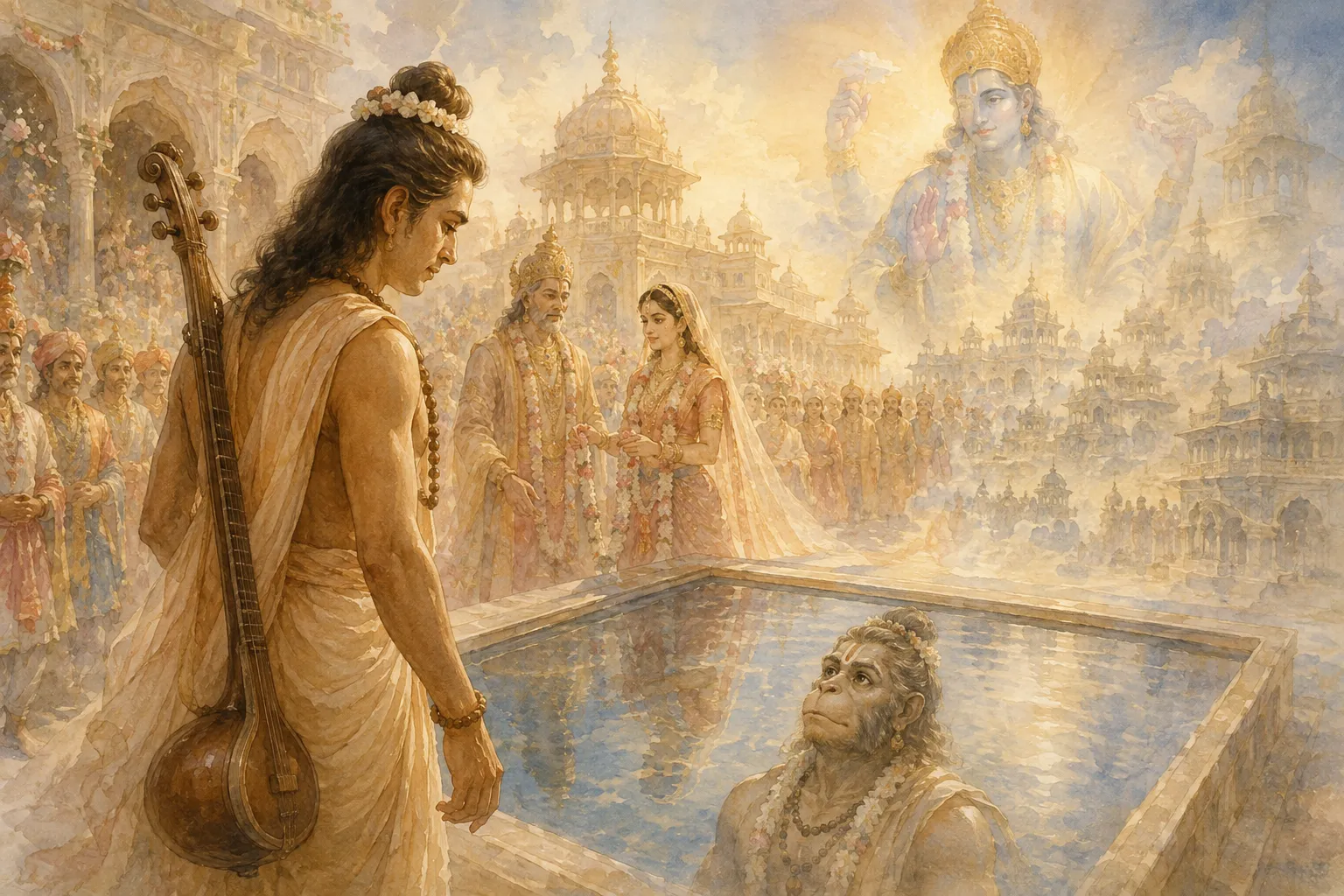
Once Narada—this is a well-known story, and a film has been made about it—heard that Lord Shiva had decided to marry, and the following thought arose in him: “Even Lord Shiva has fallen victim to maya, to sexual desire, to the desire to marry a woman, whereas I am a brahmachari; I surpass Shiva.” He shared these thoughts with Vishnu, and Vishnu decided to play a joke on him. As a result, Narada found himself in an illusory city, where he fell in love with the daughter of its king. A swayamvara was about to be held there, and he very much wanted to appeal to the king’s daughter so that she would marry him. He implored Vishnu to give him suitable, respectable clothes, for he was an ascetic (sannyasi), whereas there he had to look presentable—who would give his daughter to some sannyasi wearing a langoti, a kaupina?
Vishnu gave him clothes, but to others they looked like Hanuman’s attire. Therefore, when he arrived at the swayamvara, everyone smiled and said, “Oh, Hanuman has come to visit us.” Narada thought, “Why are they calling me Hanuman?” But then, when he saw what he looked like, he had completely assumed Hanuman’s appearance. He became very angry with Vishnu and went to complain to him, asking why Vishnu had shown such disrespect for his feelings and why he had humiliated him so badly that he had failed to win the swayamvara. Vishnu laughed and said, “The city, the king’s daughter, and the king himself were all entirely an illusion (maya). I created it simply to teach you a lesson, so that you would not think the power of your brahmacharya was greater than Shiva’s.” It was entirely an illusion in which Vishnu had briefly immersed Narada.
The power of illusion can be such that a person may imagine that they are living fully and experiencing the fullness of reality, while in fact all of it is happening only in their mind. Gods and siddhas possess such power; they can exert it upon others. This is called vashikarana-siddhi, the siddhi power of enchantment. Enchantment here is not what we mean when we smile at someone and charm them, and they make large donations to us or admire what they believe to be our enlightened qualities. In this case, enchantment means something else. Nor is it what we see depicted in films, when an apsara comes to an ascetic and dances before him while the ascetic meditates with one eye and watches her with the other until, eventually, sexual desire awakens in him. This, too, is vashikarana-siddhi, also known as prabhava-siddhi, but none of this is of a high level.
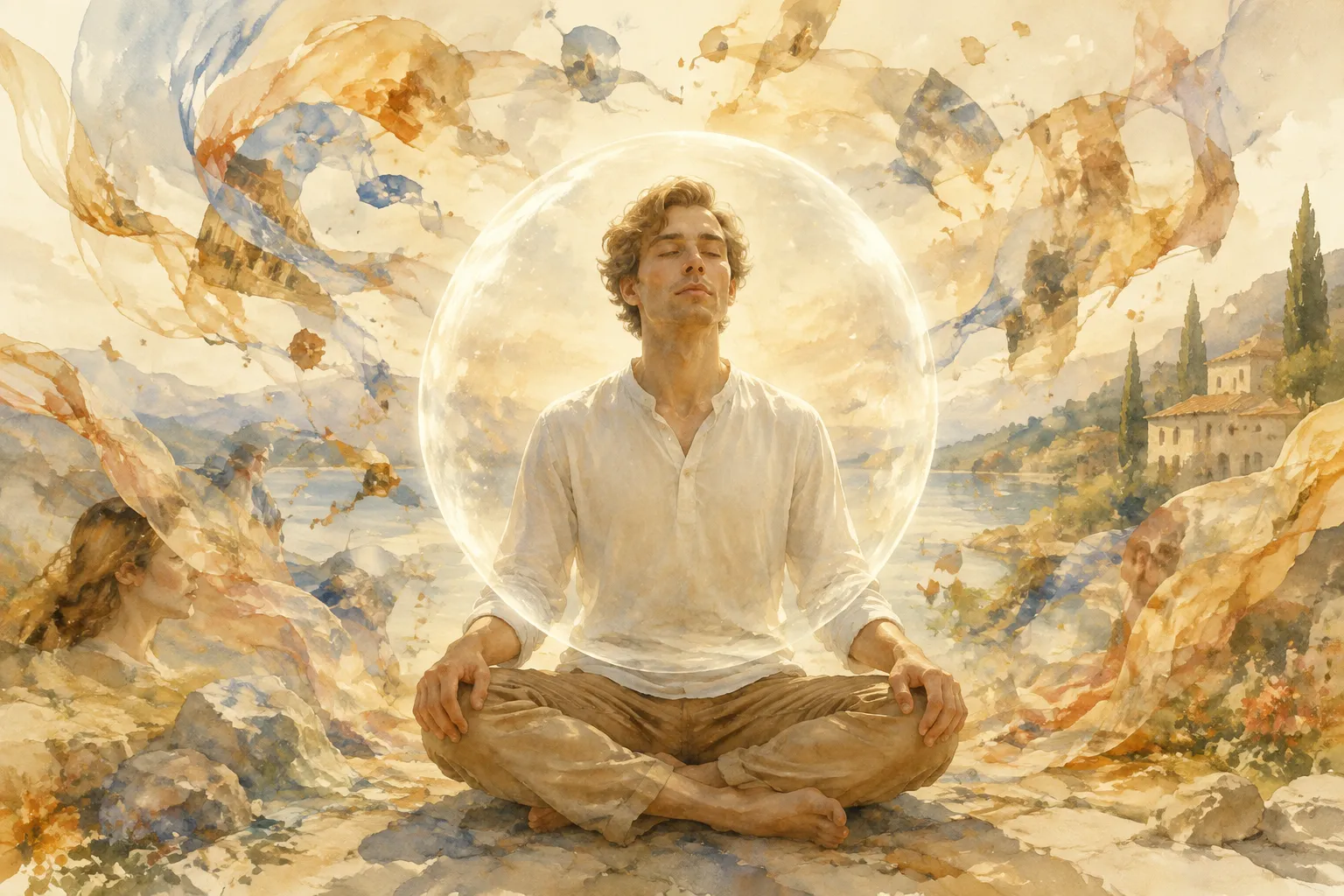
True vashikarana-siddhi, the power of moha-siddhi—the power of seduction and enchantment—is the ability to immerse someone completely in another reality, so that the person loses their bearings and cannot distinguish reality from a dream or illusion. They live in a subtle world generated by another being, and as long as that being's willpower is sufficient, everything seems to be truly happening. Siddhas who possess great power can generate this reality for several people at once. In India in the last century, there was a common trick in which white people (sahibs) would gather to watch a performance, and the magician (fakir) would take a rope, throw it into the sky, and it would hang there vertically. The magician's assistant, a boy, would grasp the rope and climb it. It had no support whatsoever: the rope was suspended in the sky, yet he climbed it, and when he reached the top, he waved his hand from above.
Then the fakir says, “Come down,” but the boy refuses to descend. The fakir scolds him, saying that it is already time to leave, but the boy still does not come down. The audience grows anxious. The fakir then takes a sword, climbs the rope as well, and strikes the boy with it. Severed arms and legs fall to the ground, and the horrified audience is ready to tear the fakir apart. Then the rope falls from the sky, and the fakir packs up his little case. But there is no rope and no boy; the fakir is simply sitting in padmasana. All of it was maya: he was merely reciting mantras, and the entire spectacle took place in the spectators' minds. There was no rope, no boy, and no sword—this is the power of immersion in illusion.
“Such is the great maya, capable of confusing even great men, yet it neither exists nor acts here, for it is merely delusion that causes all of this to appear and disappear! What are twenty-one days compared to an entire epoch? It is frightening even to contemplate the games of the mind. All of this is merely an appearance, unfolding like a lotus in the morning and revealing the multitude of petals within its flower.”
Protection from Maya Through Awareness
How can one avoid becoming a victim of maya, a victim of siddhi—whether the maya of one's own mind, the maya of other minds, or anything else—and remain in deep awareness, in the state of Shiva, beyond the reach of maya? If you have realized atma-vichara and, through atma-vichara, realized sushupti—or better still, turiya—then wherever you may be, you remember your Self. Even if you are unable to control maya, you can still remember your Self against the background of maya, maintain a subtle, aware self-existence, and refrain from identifying with it. You know that in this world, even if everything is illusory, I-am-ness, awareness itself, cannot be illusory, because even when I say that it is illusory, I confirm its existence. It alone can be real. That is, if you manage to maintain atma-vichara in both waking and dreaming, you are immune to all the enchantments of maya, because pure consciousness is never tainted by any games of the mind or energy and is subject neither to magic nor hypnosis nor anything whatsoever.
But if you do not possess this consciousness, and you perceive the world and identify yourself with the grosser layers of consciousness, then your consciousness can always be manipulated by magical beings, demons, your own samskaras, the external world, and even political ideologies. After all, somehow millions of people sit in front of the television, and the television, the one-eyed Guru, tells them something—this is hypnosis; this is how maya operates.
But when you abide in awareness, this subtlest layer of awareness is beyond the reach of maya, because maya itself is grosser than it. Therefore, a sadhu observes the single samaya of contemplation, the single samaya of awareness. Always and everywhere, he abides in awareness. This awareness is faith, Refuge, Guru-bhava, the inner Sadguru, and Atman; it is everything. It is very subtle, it flickers, it is easily disrupted, and it seems altogether elusive. Therefore, during the first few years, the disciple wonders whether it is there or not. But gradually, we begin to discover its power more and more, to rely on it, trust it, and recognize it as the essence of the Guru, the essence of Dattatreya, the essence of Shiva, the essence of the Refuge Tree, and our own essence.

“All this arises in infinite consciousness, which is pure, yet its manifestations appear to be impure. Every object appears as though fragmented, and at the end of this fragmented existence it undergoes an even stranger fragmentation. All this is relatively real and is not entirely unreal. It manifests in everything—the cause within the cause!
Dasharatha said:
O sage, tell me where this wanderer is meditating, and I shall immediately send my soldiers there to awaken him from meditation and bring him here.Vasishtha replied:
O King, this wanderer’s body has already become lifeless and cannot be restored to life. His individual consciousness has attained enlightenment and liberation—it cannot be made to experience this apparent world again. The servants are standing outside, waiting for the month to end so that they may open the door, as he himself instructed them. They will discover that by then he has already left his body. The apparent world, or delusion (maya), has the nature of limitation and of limiting qualities and attributes. It cannot be overcome through lack of understanding, but with knowledge of the truth it is easily crossed.Erroneous perception sees a bracelet in gold. Outward appearance becomes the cause of this erroneous perception. Unreal appearance (maya) is merely a figure of speech; it bears the same relationship to supreme consciousness as a wave does to the ocean. When you see the truth, appearance ceases to be a delusion. Because of ignorance, the long dream of the apparent world seems real, and thus individual consciousness arises; but when the truth is realized, all of this is seen to be consciousness.”
Pure Vision
Malas (anava-mala, karma-mala, maya-mala)
We are all one consciousness, and everything around us takes place within this one consciousness. First, maya-mala (the illusion of the multiplicity of objects) is erased. Therefore, when maya-mala—the limitation of the multiplicity of objects associated with the subject-object dichotomy of perception—is erased and dissolved, we begin to perceive everything, to some extent, as one consciousness. This is called the initial stage of the single “taste”; such experiences may occur even at the stage of fullness of attention.
Next, karma-mala dissolves. This is the illusion of “I act,” “I am the doer,” “the fruits belong to me,” “I am the enjoyer.” Another name for it is kartritva-buddhi (the mentality of the doer). We begin to feel that if everything is one consciousness, and we are already in contemplation or fullness of attention, then against the background of our actions there is stillness in movement, there is peace. Against the background of action there is non-action; behind all our efforts there is a certain relaxation and effortlessness. It turns out that this peace, this effortlessness, is the essence of every action; it is the essence of everything.
Then we think: “In that case, the fruits or results do not belong to this doer, but to this peace, to this non-action. Indeed, I do not need them at all, while this peace and this non-action possess tremendous power; they bestow tremendous wholeness, tremendous joy, tremendous bliss. This is what I shall enjoy.” This is action in self-renunciation; that is, I am not the enjoyer of objects—I am the enjoyer of the peace of contemplative non-action.

Such a yogi is said to have made the great decision to abide in great non-action—these are signs that karma-mala, the impurity associated with the illusion of the doer, has begun to dissolve. Then we understand what it means to live renouncing the fruits and results, to dedicate all actions to God, and to live in self-surrender.
Finally, there remains anava-mala, which makes us regard ourselves as an ego, an individual, a conditioned being separate from God. When it dissolves, self-recognition occurs: we realize that there is no multiplicity of objects, but one single Being; there is no doing and no doer; there is peace, non-action, and the play of energy arising from this peace. And I myself am one with this great divine Being; it alone exists, and it is I myself—this one great divine Being. How wonderful.
It is as though you had dreamed that you were a destitute homeless person, but then you woke up and found that you were a holy and mighty king, and you thought, “What an awful dream that was; how wonderful that I have awakened.” In the same way, when you realize that you are one with this great divine Being and, moreover, that nothing exists apart from it, your anava-mala—the illusion of limitation and separateness—completely disappears.
Right Enlightenment
But here it is very important to go through these processes strictly in accordance with the shastras and the Guru’s instructions, without going astray, becoming lost, or turning into one of the mastas (as those who have become somewhat lost are called in India). The power of the Advaita view, the power of the great truths, is so immense that it can confuse and disorient the mind. Therefore, we must learn how not to lose action in the view, how not to lose action in awareness, how not to lose awareness in the view, and so on. In other words, we must experience right enlightenment; we must approach unity with this one divine Being carefully, correctly, and in accordance with the shastras. Then we will experience right meditation, right samadhi, and right enlightenment.
We do not need wrong meditation, wrong samadhi, or wrong enlightenment, because they do not bring happiness or freedom; they lead us astray. Examples include wrong samadhi, wrong enlightenment (pralayakala samadhi), wrong meditation, or a wrong view (the view of nihilism or eternalism), and so on.
Whatever the concepts may be, it is only infinite consciousness that manifests as those concepts. The universe is the result of concepts held by countless individuals. Brahma’s original concept is experienced by individual consciousnesses as solid reality. But when you attain a purity of consciousness similar to the purity of Brahma’s consciousness, you see all this as a long dream.
It is all about the purity of consciousness, the purity of thoughts. The purer your consciousness, the closer you are to the one “taste.” Brahma’s mind is very pure; his vision is extremely pure, incredibly pure—that is, the frequency of his consciousness vibrates at the exalted frequency of the purest sattva, and his body consists of the purest sattva. Matter seems solid to us only because our mind is not sufficiently pure compared with the mind and purity of Brahma, who generated this Universe.

As soon as our mind is purified and becomes sufficiently pure, we can make it vibrate at the same frequency as Brahma, and then this Universe will no longer be quite so solid—not only matter, but also time, space, cause-and-effect relationships, and much else. In Tibet, there is a Master who blesses people by giving them stones. He takes flat stones and pierces them with his finger, making holes in them for good luck, and then gives them away. In other words, his finger vibrates at the same frequency as the stone and can enter it as though it were butter; for him, reality is not so solid.
There are beings for whom the solidity of the five elements is real, but who have realized kala-tattva; for them, the reality of time is not so solid, and they can move from one time to another. There are other beings for whom reality and space are not so solid, and they can move instantly from one place to another. The purer your mind and the closer its frequency is to Brahma’s Universe, the less dependent you are on this Universe—this is called the stage of the one “taste.” First comes pure vision, and then the one “taste”; there can be no one “taste” without pure vision.
The One “Taste” Through Pure Vision
A single “taste” means that everything is equally divine, and it is equally divine through the ultimate purity of pure vision, like the pure vision of Brahma. Therefore, we never tire of saying: “Practice pure vision. If you like something, practice pure vision in that situation. If you do not like something, still practice pure vision of that situation; what you dislike will pass. Before even a week has gone by, you will have forgotten about it, while your exercises in pure vision will bear fruit. Practice pure vision always and everywhere, and you will attain a single ‘taste.’”
A single “taste” means having the same purity of thought as Brahma. It is purity that brings enlightenment, it is purity that bestows siddhis, it is purity that brings success in meditation, attracts grace, and constitutes realization.
Primordial Purity and Spontaneous Perfection
The essence of God is purity; that is, God is utterly pure, unstained by anything, pure and spontaneously perfect. He does not need to be perfected or purified. Someone may say, “Well, it is God who is pure and spontaneously perfect, but I am just me.” Yet if God is pure and spontaneously perfect, this indicates that our Atman, too, is primordially pure and spontaneously perfect. In Anuttara Tantra, practice begins with our acknowledgment of this primordial purity and spontaneous perfection, which are also inherent in us, and through the view and contemplation we become established in them ever more deeply.
In the relative dimension, different situations may arise, but deep down we must always believe that we are primordially pure and spontaneously perfect. In the relative dimension, someone may say to you, “Prabhu, why are you so clumsy?” or “You made a mistake; you did it wrong,” or judge you in some other way, but this does not concern your soul, your Atman; it has nothing whatsoever to do with your Atman. It pertains to the play of the energy of your body and speech, but it does not concern your soul. With regard to your soul, all experienced sadhus observe samaya. To observe samaya means to see this purity in another soul from the very beginning, without superimposing one’s own projections upon it.
The Theory of Reflection
The concept of an object becomes the mind and thus slips away from the awareness of infinite consciousness. It then experiences various sensations, but is this mind independent of the supreme consciousness? Is not the supreme consciousness also the mind? Individual consciousness, the body, and everything else are merely reflections or manifestations of the supreme consciousness!
The next very important proposition is the famous theory of Vasishtha and the theory of Dattatreya—the theory of reflection (pratibimba-vada). Read this sentence once again.
Individual consciousness, the body, and everything else are merely reflections or manifestations of the supreme consciousness!
Our individual consciousness is reflected from the one supreme Consciousness; it functions as a reflection and is not independent. Our body is reflected from this consciousness and likewise does not function independently, but as a reflection. Yet just as a reflection contains the perfect image of the object it reflects, so our reflection contains Ishvara within it; therefore, God is reflected in even the most insignificant people, and wisdom is reflected in even the strongest kleshas.
The Awakened Mind and Diversity
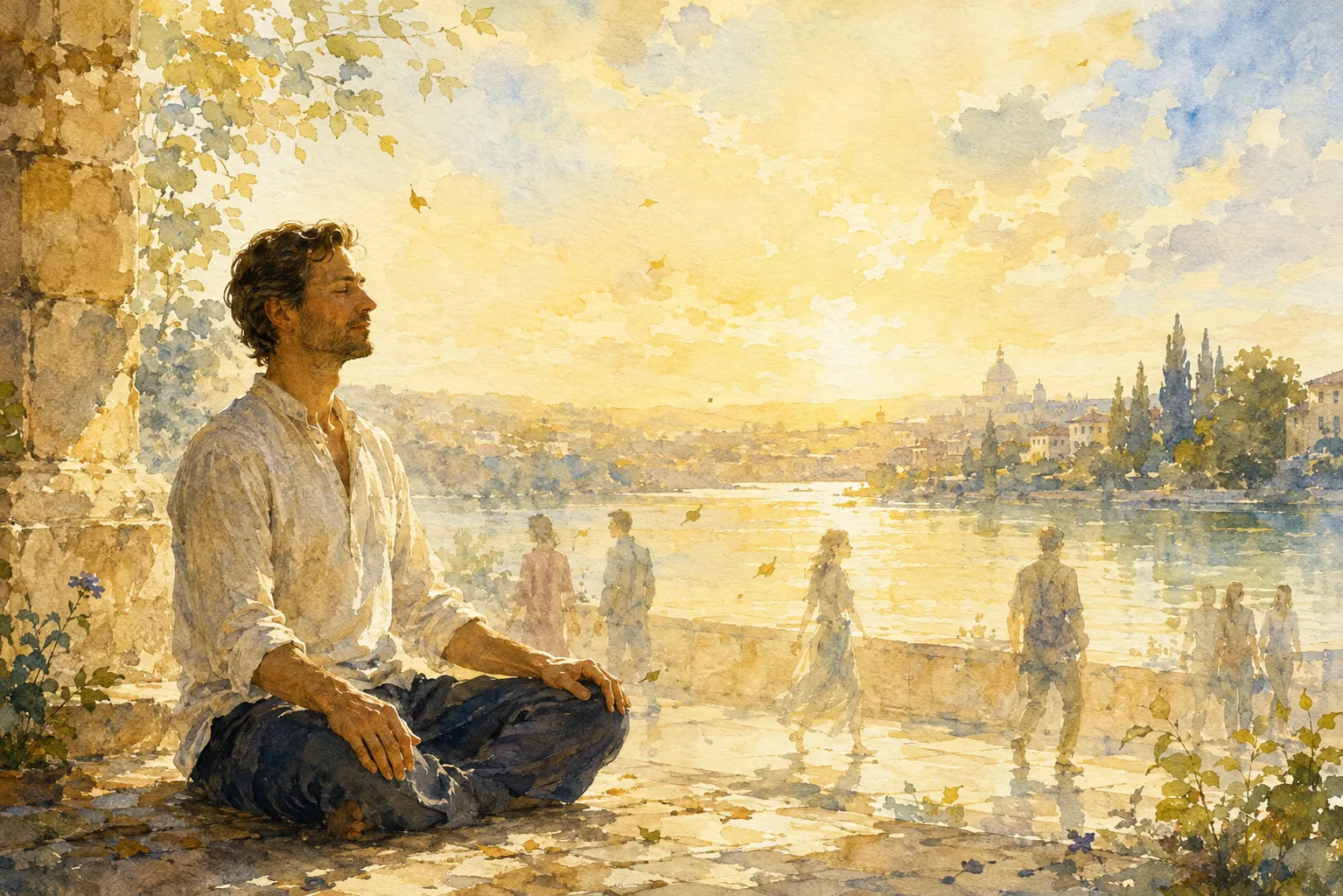
All these movements and so on occur within the one infinite consciousness, which is always infinite and aware; movement and so on are merely imagined expressions. There is neither movement nor stillness, neither one nor many—there is what is, just as it is. Diversity arises in the unawakened state and disappears with the beginning of analysis and observation.
When the mind is not awakened, there is diversity; when the mind is awakened, there is an understanding of unity. How is this experienced in practice? I have always been interested in practical questions. Philosophy is wonderful, but how are we to live by it?
For example, if your mind is awakened, someone comes up and asks you, “How are you, how have you been?”—meaning what events are taking place—“what’s new?” Various events occur in the material world. But if you are contemplating, if you are truly contemplating, and you contemplated yesterday, and the day before yesterday, and a month ago, you even wonder, “What’s new? Sankalpa is the same, the thirty-six tattvas are in place, Shiva and Shakti are playing—what could possibly be new here?”
For you, all these material events are not events at all; you no longer regard them as events. For you, the world of events as such does not exist; sequences of events and cause-and-effect relationships are secondary. What, then, is primary? Stability in awareness—that is, against the backdrop of all events, you remain steady in pure awareness, and within it nothing appears, nothing disappears, nothing comes, and nothing goes. Yes, it vibrates, it plays, it is not dead, it is aesthetic, it integrates, it sometimes pulsates with bhavas, but its essence does not change.
When your mind is awakened to contemplation, you abide steadily in this awareness, and then all the external events taking place become secondary to you; they are unimportant things which, if not entirely disregarded, can at least not be regarded as events at all. In other words, they are not events. Snowflakes are falling—is that an event or not? They fall, no one counts them, no one writes in Google headlines, “So many snowflakes fell today.” It is not an event; you attach no importance to them.
Likewise, the factors behind the manifold changes of the external world cease to trouble you, because your mind is awakened, and against the backdrop of the diversity of changes you see changelessness; and within this changelessness there is deepening, depth, and the discovery of manifold powers—this is life. Today I abided in changelessness and immersed myself in purnatva; yesterday I abided in changelessness and experienced such ananda; and this evening perhaps I will penetrate into svatantrya—this is life. But who said what, who arrived where, who left—this is not life; these are merely snowflakes falling. Likewise, this is neither an event nor life—it is play: energy played and departed. This is the life of a sadhu in contemplation, the life of one whose mind is somewhat awakened.
The Silence of Deep Sleep
The observer exists beyond all doubt—this is the supreme state. Tranquility is called the world; tranquility alone is this apparent world. Ignorance is unreal: there is neither observer, nor observed, nor the process of observation itself! The mind may imagine a defect in the moon, but no such defect actually exists. Infinite consciousness has only consciousness as its “body,” manifestation, or form.
Vasishtha continued:
O Rama, remain firmly in this state of complete freedom from the movement of thought; withdraw into the silence of deep sleep.
The silence of deep sleep is also called inner mauna (antar-mauna)—this means that while awake we recognize sushupti, jagrat-sushupti, or sushupti-jagrat for those who are more advanced in contemplation. In sushupti there is no speech, no fluctuation, no thinking; that is, deep within the soul there is no disruption of mauna—eternal mauna—even if the tongue speaks. This is called the silence of deep sleep. Such a yogin abides in deep sleep within the soul and does not speak inwardly, even while communicating with people. This is Vasishtha’s instruction to Rama on how to abide in inner mauna, the silence of deep sleep.
