

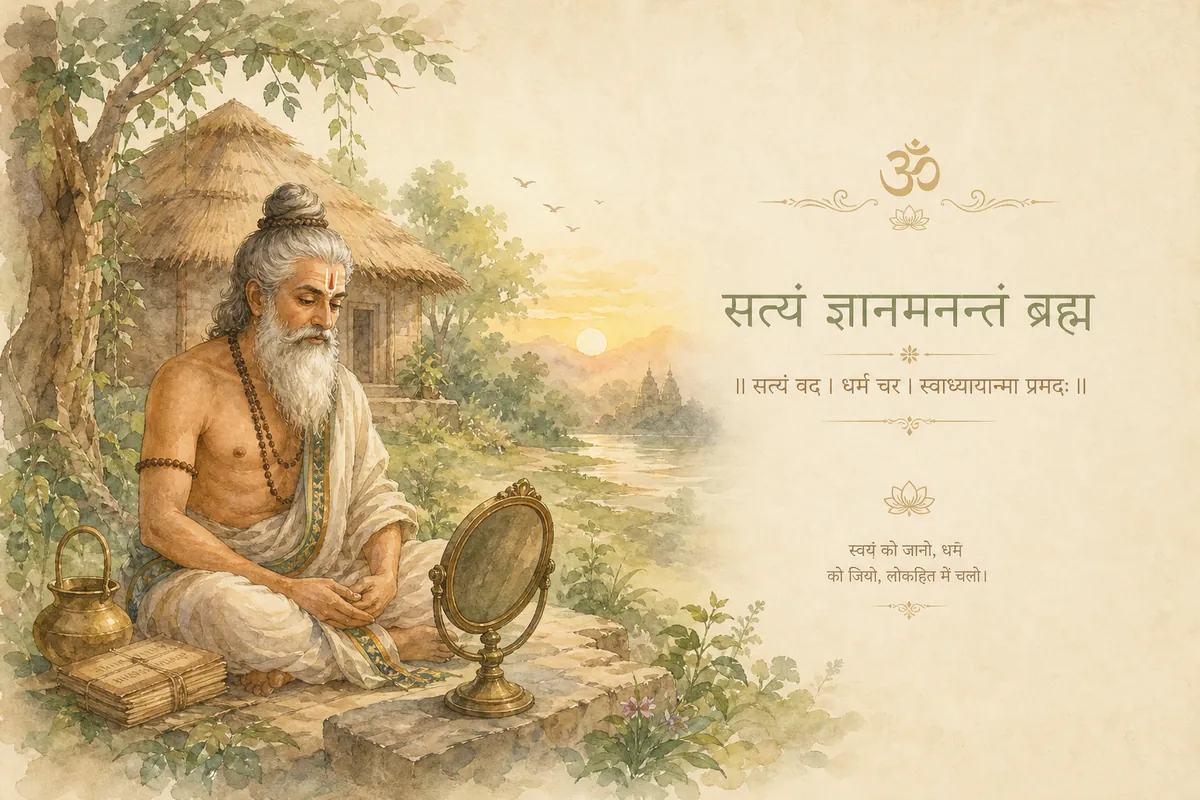
Commentary on Garab Dorje’s text “The Golden Letters”
This single and unique natural state can be discovered only within itself, or, literally, in relation to itself.
The natural state is discovered after our skills of concentration and through vigilant observation. Of course, its flashes may arise by themselves thanks to Guru Yoga. But usually a monk must succeed in observation, realize at least the second or even the third dhyana in the practice of concentration, and master the dense method of mindfulness.
When dense mindfulness has been attained, it turns toward our inner world, and nothing can escape it anymore. What we previously might not have noticed, we now notice. Then this mindfulness, simply by the power of itself, begins to purify our inner world of all residual attachments.
Primary Awareness and the Unity of All That Exists
Thus, if one knows one’s own essence, everything is united in a single moment by virtue of the presence of primary awareness, which does not surpass the knowledge of the single essence. The essence is shunya, or emptiness, the reflective capacity of the mirror. For the one who knows or has recognized one’s own essence, that is, has comprehended the mirror-like nature of one’s inner being, the entire world is instantly transformed into unity. This moment lies beyond temporal concepts, since time too is created by the thought process, existing only in concepts, which themselves are reflections and not the surface of the mirror. This timeless state is the fourth time, distinct from the present, past, and future known to us, the great time that contains the other three within itself, as well as the single instant. In this being of the mirror, and not of reflections, there continuously abides the perceiver of primary awareness, who fully realizes this single essence without needing to go beyond such awareness. One who has experienced unity in this state of genuine awareness has thereby known the entire world.
When we experience primary awareness, there is no need to know anything else, since any knowledge flows from the experience of primary awareness. There is a saying: “Without leaving the house, one can know the Tao; without looking out the window, one can see the whole world.”
One lay disciple suggested that I go to India or Egypt. I said that what I would find in India, I have here as well, and therefore I see no point in it. I will not find anything new in India or at the other end of the world. It makes sense to go there only for the sake of some kind of service. When we know our own mind, we stop searching for anything besides our own mind. And until we have known it, we continue such restless wandering, not understanding that everything proceeds from this single root.

The Traps of Samsaric Creativity
For example, in the process of practice, creative abilities, heightened clarity, and siddhis manifest in us, and there arises a great temptation to rely on this, to make it the new foundation of our life. We become wiser, purer, more intellectual, and capable of perceiving the fullness of life in all its colors and hues, and the mind wants somehow to rely on this, to rejoice, to congratulate itself on such an achievement.
However, a true yogin sees this as yet another trap; he will not allow himself this, because he knows that compared with primary consciousness, all of this is nothing. If a yogin indulges himself in samsaric creativity, he is like worldly gods. There are two kinds of creativity: samsaric and empty, and two kinds of siddhis—worldly siddhis and primordial ones, arising from the natural state. In the case of worldly siddhis or samsaric creativity, subtle energies are created, but they are not connected with primary consciousness. It is like worldly deities emanating from the body. Therefore, in Christian terms, such manifestations are manifestations of the devil; this is mara—the son of a celestial being.
Four Kinds of Maras
As you know, there are four kinds of maras:
- the mara of kleshas, arising from defilements and desires
- the mara of skandhas, arising from clinging to subtle sheaths
- the mara of death, that is, impermanence
- mara—the son of a celestial being
It is believed that mara—the son of a celestial being—is like a deity from the sixth heaven; it is the embodiment of our subtle mind, tempting us with siddhis, abilities, and creativity, when there is a desire to build upon them a support for the false ego, instead of offering all of this to the primordial presence.
The Yogin’s Vigilance and the Inner Voice
A yogin is always very sensitive and vigilant so as not to fall for this mara’s bait. When various states arise in him, he may say: “I am listening to my inner voice. This is certainly so, I know!” When people say this, I think: “Yes, poor fellow, he already knows for certain. But I do not know for certain, and therefore I take a critical attitude toward all kinds of inner voices, both my own and those of others.”
It is often said: “Do not believe yourself, believe the saints and the instructions,” or “You must listen to the inner voice, because without this you are not a practitioner; however, you must listen correctly.” When your inner voice tells you something, slips something to you, you must show it to the mirror of naked awareness; you must check it against the indicator of the natural state, primordial consciousness, emptiness, and self-liberate it. Then this will be true faith.
But if an inner layer of our awareness simply opens up, and you blindly trust it, rely on it, taking some fixed point of view, then it is merely another layer that has opened to you thanks to spiritual practice, but because of your spiritual inexperience you take it for some kind of revelation. For example: “God tells me this,” or “God tells me that.” But who is the one to whom he speaks? To whom is he saying this? Have you thought about this? And in general, is God saying anything to you at all, or is your own mind revealing to you yet another, subtler set of illusions?
In reality, the surface consciousness communicates with deeper layers of consciousness, and this process of the flowing of subtle energies is yet another form of duality. Therefore a yogin is very sensitive and always tracks inner intentions and the inner voice in time, and knows that the inner voice is silence. He carefully tracks all the encroachments of the false ego and cuts them off or puts them in their place, exposing their empty nature.
Otherwise, he may fall into samsaric creativity and generate worldly divine energies from within himself. Many yogins were known for this: they would receive certain spiritual experiences, and then their soul would open wide, and they would become carried away by such samsaric creativity to the detriment of consciousness, to the detriment of development. In such cases, Masters would unceremoniously and harshly point out to the disciple his complete illusion, especially in the traditions of Mahayana Zen Buddhism. They would say something like: “How wonderful, how touching! You fell asleep and disappeared into a dream!”

True Lila and Self-Liberation
When, however, we analyze the energies of creativity, that is, these subtle intentions, and instead of accepting them unambiguously, take a position of self-liberation in relation to them and trace their primordial source in consciousness, seeking their root, their foundation, then suddenly we are freed from their attractive influence, from the desire to manifest and express them. We resubordinate them to empty self-awareness.
Then both the tendency to become attached to them and the tendency to reject them leave us; they simply are and manifest, but it is no longer our ego trying, as it were, to identify itself. They are pure play, a manifestation of the source; we have discovered their roots, and therefore we will not become attached to them. We now know whose emanation they are, to whom they are subordinate. Such a state is the level of a saint or mahasiddha who freely manifests his energies. This differs from samsaric siddhis or worldly creativity. This is genuine lila, the spontaneous play of the primordial “I.” Here there is not even any question of egoism or ignorance; all actions are originally completely liberated.
We had a novice who, after week-long anapanasati retreats, began to receive many different experiences: she wanted to embrace the whole world, serve the poor, go to India to heal lepers, and tell everyone about her abilities. She said: “I know for certain!” I laughed at her: “When I hear such words, I know that in six months everything will change.” Six months later she came and said: “Swami, you were right.”
The Single Mirror of Consciousness
One who has known one thing has known everything. Phenomena are infinitely diverse, but direct awareness is one. It is a single mirror reflecting all things. There is no other genuine perception besides the knowledge of direct awareness. And this is like the meeting of two lovers who have secluded themselves in a secret place. There is no other genuine perception besides the knowledge of direct awareness.
It is said that there is no other true vision apart from the knowledge of this primordial consciousness. Any knowledge, no matter how captivating it may be, if it is not integrated and united with primordial empty awareness, is an illusion, patterns that arise in consciousness.

This state, unified in itself, abides only in itself. This unique and unified state is the knowledge of the state of direct awareness.
When you listen, it is assumed that, gradually opening to this understanding, you become saturated with it; this is your practice. But if you listen and think, “Oh, I am listening to this, but I have realized nothing. When will I realize it?”, then your attitude while listening is fundamentally wrong. Instead of gradually absorbing what is being given at this moment, you think about future realization and are not in the state of here and now.
When you simply listen, your open consciousness attunes itself to this primordial consciousness. Gradually it flows into you as a very subtle form of Clear Light. At first we do not understand how this happens, but after some time we can sense it, for example, as a very refined energy. We may even feel it with the body or the chakras.
The Single Root of Diversity
Although the phenomena of the world are diverse, all their differences are liberated by this very diversity through the presence of the fundamental primordial awareness, just as cutting the main knot in a rope frees the hundreds of threads of which it consists.
The yogin, observing the diversity of all that manifests, constantly tries to discover the single root of all this diversity. For example, when you practice pure vision, you see the external world, and you have several ways of seeing reality.
The first, ordinary way: reality seizes you, and within it you are a samsaric being; that is, you are inattentive and do not contemplate, but simply see trees, houses, cars, and you believe that this is how it is, and that you are part of this reality, and therefore your consciousness becomes bogged down in it.
The second way: the practice of pure vision or attentive contemplation, when you begin to see reality as a manifestation of the Absolute; your consciousness is very even, and therefore it does not evaluate any of the objects as self-existent. And then reality appears as a certain mass, a conglomerate of one energy, and you receive darshan from the situation or from the external environment, as if a great universal impulse emanates from everything and penetrates you.
I can say from my own experience: wherever you look, you see neither trees nor houses, but you see God. You are attuned to this, you contemplate and constantly see it in everything: in a bull or in a dog, in a car. From everywhere he, like light, shines through into you, filling you with enormous energy, like a radiance that penetrates you and saturates your spirit with a powerful impulse of universal consciousness; this means that the situation gives you darshan. If you have deepened in attentiveness or in pure vision, this happens very strongly even while walking, even when you go out into the city. The whole point is that you are looking at reality with different eyes.

From Receiving Darshan to Transmitting It
Finally, when you contemplate very deeply, you are so undivided from the situation that each manifestation gives you a powerful impulse, as if you were in the midst of a raging ocean of light that enters you. You yourself become this light. There are no longer external objects; there is only a raging ocean of light, and external objects simply express this energy. And then your own light begins to radiate outward. Of such a state it is said that it is no longer the situation that gives you darshan, but you who give darshan to the situation. A very strong bhavana of the Absolute arises in you, a great divine pride.
Then whatever you touch is also transformed into pure vision; you can already change the situation or influence it. This is the stage of siddhi. One can give such an example. There is a monk who simply walks around and engages in service; there is a monk who abides in contemplation, whose entire life is the practice of strengthening his contemplation; and there is a monk who has become so firmly established in nonduality that he can transmit it to others. He changes the space around him: wherever he goes, a monastery is built there; whoever he speaks to, they become his disciples; whatever he thinks about, murtis, saints, sutras appear, and people’s spirituality increases. Simply by the power of his mind, he bends space.
Once in Nizhny Novgorod, I was sitting in a café at the railway station, waiting for a train. Two people of about forty sat down next to me. When we began talking, they took me either for a Taoist or for a Chinese person. One of them took refuge after fifteen minutes of conversation and wanted to become a disciple. The second wanted to become a disciple after thirty minutes of conversation. At the same time, they were the ones talking, while I was mostly silent. Someone might think that this could not happen, but it really did happen, and more than once.
Of course, I did not take them as disciples, understanding that all of it was superficial and temporary: while I was sitting there, they were taking refuge, but as soon as I left, their consciousness would change. Nevertheless, for twenty minutes their consciousness changed completely, and they showed great interest in spiritual life.

Once, Vasudeva met in a dream with someone resembling officials from the level of the heavens of Yama—that is, not a deity, but someone similar—a worldly god. When Vasudeva began to communicate with him, he gave him a transmission, and then this official’s consciousness changed greatly. He showed Vasudeva something like a scroll, compromising material, a personal file, containing all his past sins; then he tore up one copy and gave the second to Vasudeva, saying: “And this one you tear up yourself.” This happens when in a dream you change someone’s consciousness by the power of your presence, because your presence is very strong, and others also enter into it.
It is said that if some saint is in a strong presence, then within a radius of five kilometers all living beings and spirits of the locality gradually enter samadhi, the natural state, taking refuge in the Dharma. This is called giving darshan to the situation.
