

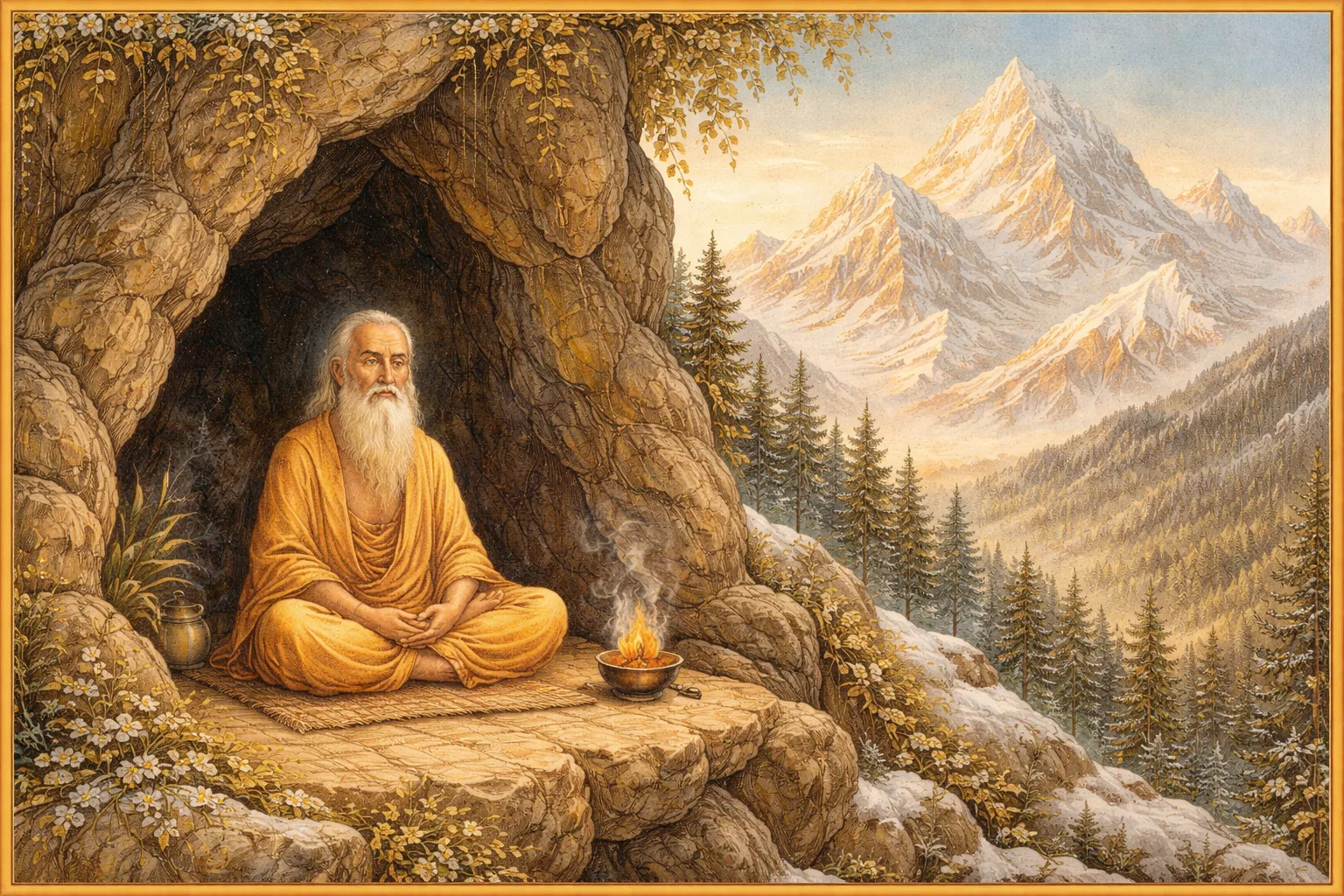
Commentary on the text “The Hundred Thousand Songs of Milarepa”
It is said that Milarepa, obeying the instructions of his Guru, went to the snowy slope of Mount Yolma, where he lived in a tiger’s cave. Five young nuns came to him and asked him for instructions on meditation. They said: “They say that this place is filled with fear, and that you practice subjugation and wrathful presence for rapid progress. Is this so or not?”
“Oh, how much happiness there is in the myriad manifestations! Both rises and falls are all a joy to me! Blessed is the body if there is no bad karma. And what, in truth, is it if not happiness? All this is confusion without beginning or end. And the stronger the fear, the happier I am. What happiness is the death of passions and feelings! The stronger the passions and the more painful the sufferings, the more joyful and cheerful one can be. What happiness it is to have no illnesses! What happiness it is, with one’s whole being, to be able to recognize suffering and joy as one. What joy it is to play with the whole body, with every gesture and movement, with that power whose manifestation is aided by yoga.”
The Principle of a Single “Taste”
Here Milarepa speaks of the fact that, in the state of one “taste,” everything is joy for the yogin: spiritual rises and falls, bad karma and good. There is an expression: “Stand like a mountain and flow like a river.” This is a fundamental principle of Anuttara Tantra.
To stand like a mountain means that the mind abides unwaveringly in a state of equanimity; it is strengthened in non-duality when, for example, you sit and unite with the element of earth or meditate on emptiness. This is the diamond-like unshakability of the mind.
To flow like a river means that when we emerge from this state of non-duality, we show flexibility in relative situations, feeling joy everywhere because we possess a single “taste.” We receive the single “taste” from the state of non-duality, when the mind abides in emptiness. And when we emerge from non-duality, we flow, like a river, amid the diversity of situations. Such flowing is a variety of sahaja samadhi. In tantra there is the expression “the samadhi of the flowing river,” which points to this. Milarepa loved to practice it. This means that samadhi continues in any situation, that our mind is unshakable in any situation, and therefore the yogin always experiences transcendent joy.
Three Qualities of the Mind
In one of his songs, Milarepa says that the mind is inseparable from the Source and possesses three qualities:
- Its first quality is self-awareness, that is, the quality of absoluteness is inherent in it from the very beginning
- The second quality is self-radiance, self-illumination, that is, the quality of light is inherent in it from the very beginning
- The third quality is self-joyfulness, that is, the quality of joyfulness is inherent in it from the very beginning
Everything depends on whether we gaze, every second, into the nature of the Mind or wander through the labyrinths of our illusions and gross states. One who continuously gazes into the nature of the Mind is in a state close to that of the flowing river. And even if he is not yet a great master of samadhi, he feels the self-awareness and self-radiance of this Source; he is always self-joyful, that is, his joy is not conditioned by anything external. And then all his actions are also filled with beauty, joy, and harmony, because he feels the great power and energy of the self-joyful Source.
“After that, Milarepa gave initiations and oral instructions to these five young newly converted nuns. After practicing his teachings for some time, the light of inner understanding arose in them. Milarepa’s joy knew no bounds, and he sang of the nectar of instruction: ‘Oh, my Guru!’”
The Song of the Yogin’s Joy
This song is called “The Song of the Yogin’s Joy” precisely because it points to such a quality of the primordial mind as self-joyfulness. When we do not have trust and do not gaze into the deep nature of the “I,” our self-joyfulness is obscured by feelings, emotions, and clouds of thoughts. We can experience it only at certain moments, when the planets have aligned and produced some favorable astrological aspects, when the winds are in their very best state, when the channels and bindu have converged in such a way that more prana enters the central channel, when in meditation the mind flows one-pointedly. And then, for a few moments, we catch this glimpse of joy. In our inexperience, we associate it with certain situations or actions.
However, from the point of view of the natural state, this joy exists primordially and does not even particularly depend on any astrological influences or on the state of the energy channels. Here the question lies only in our openness and our continuous attention to this joy. And here Milarepa writes that one wants to leap, run, dance, and frolic even more merrily. That is, he says that this state lasts regardless of the sitting posture or the practices being performed; it is united with any positions of the body.
Thus, simply by checking whether you are attuned to this self-joyfulness or not, you can learn the degree of your progress in practice and assess how attentive you are.
Instructions on Service and Samaya
“O my Guru, who knows the unerring path to liberation. Perfect Teacher, great compassionate one, I ask you, never leave me. Always be above me like a jewel finial crowning the roof of a house. Listen, followers of the Dharma, hey, contemplatives sitting here. Although the teachings of the Buddha are very numerous, the one who can practice this profound path is truly gifted. If you wish to become a Buddha within one lifetime, you must not acquire the things of this world and tease self-conceit. Otherwise you will become entangled between good and evil, and thus may find yourselves in the realm of poverty. When you serve your Guru, refrain from thoughts such as: ‘I am the one who works, He is the one who enjoys.’ And if you had such thoughts in your mind, quarrel and discord would inevitably follow, and your wish would never be fulfilled.”
Here the principle of samaya is being discussed. When we engage in service, we are, of course, performing our own practice. If we have thoughts that we are doing this according to monastic discipline or at the instruction of the administrator, then this is a kind of impure thought and an improper attitude toward service. Any service should be regarded precisely as an excellent practice, as something that advances one in the same way as meditation and techniques. If you regard service in this way, you will progress in the best possible manner.

It can often be seen that a person is diligent in study or techniques, but perceives service as a necessary evil that must be endured, as a not very joyful appendage to spiritual life that must be done because one needs to support oneself. And then he performs service unwillingly, simply so that people will not bother him. When a practitioner cultivates such an attitude, it indicates that somewhere within him there is a fundamental, deep-seated lack of understanding.
When we mature, we suddenly feel that service is like the heart in our chest, the apple of our eye, that it is in fact the way of our offering to the Clear Light; it is our gratitude, our admiration, our self-revelation and creative self-expression. It is everything altogether! Moreover, it is even discovered to be the most important practice, more important than technical practices and the circulation of energy in the body, because no technical practices or rotations of energy will free us from the illusion of “I,” from persistent clinging to selfhood. This demon of “I” is precisely the most important factor that casts one into samsara. And service does not give the ego a single chance to survive; it constantly tears true consciousness away from the ego. There is no need to erode or weaken the ego, since in a true practitioner the ego should be normal, and his personality should be strong. Nevertheless, service tears essential consciousness away from the ego, constantly turning it toward the fact of the existence of the Clear Light, toward the object of self-giving.
Pure Vision and Tantric Precepts
“When you observe the tantric precepts, do not allow association with the corrupt; otherwise you will be infected by evil influences and will be at risk of violating the precepts.”
Here it is said that when you follow the path of samaya, do not have impure thoughts. In any situation, turn everything around so as to see it in pure vision. Why is it necessary to do this? Because the perception of samsara as such is already, in itself, impure vision. Every time we judge anything, it is, in principle, a manifestation of our impure vision. And what is being discussed here is not something specific, but vision in principle. Suppose we think: “This is a house. This is a person, and this is a dog. This is a good person. This is a beautiful house.” We form a certain judgment, but it is already impure from the outset, because there is a subject who judges, and he is immersed in a particular karmic vision. From the very beginning there is already duality, there is already separation. The habit of pure vision gradually eliminates such a tendency.
“When you are busy with learning and study, do not bind yourself to words with pride; otherwise, the sleeping fire of the five poisonous passions will flare up, and your virtuous thoughts and deeds will be burned.”
“Not binding yourself to words with pride” means not becoming fixated on intellectual beliefs. Suppose a person who has not discovered the state of awareness beyond concepts may rely heavily on words. He may have various opinions; nevertheless, as long as these opinions are mental, they are worth nothing. A person with higher realization will simply think: “My God, what a wretched consciousness! What is he babbling about at all! He is completely blind! He does not even see the consciousness behind the words, and he is defending something, thinking that the problem lies there. But the problem is his unconsciousness.”

Do not cling to mental understanding and, even more so, do not cultivate pride based on this understanding. When you advance just a little, everything may turn out to be completely different, even such mental understanding and clinging.
Warnings for Practitioners
“When you meditate in a remote place with friends, do not chase after too many things; otherwise, your good deeds will be halted and your devotion will dissipate. When you practice the path with form, the school of whispered transmission, do not summon demons, do not drive spirits away from yourself, lest demons arise within your mind and the striving for worldly goals flare up.”
Sometimes, when a person practices tantric methods, visions or sensations may arise in him that obstacles are being created for him. And then, imagining himself to be a great tantrist, he tries to subdue spirits, wage war against them, recite mantras, wrathful spells, and so on. But in reality it turns out this way: the more he tries to subdue and perform various magical actions, the more such obstacles he feels, forgetting the instructions that when the mind is calm, everything around is calm as well. The more the yogin applies magical means, the more his own mind goes out of control. And often such magical means are a way of subtly clinging to the ego.
But when the yogin leaves things as they are and practices the equanimity of presence, obstacles suddenly begin to disappear on their own, without the need to apply any magical means.
“When you have gained the experience of realization, do not display either your secret abilities or clairvoyance, so that the secret words and symbols do not slip away, and so that merit and spiritual intuition are not weakened.”
When experiencing any kind of experience, one should not immediately shout about it for all to hear. Subtle states are easily lost; they can be disrupted by the subtle thoughts of others.
“Know these traps and avoid them. Do not commit evil deeds, do not eat tempting food, do not take upon yourself the burden of a dead person. Do not utter sweet words to please others.”
The phrase “do not take upon yourself the burden of a dead person” refers to a situation when a spiritual practitioner accepts donations for the commemoration of the deceased. But if it is given to him specifically as a clergyman, then he takes upon himself the burden for the consciousness of that person who is in the bardo, that is, his karma. And only a high-level practitioner can take on such responsibility. If, however, a low-level practitioner does this, he simply heaps unnecessary concerns upon himself.

Instructions on Seeking the Path
“Be respectful and restrained, and you will find your path.”
The nuns then asked Milarepa how they might find their own path, and asked him to continue his instructions. In response, Milarepa sang:
“I bear witness to my reverence for my gracious Guru; I ask to be granted the waves of your benevolence. Please help me, a pauper, to meditate happily. Although you, children of the new generation, live in cities flooded with deceptive karma, the connection with the Dharma still remains. Since you have heard the word of the Buddha, come now to me and do not lose your way. Through the constant practice of accumulating merit, you will nurture openness to devotion. Then waves of blessings will descend upon you, and the corresponding genuine realization will begin to grow. But even if you do all this, the help will be only slight if you do not attain complete mastery. Having compassion for you, I now give you this instruction. Listen attentively, my young friends. When you are alone in solitude, there is no need to think about urban amusements, otherwise someone evil will arise in your heart. Turn your mind inward, and you will find your path.”
Control of the Mind and Presence
Usually, in the Vinaya Samhita, one repents of external actions. But an experienced yogin notices not only external actions, but also thoughts and emotions; that is, he notices samsara within himself. And he watches continuously so that unconscious thoughts do not lead him into a samsaric state. If a yogin is inexperienced or has not mastered presence, he simply needs to cut off impure thoughts. Many such thoughts arise, but a monk differs from an ordinary practicing layperson precisely in that he can notice samsaric thoughts, not follow them, block them, cut them off, suppress them as the strong suppress the weak.
If you do not possess such willpower, then you are not a spiritual hero, because a true spiritual hero can tame any impure movements of consciousness. But if you have mastered presence, then you have an additional chance to purify your mind with the help of presence. You can not only block incorrect movements of consciousness, such as anger, sexual desires, or sensual attachments to anything; you can liberate them. That is, you instantly return to the primordial state instead of habitually following them. And then all these thoughts lose their value; they become like ripples on water and disperse within a few seconds.
Reflections on Samsara and Determination
“When you meditate persistently and with determination, you must think about the misfortunes in samsara and the uncertainty of death. Beware of acquiring worldly benefits; then courage and patience will grow within you, and you will find your path.”
When you held a seminar in Moscow yesterday, there were two former monks there. And in their time they practiced diligently, realizing what they were engaged in; that is, they had serious intentions. Nevertheless, they had limitations and attachments, and therefore they could not give themselves to practice completely. When a person who has chosen the path of a monk then falls and enters worldly life again, this is bad karma. To tell the truth, this is not only his personal karma, but also collective karma, because such a person, by accumulating bad karma, lowers the consciousness of others through his behavior. That is, he destroys faith in others and defames the Dharma.
Therefore, when you put on monastic robes, always respect your choice and reaffirm it three times a day in order to have determination like the horn of a rhinoceros. Think roughly as follows: “I will definitely become awakened. I will practice continuously and accumulate merit. Whatever happens, I will go forward and attain liberation. Whether through my own efforts or through the grace of the saints, I will certainly realize myself.” In fact, such encouraging words are needed only for yogins of the pashu category. A hero-yogin (vira) or a divya-yogin (divine) does not need such words, because they burn in his heart like a torch. He himself can say them to anyone. But if you need to be encouraged, then you are still very far from the state of a true disciple of the Guru.

If a disciple is true, then he will charge anyone with the Dharma in such a way that the person will be inspired no less than by the words of Milarepa.
Further Instructions on Practice
“When, in search of the profound teaching of practice, do not passionately strive for research or to become a scholar; otherwise worldly actions and desires will prevail, and then this very life will be thrown onto the scrap heap. Be respectful and humble, and you will find your path. When various kinds of experiences come to you in meditation, do not be proud and do not hurry to tell people about them; otherwise you will disturb the protectresses and mothers. Meditate without distraction, and you will find your path.”
Of course, this should be shared with the Guru or spiritual mentors when questions arise regarding experiences or meditation.
Attitude toward the Teacher
“When you accompany your Teacher, do not look at his pluses and minuses, otherwise you will find mountains of faults. Only with trust and grace will you find your way.”
If your mind has impure consciousness, you can find shortcomings even where there are none. For example, one nun thought about a monk: “How wrongly he acted! How can he behave like that?!” And then a thought flashed through her mind: “As is the disciple, so is the Guru.” She immediately covered her mouth and repented.
When you accept the principle of samaya, you make the decision of pure vision once and for all and never even return to it again.
Relationships in the Spiritual Community
“When you attend holy gatherings with brothers and sisters in the Dharma, do not think about a dominant role, otherwise you will arouse hatred and passionate desire. This will run counter to the precepts. Correct yourself, understand one another, and you will find your way.”
Milarepa speaks of something very important: “Correct yourself and understand one another.” When you are too fixated on yourself, you do not understand one another, but want to understand only yourself, that is, to think about how things will be better for you or how, in this situation, to put yourself in a more advantageous position. But imagine that another person is in the same state and wants to pull the situation to their side, because they too understand only themselves and do not see you at all. That is, you are absolutely indifferent to them, because they already have another object to understand—their own precious “I.” And when two such “I”s, who want to understand only themselves, collide, then, of course, they cannot come to any agreement.

When you are open and put yourself in another’s place, you can understand not only yourself but also the other person; you can see the situation through the other person’s eyes. Then you become very flexible and see the situation from different points of view. Your ego is no longer so stubborn, so you can compromise, maneuver, and reach agreements. You can always be harmonious; there are no sharp edges in your communication.
One could say that this is a kind of flexibility of the “samadhi of a flowing river,” the flexibility of the natural state, when it responds and manifests in different situations. But when a person is too attached to themselves, they do not have such flexibility, because it is directly connected with the ability for self-giving and for letting go of oneself.
Further on, it says here: “correct yourself.” The practice of monasticism is a practice in which you constantly correct yourself if the mind or behavior slips away. No matter how far they may slip away, we can always correct ourselves—there is no problem in this. That is, the problem is not that the mind or emotions slip away, but that we forget to correct ourselves.
Honesty in Spiritual Practice
“When you collect alms, do not use the Dharma for deception and gain, or you will drag yourself onto the lower path. Be honest and sincere, and you will find your way. And besides everything else, always and everywhere remember: never be self-assured and proud of yourself, otherwise conceit will make you take on too much, and you will be burdened with pretense. If you give up deception and pretensions, you will find your way.”
It is said that the disciples were inspired by the resolve to practice diligently, work, and reject the worldly. They wanted to offer Milarepa a golden mandala, but Milarepa refused the gold and instead gave them instructions.
