

The Ninth Stage – Nurturing
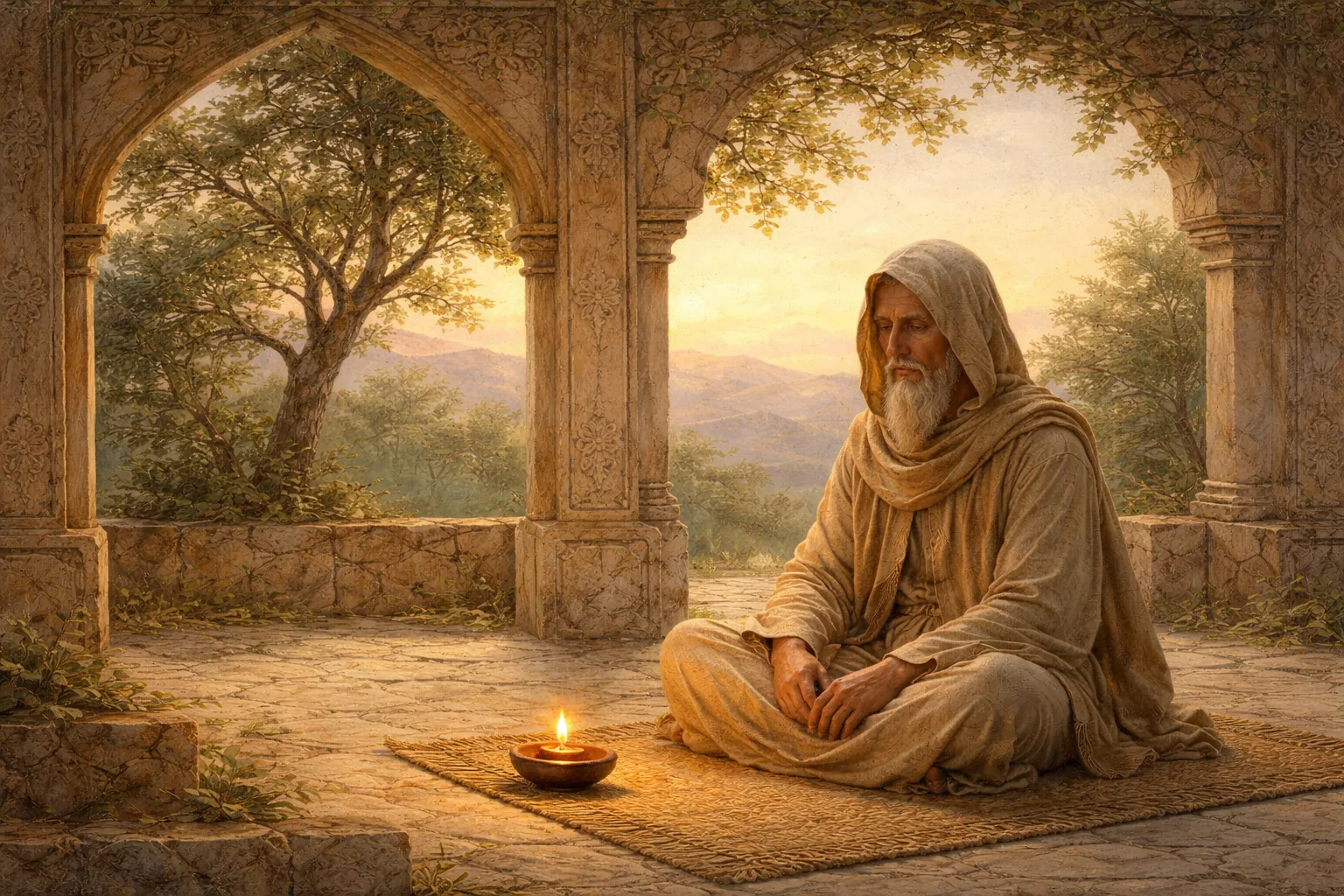
Dattatreya says in the “Tripura Rahasya” that the experience of temporary, fleeting samadhi cannot lead to final awakening. Ignorance cannot be eliminated by theory or by fleeting samadhi, and therefore the stage of nurturing exists. Although the mind has opened wide, the immortal child of awareness has been born, nevertheless it must be cared for. If the yogin at this stage shows negligence and does not take care of it, this “child” will grow up ill-mannered or imperfect.
It is believed that children have the most vivid impressions between the ages of three and five, and during this time very strong imprints (samskaras) are laid down that will influence the whole of subsequent life. In the same way, at the stage of nurturing, the yogin cultivates the state he has attained.
Dattatreya says:
“Inattentive people are simply fools who cannot comprehend the samadhi that recurs again and again in their lives. They are like a person who knows nothing of the treasure lying beneath the floor of his house and goes out every day to collect alms.
So you see that samadhi is useless for such people. The intelligence (intellect) of infants always abides in an unchanging form, and yet they do not comprehend their own essence.”
Nurturing means that, having come into contact with the inner sun, with boundless light, the yogin gradually brings it to the forefront of his consciousness — into the waking state. He brings it forth first in the form of clarity, then of bhava. This is precisely what allows him to abide in the natural state while awake, in wakefulness, without immersion in meditative dhyana, without stopping the conceptual mind.
This is a very important and fundamental point, since before this the yogin, unfamiliar with the foundations of contemplation, may have practiced concentration, mahashanti meditation (stopping the mind), and mantra recitation, but he had difficulties maintaining awareness in the ordinary state. Even if he experienced flashes of superconsciousness, in the ordinary waking state, when he is not sitting in meditation, he still remains an ordinary person. And nurturing consists in, having experienced a flash of superconsciousness, bringing it into the everyday, ordinary waking state in the form of the clarity of naked awareness and bhava.

The Process of Purifying Consciousness
Dattatreya says in the “Tripura Rahasya” (Chapter 19):
“What kind of effort can help reveal the eternally self-luminous consciousness? When it is covered by a thick layer of endless vasanas (predispositions and aspirations), it is not easily realized. The layering must first be moistened by the stream of steam of mind-restraint, and then carefully scraped away with the sharp chisel of inquiry. After that, the closed mount with the quartz crystal inside — namely, the mind purified by the aforementioned method — must be turned on the grinding wheel of vigilant awareness and finally the lid of the mount opened with the lever of discernment.”
Nurturing is when we begin to turn our mind on the grinding wheel of our awareness. Such “turning” is called the teaching on the nine liberations, which we discussed earlier.
Uniting with Various Types of Thoughts
What does it mean to “unite the natural state with neutral thoughts”? It means that ordinary thoughts arise in you, but you do not leave presence; your consciousness is not colored by the bhava of these thoughts; you do not slide into the dangerous gorge of dualistic thinking, that is, you do not indulge these thoughts. You precisely allow these thoughts to manifest as a self-liberated play.
Then you learn to unite contemplative presence with sattvic (or peaceful) thoughts. Reflecting on the qualities of deities, on Refuge, listening closely to the sound of the mantra, you unite this with contemplative presence, no longer separating mantra practice from presence, allowing them to merge completely. At the same time, you do not fall into an eternalist perception of the mantra or reflection, and you do not fall into the dangerous gorge of dualistic thoughts, into mere indulgence of mental concepts, even if they are sattvic. You unequivocally still abide in presence, but contemplation is united.

That is, if you visualize the form of a deity (this already falls under the category of a peaceful, sattvic thought), then you visualize it not in the eternalist way of dualistic worship, but you completely unite it with presence, regarding this thought as a manifestation of the nature of your Mind. This is a very subtle point.
For example, I have encountered such statements from practitioners who tried to recite a mantra: “I constantly recite the mantra, but it is not working.” And where is it supposed to go? It should remain in place, and you simply recite it. Then I ask: “And what do you want to get from the mantra? Do you understand the purpose for which you are reciting it? Do you understand exactly how we recite it in the context of the teaching of laya yoga?”
Some believe that one needs to invoke someone, or that there must be some result, and because of this anxiety arises in them. But this is precisely the uniting of contemplative presence. If contemplative presence can unite with a bowl of soup, with going to the toilet, then I do not understand why it cannot unite with a mantra. What is the snag here? It seems that it should unite with walking, mowing, undressing and dressing, but as soon as we approach the mantra, some tension immediately arises. Why?
Obviously, the mantra has been singled out here as a certain “sacred action,” completely different from walking, mowing, going to the toilet, as something absolutely special, for the performance of which one must make an effort, plan certain goals, expect some result. That is precisely why tension arose. Therefore, in such cases I usually ask: “And why do you single it out in this way? After all, it is the same action as everything else. One simply needs to learn to unite with it, without wishing to obtain anything from it, and then it will become a genuine contemplative practice.”
From the point of view of uniting, a mantra and mowing grass are, at the level of view, equivalent actions with which one should learn to unite. But as soon as we do not understand the process of uniting and begin to perceive the mantra as some separate eternalist, dualistic practice, then tension and difficulties arise: we want something from it, we try very hard, but the harder we try, the less we succeed. In fact, everything is very simple — one must remain in the very same presence while reciting the mantra.
Finally, there are wrathful thoughts with which one should learn to unite. I am not an advocate of anyone sitting and deliberately cultivating wrathful thoughts — there is nothing good in that. We are speaking of the fundamental possibility of practice at such a moment, that is, you understand how to work with these energies. And if they appear, you do not fall into panic and confusion, but remain in the same contemplative presence and instantly recognize the emptiness of wrathful thoughts, thereby depriving them of their power. This is like a snake suddenly springing up in front of you, and you pull out its venomous fangs, so it no longer has power over you. This is the principle of uniting during cultivation.

In the same way, during cultivation you unite with three types of speech and with three types of actions: peaceful (sattvic), neutral, and even wrathful.
Awareness and Emotions
Question: Guru, it is believed that if you became angry, laughed, got carried away by what did not satisfy you, or express yourself in some way, then you are not in presence, in awareness. My opinion is that you yourself can determine whether you were in presence or not, whether you were in awareness, even if you are angry or expressing yourself somehow. That is, only you yourself can answer this question.
Why? A senior monk can answer.
Question: I do not mean an individual person. I am speaking in general. Why is it believed that you should be calm as a boa constrictor, roughly speaking, that nothing should concern you, and then you are in such deep presence?
The point is that awareness presupposes integration. Moreover, integration with all the elements with which you enter into interrelationship. And integration means crystal clarity, understanding. For example, you follow a monastic canon that says one should not display anger, and at the same time you say that you are consciously angry. But it turns out that your awareness is not deep; that is, it does not take into account the fact that you will violate the monastic canon, introduce disharmony, awaken someone’s negative thoughts, contribute to someone’s downfall, and cause many unpleasant factors even in a state of awareness. Do you need that?
Question: Guru, I am talking about the fact that many people understand awareness as some almost amorphous state.
A “detached” state, yes? I see. I understand. Awareness can include emotions. One can consciously manifest even a storm of anger if it corresponds to the situation and saves some living being. But awareness implies, first and foremost, the ability to take into account a multitude of factors and to integrate with them.
If you follow the path of Vinaya, then you manifest awareness in accordance with it. If you follow the path of the avadhuta, then according to your canon you must manifest something else—this is another kind of awareness. If you follow the path of a householder, then you should show love and attachment to your family and take care of it—this is a third kind of awareness. In any case, besides the presence of clarity at the moment of action, awareness implies integration with the variety of factors and energies surrounding you; that is, this awareness is practical. Of course, it is not a detached state. However, there is no point for a monk to practice manifesting anger.
Everyone knows one former monk who tried to convince others that he was angry consciously, and therefore there was no point in restraining his anger. He believed that these were his games, that this was his form of manifestation of a wrathful deity, since he was uniting with these energies. Inwardly, I always chuckled at this and thought: “Your time will come. Time will show everything.” And so it happened. Did he think then, when he was saying this, that he would already be absent from this lecture because he would already be a layman? He did not. This is an example of superficial, not deep awareness.

We can imagine many things about ourselves, but there is karma, and at a certain moment, astrological or karmic, it will flick you lightly, and you will fly off your post, lose your status, and so on. Even the gods sometimes made mistakes by overestimating their abilities.
The Transformation of Emotions into Pure Vision
Another point is that true awareness is not the manifestation of kleshas, but the ability to turn these kleshas into pure vision. In other words, an emotion may manifest, but at the stage of complete integration anger can be transformed into something absolutely pure, absolutely positive.
For example, there was a case when I once flew into a rage. This was back in Crimea. Someone had done something very foolish, something that absolutely should not have been done. The fate of other practitioners, the authority of the sangha, the spread of the teaching—many things depended on that action. I was simply furious. Emotions manifested on the relative level, but inwardly I chuckled at these emotions and saw it simply as a game. That is, there were two consciousnesses simultaneously: one vast, inherent in the ordinary state of consciousness, and immersion in it, and also everything that concerned the relative situation, the surface mind, and anger.
Seeing this situation, I did not leave the basic, main consciousness, and I entered it more and more deeply, laughing at this anger, at the relative situation, and after some time this state completely disappeared. After that, I gave a good lecture to laypeople, which inspired them very strongly. It turns out that anger turned into something positive, into something that truly helped others.
Subsequently, I often observed that whenever any energies or emotions manifested in me, they always turned into something positive: either into some service project, or into a song, or into a commentary on a treatise, and so on. It was always the case that whatever emotion manifested, it always turned into pure vision. I did not even do anything for this; I did not persuade myself that I had to control anger, but simply remained in presence. This anger never manifested either in the form of speech or in the form of actions. It was an instantaneous flash of energy, a flash of prana.

It is similar to when someone frightened you, and the muladhara chakra opened. But because consciousness works ahead of time, it instantly takes control of this burst of prana and turns it into something else. Uniting with such manifestations means that you get ahead of these bursts of prana, and they always turn into pure manifestations, into pure vision. You experienced something, and it manifested in the form of a bhajan; you experienced something else, and it manifested in the form of some icon, sculpture, or blessing. It turns out that curses are being sent to you, while a blessing comes from you. This is complete unification and integration, the complete purification of residual karmas that arise, and a change in one’s perception of oneself.
Changing Vision and Karma
In India, as is well known, there is a caste system, and before Mahatma Gandhi it was quite firmly established. Mahatma Gandhi declared a struggle against the caste system and was the first to begin calling the untouchables Harijans (children of God). Although in the twentieth century the caste system weakened considerably, nevertheless, in villages and in areas far from the capital there were still very great restrictions on relations with untouchables. Untouchables were not allowed to drink from the same well, walk along the roads used by all the other castes, enter cafés, study, and so on.
One of the leaders of the untouchables’ movement, who fought for their rights, even became a minister while retaining the status of an untouchable. And when he failed to reach an agreement with political figures on abolishing the restrictions, he called on all untouchables to convert to Buddhism. Therefore, about six million untouchables converted to Buddhism because of the restrictions of the caste system. If a person converted to Buddhism or Islam, he automatically left the status of untouchable and became a respected person. But if he remained in orthodox Hinduism, all the restrictions applied to him. These restrictions are officially prohibited, and today there are assistance programs for untouchables. But still, it is said that if an untouchable enters a café, water will be poured for him or change will be given to him separately from other people. Such relationships exist subconsciously, because people are very afraid of being defiled.
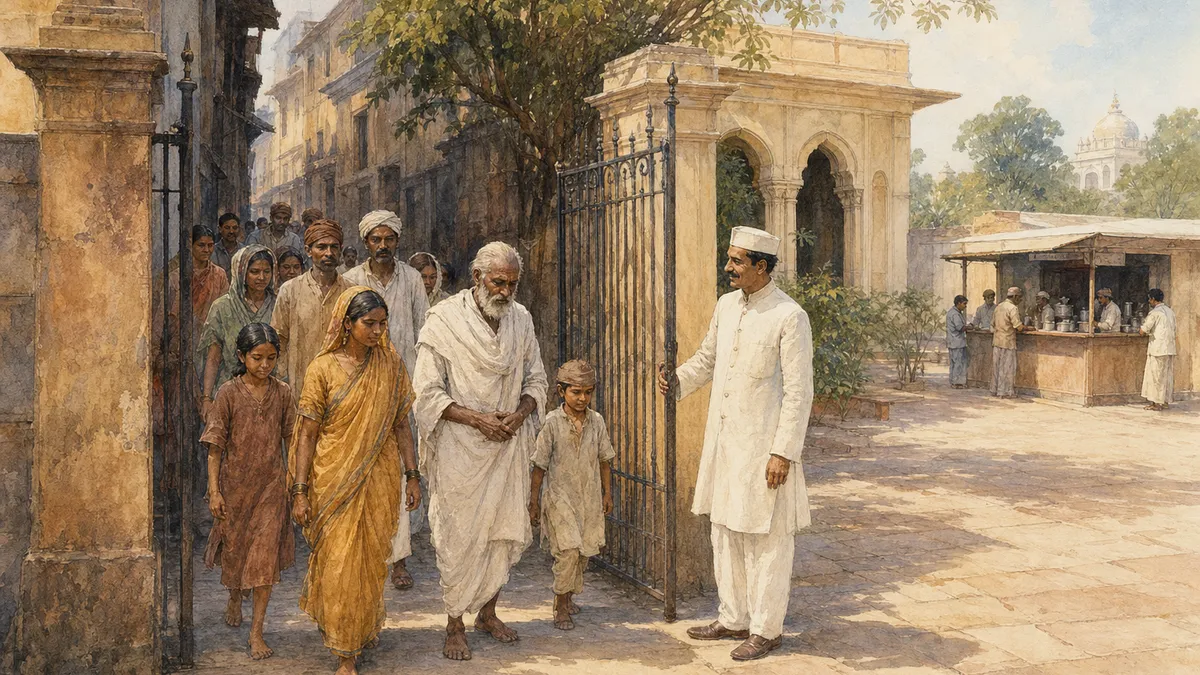
Why are they afraid of being defiled? The point is that, according to established tradition, untouchables do dirty work: killing animals, cremating corpses, tanning hides—that is, everything impure is performed exclusively by the caste of untouchables. Other castes cannot take on this work. For example, I recently saw a scene where a plumber from the untouchable caste was standing up to his neck in sewage doing repairs, while others walked past and looked down on him.
Against the background of this situation, in one of the communities of the untouchable caste there appeared a man who saw that he was under great restrictions, that he would not achieve success in life if he remained an untouchable. Then he began telling the heads and elders of the community (they have such people too) that they needed to adopt the gestures of the Brahmins, wear Brahmin threads, master their manners, gradually study the Vedas, and wear their clothing. They began adopting all the habits and rules of conduct of the higher castes: introducing vegetarianism, reading the Vedas, wearing Brahmin threads, performing initiations, establishing stricter relationships during marriage, and so on.
In parallel with this, they began spreading myths that their caste originated almost from the kshatriyas. Some Brahmins even undertook to justify this, and from that time a saying appeared: “Pay a Brahmin well, and he will trace your genealogy all the way back to Brahma himself.” After some time, this community left the status of untouchables, and in large cities it gained recognition: they began to classify it as either Shudras or Vaishnavas. They received the right to occupy various statuses and positions; that is, they became a respected and cultured stratum of the population. One can say that one person changed the fate of a large clan, an entire people, several million people. And this became possible as a result of the manifested power of intention, as a result of their establishing a different vision within their community. They changed not only their habits, but even their past.
This example inspired me very much because, when we engage in cultivation, maintain contemplation and divine pride, we can say that we are doing almost the same thing, only on the scale of our own “I.” We have many limitations, and our ego, our karma, our impure vision are like such an untouchable. Our ego, like the untouchable, is not allowed anywhere except into the world of humans or asuras: neither to the gods, nor, all the more so, any higher. But gradually, drawing upon the light of inner awareness, we accustom it to another vision; we learn to sublimate all karmas, in the end completely changing even our own past.
The Process of Cultivation and the Change of Vision
The process of cultivation is the introduction of pure vision into oneself, its penetration into all aspects of life. When such cultivation has deeply penetrated you, it will suddenly turn out that you are the embodiment of some deity—not in fantasies, but in reality; it is just that previously this was not visible to the relative mind. It will suddenly turn out that this embodiment of yours was a certain mission or lila, so that this deity might realize something. Everything will suddenly be seen differently; it will turn out to be different.
The Story of Drona and the Lesson of the Divine Weapon
When the battle on the field of Kurukshetra began, Drona, a great master in the use of magical powers, the weapon of Narayana, and others, did not allow the Pandavas to win. Using magical weapons, he killed thousands of Pandava warriors around him, sowing fear. Drona was like a god of war who had himself entered the battlefield, and so the Pandavas wondered what they should do. He was a Brahmin and the martial arts teacher of the Pandava brothers and many in their army, and it was impossible to defeat him. And then the decision was made to influence Drona’s consciousness in some other way, namely by deception. Since he had taken a vow that he would stop fighting as soon as he learned that his son Ashwatthama had died in battle, they decided to lie to him, saying that his son had been killed.
One of the Pandavas said: “You are fighting, and your son Ashwatthama has been killed.” Drona did not believe it and decided to ask Yudhishthira about it, knowing that he never lies. Yudhishthira was devoted to the moral principles that he greatly respected, and he could not lie to Drona, who trusted him, so he hesitated. But Krishna came and said: “Now is not the time for vows that have been made. If we do not change the situation now, Drona will simply kill everyone.” Since Krishna was not bound by Yudhishthira’s moral principles, he advised him to lie. When Drona asked whether Ashwatthama had really been killed, Yudhishthira said: “Yes, he has been killed. The elephant.” He said “the elephant” quietly, to himself, because in fact there was an elephant named Ashwatthama that had been killed in the battle. It is something like crossing one’s fingers. Having said this, Yudhishthira considered that he was not guilty of lying.
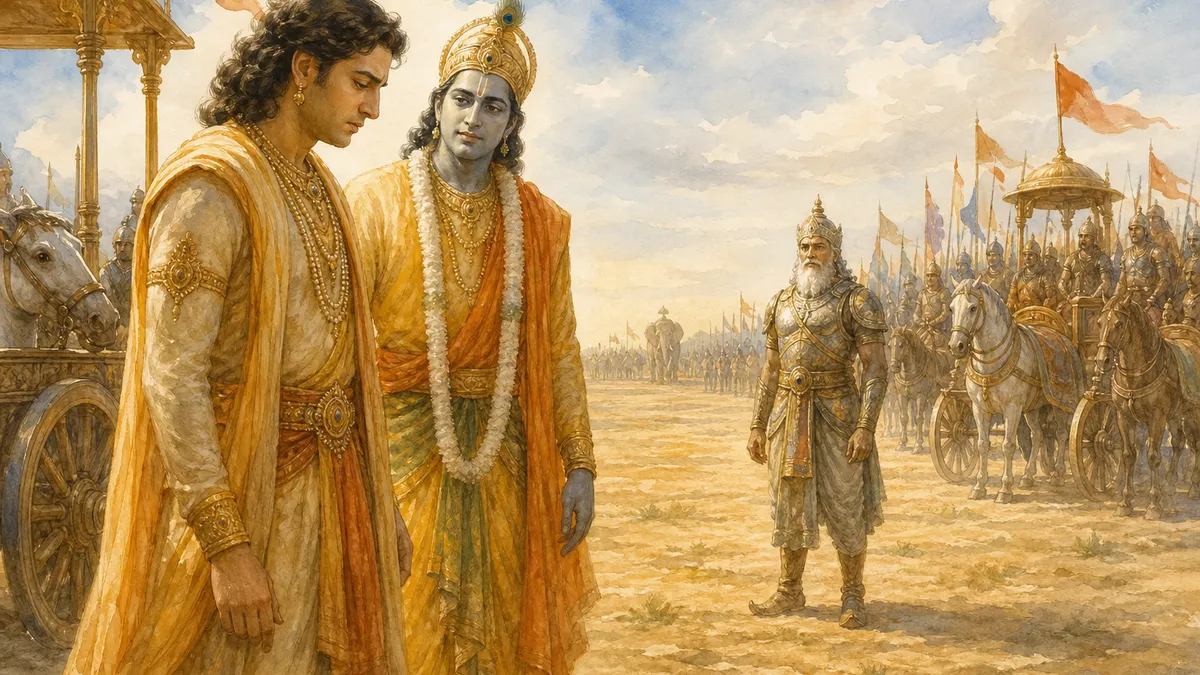
When he said this, Drona immediately lost heart. And since he was an outstanding saint, he refused to continue the battle and simply entered samadhi. At the moment when he began to enter samadhi, Dhrishtadyumna, the commander-in-chief of the Pandava army, approached him, bound him, and cut off his head. Drona himself disappeared in a flash of light that swept toward the gods above the battlefield of Kurukshetra. Since, in the relative dimension, these events continued to unfold, many kshatriyas condemned Dhrishtadyumna’s deed, for he had acted in this way by taking advantage of Drona’s helplessness.
Ashwatthama’s Revenge and the Weapon of Narayana
Ashwatthama, having learned how shamelessly his father had been deceived, flew into a rage. He was Drona’s best disciple and also possessed many kinds of magical weapons, including the Narayana weapon, which, if launched, kills all living force on the enemy’s battlefield, but only if the enemy is fighting. If the enemy lays down his weapons and abandons malicious intentions, it ceases to act. The Narayana weapon was received as a blessing from Brahma himself, and the blessing was such that this weapon could not be counteracted. Ashwatthama took a terrible vow to avenge his father and began using weapons of magical power one after another. He used the Agneya weapon, Varuna, Narayana, Brahmastra, and many other types of weapons with which people did not fight, since all of them required special initiations and were controlled by mantras or by the power of consciousness. It is said that when he used them, the topology of space changed: the sun would set, the wind would rush in, or many kinds of weapons would materialize in the air, and dogs would begin to howl. Because of this, the Pandavas once again began to suffer the most terrible defeats. That is, they had already begun to celebrate victory, since the Kauravas, disheartened by Drona’s death, were retreating, but Ashwatthama changed everything. By using his weapon, he simply scattered the army of the Pandavas.
And then Arjuna, who was considered simply a good archer, also risked using the magical weapon he possessed. It was precisely for this that, in the past, he had performed austerities and, by Shiva’s blessing, had studied in the heavens of the thirty-three gods under his heavenly father Indra, learning various subtleties of wielding divine weapons — the weapons of Brahma.
The Narayana weapon could be neutralized in only one way: by stopping, ceasing to fight, and laying down one’s weapons. Then the Pandavas were advised to stop fighting so that the Narayana weapon would not kill them. The Pandavas did exactly that, and therefore the Narayana weapon suspended its effect for a time. Instead of killing everyone, it killed only one akshauhini. An akshauhini is an army unit comprising hundreds of thousands of warriors, many chariots, elephants, and so on; it is something like a division. When this weapon ceased to operate, Arjuna activated his weapon of Brahma, received from Indra, against which there was also no antidote. By the power of his weapon, he forced the Narayana weapon to be subdued. It turns out that he, too, changed the karmic vision of the entire space with the weapon of Brahma and neutralized the Narayana weapon possessed by Ashwatthama.
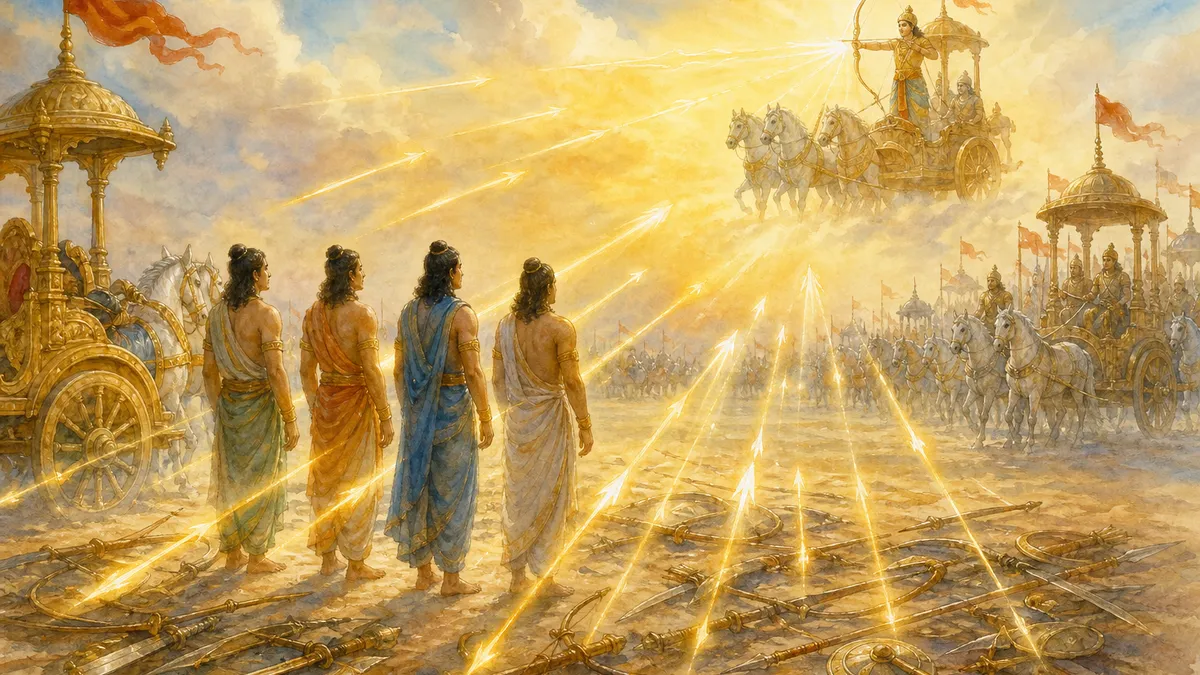
Ashwatthama’s Insight into Arjuna’s True Nature
Ashwatthama, in great distress, was indignant: why had the weapon given as a blessing not worked fully? It was supposed to destroy the whole world together with the Pandavas, yet it killed only one akshauhini. In deep disappointment he said, “All this is maya, illusion,” and stopped fighting. He asked a question of one of the sages, his patron. This sage said, “You were defeated not because you were not a valiant warrior, but because you encountered a more exalted consciousness — Arjuna.” Ashwatthama had never thought that Arjuna was anything special, since he perceived him simply as a good warrior. But this sage said, “You should know that Arjuna is Nara-Narayana himself, incarnated in a body. For many thousands of years he performed terrifying austerities, attaining the same status as Brahma himself. And now the one whom you see as Arjuna is his projection, an illusory body that is playing here with a certain purpose. This is a worthy soul in whom one should take Refuge.” When he said this, Ashwatthama’s consciousness changed at once; he was filled with great respect for Arjuna and said, “If that is so, then to suffer defeat at the hands of such a great soul is a great blessing.”
This is precisely how the idea of oneself changes in the process of the practice of self-recognition, when you recognize yourself as a manifestation of certain divine energies instead of recognizing yourself as a limited personality. Before self-recognition, this is not known; it seems like myth, like fantasy. After self-recognition, it becomes a natural fact.
