

Commentary on the text “Yoga Vasistha.” Chapter 6. Description of God
One day, Vasistha met Shiva on Mount Kailasa. He saw a Great Light and realized that this Light was Shiva, who was walking hand in hand with Parvati, while Nandi the bull walked ahead of them, clearing the way. Vasistha told his disciples of the deity’s presence, and they went to meet him. Vasistha greeted Shiva, bowed to him with reverence, and then asked him a question: “What is the method of worshiping God that destroys all sins and leads to bliss?” Shiva gave him the following instruction: “A quality of a yoga disciple is faith (shraddha or Ishvara-pranidhana). Ishvara-pranidhana is one of the fundamental qualities of yama and niyama. The quality of shraddha (faith) is mentioned by Shankara in the text “Viveka Chudamani,” where he speaks of the qualities of a disciple. Discrimination (viveka), dispassion (vairagya), aspiration for Liberation (mumuksha), and the sixfold quality of sattva (shatsampat): shama, dama, uparati, titiksha, shraddha, samadhana. The penultimate quality is shraddha (faith).
Faith as the Foundation of the Spiritual Path
We must clearly understand what faith means to us within the Teaching, what the object of faith is, and who it is that believes. Faith is a process that should grow and intensify over the years of spiritual practice. If, over the years of practice, your faith in the Absolute, in God, grows, you are moving in the right direction. If it fluctuates, wavers, or remains unchanged, you need to reflect on this: you need to invoke it, correct mistakes, purify yourself, and repent, because faith must grow in the course of spiritual life; otherwise, what is the point of spiritual practice? You can cleanse your frontal sinuses by practicing neti, but I doubt that this will help you free yourself from ignorance in any way. You may even master certain techniques, but techniques will never free you from ignorance. Ignorance disappears through the grace of God, the Absolute, and such grace is the result of self-surrender. Self-surrender requires faith; it cannot be accomplished without faith. Over the years of spiritual practice, we become ever more firmly established in faith.
Sometimes it is useful to reflect on representatives of other religious traditions: how they love their Dharma, how they believe in their God and their path, and to compare: “What is my faith like? Is it just as strong, or is it not as strong?” Faith does not contradict the principle of contemplation; it is its essence, its heart. We might say that contemplation is faith realized in meditation. What, then, are God and faith from the perspective of the Laya Yoga Teaching?
Shiva said: “Do you know who God is? God is not Vishnu, Shiva, or Brahma; not the wind, the sun, or the moon; not a king, not me and not you, not Lakshmi and not the mind. God has no form and is indivisible. That bliss and majesty which was created by no one and has neither beginning nor end is God, who is pure Consciousness. This alone should be praised and worshiped, for this alone is everything.
If someone is unable to worship the formless Shiva, they should worship a form. This leads to limited results, whereas the former leads to infinite bliss.”
If our mind has limitations and we find it difficult to practice or accept formless worship, formless contemplation, the highest sankalpas, and all that is subtle, we must begin with form. We begin by venerating that which has form: by venerating the Ishta-devata, establishing the proper relationship with the Guru, and honoring practitioners and samaya brothers and sisters. Gradually, through such worship involving form, we ascend to the formless.
“One who ignores the infinite in favor of the finite abandons a beautiful garden and searches for a thorny bush. However, sages sometimes playfully worship form as well.
Among the things used in worship, the most important are wisdom, self-control, and the perception of the Higher Self in all beings.”
If you follow the path of the formless Brahman, this does not mean that you are in conflict with form. If you feel that you are in conflict with form, then you resemble Dayananda Saraswati Swami.
Swami Saraswati Dayananda lived sometime in the nineteenth century, founded one of the Indian societies, and fought for the purity and purification of the Vedas. He was deeply imbued with the concept of the formless Brahman. Together with his disciples, he went from temple to temple, debating with Brahmins on Vedic philosophy and Advaita, and he defeated everyone he debated. Whenever he won, he destroyed the murtis, the statues. All the Brahmins feared him, for he had destroyed many statues in many temples and ashrams. His arguments were impeccable and simple: “Brahman has no form, color, taste, or smell. Why are there statues? This is idolatry! It only obscures the absolute Truth”—his logic was devastatingly direct and simple. Wherever he debated, the Brahmins lost to him, and all the statues were destroyed. He continued debating in this way until he met Lahiri Mahasaya. By the power of his siddhi, Lahiri Mahasaya rendered him speechless. He said, “Your understanding is not the whole truth; form does not contradict the formless. It is holding extreme views that is harmful.” Extreme views are adherence either to form (eternalism), or the denial of form and adherence solely to the formless (nihilism). Holding extreme views in the Teaching is one of the root downfalls. If you adopt a black-and-white view, you are on the wrong path, and this must be changed. The principle of the formless includes form; they do not contradict one another. The formless is primary and takes precedence, but it includes form. In fact, they are one.
In the Teaching, this fundamental principle is expressed in the teaching of integration. The teaching of integration means that while abiding in nondual, infinite awareness, we can freely unite it with form and with anything whatsoever: with actions, words, and thoughts. We can play with them however we wish, and they are all harmless, like a venomous snake whose fangs have been pulled out, leaving it unable to bite. They all self-liberate.
Shankara encountered the same misunderstanding when he performed worship of Shiva. Shankara abided in the state of Brahman, in nondual presence. To explain his conduct, he recited an apologetic prayer to Brahman, asking forgiveness of the nondual for practicing dualistic worship. But when we perform sadhana, we do not need to ask for any forgiveness, because while abiding in contemplation, it is natural to perform any actions. While abiding in contemplation, all your actions self-liberate: the three actions of the body, the three actions of speech, and the three actions of the mind. For example, if you perform ritual worship while abiding in contemplation, it is self-liberated. If you chant mantras or engage in work, such an action is also self-liberated. Even if you do something wrong, that action must still be self-liberated, although I am not urging anyone to commit wrong actions—but this is so in the View. Therefore, all actions are self-liberated for a true jnani.
Pay No Attention to the External
When we practice sadhana, one of the principles is: pay no attention to the external. I ask everyone to remember this principle—it is a fundamental one. I repeat once again: pay no attention to the external! Why is this so important? Because our minds are strongly captivated by external things. And instead of practicing the essence, we often miss the essence by paying attention to the external. For example, we dislike someone, and the mind slips into impure vision; we see something, and the mind starts making judgments and interpretations. And what about the instructions, shravana, manana, nididhyasana, sankalpa, Atma-vichara? Everything is lost, everything is forgotten! Why? The tendency of the mind is extroverted—to pay attention to the external. It often happens that even after embarking on the spiritual path, a person forgets their choice and forgets God simply because the mind has paid attention to something or, crudely speaking, “fallen for it.” It keeps turning that thing over and over and over. This is a great delusion!
I will put it this way: you should not pay attention to outward appearances; the sutras and shastras say this as well. They speak of the Guru and of other practices. Everything external is changeable; it is all temporary. That is not what you are here for! What difference does it make who said what to you? What difference does it make how someone looks or what someone does? Do your own spiritual work; that is what you came here for. Everyone goes to God on their own. Whatever each person has earned is what they will receive when they stand before the Almighty. You must explain this to your mind once and for all. If you do so, you will have no problems throughout your life, and it will be easy for you to maintain pure vision. Whether it concerns practitioners, laypeople, animals, or anything else, do not pay too much attention to outward appearances. For the external does not express the essence of spiritual work; all spiritual work takes place within. A temple may be large, like a magnificent palace, or it may have dilapidated walls. Do you think one cannot enter samadhi and attain Liberation amid dilapidated walls? One can! A Guru may have thousands of disciples, or there may be one or two. If you come as the third, do you think your meditation will be worse than if there were thousands of them? Not at all! Yet we pay a great deal of attention to outward appearances. This external aspect of religion strongly conditions and impresses the mind.
The teaching of Laya Yoga is an inner Teaching, a very inward one. Sankalpa, Atma-vichara, nididhyasana—all these are subtle things. This is what you should pay attention to if you follow the path of the Laya Yoga Teaching.
To convey this truth, Dattatreya performed mind-boggling tricks with his disciples. I cannot perform such tricks; you should understand that—perhaps I am not ready for it. Testing his disciples, he drank wine, ate meat, pretended to be a vagrant, amused himself with women, beat his disciples, and spat on them—even on kings. What was the essence of his entire Dharma? Do not pay attention to outward appearances! Why are you looking in the wrong direction? God is within. If you have faith, you will not pay attention to these external things. Indeed, what is so extraordinary about it? So he drank some wine. Who does not drink wine? Millions of people throughout Russia drink wine, and no one makes a tragedy out of it. But if Dattatreya has a drink, there is so much talk! That is what he wanted to convey. Who does not cling to a woman? The whole World clings to a woman. What is so extraordinary about that? Yet these stories endure for a thousand years. “Oh, Dattatreya”—it impressed everyone so deeply. He says, “You do not see Me—all of this is external. I deliberately provoke you, showing you your foolishness, your conditioning, your ignorance. Even though you call yourselves people of the Dharma, time and again you allow your minds to be swayed by all these things.” Who does not eat meat? Half the world eats meat! Using these seemingly simplest of tricks, Dattatreya awakened people very powerfully, stirring up masses of karmic movements in their minds. This is his message: “Do not pay attention to outward appearances!” For God, spiritual life, and contemplation all take place within. The simplest way is to understand this and quietly go about your own business. But practitioners are often such people that I am simply astonished; sometimes I am even at a loss for words. We must learn the lesson from these instructions of Dattatreya—not to pay attention to outward appearances.
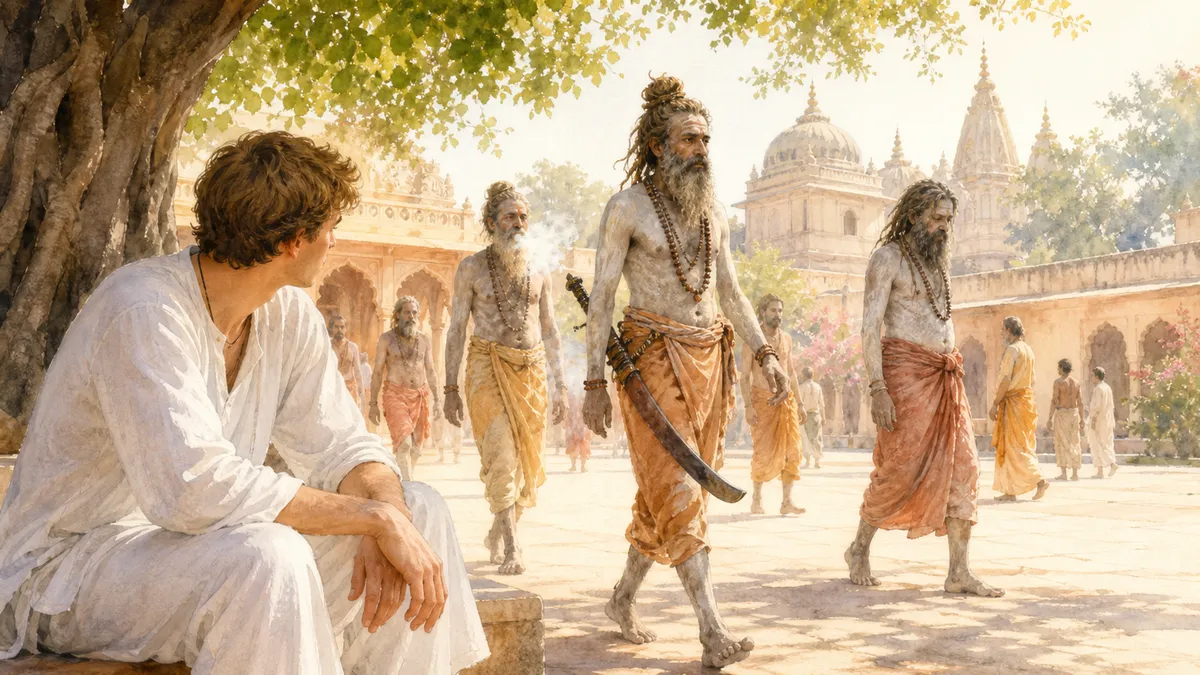
What would you say if monks came out like naked Naga sadhus in India, smeared with ash, carrying swords and smoking? There would certainly be a lot of talk about the monks, wouldn’t there? An impression to last a lifetime. But in India this is a normal occurrence. Once again, it is all external. We cannot see another person’s level of realization, spiritual purity, or holiness. One should never judge by outward appearances: by behavior, body, or manners.
In my youth, I myself was guilty of this. For example, I once went to receive the Teaching from a Teacher. The Teacher was large, enormous like an elephant, and fat. I immediately thought, “But he should be a thin ascetic. How can I receive the Teaching from him?” This confused me. Then he said, “I am busy right now; I will give the Teaching later. I am moving into a new house.” I thought, “Well, if he lived in the mountains, there would be no attachments.” Nevertheless, years later, after I received the Teaching and analyzed it, I realized that it was a Teaching of the highest order. But at that time, my mind was evidently too conditioned by external things and was not ready to perceive the essence without paying attention to outward appearances. Even people of spiritual standing pay attention to outward appearances.
Once, Ashtavakra came to an assembly of brahmins. Ashtavakra was a cripple; his body was bent in six places (which is why he was called Ashtavakra). When the brahmins saw him, they began to laugh at him, so ungainly did he look in his crippled state. He had come to debate and engage in discussions about the absolute Truth, but the brahmins began mocking him, saying, “Look at this little freak. And he has come here to debate. Not only is he a commoner, but his body is bent in six places, and yet he claims to know the Truth.” Then Ashtavakra himself burst out laughing. His laughter greatly offended and upset the brahmins. They began angrily whispering among themselves, “Why is he laughing? Who does he think he is?” He said, “I am laughing because I came to an assembly of learned men and hoped to find learned men here, but I see that I have come to an assembly of commoners who see only skin. Just as those who work with leather all their lives see only skin, so you see only the body, only the skin, and look only at outward appearances: at my body, without seeing my realization.” With his speech, he deeply shamed the brahmins for their superficial, materialistic attitude.
Pure Consciousness and the Dissolution of the Ego
The Supreme Self is Shiva, to whom the flowers of wisdom should be offered.
I asked Shiva, “I beseech you, tell me how this world turns into pure Consciousness, and how this pure Consciousness becomes individual consciousness and other things?”
Shiva continued, “Truly, only the infinite Consciousness that remains after cosmic dissolution exists even now, completely free from objectivity. Concepts and notions illuminated by consciousness within itself appear as this world, just as dreams arise within a dream. It is utterly impossible for an object of perception to exist outside the omnipresent infinite Consciousness. All these mountains, the entire world, individual consciousness, and all the elements that constitute the world are nothing but pure Consciousness.”
Here Shiva explains the principle of pure Consciousness. For us, God is Prajnana, the primordial, self-born Wisdom. This primordial Wisdom always exists; it existed even before our birth, and we possess it by right, just as a royal offspring, a prince, has the right to inherit the throne. The point is not to acquire or attain it, but to discover it, to reveal it as that which is and always has been. Something prevents us from discovering it as that which has always been. What is it? It is the so-called sixteen knots of ignorance (vidya-granthas). These sixteen knots of ignorance constitute ahamkara, egoism. To reveal it, we must strive with all our might to rid ourselves of egoism. Egoism makes us think that we are very important persons, that the ego amounts to something. But in reality, in the infinite Universe, it amounts to nothing. It is merely a bubble. This must be understood. Then we will become very simple, light, and fluid. We will have no problems, no resentments, no suffering, and no confusion.
If egoism is strong, we tend to become irritated, nervous, enraged, offended, and arrogant. But all of this happens because we do not understand our place in the Universe. It is as if an ant, balancing on a sliver of wood carried by a raging ocean, were angry at another ant for blocking its view. Is that wise? We are all such ants. The ego is an ant sitting on a sliver of wood and being swept along. It may think a great deal, of course, but that sliver is rushing at tremendous speed through a turbulent current and will soon be flung somewhere, while the ant will disappear. That is what we are in the Universe. Egoism makes us feel important. It is wrong to feel important without God. We are not referring to divine pride; that is a different category. Before practicing divine pride, we must lose our egoism; we must understand how pernicious it is, that it is actually a great demon. Moreover, this demon does not surrender so easily. It will show you its face more than once (or rather its “snout,” since demons do not have faces).
When we have enough strength, humility, and courage to overcome selfishness, we discover that our lives have become much simpler and easier. We cease to react in such a conditioned way, we do not lapse into dualistic judgments; in fact, we become empty, light, and fluid. We see that everything is wonderful, and even if someone scolds us or we feel something, we think, “I have no problems at all; perhaps they have problems, but everything is fine with me!” That is how you feel. Everything happens with ease for you. But if selfishness is strong, such a person may harbor resentment for years (for years!), even sustaining that resentment while on retreat. Imagine that! They may have long-standing, deep-rooted notions that their mind continues to turn over and over. All of these are manifestations of selfishness; that is, a person cannot let go of the simplest things and take everything lightly. Why? Because they do not understand that they are an ant, you are an ant, and we are all hurtling along on the same wood chip. In the infinite Universe, all of this is ridiculous. We should be thinking about something else; none of this matters. Only true sages understand the importance of relinquishing selfishness. Yet people fuss over their selfishness as though it were their most prized possession. Their ambitions, attachments, pride, various unrealized projections, hopes, and fears are of great interest to them. This must be relinquished. In truth, this is very important. It really must be relinquished! Once you relinquish it, you will see that it was a heavy burden that prevented you from seeing reality and building relationships properly, and that always left you feeling hurt. True humility arises when we relinquish our selfishness, begin caring for others, loving others, and simply freeing ourselves from our selfish impulses.

The World as a Manifestation of Consciousness
“Before so-called creation, when there was only pure Consciousness, where was all of this? ‘Space,’ ‘creation,’ and ‘consciousness’ are merely words; as synonyms, they point to one and the same Truth. Just as the duality experienced in a dream is illusory, so too is the duality implied in the creation of this world. Just as objects seem to exist and operate in the inner world of consciousness during sleep, objects seem to exist and operate in the external world of consciousness while awake. In reality, nothing happens in either state.”
External objects are a product of consciousness. This is true both in dreams and in waking life. It should be understood that objects seen in dreams, which are generated by consciousness, are generated by consciousness in the external world in exactly the same way. It is only that the objects of the external world are more inert, since gross tattvas predominate here, but the principle is the same. It is very difficult to understand the principle of the instantaneous creation of the Universe, which states that any objects are instantly created and destroyed by each act of perception. Here is an example: when we fall asleep, we do not construct palaces, houses, people, and trees in our dreams. They all appear instantly. In the same way, in the relative world, the Universe is created anew every second by each act of consciousness. For the Universe to be sustained, our own subjective consciousness is necessary; there must be someone who perceives the Universe. Without subjective consciousness, there will be no external Universe.
The laws governing the instantaneous creation of the Universe are highly complex. Nevertheless, stated briefly, they are as follows: the cause-and-effect relationships established between subject and object only appear linear and unambiguous. In reality, this is not entirely so. For example, everyone takes it as axiomatic that if we lay bricks, sooner or later a wall will be built. But from the perspective of the instantaneous creation of the Universe, the wall already exists. The version of reality in which the wall has been erected already exists. The question is whether we can shift reality so that the wall manifests. What, then, is bricklaying? Bricklaying is a magical ritual that draws in the version in which the wall has already been built. We are not so much laying one brick upon another as changing reality and our consciousness in such a way that the version of reality in which the wall already stands in the Universe manifests fully. This is a form of magic that we have mastered. Although there are also plenty of other methods, this one is the most accessible. This is very difficult to understand; nevertheless, the theory of the instantaneous creation of the Universe holds that we do not create cause-and-effect relationships by gradually moving toward a result, but rather manifest the result instantaneously simply by changing our consciousness. Bricks and cement are like an offering, a means of shifting to another version of reality, of changing our vision and consciousness toward one in which the wall or temple has already been fully built.
“In reality, nothing happens in either state.”
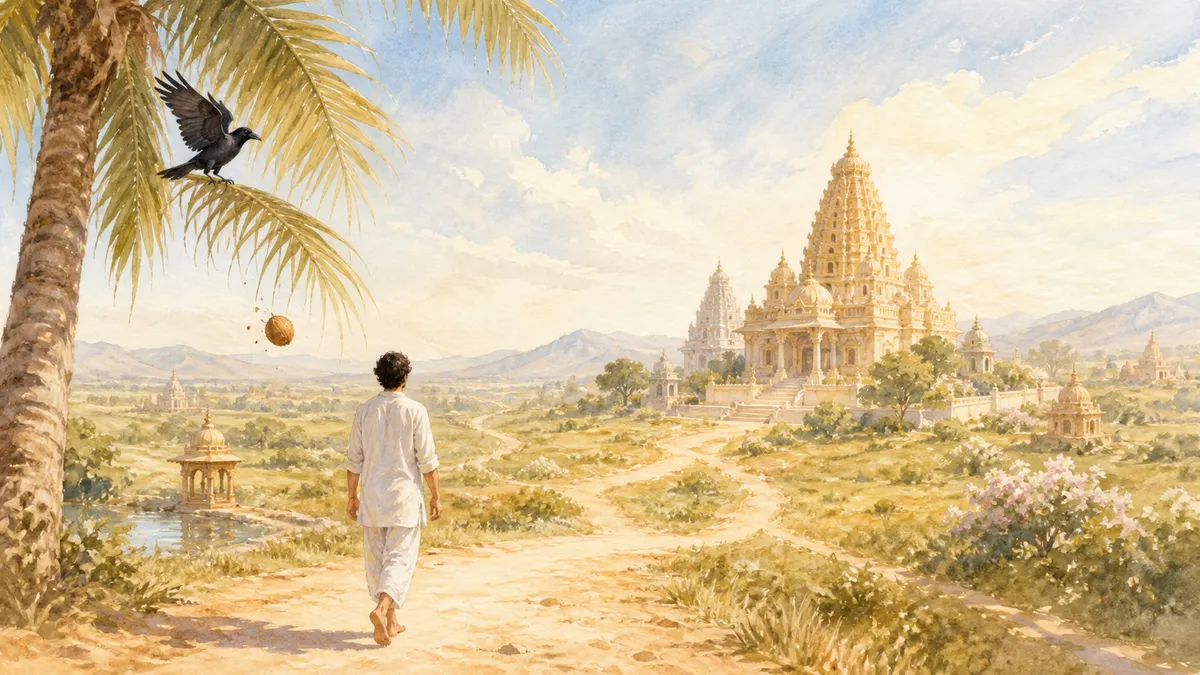
In reality, nothing happens in either state. All the temples have already been built, all the monks have already attained Liberation and become Buddhas. Brahma’s entire plan has already been laid out. Nothing happens! However, it is laid out not linearly, but in a multivariant and stochastic manner. And samsara is a version of reality in which this has not yet come true, has not yet occurred. Therefore, temples must be built and practices must be performed in order to move oneself into another version of reality, where all of this has already been realized and already exists. But this is not an ordinary cause-and-effect relationship. Cause and effect only appear to be truly existent, but the connection between cause and effect is like that between a crow that happens to land on a palm tree and a coconut falling at that very moment.
Faith and True Worship
“Just as consciousness is reality in the dream state, consciousness is likewise the only reality during wakefulness. This is God, the supreme Truth, that which you are, that which I am, and that which everything is.”
Even while we do not understand the principle of consciousness, we should cultivate faith. In truth, do not expect that you will understand God. You will not understand Him now, or in a thousand years, or when you become Buddhas, gods, mahasiddhas, or Brahmas. If you think that Buddhas understand God, you are, of course, mistaken. If you think that the great gods understand God, you are mistaken as well. No one understands God! Buddhas understand their own ignorance and have eliminated it, but none of them says that they understand God, because God cannot be understood; it is impossible. I would like to see such a person. Even the great gods cannot understand Him. Everyone has their own measure of understanding, even the greatest saints, ascetics, and tapasvins. Everyone has their own measure of understanding God, but this measure by no means reflects the entirety of God’s understanding. One can understand karma, eliminate karma, attain Liberation, eliminate personal ignorance, and even create an entire Universe, like Brahma, but it is impossible to understand God, who plays with Brahmas, blowing them like bubbles. That is why we say He is inconceivable (achintya). One can eliminate one’s “I” and merge with God, becoming one state of Advaita. However, in that case, one cannot say that someone has understood God; someone has completely eliminated the ignorance of individual existence.
Nevertheless, if we do not understand God, we should strengthen our faith. If God could be understood through reason, He would not be God; He would be some kind of mathematical formula. But faith in what is incomprehensible, in what lies beyond logic, the mind, and the senses, is true faith. Over the years, such faith should grow and become clearer. It begins with faith in logic, the Creed, concepts, the murti, the Ishta-devata, the Guru, and the Three Jewels. Over time, this faith becomes clearer and deeper. We discover the ambiguity, nonlinearity, and multivariance of the principle of the Guru, the Three Jewels, and the Ishta-devata. We discover its depth and gain insight into this faith. Faith should be tempered, strengthened, and nurtured. The sprouts of faith should be watered regularly so that they may grow. One should pray to acquire strong faith. We do not possess strong faith immediately. The attainment of faith (shraddha) is the result of extensive work on oneself, invoking it, and self-surrender. But when you have strong faith, it is a true blessing. All signs of realization come to one who has strong faith. The siddhas of old always tested their disciples’ faith first. Faith does not appear at once; it must be tested and pass through trials. Everyone has their own trials of faith, and you must be prepared for your faith to be tested, to have already been tested, or to be undergoing tests now. Without trials, faith will not be tempered, and it is worth nothing.
Shiva continued: “Worship of this God is true worship; through such worship, everything can be attained. He is whole and indivisible, nondual and not created as a result of activity; He is unmoved by external efforts. Worship of Him is the source of joy and bliss.”
As your faith grows stronger and you reinforce it through living contemplation, this source of joy and bliss opens up within you. Right faith and right contemplation always lead to the experience of joy and bliss. Sooner or later, signs of realization appear: pure vision, strengthening of faith and devotion, renunciation of egoism, and an increase in sattva and inner harmony. These are the first signs that you are on the right path and that your faith is growing. If your pure vision is not increasing, if your humility is not deepening, if your inner peace and harmony are not deepening, if your devotion is not growing, this means that you need to reflect and correct your mistakes, purify your samaya, practice repentance, and perform special practices.

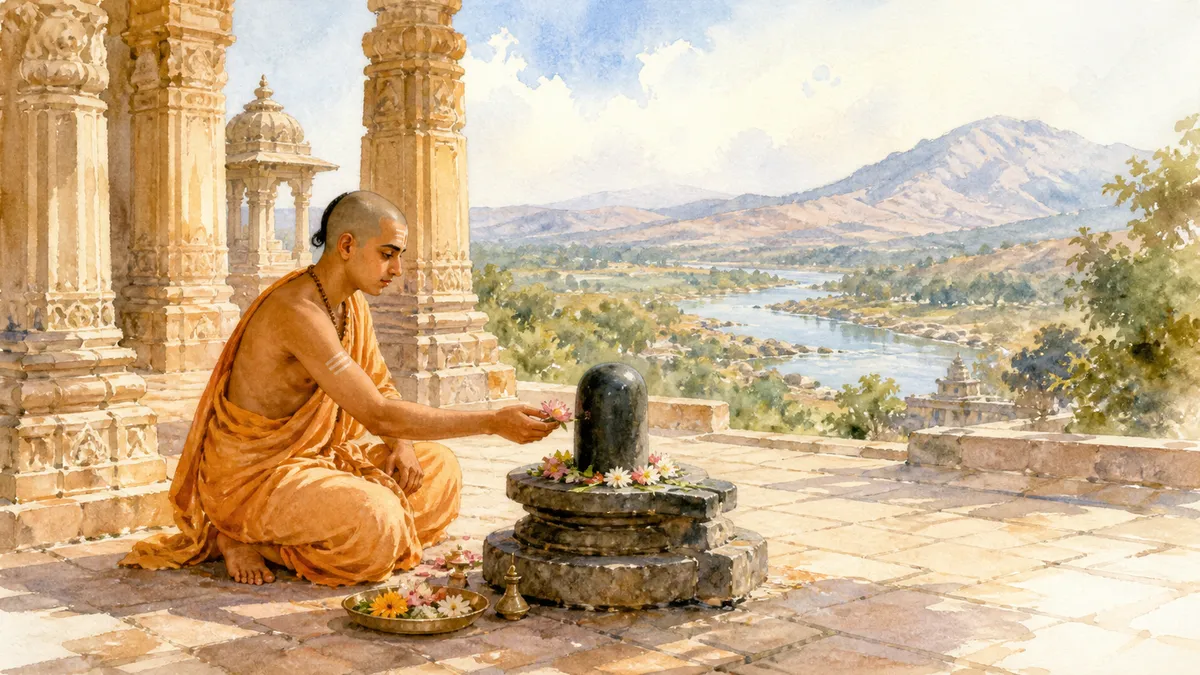
“External worship of form is recommended only for those whose intellect has not awakened. If someone lacks self-control, they use flowers for worship; such worship is pitiful, as is the worship of an external form. Yet these immature practitioners derive satisfaction from worshiping an object they themselves have created, and they may even obtain useless results from such a practice.”
Many people perform worship in the style of Kriya-Charya Tantra. Kriya-Charya Tantra (temple worship) is an elementary practice for many millions of people: the simplest ritual of offering flowers and serving in a temple. People worship without thinking. They believe, “Here is this deity; I worship it and make an offering to it.” But in reality, Kriya-Charya Tantra is only a preparatory practice. The next stages are Yoga Tantra and Anuttara Yoga Tantra.
When we make offerings, perform pujas, and sing bhajans, it is entirely different. First and foremost, we abide in non-dual contemplation, and from within non-dual contemplation, we are free to do whatever we wish. True worship is abiding in the natural state. Even if you do not perform ritual actions but, for example, pick up and toss a book or beat a drum, in the true natural state this will still be true worship. This is because the natural state opens up pure vision, in which every action is like worship. And then, if you perform any ritual practice, such a practice is far more effective; it is true worship. Whatever a true siddha may do—whether a peaceful, neutral, or wrathful action—he always abides in true worship, because he is immersed in natural contemplation, the nature of Mind, and does not leave God for even a second.
“And now I shall describe how advanced practitioners such as you should worship. The God worthy of prayer is truly the One who sustains all creation, who is beyond the reach of thought and beyond description, beyond concepts, even such as ‘everything’ or ‘universal wholeness.’ Only the One who is not divided by time and space, whose light illuminates everything, who is pure and is absolute Consciousness, is called God. He is the consciousness that stands behind all its parts, concealed in everything that exists, which is the essence of all things and veils the truth.”
Such worship is also called Brahma-vichara. Whatever we may be doing, whatever practice we may be engaged in, the mind should be directed toward Brahman. This is the essence of worship in the teachings of Advaita Vedanta and Laya Yoga.
Once I witnessed the following scene in one of the temples belonging to another religious organization. A young prabhu who ran a small ashram, where there were three matajis, was walking around in this state and shouting at the matajis, “How can you not think of God?” They were idly chatting about something, while he was reciting a mantra and occasionally raising his voice at them. The prabhu himself was twenty-three years old, and the matajis were twenty. In fact, it is very useful to raise your voice at your own mind like this when it begins to become conditioned and lose awareness and contemplation. Until you become a great practitioner of awareness and mindfulness, it is very useful, at least on the external level, to redirect your mind.

From Practice to Contemplation of the Absolute
A jnani is constantly immersed in the contemplation of Brahman. But what should we do if we are not yet jnanis, if the matters of contemplation are a great mystery to us and Brahman is also a great mystery? At least on an everyday level, we need to think and tell the mind, “Think of God!” This very turning of the mind brings us into a contemplative state, and then we reinforce it with sankalpa, observation, and awareness.
Awareness must always be transcended. Sankalpa, satipatthana—all such practices must inevitably be transcended when practiced correctly. To transcend means that the mind must be directed toward the Absolute; if transcendence does not occur, the mind becomes suspended in certain lower states of consciousness: states of partial attentiveness or partial clarity. It should be understood that every practice—sankalpa, Atma-vichara, satipatthana, self-observation—must lead to meditation on the Absolute. We must not stop in a suspended state of clarity or pseudo-clarity that ultimately results in our sinking ever deeper into self-reflection and rummaging through inner data. Any practice of maintaining awareness must be transcended; that is, it must lead directly to meditation on God.
