

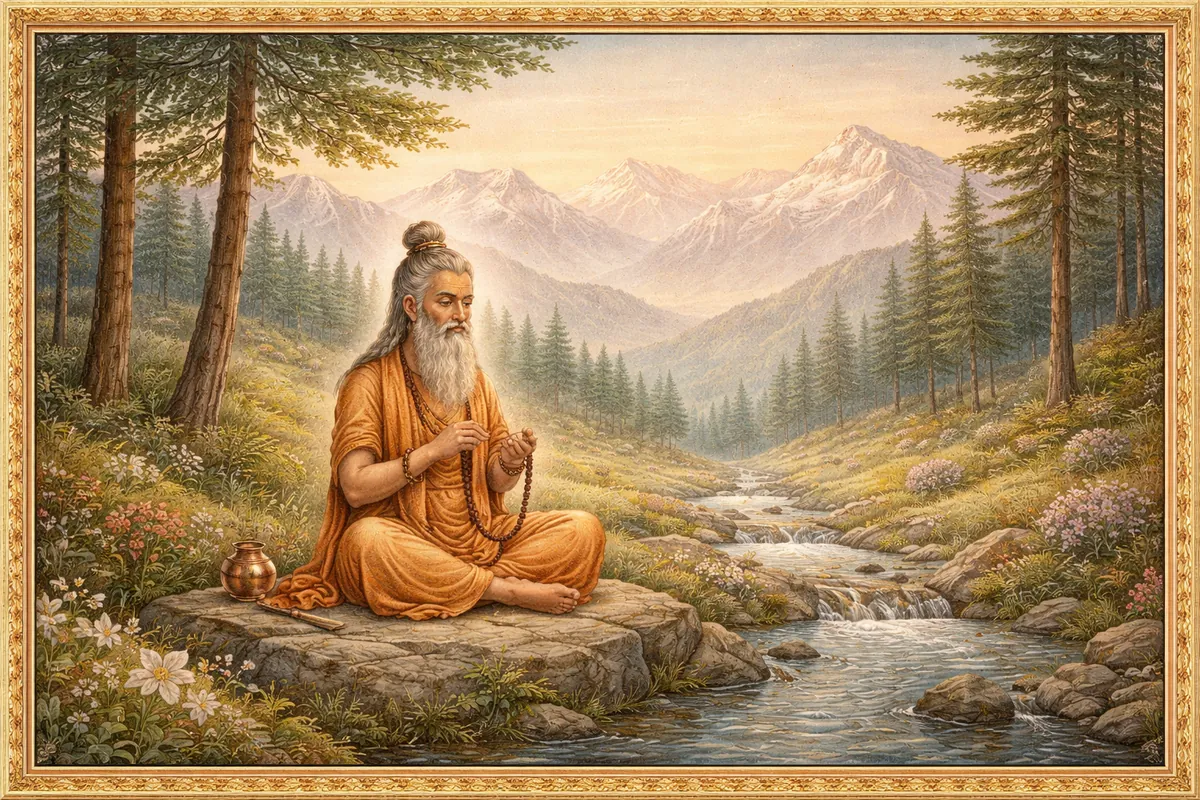
Constant Remembrance of God
We continue the text “Shiva-stotra-vali.” The meaning of the saints’ instruction is to always remember God and never forget Him. If detailed, this means:
- constantly listening about God (shravana)
- constantly remembering God (smarana)
- constantly reflecting on God (manana)
- constantly meditating on God (nididhyasana)
- constantly glorifying God (kirtana)
- constantly serving God (sevana)
- constantly worshiping the lotus feet of God (pada)
- constantly realizing oneself as a servant of God and the sadhu (dasya)
The principles of conduct (shilas) of self-discipline described in the “Chandra-jnana-agama,” if summarized, describe the same thing:
- To reflect on God and reject thoughts of anything other than God and service to Him
- To always speak about God and reject speech that is not about God and not about service to Him
- Concerning the actions of the body — to perform service and sadhana for God and reject other speech and actions
For monks (sannyasis), this is a special way of life. For householders (grihasthas, karma-sannyasis), one must cultivate one’s abilities in such a way that they can do this while living in the conditions in which they find themselves, mastering very great flexibility. Nevertheless, all the inner principles are the same.
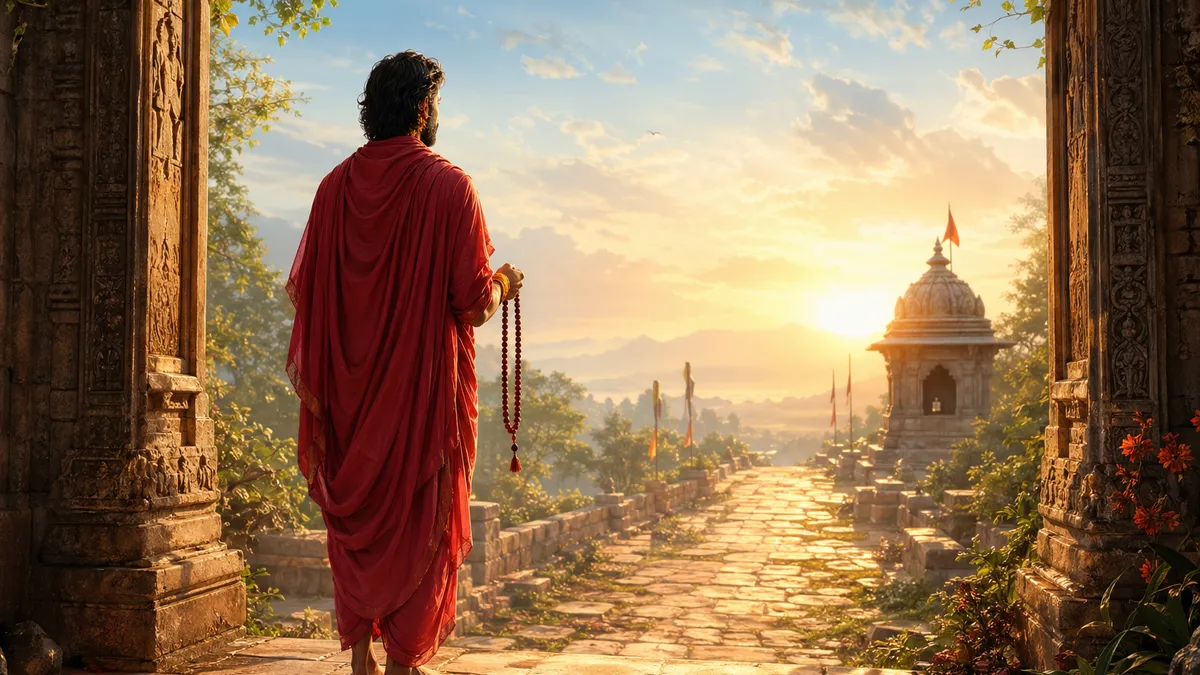
Hymn 17: “Greatly Disposed Toward Divine Play”
Ah, most magnificent is this blissful festival of worship, from which drops of the sweet nectar of immortality gush forth. All actions connected with Your worship conduce to siddhis. But for Your devotees, who are already one with You, these actions are siddhis in and of themselves. Those who, in any state, always worship You as the One who has taken the form of all things are truly my chosen deities.
Thus, the sadhu adopts two things as his main way of life: nididhyasana (constant contemplation of Brahman, contemplation of God) and upasana (constant worship of God). Two bhavas correspond to these two types of actions, in which the sadhu always abides:
- Contemplation corresponds to brahma-aham-bhava — “I am Brahman”) or “Shivoham” — “I am Shiva”
- Upasana corresponds to divya-bhava (divine love), devotion to God
From these two actions — upasana and nididhyasana, and the two bhavas — brahma-aham-bhava and divya-bhava, arises mukti-bhava, in which all saints abide. Mukti-bhava means the bhava of liberation from samsara, from the state of pashu. All beings on the altar: gods, saints, sages, rishis, and siddhas, all abide in mukti-bhava, consisting of these two aspects. One may say they know the essence of mukti-bhava.
Mukti-bhava is the experience of liberation in God, the experience of freedom in God, when one of God’s aspects or several aspects are experienced. For example, svatantrya (freedom, self-sufficiency, wholeness), purnatva, sarvajnatva (omniscience).
How to Receive True Answers
How can one always live in truth, how can one always live in faith in God, how can one make God number one in one’s life, how can one always live in purity and love for God, how can one live in devoted contemplation and self-surrender to God, in self-recognition in God? True answers to these questions can be obtained from the shastras, from the Guru’s instructions, but ultimately both the shastras and the Guru’s instructions are intended for manana; they are not literal answers, because answers cannot be obtained on the relative level.
The disciple must receive true answers in his heart, taking instructions from the shastras and the Guru’s upadeshas, passing them through the heart — interiorizing all of this, that is, letting it in. Having let it in and reflected on them, he receives answers from within, and these will be true answers.
Shiva’s Testament: To Leave Samsara
When we make God the foundation of our life, we fulfill Shiva’s testament, left by Him in the scriptures: “Atmagotramparityaja, Shivamgotramparishat” (Leave your gotra and enter Shiva’s family).
“Gotra” is not only caste, lineage, or ancestral clan, family-ancestral karmic lines, ancestral karmas, the karmas of humanity, the karmas of a nation — it is, in general, the plane in which the soul has become entangled as if in sticky threads, the entire karmic samsaric plane. Shiva says: “Leave all this and enter My family — it is so simple. Leave it and enter My family and be free. Liberate yourself and become free.”
Why, then, do we not want to leave it; what is the problem? Perhaps we do not fully understand Shiva’s testament; perhaps we still want to play in the web, to shake and sway, but the spider named death is waiting. This web is not safe, the web of samsara; one will not dance in it for long without consequences.
It is precisely the jiva’s lack of understanding that the paths of samsara must be left behind that is an obstacle on the path to liberation — the lack of understanding of what must be left behind and the lack of understanding of how to leave it behind correctly.
A monk in Tibet constantly listened to a master speaking about the need to leave samsara behind. Eventually he changed his clothes, put on orange garments, came to the other villagers, and said:
— I have left samsara behind.
They asked him:
— How did you leave samsara behind?
— Very simply: I put on orange pants.
What It Means to Leave Samsara Behind
How exactly to leave samsara behind — we must understand this, we must become convinced that samsara must be left behind, we must understand what samsara is. Samsara does not mean the material world; one does not need to abandon this earthly life. Samsara means the samsaric, egoistic mentality attached to the world.
Leaving behind means inner vairagya, inner asceticism in relation, above all, to attachment to the ego and the material world, and self-surrender to God. The reverse side of leaving behind is unconditional surrender, unconditional devotion to God, and detachment from worldly desires, ambitions, goals, and ego.
The process of how exactly samsara should be left behind:
- From the point of view of Shaivism, we begin by wearing rudraksha, smearing ash on the forehead, performing sandhya-upasana, and reciting the mantra “Om Namah Shivaya”
- From the point of view of Advaita Vedanta, we begin to practice concentration, develop the practice of mindfulness, meditate on the mahavakyas, sit in mahashanti, and contemplate Brahman
- From the point of view of Laya Yoga, Anuttara Tantra — the whole point lies in the intuitive penetration of the view like the sky, habituation to it, and constant contemplation
All these three practices are precisely what allow us to leave the samsaric gotra and enter the family of Shiva.
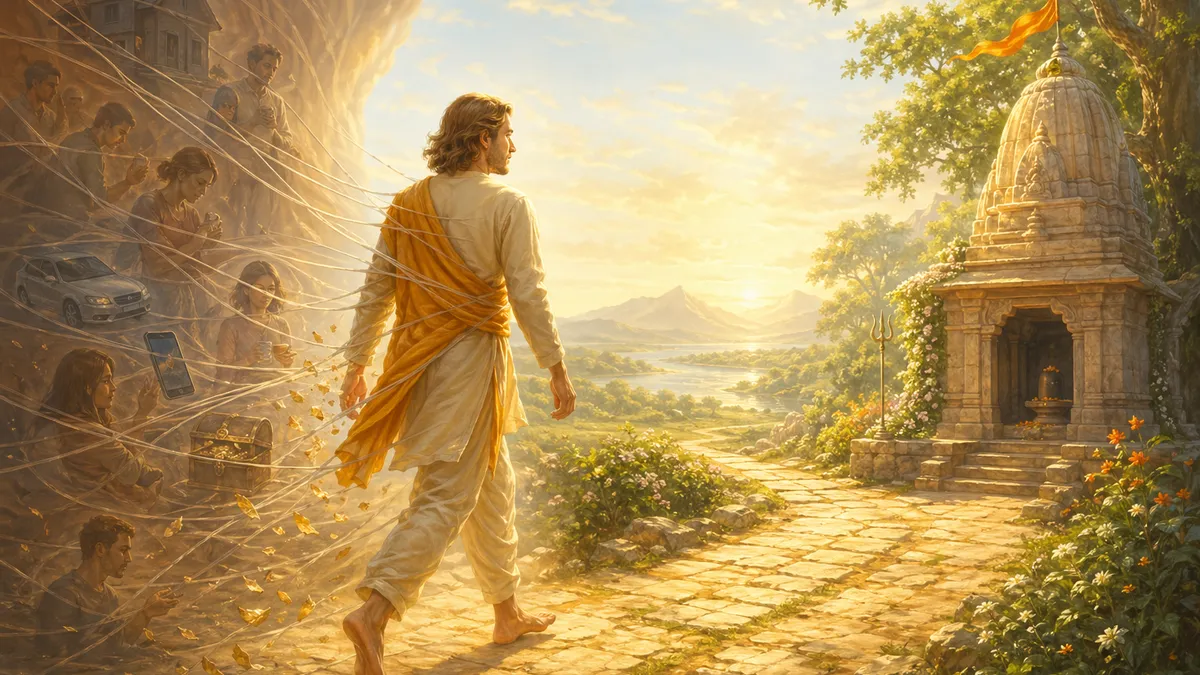
Entering the Family of Shiva
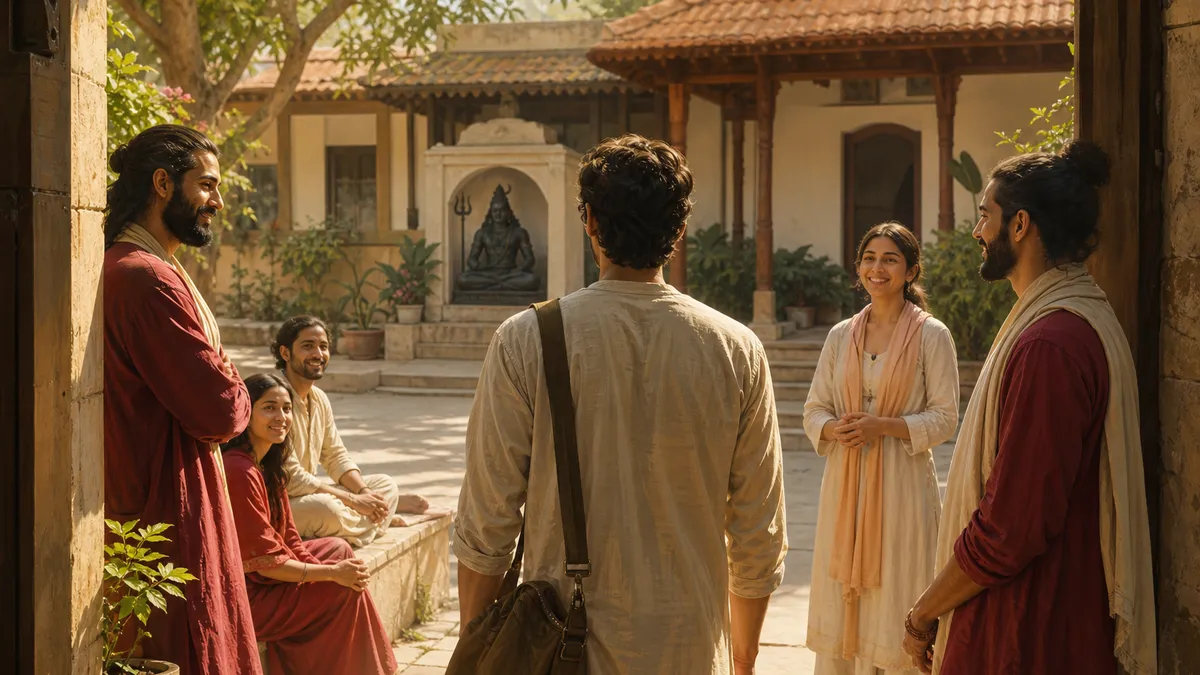
Ultimately, this manifests on the external level, but without leaving the samsaric gotra, it is impossible to enter the family of Shiva. We are very conditioned souls, and we are formed by the mentality of samsara — the mentality of the culture, the society that raised us. We think this way and not otherwise only because we are social beings. But the path implies entering the family of sadhus, entering the family of Shiva.
When we enter the family of Shiva, the family of sadhus, we enter a new society, new connections and relationships. Connections and relationships do not end; they are divinized, spiritualized, and become completely different.
Even in the heavenly worlds live angels and spirits, and some are richer, others poorer, gods (devatas), siddhas. Some have families, others do not and live as hermits; they group themselves according to their clans, castes, and various communities. They also engage in service; there are spirits and gods there, angel-mandaleshvaras (rulers), those who are wiser and those who are simpler. There are higher heavens, and there are lower heavens, which keep a distance from one another.
If an angel or deity of lower wisdom enters a world of higher wisdom, he understands nothing. If gods or angels of higher wisdom descend downward, their minds become clouded; they are not advised to visit the lower heavens. This is roughly the same as wealthy people not being advised to go into certain Black neighborhoods in New York; they are warned: “Be careful there.” It would seem that everyone should be loved, but going there is not recommended; they love from a distance.
In the divine worlds there are also connections and relationships. In the angelic worlds there is a division into male spirits and female spirits; some live in pairs, some alone, some as families, some as clans, some as communities, but these connections and relationships are completely transformed. They are divinized and devoid of all the flaws and vices of samsara, and are filled with non-duality.
I am not speaking about sayujya samadhi, nor about sayujya mukti — I am speaking about sarupya mukti, about the lower muktis, about salokya mukti, samipya mukti. There exists another, divine life in which siddhas, gods (devatas), angels, and spirits live, and in the earthly world sadhus live.
Gradual Transition into the Sadhu Tradition
In leaving samsara behind, we do this gradually; we gradually move into the sadhu tradition, into the community of sadhus, the ethics of sadhus, the culture of sadhus, the life of sadhus, and we accept the meanings, values, and goals of sadhus. This must be done in such a way that the family of sadhus, the way of life of sadhus, becomes our new family, our new community, so that we find ourselves fully in this community and realize ourselves in this community, in a community where God is placed at the forefront; and this is the path of how to become free from samsara.
It is impossible to leave samsara at once; it is impossible to do this by oneself all at once. This is impossible because we are social beings, brought up in the collective karmas of a lineage, clan, nation, humanity, community — we are a product of social self-organization, a product of collective karmas; therefore, Shiva first says: “Leave your samsaric gotra and enter the family of Shiva.”
To enter the family of Shiva is a very multifaceted concept. For example, it means taking Refuge. Having taken Refuge, we accept the family of divine beings, the saints of the lineage, the Guru lineage — a very great family, and all this inheritance comes to us free of charge. We may not fully realize this — it is like belonging to a very powerful, elite, wealthy, noble clan in the world, only in the spiritual sense.
To enter the family of Shiva means to enter a specific community, the lineage of a specific Master — it means to enter into the practice of methods and to absorb all this culture and ethics that contribute to liberation. All of this is what it means to enter the family of Shiva.
Finally, in a more subtle sense, to enter the family of Shiva means, through contemplation, to enter the realm of the pure tattvas — Shiva-tattva, Shakti-tattva, Sadashiva-tattva, Ishvara-tattva, Sadvidya-tattva. The family of Shiva is the five pure tattvas, the purest and most subtle energies. The process of liberation takes place in the family of Shiva; it takes place in the transcendental dimension, surrounded by saints and deities of the lineage, and in service to God, in the practice of methods — then it becomes possible.
Worship as a Celebration
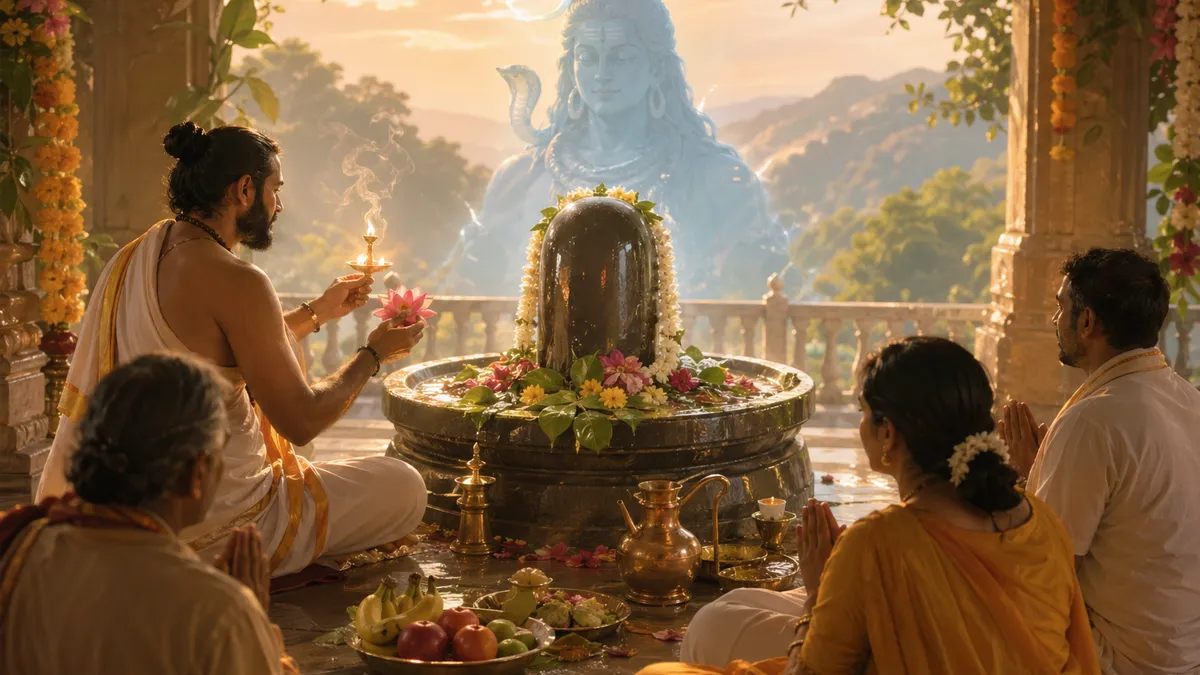
The siddha leaves behind the attempt at meditation, for all his joy is attained through your touch. It, O Lord, contains within itself all acts of worship for the devotees. The time of the equinox, whose essence is serenity, is continuously celebrated by the devotees, for it always makes their worship consist of the sweet bliss of devotion to you. Without beginning, without end, and unlimited by time — such is the essence of worship, O Lord, performed by the devotees. They are the lords of Brahma and the other gods, and they receive favor — those in whom the celebration of worship is established constantly, even during sleep and, indeed, even in dreamless sleep.
Worship of God is a celebration. One who understands its meaning, who realizes the sense and essence of worshiping God, always abides in happiness. He never asks the question: “When will this worship finally end?” because when a person is happy — these are, I believe, the words of Sri Ramana — no one says: “when will this happiness finally end?”
Worship of God in the true sense is always happiness and joy. Often we are compelled to do many practices, to perform tapasya, overcoming ourselves by willpower — for example, to meditate to a double limit, to concentrate, to practice pranayama. All this is tapas — tapas that leads to true worship and precedes it. Without it, it is impossible to purify oneself for true worship, but worship itself is abiding in happiness, joy, and bliss. It is a kind of antar-tapasya, detachment, which leads to bliss, to ananda.
The Prayer of the Soul in the Womb
A sadhu begins by realizing his position in order to inspire himself to such constant worship. He reflects on how his soul was born into this world, why it was born into this world, and what the meaning of its incarnation was.
There are scriptures, Upanishads, for example the “Garbha Upanishad,” where in the fourth chapter it is said: “The soul, dwelling in the mother’s womb, realizes all its past births; it realizes what limitations it has entered into and realizes the life that lies ahead of it.” It prays in the mother’s womb approximately as follows:
“O Lord, I have journeyed from one species to another for thousands of lives. I have suckled at different breasts and eaten various kinds of food, only to be born and to die. I see no way out of this ocean of pain and suffering. I have performed good and bad deeds, telling myself that this was my duty and that I was doing it for those I love. Today I alone suffer from the pain of those cruel past actions. O Lord, I pray, help me get out of this place; this time I promise — I will accept only you and serve only you.”
This is the prayer that every soul recites in the womb, because it still has clarity, the memory of past lives, and a vivid awareness of why it entered this womb. But when it is born, the action of a special prana begins; it is called Vaishnava-prana, and this Vaishnava-prana erases the memory of past lives and erases the memory of its prayers, vows, and promises. It is as if it is born with its memory wiped and acts already on the basis of samskaras and vasanas.
Vaishnava-prana is intended specifically to block memories of past incarnations, so that the mind does not fall under the influence of past karmas, but remains quite pure and has a connection with the Atman. This is the reason why we do not remember our past birth, why we forget our vows and promises, and, having been born here, become conditioned again.
It is believed that only saints who possess a mighty power — trikala-jnana, the ability to remember the past, future, and present even in the physical body — do not forget. Those who created strong intentions to remember, or who possess a strong meditative consciousness. Having been born, they quickly remember themselves and engage in nothing else except service to God. All the others, because of Vaishnava-prana, remember samskaras and vasanas, but they do not remember their vows and promises to God. In order to remind them of these vows and promises, Ishvara sends texts, sends the Guru. We listen to the texts; the Guru is before you.
Devotees celebrate the festival of worship not only while performing japa, pouring the sacrificial offering into the fire, bathing, or meditating, but in all states. Who among the ruling gods — Indra, Brahma, and others, and even among ascetics — is equal to the one who enjoys the sweet nectar of worship? In the great festival of worship of you, devotees attain that which is attainable, the sole cause of the destruction of the world. This they truly understand. Resting in the splendor of your consciousness, may I always worship you, O Lord, through body, speech, and mind, the products of the thirty-six tattvas.
Grace and Spiritual Power
When a yogin has faith in God, worships God, contemplates God, he always receives a blessing, Anugraha-shakti, and grace is always with him. His karmic tendencies, samskaras, and the strongest samskaras — vasanas — weaken under the influence of the descent of grace and being filled with Shiva. Vasanas are the strongest of the samskaras, determining birth in this life and the tendencies of this particular life. Then the yogin is able to restrain the senses, subdue the mind, control desires; he is able to be independent, self-sufficient, not dependent on the dominant culture, public opinion, nation, culture, language, or any ancestral ties. He acquires power — this is a sign of power (purnatva), a certain self-sufficiency.
For example, what do you think: could you go to another country with little money, weak English, and preach there? After some time, awaken faith in the hearts of others, create an ashram there, truly awaken faith in dozens of people, change their lives — not merely survive yourself, but bring about the flowering of the Dharma?
If you have faith and self-sufficiency (purnatva), fullness with Shiva — you have no doubts, none at all; for you the whole world is the same. For example, there was such a saint, Sri Prabhupada, who had fifty dollars and for whom a ticket was bought. He was nearing seventy, he went to America, lived among hippies, psychedelic culture, LSD, all that flourishing — he simply preached. He sang bhajans, recited mantras, spoke about God in English; after some time his shakti spread throughout the world. This shakti is the power of faith and devotion. He was simply a strong devotee; for six years he performed tapasya for this — that is power, spiritual power.
Liberation from Intoxication
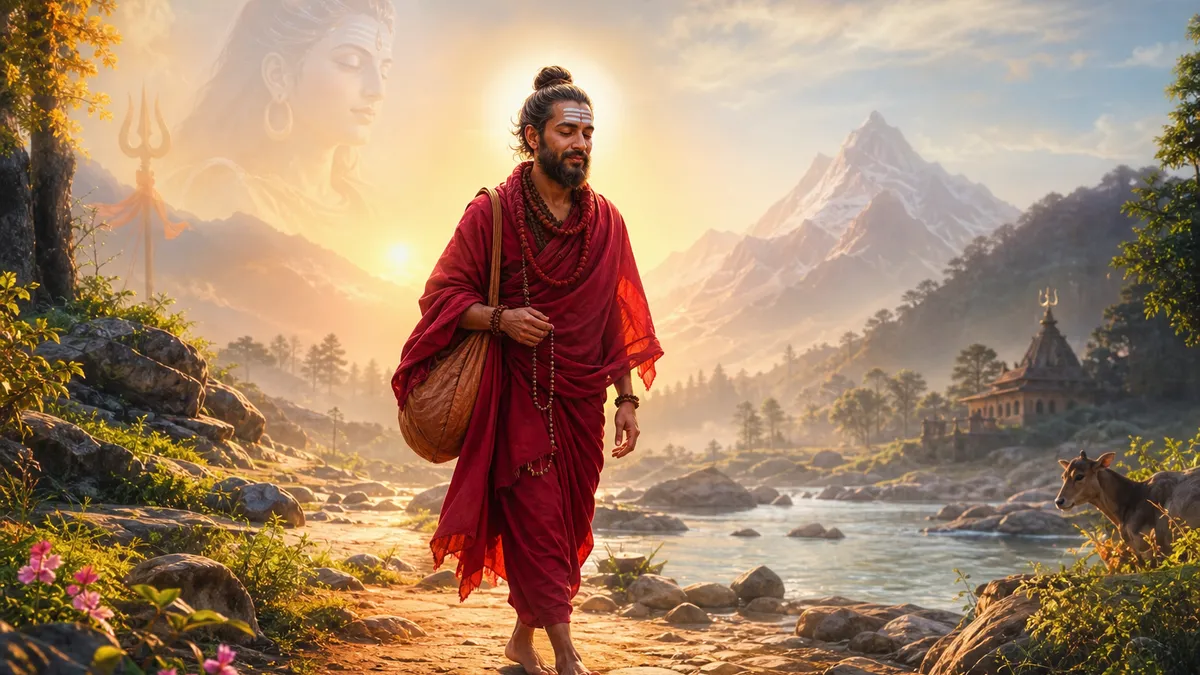
When you have the power of faith and you perform tapasya, you receive grace from God; God gives you this power. Your desires cease to intoxicate you; you no longer think: “How can I fulfill my desires?” Your desires are nothing — spit on them, grind them into dust, that is all, they are gone. You have one desire — how can I serve God, how can I become a perfect conduit of the divine will.
You are no longer intoxicated by the energies of the body; the energies of the body do not impress you. You are also not intoxicated by the energies of the soul: emotions, energies, assessments, judgments do not impress you. You are not intoxicated by concepts, by knowledge — you know that concepts, knowledge, philosophies, theories, and points of view, no matter how sophisticated they may be, are all limited before God — you are not intoxicated by any of this. You are not intoxicated by loka-drishti — the dominant karmic vision. This is culture, the political situation, as it happens in any country — there is something of its own. You know: all of this is earthly, human, transient; we have already seen all of this.
There were communists; before the communists there were capitalists; after the communists there were democrats; after the democrats there was something else. Even within a single lifetime a person sees this, and you are not intoxicated by loka-drishti (karmic vision). You are not seized by anything, and you have faith and the ability to serve the divine will everywhere and always — this is where divine power is born. You have no other desires or ambitions, no intentions other than to serve God, glorify God, and do everything for this. This power does not come through the efforts of the ego, nor through the intellect; it comes as the blessing of the Guru and God, of the saints of the lineage, and in no other way. It comes as grace, but it unfolds in yoga.
Satisfied, delighting in attachment to your worship, let all my time become infinite. This alone I pray for. May my longing to enjoy the immortal nectar of your worship increase each day, always bringing generous fruits. In your ocean, overflowing outward at the dissolution of the universe with the immortal bliss of unity, let me remain here, O Great Soul, always adoring you. Purified and released through the cutting of the knots of hidden desires, devotees can finally dedicate their minds to the sweet action of your worship. Even while dwelling upon their objects, the capacities of these sense organs provide devotees with the immortal wine that constitutes the essence of your worship, O Lord.
Signs of True Devotion
A sadhu who always remembers God — whatever his senses, his mind, thoughts, or body may be engaged in — always keeps God in memory, reflects on God, contemplates God, concentrates on God through upayas, skillful methods, and performs upasana (worship) to Him. In essence, absorption in contemplative presence, absorption in brahma-aham-bhava, absorption in divya-bhava (divine majesty), love and devotion to God — these are descriptions of one and the same process: entering the divine dimension, eliminating vasanas and samskaras, purifying the soul, and the complete surrender of the soul.
For devotees irresistibly inflamed by the burning heat of ardent devotion, what other means of extinguishing are needed besides plunging into the nectar of your worship?
What are the signs of one who is devoted to God? He always thinks of God, and he is not interested in thinking about anything else; and when he sees that others are interested in thinking about something else, it seems strange to him. A sadhu devoted to God is interested only in speaking about God. When others speak at length about something else, that too seems strange to him. Finally, a sadhu is interested in serving God, doing things for God, manifesting divine energy. When someone does not serve God but serves something else, does not act for God, this too seems not very comprehensible to him. Why? Because the sadhu clearly hears, feels, and sees the grace of God, and he has intuitively understood how to remain in this grace always and never fall out of it.
The Hierarchy of Divine Beings
In the same way, all gods, all saints, all angels, all devas — what is called the entire holy host, the whole sacred army on the altar and beyond it — our altar is not yet the most complete. In fact, if all the saints of the Refuge Tree were to be depicted, there could be an enormous altar of nine levels: all lineages, all families, the paramparas of all saints, all classes of deities. All divine beings likewise abide in constant divine grace, in constant divine love, constant self-giving, and contemplation of God, without deviation. Those who abide most deeply are the wisest, most respected, and most revered. Those who abide less deeply are the so-called peripheral deities or deities of the retinue. But those living beings who completely forget become humans, animals, and other beings.
In other words, our position in the universe, our next birth, our destiny, our karma depend entirely on closeness to God, on the ability to remember God and abide in the rays of His love. Let us say, to abide in His energies, in the high tattvas close to God, in the contemplation of divine qualities, and on the extent to which we have absorbed these divine qualities into ourselves and developed our inner principle under divine grace. To the extent that we have filled ourselves with Shiva, to the extent that samavesha (being filled with Shiva) has occurred, and to the extent that we have surrendered ourselves to Shiva, to the extent that prapatti-yoga has occurred. The highest saints of the mighty hierarchy of creation, the mighty gods, have not only filled themselves with Shiva; they have also accomplished self-recognition, realized their identity, their unity with God, and manifested various qualities of Ishvara, Bhagavan, within themselves, such as sarvajnatva, purnatva — that is, omniscience, self-sufficiency, divine power, divine freedom, and others.
Divine Amrita and the Nourishment of the Soul
In any action, at all times let me enjoy the supreme bliss of intoxication with the immortal wine that arises from your worship, O Lord.
From worship arises amrita (the nectar of the gods), and what is this nectar? Amrita is nothing other than Anugraha-shakti — concentrated divine grace. This amrita gives rise to bliss in the soul, and it alone bestows eternity and immortality, and all the gods, all the saints know how to partake of this amrita. In other words, it is the purest sattva, the divine light coming from the center of the universe. The gods, saints, rishis and siddhas, jnanis know this secret of how to partake of this amrita, how to partake of this divine light, how it fills the soul with strength, purity, wisdom, how it awakens in them all the highest qualities. Beings of the pashu class, bound living beings, bound by the fetters of matter, by the fetters of karma, do not know this secret, and therefore they are always seeking nourishment somewhere apart from divine grace, completely confused and lost.
For the most part this is nourishment through the excitation of the chakras, from worldly desires, through the excitation of the senses and emotions, through the excitation of the mind by means of external objects; therefore the nourishment of divine beings, angelic beings, devas, and beings of the pashu class is fundamentally different. Those who belong to the Pati class are nourished by divine amrita; those who belong to the pashu class are nourished through external objects, the excitement of the mind, the satiation of the sense organs, the excitation of the chakras by external objects, and coarse worldly desires. Accordingly, a sadhu is a transitional being from human to God-man, from pashu (one bound by karma) to Pati (lord over karma). In the process of this transition, he sometimes feeds on external objects, samsaric excitations of the mind and emotions, like ordinary people, and sometimes he feeds on meditation and contemplation, divine grace, mantra, visualization, and ananda during upasana.
The wiser and more experienced a sadhu is, the better he understands how to be nourished by this divine light through upaya, and how the senses must be restrained, how nourishment by samsaric energies must be limited. In society today there are many classes of people who attach importance to proper nutrition, so many nutritionists, so many recommendations for cleansing this or that, raw foodists, fruitarians, prana-eaters, experiments with diets; in fact, this is a very fashionable interest — vegetarians, vegans, fruitarians. But in reality, the question of the nourishment of the physical body is not as fundamental as the question of the nourishment of the soul. One can be a great nutritionist, yet the soul will still be nourished by samsaric energies. The question of how to learn to be nourished by divine mercy and divine grace is the most important thing: how to switch completely to nourishment by divine grace. Even if the physical body is nourished by ordinary food. The question is what the soul is nourished by, and it is possible to accustom the soul to such a divine diet; this is what sadhana, upasana, constant upasana to God consists of.
For devotees, the meaning of the supreme aspiration toward your worship is perfectly clear. From this they experience joy beyond all expectations. In my opinion, there is not even a trace of an abundance of joy until one has experienced the great festival of your veneration. Immersed in worship, devotees find themselves deep within your being, abiding effortlessly, without anxiety over anything.
