

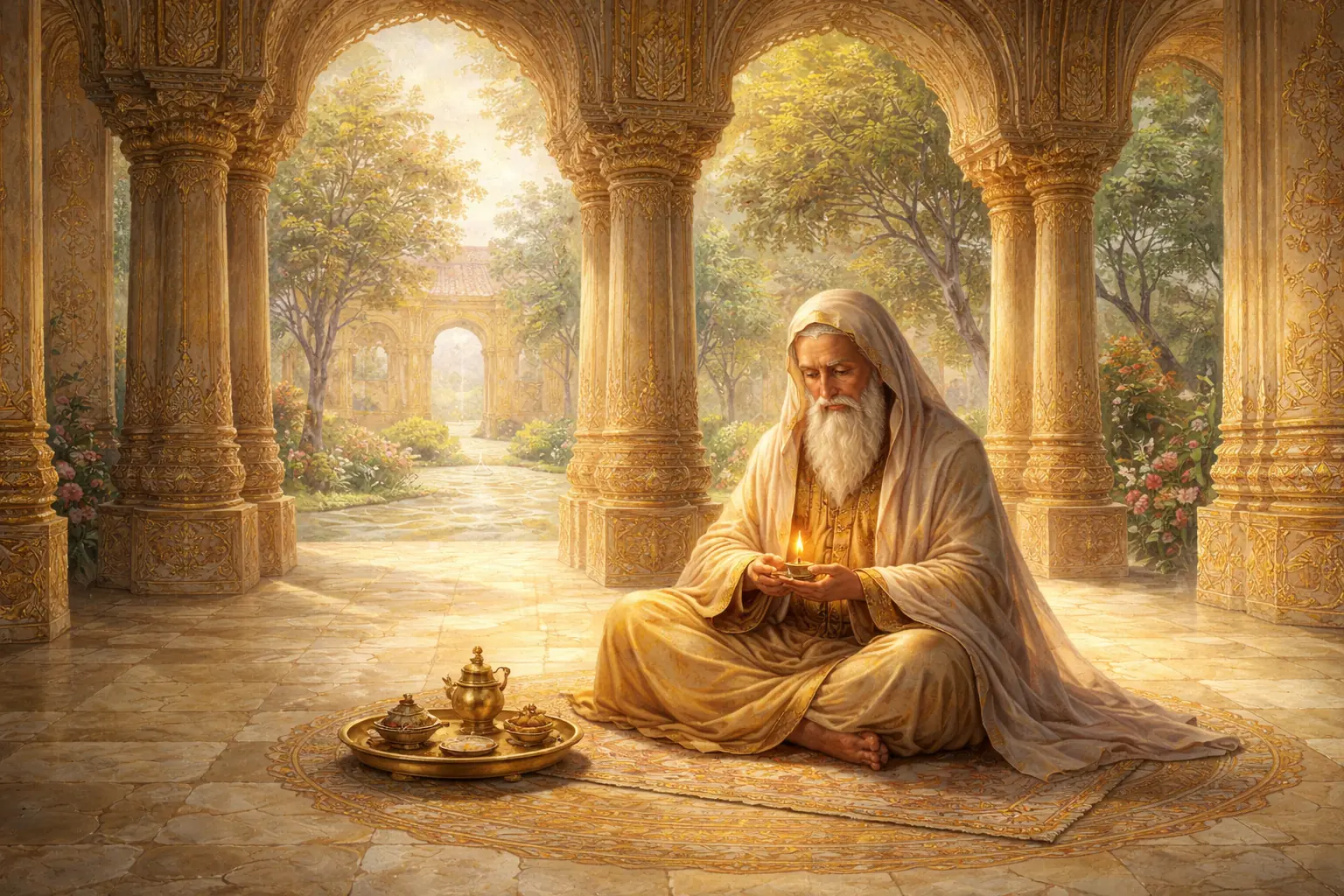
Worshiping God Through Integration with Reality
“Remain in this state, O wise one, perceiving everything like a child. Worship the God of this body (the intelligence that pervades it) with everything that time, circumstances, and your surroundings bring you; remain calm and renounce desires.”
In the teaching on the 16 kalas, the stages of “nurturing” and especially “upbringing” are associated with the art of integration. The art of integration means the ability to be in the present moment and immerse oneself in it, the ability to merge with what one is experiencing, and the ability to remain whole while living through every action and every situation totally.
When we are unable to live through a situation totally, when we close ourselves off from it, block it, or contract, we become rooted in our separateness and in the idea “I am this body.” The art of integration, by contrast, roots us in nondual space. This is precisely the principle of such worship through everything that time, circumstances, and our surroundings bring us.
If we unite with time, then we experience totally, wholly, and fully whatever changes it brings. What does totally and wholly mean? It means that our mind is wide open and we merge with the changes brought by time. During growth, we become the principle of growth; during preservation, we become the principle of preservation; during aging, we become the principle of aging; during dying, we become the principle of dying; during rebirth, we become the principle of rebirth. Then all manifestations of time, all transformations—birth, growth, preservation, decline, and disappearance—become a play upon the surface of this principle of space.
When we unite with circumstances, we always merge with the situation and experience it completely and wholly; we enter into it. What does it mean to enter into a situation? It means discovering its source, its essence. And since the source and essence of all situations are one and the same, we are never deluded. Situations, cause-and-effect relationships, sequences of events, karmic chains, and reactions do not lead us astray because we see their essence, their source. And when we perceive this source, we discover a boundless space of light, a boundless Essence filled with light, while sequences of events, chains of cause and effect, and karmic reactions are merely a play upon the surface of this space.
To enter into the essence of something, to unite with it—this is what such worship means. Whenever we enter into the essence of something, we discover emptiness, and beyond the principle of emptiness we discover fullness with the supreme Source. The principle of emptiness, to which Buddhists pay great attention, means that a situation does not exist in itself; behind it lies awareness resembling space. But for us, awareness resembling space is not merely nonexistence, not merely emptiness. It is the ultimate positive, ultimate fullness, the ultimate capacity for manifestations and play.
In Buddhism, the ultimate positive, the capacity for manifestations and play, exists only in the most secret and highest vehicles, such as Atiyoga. In other vehicles, this receives no attention, while the aspect of emptiness itself is emphasized. We, however, say that the aspect of emptiness is merely the very beginning of comprehending this principle. This principle itself possesses incredible unfathomability and fullness. And discovering this principle behind all situations is the principle of worship.

Worship as Self-Transcendence
“Whatever you do, whenever you act or refrain from action, everything can be used to worship God, who is pure consciousness. Regarding all of this as worship of the supreme Self, which is God, he rejoices.
Like and dislike, attractive and unattractive—these are merely words that do not exist outside the supreme Self. Even the concepts denoted by the words ‘independence,’ ‘poverty,’ ‘pleasure,’ ‘pain,’ ‘mine,’ and ‘others’ are in fact worship of the supreme Self, because the intelligence that gives rise to these concepts is also the supreme Self. Knowledge of the cosmic Being is the only suitable method of worshiping it.”
Worship means that the mind and body have a subordinate role. Until we understand the principle of this subordination and bring the mind into complete humility before the higher Self, self-transcendence will not occur. And even if we maintain mindfulness through effort or try to be mindful effortlessly, self-transcendence cannot occur until the mind and ego attain ultimate humility, until they surrender to the higher Self, until, in complete humility, they abandon all their preferences, opinions, judgments, and evaluations and begin to listen impartially and humbly to the higher Self.
Self-transcendence (the second stage of contemplation) occurs precisely when the mind becomes convinced of the need to surrender to the higher Self and, abandoning its evaluations and opinions, simply begins to listen to this higher Self and meditate on it.
Ahamkara is a structure that forms from birth and to which we gradually become accustomed. We even begin the spiritual path on the basis of this structure. It has its own ideas about everything, including the spiritual path. But sooner or later, it reaches a point where these ideas must be discarded, because the spiritual path itself, if based on these ideas, will be false. Such a point is the point of paradox. For the ego, it is always the place where its dissolution occurs. Our “I” becomes infinitely bewildered when it realizes that it never existed in the first place. This fills it with endless astonishment. And if it has not been prepared by philosophy and purified through guru yoga, service, and self-surrender, it may even fall into despondency. In other words, all its spiritual fervor and enthusiasm begin to evaporate at this point; it begins to feel dejected upon realizing that it is moving toward a goal in which it itself will no longer exist. This fills it with endless astonishment. It begins to brood and sink into despondency as it reflects on these matters. And suddenly the path no longer seems to be what it thought it was. It appears to be a boundless, terrifying abyss.

It is very important not to make a mistake here, because making such a mistake closes the path to realization. One such mistake is called “the dangerous gorge of dualistic thoughts,” that is, the tendency to overthink the matter intensely. Another tendency is called “clinging,” that is, the ego’s tendency to cling to something, to try to preserve its hopes and fears, and its fear of cutting them off.
If you have faith, samaya, and devotion, you will traverse this path, and your ego will fall into neither despondency, nor self-reflection, nor clinging. You will truly enter the great path of the siddhas and fearlessly step into the “lion’s jaws,” like the saints of old. If you lack sufficient faith, samaya, and devotion, you may step not into the “lion’s jaws” but somewhere else and remain with the same things with which you began. This is precisely where true self-surrender begins. Self-surrender means that we do not cling to our selfish plans, goals, and hopes. There is something much deeper within us.
The Mystery of Individual Consciousness
“Oh, what a mysterious wonder it is when this higher Self, which is pure consciousness or intelligence, seems to forget its own nature and becomes individual consciousness in relation to itself!”
We ourselves are this mysterious wonder. We ourselves are that pure intelligence which seems to have forgotten its own nature and become individual consciousness, imagining itself to be individual consciousness. When self-surrender and self-transcendence occur, we discover that we have actually gained, while what we have lost consists of our illusions and limitations. The ego is an illusion; it is a limitation. And to rid ourselves of this illusion, we must truly make a real effort—that is, tapas is necessary. When we read about the feats of the saints of old, we should not think that such a path was necessary only in ancient times. In fact, the ego of modern human beings and the ego of ancient human beings are almost identical. And when looking at the feats of the saints, we should not think that we may make less effort or practice half-heartedly simply because it is already the twenty-first century. Whether it is the tenth century or the twenty-first century makes no difference whatsoever. These efforts are tapas. It is impossible to free oneself from the illusion of the ego just like that if there is no tapas.

The Nonduality of Worship
“In truth, in this cosmic Being, which is the reality of all things, there is not even any division into the worshipper, worship, and the one who is worshipped.”
The process of division exists in the conditioned, relative world when we describe the world from the standpoint of duality. In that state, however, there is no such division. Yet this principle of worship must be understood, because the mind and ego are necessarily subordinate to the higher Self—only then can self-transcendence occur. If this subordinate nature is not understood, self-transcendence cannot occur in principle. We often do not fully understand this. And when the question of liberation from illusion or attachment arises, we may forget or ignore it. Yet this is precisely the path to transformation.
If it is necessary to relinquish certain attachments or preferences on the spiritual path, then nothing should stand in the way of doing so. When we engage in service or anything else, it is in fact very important to understand the principle that we should engage in worship. If you are sweeping a road, you have two ways of doing it: the first is simply to work; the second is to perform worship. And it is very important not to work, but to perform worship, because if you merely work, the benefit is questionable; that is, you will simply accomplish a certain task on the external level, but nothing more. But if you perform worship, your spiritual sadhana will inevitably develop. As a rule, those who perform such worship while engaging in service are always very successful both in contemplation and in service; but if you lack this principle, then both your contemplation and the way your service manifests are highly questionable. Why? Because to perform worship while engaging in any activity means connecting to a transpersonal source of energy and always acting in a state of such connection, whereas merely doing work is a form of worldly activity that yields only relative merit.
Service is always this principle of worship.

Consciousness Worshipping Consciousness
“We do not consider those who believe that God is limited by time and space to be worthy of instruction. Therefore, having abandoned all such limited notions, and even the division into the worshipper and the one who is worshipped, worship consciousness with consciousness.”
In reality, there is no process of worship, no worshipper, and no one who is worshipped. All of this is the single energy of awareness, chit-shakti-vilasa. However, it is entirely legitimate to speak of these concepts as long as we retain the notion of “I.” At the level of the View, in contemplative presence, of course, it is enough for us simply to abide in the natural state. But when we speak of the position that our mind and ego should assume in relation to the supreme Self, the supreme Source, it is legitimate to speak of the principle of worship and self-surrender.
Activating the Higher Circuits of Consciousness
“Be calm, pure, and free from desires. Regard all your sensations and expressions as worship of the higher Self.
It is very easy to be calm and free from desires during retreat practice, when there are no distracting factors and you feel aware. But when there is activity and there are distracting factors, this is very difficult to do. Yet the whole essence of practice lies precisely in preserving and increasing this awareness, bringing it into all manifestations and actions. What does this calmness depend on? What does contemplation depend on? On how active our higher circuits of consciousness are. When they are dormant, certain subtle parts of us seem to switch off, and only the ordinary mind (manas), ordinary reason, and intellect (buddhi) remain active. Those whose higher circuits of consciousness are switched off are like artificial intelligence, which seems to function and give the right answers, yet something is missing from it. What it lacks is the truth of the living Spirit. Conversely, when our higher circuits of consciousness switch on, this artificial intelligence (manas) is imbued with the higher spark of the absolute Self.

A genuine practitioner differs from an inexperienced one in that the higher circuits of consciousness are never switched off. They are always active and operate nonstop. A beginner in spiritual life, however, is able to enter these higher circuits of consciousness only for a few seconds, and therefore must struggle with distractions in order never to fall out of these higher circuits.
