Commentary on the Text of the Shiva Purana, Chapter 37
November 21, 2025
The Story of Durvasa Muni
“Nandishvara said: ‘O wise one! Listen to the story of the incarnation of Lord Shiva, the bearer of Pinaka, in the form of Kirata, who slew Muka and joyfully bestowed his grace upon Arjuna.’ Having been defeated by Duryodhana, the noble Pandavas went to the Dvaita forest, accompanied by their chaste wife Draupadi. Sustained by the bounty bestowed by the sun, the Pandavas spent all their time happily. O Brahmin, Durvasa, the foremost sage, was induced by Duryodhana to go to the Pandavas in order to deceive them.”
After losing to Duryodhana in the famous dice game, the Pandavas were required by the terms of the wager to go into the forest for twelve years and surrender their kingdom, power, and wealth, which they were forced to do. And so they lived in the forest. But the Kuru clan, Duryodhana’s clan, continued to plot against them and sought to cause even more trouble for the Pandava clan. The Pandava clan represents the deities, while Duryodhana’s clan represents the asuras as embodiments of the kleshas.
One of the Kaurava clan’s schemes was to bring Durvasa Muni’s wrath down upon the Pandavas. They hinted to Durvasa Muni, “The Pandavas are living there in the forest; it would be good if you visited them.” They did not even ask him directly. But they said, “They are doing well there; they have the Akshaya Patra, an inexhaustible vessel that can feed any number of people.”
Durvasa and his disciples—he had ten thousand sannyasi disciples—decided to visit them. But Duryodhana’s calculation was that they would be unable to feed so many sannyasis. It was impossible to satisfy Durvasa, and sooner or later they would make a mistake, Durvasa would become enraged and curse them, and then their lineage would surely be wiped from the face of the earth. That was their plan.
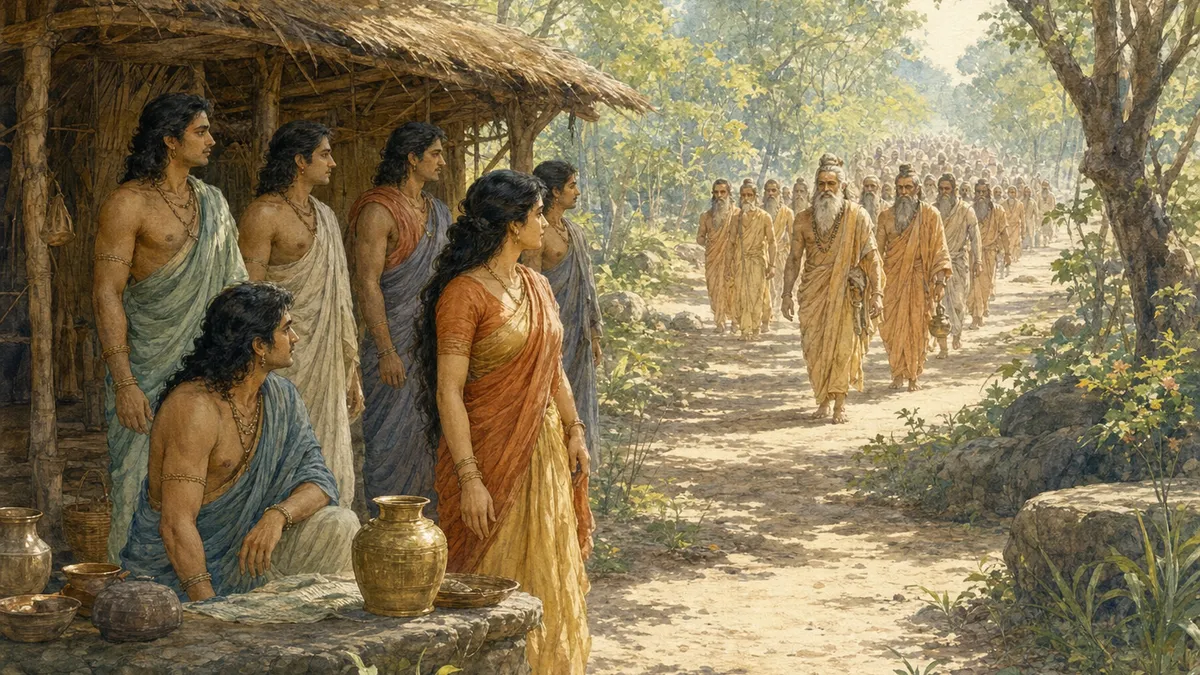
“Accompanied by his ten thousand disciples, Durvasa approached them and asked for food and other things for his disciples. After he had been received, Durvasa and the other sages and saints were sent by the Pandavas to perform their ablutions. O great sage! Because of the lack of food, all the Pandavas were deeply distressed and resolved to give up their lives. But Krishna appeared when Draupadi remembered him. He immediately satiated them, and upon learning that the disciples were fully satisfied, Durvasa departed. By Krishna’s grace, the Pandavas were delivered from their predicament.”
Here Krishna saved the Pandavas from Durvasa’s curse. Yudhishthira, Bhima, Arjuna, Nakula, Sahadeva, and Draupadi were near Bimala Kunda in Kamyavana, in the forest. The wrathful Maharaja Durvasa Rishi came to them accompanied by his disciples—some say ten thousand, while other sources say as many as sixty thousand—that is, a vast number of followers.
When Yudhishthira saw Durvasa, he addressed him very humbly: “O sadhu, enter my home and adorn it.” But Durvasa immediately found a reason to become angry and said, “If you were not the son of Kunti, whom I blessed, I would certainly curse you.” Yudhishthira did not even understand what was wrong, for he had offered Durvasa pleasant words of welcome. But he immediately bowed and began asking his forgiveness. Durvasa Rishi said, “I am not some piece of cloth or ornament with which you may adorn your home.” And Yudhishthira immediately replied, “Very well, sadhu, please forgive me; I was mistaken. Do not adorn my home, but purify it by sprinkling it with the dust of your lotus feet.” Then Durvasa said, “All right.”
According to the shastras, when a true saint enters someone’s home, the dust from his lotus feet sanctifies the entire space. Durvasa then said, “You speak correctly: the dust from the feet of a sadhu purifies everything around it. Very well, but before I take prasada in your home, I will go with my disciples to perform our ablutions and then return. Meanwhile, prepare a fine offering according to this menu: rice, dal, sabji, khichri, pakoras, kheer...” —and more than fifty dishes were listed. In other words, he imposed conditions under which they had no chance of succeeding. He himself went to bathe in the Ganges.
Yudhishthira was shocked. He began asking Draupadi, “What are we to do? Durvasa Rishi will return soon, and if we fail to satisfy him properly, he will curse us all and reduce us to ashes—that is, destroy us with his curse.” And Draupadi said, “But I have already washed the Akshaya Patra; it can no longer manifest prasada.” She had the Akshaya Patra, a magical vessel that could manifest enough food for any required number of people. But it could do so only once a day. The problem was that they had already eaten, she had already washed it, and it would no longer work that day. That was it; it had already exhausted its power.
Akshaya Patra is a mystical pot that Krishna gave to Draupadi. It could manifest an unlimited amount of prasada, but only until Draupadi herself had eaten from it. Once she had eaten, it ceased to function, as it were. One had to wait for some time.
Draupadi became frightened, closed her eyes, and began to pray mentally to Krishna. Draupadi's vibration—that is, Shabda Brahman in the form of her thoughts, her mental appeal—reached the city of Dvaraka, Rukmini's palace, where Krishna was. Krishna had just finished taking prasada in the palace of His consort Rukmini. And He received a mental message from her, as if by mobile phone. Then, in His illusory form, He appeared before Draupadi in the Kamyavana forest and said, “I am hungry.”
Draupadi continued to weep and say, “Durvasa has come with his disciples; he has come to us to take prasada. He will bathe and return, but I have nothing to feed him. If we do not satisfy him, if we do not feed him properly, he will curse us. And now You are asking for prasada too! That is it—I have absolutely no idea what to do anymore. I cannot feed any of you; I cannot satisfy anyone.” And she was utterly despondent.
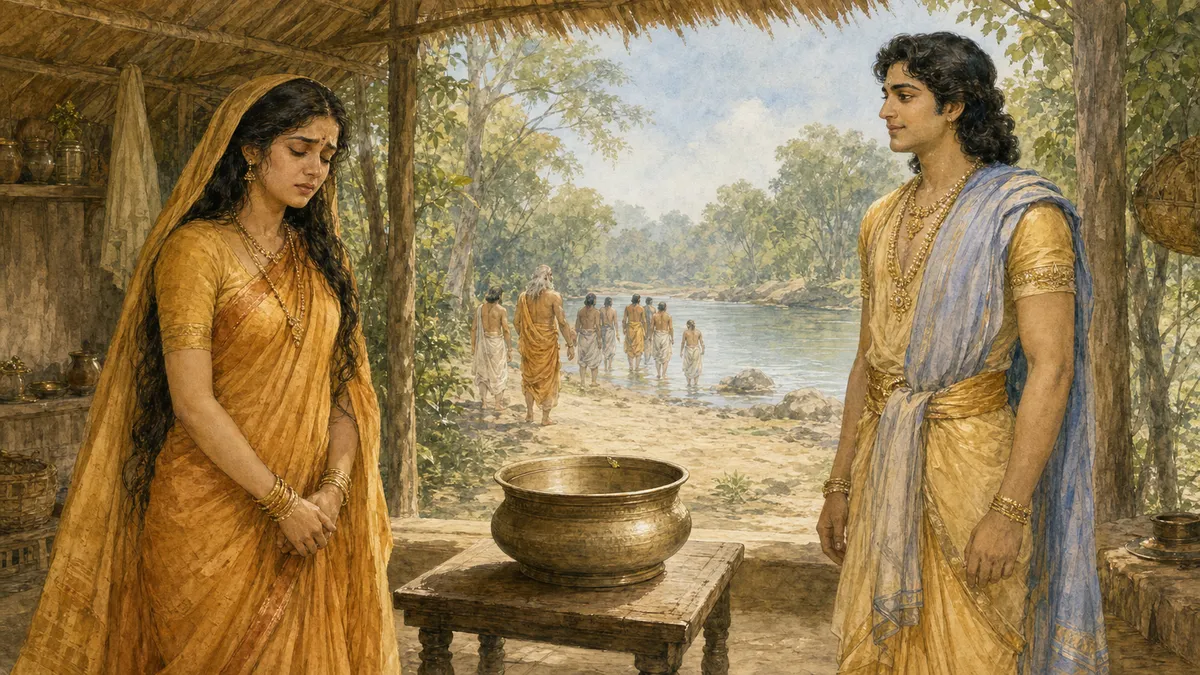
But Krishna deliberately kept insisting, saying, “I am hungry.” Then He wiped away her tears and said, “Just give Me a glass of water and bring Me the Akshaya Patra, and I will do everything Myself.” As an offering, she gave Him a glass of water to drink and brought the Akshaya Patra. He looked at it and noticed a tiny piece of green salad leaf stuck to the side of the pot. He said, “Look, there is prasada here.” He ate it, washed it down with water, and said, “That is all. I am completely satisfied. Thank you. Namaste.” And He disappeared. He vanished from the forest.
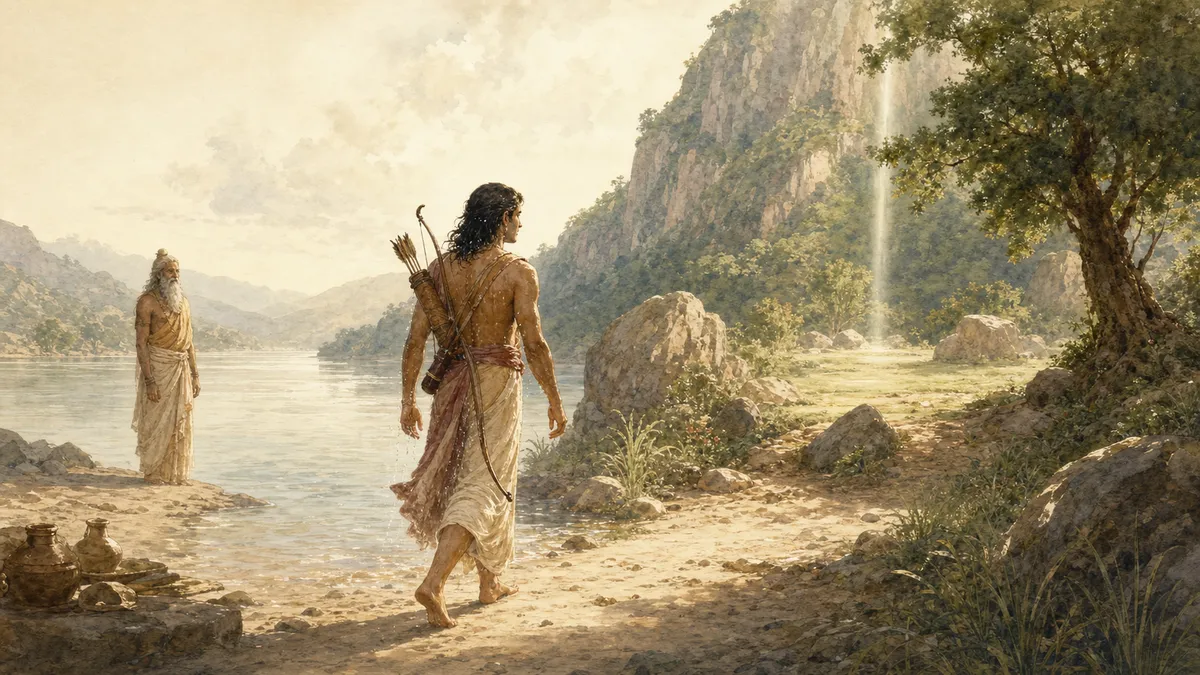
Meanwhile, Durvasa Rishi had already bathed and begun reciting the Gayatri mantras while performing sandhya-upasana. And Krishna said, “Go to the riverbank, invite Durvasa and all his disciples, and tell them that Draupadi has prepared a wonderful offering for them. We do not know how this will happen, but Krishna promised that we need not worry.” Then Bhima slung his mace over his shoulder—he was a kshatriya with such a mighty mace—and went to the riverbank to summon Durvasa Muni and his companions.
At that moment, the following occurred. All of them suddenly felt that their stomachs were completely full of food, that they were stuffed to the brim. They began to pray to Durvasa and came to tell him, “Gurudeva, our stomachs are full. It feels as though we went to Yudhishthira Maharaja's hut in a dream and ate our fill there.” And Durvasa felt it too: “I have the same feeling. My stomach is so full that air is coming out.” Then they also saw Bhima with his mace and thought that if they now refused the prasada, he would attack them with it. They had been invited, yet they would be refusing even though they had promised beforehand. They became frightened and fled. Durvasa himself used his siddhis to get away from that place as quickly as possible, without any explanation.
That is how Krishna's magic worked and the problem was resolved, while the intrigue failed to materialize. Durvasa did not curse them; Krishna saved them. Therefore, it is said: “Yasmin tushte jagat tushtam.” In other words, if the Lord is satisfied, then everyone will be satisfied. If the Divine beings within us are satisfied, then everyone else will also be satisfied.
Krishna's Instruction on the Worship of Shiva
“Then they asked Krishna, ‘O Lord, what will happen now? A very powerful enemy has appeared. What will be done at this moment?’ And Nandishvara said, ‘O sage! When the Pandavas asked Him about this, Krishna remembered the lotus feet of Shiva and spoke to them.’ Lord Krishna said, ‘O excellent Pandavas! Now listen to the details of my experience connected with serving Shiva. After hearing them, you should act accordingly. I went to Dvaraka to defeat my enemies. And, obeying the instructions of the noble Upamanyu, I propitiated Lord Shiva. I propitiated him for seven months on the excellent Mount Vatuka, and thus Shiva was pleased with me. Appearing there, he fulfilled all my desires, and through his power I attained supreme efficacy in everything. The Lord, who bestows worldly pleasures and liberation, is propitiated by me even now. You too should serve Shiva, who bestows happiness upon all.’”
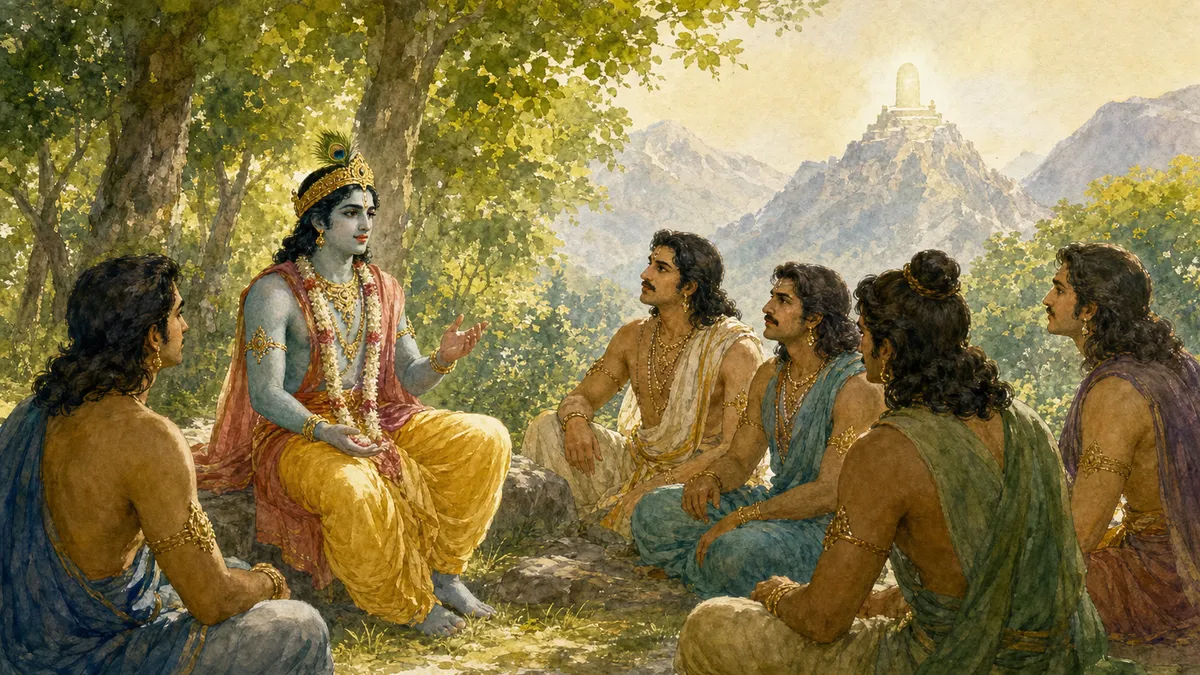
After this incident, the Pandavas approached Krishna and said, “Krishna, we are grateful to you for saving us from this difficult situation with Durvasa Muni during our exile, but the Kauravas will not relent. They will keep putting pressure on us, taking advantage of the fact that we have neither power nor an army. They will try to drive us out and wipe us, our entire lineage, and our entire clan off the face of the earth in order to retain power. What should we do?” And Krishna told them to worship Shiva. “I myself worshiped Him on Mount Vatuka and received all blessings and all power from Him. Therefore, the only way for you as well is to worship Shiva.”
Vatuka Bhairava—the Child Form of Kala Bhairava
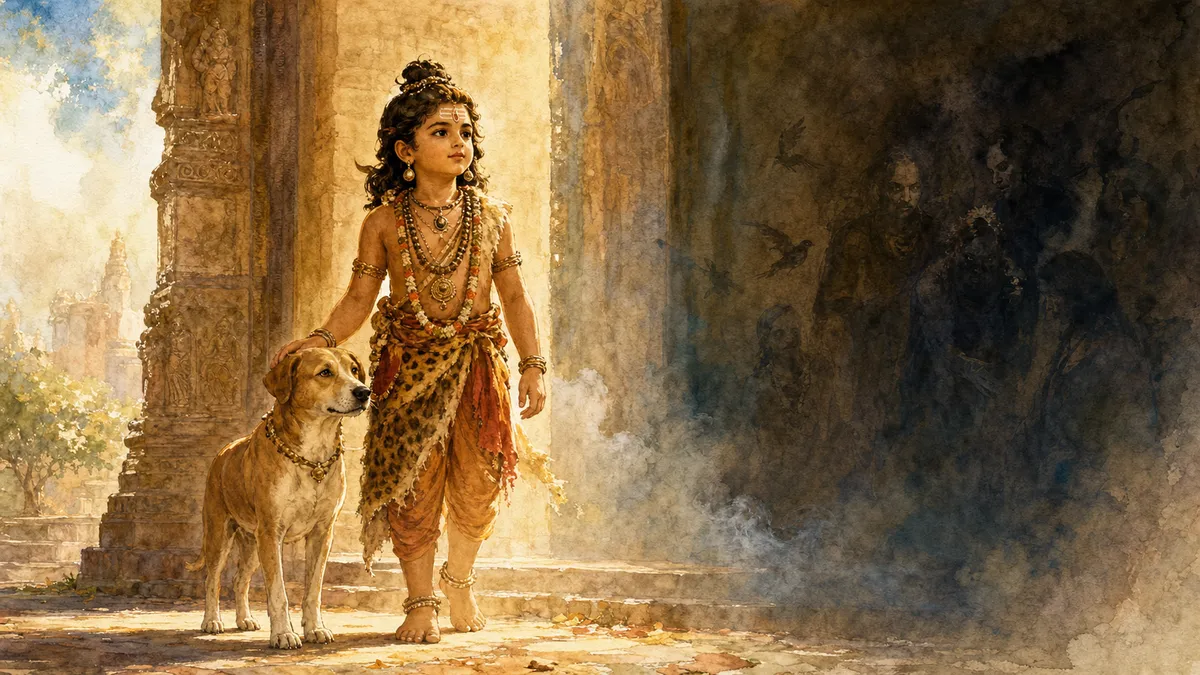
Krishna worshiped Shiva Bhairava in the form of Vatuka. Vatuka Bhairava is the child form of Kala Bhairava. He is the complete God, endowed with all divine powers, yet he possesses bhairava-tattva, meaning a wrathful nature. Kala Bhairava is associated with purely destructive energies, but Vatuka Bhairava is sattvic because he is an innocent child.
It is believed that if a person is struggling with spirit possession, addictions, fear of death, black magic, or severe emotional trauma, they should pray to Kala Bhairava and Vatuka, reciting the “Kala Bhairava Ashtakam” and the “Vatuka Bhairava Chalisa” daily and performing some simple form of worship with a mantra.
Vatuka Bhairava is a form of Bhairava known as Vatukeshvara, or Bhairava in the form of a boy or young man. He protects the jiva from falling into the realms of Patala, the lower worlds, and liberates it from the lower worlds. Like Durga or Hanuman, he removes the influence of all asuric forces: vetalas, rakshasas, and pishachas—that is, evil spirits, zombies, and ghouls of the astral world.
Descriptions of Vatuka Bhairava in Sacred Texts
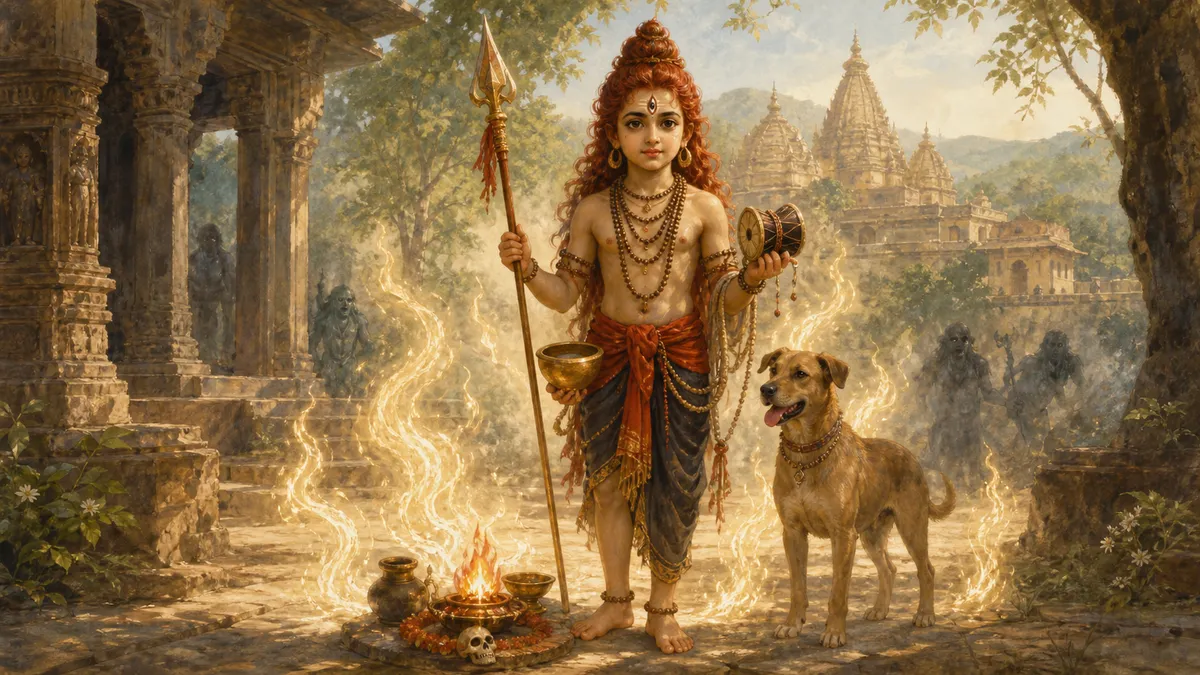
The “Rupa Mandana” gives the following description of Vatuka Bhairava. He has eight arms; in six of them he holds a staff topped with a skull—a khatvanga—a noose, a spear, a damaru, a skull begging bowl, and a snake. One of the remaining hands holds a piece of flesh, while the other is in abhaya mudra. Beside Vatuka, this Bhairava, is a dog of the same color as its master.
The “Vatuka Bhairava Kalpa” gives the following description of this aspect of Bhairava. He has three eyes, a red body, and twisted red hair—jatas. In his hands he holds a spear, a noose, a damaru, a skull, and a begging bowl. He rides a dog. Vatuka Bhairava is depicted completely naked and surrounded on all sides by a host of demons. Sometimes he is depicted surrounded by flames, with large fangs and round eyes, to emphasize the terrifying aspect of this deity. In other words, he brings under control all the negative energies of the lower dimensions, all the way down to Patala Loka, and frees one from the influence of these negative energies.
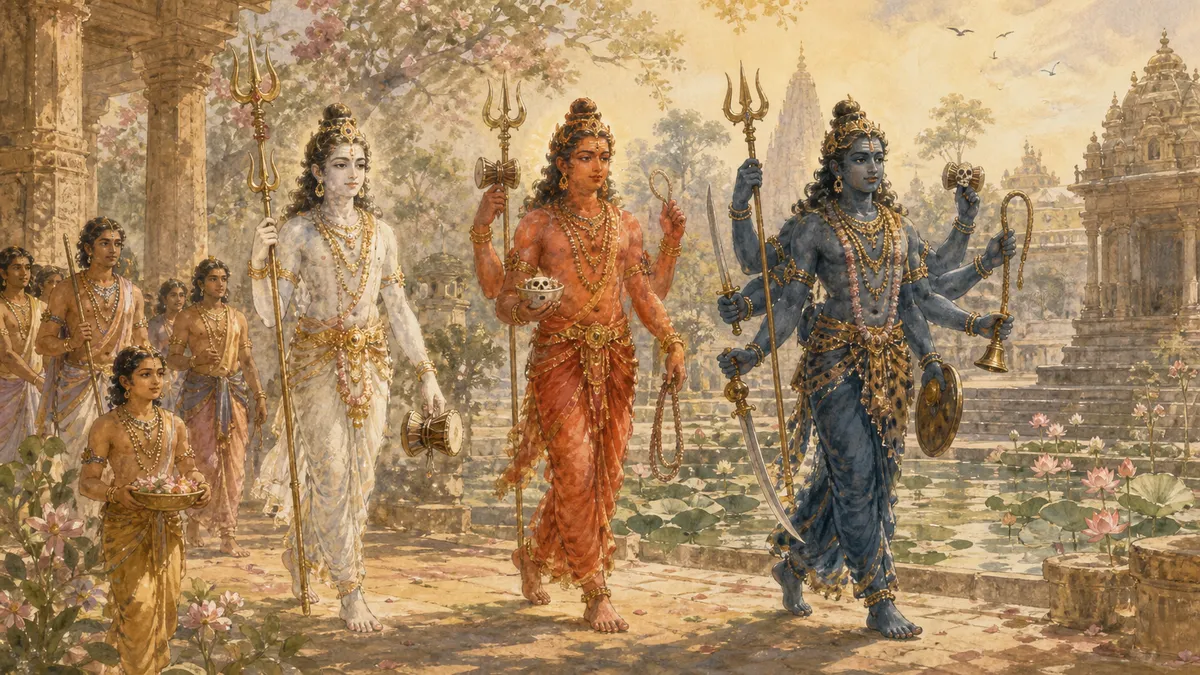
The “Rudra Yamala Tantra” describes the worship of Vatuka Bhairava as a small boy and provides dhyanas—dhyana shlokas—for each of the gunas, as well as a dhyana for all three gunas. There is a Vatuka Bhairava who transcends the three gunas, and he is described as pure crystal, shining like the rays of a thousand suns, the color of a sapphire storm cloud, and clothed in sapphire skin. He has three eyes and eight arms, and a terrifying, tooth-lined, gaping mouth, as well as a belt and bracelets made of living snakes. He is Digambara, clothed in space. He is the mighty lord of all beings. In his right hands he holds a staff topped with a skull—a khatvanga—a sword, a noose, and a trident. In his left hands are a damaru, a skull, and a snake. Another hand blesses devotees in varada mudra.
The sattvic dhyana shloka describes Vatuka Bhairava as resembling crystal, white as a kunda flower, dressed in celestial garments adorned with nine precious gems, blazing in appearance, ornamented with bracelets of bells, and possessing a radiant, beautiful face with three eyes. He has two arms, one of which holds a trident (shula).
There is also a rajasic form of meditation on Vatuka Bhairava. He resembles the red rising sun and has three eyes and four arms. In one right hand he holds a skull, while the other hand is in varada mudra, bestowing blessings. In one left hand he holds a trident, while the other displays abhaya mudra, dispelling fear. His blue throat is adorned with precious gems. A crescent moon shines in his diadem, his crown, and he wears garments as red as the banduka flower.
There is also the tamasic form of Vatuka, described by tamasic dhyana. In the tamasic form, he is meditated upon as a completely naked Digambara, blue in color, with reddened hair, terrifying fangs, three eyes, bracelets of jingling bells, and eight arms. Such are these three forms of Vatuka.
If you remember, there is an episode in the Bhagavad Gita where Arjuna asks Krishna for inspiration, and, in order to transform his mind, Krishna shows him the universal form of God, containing a multitude of figures holding various kinds of weapons, with various animal heads, and gods spewing flames. This form simply shocked and frightened even Arjuna, and he fell prostrate before it. And perhaps it was a form of Bhairava that was manifested.
Qualities and Functions of Bhairava
Bhairava is Bhutanatha, the lord of all living beings. Bhutatman—the soul of all forms of life. Bhutabhavana—the one who always cares for the welfare of living beings. He is the bestower of kshetra. Kshetra, that is, the field—the physical body and prakriti with its three gunas. And its guardian is Kshetrapala. The possessor of kshetra wisdom, yogic wisdom; a kshatriya, a warrior, Virat, all-pervading, all-encompassing.
There is the “Vatuka Bhairava Apaduddharana Stotra” for his worship, which consists of 108 names of Bhairava that bestow blessings and protection from danger. And Vatuka Bhairava manifests in eight forms, the Ashta Bhairavas, and guards all eight directions. It is believed that he sees all times—the past, present, and future—because he is beyond time.
Vatuka is called Prashanta, the one who has attained complete peace, and Digambara, clothed in space. That is, he is the all-pervading, infinite Shiva, and therefore the directions cannot envelop him like cloth. He is naked because he is infinite. Bhairava is terrifying in himself because he represents pure consciousness beyond all compromises, limitations, human patterns, and identifications. It is pure consciousness before which the kleshas and conditioning of an ignorant person collapse.
Krishna said that He worshiped Bhairava, and that through worshiping Bhairava on Mount Vatuka, he attained all power and all siddhis. In fact, of course, he was an Avatar and already possessed all powers. But to inspire the Pandavas, he told them this story.
Question: “Om, Guruji, what is the significance of his being a boy or a young man? What is the difference between worshiping a Deity and a youthful Deity?”
He is considered so innocent, pure, and sattvic, unlike ordinary Bhairava. That is, he is wrathful, but sattvic. This is a symbol, a symbol of nondual awareness that is pure and has not yet mingled with the material world at all. A symbol of total self-liberation, before which neither ghosts, nor spirits, nor hindrances, nor obstacles, nor karmas, nor attachments can stand. Moreover, this self-liberation possesses power; it is forceful.
Vyasa’s Instructions to the Pandavas
“Nandishvara said: ‘Having spoken these words and delighted the Pandavas, Krishna disappeared from there. Remembering Shiva’s lotus feet, he hastened to Dvaraka, while the Pandavas sent Bhima to assess Duryodhana’s virtue and strength. He learned of Duryodhana’s prosperity and virtue and returned to the Pandavas. And upon hearing what he told them, O great sage, the Pandavas became deeply distressed and, in their grief, said to one another: “What shall we do now? Where shall we go? Although we can fight now, we are restrained by the bonds of truth.” And Nandishvara said: “Meanwhile, Vyasa arrived there, his forehead adorned with ash, wearing rudraksha beads as ornaments, and with his matted hair neatly arranged. He was reciting the five-syllabled mantra. He was wholly absorbed in love for Shiva. He was a mass of radiant splendor, an embodiment of Virtue itself. Upon seeing him, the Pandavas were overjoyed and hastened to meet him. They offered him a seat made of deerskin covered with kusha grass. They stood before him. When he had been properly seated, they honored him with great delight and, extolling him in various ways, said: ‘Ah, we are blessed! O Holy Lord! Having seen you, we are all content! We have attained the fruits of our austerities and our various charitable gifts. And upon seeing you, all our sufferings have vanished—sufferings inflicted upon us by the ruthless deeds of wicked men. Misfortune disappears at your mere glance. Has there ever been a time when it did not disappear? We know this to be true. And when a person reaches the abode of a sage capable of all deeds, if misfortune does not dissipate, fate alone is the cause. Poverty, the cause of misery, will undoubtedly be removed. Such is the nature of great men. In fulfilling desires, they are likened to the kalpa tree, which grants every wish. Thus, the qualities of the great should serve as an example. A person becomes renowned simply by seeking refuge in them. In considering the difference between the lowly and the great, it should be understood that such is the nature of the great: they will always protect those who suffer. The distinctive traits of the unfortunate and sorrowful contribute to their glory, for they are thereby given an opportunity for strenuous effort and service to good people. After that, it will be your own fate, and no one is to blame for it. Therefore, O Lord, as soon as you are seen, every auspicious thing immediately comes to pass.’”’
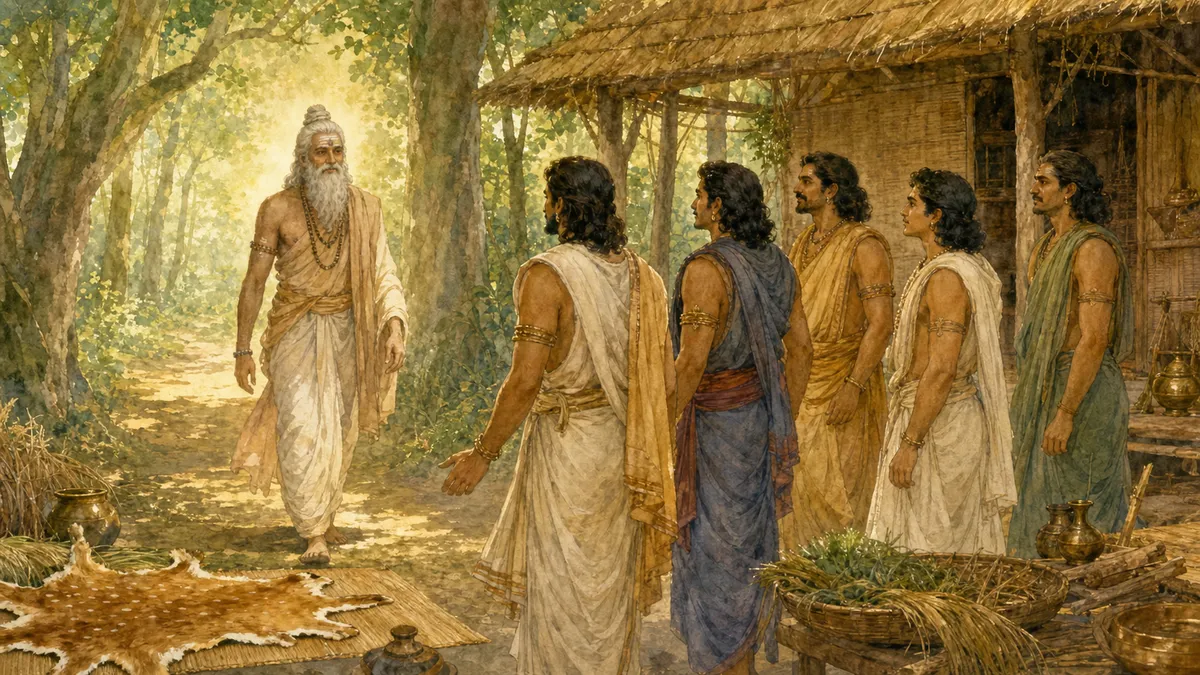
The time of their exile was drawing to a close, and the time to return was approaching, but they understood that they were not ready to fight, not ready to return, while Duryodhana’s clan would not simply hand their power and possessions back to them. And they were greatly perplexed. They thought and worried, absorbed in concern over how their royal clan and royal lineage would survive and how it would all unfold. And they sent a messenger, a scout and spy, to Duryodhana’s kingdom; he went there, observed everything, returned, and reported that Duryodhana was prospering and that all was well with him. This distressed them even more because they understood that either their own clan and lineage would live or Duryodhana’s would, and that they would not be able to live in peace. At that time Vyasa arrived, and they were very glad, hoping that Vyasa could give them some advice on how to proceed.
“By your mere appearance, our minds have been satisfied. Give us instruction by which our sufferings may be dispelled.” Nandishvara said: “Upon hearing these words of the Pandavas, the great sage Vyasa was delighted and said: ‘O Pandavas! You need not worry so much. You are all blessed. You do not allow truth to elude you. The noble nature of good people remains unchanged even after death. They do not abandon virtue; they always take refuge in truth. In our view, you and the Kauravas should be equal. And yet our preference is given to virtue. This preference is approved by the learned. Virtue was abandoned from the outset by the wicked and blind Dhritarashtra because of his greed. Your kingdom was seized. Undoubtedly, both you and they are his sons. Although your true father is dead, you are noble souls and therefore deserve compassionate treatment.’”
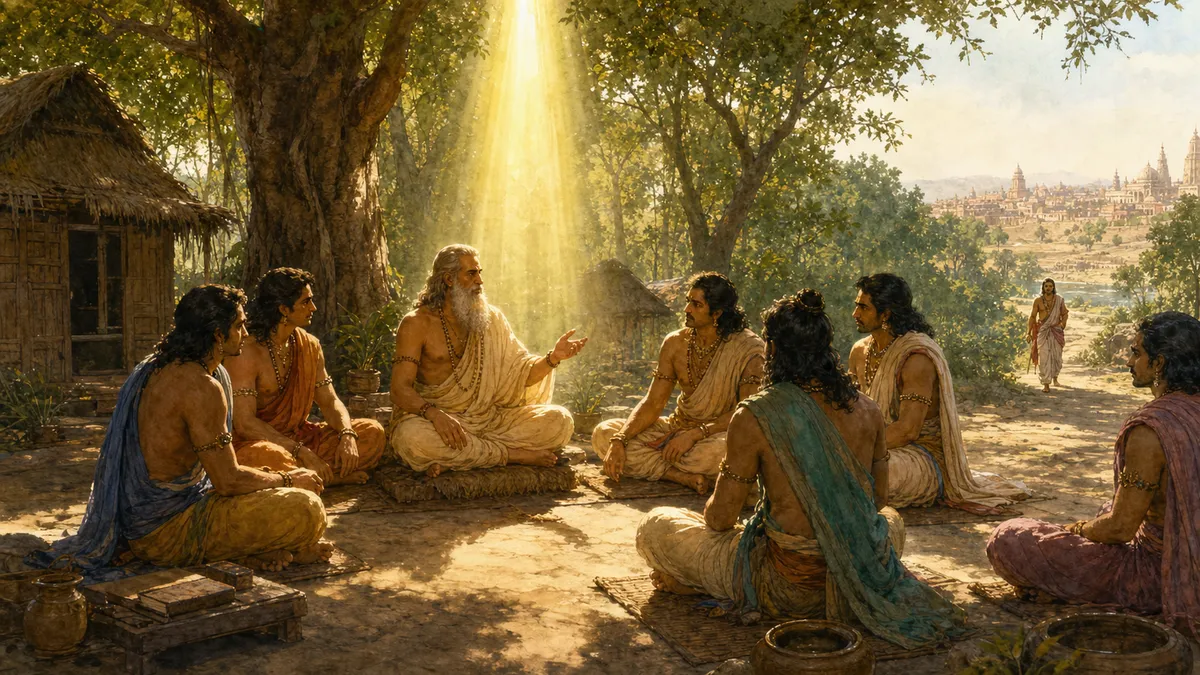
Vyasa said, “From the standpoint of the single taste, you are equal to us.” In the same way, to a sadhu, from the standpoint of the single taste, the devas and asuras are equal. Sattvic energy and rajasic energy are equal. He said, “Yet on the relative level, we support you because you adhere more closely to the law of justice, while Duryodhana’s clan is mired in injustice.” Likewise, in the relative sense, a sadhu supports the path of the gods because the gods are closer to divine wisdom and divine grace than the asuras. On the one hand, the gods and asuras must be equal in the vision of a jnani sage who sees everything as Brahman. On the other hand, he supports the side of the gods because the gods possess more sattva, wisdom, and understanding; they understand dharma better and fulfill it better.
In the relative sense, every sadhu regards the various energies within himself equally because all energies arise from nondual awareness. And he does not allow nondual awareness to be colored by sattvic, rajasic, or tamasic energies, subjecting them to the process of self-liberation. On the other hand, just as Vyasa supports the Pandava clan, he nevertheless supports more sattvic energy within himself. He encourages divine sattvic energies within himself because sattvic energies help him draw closer to divine shaktipat and give rise to clarity.
The Symbolism of the Blind King and the Ego
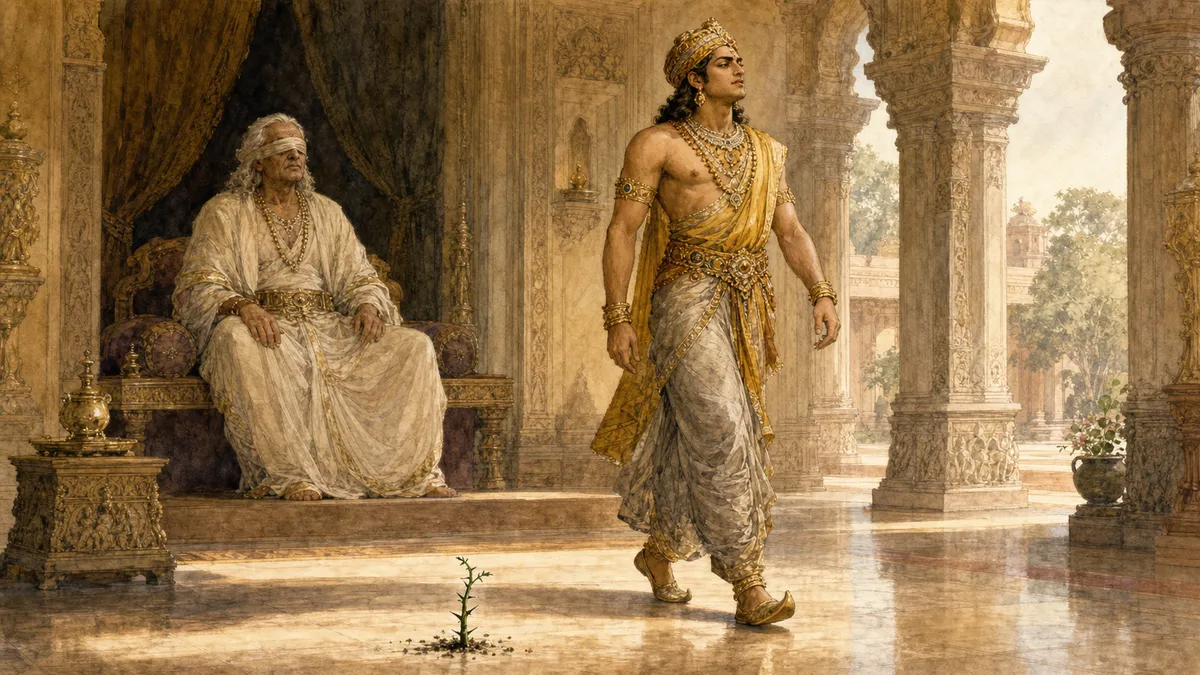
“Dhritarashtra never tried to dissuade his son. If only he had done so, this misfortune would not have occurred. Whatever has happened could not have been otherwise. He is wicked, while all of you are virtuous and truthful. Therefore, in the end, only evil will befall him, and the seed that was sown will sprout.”
Here, the blind king Dhritarashtra symbolizes the buddhi—the buddhi that is unenlightened and unclear. His son Duryodhana symbolizes the ego. And they say that the problem is that this blind king Dhritarashtra never dissuaded his son Duryodhana from evil deeds, oppression, and unjust decisions. When our buddhi is asleep, it is like the blind Dhritarashtra, while our ego, like Duryodhana, acts by committing various wrong deeds of body, speech, and mind and making unjust decisions. It unleashes selfish wars. And because of this, major karmic problems then arise.
Instruction on the Worship of Shiva
“You need not be distressed at all. Prosperity will come to you. You need not harbor any doubts.” Nandishvara said, “Thus the Pandavas were consoled and encouraged by Vyasa. Then Yudhishthira and the others spoke these words.” The Pandavas said, “O Lord! We shall tell you the whole truth. Even in the forest, the wicked and malicious Kauravas cause us suffering again and again. O Holy Lord! Please dispel our suffering. May something auspicious be granted to us. Krishna taught us that Shiva must always be propitiated. And we made a mistake by not following his advice. May divine guidance be given to us again now.” Nandishvara said that, upon hearing these words, the delighted Vyasa remembered the lotus-like feet of Shiva and gladly addressed the Pandavas. Vyasa said, “O Pandavas, listen to my words with virtuous minds. What Krishna said was true, and I too have served Shiva. May you also serve him with joy. Incomparable happiness will always follow. Suffering arises only from not serving Shiva.”
The Pandavas listened to Vyasa’s blessing and his assurance: “Do not fear or worry; everything will be all right.” But they asked, “How are we to protect ourselves? What should we do about the attacks of the Kauravas? Krishna told us before that we should worship Shiva, but because of our royal affairs and duties, we somehow let it all go in one ear and out the other. Is that right?” And Vyasa was very pleased. He said, “Yes, because I too worship Shiva. You must worship Shiva.”
And in this sense, worshipping Shiva means, first and foremost, realizing the nondual nature. For in Shaivism, Shiva who has a form and a name, who is the lord of the goddess Uma—the Puranic Shiva who lives on Mount Kailash, Uma-Patinatha—is one of the emanations of the universal cosmic Shiva, who is infinite divine consciousness. And worshipping Shiva primarily means abiding in the nature of mind, realizing the nondual Brahman, realizing sahaja, natural awareness. It means worshipping Brahman both in the aspect of the unmanifest Brahman and as Ishvara: Brahman who creates, sustains, destroys, and conceals divinity, possessing will and the power of emanating creation, and possessing chit-shakti, ananda-shakti, iccha-shakti, jnana-shakti, and the fivefold kriya-shakti.
Vyasa rejoiced and said, “Yes, I myself always worship this Shiva, because all sadhus always worship this Shiva, this form of Shiva—Paramashiva, who contains within himself all 36 tattvas and all other forms of Shiva as emanations.” These include the 11 Rudras, the Lord who shakes the universe and creates the universe, the various Bhairavas, Lord Uma-Patinatha who lives on Kailash, and many other forms of expansions, emanations, and illusory bodies of Shiva existing throughout all dimensions.
“The sage Vyasa declared Arjuna the most worthy of the five brothers to worship Shiva. Then, reflecting on vengeance and on worthy penance, the excellent sage once again addressed the Pandavas, who were firmly established in virtuous rites.”
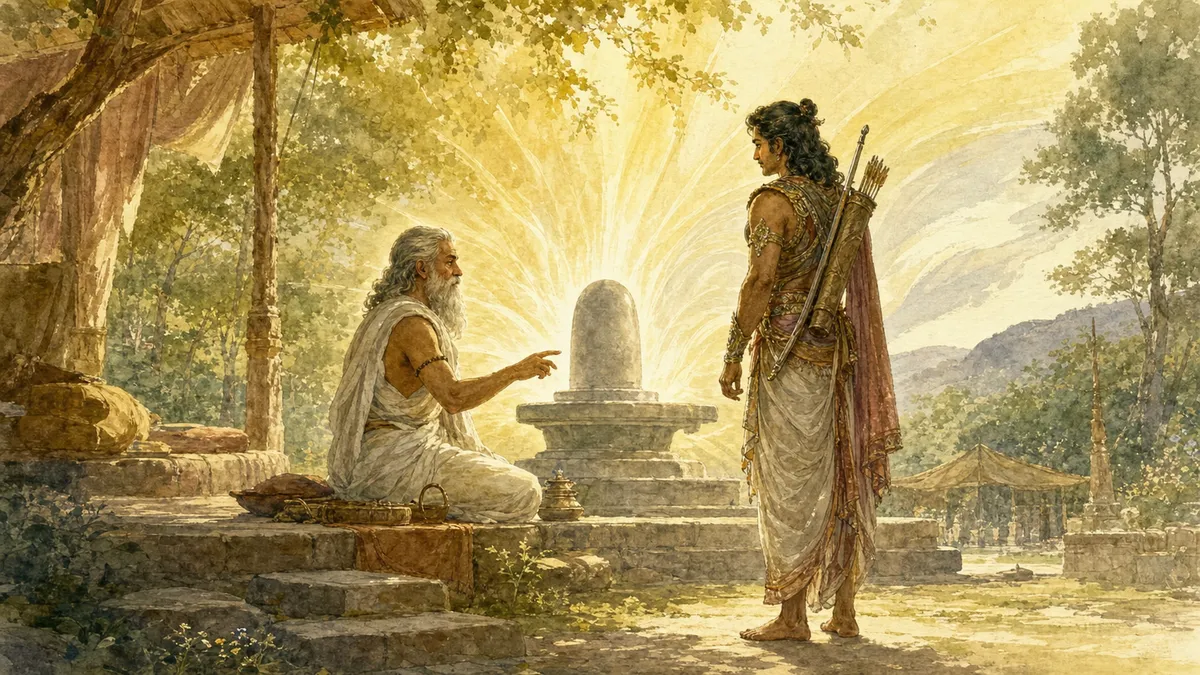
The Pandavas said, “Yes, we are ready to follow the path of tapas, but we cannot all do it at once; we will not survive if we all begin to perform tapas at the same time.” They gathered and decided to choose one of them to perform tapasya on behalf of all of them, on behalf of the entire lineage. And they chose Arjuna. Arjuna resolved to perform tapasya. Then, following Vyasa’s instructions, they decided to choose a place—a mountain—and a type of practice. Vyasa also gave this instruction: “First, you must receive Indra’s blessing. For some time, you must invoke Indra. Only after that—that is, after strengthening your mind and your capacity for clarity—will you receive Shiva’s blessing.”
Shiva as the Great Brahman
“Vyasa said, ‘O Pandavas! Listen, and I shall tell you what is always good and beneficial. Shiva should be regarded as the great Brahman and the goal of goodness. From Brahma the Creator to infinity, everything we see in the universe is a form of Shiva. You must worship him and meditate upon him.’”
Shiva should be regarded as the Great Brahman. And all the forms in the world should be regarded as manifestations of Shiva.
“Shiva, the deliverer from all suffering, should be served by everyone. And through devotion, Shiva becomes pleased in a very short time. There is no doubt that a delighted Shiva bestows everything upon his devotees. He grants worldly pleasures here and salvation hereafter. Therefore, Shiva will always be served by those who wish to obtain the fruits of worldly pleasures here and salvation hereafter.”
Shiva is considered easy to please because he showers grace without making strong distinctions. This is non-discriminating consciousness. For example, if someone wishes to receive a blessing from Vishnu, they must perform tapasya and lead a sattvic life, and Vishnu instructs them: “First purify yourself and draw closer to sattvic qualities. As long as you possess tamasic and rajasic traits, you will not be able to receive my blessing.” Therefore, Vishnu always teaches such strict sattvic sadhana on the path of devotion, the path of self-surrender, which has no alternative. And this is a lengthy path, because the nature of the jiva cannot be changed in a short period of time. Even in 25 years, you cannot change your nature, for example, from tamasic-rajasic to sattvic. You may rearrange it somewhat and outwardly construct a kind of façade, but inwardly this nature will remain tamasic-rajasic for a long time.
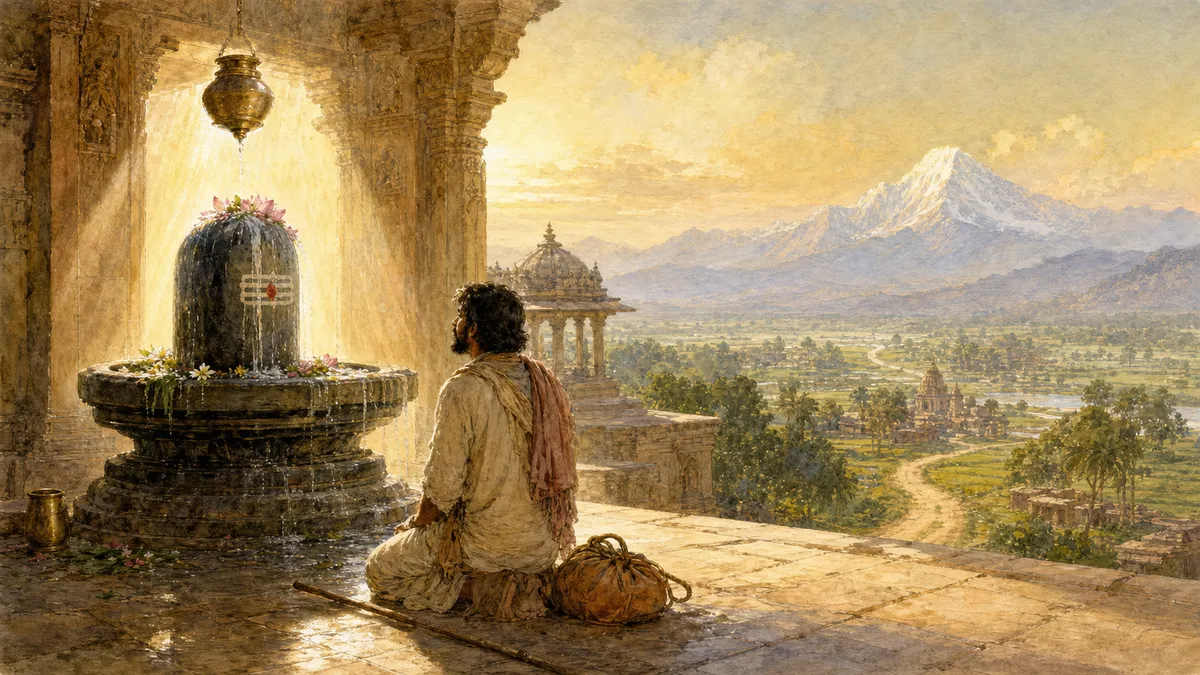
But Shiva is considered much easier to please. Why? Because, being the essence of all living beings and being nondual awareness, he begins not by transforming the external, but by transforming the internal. He reveals himself within the jiva as the pure space of nondual luminous awareness, even within a rajasic one, even within a tamasic one. And he sets no conditions. He says, “I will reveal myself within you in my true nature, and within you as you are, without waiting for you to become perfect.” That is, Vishnu waits for us to become perfect. And he can wait a long time. Most importantly, Vishnu lives for billions of years, so he is in no hurry. He says, “Practice, purify yourself, serve; I will wait—I know how to wait. Perhaps we will meet in a million years. The main thing is not to abandon service and devotion, and we will certainly continue meeting. I will wait until you are completely purified and become perfect.” Shiva sets no such conditions. He says, “If you have devotion and self-surrender, if you practice with self-surrender, serve, and invoke me, I will manifest within you as infinite consciousness, as infinite light, and as divya-bhava, just as you are. I will bless you exactly as you are; that is how I will bless you.”
And herein lies Shiva’s great compassion, which is bestowed unconditionally. It is said that Shiva is so compassionate and impartial in this regard, because he is the bearer of the single taste, that problems even arise from time to time when he grants a blessing to some asura. And this asura asks for some foolish blessing, such as the ability to knock off everyone’s head, a mystical power, or the ability to destroy everyone with his mace. Shiva grants him this power, and the asura immediately tries to demonstrate it on Shiva himself. Nevertheless, this is Shiva’s vow, his oath, his promise, his principle—to manifest in any living being without limitation, without waiting for that being to become perfect.
In the inner sense, this offers great hope to the practitioner. When we follow the path of Anuttara Tantra, without waiting until we have completely purified ourselves and become perfect, we can immediately enter natural awareness, sahaja, the state of the nature of mind, which is like the sky. Because ordinary traditions say, “What sahaja? What are you even talking about? What nonduality? Just practice little by little, study, serve, purify the kleshas, recite the mantra, perform upasana, purify yourself—this is too early for you. That will come sometime later.” Anuttara Tantra, like Shiva, says... Of course, it does not reject the path of purification; all this must be done, but it says, “All this must be done, but try to do it immediately from the state of Shiva, to do it immediately from nonduality.” Therefore, on the one hand, we purify ourselves and cultivate qualities—all this is absolutely necessary; we do not follow the path of the asuras, who have no intention of changing at all, whose credo in life is: “I am an asura, and that is what I will remain. I will receive a blessing for my asuric goals, and I do not care.” We understand that, as sadhus, we must always work on ourselves, cultivate our qualities, and develop sattvic qualities. But Shiva does not set the condition: “Become perfect, and only then will I bless you; only then will I allow you to meditate on me and enter nondual awareness.” We say, “Try right now to sense, attune yourself to, and enter the nature of mind. And do everything you do, but do it from this state of the nature of mind.” This is Shiva’s blessing.
Arjuna’s Path of Tapas
“Shiva is Himself the Divine Purusha, the slayer of the wicked and the goal of the virtuous. But from the very beginning, we shall repeat Indra’s teaching with a steadfast mind. For a Kshatriya possessed of great radiance, this alone promotes well-being. Therefore, let Arjuna first repeat Indra’s teaching, but gradually. First, the Lord will test him and will wish to be satisfied by this trial. If He is pleased, He will remove all obstacles. This teaching will bestow Shiva’s auspicious gifts.” Nandishvara said: “Having said this, he summoned Arjuna, instructed him in Indra’s teaching, and Arjuna performed his ceremonial ablution and, facing east, endowed with mighty intellect, received this teaching. The great sage gave him the rules and rituals of worship prescribed for a king. Thus spoke the generous-minded Vyasa to Arjuna.” Vyasa said: “Arjuna, set out from here and follow this path to the beautiful Mount Indrakila. There, standing on the bank of the Ganges, perform severe penance. Secret knowledge will be revealed to you.” And thus he gave him his blessing. Then the sage addressed them all: “May all the excellent kings remain steadfast in virtue. The result will be excellent in every respect. There is no doubt about this.” Nandishvara said: “Having thus blessed the Pandavas and remembered Shiva’s lotus-like feet, the great sage Vyasa instantly disappeared.” Thus ends the thirty-seventh chapter of the sacred Shiva Mahapurana’s third Shatarudra Samhita, entitled “Vyasa’s Instructions” in the story of Shiva’s incarnation in the form of Kirata.