

Commentary on the text “Ishvara Gita. Chapter 8”
When we show respect for something or make an offering, that energy is strengthened in our life. Upasana and the principle of worship are built on this. Respect something, and it will fill your life. Our consciousness illuminates from the space of probabilities of the Universe that which we respect, while that which we do not respect, that which we ignore, disappears from our life. And if we also accompany this with offerings, then it manifests even more strongly, because an offering is energy, the principle of Shakti.
Liberation is when we begin to show respect for those objects that personify our higher “Self” and ignore certain samsaric objects, for example, the kleshas, so that they calm down, fade away, and dissolve. We make offerings to the saints, to Dattatreya, to Ishvara, so that they may come into our life, increase in our life, fill it, because it is very important to fill one’s life with the blessings of sacred objects.
The Law of Filling the Mind
The mind cannot bear to be unfilled; it always wants to be filled with something. If we do not fill it with something holy, something blessed, it will try to fill itself with maya (illusion, samsara). This is a law. Even scientists have such an expression: “Nature abhors a vacuum.” What is meant is material nature (prakriti). Emptiness is non-duality, it is Brahman, the higher tattvas, that which is beyond the categories of prakriti (the material world). But the material world (prakriti) does not tolerate emptiness. The mind also belongs to prakriti, and it does not tolerate emptiness; it wants to be filled with something if it is not in samadhi. Therefore, a sadhu consciously fills his mind with the right things, the right objects, knowing that such filling creates causes for favorable (enlightened) future births or causes for Liberation. We remove some causes and create others. This is the art of spiritual life.
For example, earlier we created many different karmic causes, and right now we are at the point of these causes. These causes are mixed, both spiritual and worldly. Spiritual, because you are sitting before the Guru, before the deities in the ashram. This is an obvious sign of spiritual causes: you dreamed of this, you thought about this, perhaps you invoked, prayed, made offerings to the saints in past lives. But material causes are also present; for example, the material body is a sign of material causes. You do not abide in a rainbow body, you do not sit upon a lotus like the deities, and you do not spread throughout the Universe as consciousness like the deities of the higher tattvas. This means that enough material causes were also created. All of this together produced a mixed result. A mixed result means the presence of both spiritual and material causes together.
Spiritual life is the correction of the past, when we increase spiritual causes and illuminate and ennoble material causes. At the same time, we do not reject prakriti (matter) itself, but we illuminate it, transform it. For example, the energy of the kleshas can be transformed into the energy of wisdom; material energy (material things) can be transformed by engaging it in service, and so on.
“Ishvara said:
– I shall impart another, most secret knowledge, O best of the brahmanas, by which a person crosses the terrible ocean of samsara. I am Brahman, the Peaceful, the Imperishable, the Pure, the Eternal, the One Bhagavan, the separate Supreme Lord. My womb is the great Brahman; into it I place the seed. That (womb) is called root maya; from it this Universe is born. First was Purusha, the Atman. From Him arose Mahat, the elements, the tanmatras, the senses, and the great elements.”
Types of Vichara and the Path to Liberation
Our destiny as sadhus is to carry out vichara (inquiry). Vichara leads to viveka (discriminating wisdom). Viveka leads to vairagya (detachment from illusions). Vairagya leads to moksha (liberation). Such is the formula.
There are several types of vichara:
- Atma-vichara is connected with the inquiry into one’s Atman, one’s nature, one’s essence, one’s selfhood
- Bahir-vichara is connected with the inquiry into the Universe, the tattvas, the five elements, the Gods, the laws of the Universe, nature (prakriti), the law of karma (cause-and-effect relationships and the interconnection between them)
- Brahma-vichara – the most important – is the inquiry into God, the inquiry into the Absolute
And we, like scientists, must become professionals in this inquiry.
Comparison with Material Science
Scientists conduct research, for example, in the fields of genetics, neurobiology, and cognitive sciences. Each advances in their own tunnel of reality, and every day obtains some discoveries, achievements, knowledge. Then there is the applied part of science, when knowledge is used, grows into technologies, and in this way changes the world. Over the past hundred years, they say, as much has been discovered as had not been discovered in the entire existence of humanity. This is, of course, if one adheres to Darwin’s theory of evolution: that there were dinosaurs, then Homo habilis (skillful man), then Homo sapiens, then upright-walking man, and so on up to the present time; that is, if one assumes that there supposedly were no ancient civilizations. Although reality says the opposite—Ancient Civilizations did exist, and they were far wiser than the modern one. Nevertheless, over the past hundred years as many discoveries have been made as had not been made over the last two thousand years since the Nativity of Christ. Society has changed greatly in terms of science, and this is the result of vichara. Scientists explore the material world and its laws; they move society toward progress. Most people are not scientists; most people think about cars, country houses, yachts, vacations in Turkey, the Dominican Republic, Bali, Goa, about money, power, who is having a relationship with whom, who married whom. Most people are not interested in science; they lack reason, because the world is ninety-five percent primitive. There are very few scientists, and intelligent and brilliant ones who do breakthrough things are only a handful, but it is precisely thanks to them that humanity grows. This is Bahir-vichara.
But we are engaged in another vichara, and this vichara does not provide such great benefits in material terms. For example, you may practice Atma-vichara and Brahma-vichara your whole life, but this will not create for you some new iPhone based on Atma-vichara; it will not grow into nanotechnology. This is an inner technology, this is only your achievement; you can only tell others about it, but it is difficult to embody it directly in some material things. It can be embodied indirectly, thanks to the clarity that has opened up. Inner technologies provide personal God-realization and change karmic vision, but they do not provide achievements in material terms. However, these inner technologies are far more important.
The Path to “Aham Brahmasmi”
We are gradually moving along the path of establishing a connection with the Absolute and identifying ourselves as Brahman, toward the formula described in the Upanishads: “Aham Brahmasmi.” This is called self-recognition. And many who study Advaita, especially without a Guru, quickly reading the texts of Advaita Vedanta, immediately try to “take the bull by the horns,” that is, to take up the formula “Aham Brahmasmi” right away. However, you will not simply approach the formula “Aham Brahmasmi”; it is like trying to climb a hundred-thousand-meter peak without having conquered a five-thousand-meter one. There are simple mountains, for example the Caucasus Mountains, and there is Everest. You will not be able to climb Everest if you have never climbed simple mountains, because Everest is very difficult even for experienced people.
It is the same with the formula “Aham Brahmasmi”—with the ultimate truth of Advaita Vedanta. As a view, we gradually study and apply it, but in the relative dimension we move along a certain path. And what is this path?
- Developing faith in the Refuge, developing the abilities of concentration, meditation, and fullness of attention, basic practices
- After all of these have developed—the development of the abilities for contemplative presence and self-liberation
- When we have succeeded in self-liberation—the development of the ability for self-surrender (prapatti yoga)
- And only then—the development of the abilities for self-recognition, and here the meditation “Aham Brahmasmi” comes to the forefront
But it cannot come to the forefront before we have developed all these qualities and abilities within ourselves.
Moreover, before the meditation “Aham Brahmasmi,” some time must be devoted to the investigation of the mahavakya “Tat tvam asi.” That is, it is considered that one must first understand “Tat tvam asi,” and then move on to “Aham Brahmasmi.” “Tat tvam asi” is the pass to “Aham Brahmasmi.”
Developing Devotion and Self-Surrender
The development of faith, devotion, and the investigation of Ishvara (Brahma-vichara) at the stage of kriya-pada are very important. Put simply, we must always think of God; we must stop fixating on our little “I,” even on that “I” which desires Liberation. To act in the spirit of self-surrender and devotion means gradually becoming accustomed to the fact that your life is inseparably connected with God, it is inseparably connected with Ishvara. And these are not merely abstract things; they are concrete, they must enter into everyday life, into goal-setting, into meanings and values. One must develop the habit of thinking: “My life belongs to God. I serve for God. I work for God. I eat for God. I perform pujas for God. I even do sadhana not for myself, but for God. These are my flowers of offering to Him. I establish a connection with God not only out of personal mercenary aims, for example, to attain Liberation, to develop wisdom, and to cease suffering (this factor, of course, must also be taken into account, but it should not dominate). I establish a connection with God for the sake of God Himself.”
This is devotion. We do everything for the sake of love for God, for the sake of love itself. Love for the sake of love is the purest love. It happens that a woman loves a man who gives her expensive gifts. That is why she loves him. This is not a very pure motivation, because if there are no gifts, then the love will end as well. But if she loves him without gifts, without any motivation, only for the sake of love itself, that is true love. In the same way, we establish a connection with God for the sake of love for God itself, for the sake of God Himself. This is prapatti-yoga.
Comprehending God Through Different Tattvas
To become accustomed to establishing a connection with God and to thinking: “My life belongs to God, I myself belong to God, all my actions are dedicated to God, I strive to be a conduit of the divine will, this is my mission and the meaning of my actions, I strive to comprehend God in order, in the end, to merge with Him and become one with Him,” this is Brahma-vichara. “I strive to comprehend the aspects of the divine (its various tattvas).”
Many say: “God,” but God has many different planes, different tattvas. For example, the first tattva differs from the sixth, and the sixth differs from the fourteenth. All of this is God, but on each tattva God is comprehended differently. There is God comprehended through the mind, there is God comprehended through the ego (the sixteenth tattva), and there is God comprehended through buddhi (the fourteenth tattva), there is God comprehended through prakriti-tattva, there is God comprehended through purusha-tattva (i.e., through the astral body), there is God comprehended through the kanchukas (i.e., through the mental body — vijnanamaya-kosha), and there is God comprehended through the fifth, fourth, and third tattvas (the causal body, karana-sharira — anandamaya-kosha). That is, God changes depending on through which tattva we comprehend Him, through which body we comprehend Him. Therefore, for every living being God abides in the form in which He is comprehended, through the instruments by which He is comprehended.
The Golden Egg and Creation
“Then there arose a golden egg, shining like ten million suns. In it was born the great Brahma, endowed with my power. Many other living beings are identical to Me, but they do not see Me (the Father), deluded by my maya.”
God the Father — God who assumes personality (personification) — begins with the second tattva. Strictly speaking, Ishvara in all His fullness is already the fourth tattva, but the personal perception of God begins already with the second tattva, that is, God of whom it can be said that He expresses will, acts, and creates the design of this Universe. In other words, the Universe did not arise by itself as a result of the Big Bang. The Big Bang was preceded by the design of the Universe, and the design of the Universe was preceded by the appearance of the Creator’s sankalpa, and the Creator’s sankalpa was preceded by the appearance of the Creator Himself, and the appearance of the Creator Himself was preceded by Ishvara’s sankalpa to create this Creator, and Ishvara’s sankalpa was preceded by vibration — the arising of Shakti in the Absolute. That is, very many chains, very many steps arose.
The Great Womb of Maya
“The forms that are born in all wombs — for them maya is the great womb, while I am known as the Father. He who knows Me as the Seed, the Father, the Lord, is steadfast in all worlds; he will not fall into obscuration.”
The Great Womb (maha-yoni) is maya, the universal material energy. Beginning with the sixth tattva, this is material energy that has been fertilized by the principle of the Father, the principle of the seed (Shiva). And the principle of Shiva is Emptiness, the great shunya, the first and second tattvas, that is, the purest non-dual Consciousness. And when the purest non-dual Consciousness is reflected in the principle of maya, various forces, kanchukas, are created; when it is reflected in the principle of prakriti, the embryos of the five elements, ahamkara, manas, and buddhi are born. From all these mixed tattvas, gods, angels, siddhas, and a multitude of beings are created. From the gross elements, the external Universe is created, and external creation begins.
The Qualities of Ishvara
But we are not interested in maya itself. We are interested in the Source of all this—Ishvara, the ultimate Source on whom we meditate—Bhagavan Dattatreya, Shiva in his primordial purity. And what do the Scriptures say; what is this Source like? He possesses svatantrya (primordial freedom); he is the Source of all freedom. That feeling of freedom that sometimes arises in us is His power, His svatantrya-shakti, which we experience for a time.
He possesses eternity, that is, he is free from the influence of kala (time). Kala-kanchuka is nothing other than the reflection of ananda-shakti in maya. When the original second tattva is reflected in maya, mingles with it, kala-kanchuka (the flow of time) appears, when we feel: “I am not eternal. I want to live forever, but I am not eternal, because I am identified with the body.” This is the reflection of the second tattva (ananda-shakti) in maya. But Shiva as Ishvara is free from the kanchukas, therefore he possesses eternity, and this quality of eternity is called nityatva. Khanda-kala (divisible time) does not exist for Him. For Him there is no division into hours, minutes, years, seasons, seconds, cycles, rhythms, or even kalpas. Just imagine feeling such a bhava of eternity! And this is your nature.
All people want to live forever. Why? Because they feel this nature, but at the same time they are bound to prakriti (the material body), and therefore there is bewilderment: “It seems that I feel eternity, yet the body is aging.” This happens because the eternal bhava manifests in a non-eternal body. Therefore all living beings feel injustice; they feel that they are eternal beings, while everything in the world is impermanent, and the body is not eternal. That is why this confusion is present. Many strive to preserve the physical body for as long as possible, undergo various plastic surgeries and rejuvenating injections. There is nothing they will not do to bring a little nityatva into the body. In all times, court alchemists and magicians sought the recipe for immortality for various emperors (Paracelsus, Count Cagliostro, Joseph Balsamo, and others). Under Emperor Huangdi there was a whole cohort of Taoist alchemists who supposedly created an elixir, but the emperor took it and left the body; it did not work. There was Professor Bogomolov in the Soviet Union, who also, under Stalin’s direction and under the aegis of the communists, sought a means of immortality. His work was personally supervised by Stalin and Beria. The communists, the party elite, also wanted to possess eternity. And then this professor himself, who headed an entire institute, unexpectedly left the body, and Stalin wrote: “The scoundrel deceived me!”
Humanity is always searching for nityatva (eternal life), and this is a quality of God; it is not a quality of prakriti (material energy). But by practicing certain sadhanas, for example, sadhanas for long life, expressing a sankalpa for the siddhis of health and longevity, one can prolong one’s life.
There are various stories about how some sadhu prays, recites mantras, and Brahma appears to him, whom he asks: “Make me eternal.” Brahma says: “That is impossible; such is the order of things! But prolonging life for a long time is possible.” Why is it impossible to make a living being eternal? Not because Brahma cannot give a blessing, but because the quality of eternity does not belong to prakriti (material energy); it is changeable. This quality belongs only to pure Shiva, to what in Taoism is called pure Yang, and in the Vedanta tradition is called Shiva-tattva, Shakti-tattva, Brahman, the Absolute. But when we are identified with material energy, we want to project this quality of eternity onto material nature.
The next quality is purnatva. Purnatva means wholeness, self-sufficiency, the absence of desires. This is a quality of God, a quality of Ishvara.
The Equal Presence of Ishvara
“The Lord of all vidyas, the Supreme Lord of beings, the image of the syllable OM, I am Bhagavan Prajapati Brahma. Equally in all beings abides the Supreme Lord, the Imperishable among those subject to perish. Whoever sees Him truly sees. The one who sees Ishvara abiding equally everywhere does not harm himself; he walks the highest path.”
Karma and the Soul’s Self-Harm
“One who sees Ishvara dwelling equally everywhere does not harm himself.” What does this mean? The point is that deluded living beings create various fruits of karma (karma-phalas). Karma-phalas can be both good and bad. Good fruits of karma, in the form of sattvic deities, await us with lotus flowers, with bowls of the elixir of immortality, with pitchers full of gold, jewels, and various foods. This is how they may be visibly expressed symbolically. Bad fruits of karma also await us in the form of deities, but with swords, skulls, and in certain threatening states.
And souls harm themselves when they act unconsciously, without taking into account the law of karma, when they thoughtlessly create actions of body, speech, and mind. Sometimes they accumulate good karma, and sometimes bad karma. Bad karma means that sometimes, through inexperience, they go beyond the limits of the habitual karmically accepted energies (for example, beyond the limits of tamas or beyond the limits of rajas) and draw upon some forbidden energy that they are unable to digest, that they are unable to sublimate, and from which they are then unable to emerge.
This resembles a situation in which a bird hunts, dives into the sea, and catches a fish. It seizes the fish with its claws and emerges with the fish. It does not dive completely, but submerges only enough to be able to seize the fish with its claws. But when, out of greed, it chooses a large and strong fish, sinks its claws into it, but cannot, rapidly flapping its wings, rise upward, the fish begins to resist and go down to the bottom. Then the bird, too, begins to go down after it, and it can no longer release its claws because it has dug them deeply into the fish. The fish goes down to the bottom, and the bird goes with it. There have even been cases where the fish swims, and the bird that has dug its claws into it swims along with it, having already left its body. That is, the bird miscalculated its strength. For it, the water is like a heavy karmic environment, like the embodiment of tamas, and it dug into the fish because of its avarice and greed.
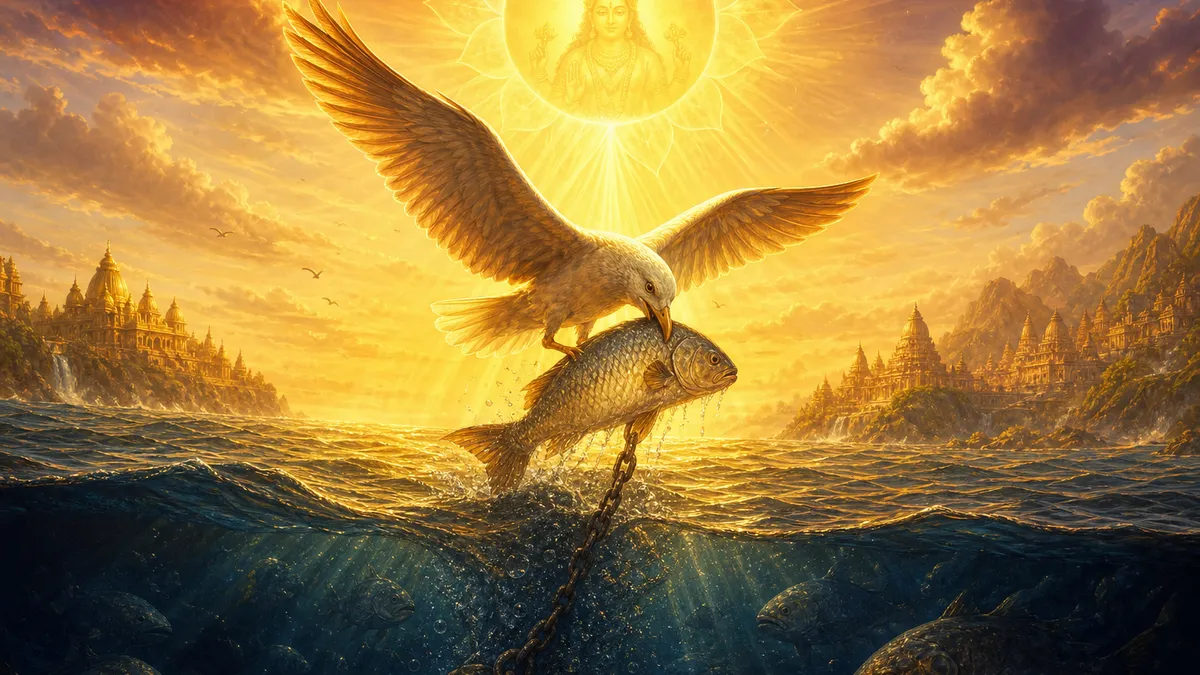
In the same way, souls often harm themselves when they cling to something tamasic or rajasic, without calculating their strength, and then sink down. But here it is said that one who remembers Ishvara always and everywhere will never harm himself, will never cling to illusion, will never sink into the abyss of maya. This means that the prescription is to always remember God. And as long as there is no possibility of remembering Him through nididhyasana, through contemplation, we remember Him through the Ishta-devata, through the Tree of Refuge, through Guru Yoga, through mantra—that is, in a way accessible to us.
The Six Perfections of Maheshvara
“Having known the seven and the six subtle parts of Maheshvara, and the constituent parts of pradhana, one attains the Supreme Brahman. Omniscience, contentment, beginningless consciousness, self-sufficiency, inexhaustible power, infinite power are known as the six parts of the Great Maheshvara.”
Sometimes the perfection of wisdom (jnana), the perfection of glory (kirti, yashas), the perfection of beauty (shri), the perfection of renunciation (vairagya), the perfection of wealth, and the perfection of strength (bala) are enumerated. These are the qualities of Ishvara, the qualities of Bhagavan. In tantric texts, six other perfections are listed: svatantrya (perfect freedom), nityatva (eternity), purnatva (perfect self-sufficiency and wholeness), aishvarya (divine omnipotence), sarvajnatva (divine omniscience), vyapakatva (divine omnipresence, all-pervasiveness).
By meditating on Ishvara, on these qualities, and reflecting on them, we practice Brahma-vichara. The four preliminary practices in Brahma-vichara mean asking the questions: “Who is God, who is Ishvara? What are His qualities? Where does He abide? What is my connection with Him?” These four preliminary practices can be performed both for the investigation of Brahman (the Absolute) and for the investigation of Ishvara. I hope everyone understands the difference between Brahman and Ishvara. Theologically, these are somewhat different categories, but you can apply these preliminary practices both in relation to Brahman and in relation to Ishvara.
“Who is God? What are His qualities? Where does He abide? What is my connection with Him?” And when you come to the question “What are His qualities?”, you meditate on these qualities: svatantrya (divine freedom), nityatva (divine eternity), purnatva (divine self-sufficiency and wholeness), aishvarya (divine omnipotence), sarvajnatva (divine omniscience), vyapakatva (divine all-pervasiveness).
We begin with logical inquiry; Brahma-vichara begins with logical analysis. Then, thanks to logic and clarity, we obtain an experience (bhava). Bhava is already beyond logic, beyond the mind (amanaska). And Brahma-vichara also changes its level. Here Brahma-vichara becomes thought-free, when you attune yourself to God instead of holding on to Him through logic. When such attunement reaches such great depth that it merges with your “I,” this is called “Brahma aham bhava.” Brahma aham bhava is a high attainment for a yogin, therefore at first we simply experience Brahma bhava, and when Brahma bhava merges with the “I,” it becomes Brahma aham bhava. From Brahma aham bhava, pratyabhijna (self-recognition) is possible.
The Seven Subtle Tattvas
“The tanmatras, the mind, and the Atman are called the seven subtle tattvas. Their cause is called Prakriti.”
The tanmatras, the mind, and buddhi, probably, should be in the translation. There is an error there. These are the seven tattvas. The tanmatras are the germs of the five elements. Each element has its own germ: the seed sound, the seed principle of air, the seed principle of fire, the seed principle of water, and the seed principle of earth. Also manas and buddhi; as a result, there are seven principles of prakriti.
“She is also pradhana; by her bondage is produced. Shakti is prakriti in dissolved form. In all the Vedas she is called the womb of Brahman. Above her is the one Parameshthi, Maheshvara, Purusha, the image of Truth. Brahma, the yogin, the Supreme Atman, pervading space, Comprehended by the Vedas, ancient, the One Rudra, Death, the Unmanifest, the One, the Seed, the Universe — all this is the one God. Some call Him one, others not one. Some say that this is one Essence, others that it is another. Smaller than an atom, greater than Mahat, Mahadeva is so called by the knowers of the Vedas. Whoever thus knows the hidden supreme Lord, the ancient golden Purusha, in the form of the Universe, consisting of buddhi, as the supreme path — that sage becomes one who has transcended buddhi.”
Different Understandings of God Depending on the Tattvas
Why are there different understandings of God? Because the mind penetrates different tattvas, and, being colored by the tattvas, it perceives God from the point of view of one tattva or another. Therefore religious people, abiding in different tattvas, cannot understand one another. Those who abide in a higher tattva easily understand those who abide in a lower tattva, and vice versa.
For example, if you know the psychology of cats, you can easily understand a cat’s motives. A cat’s motives are not complicated, if one does not dig too deeply: sausage, sour cream, mice, female cats. There is even a demotivator like this: a cat with its head hanging down, a glass beside it, and the caption: “Female cats, dogs, mice... Everything is decay!” That is, if you are in a higher tattva, you can understand any consciousness that is in a lower tattva. In which tattva is animal consciousness found? In a lower one — manas-tattva, karmendriya-tattva, jnanendriya-tattva. There is no buddhi there. There is ahamkara, that is, at most it is the sixteenth tattva. You can understand an animal, but an animal cannot understand a human being who abides in buddhi-tattva, in a more highly developed ahamkara. An undeveloped ahamkara cannot understand a developed ahamkara. It is not difficult to understand canine psychology; it is also not difficult to understand bovine psychology. But for a cow and a dog it is difficult to understand a human being.
Recently I rode a horse (in a carriage). And I thought that the horse is harnessed, it transports people, and people even receive money for using it as a draft animal. People have arranged things quite well for themselves: they have created for the horse such a tunnel of reality in which it constantly runs, transports people, and in return they give it only an armful of grass. At the same time, it could eat this grass anyway; grass grows, and the horse thinks that it cannot do without a human being. But the human being is more cunning. Abiding in a higher tattva, he uses his superior position to exploit horses. The horse, however, does not understand at all what is happening to it — they put a collar on it, gave it grass, told it to run, and it runs. This is precisely what limitations (kanchukas) are.
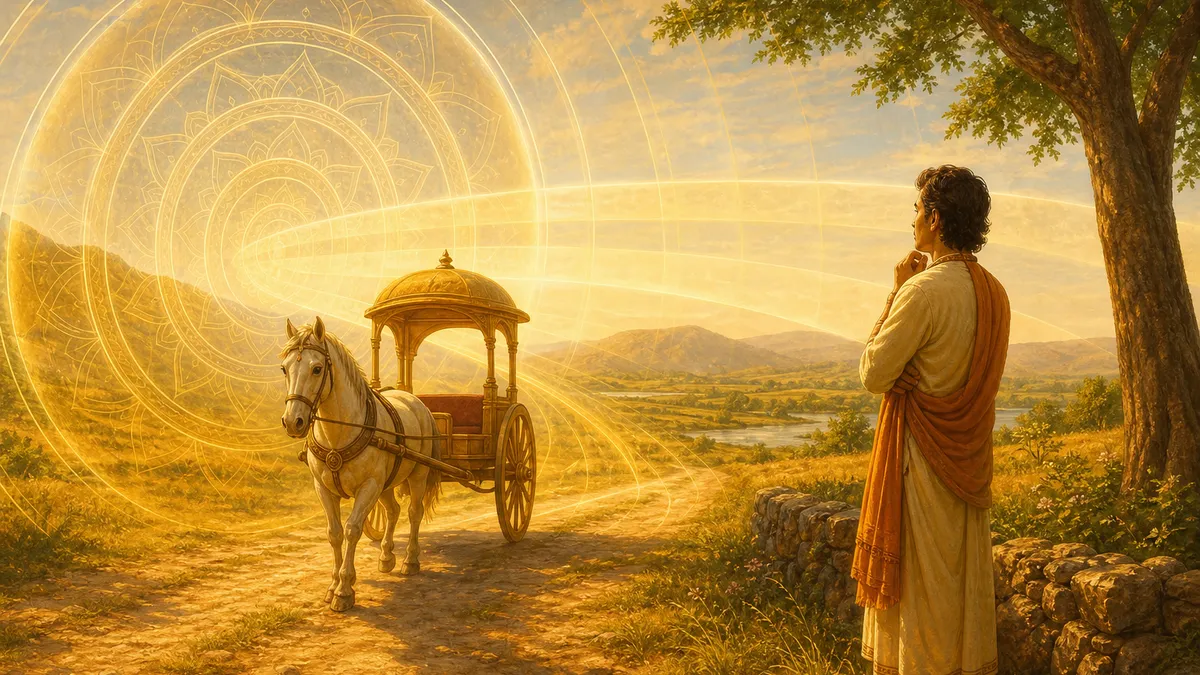
In a certain sense, a human being also resembles such a horse; he too is harnessed, only by subtler energies. Various divine and semi-divine beings dwelling in higher tattvas relate to him in the same way; they likewise ride upon people. Did you not know this? After all, the Gods do not use bodies; they use the bodies of people and other beings. Spirits do not use bodies; they have no material bodies, but if they need to, they can enter a human body and whisper something to him, inspire him, or stop him. People are the vahanas of divine beings. Within each of us there are inner subtle divine tattvas, and they ride upon our body. Different moods, states of insight — these are the subtle divine tattvas that ride upon our body. But our body itself, our mind, is bound in the same way as such a horse. This is the principle of a higher tattva.
I thought: what if horses became more intelligent and began to perceive higher tattvas — what would they say to people about it? Would they continue to carry people and entertain them; could they then be used for plowing? No, of course not. What would fish say about fish-canning factories? What would birds say about poultry farms? They would probably have a great deal to say to people. And people would have to hear words that were not the most joyful. But such is human culture; it is considered normal, accepted. An advertisement promoting chicken broth, where a mother lovingly prepares soup for her son and says, “Eat!” But what would the chicken think of their touching relationship? She would not accept such motherly love and such care. They would express themselves very harshly. Sadhus do not even use such words. But this is reality.
A human being, abiding in a higher tattva, uses material nature; he uses other living beings abiding in lower tattvas. In the same way, the human being himself is operated by beings from higher tattvas. But the point is that most beings from higher tattvas are more humane; that is, they do not treat lower beings the way humans do. The higher the tattva, the more humanism there is. Therefore the gods, if they are peaceful and not wrathful gods, are more compassionate toward people, kind, merciful; they do not take advantage of their position in the higher tattvas; they grant human beings freedom of will, because this is a divine law.
But one who recognizes Ishvara steps out of this entire mechanism of conditioning. He ceases to be dependent on all these kanchukas, on all these yokes; he is liberated. Why? Because he perceives the very highest tattva. Ishvara is the very highest tattva, liberating one from all these bonds.
Chapter Nine. The Nature of Parameshvara
The rishis said:
“Parameshvara is indivisible, stainless, eternal, inactive. Tell us, Mahadeva, how then does He assume the universal form?”
Ishvara said:
I am not the Universe and not outside the Universe, O twice-born ones! Its cause is maya; it conceals the Atman. The beginningless vessel is Shakti, maya rooted in the unmanifest. She is the cause of this world-manifestation. From the unmanifest she arose. The unmanifest is called the cause, Bliss, the imperishable light. I, however, am the Supreme Brahman; apart from me there is nothing. Therefore My universal form, according to the firm view of those who speak of Brahman, is called both one and separate. I am That Supreme Brahman, the Eternal Supreme Atman. He is called causeless, O twice-born ones; the Atman has no flaws. Infinite shaktis (maya and others) abide in the Unmanifest. In this sky only the Unmanifest shines eternally. By their nature they are different and not different, and are firmly one with Me, the beginningless steadfast vessel.
Here we are dealing with three categories or objects: Shiva, Shakti, and nara. Shiva is the principle of non-distinction, the principle of the unmanifest, abheda. There is no duality, no difference, one taste; everything is one Brahman. Shakti means the principle of bheda-abheda (both difference and non-difference). Nara means bheda (there are differences). Nara is the material Universe, this manifest world. Shiva means transcendent reality. Shakti means the energy that has emerged from the unmanifest and creates this world, prakriti, which underlies the manifest world. Let us say, it is not even the atomic or electronic level, but the subtlest luminous quantum level of the universe, where probabilistic Universes exist and arise, where the subtle bodies of all objects are formed. The world of subtle ideas, of eide according to Plato. This is Shakti.
The three bodies of Dattatreya correspond to this. That is, Dattatreya has a nishkala body (unmanifest). He also has a sakala-nishkala body (manifest and unmanifest), which is why it is often said of Him that He is both in the body and beyond the body, that He is both eternal and finite. He also has a sakala body (a manifest body), that is, a body with attributes, which appeared to the rishi Atri. It is said that when the rishi Atri prayed to the three Gods, at first a boy with three heads appeared in the radiance of rainbow light from a pure, luminous body. But somehow the rishi did not accept him; he did not like Him very much, he was frightened, because this son was far too transcendental. Then Dattatreya dissolved and was born in the form of an ordinary human being. That is, He could manifest His various aspects, but all of this is one and the same Dattatreya.
The Supreme Foot of Vishnu and the Three Yogas
“The beginningless Purusha grows from one and diminishes from another, being bound by avidya. That supreme manifest is surrounded by a circle of light. That imperishable supreme light is the supreme foot of Vishnu.”
The supreme foot of Vishnu is Paramapada. This is the supreme abode, the place in which Brahman, Vishnu, and Shiva are one. And the question is how to remain at all times in the consciousness of Shiva (Shivatva), in the consciousness of Dattatreya? How to recognize it and dedicate oneself entirely to it, how to surrender to it? This is the art of prapatti-yoga. First we master the art of self-liberation, we learn to contemplate, dissolving thoughts. When contemplation reaches depth, we move on to prapatti-yoga (the art of self-surrender). In the end, the great mystery comes, the great secret discovery of one’s true nature — pratyabhijna-yoga (the yoga of self-recognition).
One can speak a great deal about self-liberation and prapatti-yoga, while pratyabhijna-yoga is a mystery about which much is not said, but which is experienced. How should one dedicate one’s actions to God, how should one be in God at all times, how should one surrender to God? This is a great art. If you can surrender to God, your thoughts will not seize you, your desires will not seize you. This means that you cease to act selfishly and, in everything and always, rely on God. Anger arises — give it to God; a problem arises — give it to God; attachment arises — give it to God; you possess some material goods — dedicate them to serving God, and there are no problems; you do something, engage in something — dedicate your actions to God. Dedicate everything to God — such is the principle of prapatti-yoga. If you accustom yourself to surrendering to God, to acting completely in the spirit of devotion and self-surrender, then the bhava of devotion never leaves you, the blessings of Ishvara, divine grace, will always be with you, because you give the entire burden of your karma to the Divine Source.
Sri Ramana Maharshi compared this to a person carrying a heavy load who boarded a train. And when he boarded the train, he no longer had any need to keep the load on his head or shoulder, because the train is carrying both him and the load as well. It is impossible to surrender to God and feel suffering. People came to Sri Ramana Maharshi and said: “We have become interested in your Teaching on self-surrender. We have given everything to God, but there are no results, the suffering has not disappeared.” Ramana laughed at them and said: “Then you have not given everything to God, as you say. It is impossible to give everything to God and say that there are no results. Simply impossible. It is impossible to suffer if you have given everything to God. The body may suffer, but if you have given the mind to God, then the mind will be in happiness and blessing. It cannot be otherwise!”
In other words, when we feel confusion, suffering, dissatisfaction, there is only one reason — we have not given it to God, we have appropriated it, we hold on to it, we make it our own and are in no hurry to give it away; we even draw some kind of masochistic, egoistic satisfaction from the fact that we suffer but do not give it away. That is, we do not want to be in ecstasy, we do not want to rejoice, to enjoy, to be in bliss, to be in happiness, ecstasy, reverence, glorification. We like to suffer. It is so easy — give it away, and that is all, but for some reason we do not want to do this. This is the reason. And why do we not want to? Because of identification, because of avidya, because we consider it our own and are in no hurry to give it away, or else we do not understand that it can be given away. And the prescription here is simple — all of this can be given away.
Practical Methods of Self-Surrender
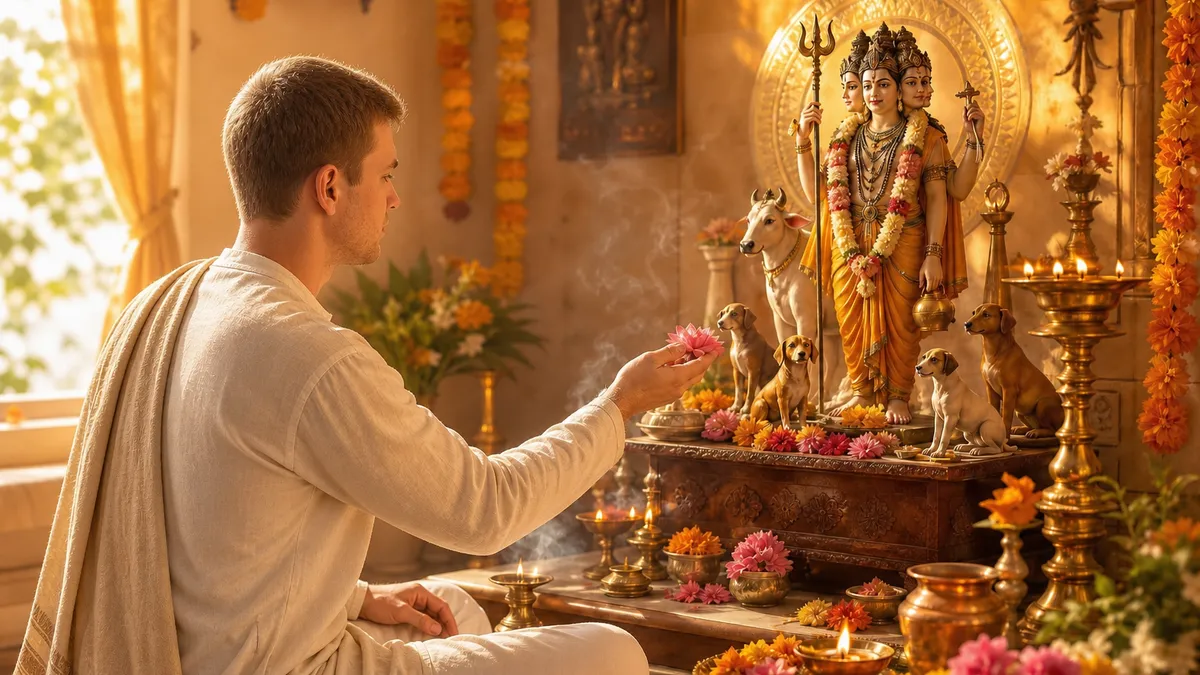
If you do not understand exactly how to give it away (after all, people often simply do not know how to give), then sit down before the altar, look at the murti, and make a symbolic gesture: “I give it to you. Accept, Dattatreya, everything that I have.”
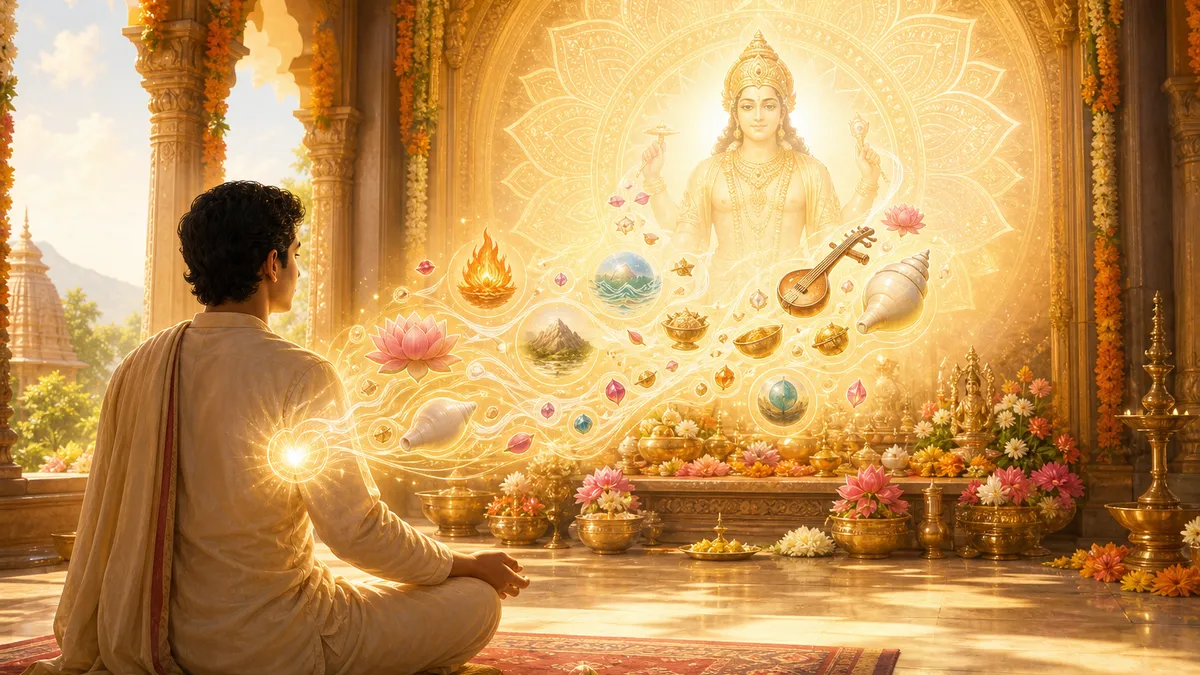
If you are skilled at visualization and inclined toward the yoga of the illusory body, then perform the theurgic practice in full: transform into the meditation deity, then visualize a multitude of offerings emanating from the chest, a multitude of offering goddesses; visualize the five elements, delicacies, musical instruments, precious conch shells and jeweled attributes; create an entire mandala in accordance with the instructions on the yoga of the illusory body. Then visualize all your problems and kleshas in the same way, but first purify them and transform them into pure nectars, because only pure nectars may be offered to deities. But problems and kleshas do exist, which means they must first be purified with the three syllables: vam, yam, ram. And when you have purified them with the three syllables and transformed them, you offer them.
Self-Offering and the Descent of Grace
Thus, offering everything that exists to God is the art of self-offering. The descent of grace always and invariably follows self-offering. You cannot give and not receive, because when you give, you free up space for grace, for blessings, uniting with the Supreme Source. And when anugraha (grace) descends, you feel joy, because consciousness moves into the higher tattvas. Instead of dwelling in manas-tattva (in the mind), in ahamkara-tattva (in egoistic clinging), you move your consciousness for a time into a higher tattva (into buddhi-tattva or even higher tattvas), and your mind receives blessing and darshan in accordance with the tattva into which you have moved.
Life in the Spectrum of Divine States
Therefore, one who lives in self-offering always lives in happiness, always lives in joy. He never descends below happiness. In the spectrum of emotional states, he lives between happiness and ecstasy. Happiness, delight, joy, bliss, ecstasy, glorification—he lives roughly within this spectrum. Even if he has not yet realized some higher tattvas connected with the experience of aspects of divine majesty, he does not descend below happiness. Sometimes he simply has happiness, when everything is simply good, and sometimes there is delight and ecstasy that compel him to be in incredible divine states. But fear, despondency, sorrow, and all the lower tattvas—clinging, egoism, obscuration—are unknown to him. He never descends below this spectrum. If you feel that your emotional background has fallen below this spectrum, immediately remember that you need to offer it to God.
Sri Guru Dattatreya Avadhuta ki—jai!
