

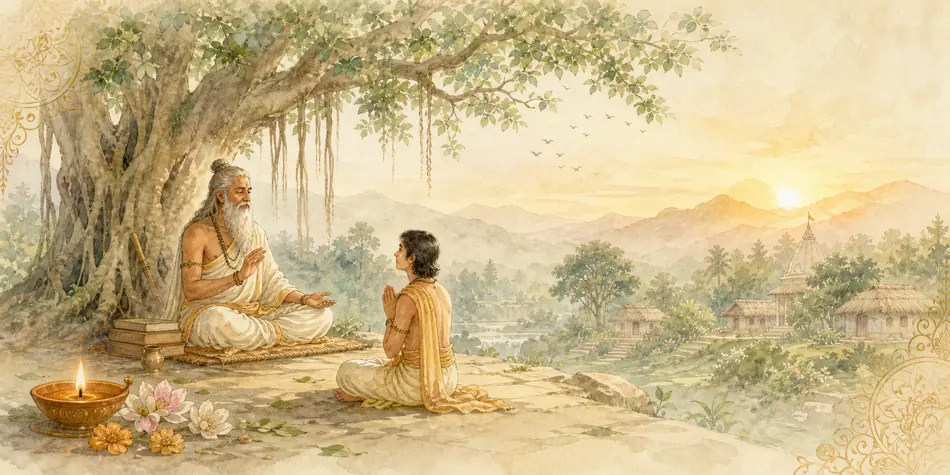
Question: Guruji, the question is this: Ishvara, having a personal aspect limited by the guna of sattva, is therefore not eternal, and in the universal ocean there are infinitely many such Ishvaras and Universes?
It depends on which aspect of Ishvara you are considering. Ishvara, as a body, may be limited in manifestation, but as essential consciousness, he is boundless; he is not limited. For example, there is the aspect of Ishvara as Brahma, the creator of the Universe. Brahma himself is a reflection of the Absolute in sattvic maya; he then creates the material world, the material body. This is also his body, meaning that he himself is not limited to sattva alone: he is sattva, tamas, and rajas. Ishvara can manifest through various tattvas.
There are only five tattvas, and they are called: Shiva-tattva, Shakti-tattva, Sadashiva-tattva, Ishvara-tattva, and Sadvidya-tattva. Depending on the tattva through which Ishvara manifests, he assumes particular qualities, but all these tattvas are eternal and pure; they are indestructible and free. These lesser creators of the Universe, the various kinds of creator Brahmas, are aspects of Ishvara, while Ishvara himself is a manifestation of Brahman, the Absolute.
The following example may be given: if we consider the consciousness of a saint, sage, or siddha, it has a dual state. On the one hand, he has a body, and this body is living, mortal, and ordinary; on the other hand, he has an infinite mind, an enlightened mind, his consciousness is wide open, and he abides in constant bliss. If someone accepts such a sage as a Guru, they should focus on his infinite mind, on his inner state of bhava—this is called Guru Yoga—and should not attach too much importance to his physical body.
Ishvara is the same: he is like the primordial Guru, a universal Guru who possesses both a material body and the same wide-open aura, the same divine bliss, and various energies, only quintillions of times greater and more powerful. When we practice Guru Yoga with Dattatreya and unite with him, we unite not with material, transient qualities, but with eternal, absolute, unlimited ones. Dattatreya may have transient, limited qualities, and he manifested physical bodies, or manifested as Brahma or someone else, but this is merely his manifestation; he himself is not transient.
Question: Is everyone their own Ishvara, or is there one Ishvara for the entire Universe? How can this be understood?
There is one Ishvara for the entire Universe, but as a living soul evolves and receives blessings, it may also eventually become an Ishvara someday—an Ishvara of lesser capabilities, yet possessing the same qualities. Our goal, as we evolve, is gradually to rise to the level of Dattatreya. As all yogis evolve, they rise to the level of Satya-loka, unite with the body of Ishvara, and live united with the body of Ishvara until the end of the creation of the Universe. While Brahma lives, the yugas and kalpas unfold, and Brahma lives through a complete cycle, according to Sanatana Dharma, until his life in this body comes to an end.
The yogis abide within the body of Brahma; then mahapralaya occurs, and Brahma enters his unmanifest state, manifesting as the Absolute, Parabrahman. The yogis enter mahapralaya together with him, and then, if they have accumulated enough wisdom and spiritual power, they too may manifest as Ishvara. But at present, not everyone is their own Ishvara; one must first ascend very, very high on the evolutionary ladder.

Question: Can the Christian Holy Spirit or Socrates’ Daimon be regarded as an analogue of Ishvara in Western spirituality?
God the Father can sometimes be compared to Brahman and God the Holy Spirit to Ishvara—no, rather, that is not quite right. The Holy Spirit can be compared to Brahman, God the Father can be compared to Ishvara, and God the Son can be compared to the manifestation of Ishvara in a material body. These are also called the three bodies: jnana-deha, maya-deha, and siddha-deha.
On Lineages and Déjà Vu
Question: Where do new lineages come from?
New lineages. I do not know where new ones come from; we are not new, we are old. But perhaps it is Ishvara’s play; perhaps it happens when old lineages lose their power and disappear. Suppose there was a great saint who had disciples, and a lineage (parampara) existed. But then the planets aligned in a certain way, Kali Yuga began, the disciples did not fully understand everything their Guru taught them, practiced poorly, and failed to realize what they were supposed to realize.
The guru left the body, the disciples left the body, and only the followers remained; and the followers had scriptures they no longer understood—and that was all. The lineage fell into decline, the school disappeared, and there have been many such cases in which entire movements and entire schools vanished. For example, the Kapalikas were the last known school of this kind in Hinduism. Then Ishvara decides to create a new lineage, a new tradition.
To do this, he sends his avatar—that is, he emanates a part of himself and creates a personality endowed with special power and wisdom, also granting that person authority. This is called a Shakti-avesha-avatar. He comes, and a new lineage is established—created entirely anew. This means that Ishvara breathed life into this person, infused him with his blessings, and an entirely new chain of succession was created. Thus, people once again gain the opportunity to practice, and the tradition is revived.
Question: What is déjà vu? I make decisions, sometimes difficult ones that I consider momentous, and then, at a certain moment, I experience déjà vu. Does that mean it was meant to be?
It is contact with the subtle body. The fact is that before you make a decision, before something happens, all of it has already been created; it has already been planned by Ishvara on the subtle level, and the script has already been written. When you intuitively enter the subtle world, the subtle body, in the right way, you perceive this script, and then the feeling arises: “I have seen this somewhere before.”
There is also the term “flashback”—this is when the main character in a film suddenly returns to memories of the past, and images of the past surface in their present life. Déjà vu is such a flashback. Our past, future, and present lives have already been recorded in the book of life. There is, of course, a small degree of free will, but it is limited. The main scenarios and major events of life have already been created and written; they merely unfold through samskaras. For a time, our intuition may perceive and grasp these scenarios, and then, when we act, the effect of déjà vu arises, and we realize: “Yes, I have already sensed this somewhere.” This means that the soul has come into contact with these scenarios.
On Will, Intention, and Sadhana
Question: The Buddha said that, in order to live, one should exert neither too little nor too much effort. Is there a way to describe what these inner efforts, aspirations, and intentions of attention are?
Nothing can be achieved without effort, as Rishi Vasishtha said in the “Yoga Vasistha.” There is a will within us—our own personal will—but this personal will is part of the divine will. It is called iccha-shakti, and when we become aware of this will within ourselves and consider where to direct it, we create an intention.
Will is a force; it is impersonal. If we wish, we can direct it toward buying sweets, toward some form of entertainment, toward God, or toward sensual pleasure—it does not matter where. It is a certain resource at our disposal. But sankalpa (intention) is precisely what gives will a goal, and so we must cultivate right intentions within ourselves and apply sankalpa; then our will shall be directed toward the right objects.
For example, if you contemplate, you must form a sankalpa to remain in a state of awareness. If you practice mindfulness in movement, you must form within yourself the intention to be attentive to the movements of the body, the actions of the body, bodily sensations, and thoughts; then you will be practicing mindfulness.
If you worship God in the aspect of Ishvara, you must form the intention to think of Ishvara, remember him, and glorify him. Everything is governed by intention—this is sankalpa. The art of intention is called sankalpa-vidya. It is very important because it is the power of intention that is directed toward achieving the right results.
What do the saints say? “Do not scatter your intention; gather all your energy, all your will, and direct it toward God.” When we direct our will toward God, this is called maha-sankalpa or sat-sankalpa, because by directing our energy toward God, all our tasks, questions, and problems will gradually be resolved, since God is the source of all transcendent divine qualities.

Question: What sadhana is suitable for realizing and identifying with Ishvara?
The one given to you by the Guru, because the Guru is Ishvara Himself, who has come to the disciple. But the simplest thing you can do is a mantra. The Guru mantra, if you have diksha, karma-sannyasa diksha, or the mantra “Om Namah Shivaya,” or Dattatreya’s seed mantra, if you received it from the Guru—that is, you must receive a sadhana.
You should not choose a sadhana on your own; sadhana is always given as a blessing, and then it will work. If you choose it yourself, you will not receive that blessing; you will practice for a while and then abandon it, and there will be no result. Instruction (shiksha) is needed, transmission is needed, and I recommend beginning with the mantra “Om Namah Shivaya.” “Na” removes anava-mala, the syllable “Ma” removes maya-mala, the syllable “Shi” means Shiva, the syllable “Va” means Shakti, and the syllable “Ya” means Atman, the soul.
When you recite “Om Namah Shivaya,” recite “Om Namah” with your tongue and “Shivaya” in your mind. When you recite “Om Namah Shivaya,” you address Ishvara, and you may recite “Om Namah Shivaya” and Dattatreya’s seed mantra—this will always bless you; and if you have karma-sannyasa diksha, then recite the Guru mantra.
On Clarity, Presence, and Mantra
Question: Please explain the terms “clarity” and “presence” in the context of meditation practice.
When, through any practice—Mahashanti meditation, emptiness meditation, full attention, or atma-vichara—you have discovered the space of pure awareness beyond thoughts, you abide beyond thoughts. There is a subtle layer of consciousness, and this subtle layer of consciousness is beyond concepts; it does not divide anything, yet it sees everything clearly. It contains viveka, it contains tranquility—this is clarity.
Clarity means that you see everything clearly, as it is, without the mind’s fabrications, without concepts, without feelings, without the sense organs, unaffected by emotions. There is only pure consciousness, even and smooth like the surface of a mirror—this is clarity.
Presence is the next step: when we abide in clarity for a long time, clarity begins to abstract itself from material conditions and objects and takes the form of space, and we are present in this space—this is already the beginning of presence. All this is a rather complex subject; it must be confirmed with the Guru, the teaching of the sixteen kalas must be studied, and direct introduction must be received. Presence is already the threshold of sahaja samadhi.
Presence differs from clarity. Clarity is not yet specifically directed toward anything; it is simply the mirror of pure consciousness, whereas presence has a directedness toward God. There is vichara-spanda; presence always generates vichara-spanda (an investigative vibration directed toward Brahman), toward God; it is also called brahmakara-vritti. Presence is always connected with nididhyasana, abiding in Brahman, while clarity is merely the threshold to this, the first step toward it.

Question: Are chanting Om aloud and chanting Om without sound, through inner perception, essentially the same, or is the physical vibration of sound necessary for synchronization?
There are different levels of chanting and reciting a mantra: there is whispered recitation, there is mental recitation, called manasika japa, and there is recitation beyond these, called ajapa japa. These are simply different levels, and you should always begin by moving your lips and hearing the sound—not very loudly, but you must hear it. More subtle recitation and chanting of a mantra are accessible to highly advanced sadhus of the divya category, but that is not where one should begin; it is better to begin with sound.
On Karma, Rebirth, and Liberation
Question: What should one do if one practices with a Master throughout one’s life and performs good deeds, but then is reborn in hell because of some unresolved karma? Is there a chance of getting out of there?
You should consult your Master to ensure that this does not happen. If you correctly follow your Master’s instructions, then rebirth in hell is impossible; that is, it is possible if mistakes are made somewhere or karma is not purified. You must attain such confidence that this will not happen. You must accumulate so much merit beside the Master that you can be certain that at least some degree of liberation will be attained, even if only the initial one—salokya-mukti—so that you will at least reach heaven, with no hell whatsoever.
The Master is a field of great merit, the Dharma is a field of great merit, and everything connected with sadhus is a field for accumulating great merit. Accumulate as much of such merit as possible so that your consciousness may abide in purity, happiness, love, and joy. Cultivate your qualities in this way, and you are guaranteed the initial liberation (salokya-mukti). In Shaivism, this is called charya-pada, the first stage of spiritual life. And if you perform worship, worshipping the ishta-devata in kriya-pada, and receive a blessing, then, if your karma has been purified, you are guaranteed the second kind of liberation—samipya-mukti.
Samipya-mukti means being born close to a deity, being in its retinue in some heavenly realm—for example, near Shiva or Dattatreya. But for this, one must receive grace, receive a blessing, and practise sadhana. However, simply to avoid ending up in hell, at the very least, just never become angry and observe the commandments; that is enough. Do nothing bad. To end up in hell, one actually has to make an effort: constantly do foolish things, constantly become angry, and constantly remain in a clouded state.
Just remain in a pure state, observe the principles of sannyasa, and live a pure life, and you will be protected, because you have the Refuge with you, the blessing of the Guru and the ishta-devata; the saints protect and bless you because of this.
On Love, Devotion, and Divine Energies
Question: Namaste, Guru, how can one develop true love, devotion, and selflessness towards the One whom one is only trying to comprehend? How can one sustain and cultivate sincere devotion within oneself? How does Ishvara’s love for a person manifest?
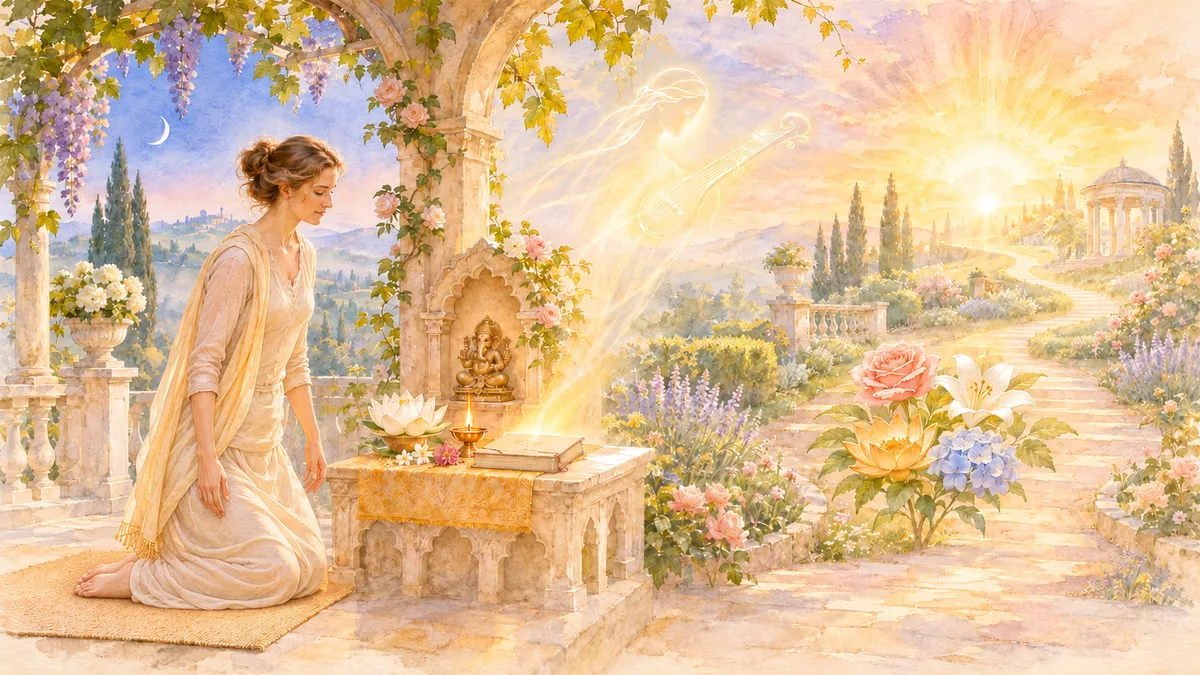
First, you must make it your heartfelt wish and constantly express your desire in the form of prayer; you must pray for a blessing. Lofty qualities and abilities always come as a blessing from above. Of course, you can also cultivate something within yourself through your own efforts, but that accounts for fifteen or five percent; the main thing is the blessing. If you lack something, some quality, or wish to cultivate something, simply pray to your chosen deity and the Guru-shishya-parampara for the higher powers to bestow their blessing; the sanction of the higher providential forces is required.
If the blessing comes, it will gradually become part of your life. For example, if someone lacks wisdom, they should turn to Saraswati, make an offering on Friday during the waxing Moon, write a treatise, perform a puja, and pray to Saraswati. After praying, they should watch at night for signs in their dreams. If, for example, you meet a young woman who shows you the way upwards or gives you something, this means that your prayer has been received, that it was successful, and that the blessing will come.
In the same way, to develop love, pray to Dattatreya and Shiva for the blessing of love, and, of course, make efforts on your own part: practise the meditation on the Four Immeasurables every day and be persistent in this meditation. Pray for the blessing of devotion to God, and since all gods and all saints abide in the realm of love, these qualities will awaken in you as well.
Question: What does the Guru consider the energies of the planets to be? Are they enlightened deities or impersonal mechanisms?
Of course, they are deities; there can be no question about it. Physical planets are merely bodies. Just as we have the earth element in our bodies—muscles, flesh, bones—all of this is the earth element, part of our body. Deities also have bodies, and the terrestrial, solid planets are parts of their bodies; they are their gross bodies. The planet Mars is the deity Budha, the planet Venus is the deity Shukra, and the Moon is the deity Chandra. They are divine, enlightened, godlike beings, but they have bodies in the form of planets. We have bodies in the form of humans; someone else may have a body in the form of a planet, while another, like Dhruva, for example, may have a body in the form of a star—there is nothing surprising about that. Ishvara may have a body in the form of billions of universes—that is perfectly natural.
Question: Is Ishvara connected with kundalini, and if so, in what way?
There is not a single atom in the Universe with which Ishvara is not connected. Why? Because we ourselves are a cell of Ishvara; all the elements are the body of Ishvara. All life is Ishvara’s dream, his imagination; we live inside his body, we consist of his consciousness, of his energy. Yes, of course, he is connected. Kundalini is Shakti, it is energy, it is the feminine aspect of Ishvara, it is his Shakti; that is, in our understanding, Kundalini is Shiva’s consort—Parvati, Durga, Kali—or Dattatreya’s consort, Anasuya.
Satya Loka and the State of Turiya
Question: Is there a place in the Universe where only God as the source exists?
Yes, there is. This place is called Satya Loka. It is also called turiya; turiya means “the fourth.” There is the state of jagrat—wakefulness (the material world); there is svapna (dreaming sleep); and there is sushupti (dreamless sleep). These three states are material; they are worldly states. Even with heavens and gods, Prakriti is still material energy. But there is a pure, divine state where there is nothing but God, no other energies, no admixtures of sattva, tamas, or rajas—a pure, divine, transcendent state. This is called turiya.
Turiya is God alone, and this dimension of turiya has eight gradations, all of which are absolute happiness, absolute bliss. When these gradations are named, their names always end in ananda—different kinds of bliss: nijananda, brahmananda, and some other ananda—nothing but blissful states.
Dattatreya in his pure form abides in this dimension; Shiva abides in this dimension; Guru Brahmananda abides in this dimension; all the saints of the Guru-shishya-parampara—the greater part of their souls—abide in this dimension. One could say that the place where there is only God is the heart of Dattatreya, the heart of Guru Brahmananda, the heart of Shiva.
Spreading Sanatana Dharma
Question: I am a tarot reader and healer, and I have a YouTube channel. How else can I spread Sanatana Dharma, apart from the methods you have previously spoken and written about?
You need a blessing; you need some kind of revelation, so that it is not you making the decision, but rather something given from above. That is, you should pray earnestly to Shiva, Dattatreya, and the saints of the Refuge Tree, asking them to show you the way or give you a sign. Simply pray, make an offering, and then, over the following three days, pay attention to your dreams and to any changes that may occur in your life. But this should be done on a Thursday.
Thursday is the day when Guru-tattva is strong, and you should appeal to God, to Ishvara as the Guru principle, asking him to guide you. It should be during the waxing moon. If you do this, an inner revelation will come, and that revelation itself will show you how.
The Nature of Bliss in Practice
Question: Is the bliss of the dhyanas connected in any way with the bliss experienced when concentrating on the chakras, and are they related at all?
The bliss experienced when concentrating on the chakras is connected with Shakti (with energy), while the bliss of the dhyanas is connected with consciousness. They are related in the sense that when you attain a particular dhyana, bliss may become activated in a chakra as energy, but they are not directly connected.
Question: When you speak of the principle of consciousness or the principle of bliss, how should the word “principle” be understood?
An essence, an essence that manifests.
Practice Within the Family
Question: Please explain how a beginner who lives in society and has a family that is calm but not particularly enthusiastic about Sanatana Dharma should best practice.
This is a difficult question for everyone. At one time, I too faced this question, and I had various thoughts about it, even different scenarios. Sometimes I thought it would be good to talk to my parents so that they would become monks, and then I would become one too, and everyone would be happy. For a while, I also tried to preach the Dharma to my parents, but all of it was unsuccessful.
You do not need to try to change others, but you do need to change yourself, and that requires practice and a certain status, such as that of a karma sannyasi. If you take the karma sannyasi vows and commitments—which are not difficult—set up an altar, adhere to the principles of karma sannyasa, perform the practices, associate with practitioners, and read the texts, wisdom and spiritual power will gradually awaken within you, and others will begin to feel it.
They may not be enthusiastic yet, but they begin to respect your choice and appreciate it, seeing that your wisdom and spiritual power enable you to solve various problems and help them as well. Your love blossoms, and they begin to value your inner spiritual sattva, recognizing that it has come through your practice. Then they respect your choice and do not interfere with you; even if they do not follow your example, they at least treat your choice with respect.
But at first, you need to make an effort; you truly need to strive to follow your chosen path without turning aside or wavering. Yet you must do so harmoniously, so that there are no quarrels, scandals, or anything of the sort, because people are always jealous of spiritual life; they feel jealous of God, jealous of the Guru, jealous of Dattatreya.
They feel that everything was fine: we were living a worldly life, and suddenly Dattatreya appeared, and for some reason he begins to say that he loves Dattatreya more than me—who would like that? A Guru appears; he begins to listen to the Guru and stops listening to me, so my ego is not satisfied, my feelings are not satisfied—what is this? In other words, you can easily provoke all sorts of wrong thoughts in the minds of others.
But if you practice correctly and build relationships harmoniously, you should reassure all those close to you and say: “You will not suffer; you will receive from me what you hope to receive, and even more than that, much more. You will be happy if I practice, because the wisdom, spiritual power, and grace that I accumulate will help you not only in material life but also in spiritual life; it will help you for hundreds of years to come, for thousands of years to come.”
Of course, this must be expressed properly. If you start saying such things right away, people will not understand either. Some say: “Thanks to my practice, generations... If it were not for me, you would have already fallen into hell.” This is indeed true, but it must be expressed properly, in language that people understand.
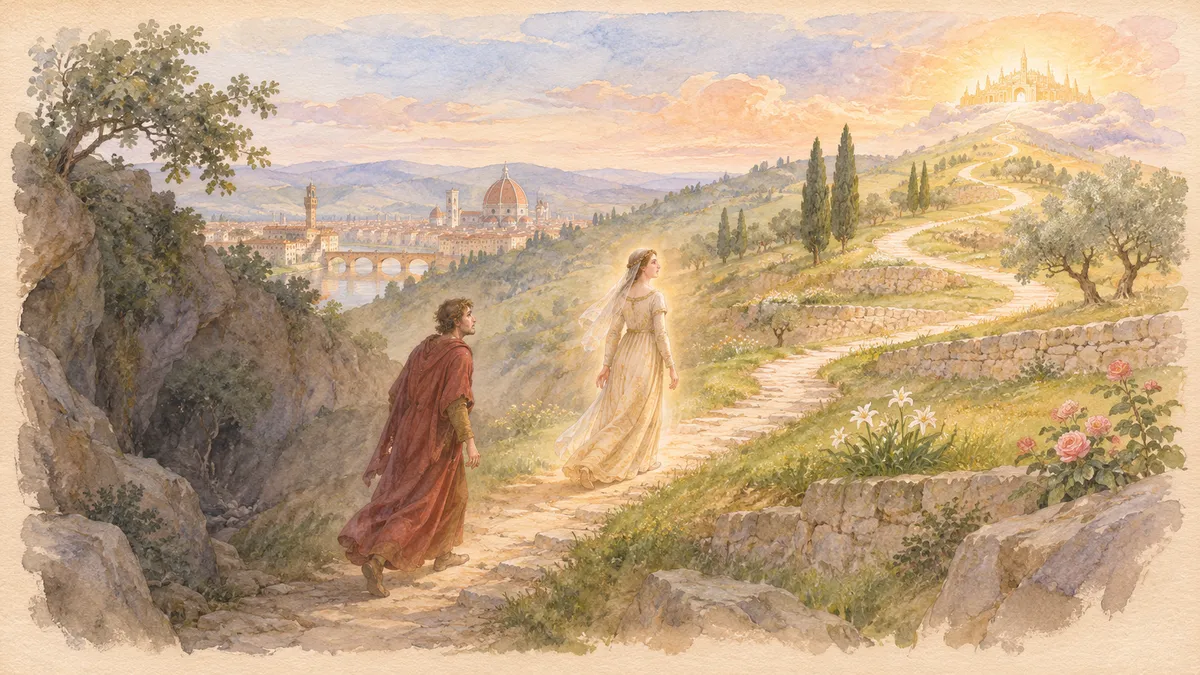
For example, if you have read Dante Alighieri’s “Divine Comedy,” what happens there? The main character reaches heaven thanks to his beloved. She practiced, was deeply devout, and accumulated great spiritual power. He first passed through the hells, and then, thanks to her, ascended higher and higher. Her spiritual radiance was so great that, through their karmic connection, his mind was purified of karma. He saw that his beloved was a saint, a holy being, not at all what he had thought, and thanks to her, he ascended from the lower worlds toward the heavens solely through their connection.
In the same way, solely through their connection with you, your loved ones can receive blessings and grace and attain a better rebirth. It is a great blessing to have a practitioner in the family. If that person is a powerful practitioner, a saint, it is the greatest blessing. It is believed that a lineage with no saint comes to an end; it has no prospects or future.
In the past, the strength of each lineage rested on several saints within it, on a few very pure and powerful people. Why has the strength of lineages disappeared today? Because there are no holy people left in them; all the shaktimans, all the saints have disappeared from the lineage, and there is no way to sustain this power any longer. But if there is even one saint in a lineage, then the souls connected with that saint ascend with them to the heavenly worlds.
Dissolution of the Subtle Bodies
Question: Please explain the process of dissolving the astral and causal bodies.
To explain the process of dissolution, or laya, one must understand what the astral body is. The astral body consists of seventeen parts, and one must study what these parts are. The five pranas, the five karma indriyas, the five jnana indriyas, manas, and buddhi—these are the seventeen parts of the astral body.
The process of dissolving the astral body takes place when we discover within ourselves the light of God, the light of great love. When we discover Ishvara within ourselves, the consciousness of Dattatreya awakens within us. When the light, the space of the power and mind of Shiva and Dattatreya, is revealed within us. This light, this grace begins to descend upon the astral body, and then what happens? Manas—the mind—begins to dissolve; buddhi, intuitive consciousness, the intellect, also begins to merge with this light and become its conduit.
All the karma-indriyas, the organs of action, and all the sense organs become permeated with this light; all the pranas become permeated with this light as a result of the descent of grace. When this dissolution of the subtle body occurs, a person gains the ability to create a divine subtle body; this is called maya-deha or maya-kaya (the illusory divine body). What does the fact that someone possesses an illusory divine body indicate? That they have completely dissolved the subtle body.
And what happens when the causal body dissolves? It means that the ego itself dissolves in the light of God, in God's blessing; all hopes, all attachments, all fears, and all concepts dissolve. When such dissolution occurs, the causal body becomes illumined and merges with the causal body of Ishvara, God; this is called jnana-deha or jnana-kaya. The ability to live as consciousness manifests within us—not merely as consciousness, but as divine luminous consciousness, a space of light like a million suns.

There are signs described in the “Advaya Taraka Upanishad” and the “Mandala Brahmana Upanishad” that depict the process of dissolving the causal body as the experience of five spaces (vyoma-panchaka), and these signs and the methods by which this occurs must be studied, but that is not the topic for today—it is a complex subject.
Ishvara’s Freedom
Question: Does Ishvara have the freedom to cease to exist?
Ishvara possesses every freedom; svatantrya is completeness in every freedom and every dimension. For him, it is possible both to be and not to be simultaneously. Ishvara’s freedom is not human freedom; it is freedom in all directions, in all manifestations, in all dimensions, in every sense, and in every quality. What is inaccessible to a human being is natural for Ishvara.
Methods of Realization and Liberation
Question: What is the method for directly realizing the nature of Shiva?
If you possess the necessary qualities, you need to learn to abide beyond concepts, in awareness—there are no thoughts or concepts, or they play out on the periphery, while you remain aware and abide in this awareness, going all the way to the fullest liberation. This is called the method of direct realization, the path to sahaja samadhi, but it must be studied; it is called laya yoga, shravana, manana, nididhyasana, and one must receive direct introduction from the Guru.
Question: Is it possible to escape the cycle of samsara in this incarnation?
If your merit is sufficient, then yes, it is possible, but to do so you must lead a certain kind of life, observe the principles, perform sadhana, do seva, study the sacred scriptures, periodically practice austerities and undertake retreats, receive the right experiences and blessings, and then anything is possible.
There are three categories of people: divya, vira, and pashu—divine people, those with the potential of spiritual heroes, and ordinary people bound by karma.
For those who possess divine karmas, this is not difficult. They have a great deal of merit (dharma-sukriti) within them: the Guru merely tells them something, and they understand immediately; he only transmits a practice, and they are already realizing it. The Guru is still speaking, while within them all of it is already unfolding on the intuitive and mental level. They study the scriptures and understand everything—this is divya, meaning they were yogis or gods in a past life; some karmas have not yet been worked through and still remain, but overall they possess many abilities. Such people attain liberation in this lifetime; in fact, they do not need to exert very much effort.
There are vira yogis—another category. They have more rajasic energy, and their ego clings more strongly to karma. But they need to exert sufficient effort and develop strong devotion and intense concentration; they, too, can attain liberation.
Finally, there are those who belong to pashu-bhava: bound by karma, with plenty of desires, plenty of kleshas, plenty of attachments and clinging, but not enough merit. Such people can also attain liberation, but they must work hard on themselves, worship extensively, and devote their entire lives to karma yoga, bhakti yoga, raja kundalini yoga, and jnana yoga. If they manage to purify their tamas and rajas and attain the right experiences, they will be liberated.
Throughout history, there have been cases in which even saints with bad karma—robbers, even murderers, gamblers, and drunkards—attained liberation and the highest levels of holiness; these are true stories. This means that they were able to rise even from the level of pashu.
For example, before Milarepa became a great saint, who was he? An ordinary village boy with not very good karma, poverty, and suffering. His mother sent him to study black magic so that he could take revenge on those who had wronged them and taken away their house, wealth, and so on. In other words, Milarepa had no intention of pursuing liberation at all.
He studied black magic and used it to bring down a house during his enemies’ wedding, killing thirty-eight people. So his karma did not seem particularly good. But then Milarepa made tremendous efforts, and with the help of Guru Marpa, he managed to purify all his sins, cancel out all his negative karma, and become one of the greatest saints—is that not a miracle? All of this is possible.
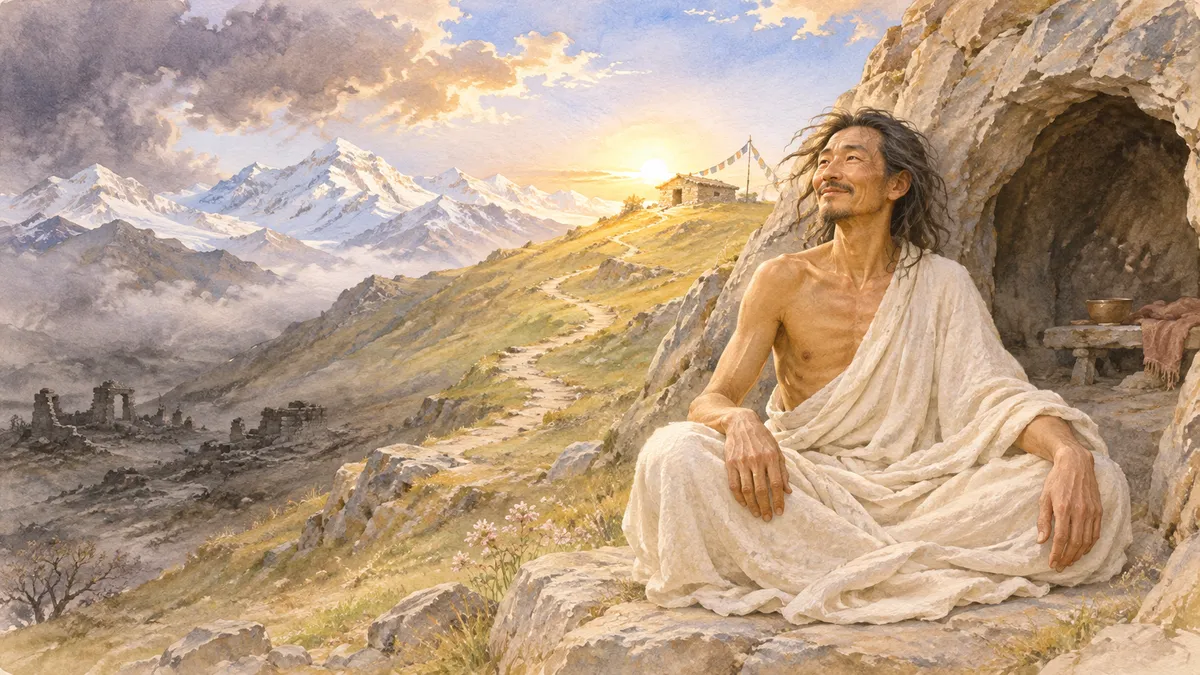
There are many such cases in which sinners and robbers—those clearly in pashu-bhava, who had not even intended to follow a spiritual path—nevertheless attained great spiritual heights in their lives. If we are not utterly depraved sinners or robbers, then why not? Why can we not attain the same through practice? It is possible.
Practical Questions of Spiritual Life
Question: What is attention?
It is the orientation of consciousness toward an object, accompanied by heightened awareness. In the highest sense, we should direct our attention toward God, but since God is a concept that is very difficult for each person to define, we have an ishta-devata (chosen deity), which possesses the same qualities but is more human, so to speak—it has a form and a manifestation. This is the meaning of ishta-devata yoga, to which this lecture is devoted.
Question: Please help me see how to relax and not become angry or distressed by the world around me, especially by my loved ones. I remain in observation, but if something does not go my way, I explode; anger is followed by shame, which then gives rise to distress again. The mind does not engage in dialogue, but the sensations are very intense.
When there is anger and powerful energy, mere observation will not help, although it may weaken it to some extent. You have a degree of observation, an observing awareness, and you distance yourself a little; nevertheless, it does not help directly or quickly, because anger is energy.
Unless the observer has completely detached itself from worldly life and from all events, and you see everything simply as an illusion and rejoice—“The world is an illusion, so why worry at all, and whom is there to be angry with?”—observation alone will not enable you to get through it. Until that state is attained, anger, envy, attachment, lust, greed, and pride are all energies, and another energy is needed to overcome them.
The observer is still weak here; it will not work. You need to develop within yourself the energy of the Four Immeasurables, to meditate on the four brahma-viharas recommended by Patanjali in the Yoga Sutras, which we practice every day, and to become firmly established in this meditation. You need the energy of love, joy, compassion, and detachment; cultivate these within yourself. Here you must tell yourself: “No matter what, you must learn to love, you must learn to be compassionate, and you must learn to rejoice in the success of others.”
What is the meditation on the Four Immeasurables?
Infinite love—may I love all living beings, regardless of how they manifest themselves
Infinite compassion—may I be compassionate toward all living beings who suffer, regardless of their level or how they treat me; may I generate such empathy
Infinite joy—this is the intention: may I rejoice in all living beings and their successes, regardless of how they manifest themselves; may I wish them happiness
Detachment—may I regard everything with equanimity and detachment, as an illusion
A powerful energy is needed, accompanied by such energies—this is precisely the meditation of the Four Immeasurables.

Question: I had an experience of infinite space resembling an infinite empty screen. Can this be called an experience of presence?
It can be called that, or it may not be—it all depends on how you make use of it. If this experience is subtle, beyond the mind and thought, and if you sustain it continuously, then perhaps yes. But you should not cling to it; offer it to God—everything we offer to God is later returned to us in the form of blessings.
When you have an experience, do not hold on to it or allow yourself to be impressed by it; offer it to God. God will return it to you, but in the form of blessings, in the form of intuitive wisdom about how to make even better use of this experience.
Question: Please tell me, how can I receive a blessing for the practice?
Simply write a letter and ask for it.
Question: A Buddhist teacher said that all mental illnesses stem from selfishness. Do you agree with this statement, and could you comment on it in more detail?
I agree, because the ego separates us from God, from divine grace, from pure sattva, from profound transcendental awareness; it fragments reality, creating different fragments of the mind. When our consciousness is fragmented and separate from God, we may fall into complexes, phobias, and various absurd ideas, become consumed by all of this, and that is the beginning of various illnesses—yes, that is so.
Question: Does salokya-mukti make sense from the standpoint of consciousness ascending through the sixteen kalas? Is human birth better or worse from this perspective?
If you have a stable connection with saints and know how to contemplate, salokya-mukti makes sense. For example, salokya-mukti means that you are born in a heavenly realm, in a pure land with excellent conditions, where samayas are observed and only high-level sadhus live, and there, over five hundred divine years, you attain complete enlightenment, complete awakening. This is better than being born on earth again: you do not know what family you may be born into, whether there will be Dharma in that country, whether you will find a spiritual teacher when you seek one, and you will face various limitations, so in this sense it is not bad.
Signs of Nectar Flowing from the Soma Chakra
Question: What are the signs of nectar flowing from the soma chakra, as described in Kundalini Yoga?
Your mouth fills with saliva; if there is a great deal of energy, something begins dripping and clicking in your palate—this is the beginning. You will not miss these signs if the nectar begins to flow—it is impossible; you will feel them. It is like a hunter describing a safari:
“There we will hunt a tiger.”
A woman asks:
“And how will I recognize it?”
He says:
“By its striped fur. And there we will hunt an elephant.”
The woman asks again:
“And how will I recognize it?”
He says:
“By the gentle breath of coconut coming from its mouth.”
You will not miss it when the nectar begins to flow; you will feel it, your body will know.

The Nature of Enlightenment and the Inner Instrument
Question: Master, who becomes enlightened? Is not Parabrahman already enlightened in all monads?
The false concept of “I” becomes enlightened; the ego becomes enlightened and disappears. That which brings us suffering and ignorance is what becomes enlightened. Parabrahman is enlightened, but our “I” derives no benefit from that enlightenment and has nothing to do with it, because ignorance is very strong and the concept of “I” is very persistent. This is called the ego, the antahkarana (inner instrument). This instrument, separated from God, is unenlightened, and it is this instrument that must become enlightened.
What is the inner instrument? Manas, chitta—that is, the mind and memory—buddhi (spiritual intelligence), and ahamkara (ego): these are what must become enlightened. None of this is Parabrahman itself; it is prakriti (subtle matter), created by Parabrahman, but for some reason we have identified ourselves with it, and all this ignorance must be illumined.
Overcoming Negative States Through Worship
Question: How can negative emotions and tamasic states be overcome?
You should meditate on the name of God and worship Him in the aspect you need, and here I believe the aspect of happiness (ananda) is needed. Meditate on Dattatreya in the form of happiness, joy, and bliss; choose an appropriate name and pray using that name. Shiva also has names; every god and deity has one hundred and eight names—this is called the Ashtottara Stotra—and there are also a thousand names (Sahasranama Stotra). Simply find a name associated with happiness, joy, and bliss, and recite it before the altar on Thursdays or Mondays. Recite it at least three or seven times; you may recite it one hundred and eight times using prayer beads, and then pray in your own words to either Shiva or Dattatreya: “O Lord Dattatreya, or Lord Shiva, please grant me the blessing of being happy and joyful; send me happiness and joy, and bestow your grace upon me.” Then positive emotions will increase more and more, while negative ones will diminish.
Shiva, Dattatreya, and all the saints are sources of such tremendous positivity, of very joyful and happy energies. They all abide in happiness; none of them is depressed. To be unhappy is simply the lot of souls in samsara who are subject to karma, whereas all divine beings are ananda (bliss), happiness. Simply thinking about them, reciting a mantra, and praying already attunes you to their state of happiness. Experiencing positive emotions and being happy during spiritual life is very important, because only from this state can you move forward. How can you meditate from a depressed state?
The God-Centered Family as a Spiritual Ideal
Question: If, in this life, you have managed to bring together your own fractal of a spiritual family, when you understand that the voices of the family from the Source belong to people with whom you are physically close in this life, what is the highest purpose of such a family?
The purpose of every family is the realization of God and spiritual evolution. Neither the husband nor the wife should be the head of the family; God should be at its center. In other words, a God-centered family is the ideal of Vedic culture and Vedic civilization, especially the ideal of a karma sannyasi family. Being God-centered means that everything is done as worship of God, as service to God, and as an offering to God. If you set such a goal, your relationships will be harmonious and happy, and you will be happy as well.
But this cannot be imposed; it must arise naturally on its own. If you try to impose spiritual ideals on your family and say, “Let us worship God and strive toward God,” while the others cannot or do not want to do so, it is not merely difficult—it is impossible. But if everyone in the family understands that striving toward God is important, if there is such unity, interaction, and resonance, then there will be happiness, because happiness is in God. God is the source of happiness, a mega-object radiating happiness to all living beings.
Criteria for Spiritual Realization
Question: Is it possible to measure and compare the compassion of a detached monk in the mountains with that of an active volunteer in the world?
Yes, it is. As they say in India, “To find out what is inside a vessel, you need to shake it a little.” This can be tested and measured in certain situations; that is, until a situation arises, it is difficult to see. But when a situation does arise and you observe someone’s behavior—for example, a person demonstrates faith, devotion, detachment, and love without reacting to provocative circumstances—it means that they have cultivated and developed the necessary qualities within themselves. The ability to manifest the necessary qualities in a particular situation is the criterion.
If you have attained a sufficient level, you can manifest pure and holy qualities in any situation, regardless of whether you are a monk in the mountains or a volunteer in the world. If someone says, “I have attained a high level of realization,” then fine—a high level of realization must be accompanied by certain qualities. Observe those qualities.
If these qualities are present, then there is a certain level of realization, regardless of where it is found. Detachment, mercy, compassion, asceticism, wisdom, clarity, love, joy, inner harmony, pure vision, the one “taste,” divine majesty, beauty, refinement, and compassion of the soul—all these are different qualities, spectrums of qualities, manifested in the souls of those who have attained a certain level of holiness. But, of course, there are no instruments that measure holiness. We can assess it only by studying the sacred scriptures and comparing sadhus.
Protection from Unwanted Visions
Question: Please tell me what to do if a fourteen-year-old child sees and can hear spirits and sometimes gets frightened?
You should pray for this vision to be closed. You should pray properly and make an offering to Shiva, Dattatreya, or another saint with whom you have a connection, with the intention that the child be freed from this vision, because his psyche is not ready for it and he may become unstable. Pray for the blessing that it be closed. There is a mantra, one of Shiva’s names from the “Shiva Sahasranama Stotra,” which goes: “Om Niravagrahaya Namaha” (Worship to Shiva, who is dependent on nothing).
You can also pray that whatever he sees never affects or influences him, and that he remains independent of it. There is such an aspect of Shiva who is not dependent on anything: visions, experiences—he depends on nothing, pays no attention to anything, and ignores everything. Make an offering to Shiva with this mantra.

Developing Qualities on the Spiritual Path
Question: May I attend the annual two-week retreat on basic practices for lay disciples if I am not yet a disciple?
Yes, you may. Take the Creed at home and speak with the mahant. Perhaps you do not need to attend for the full two weeks; at least one week would be enough.
Question: Is there any point in developing certain practical personal qualities that one lacks in worldly life, or should one simply follow the path of enlightenment, and everything will develop automatically?
Qualities must be developed, but you need the right motivation and the right approach to developing them. It makes sense to develop any qualities in connection with God, with the Dharma, and with realizing God. Sometimes we lack patience and cannot practice simply because we do not have enough patience. Sometimes we lack concentration; sometimes we lack the intellectual wisdom needed to understand the texts—all these qualities must be developed. But you must cultivate the right motivation: why am I developing all this? In order to realize God—not to use these qualities or appropriate their fruits and results for yourself, but to realize God.
Acting from Reason Rather than Emotion

Question: Guru, what is the right way to behave when negative events happen to loved ones, so that we can help them without becoming troubled ourselves? The Four Immeasurables help, but not always.
You should be guided by the philosophy of the teaching. Do not act like an ordinary worldly person from a position of emotion; act from a position of reason. You must remember this phrase: do not act from a position of emotion, but from a position of reason. And what is this position of reason? It is the position of the sacred scriptures, the position of the saints, the position of philosophy—when you control your mind, control your speech, control your behavior, and your buddhi (spiritual intelligence), intuition, open awareness, clarity, will, logic, and conscious awareness awaken. These are the positions from which you should act.
You should always pray to your deity and the Guru Parampara to act only from a position of reason, not from feelings or emotions. If you act from a position of reason, then buddhi, the intuitive consciousness illuminated by the light of the Atman, will always suggest the right decision to you. But what exactly should you do? Recite the mantra and meditate on the Four Immeasurables whenever something negative happens, and you will have enough strength of spirit and power of love to extinguish negative events and transform them into positive ones, because clarity manifests from spiritual strength and wisdom, and clarity shows how to do everything in the best possible way so that all may be brought into harmony.
