

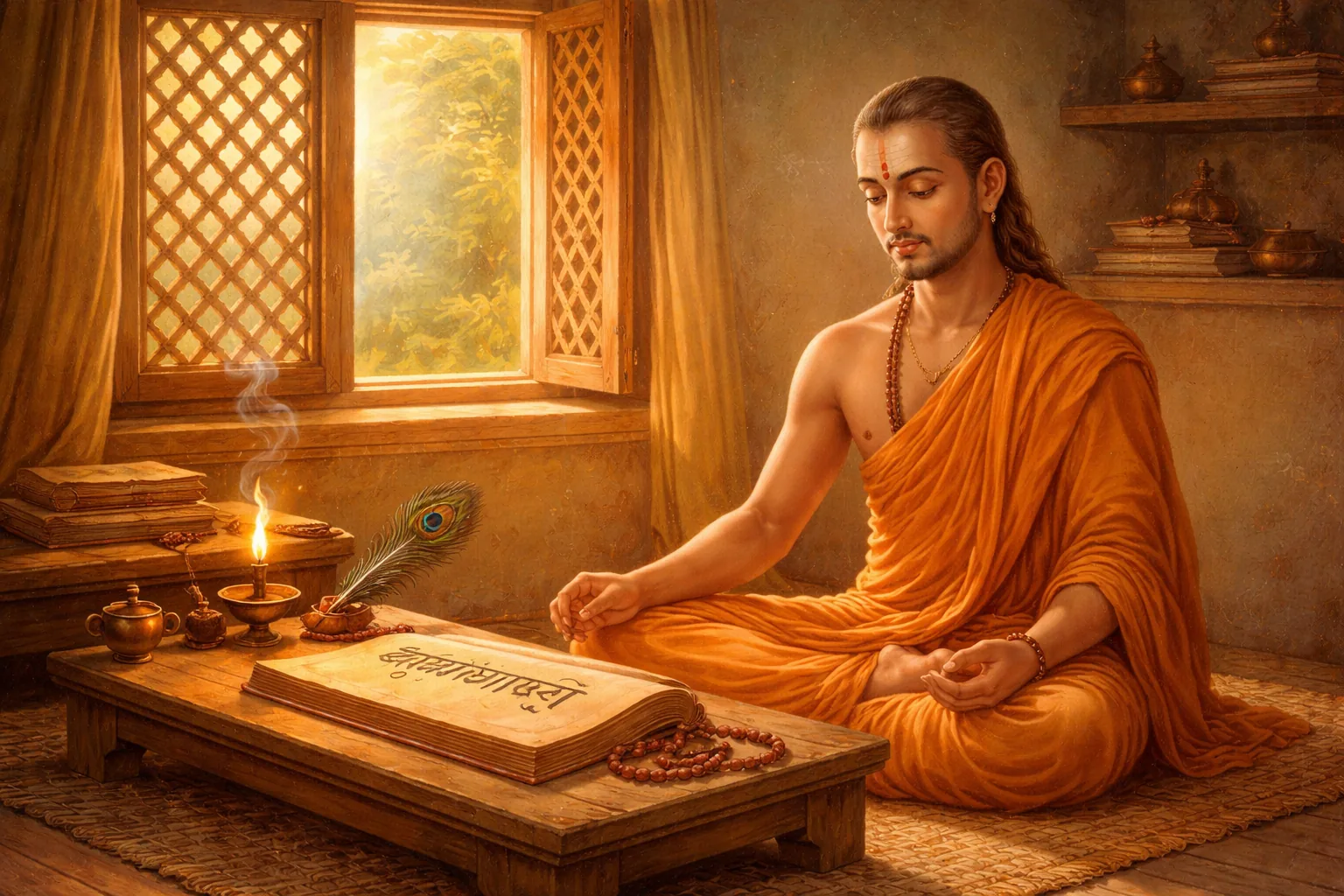
Commentary on the text “Brahmanachintanam” by Sri Shankaracharya
Divine Pride
The essence of one god or another is different from My nature. Whoever worships other gods in this way does not know Brahman and falls under the power of the gods, like cattle under the yoke.
This is the fundamental principle that should be understood in the relationship between one’s consciousness and the Absolute, manifested in statues, deities, and other people. From the point of view of Advaita, dualistic worship is unacceptable. For us, the practice of worship is always the principle of non-duality, of integration.
In the dualistic traditions of bhakti (Vishishta-Advaita), dualistic worship is acceptable, since it is considered that there is always a subtle boundary between the soul and the Absolute. However, the saints say that dualistic worship is suitable for souls that are not yet able to contain non-duality.
A bhakta motivates his dualistic worship by saying that it is better to eat chocolate than to be chocolate; that is, it is better to receive pleasure and bliss from the practice of worship than to dissolve into the unmanifest, into the impersonal aspect. However, dissolution into the unmanifest, into the impersonal aspect, is not the essence of worship. On the contrary, the saints warn that absorption in the unmanifest void is one of the traps.
By and large, true enjoyment of chocolate is possible only after you have realized non-duality and avoided being seized by unmanifest emptiness. At the same time, you have again entered into the perception of energies, into the vision of all qualities; nevertheless, now this takes place on a completely different level than in dualistic worship. And then all energies manifest, but they are seen as the manifestation of one’s own “I.”
In other words, when we practice non-dual contemplation, or Brahma-bhava, we do not allow our mind to be subjected to any dualistic perceptions (visions, sounds, etc.), or to recognize anything as different from our non-duality. At the same time, there is also no rejection of visions or any divine manifestations.
I am the Atman. Truly, I am Brahman, untouched by sorrow. I am expressed as being, consciousness, and bliss. And My essence is eternal freedom. I am Brahman. Whoever lives with this faith unceasingly will not commit a bad action, and neither difficulties nor evil will touch him. I am Brahman. And with this affirmation, constantly follow your path happily. Whoever, even for a moment in meditation, realizes himself as “I am Brahman,” will destroy even his grave sins, just as darkness dissolves in the rays of the rising sun.
Like a bubble, ether arose from Brahman through the power of maya. From ether, air manifested; from air, fire; and from fire, water. And the waters gave birth to earth; earth, to grain and rice. And at the same time, earth dissolves into water, water into fire, and fire into air. Air merges into ether, and ether into the unmanifest. The unmanifest dissolves into the pure one Shiva. This supreme Shiva am I.
The external material phenomena of the universe, the five elements, manifest from the primordial state. The practice of divine pride is a continuous attunement to this primordial state, bhava.
Mistakes in the Practice of Divine Pride
When a yogin tries to maintain such divine pride, at the very beginning he has many deviations or mistakes. For example, he becomes distracted and loses attunement to bhava because of thoughts and affairs. In the beginning he had some elevated state; then he began to project atma-shakti from himself and radiate inner energy, that is, to think, to do something with his hands, to radiate speech—all these are different kinds of radiation. Mental, verbal, and physical energy are all the radiation of prana. Since this is prana of a lower level, the yogin is knocked out of Brahma-bhava. This is distraction.
Lack of diligence is a state in which we simply do not concentrate on bhava, when we do not have the proper perseverance.
Another mistake is weak faith, that is, doubt in the liberating power of the Supreme Source, when we think: “Does this svabhava exist? Perhaps it does not exist at all? Will it liberate us or not? Is the Absolute really in my heart, or is all this my own invention?” That is, this is a lack of faith, when our mind has not yet acquired an attunement like the needle of a compass. We think: “Is the Guru a human being, Brahman, or simply a sage? And who am I myself?” We are tormented by such thoughts. We have a deep bewilderment with regard to everything.
In the initial stages this is normal, but as the mind is purified, we begin to see everything as it truly is. Our vision changes substantially, it turns upside down, and then mountains cease to be mountains, rivers—rivers, dogs—dogs, men—men. Instead of perceiving in duality, we perceive the world in another way, an absolute one.
To perceive the world in an absolute way means to stand at the center of this world, at the center of the universe, and then the entire universe revolves around the deep center of your “I.” You see that you yourself are the center of the universe, and everything external is a manifestation of the energy of this center.
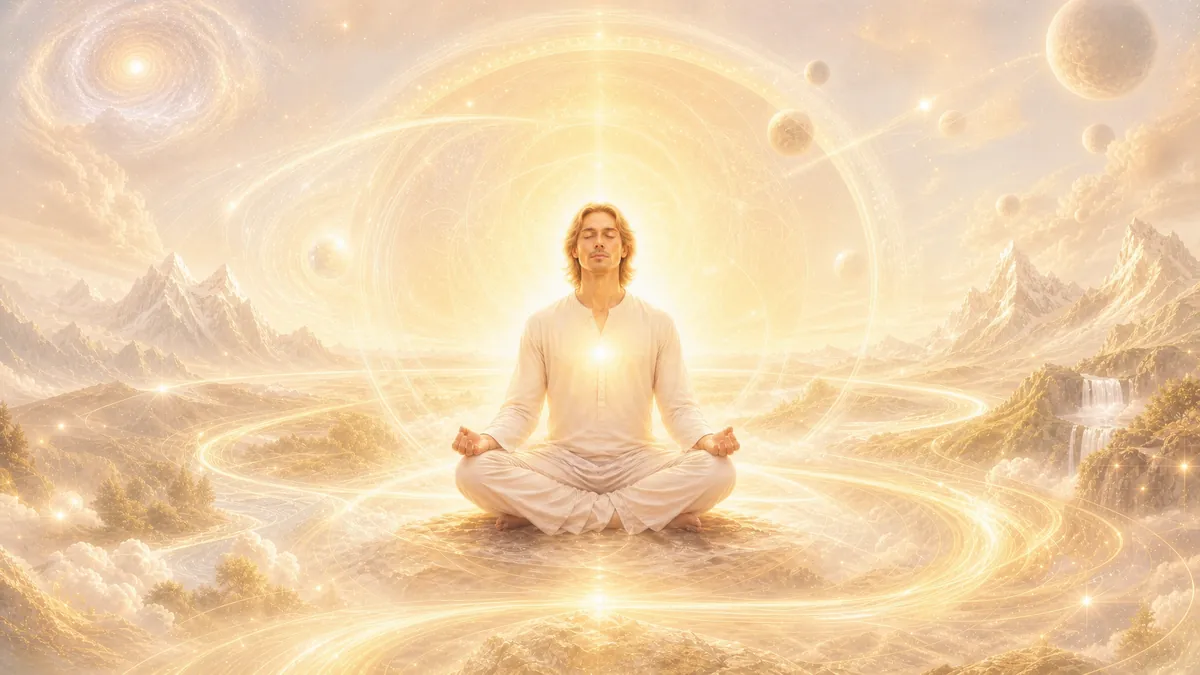
From the point of view of the center of the universe, everything is seen as it truly is. It is precisely when we are at the center that we can understand the principle of bhava, the natural state. But how can one constantly remain in this center and not leave it? To be at the center means to be in the natural state.
It can be said that unawakened living beings are eccentrics who have been distracted from their center and wander along the periphery. When you contemplate directly with naked awareness, when you abide in atma-vichara, you move toward the center. When you let go of egoistic perceptions, allow the open mind to lead you and carry you along, then you fly toward the center. And when this experience of greatness, transcendence, and power within you already gives rise to bhava, then it can be said that you have almost arrived at this center. It is impossible to arrive there completely, since this is an infinite process. This center always exists; it is right here in the present moment, but it often seems a mystery to the conditioned mind, which cannot in any way grasp where this center actually is. Brahma-bhava, if we hold to it tirelessly, gives a direct sense of this center.
The next deviation, or mistake, is dullness, when the bhava is unclear, not vivid; that is, there is some kind of feeling, but it is not very deep. There is also agitation, restlessness, when against the background of bhava many thoughts arise that do not self-liberate.
Often, when we do something or think, we become absorbed in doing or thinking, but it is necessary to understand the following: what you do and think is not important; what matters is the status in which you do and think it. Imagine, if a master thinks or acts, then everything he does will be masterful. But if an amateur thinks or acts, then no matter how much he fusses about, his actions will be amateurish. Why does this happen? Because the status of consciousness is very important, that is, the level of awareness.
When we understand this, it becomes easy for us to practice maintaining bhava. We know that the most important thing is to be in this state, and then all other actions will be impeccable; they will flow from this state. The results will be an order of magnitude higher if we act from this state. Then restlessness goes away, and we relax. That is, no activity can disturb us or narrow our mind, because we have tremendous clarity, and we know that with such clarity we can handle anything.
We can manifest clarity in such a way that, without any difficulty, we can examine this situation from seven sides and choose the optimal option. That is, our clarity allows us, in a single instant, to sort through many options and choose the optimal way to influence the situation in order to harmonize it or achieve the completion of some task. And at the same time there is no tension, no feverish thinking. Everything happens as naturally as breathing or digestion, that is, by itself.
This is the result of clarity that appears as a result of continuous immersion in bhava, because Brahma-bhava is the consciousness of a deity, and a deity possesses multidimensional creative consciousness; therefore, what is a miracle for a human being is an ordinary matter for it. Then suddenly we relax; no activity disturbs or puzzles us anymore. We act as if playfully, in a relaxed way, abiding in presence, in bhava. We have no confusion before anything.
Another mistake is excessive effort, when, instead of attuning ourselves to bhava, we try to artificially invent it. We straighten our shoulders more broadly, walk pompously, and proudly repeat to ourselves: “Aham Brahmasmi!” But this is artificiality. We can concentrate strongly on this, we can even somehow inflate ourselves and actually feel a certain inspiration. In principle, such efforts will bear fruit up to a certain level, but by and large, the practice of maintaining bhava with effort comes from the mind and the ego.
At the initial stage it may have an effect, but at later stages one should discard effort, relax, and move to a level beyond the ego, that is, to the transcendental level, when we understand that bhava does not depend on us, that it simply exists, and we simply need to attune ourselves to it. Effort only shrivels the mind within the egoistic sphere. Weak effort means that, on the contrary, we do not apply enough strength to maintain the necessary attunement.
These are the main deviations and mistakes.
Methods for Overcoming Deviations
How can one get rid of such deviations?

When distraction and loss of attentiveness occur, one should apply vigilance, which controls attentiveness.
In the case of the error of lack of diligence, one should show determination by expressing the sankalpa to practice in short intervals, paying attention to quality.
When contemplation becomes dull, one should perfect contemplation through naked awareness, that is, train in Shambhava-mudra, in the application of sankalpa. One may apply the method called “the mother feeds the son,” when you open your eyes wide and integrate with external objects, with the manifestations of nature, thereby allowing the mandala of the body to be saturated, that is, you activate the perception of external objects. Or, to put it more simply, you awaken enthusiasm by looking at the external world while remaining in integration with it.
When there is agitation, one should let go of oneself and relax, reflecting that everything is an illusion, like a dream, reflecting on eternity. The method of reflecting on vast intervals of time (kalpas, eons, yugas) is often used in Kashmir Shaivism and gives an amazingly calm state of mind.
If the effort is weak, then for a time one should stop, become still, cease activity, and generate a one-pointed attunement to contemplation. And if the efforts are excessive, then one should let go of oneself and the situation, imagining oneself as a bundle of straw on the road. In this way, all deviations in the practice of contemplation are overcome.
A Change in Ontological Status
I am Vishnu, I am Vishnu, Vishnu is I. And who performs actions? Is it I? Who enjoys or grieves? Is it I? Truly, all such notions are merely the offspring of ignorance. I am unshakable and boundless. I am Govinda. I am Shiva. I am filled with the highest joy; infinite am I, unborn, immortal. Eternal am I and unchanging, bodiless and indestructible. I am being, consciousness, bliss. And in my essence I abide beyond the five bodily sheaths.
The practice of divine pride should truly change your status. If you hear “I am eternal,” while you yourself sit there looking utterly dejected, this means that right now you are fundamentally missing the mark in some way; that is, the darshan is passing you by. This is what you should allow into your soul.
When you practice, you change your status. Enlightenment presupposes nothing other than a change in one’s ontological status, one’s perception of oneself, when all frameworks are removed from consciousness, when you begin to see yourself differently. Until these frameworks are removed, you cannot change your ontological status. One may endlessly raise one’s intellectual level, fill oneself with new knowledge, techniques, transmissions, and philosophies, yet still remain the same being with the same ontological status. To change one’s ontological status means to begin perceiving oneself differently, to change one’s self-assessment. That is, not merely to improve it somehow, but to change it radically.
Such a radical change in self-assessment does not happen in one day. It is the result of nurturing, cultivation, and habituation. When you do this day after day, you gradually enter into a new vision.
Imagine that there was a person from some poor village family who desperately wanted to enter high society, the bohemian world. Perhaps he did not possess the appropriate qualities, but he always dreamed of a beautiful life and strove to enter high society. He made great efforts, established the necessary acquaintances, and imitated these people from high society. He was thrown out of there by footmen many times; nevertheless, he was very persistent and tried to reflect on how people of high society think and live. He thought about what their ideals and values were, why he could not get there, and what he had to change in himself in order to become a member of the elite circle.
Finally, he understands that in this elite circle there gather people with certain values, with creative potential, and that they have an entirely different consciousness. Suddenly he sees that his potential is insufficient to get there, that he must develop certain qualities within himself, and he develops them. Having developed these qualities within himself, he suddenly becomes the possessor of even greater qualities, and then all of high society is glad to see him; he is welcomed and invited. One could say that he now becomes a trendsetter of this high society. And this happened as a result of his acquiring all these higher qualities.
In essence, when a mahasiddha in meditation sees gods inviting him to the heavens of Indra or making an offering to him, it is the same thing. By virtue of what does this happen? By virtue of the fact that the mahasiddha has completely changed his self-assessment, has ceased to have frameworks and limitations in consciousness, has acquired boundless creative consciousness, and has begun to feel himself to be the Absolute.
Our task is not to enter high society or some kind of heaven. This is merely a metaphor. Nevertheless, this is approximately how everything happens.
Awareness of Eternity
I am not the doer and am not involved in action, nor is enjoyment mine. I am connected with nothing. I am the highest of the Lords. All the organs of the body work ceaselessly because of My presence in it. I have no beginning, middle, or end.
Just try to feel this right now: “I have neither beginning, nor middle, nor end.” As soon as your thought begins to develop in this direction, you will immediately feel changes in consciousness. “I have no beginning.” Usually you identify yourself with some year of birth. However, if you have no beginning, then this means that behind you are billions, quintillions, quadrillions of kalpas. This is simply incomprehensible.
Even simply reflecting on the fact that your consciousness has no beginning completely changes the perception of the world, time, and your own little destiny against this background. You see that your current destiny is simply a drop, a spark; it is the consequence of all the quadrillions of years of your evolution. The fact that you have come here is the result of the intersection of karmic threads created in countless billions of lives. And then the present life becomes not so important after all; egoistic clinging to it falls away. You feel yourself to be part of something greater, something more global.
The same can be said with regard to the future. Of course, the bodies of living beings die if they have not yet attained physical immortality. Nevertheless, consciousness is immortal. It is eternal and will live through countless kalpas. Whoever gains rebirth in the worlds of the gods will live for thousands of years by the standards of the gods. Whoever, in samadhi, becomes a god of the world without form will live for thousands of kalpas. Consciousness has no limitation in the future either, although the body does have such limitations.
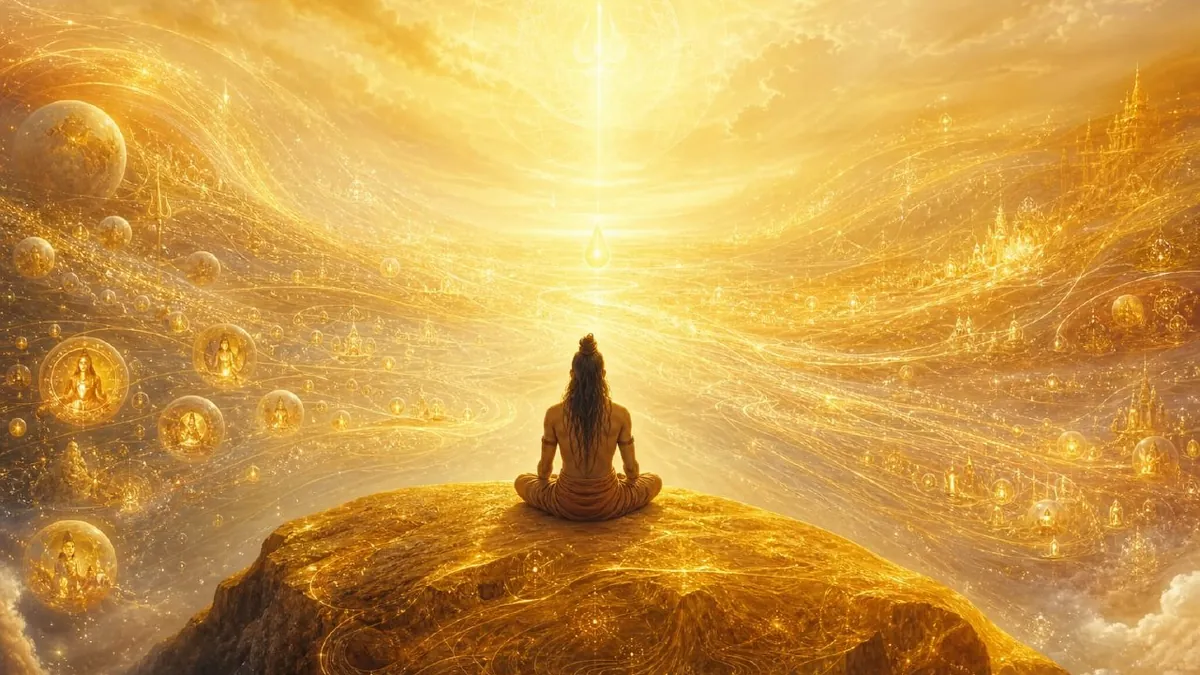
When you reflect in this way, your consciousness instantly abstracts itself from the momentary situation and looks at the world in a completely different way. And then bhava is born within you. You see that there is nowhere to hurry, because eternity lies behind you and eternity lies ahead. And the main thing is to be in this state of awareness of eternity, not to do anything. Then all fuss, anxiety, confusion, fear, hopes, and plans leave your mind.
To Be That, Not to Think About That
I am not bound by anything, ever. By My nature I am clear and pure. Truly, I am Brahman, and there is no doubt in this. Truly, I am Brahman, not a samsarin. I am eternally free, and establish yourself in this truth. If it is difficult to realize it, then at least repeat these words ceaselessly.
It is said: “What you think about, that you become. So cast aside your doubts and practice contemplation with determination.”
One sannyasin was constantly performing meditation, repeating “Aham Brahmasmi.” He came to Bhagavan Shri Rajneesh and said:
— I have been meditating on “Aham Brahmasmi” for twenty years.
Shri Rajneesh asked him:
— Are you repeating “Aham Brahmasmi,” or do you feel it?
The sannyasin replied:
— I myself have already become confused.
It is very easy to substitute the bhava of “Aham Brahmasmi” with the repetition of “Aham Brahmasmi.”
Ramana Maharshi gave this upadesha: “Do not think that you are That, but be That.”
To think means to have a mental concept, a model. It is merely a projection of the dualistic mind. But bhava is necessarily connected precisely with being. When we experience bhava, we do not think “I am Brahman”; rather, we directly experience ourselves as Brahman.
Ramana said it this way: “All is only That. Being That, why strive for That? Do not meditate, but be. You already are That.”
As soon as you enter into attunement with bhava, your practice changes, because for you it is more important to be than to do something. At the same time, in the relative dimension, you continue to perform all practices, but now all practices are performed under the sign of Brahma-bhava. One can say that this is a means of cultivating and nurturing bhava. The combination of relative practices and the absolute view or bhava is the greatest difficulty for inexperienced practitioners, because they often confuse these two sides of practice.
Integration of Method and Bhava
One person said: “I don’t know how one should recite a mantra.” I looked at how he was reciting the mantra and saw that he did not know about the three main deviations. I told him: “A mantra must necessarily be integrated with bhava.” In the same way, asanas, pranayamas, and any techniques must also be integrated with bhava. Some people become confused in their minds because the mind clings to methods and techniques. I usually ask such practitioners this question: “When you brush your teeth, doesn’t your mind cling to this activity?” He says: “No.” Then I ask: “And how is brushing your teeth different from what you do during your daily practice? After all, it is the same kind of method; only it is connected not with cleansing the teeth, but with cleansing prana or the mind.”
When we find the golden mean, method and wisdom are balanced. We know that there is wisdom, and it gives bhava. We also know that there is a method, and it helps to reveal bhava. Whoever ignores one to the detriment of the other is a short-sighted practitioner. Without a method, no matter how hard you try, you will not reveal wisdom. Without wisdom, the method is an empty shell. The unity of method and wisdom—this is the essence of the teachings of the siddhas. When you have advanced in the practice of contemplation, wisdom itself becomes the method. However, this is possible only when you have fully become established in wisdom.
The Principle “What You Think About, You Become”
What you think about, you become, as in the example of Bhramara and Kita.
This is a traditional example in the Vedic scriptures. They are two insects, one of which constantly runs away, while the other constantly gives chase. And the insect that runs away is so afraid of the one chasing it that it constantly meditates on it and takes on its form in order to deceive it.
For example, a person who has a critical consciousness constantly thinks judgmentally about certain people. And he thinks this way for a day, a week, a month, half a year. Specific impressions have already appeared in his soul. This is already becoming his style of perception. And after some time he himself becomes what he thinks about; that is, he has integrated—this is the essence of the principle. Another person praises the elevated qualities of the people around him; he tries to see God even where it would seem completely impossible to find Him, that is, in something primitive and ordinary. After some time, this leads to a most powerful upheaval in his consciousness, and then he begins to see that he himself possesses the same elevated nature. He discovers God within himself, although earlier he considered himself a completely ordinary, even primitive person. Suddenly, a complete re-evaluation of himself takes place within him.
These were examples of how thinking can be used. Thinking is very plastic. We begin with something small, and over time our mind unfolds an entire universe. That is why it is said that we always become what we think about. The principle of maintaining bhava is always extremely positive thinking, which includes any manifestations. One could say that the Absolute is the ultimate positive, which lies even beyond the duality of “positive-negative,” and is capable of containing even the negative within itself. Nevertheless, one can say that it is the ultimate positive. Attunement to bhava is also an extremely positive absolute perception of oneself.

Overcoming Karmic Tendencies
If, because of past karmas, a person feels dissatisfied, then in his soul he becomes a hungry ghost. It would seem, why should he not feel satisfied while meditating on bhava? But no, his mind will inevitably come up with something to be dissatisfied about, because such is its tendency; this is how old karmas manifest. In such a case, a person must detect this tendency within himself, rap his bad mind over the knuckles, and constantly reorient it toward an absolutely positive perception of himself, generating divine bhava and attuning himself to it.
If you were right in your vision when criticizing someone or being dissatisfied with something, then others would have the same consciousness as well. However, this is not so, because someone else near you is constantly in joy, in happiness, in bliss, in an elevated state, and looks at another person or at the situation with completely different eyes. This means that everything depends on consciousness. And if this is so, then you can completely change your perception by changing your consciousness.
To train in bhava means to constantly change one’s perception, even if it changes with difficulty and slowly, even if it is inclined to perceive everything in the old way. We must constantly oppose it with Brahma-bhava and self-liberate the inner data. This is precisely what monastic practice consists of.
Monastic Practice in Everyday Life
You can immediately notice who is doing monastic practice and who is not, who is specifically missing the mark. A single fleeting glance is enough for this. You must remember that your monastic practice is your most important task, while building fences, preparing prasada is your secondary task, which in no way interferes with the main monastic practice. It is absurd to think that monastic practice can be done only in retreat. Nothing of the sort. Sometimes in retreat it is even harder to do it, if the pranas have not been purified. Monastic practice accompanies a monk’s life every second, from getting up to falling asleep, and ideally even at night. Moreover, among services it is much easier to nurture it, if the mind does it correctly.
When you practice the path of bhava, your soul and heart are necessarily purified. It should not be that years go by and you remain with what must be discarded, because this is either a deviation in practice or you are making some mistakes.
Signs of Spiritual Progress
There are specific signs by which one can judge whether you have spiritual progress or not. Of course, they do not manifest immediately.

The initial signs in dreams are as follows:
- Seeing yourself naked in a dream is a sign of purification from obscurations and karma.
- Seeing that you are ascending to the upper floor of a house, up a mountain, up a staircase into the sky is a sign that bhava is being nurtured, that you have deeply entered the path. Sometimes you may see an elevator carrying you into the sky, or a bus climbing such a steep mountain that you become frightened whether it will be able to get up there at all. This is a sign that consciousness in a dream is being transferred to a higher dimension. And then you arrive in some place where there are many temples, or where there are exalted people who greet you with smiles. If your consciousness in dreams goes to higher worlds, this is a sign of purification of the mind.
- Seeing saints and deities transmit the teaching.
- Seeing saints and deities separate from yourself.
- Seeing yourself as equal among saints and deities.
- Seeing yourself in dreams in the form of a saint or deity whose essence is empty, who has no front or bottom, that is, no particular concrete form.
- In dreams, while seated on an adorned throne, receiving honors and abundant offerings from many living beings: gods, dakinis, people.
- In dreams, receiving praise from divine beings, invitations to teach them, assurances of devotion, requests for blessing.
- Seeing yourself feeding all beings in the universe.
Signs indicating an approach to attainment:
- Seeing in dreams that you are riding lions, elephants, tigers.
- Feeling yourself in a dream as a bright sphere, a flash of light, the perception of which is not interrupted.
- Experiencing Brahma-bhavana in a dream, when consciousness is not interrupted.
Time Frames of Attainment
So cast away your doubts and resolutely practice contemplation of the truth. Through yoga, through meditation for one month, one can be freed even from grave sin. Whoever practices meditation unceasingly for one year acquires the eight supernatural powers. And whoever meditates constantly throughout life attains liberation even in this very life.
Shankara, apparently, was writing about himself regarding one year and one month.
A disciple with good abilities obtains the results of accomplishment in about three to five years, one with average abilities in eight to twelve, and one with low abilities in twenty or more. Everything depends on how intensely Brahma-bhavana displaces one’s own karmas. If you have strong faith and one-pointed practice, this process happens rather quickly, and then your self-perception changes. But if a person’s obscurations are strong and contemplation is unstable, then he may contemplate for only twenty minutes a day, while remaining in his karmas for twenty hours a day. That is, everything depends on whether the displacing ratio is achieved, when for most of the day bhava abides in your heart and displaces all impure karmas.
