

When you perform sadhana with the Om mantra, you listen attentively to the sound vibration. This sound vibration is threefold. The initial syllable “A” indicates creation, the syllable “U” — maintenance, and “M” — dissolution, destruction. And the silence and absence of thought after “M” indicate the unmanifest. These three syllables signify the three states of consciousness — waking, subconsciousness, and superconsciousness. And the absence of thought after “M” points to turiya.
When we recite the Om mantra in the style of laya-yoga, anuttara tantra, we learn not to separate these three sounds, listening attentively to the unity of all sounds. We listen to the sound and try not simply to concentrate on it, as happens in ordinary raja-yoga practice, but to integrate ourselves with it, that is, to unite contemplation with sound. The process of reciting the mantra in contemplation is a thousand times more effective than reciting the mantra merely in concentration, because the true essence of the mantra manifests when we are present while reciting it. Thus, the practice of reciting the mantra serves as a means of deepening contemplation.
The Difference Between Anuttara Tantra and the Lower Paths
The style of anuttara tantra practice always differs from the lower paths or preliminary practices. It differs in that we integrate, reunite, and blend everything. And while in relative sadhanas one can successfully practice kundalini yoga or recite a mantra, engage in walking practice, or perform the ritual practice of a particular deity in the hope of attaining siddhis or a mystical experience, in anuttara tantra all these practices are supplemented by a completely new dimension — the presence of nondual awareness, the understanding that subject and object are inseparable.
While in dualistic bhakti yoga a bhakta worships a saint or deity in the hope of receiving their blessing or grace, hoping through such worship to cast off their ego and dissolve it, in laya-yoga every sadhana is accompanied by an understanding of nonduality and the presence of contemplation. In other words, a new dimension is always added to your practice — invisible, yet present — which reveals the very essence of your practice, revealing its true spirit.
In other words, you do everything consciously, and then your ritual practice, technical and basic practices acquire an entirely different meaning than they have in ordinary forms of tantra. They emphasize and deepen your natural state. One could say that you do not want anything specific from them or from them in themselves, but want only the Supreme, because your consciousness is deeply immersed in the natural state. Then the method and wisdom merge. You cease to be limited by your ego, your sense of being a practitioner, and your desires. From the very beginning, you enter into perfection, into the absolute state, while practices are methods that emphasize and deepen this perfection. This is the only way to truly overcome duality while practicing and enter the path of the supreme vehicle.
There is a story. Two monks meet. One is walking joyfully and uplifted, while the other is sad and tense. And the joyful one asks the other: “What are you constantly thinking about?” “What do you mean? Day and night I think about enlightenment, and I suffer because I still have not attained it.” Then he asks the first monk: “And what do you think about?” He replied: “I think about God.” This is an example of correct and incorrect practice.
A person who thinks about enlightenment based on their limited notions, from the ego, will never go beyond their personality. Even if their desire is so strong that they somehow manage to go beyond it by some extraordinary means, they will still have to think about the Supreme Source, not about their own limited enlightenment. When we direct the mind toward the Supreme Source and do so correctly, enlightenment is attained by itself. Directing the mind toward the Supreme Source is a distinctive feature of anuttara tantra. There is no place here for the egoistic desire for liberation.

Liberation as an Intermediate Goal
The saints say that liberation is not the ultimate goal of spiritual practice. It is an intermediate goal, meaning that it is genuine but not final. In other words, liberation is a certain level that arises at a particular stage of natural contemplation, but after liberation, practice continues. Gods, saints, and mahasiddhas continue their reunification with the Absolute. Only now it ceases to be practice and becomes something immeasurably more global, subtle, and exalted. Yet this movement does not cease even after liberation, after attaining immortality. Saints, gods, mahasiddhas, and the great gods who create universes—all of them meditate on absolute truth in accordance with their own understanding.
Once, Neem Karoli Baba was asked about yoga and attaining liberation. He said: “Yes, I practiced asanas, pranayamas, and so on. But then I realized that love for God is the most important thing.” Asanas and pranayamas express the method, while love for God is the path of contemplation and entering the natural state; it is meditation on the Absolute and complete self-surrender; it is wisdom. The method must always be subordinated to wisdom. When we have such wisdom, we can perform asanas while uniting them with contemplation, or carry out any kind of work. Ultimately, we must reach a level at which practice and non-practice have the same “taste,” when every action becomes reunited with the natural state.
The Three Golden Rules of the Teaching
“This is Brahman, without parts, unchanging, stainless. Knowing, ‘I am this Brahman,’ a person undoubtedly attains Brahman.”
The teaching contains three golden rules. The first means becoming acquainted with the view or receiving direct introduction, the second means cutting through doubts and gaining clarity, and the third means remaining continuously present. In fact, understanding the three golden rules means grasping the very heart of the teaching.
Becoming acquainted with the view means entering nonduality, recognizing one’s nondual nature, and receiving such a flash of insight that clearly reveals the nonexistence of the “I” and complete unity with the Absolute. It means unveiling divine pride. In Sanskrit, this is called “brahma-aham-bhava,” that is, the worldview “I am the Absolute.” As soon as you have even a momentary flash of such a worldview—when your mind receives transmission during meditation, during the guru’s darshan, or while studying the teaching—it can be said that the first golden rule has been fulfilled.
Then you must cut through all doubts, make certain that this is the correct state, receive some confirmation from sacred texts or from a spiritual teacher, and continue working with it. Next, it is necessary to remain continuously in this state so that it may gain genuine strength and become very deep and vivid. Once this state has gained strength, it is necessary to give it flexibility, to train it under strain, to test it in pure vision, amid destabilizing or shocking states, in harsh conditions or during pleasures—in other words, amid the entire diversity of energies, with their instantaneous release. This is the final stage of training, which distinguishes an ordinary yogin from a siddha.
Recognizing the Unchanging and Infinite
“Having recognized the unchanging, infinite, causeless, and incomparable, immeasurable and beginningless, he realizes the supreme good.”
What does it mean to uncover the natural state, unveil divine pride, and recognize the unchanging within oneself? The unchanging is that which does not change with time, with metamorphoses, or with anything external. Some say that it is the inner center, the observer. I would not rush to put it that way. Of course, it is both the inner center and the observer, but this is only the very beginning.
The inner center develops through ordinary satipatthana and ordinary, superficial atma-vichara. But this is only the beginning. The inner center simply means a certain centered clarity, a certain attentiveness gathered into a single focus, which allows one to notice kleshas and desires and to self-liberate thoughts. But this is entirely insufficient; it is only the beginning.
Then this inner center is discovered not as a center at all, but as a kind of space. It is both center and periphery; it cannot be defined in any particular way; it is neither inner nor outer. It is not merely an observer inherent in you, but a kind of global consciousness inherent in all living beings. It is not something personal that you carry inside your skull. In other words, the inner center subsequently develops into a global space. That is why it is said here: “Having recognized the changeless and infinite, you discover in this center an infinite depth that is inconceivably diverse and has no limitations.”
This depth surpasses the human intellect. You discover it as something inherent in yourself, something you have never lost. You begin to recognize it as your true essence. When such depth is recognized, you gradually come to see the entire world as equally deep. You see that there is nothing finite in the world, nothing superficial; everything is transcendent, sacred, and absolute. Then the veil falls from your eyes, and the external world, thoughts, and feelings no longer mislead you.
For example, if you perceive the guru as a human being, or perceive his teaching only through the mind, this too is a subtle illusion. The nature of the guru is infinity, which simply manifests in a finite form. If you perceive the monk sitting beside you as an ordinary person, this too is delusion. The Absolute is playing with you, having assumed such an appearance in accordance with your karma.
Deepening Contemplation and Divine Pride
“Having recognized the changeless, infinite, causeless, and incomparable, immeasurable and beginningless, he knows the highest good as well.”
Deepening contemplation consists in increasingly recognizing all these qualities in oneself. At first, of course, we have a certain experience that may be external. Then we gradually recognize these qualities in ourselves. However, saying that we recognize them in ourselves, somewhere within, is also a mistake. I would say that we recognize them not within ourselves, but as inseparable from our consciousness. Yet this is neither inner nor outer. A major mistake made by beginning contemplatives is to delve too deeply inward, ignore the external, and attach importance to the inner. In reality, there is neither inner nor outer. The natural state transcends subjective clarity.
When we try to recognize this, our knowledge of ourselves and our memory of ourselves as limited beings periodically surface, especially at moments when we lose awareness. Vigilance consists in constantly maintaining such recognition and believing in it. This contemplation is the natural state; it is Guru Yoga. It may be called true faith. Our old memory constantly tries to take hold of us and convince us that we are a small, limited being, but we must free ourselves from this influence and return to recognizing the changeless and infinite within ourselves.
Saints are those who continuously recognize their changeless, infinite nature. There is not even a second when they fail to recognize it. They have no conception of themselves as separate individuals. They always rightly regard themselves as infinite, absolute, eternal, and inconceivable. At the same time, there are saints who lose this state under certain influences. If their mind becomes slightly disturbed, they quickly lose it. There are saints who do not lose this worldview; their minds are very flexible. There are saints who will not lose it even under the most intense strain, because their level is even higher.

When we unfailingly recognize this state, it is said that divine pride begins to arise within us. It is mistaken to regard divine pride as a quality of the personal “I” or individual consciousness. Divine pride is divine precisely because it is not personal. It is the pride of the Supreme, yet it manifests in our body as a feeling of elevated consciousness, grandeur, and expansiveness; as an experience of globality, inner magnitude, breadth, and complexity; as an experience of inner unfathomability and depth; and as an experience of the greatest love, inspiration, and all-encompassing compassion. When we recognize the divine pride inherent in us, the egoistic view of ourselves recedes, our self-perception gradually changes, and spiritual practice truly begins to deepen.
Supportless Contemplation
“Here there is neither destruction nor origination, neither anything worthy of praise nor punishment, neither striving for liberation nor liberation itself—such is this Supreme Essence.”
When we try to trace the source of this divine pride, we see that it cannot be defined by any parameters; it is elusive, yet it is experienced. To establish our continuous consciousness in the invisible, indefinable, infinite, centerless, and to make consciousness supportless (nirālamba)—this is the path of true contemplation. In the Shiva Samhita there is the following expression: “There is one God—Nirālamba.”
For us, God is not associated with a name, form, or doctrinal dogmas, but with this supportless state of contemplation. The very idea of such supportless contemplation pulls the ground out from under the little ego. And until the ego has developed faith in this supportless consciousness, it may experience great confusion, a feeling that it is approaching an ocean that may engulf it. Hence the saying: “Forward, into the lion’s jaws.” This supportless consciousness is that ocean, and our practice is the gradual approach to it.
We must approach it with the utmost caution, attentiveness, and knowledge, and not lose ourselves in it. The aim of practice is not to become dancing lunatics. The aim of practice is for the ego to be restructured and to understand its subordinate nature, its constant and inseparable connection with this Source. Moreover, it must learn to draw strength from this Source, because the practitioner’s ego is the instrument we have for sadhana.

The Unity of the Three States of Consciousness
“One should contemplate the Ātman as one and the same in waking, dreaming, and deep sleep. Having overcome these three states, one is no longer born into the world.”
Some texts put it this way: “Just as everything visible in a dream—animals, houses, mountains, men, and women—is one great dream, so too this world, the dream world, and the world of dreamless sleep are likewise one great dream.” All these phenomena have the same nature, but this can be understood only upon awakening. A person who saw a multitude of objects in a dream, upon awakening sees their utter insubstantiality, understanding that they were merely acts of their own consciousness. In the same way, upon the great awakening, a saint sees the insubstantiality of all the objects of waking and dreaming, knowing that they all have the nature of consciousness.
A New Birth in the World of the Saints
When this vision has opened, the yogin must learn to live with it in the manifest world. On the one hand, the full opening of this vision signifies a certain enlightenment, but on the other hand, spiritual practice only begins at this point. With the opening of nonduality, spiritual practice in a certain sense comes to an end; from another perspective, one may say that it is only beginning.
A yogi who has realized nonduality feels like a newborn in the world of saints. They need to learn to look at the world anew, unite with energy, and manifest play, harmony, and pure vision. They are like a newborn god. They have left the human world and been born into the world of nonduality. Therefore, practice does not end with the realization of nonduality. One could say that from this moment on, we only truly begin to see the world and understand what it means to interact with the energies of this world.

And the further practice of contemplation consists in deepening it to such an extent that it becomes possible to unite it with energy and transform that energy. This process begins in the human body, but it has no end. It subsequently takes place in the body of a deity, in the body of the creator of the mandala of pure realms, in the body of a great god who creates universes, such as Brahma or Vishnu. The further development of contemplation is always connected with integration with certain energies (shaktis). In other words, this is contemplation that gathers strength and can manifest outwardly. When saints or gods want to determine the level of realization of nonduality, they demonstrate such shakti to one another. And it is precisely the degree of mastery of such shakti that indicates mature contemplation.
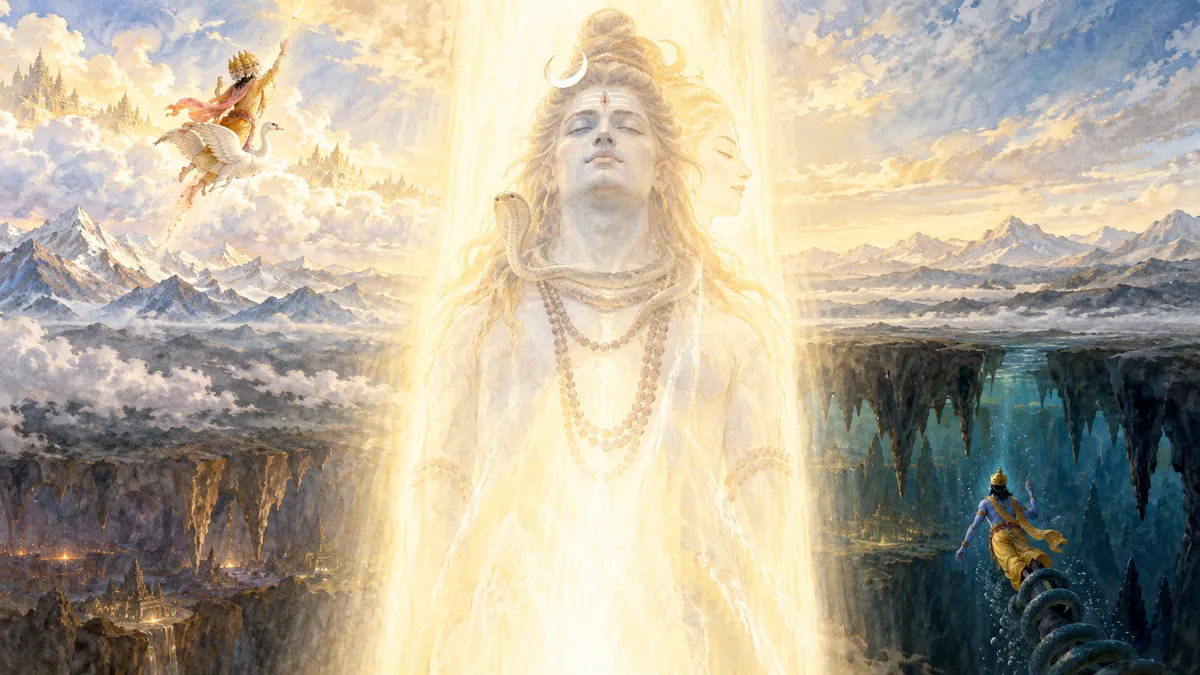
There is a story about how Brahma and Vishnu argued over which of the gods was superior. Needless to say, it was a play. Such stories should always be understood as metaphors. They argued about which of them was stronger and who had understood the principle of the Absolute more deeply. As soon as they decided to test one another, they suddenly saw an enormous pillar of light descending upon them. Then they decided to measure it. Vishnu descended downward—into the deepest abyss, into the densest matter, all the way to the realms of hell, while Brahma flew upward—to the most void-like abysses. But neither below nor above were they able to find the boundary of this pillar. Then the pillar diminished and took the form of Shiva. And then Brahma and Vishnu respectfully bowed before Shiva, acknowledging that he was the greatest of them all. Shiva demonstrated the depth of his contemplation in the form of manifested shakti.
Levels of Realization Among Saints
It can be put this way. There is a saint who has realized presence and enlightenment. There is a saint who can control the elements. There is a saint who has transformed their body into a deity. There is a saint who has not only become a deity but has also created a world, a mandala with its inhabitants, through the power of their thought. And there is a saint from whose every pore such worlds emerge from their divine body. All of these are different levels of the same natural state, and the difference lies in the depth and the ability to operate universal shaktis. Therefore, we say that with enlightenment, spiritual practice only begins—but it begins in an entirely different capacity.
