

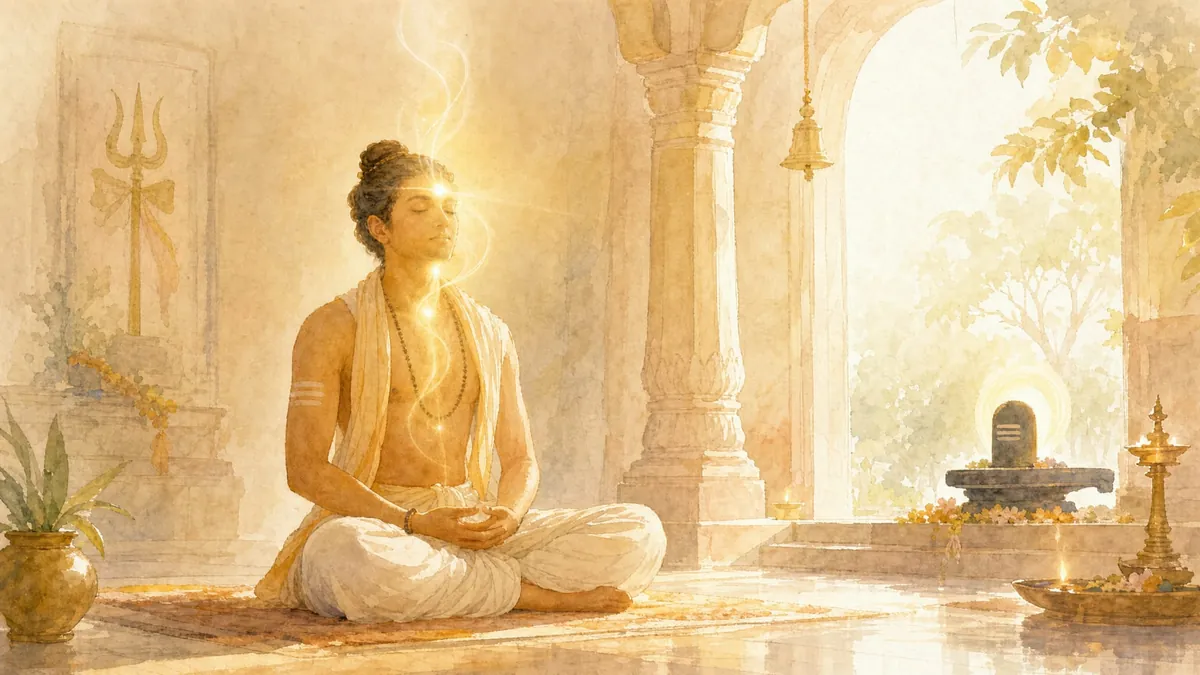
Channels and Winds
“Prana moves through the body in channels. It is believed that there are eighty-four thousand channels in the body or, according to other systems, three hundred and sixty thousand channels.”
According to the “Hatha Yoga Pradipika,” there are seventy-two thousand channels. Different systems contain discrepancies because in some, blood vessels are counted as nadis, while in others they are not. In some, manovaha nadis are counted, that is, subtler channels.
“These channels are divided into gross, subtle, and very subtle. The gross channels are blood vessels, nerves, and lymphatic ducts. The subtle channels are not material but energetic formations, similar to the meridians of the energy circulation system. The very subtle channels are the pathways of very subtle prana; they cannot be detected or measured, but they can be directly felt by a person with natural sensitivity or by a yogin who has developed such sensitivity within himself. Sometimes, to explain the relationship between prana and the channels, a comparison with a house is used. The body is the house, the channels are the electrical wires within it, prana is the electricity, the senses are the electric light bulbs, and the mechanical functions of the body are electrical appliances. If there is not enough prana, the bulbs will not light up or will shine dimly, the senses will not work at full strength, or the mechanical functions of the body will be impaired, or thinking will be unclear. The same happens if the channels are damaged or function improperly. Although such analogies are used, it would be a mistake to imagine the subtle and very subtle channels as material tubes through which prana flows. To bring the idea of them closer to their true nature, they can be imagined as pathways of light, a network of light permeating every cell of the body.”
There are channels that can be purified by pranayamas or by controlling the wind. If you apply the methods, you feel how a blockage of energy is broken through, as if an obstacle is being removed, and therefore prana can flow freely.
There are subtler channels that cannot be purified by pranayamas. They can be purified only by changing consciousness, entering astral samadhi, into a very subtle state of mind, entering deep samskaras in meditative concentration and changing something within them. These channels belong not to the energetic body, but to the astral, manomaya.
The Three Main Channels
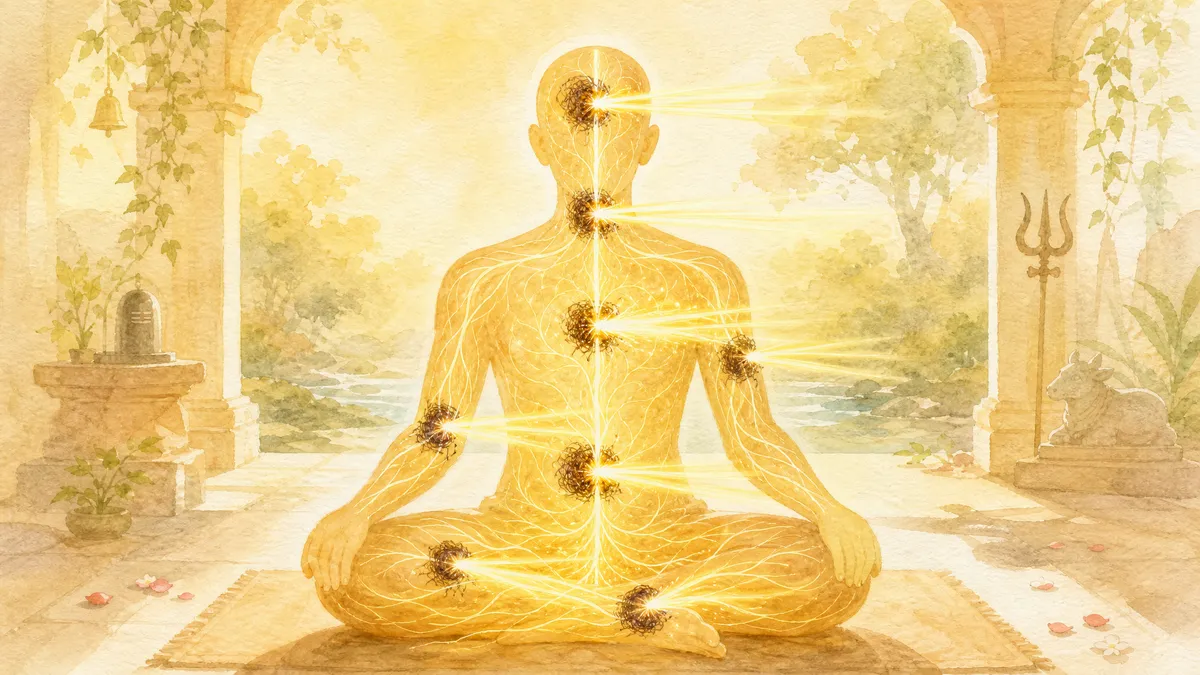
“Some of the channels are stronger and brighter, others weaker and less bright. In many yogic practices, three channels are used: the central one and two side ones.”
Some texts say: “The most important are ida, pingala, and sushumna; the rest are useless.” From the point of view of realization, everything consists in introducing prana into the two side channels and then awakening the central one. In fact, yogins need only the central one; however, it is difficult to reach because there are numerous informational blockages in the superficial and side channels. Therefore, one cannot avoid purifying the superficial and side channels either. That is, everything begins precisely with the purification of the channels.
Of course, our discussion of channels and winds in the context of the shakti yantra proceeds from the point of view that we understand that the shakti yantra occupies a subordinate position in relation to the prajna yantra. In other words, ideally, the yogin purifies the channels while remaining in the natural state and without being distracted from contemplation. That is, he is already immersed in this state, and from within it, feeling the need to control the wind, he performs various practices. It is precisely in this context that the discussion of channels and winds takes place.
“We visualize these channels in order to establish a connection with the prana moving through them. Although we visualize this only symbolically, figuratively, it directs our attention to the energy that is truly present in the body. The description of the three channels is as follows. The central channel is blue; it begins in the center of the body, four fingers below the navel, and rises straight upward along the midline of the body. It is the size of a thick fountain pen and, at the level of the heart, slightly widens toward its opening located at the crown of the head.”
Terms familiar to modern people are mentioned here. The ancient tantras say that the central channel resembles a goat’s intestine. Tibetans would know better what a goat’s intestine is. Or it is said that it resembles the shaft of a spear. The point is that the tantras are a flexible teaching, not something ossified or frozen. One of the instructions points to the need to choose an appropriate metaphorical language when transmitting the teaching. It also says that symbolic language in tantra is very important, and that depending on the language in which the teaching is transmitted and on how well the symbols correspond to a person’s consciousness, a person may or may not be able to receive the teaching. In accordance with this, Teachers periodically change metaphors and symbols so that they correspond as closely as possible to the perception of their contemporaries. I, too, am often interested in the problems of language in transmitting the teaching, since correctly chosen symbolic language makes it possible to come into contact with a person’s samskaras. Incorrectly chosen symbolic language may fail to convey something.
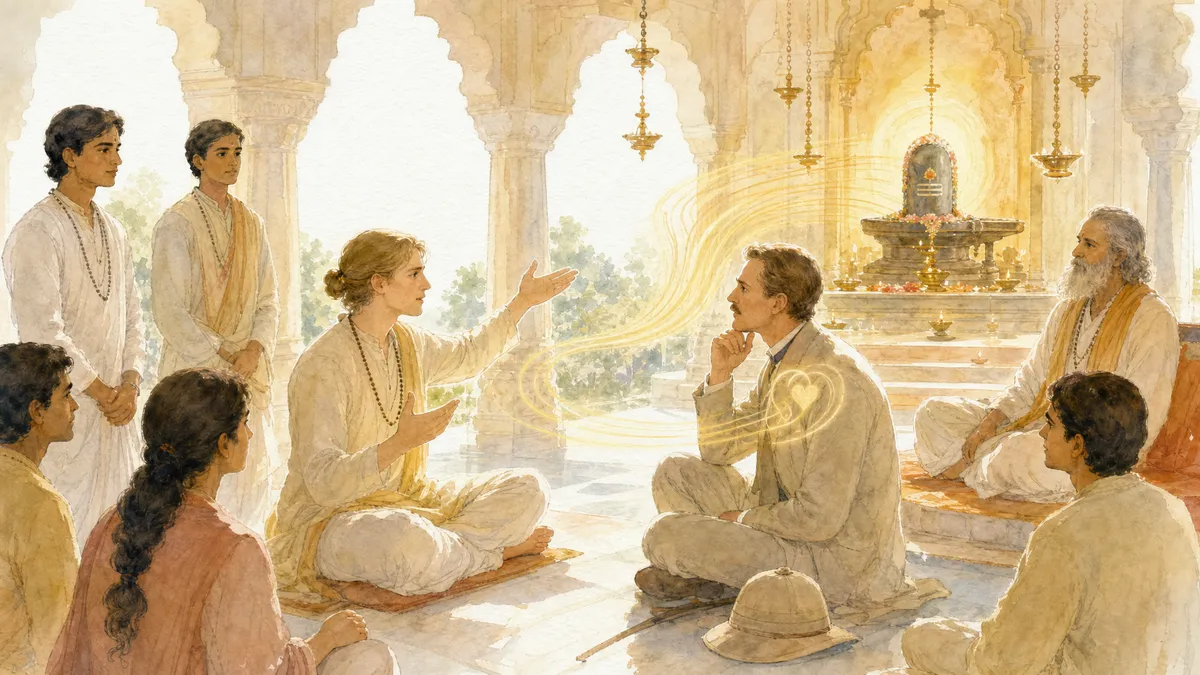
I read about how a wealthy English official in India entered a temple and saw devotees dancing before the deities and some practices being performed. When he, too, was invited to dance before the deities, he said:
“This is a religion for ignorant Hindus. Would I, such an intellectual gentleman, dance before dolls made of wood? This is not serious. I understand that one should practice, but this seems childish to me. I understand yoga, but dancing before little dolls is, in my opinion, not serious.”
Then they approached the Teacher and asked him:
“How can we explain it to him?”
The Teacher replied:
“I am unlikely to be able to explain this to him, since I am a Hindu, not a European. But I have a European disciple who can help explain it.”
The European disciple was quite advanced. He asked the official:
“Where do you work?”
It turned out that he was a scientist in the field of physics or radio electronics. Then this disciple said:
“You see, the deities are a kind of module for tuning your consciousness, which emits very subtle radio waves. Dance is movement; it is an encrypted code by means of which you tune in to these waves. And the basic source of these waves lies beyond the sphere of our consciousness. If you do this (dance), you will tune in to these waves and enter into resonance with the primordial space from which they emanate.”
Then the man said:
“Oh, this is very serious! Then I agree. This is truly real practice!”
He joined the practitioners and also began to sing and dance before the deities. That is, the wooden dolls ceased to be merely dolls for him. The man understood the true purpose of this action; he understood that it was a real practice, because its essence had been explained to him in accessible language in accordance with his metaphorical system.
“The side channels, as thick as a pencil, connect with the central channel at its base below the navel. They run upward through the entire body along the sides of the central channel, curve beneath the skull, pass behind the eyes, and open into the nostrils. In women, the right channel is depicted as red, and the left as white. In men, the right channel is white, and the left is red.”
It is considered that in women the left and right channels, ida and pingala, change places. In general, it is believed that women are more subject to the red drop (the energy of the earth), while men are more subject to the white drop (the energy of heaven). The red drop in mataji (women) means rootedness in the earth, in the body, and integration of the situation. The operational-instrumental part of the mind is stronger in them. Prabhu (men) are more rooted in the white drop, in heaven. The abstract-analytical part of the mind is stronger in them; there is less rootedness in the body and the situation, but a greater flight of abstract thought or imagination. It is believed that thanks to this, mataji possess greater flexibility in everyday affairs, while prabhu possess greater clarity in far-reaching goals and abstract matters. This is due to the fact that the red and white drops have different effects on the mind and body.
Karmic Prana and the Central Channel
Usually prana flows intensely through the side channels. This is karmic prana. It can be positive, negative, or neutral. There are different kinds of karmic prana. The central channel belongs to the category of the very subtle; within it flows prana that is the energetic aspect of nondual awareness, the natural state. If the nature of reality is described from the point of view of two inseparable aspects (form and emptiness, bliss and emptiness, or the natural state and emptiness), then it is precisely the central channel that is connected with the experience of the inseparability of the two aspects of apparent duality. In yogic practices of subtle winds and channels, the task is to open the main chakras and transfer prana from the side channels into the central channel. At the same time, the mind is freed from dualistic delusions, and it abides in nondual awareness, in the natural state. This is why, in the practice of returning the elements, the energy obtained back pours into the central channel. When prana is in the central channel, the practitioner can abide in the nature of Mind. Prana and mind always accompany each other; there is no mind without prana.
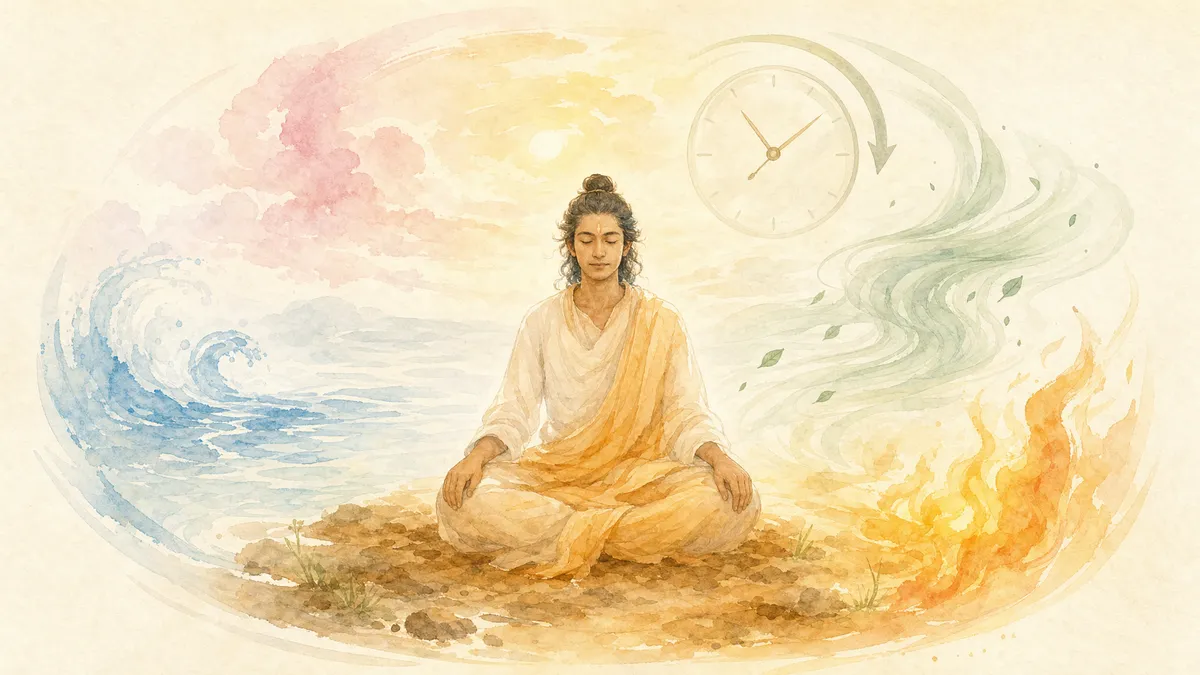
Over the course of a day and over the course of an hour, our state changes many times because different elements periodically change their influence. For example, at first we are subject to the earth element. We may have a more inert or stable state, and if there is a lack of clarity, a more dull or sleepy one. Then the influence of the elements changes, and the turn of the water element comes. During this period we are more flexible; mirror-like wisdom is active in us. If at this time we are engaged in some activity requiring flexibility, we will succeed at it. Then the dominant element changes again, the fire element begins to act, as a result of which our assertiveness and efficiency increase. Then a certain amount of time passes, the pranas change again, and the wind element begins to dominate. During this period, a state of magnanimity manifests in us; there is a tendency toward change or some kind of activity, for example we may display our talent in writing. Finally, the wind element changes to the space element, and a state of emptiness, deep clarity, arises in us. We do not want to do anything, only to meditate. If we try to do something, everything falls from our hands. There are people like this, for whom everything falls from their hands, whatever task they are given; that is, they definitely need to be supervised. This happens because they have an excess of the space element, which they are not yet able to cope with and connect other elements to. But in reality these are simply the elements, which periodically change their action in the body.
The rider. Tigli.
Tigli literally means a sphere or circle. This is exactly what is visualized in the practices—a sphere of light that is either located in the chakras or moves through the channels. Tigli, or bindu, symbolize the aspect of mind present in experience. This is the rider who has mounted the horse of prana. In the teaching on the relationship between mind and prana, there is such a metaphor: the mind is a lame rider, and prana is a blind horse. Without mind, there would be no one to guide prana; without prana, the mind could not move. They act as a single whole.
When we do not apply techniques, it is considered that we control prana solely through contemplation. It is believed that the elements and pranas of a yogin who has deep immersion in the natural state will, over time, balance and harmonize by themselves. This happens because he is whole; he has no egoistic attachments or obstacles, and therefore there are no energy leaks. Over time, the pranas begin to submit to the natural state and gradually are drawn into the central channel.
For example, someone who performs atma-vichara well may feel something like a cranial pump forming in the head, which draws prana from the muladhara chakra along the central channel up to the head. However, both atma-vichara and the practice of kundalini yoga can work only if your channels are fairly pure and the sushumna is also open. If your sushumna is not yet open and the channels have not been purified, you will not be able to raise prana through atma-vichara along the central channel into the head. But if you have succeeded in opening the sushumna, then even through one-pointed sitting meditation you can ignite white light in the area between the eyebrows and ignite golden light in the sahasrara chakra. For example, practicing one-pointed concentration on aham-vritti for ninety minutes, one can realize this.
At a higher level, the yogin does not even apply one-pointed concentration on the aham-vritti; he abides in an expanded state of letting go, similar to space, and constantly feels an ascending flow of energy, as if a wind were easily and continuously circulating in the body and being drawn upward along the sushumna nadi.
If you have mastered padmasana for an hour, kumbhaka for two to three minutes, and steadily perform pot breathing, then after some time your nadis will become so purified that you will be able to experience dardri-siddhi. Soon we will hold a seminar on attaining dardri-siddhi to help those who have not yet obtained it. This is the simplest attainment for a yogin; there is nothing easier. When you perform breath-retention practices for five days in a row, the body begins to shake and then to bounce in the lotus posture; sometimes it may bounce quite high. This means that the first stage of controlling the pranas has been attained by you.
“The visualized bindu may be a symbol of consciousness or of one of the qualities of consciousness, or of both. For example, a bindu in the heart may symbolize compassion; a bindu rising through the central channel may be a symbol of the nondual, natural state. A bindu or tigle flying out from the crown of the head may represent a person who, while dying, leaves the body, and the like.”
In visualization practices, the bindu symbolizes our mind gathered into a single point. For example, in the secret meditation a red cylinder is visualized, which rises and transforms into a deity. In dream yoga, in order to reach the pure lands, one must imagine oneself in the form of a bindu which, with the speed of a shooting star, is instantly transported to the pure lands, for example to the heaven of the Tushita gods.
As another example, this may occur in dream yoga. In the heart, five tigles are visualized, symbolizing the five goddesses of the pure essential elements, the pure lights.
Purification of the Channels and Obstacles
So, after you have studied in detail the structure of the nadis, chakras, and pranas, learned which practices should be observed from the point of view of energy, and become acquainted with the basic kriyas, you purify the channels. When the nadis are purified, certain signs of this arise: lightness in the body, calm breathing, a reduction of worldly desires, a reduction in the duration of sleep, a good appetite, absence of illness and fatigue, a strong voice, brighter eyes, and hair that had turned gray becomes dark again. Nada sounds are also heard in both ears, lightness is felt during seated meditation, and the circulation of pranas throughout the body is sensed. In those places where there are blockages in the nadis, problems may be felt. And if during this period the yogin practices concentration on the chakras or performs certain techniques, his karma may be washed away. That is, the time has come when he, as it were, opens up old karmic debts or sins, and his body signals this. When such obstacles arise, the yogin seems to run into a kind of blockage in his energy body. If there are no obstacles, then the technique of purifying the nadis proceeds smoothly.
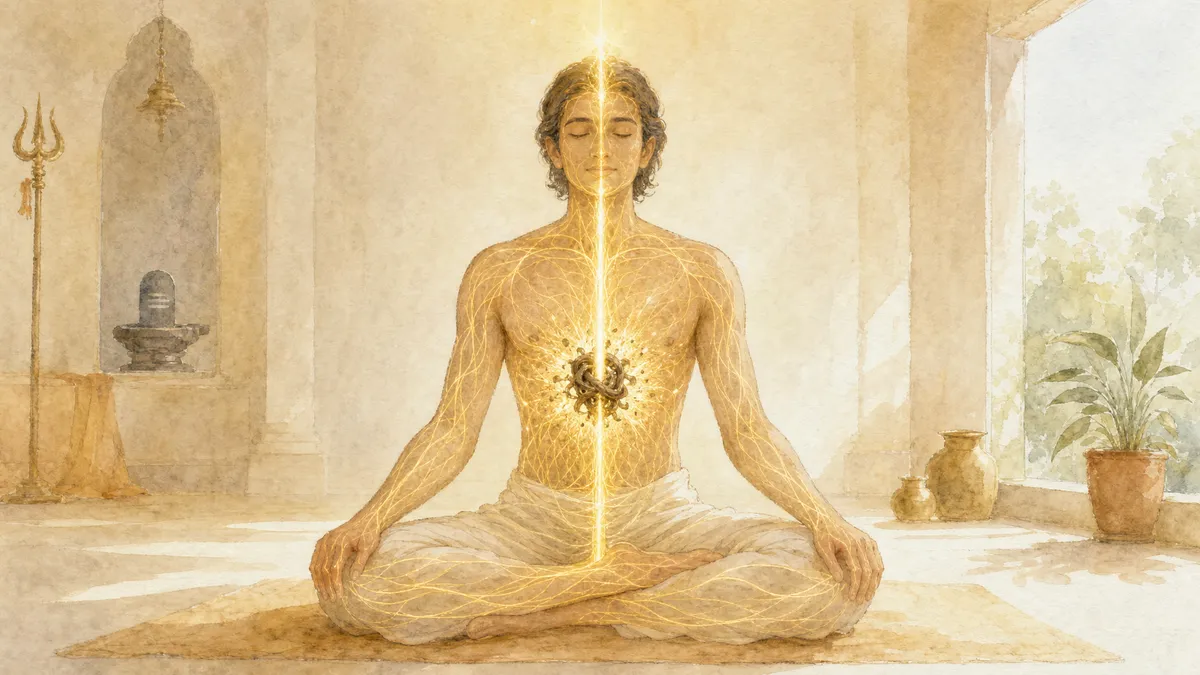
There are three types of obstacles.
The first type of obstacles is karmic obstacles. These are energetic blockages that are overcome by concentration on the chakras or by techniques that purify the nadis, for example sahita-kumbhaka pranayama. If we diligently perform the practice, over time the nadis and the body will be purified. Signs of purification can be seen in dreams. For example, you may dream as if you are vomiting; when you see a dream with vomiting, it is a sign of purification. Or you may see insects coming out of your body (scorpions, cockroaches, and so on). Such dreams are a sign that impure entities are leaving the body.
The second type of obstacles in practice is an imbalance of the pranas due to unskillful performance of yoga practices. Dattatreya wrote in the text “Yoga Rahasya” that if unskillful practitioners perform techniques with prana incorrectly, they may experience certain imbalances. In such a case, it is necessary to learn how to balance the pranas correctly.
The third type of obstacles are obstacles that arise due to the influence of nonhuman beings who, having detected the yogin’s strong energy, may come to him at night.
All these types of obstacles should not disturb the yogin. The texts say that they will recede if he continues the practice, showing courage and heroism. If the yogin has good karma, then none of these obstacles arises, and therefore he proceeds along the path smoothly. He purifies the nadis without difficulty and advances quickly in the practice.
When the nadis are purified, knots (granthis) remain—these are nadis in which karma acts most strongly, that is, strong interweavings of nadis. Vishnu-granthi is located in the region of the heart, Rudra-granthi in the region of the forehead, and Brahma-granthi in the region of the navel. And all these knots must be untied. If the yogin does not apply certain special methods, he will not be able to pierce these granthis. Vishnu-granthi is untied by bhastrika-pranayama; Brahma-granthi is untied by the technique of ashvini-mudra, padmasana, and other practices that purify the lower chakras. Rudra-granthi is untied by anuloma-viloma and shambhavi-mudra.
Untying the Knots and Awakening Kundalini
When the knots are untied, the yogin not only has pure channels, but is reborn anew in an energetic sense. He no longer has any obstacles; enormous energy accumulates in his body, and then he proceeds directly to the awakening of kundalini. Here comes the turn to unite prana and apana. When prana and apana unite, samana is activated, which is considered the most important from the point of view of kundalini yoga. It is samana that produces the explosive impact that brings prana into the sushumna; therefore, in Tibetan yoga, kundalini yoga is called the yoga of heat, or tummo yoga, associated with samana-vayu.
When prana and apana have united, and samana begins to flare up in the body, producing mystical heat that spreads throughout the entire body, the winds enter the central channel. There are signs of this. For example, if the breath flows through both nostrils, the spine is taut like a string, and the body sways, this is a sure sign that the winds are moving through the central channel. And already at this stage, our abilities for dardri-siddhi begin. The cessation of breathing and other signs appear a little later.
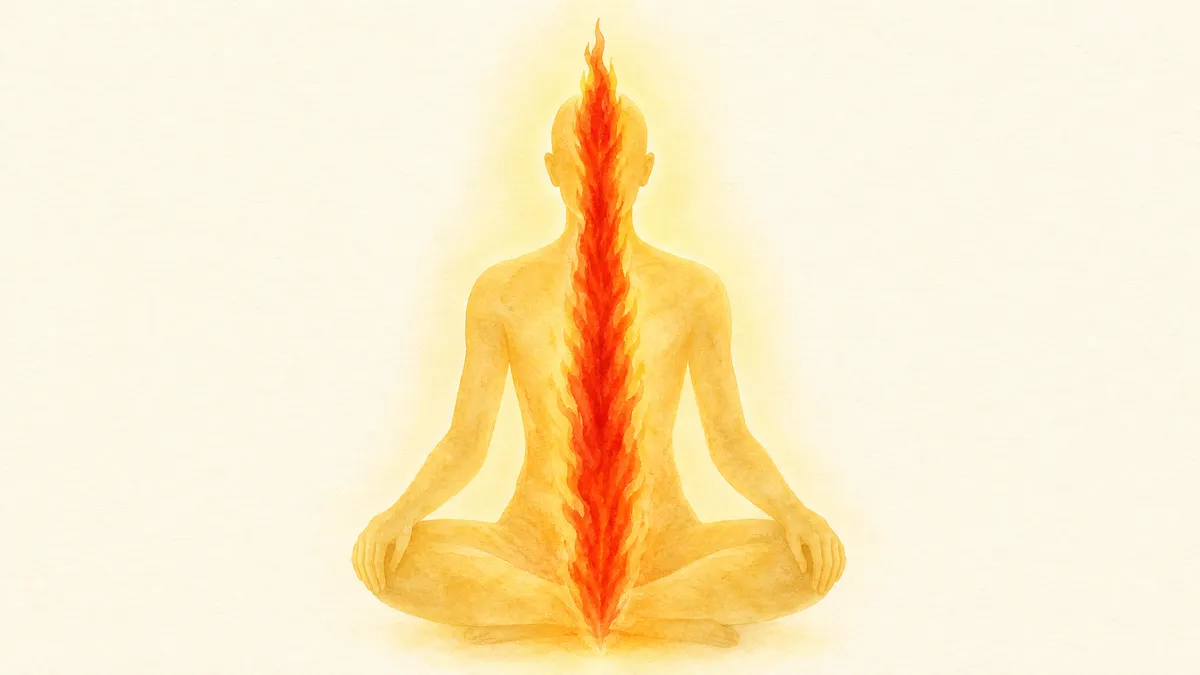
However, it is not enough to bring prana into the central channel; it must also be raised through the sushumna to the head. Therefore, the yogin must perform ashvini-mudra many times, opening the muladhara-chakra, raising apana even higher and uniting it with prana. He must also perform vase breathing in order to saturate the sushumna. Then he must alternate this with chandali, thereby inducing circulation. When this happens, the five signs of day and the five signs of night truly appear.
Signs of the Awakening of the Muladhara-Chakra
During the awakening of the muladhara-chakra, the yogin may have visions of something red rising from the coccyx, or of a silvery-white snake ascending the spine while rotating to the left.
At this time the yogin’s muladhara becomes more active; if the energy has not yet begun to move through the sushumna, a somewhat irritated, very energetic state may arise. When a person with awakened kundalini speaks, he seems a little angry; however, this is the action of prana, which his mind simply does not have time to sublimate.
Or in dreams the yogin may have visions that he is having sex with his father or mother (for a prabhu—with the mother, for a mataji—with the father, that is, with the opposite sex). This is a sign that the energy has awakened; you are coming into contact with the red drop, which was received from your parent and is present in your body. When you come into contact with it, in a dream it is seen as an actual parent. Or in the early morning, when the red drop becomes activated, wrathful dreams may appear. All these are signs of the circulation of the wind through the sushumna.
Raising the Energy to the Sahasrara and Nectar
When the wind rises through the sushumna, many different experiences occur in dreams and in meditation. However, the yogin’s goal is to raise the wind through the sushumna to the sahasrara-chakra, to the soma-chakra. If the central channel is closed or the surface channels are blocked, this is impossible. If the yogin has a constant sensation of heat in the coccyx and, during any practices, mula- and uddiyana-bandha often arise spontaneously, then this heat begins to spread upward, making it easy for him to raise the energy to the soma-chakra, to the sahasrara. And then nectar appears, of which there may sometimes be little and sometimes a great deal.
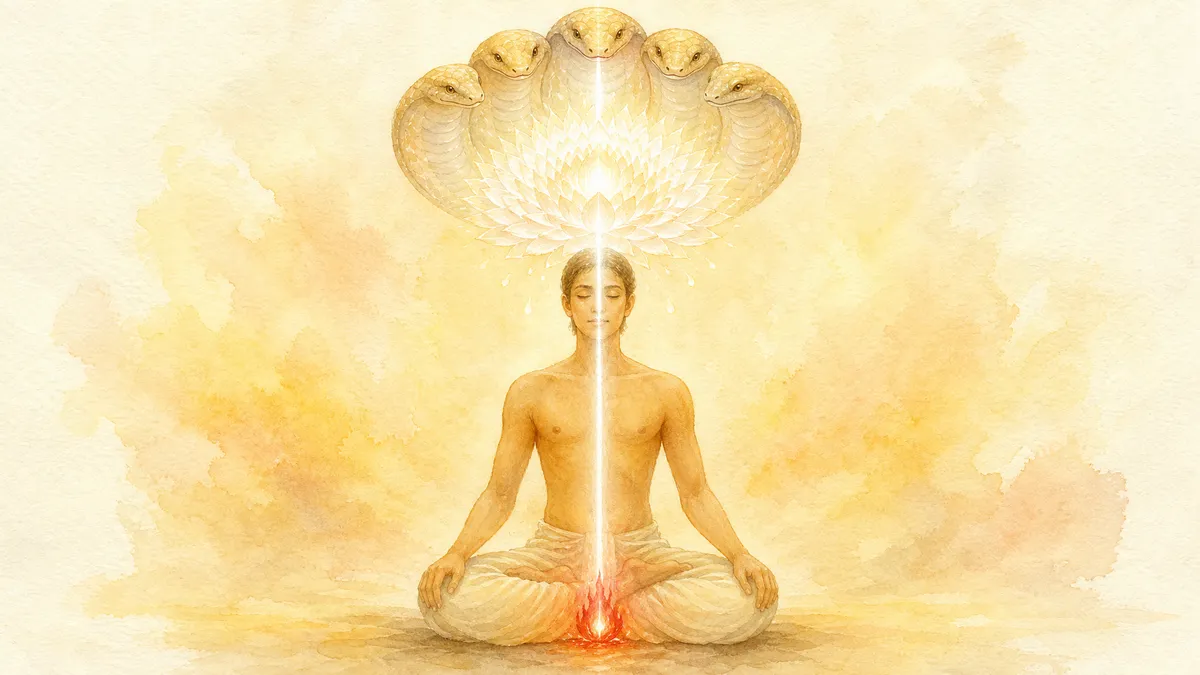
To experience nectar, the yogin must constantly keep the tongue pressed against the palate, performing nabho mudra. Nabho mudra means “the tongue in the middle of the palate.” There is also jihva mudra, when the tongue is closer to the teeth (some say it should touch the upper part of the teeth). There is manduki mudra, when the tongue is curled deeply and touches the edge of the palate, as if licking up or absorbing the secretions that come from the center of the head.
Nabho mudra is connected with strengthening the element of air; manduki mudra, with the element of water. If the yogin constantly performs nabho mudra and manduki mudra, he closes the front and rear central channels, and therefore energy can constantly circulate within him.
The scriptures say: “A true yogin always performs mula bandha, holds the breath, and performs manduki mudra.”
You do not need to hold your breath constantly, but performing manduki mudra and nabho mudra is beneficial.
Accumulation of Energy and Experiences in the Chakras
If the yogin preserves his energy and cares for the purity of the channels, does not violate the commandments, does not allow the loss of secretory fluid in sleep and especially while awake, does not overeat, does not sleep too much, avoids tamas, does not spend much energy on talking, and walks vigilantly and carefully, then energy accumulates in his body. And then he can rotate it through the body and feel the filling of the sahasrara.
When the sahasrara is filled, there arises a sensation that something is moving inside the skull, and this is accompanied by various experiences:
- Sometimes the yogin may hear voices
- Sometimes visions or a soft, dim white light appear in his ajna chakra
- Sometimes he recalls past lives that move before him like pictures; he simply observes them from the side or sees himself as a participant in them
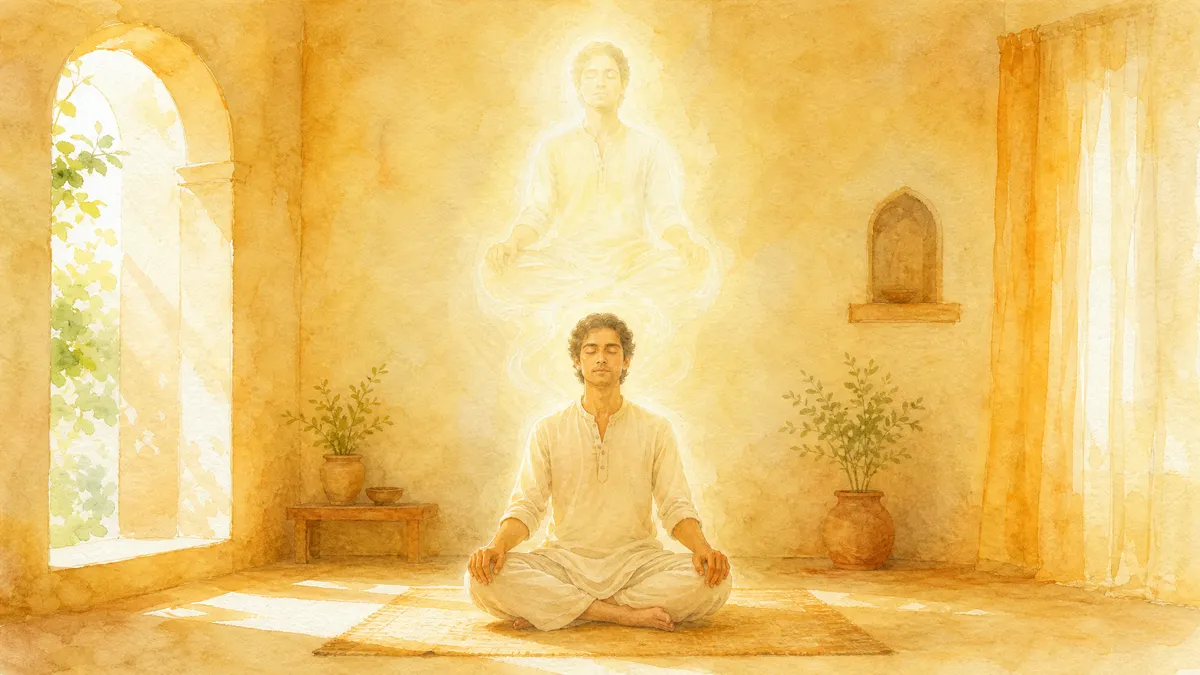
If the amount of prana becomes even greater, light appears in the anahata chakra and becomes brighter. Then light arises in the forehead and golden light in the crown of the head. Over time, the yogin can easily immerse himself in this light. If even more prana is accumulated in the sushumna and the energy is rotated, the nectar also increases. Over time, the yogin’s energy becomes so strong that it can exit through any chakra in the body. And then he can leave the physical body in the subtle body.
Leaving the Physical Body
Some say that one can leave the physical body only through the crown of the head, but this is not so. The yogin can exit through the vishuddha chakra, the ajna chakra. But we do not specifically strive to develop the ability to leave the physical body; this divine ability comes naturally at a certain stage of practice and is a sign of progress. However, in some teachings it is obligatory, that is, everything depends on which school of practice you follow.
Savikalpa Samadhi and Continuous Awareness
When the subtle body emerges, savikalpa samadhi begins, that is, astral samadhi. Savikalpa samadhi is the minimum that must be attained when practicing kundalini yoga. It includes:
- Cessation of breathing
- Immersion in light
- Separation of the subtle body
- Remembering past lives and foreseeing future lives
- Continuous awareness
Continuous awareness is the most important thing we can derive from the practice of kundalini yoga. If you have continuous awareness, then your head is always very fresh; very clear prana is always moving in it, and therefore you do not fall asleep at night the way an ordinary person does. For example, if at nine or half past eight you have unbearable tamas, then this is a lack of prana in the head.
It is believed that coarse prana should not be in the head; therefore, if you raise coarse prana to the head, you must not forget to bring it down. There is a saying: “Beware of cooking your own brain.” That is, coarse prana should not be held in the head, since it is easily lost through the eyes, mouth, and ears during conversation. It is believed that prana is dispersed most of all through the upper palate during conversation, and only then through the ears and eyes.
But subtle prana can constantly stimulate the upper chakras, which is why we say that it must descend to the area of the yonisthana. “Yoni” is the universal womb, or repository of energy; “sthana” is a location, a dwelling place. Yonisthana is the same as the dantian in Taoism. Therefore, all coarse prana should be directed into the yonisthana, while subtle energy can fill the head. In this case, you will always have subtle consciousness. For example, if you feel that your eyelids are sticking together unbearably, this is a manifestation of a deficiency of kurma prana and samana prana. But if you have enough prana as such in the sushumna or in the head, then the other pranas are also activated, and then your eyelids do not stick together, and there is no tamas in meditation.
So, these are the minimal attainments of samadhi in kundalini yoga.
The Higher Stages of Practice
Next comes the attainment of a higher state of samadhi—the samadhi of emptiness and light. At this stage, the main practice is the unity of bliss and emptiness and the opening of various kinds of space in the body, connected with the melting of drops in the chakras and elements.
Finally, when the various kinds of space in the body are opened, the yogin receives profound experiences of emptiness in the body and is able, from each element, to depart into the state of the pure lands. Then the next phase begins—the creation of the immortal illusory body. At this stage, the concluding stage of the practice begins—the realization of the great transition into the rainbow body. With this, the practice of kundalini yoga comes to an end.
We will examine all these phases in more detail another time.
The Unity of Prana and Mind
At first it seems to us that consciousness (awareness) is one thing, while prana is something else, and that meditating and performing maha bandha are completely different things. But over time we become convinced that they are one and the same, not different things: to perform maha bandha is to meditate in kumbhaka, and to meditate is to draw prana into the sushumna just as in maha bandha. The further you advance, the more you come to understand that through the power of contemplation one can achieve the effect of pranayama, and through the power of pranayama one can immerse oneself in the natural state. That is, these are two mutually balancing states of one and the same thing. And then clarity arises in us that prana and mind are one substance.
Those who have difficulties with pranas, with controlling the wind, with kundalini yoga, can also make progress, even if they are not particularly talented in terms of energy control. There is a method in which you take Ayurvedic remedies while doing almost nothing. That is, you consume various pastes and tablets, and your winds still enter the sushumna. And for those who have the difficulties listed, we will nevertheless give such preparations during retreat so that they may have meditative experience. We have the corresponding recipes.
