

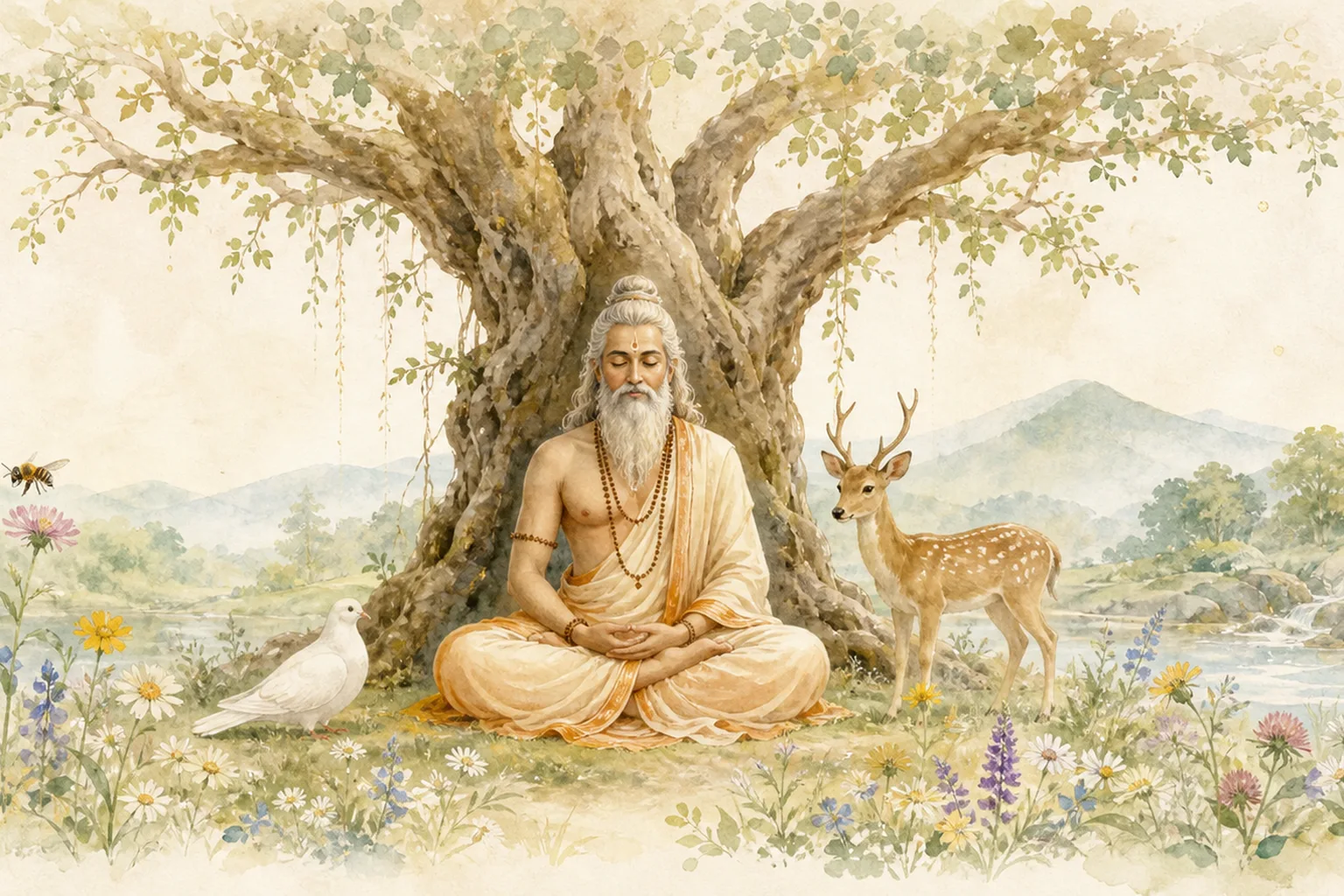
To begin with, I would like to say that in spiritual practice, our motivation and the state of mind in which we receive the teachings are very important. If we have developed the right motivation, our practice will also be successful. But if our motivation is wrong, we will not fully understand what we want from the teachings or where we should go next.
The right motivation matters greatly. If you have the right motivation, you are on the right path and will therefore succeed in time. If your motivation is wrong, you may still gain something, but its benefit will be questionable.
How can we cultivate the right motivation? First of all, we should reflect on the preciousness of human birth and on the fact that right now we have the opportunity to make use of this precious human birth. For example, you were born as human beings, while other beings were born as animals; if you were animals, you would have no opportunity to understand the Dharma or practice the teachings. You were born in a country where the Dharma, although it does not particularly flourish, nevertheless exists; but if you had been born in some region of Central Africa, you would hardly have had the opportunity to receive an education or listen to the teachings. You have the opportunity to meet a spiritual teacher, your body is healthy, your mind is clear, and you can understand what is being discussed. If you did not have a precious human birth, you would be among those who neither follow nor understand the Dharma. If someone were to speak to such a person about the Dharma, they would say, “What are you even talking about?” In their view, the Dharma does not exist, but for you it does.
We can also think about future lives. If we have common sense and sufficient intelligence, we reflect on future lives, understanding that this life is not endless. Since the law of karma—the law of cause and effect—exists, future lives also exist. If we lack intelligence or our consciousness is childish, we do not think about future lives; we may plan our lives no more than five or ten years ahead, and anything beyond that is unknown to us. In other words, our event horizon is limited to just a few years. This is foolish, of course. But if we have sufficient clarity and can think beyond ten or twenty years, we understand that we must think and act strategically, rather than behaving like boys in the yard who think it is great to play football today and do not care what happens tomorrow.
When we reflect on precious human birth, the law of karma, or the suffering caused by it, and wish to overcome that suffering, we develop the right motivation to train the mind and work properly with awareness. If we have a different motivation—for example, if we want the teacher to show us miracles or a deity to come and give us something—then this is the wrong motivation. If we have trained and cultivated the mind, we will obtain everything we want. But if we do not train or cultivate the mind and have the wrong motivation, we will accomplish nothing; we will continue to live in our illusions, and our entire life will pass in vain.
The mind can be trained and cultivated in the same way that an athlete trains the physical body. If an athlete takes care of their physique, goes to the gym every day, and trains the muscles of the body, then a yogi goes to the retreat hall and trains the mind.

The Goal of Spiritual Practice Is Transformation
When we have developed the right motivation for cultivating the mind, we gain great benefit from the teachings. When we know that we are cultivating the mind in order to make use of the opportunity afforded by this precious human birth and attain the state of a deity—for example, to reveal Dattatreya within ourselves, transcend the limitations of human existence, enter a divine state, and become free from birth and death—then this is the right motivation. To practice means to enter a qualitatively new state, that is, to change and move toward a new life. But if we are not moving toward a new life and think, “This life satisfies me as it is. Why should I move toward a new life?”, then this is the wrong motivation. The purpose of spiritual practice is transformation. In other words, spiritual practice must necessarily result in transformation; otherwise, there is no point in undertaking spiritual practice. The spiritual path is a teaching about transformation, about changing from a limited mortal being into something freer, such as a deity.
There are different methods. The path of tantra is genuine transformation, when one thing is turned into something else. For example, from a being with impure conditioned vision, we transform into a deity. The path of anuttara tantra and laya yoga does not involve creating or transforming anything, but rather recognizing; that is, the principle is the same, but a different method is used—natural recognition. It is like a certain problem that we need to solve. Given: ourselves, with five subtle bodies and a physical body, a lifespan of approximately 100 years, samskaras, vasanas, and karmas. What must be done: we must transform into a deity beyond birth and death, possessing a body of wisdom (jnana-deha), an illusory body (pranava-deha), and a pure manifested body (siddha-deha). This is the problem we have to solve. If we understand this problem, then we have the right motivation; but if we do not understand it and instead have certain fantasies and delusions, then that is, of course, the wrong motivation.
The Right Attitude for Receiving the Teaching
Once the right motivation has arisen, the next understanding that must be cultivated is the right attitude in which we practice and receive the teaching. The teaching is precious, but if it falls on unprepared soil—that is, into an unprepared mind—it cannot produce the desired result.
It is believed that liberation occurs when certain factors come together: a knowledgeable teacher, a liberating teaching, and a devoted and understanding disciple. If these three main factors converge, liberation is possible. It is not guaranteed, but there is a certain likelihood if we practice. It is like alchemy: if you are a good alchemist and mix certain ingredients in the right proportions, you may obtain the philosopher’s stone. But if you are an unskilled alchemist and have confused the proportions of the ingredients, you may spend your entire life standing over the crucible, experimenting with various substances, yet still achieve nothing.
It is very important to receive the teaching in the right state—the state of a disciple.
Stages of Tantric Conduct: From Bee to Disciple
There is the state of the “bee” before taking Refuge, and there is the state of a disciple, and this distinction must be clearly understood. “Bee” means that you are receiving many different teachings and have not yet definitively decided which teaching you want to practice. In the state of the bee, you should visit different spiritual teachers and read various kinds of spiritual literature. The more you do this, the better it will be for you, because you are broadening your spiritual horizons. You should examine the symbols of different teachings and compare the teachings with one another. You should attend seminars of various spiritual traditions and absorb them, just as a bee gathers nectar from different flowers. You should analyze and evaluate teachers, examine different types of teachings, and so on. You should make offerings to different types of views. You should knock on different doors and take something useful away for yourself. In other words, at this stage we move not in depth but in breadth. However, there comes a time when the state of the bee has exhausted itself. At a certain point, you yourself realize that you have flown around enough and drunk enough nectar from different flowers, and that now you need something more; you no longer want to be a bee, but to become something else—for example, a dove or a swallow.
The bee is the first type of tantric conduct, and it is normal at a certain stage, like kindergarten, for example. After all, no one says, “Kindergarten—ugh! That is so lowly!” Anyone who says that is simply foolish. Children need kindergarten. They need primary school too. But then we realize that we have passed through a certain period—kindergarten and primary school—and that we need to grow up. At that point, the conduct of the bee is no longer suitable. The next stage of tantric conduct is called the “swallow” or the “dove.” Just as a swallow gathers various threads, twigs, and leaves and builds a nest in which to settle, so too does a practitioner at this stage gather everything together and create a foundation for future spiritual growth. At this stage, a candidate for novicehood begins to study the teaching; a layperson who has taken Refuge begins to build a retreat hut; a practicing disciple sews a meditation belt. In other words, the bee can no longer keep flying, so some kind of nest must be built. This is the stage when we begin to prepare seriously for spiritual practice. The stage of flying is already over; you have fluttered around enough. Everything was wonderful, but it cannot continue indefinitely, because life does not stand still and time passes. You understand that you need genuine transformation, because otherwise it will be like the dragonfly: “So, you sang? Very well, then go and dance.”

We understand that we now need to prepare for serious sadhana, for the stage of the deer. The deer is one who cultivates the teaching within themselves in solitude. But it is impossible to leap straight to the stage of the deer just like that. We need to prepare and accumulate certain resources. For example, if someone is planning to go to Mars, they cannot do so immediately; they need to prepare seriously for this expedition.
And the stage of the dove is precisely the stage at which we accumulate merit, gather shakti, and learn to perform the basic practices. In other words, we prepare ourselves, making the necessary preparations and accumulations so that, after some time, we can become a full-fledged deer. And if we do not make such preparations, then, of course, nothing will work out. If you want to reach the North Pole, you need to find a good sled team and dogs, and stock up on provisions, a map, a GPS navigator, and much more. But if you do not make such preparations, you will only get as far as the Kola Peninsula; your journey to the North Pole will end there, and you will not reach your destination.
The same is true in spiritual life: if you want to reach your destination, then at the stage of the dove you prepare very seriously and thoroughly. You have chosen a path, a teaching, a teacher, and a sangha, and you are already going deeper; you are no longer flying far and wide. This is already the stage of a disciple who has taken Refuge, that is, a disciple bound by samaya. At this stage, one should not visit other teachers, read outside literature beyond what is necessary, or wear the symbols of other teachings. There is actually nothing wrong with any of this, but it is important not to scatter your attention.
One should not attend retreats and seminars of other traditions, because then one would have to start from the very beginning. At the stage of the bee, this can and should be done, but at the stage of the dove (the disciple), it would be wrong. If you do this, no one will condemn you, but you should know that you are then at the stage of the bee and have no moral right to call yourself a dove, much less a deer.
At this stage, one should also refrain from analyzing the qualities of different teachers. Before you have chosen a teacher, you may critically analyze them, assess them, and think: “This one is right for me, but that one is not. This one has such-and-such qualities, while that one has such-and-such shortcomings.” But once you have chosen a teacher and taken Refuge, you should regard them with pure vision, in samaya and guru yoga, and cut off everything else. Doubts are useful at the stage of the bee, but after taking Refuge they are no longer acceptable; they will only make things worse for you.
How else can these two types of behavior be compared? It is like a young man before marriage and after marriage. If before marriage he goes to discos and meets different girls, people will tell him: “That is perfectly fine. Good for you! You need experience!” The young man evaluates the girls and thinks: “This one is beautiful, but a little foolish. This one is intelligent, but her figure is not so good. This one is both beautiful and intelligent, but she cannot cook. This one has none of those qualities, but her parents are rich. Whom should I choose?” The stage of the bee is roughly the same; it is behavior before marriage. Behavior before marriage and after marriage are different things and should not be confused. If a man goes to discos after marriage and thinks, “This one is beautiful, and that one is such-and-such,” his wife will say to him, “How can you behave like that?!” Or his parents will say, “You should have thought about it and made your choice earlier.” After marriage, it is too late to choose; you need to accept your spouse as she is and meditate on her with pure vision, otherwise life will turn into a nightmare. Likewise, if you are choosing a car, you should evaluate and compare cars before buying one. But once you have bought it, you simply need to get in and drive.

This is not fanaticism; it is a principle of wisdom. We have only one life, while teachings and teachers are many, but the goal of spiritual practice is not to sail in different boats, but to reach the other shore; not to float on different life buoys, but to be saved. In other words, at the stage of the disciple, we no longer move outward but deeper; we penetrate the divine aspect of the teaching.
The Manifest and Divine Aspects of the Teaching
The teaching has many different aspects. There is a manifested aspect of the teaching, which is visible. For example, you see murtis, the teacher, monks, and practitioners, and you hear the audible Dharma. There is also a divine aspect of the teaching, which is unmanifested and invisible. It is difficult to see it now, but I can assure you with absolute certainty that it exists. To penetrate the divine aspect, the depths of the teaching, one must practice differently—not in the manner of a bee, but in the manner of a dove, a deer, a mute, a madman, and so on. In the divine aspect of the teaching, everything is somewhat different. For example, from the manifested aspect of the teaching, the teacher sits before you as a human being, whereas from the divine aspect of the teaching, the teacher may not be a human being at all, but a deity seated on a throne in a celestial palace. The monks are also not human beings, but deities dwelling in a pure land. You, too, are potentially a deity, though you are not yet aware of it. From the divine aspect of the teaching, conceptual Dharma is not so important; what matters is pure understanding. To penetrate this divine aspect of the teaching, one must practice much more deeply. The approach of the bee will not work here at all.
Once we have determined who we are in our own eyes—whether we are a bee or have already gone beyond the bee—this is very important; it is a certain milestone. But those who do not know this remain bees throughout their lives. They fly from one flower to another, and then from the second to a third. Eventually, they realize that they have already had their fill of superficial nectar, but they do not know what to do next. Yet life is not infinite. If we lived for 10,000 years, or 80,000 years, or 2,000,000,000 years, we could spend the first million years flying around to our heart’s content, studying all traditions, and developing some point of view. But the fact is that we do not have that much time. We must resolve all these questions for ourselves more urgently. Samsara is not a place where one can live like the gods for 10,000 years. Samsara is like a jungle where there is a lot of shooting all around, and when a helicopter descends, you must take only the essentials, quickly climb aboard, and fly away; otherwise, a stray bullet will hit you, and then everything will be over. One cannot relax in samsara. Samsara seems interesting and exciting to those with a childish mind, but if your mind is no longer childish but mature, then you know its true nature very well. It is like the jungle during the Vietnam War. When you understand this, the preciousness of human birth is revealed to you, and so the right motivation arises easily.

Those who intend to amuse themselves in samsara and possess a childish mind fail to take into account that over time their life force will diminish and their senses will weaken, especially if they do not practice. Even the pleasures they experienced at the age of 20 will no longer be pleasures at 40, and at 60 or 80 they will become suffering. Everything will change. And this mutability is the principal characteristic of samsara. The plans a person had in youth will cease to be significant to them 20 years later. The goals they set in youth may change if they are samsaric goals, because everything in this world is impermanent. Samsara itself is an unfavorable place for pleasure.
The Heavens of the Gods and Human Birth
If you want worldly pleasures, it is better to go to Indra’s heaven. It is better suited for that. Life lasts longer there. One can live, for example, for 10,000 years and enjoy oneself in a more refined manner. But in a human body, it is not really possible to enjoy even worldly pleasures very much.
On the other hand, precious human birth and the world of samsara are conducive to spiritual practice and attaining liberation, because there is a certain degree of coarseness and suffering here, and the mind detaches from attachments and pleasures more easily than in the world of the gods. It is believed that in the world of the gods it is difficult to detach oneself from attachments: they are very subtle and delight the senses. The world of the gods is more like an endless virtual reality in which everything obeys you, and you become so absorbed in it that you have no time for spiritual practice.
But when the game ends, the god Brahma says, “And now you must return to the human world. Your merit has been exhausted, so you must be reborn again.” Seven to ten celestial days beforehand, the gods see the place of their future rebirth, and since it is a lower world, this deeply depresses them.
The Goal of Spiritual Practice Is to Tame the Mind
Having cultivated the right motivation, we can proceed further in our practice. The goal of spiritual practice is to tame the mind. We should not set other goals until we have genuinely tamed the mind. For example, we may think, “I want to attain siddhis,” or “I want to attain immortality,” or “I want to become like Brahma, the creator god” (there is such a stage in the teachings). These are all very lofty goals, but they cannot be achieved until the mind and ego have been tamed. On the contrary, when we learn to tame the mind, these goals are attained naturally.
There are five favorable qualities of the mind and five unfavorable ones.
Favorable qualities of the mind:
serene
strong
pure
clear
devoted
With such qualities, we are very close to attaining spiritual experiences, such as attaining the illusory body (pranava-deha) and attaining the wisdom body (jnana-deha).

Unfavorable qualities of the mind:
restless; such a mind may be dissatisfied or agitated
weak and untrained; when the will is weak, one cannot concentrate on something for a long time
impure; when there is little merit, few pure imprints have been created, and there is a tendency to see everything through the kleshas (afflicted states)
unclear; such a mind may be dull, confused, and hold false views
egoistic, self-centered
If we lack favorable qualities of the mind, this is a sign that unfavorable qualities are present, and therefore we need to work on this, taming and purifying the mind. And if we do not tame the mind and acquire its favorable qualities, we will not be able to reach the goal; for example, we will not be able to realize the illusory body or the immortal wisdom body.
The Importance of Right Understanding
How do we practice in order to achieve our goals? There is an Indian saying: “Dry dung burns, while fresh dung laughs and says, ‘Burn, burn! I am not afraid of fire.’” Such behavior is characteristic of those whose minds have unfavorable qualities and who fail to recognize the fact of impermanence. All living beings know that the world is impermanent, that sooner or later everyone will have to die and that another life will follow, yet for some reason some try to work with the mind, control desires, and free themselves from the kleshas, while others do not. Even when they are told about the Dharma, they are like that fresh dung which says, “Burn, burn! I am not afraid of fire,” meaning that they imagine it does not concern them. But this is precisely immature, childish behavior.
Training the mind begins with returning once again to the four mindfulnesses, to an understanding of the preciousness of the Dharma and the importance of our choice. If such an understanding is present, our practice of training the mind will be favorable. There is an expression, “manda bhagyah,” which means “the unfortunate live in the age of Kali Yuga.” We are now living in the age of Kali Yuga. It is believed that unfortunate beings are born in the age of Kali Yuga, while more fortunate beings are born in the age of Satya Yuga or Dvapara Yuga. Why? It was easier for them to attain siddhis and samadhi. On the other hand, it is easier for us to understand the preciousness of human birth, because there are more limitations and suffering in Kali Yuga.
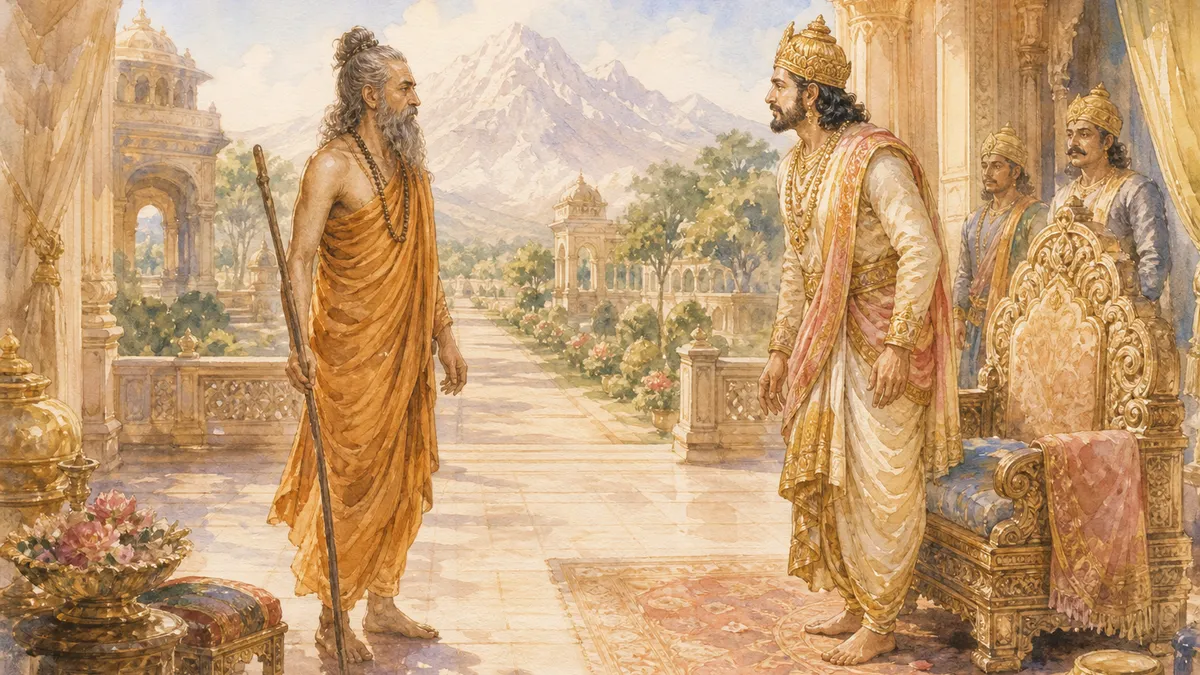
Vishvamitra once came to King Dasharatha. The king greeted him by saying, “Well, how are things? Are you succeeding in your efforts to gain victory over birth and death, O sage?” In other words, Dasharatha did not ask, “How is your wife? How is your father-in-law? Have you received many donations?” Nor did he ask, “What is the weather like in northern India?” He asked the most important question: “Are you succeeding in gaining victory over birth and death?”
When we have this understanding, the Dharma becomes the most important thing for us, while everything else becomes secondary. When the Dharma has become the most important thing for you, it indicates that the unfavorable qualities of the mind are gradually beginning to disappear and favorable ones are beginning to arise.
Spiritual Practice as a Business
Spiritual practice is like a business. In business, you have to invest capital wisely in order to make a profit, but if you manage your enterprise poorly, you will face ruin, bankruptcy, and crisis. In spiritual life, however, it is very important not to become bankrupt. Many people think that once they have embarked on the spiritual path, they have already solved some major task in their lives. On the one hand, this is true. On the other hand, merely beginning spiritual practice is not enough; it is important to achieve results. Results are possible if we manage our spiritual business skillfully. In other words, we must invest our spiritual capital in such a way as to become spiritual oligarchs, spiritual billionaires, spiritually wealthy. This means attaining signs of spiritual realization, becoming a deity, attaining the realization of the illusory body, the realization of the wisdom body, and the realization of siddhis.
And here, just like an experienced businessman, you must always remain vigilant about the course of your spiritual Dharma. If a businessman manages his business poorly, corporate raiders come and say, “Let us buy your farm. And if you do not want to, we will force you to sell it.” Or a crisis strikes, creditors come and say, “Pay back the loans you took out!” The businessman says, “I have no profit. My suppliers are letting me down,” and they reply, “We do not care. Give back what you took!” Then he sells everything he had and ends up in debt. This is an inept businessman who fails to assess the situation and does not know how to work with people. He is an unsuccessful businessman who cannot foresee a crisis and does not take any additional measures to overcome it. The same thing happens in spiritual life. If we manage our lives ineptly, then instead of achieving anything, we may simply become spiritually bankrupt and go broke.
Self-Love as the Main Problem

What distinguishes someone who skillfully manages their spiritual life from someone who manages it poorly? A person with a trained mind endowed with favorable qualities skillfully manages their spiritual life and leads themselves toward the attainment of the goal. And the main problem is a self-loving or selfish mind. While other states of mind—for example, a restless, dissatisfied, agitated, weak, impure, or unclear mind—can be overcome, the most difficult quality is self-love, selfishness.
It is very important to understand that the self-loving mind is the source of suffering. For example, our present sufferings are the consequences of mistakes made in a past life when our self-loving mind manifested itself. Suppose you are poor in this life; this means that in a past life you evidently stole or manifested your self-loving mind in some other way, and therefore your circumstances manifest in this way in your present life. If people treat you negatively or with contempt in this life, it means that in past lives you behaved in a similar manner based on a selfish outlook, and now you are reaping the consequences of those causes. When we understand that the self-loving mind is the source of suffering, we strive to overcome such self-love.
Training Various Qualities of the Mind
Of course, there are different kinds of mind training for cultivating favorable qualities. For example, if your mind is weak, that is not good either. With a weak mind, you will achieve nothing. What does a weak mind mean? You make a decision and then reverse it or are unable to put it into practice; you make a promise and then fail to keep it. In other words, if a person is irresponsible, this is a sign of a weak mind. Perhaps they are driven by good intentions, but they cannot see things through to the end. Or you decide to practice, but in the morning you think, “Well, it would be nice to sleep a little longer.” Or you decide to remain in retreat for three months, but after only two weeks you think, “Well, perhaps I have other important things to do.” These are all manifestations of different kinds of weak mind. If your mind is strong and your will is unyielding, you achieve your goals both in material and spiritual life. A strong mind must be cultivated through concentration, willpower, and selfless service. When you go against your feelings and your ego, you cultivate a strong mind.
An impure mind must be trained through the practice of pure vision; one must exercise pure vision. Again and again, whenever the mind slips into impure vision, one must examine what pure vision means and how to abide in it. An unclear mind is trained when we study philosophy and practice contemplation, and then false views, confusion, and dullness gradually disappear. A restless mind is pacified through the practice of meditation and concentration. But to work with a self-loving, selfish mind, one must truly make a great deal of effort, because this is the most difficult aspect of the mind and the hardest to train.
Seven Instructions for Pacifying the Mind
The first quality conducive to overcoming the self-loving mind is this: one must look for the cause of problems within oneself. For example, when external problems or difficulties arise, many people tend to look for their cause in others. They look for enemies and claim that these enemies are somehow hindering them. Or they attribute the problem to some external crisis. But if you want to train your mind and cut off self-love, you should understand that it is very important to always bring everything back to your own “I” and always look for the cause of problems within yourself. If you know how to do this, then you are on the path to pacifying your egoism and overcoming self-love.
For this purpose, there are seven instructions for pacifying the mind:
1. Do Not Criticize Others
If we criticize others, it means that we are looking for the cause of problems not within ourselves, but in something external.

2. Serve Others More Than Yourself
If you truly try to follow this instruction literally, you will find that your entire concept of personality and ego begins to change. We are usually accustomed to serving ourselves more than others, but this instruction says, “Serve others more than yourself.” At first, we do not understand why we should do this, because there seems to be no benefit in it. When we serve ourselves, it is pleasant and understandable. But when we serve others, we do not understand how it can help us personally. Even practitioners often ask, “What does this give us?” This very question already contains the seed of ignorance.
The point is that when we have a selfish mind, we limit ourselves; we are enclosed in a kind of cocoon of dualistic perception. The cocoon of dualistic perception (egoism) prevents us from moving toward liberation. Liberation is a state completely beyond the ego. It is when you no longer have the false idea that “I am a person” or “I am the body,” when you do not separate yourself from others, when other people become part of you, when all humanity becomes part of you. If others and all humanity become part of a saint’s identity, why would the saint not serve others? Is that not so? After all, the saint can easily take responsibility for them. It is the same as taking responsibility for oneself. It is the same as serving oneself. What difference does it make whether you serve this body or another if you are both this body and other bodies? When we act in this way, we overcome our selfish motivation.
People usually like being served. For example, a wife expects her husband to satisfy her desires, while the husband expects his wife to satisfy his desires and serve him. But when they come together, everything turns out the opposite way: each expected the other to serve them while they enjoyed the fruits of that service, but these hopes are not fulfilled, and so suffering and conflicts arise. But if they were motivated to serve the other more than themselves, this would not happen.
And this happens at every turn. For example, a person serves in some mandala, organization, or system and expects that structure to give them something; in other words, they have certain expectations. Meanwhile, the mandala expects the person to give it something and to serve it. As a result, the person is dissatisfied, and the mandala is dissatisfied. The employee says, “I am underpaid,” while the company’s management says, “This employee is completely incompetent! They want a lot but do very little.” The management dismisses the employee, and the employee leaves feeling resentful. In other words, they too failed to reach an understanding because each wanted to serve themselves.

However, the principle of “serve others more than yourself” is the opposite: you do not seek to satisfy your ego, but seek to satisfy others. If you begin to do this, your entire previous concept of life will begin to change and crumble, because your whole life until now has been aimed at serving yourself more. You will see your old karma begin to leave you.
Someone may think, “I serve my family, and I believe that in this way I serve others.” But there is a mistake here as well, because attachment is a form of selfishness. When you extend yourself to one or two people, it does not actually change you very much. It does nothing to free you from selfish motivation.
“Serving others more than yourself” means expanding your perception to encompass all living beings. It means accepting far greater responsibility and being prepared to fulfill it. Serving one person, especially someone you love, is not so difficult; for example, a mother gladly serves her child. But it is much harder to accept responsibility for serving all living beings, or to serve those who are not close to you, whom you do not love, and who are equal to you in status. This is a radical blow to egocentrism; it requires a complete restructuring of the selfish mentality.
For example, you are sitting in a retreat, and one of the practitioners opens a window. If your consciousness is selfish, you may think, “But I’m cold! How could he do that?!” But if you put yourself in the other person’s shoes, you will think, “Perhaps he is hot. Why should I give preference to myself? Why not adopt the viewpoint that would make things better for the other person?” And if you keep doing this, you will see how your selfish worldview changes. But if we adopt the perspective of “I,” it is always a selfish worldview, and the more years pass, the more deeply this false viewpoint takes root.
3. Love Everyone Equally

It is very easy to love those who love us, those to whom we are attached, and those who are close to us. But loving everyone equally is a great challenge to our beliefs. Nevertheless, if we aspire to liberation and the taming of the ego, then we must do this. When we are able to do so, all living beings, even those whom we have rejected, will begin to enter the field of our consciousness, and we will assume the position of the mandaleshvara consciousness of all humanity. When we love those who are attached to us or whom we like, it is something very narrow; loving everyone equally means including absolutely all living beings within our field of vision and care. And if all living beings are included within your field of care, then you are no longer an ordinary human being.
4. Never Take Offense
Taking offense is a form of affliction, a form of ignorance in which we do not understand how life works and do not understand the nature of the world as it truly is. It is the result of excessive selfish expectations: when they are not fulfilled, such things happen.
We take offense when we do not understand what is actually happening. For example, we lack pure vision, so we cannot understand that deities may act through other people. Another person says something to us, and we think, “How could he say such a thing? Who does he think he is?!” But perhaps at that moment a deity entered the person’s body and conveyed important information to us. Perhaps it is a signal telling us that we need to change, but we see only an ordinary, limited person, so we ignore and miss that signal. Instead of responding properly to the situation, we take offense and fall into a typical shrunken and limited human state.
A person with a tamed mind is a very easygoing person. They never suffer and are always happy. They never have any problems. If the mind is tamed, then whether it is winter or summer, whether things are bad or good, whether the food is delicious or not, whether people treat you well or badly—you are always happy, because you rely more on inner awareness than on external things. Whether you have problems or not—you are happy; whether the body suffers or feels wonderful—you are happy. If your mind is tamed, you do not take offense at anyone, but if the mind is untamed and there is strong selfishness, then you are always inclined to look for the cause of your problems in others.
Sometimes people think that, for example, the government is to blame for their misfortunes. They often say that the government failed to do this or provide that. This is the mindset of a hungry spirit, a dependent who is accustomed to always being given something. This is an untamed mind. But if a person has a tamed mind, they think: “What do I care about the government, and what does it care about me?! I am my own master and capable of creating a happy life for myself.” Or a person may resent others, thinking that others owe them something. But if you are self-sufficient and have a tamed mind, how can you resent others? You can only give to others. Why ask or demand anything from others if you are capable of providing yourself with everything?

Sometimes a person may even resent God, thinking that God is treating them unfairly. This is a particular form of the untamed mind characteristic of religious believers. They think: “Why is God so unfair to me? Why does He hurt me like this and treat me so badly?” For example, one man in America even filed a lawsuit against God, citing a violation of consumer protection law. He justified his claim as follows: “As a consumer, I paid for services by making an offering at church. In return, I was promised salvation, paradise, and peace of mind, but I never attained peace of mind. If the church is an institution that provides services and I am a consumer paying for those services, then I should receive the product, but there is no product.” The court explained to him that it could not accept the lawsuit because the defendant’s place of residence was unknown. This is, of course, the most absurd case in the entire history of jurisprudence, but it really happened.
When your mind is tamed, you look neither for enemies nor for problems outside yourself; you take offense at nothing, understanding that everything lies within you. If you have fallen short somewhere, that is precisely what manifests itself. And if you want to change it, you simply need to train your mind better and work on yourself more diligently. Neither other people nor anything else has anything to do with it.
5. Give More, Demand Less
This is a very important principle. By following this principle alone, you can completely change your destiny on the physical level, alter your financial situation or social status. Your destiny can take an entirely different course if you adopt this viewpoint as a guiding concept, because “give more, demand less” is the attitude of a deity.
When a saint or rishi, standing on one leg and reciting a mantra, invokes a deity and does so for a long time with great austerity, the deity (for example, Saraswati, Brahma, or Dattatreya) appears before him and asks: “What do you want? How can I reward you for your tapas? What can I bestow upon you?” The deity does not say: “Make an offering to me. Give me something,” because the deity is self-sufficient. It has everything and therefore needs nothing and asks for nothing. It only bestows gifts and blessings. And when you understand this principle (“give more, demand less”), you too become like a deity, and your qualities develop into those of a deity.

When we first come to the Dharma, we do not immediately understand this principle. We expect to have the same kind of relationship with the Dharma as that man had with the church: “I paid for the services, so I need to get a result.” However, coming to the Dharma entails a change in mentality. In other words, the Dharma will truly work when we embrace this principle and learn to give more and demand less.
Our relationship with the Dharma and with the teacher is very different from ordinary relationships. If we think, “I have invested this much in the Dharma, so I should receive a return in the form of profit,” or “If I give something, what will I get out of it?” or “I have performed this much service, so how many retreats will I get in return?”—these are all misguided approaches. But if we attune our mentality to the attitude of “giving more, demanding less,” then the Dharma truly bestows upon us everything it has, because such a state of giving is always the attitude of a deity abiding in the pure dimension, and in the pure dimension everything is already there by default.
6. Rejoice in Everything as God’s Grace
Various things happen to us. But if we do not recognize the source of these things, we habitually judge and categorize them. This is when dualistic thinking operates in us. Some things are favorable to us, while others are not. We constantly alternate between acceptance and rejection. It is natural for us to rejoice in what is pleasant and to be upset by what is not so pleasant. But if we do this, it is a sign that our mind has not been pacified.
In a state of pacified mind, one can rejoice in everything as a blessing, as a manifestation of grace. A saint can perceive both what is favorable and what is unfavorable as a blessing. For example, he sees what is unfavorable as a wrathful form of blessing. It is simply a denser form of blessing.

An ordinary person considers only something sublime and subtle to be a blessing, while not regarding other things as blessings. For example, in our “Divya Loka,” there was an incident that did not seem very favorable at first glance: the wooden bathhouse burned down. Everyone was upset because a great deal of effort had gone into it. But I decided that it must surely be some kind of blessing, because bathhouses do not burn down for no reason. I thought, “Obviously, the time has come to build Vasistha’s temple complex on this site.” And several years later, I can see that it truly was a blessing. The deities thought, “What is the point of having a bathhouse here if a temple is meant to stand here?” Now there is a beautiful temple of Vasistha there, and next to it is a temple of Dattatreya. But if the bathhouse were still there now, how could the temples be standing there?
We often do not understand the logic of the deities. What seems unfavorable may in fact be favorable. For a pacified mind, everything is always favorable. Even when things happen that seem negative at first glance, in pure vision and in an auspicious state, they too are a form of blessing.
For example, a global crisis occurs. Many people think, “What a nightmare! Businesspeople may lose their fortunes because of this.” But if you perceive it as a form of blessing, perhaps it is a signal to humanity that it has grown complacent and needs to accumulate more merit and become more focused. Perhaps this crisis will bring about some major breakthrough.
7. Do Not Look for Enemies Outside Yourself
When people have impure vision, they often try to look for external enemies, and these external enemies encourage them to be more disciplined and focused. People rigidly divide the world into their own and outsiders, but from the perspective of nonduality and pure vision, no external enemies exist. Even various demonic beings are manifestations that are simply meant to help us resolve certain karmic tasks and pacify our minds. When we understand this and stop looking for enemies outside ourselves, our vision changes, and we cleanse the karma of the asura realm; this karma simply disappears.
The karmic vision of the asuras is sustained by our constant search for enemies. The state of an asura is such that if you look at him angrily, he thinks, “This is my enemy.” And if you look at him with a smile, he thinks, “This is a trick. He is smiling now, but he is hiding something behind his back.” If you say something pleasant to an asura, he thinks it is mere flattery and waits for an opportunity to strike from behind. And if you say something to an asura directly, criticizing him, he thinks, “This is definitely my enemy.” In other words, the state of an asura is one that is always looking for the image of an enemy or some hostile energy. If you repent and ask an asura for forgiveness, he thinks, “This is hypocrisy; he is doing it deliberately.” And if you offer him a helping hand, he thinks, “I should expect a blow to follow.” In other words, an asura’s consciousness is one of constant vigilance, but in a distorted form: he looks for a hidden agenda in everything and constantly expects a blow or punishment. This is the utmost closed-mindedness. It is a world that has completely degenerated.

But if your mind is subdued, you are utterly sincere and open. You do not expect or seek anything of the sort. You are not looking for a catch, so there is none. But if you are looking for a catch, rest assured that it will come to you, and then the mind will say, “Aha! I told you so.” This is exactly how everything works, because consciousness itself projects everything. If a person is open and does not look for enemies outside, they have none; but if a person is anxious, closed off, and looks for a catch, those enemies will inevitably appear, because that is how the laws of consciousness work.
The Ten Acharas of the Teaching
There are ten acharas in the teaching. Acharas are the principles according to which our teaching develops.
Advaitachara means that we follow Advaita.
Sahajachara means that we follow the path of the natural state.
Sadachara is the principle of honoring the Guru, Dharma, and Sangha.
Samayachara is the principle of maintaining the samaya bond.
Tapachara is the principle of inner tapas. Once you have entered the path of the teaching, you should devote yourself to tapas. You do not necessarily have to do it in the same way as the ancient rishis, that is, standing on one leg in the forest and subsisting on air and leaves. First and foremost, we are speaking of inner tapas (antar-tapas), which is associated with awareness.
Siddha-svecchachara means following your inner will or your inner path.
Bhrityachara is the principle of compassion, love for others, and overcoming selfishness. This principle is closely connected with subduing the mind and overcoming self-love. If you are guided in your life by the principle of bhrityachara, there is a strong likelihood that egocentrism—the self-loving mind as the source of suffering—will be overcome.

It is very important to reflect again and again that the true source of suffering is the self-loving mind. And this self-loving mind will not surrender so easily. It is like a treacherous minister who has seized power in the city of our mind and will not relinquish that power without a struggle. The true king, that is, the higher Self, is asleep, while this treacherous minister derives a great deal of false benefit from self-love. Various methods must be applied to overcome such a self-loving mind. But when we train according to the principle of bhrityachara, this self-loving mind gradually recedes, and then signs of realization appear.
Four Initial Signs of a Subdued Mind
Yesterday we spoke about the four initial signs of a subdued mind.
The first sign: wherever you are, you always feel happy.
If you are in Divya Loka, you feel happy. If you are in retreat, you also feel happy. If you are in Moscow, you feel happy. If you are in China, America, or Africa, you feel happy there as well. Your inner awareness enables you to be happy anywhere. You are not bound to external reality. But if you do not feel happy everywhere, this indicates that your mind has not yet been subdued.

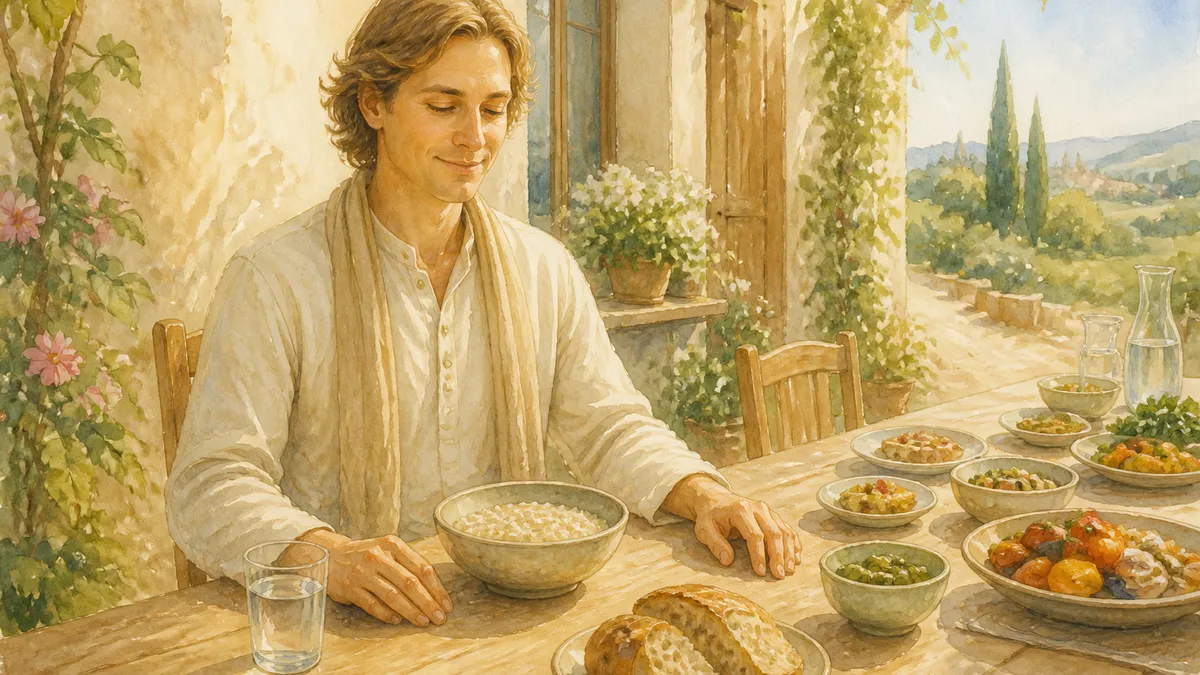
The second sign: when you eat any kind of food, you feel equally happy.
For example, there are people who, in a worldly sense, are very particular about food. They order very elaborate and refined dishes, and if they are given simple food, they consider it an insult to their taste. There are practitioners who link their spiritual life very strongly to diets, and this becomes extremely important to them. If they do not have these diets, they feel unhappy. But in fact, if your mind is subdued, none of this is essential to you.
I read that there was a Christian saint who would mix the first course, the second course, and fruit compote in a single bowl and then consume it all. When asked why he ate in such a strange way, he would say, “Why separate them? Why make things so complicated if everything will get mixed together in the stomach anyway?” When you can take this so lightly, it is a sign that the mind has been tamed.
The third sign: you are happy no matter what clothes you wear.
In the human world, people attach great importance to clothing, especially women, but this, too, is a sign of an untamed mind.
Bhagavan Shree Rajneesh instructed his disciples who had received neo-sannyas to wear orange clothes everywhere: to work, when visiting others, while out walking, to the store, and so on. And when some of them actually wore these clothes everywhere, their lives changed completely. They were either fired from their jobs, had spiritual experiences, or their egotism dissolved, but their lives invariably changed. There were also those who could not do this. They would say, “I received an inner message from Bhagavan in which he said that I should take it off,” or “I had a feeling that it was time to take it off.” But in reality, their egotism was simply resisting it. It was a challenge for them. It was difficult for them.
For example, if you put on orange clothes and walk around Moscow for two weeks, you can be sure that the lives of many of you will change. But if a person who has tamed their mind does the same thing, they will not feel that their life has changed in any way, because they have already freed themselves from all these attachments. Yet if we aspire to attain liberation, we must clearly see what we are attached to and learn to be free from it. When our mind is attached to external circumstances, we often fail to notice it, so it is sometimes useful to place ourselves in circumstances where this becomes apparent.

The fourth sign: whatever situation you find yourself in, you are always happy.
If you are poor, you are happy; if you are rich, you are happy too. If you are a superior, you are happy; if you are a subordinate, you are happy too. If you are in favorable circumstances, you are happy; if you are in unfavorable circumstances, you are happy too. Your happiness is in no way connected with external conditions.
I was once invited to take a trip to an exotic country. I thought, “All right, I will go there and practice concentration on the chakras. But is it worth getting a passport and a visa and setting off on a journey if I can do the same thing while sitting on my sofa? I will be happy there, and I will be happy here. But is it worth it? So why should I go?”

Advanced Signs of Realization
When you attain these initial signs of taming the mind, it means that you are working with your mind correctly. But there are more advanced signs: the 24 types of discriminating wisdom and the 16 knots.
A tamed mind makes it possible to overcome the 16 knots of ignorance and give rise to the 24 types of discriminating wisdom. When these 24 types of discriminating wisdom arise, the 16 knots of ignorance are untied, and only then do we become a deity. But if these types of ignorance are not untied and these types of wisdom do not arise, we remain in some intermediate state. We will discuss this next time, because it is a separate topic.
The Importance of Understanding Egotism as the Source of Suffering
It is important to understand that our egotism is the source of our suffering. If we continue to adhere to egocentric motivation and an egocentric point of view, this suffering will come to us in the future.
We are now reaping our good karma. For example, we are able to study the teaching and have favorable conditions. This is happening because we have imprints from past lives. But if we do not continue to create favorable, positive imprints, there is no knowing which imprints will manifest.
When we are in an egoistic state, we always create wrong imprints, ones that are not very good. Conversely, when we are in a selfless state, we always create good imprints, correct and positive causes.

If we contemplate future lives, it is very important to understand this principle right now and accumulate more of these good imprints. These imprints sprout as effects: if there is a cause, there will be an effect; if the cause has not been created, there will be no effect.
The Law of Karma as the Echo of Our Actions
The law of karma is like an echo in the mountains. In other words, karma is the echo of our actions. If someone goes far into the mountains and shouts, for example, an unpleasant word, the echo will return to them as the same unpleasant word. It never happens that you shout a bad word in the mountains and hear “Om Namah Shivaya” in response. If you shout a bad word, you hear the same thing in return. This is the law of karma: as the cause is, so is the effect.
Accumulating merit means continually creating a great chain of good causes. We need to create a great many such causes, and we must create them continuously. If we act in this way, we are like wise people who create a favorable future life for themselves. But if we do not create such causes, we are like boys in the yard who only care about playing football right now, no matter what happens afterward. It is very important to have mature strategic thinking and constantly create only positive causes, because through such causes we are building the tunnel of our future reality.
Taming the Mind as a Criterion of Spiritual Progress
A saint was sleeping near a temple. A drunken beggar passed by, failed to notice the saint in the darkness, and urinated on him. The saint woke up, saw what had happened, stood up, and said, “Look, ego, at what you deserve!” Then he walked away as though nothing had happened. This is the approach of a person who has tamed his mind and freed himself from egoism. Now put yourself in that person’s place. How would you react? Would you be able to act as that saint did? If you could, it would mean that your mind is tamed.
An untamed mind is constantly in one kind of afflicted and dualistic state or another. At times it becomes attached, angry, envious, hateful, or craves something. When we are in such states, it is a sign that our mind is very far from tamed; it has become hooked on samsara, so to speak, and has contracted the disease of samsara-dependent life. If we experience such things, then we are samsara-dependent individuals and need treatment. The guru is like a doctor, the monks are nurses and caregivers, the monastery is a hospital, an inpatient facility, and the place where we are holding this seminar now is a mobile treatment center. We simply need to take our medicine on time. But not everything depends on the guru. His contribution accounts for only 50%, while the remaining 50% depends on the disciple, on how much the patient himself wants to be healed.

If our mind becomes angry, attached, envious, hateful, and full of craving, then all the signs of severe dependence on samsara are evident. For example, there is Internet addiction. It is now recognized that such an illness exists, in which people immerse themselves in virtual reality and forget about this world. Their families and businesses fall apart while they continue playing some game, such as Over Quest, in which two million people around the world are immersed. There is drug addiction. But all these addictions are specific addictions, whereas there is one great maha-addiction—dependence on samsara. In other words, we are extremely dependent on samsara.
Understanding the Nature of the World and Liberation
Someone might think, “But if everyone is liberated from samsara, no one will live here or have children, and then the Earth will become deserted.” Yet this must be viewed differently. The teaching has its own perspective. If we think that the Earth—the human world—is a wonderful world, we are mistaken. From the perspective of the saints, the Earth is like a hospital, a prison, or a place where suffering is experienced. Is it bad if a prison becomes empty? Is it bad if hospitals become empty and doctors have no work? But even if all people move to the pure realms, to Svarga-loka, the evolutionary stage of development will be taken up by monkeys, bears, wolves, and dolphins.
In fact, the Earth will never become empty, because it has its own mandaleshwaras, gods, and patrons. They watch over the evolutionary growth of beings. When some ascend, others take their place. Intelligent rats, intelligent insects with a collective mind, wolves, bears, dolphins, and mammals whose brains are similar in condition to those of humans will come; they will take up the evolutionary baton and continue to develop, while humans will move on to the pure lands. There will be nothing wrong with that. But it should be understood that the Earth is neither heaven nor a world of liberation. The Earth is a training ground for cleansing the karma of certain beings; it is like a prison, a hospital, or primary school. It is not a place where one should settle down in earnest. Saints also come to this place. It is like someone from a non-governmental human rights organization visiting a prison to see the conditions in which inmates are held and to defend their rights. A doctor may come and inquire about the health of the patients, but doctors themselves do not live in hospitals. Nor does the prison warden live in the prison, because he knows what a prison is. And who lives in prison? Fools who have failed to abide by the law, who do not control their minds. And who lives in a hospital? Sick people whose task is to recover as quickly as possible.
Liberation does not mean that we must leave this Earth behind and fly off somewhere to heaven. Ultimately, we should understand that, in pure vision, the Earth is already paradise; it is already the Absolute Brahman itself. It is not so much an external matter as it is a matter of discovering the nature of Mind, of discovering pure vision within ourselves.
Separating Consciousness from the Mind
What happens when our untamed mind becomes angry or attached? We confuse our essential consciousness with the mind. For example, the mind becomes angry, but we think that it is we who are angry, and since we are angry, we experience the karmic consequences. Or the mind becomes attached, but we think that it is I who have become attached, and then we undergo the karmic consequences.
The taming of the mind begins when we separate ourselves from the mind, when we are able to enter the state of the witness (sakshi), the inner observer, and practice drashta yoga. The mind becomes angry, but we do not; we simply remain in a non-judgmental state. The mind wants to become attached, but we ourselves do not become attached. The mind feels envy or hatred, or tries to do so, while we stand aside, making no assessments or judgments, simply abiding in natural awareness. If we act in this way, all our emotions are naturally liberated. When this happens, it is a sign that the mind is gradually being tamed and that you, as a yogin, are making progress.

The True Criterion of Spiritual Progress
Progress is not how long you can sit in padmasana, how long you can hold your breath, or which dhyana you have attained. Progress in spiritual life is determined above all by how much you have or have not tamed your mind. For example, a person may have certain visions, even of divine beings, but this does not constitute progress. If their mind is not tamed, these visions are of little value, because demons and spirits can also appear in the guise of divine beings. They can assume any form.
For example, when Lakshmi was performing tapas and wished to have Vishnu as her husband, the god Indra came to her in the guise of Vishnu. Since Indra can assume any form, he took the form of Vishnu, with a mace, chakra, crown, and other attributes, and said, “I am your Lord. I am ready to become your husband.” Then Lakshmi said, “O Lord Vishnu! Show me your infinite transcendental form.” Indra could not do this and departed in shame. Lakshmi continued to perform tapas, awaiting Vishnu as her husband. Many other gods also assumed the form of Vishnu, but she tested them all in the same way. Only when Vishnu himself came and revealed his infinite essence to her did she accept him as her lord.
In the same way, we may have various experiences on the spiritual path, but none of these experiences may be all that important. What matters most is how much we have tamed our minds. This is like a touchstone that shows whether you have truly made progress or whether your progress is not very great.
One man renounced the world, became a sannyasi, and after twelve years was already quite well known and even taught others. A friend of his, who had known him since childhood, decided to put him to the test. He came to him and said:
“Oh! I see that you have become a great sannyasi. You know so much about the Dharma, while I am just a simple layman. And I would like to know what you teach.”
The sannyasi replied:
“I teach patience.”
The man asked again:
“What do you teach?”
The sannyasi repeated:
“Patience.”
The man asked for a third time:
“I don’t quite understand. So what is it that you teach?”
The sannyasi practically roared:
“Idiot! I teach patience! Don’t you understand?”
Then the man said:
“Yes, yes, now I understand what it is that you teach.”

Natural Awareness and a Tamed Mind
Our ego can often deceive us and lead us into illusion. We may think that we have attained enlightenment, that we are great sadhus or great yogis. We may have spent six months in retreat or seen a hungry ghost in the astral world and thought, “I am a great yogi.” How can we determine whether this is an illusion or not? We need to check whether our mind is tamed; everything else is of no significance. You may see anyone at all, and your energies may move, but the true criterion of your spiritual progress is the taming of the mind. This can truly be understood when you act without attachment in ordinary situations, when you are happy always and everywhere, when you are lighthearted and never lose your natural awareness.
It is impossible to be unhappy if you have natural awareness. If you maintain the natural state, happiness always follows you, no matter what situations you find yourself in. A tamed mind and abiding in sahaja-sthiti (natural, stable awareness) are one and the same. This is the most important criterion.
For many people, natural awareness is still a vague and elusive concept. They may think, “It is hard to say whether I am in natural awareness or not. Who can tell?” or “Of course I am in natural awareness. I have never left it.” If they have received teachings from teachers on natural awareness for long enough, listened to lectures, and read books, they may fall under the illusion: “I abide in natural awareness. I am in non-conceptual consciousness, in nonduality. I abide in relaxation and letting go.” But then their girlfriend says, “I’m leaving you.” They become indignant: “What? Where are you going?” And somehow all their natural awareness disappears. This, of course, cannot be called taming the mind, because in natural awareness the mind is always immersed in the Source, it is completely surrendered to the Source and no longer needs anything external. This is a sign of abiding in the correct natural state.

Nowadays, many practitioners like to say that they abide in natural awareness. Since natural awareness cannot be defined or verified in any way, it is very easy to become confused about it, very easy to mistake an inauthentic experience for an authentic one. But a tamed mind is an infallible criterion that will invariably show you what kind of awareness you are abiding in.
