

Commentary on the text “Chaturashiti-siddha-pravritti.” Champaka
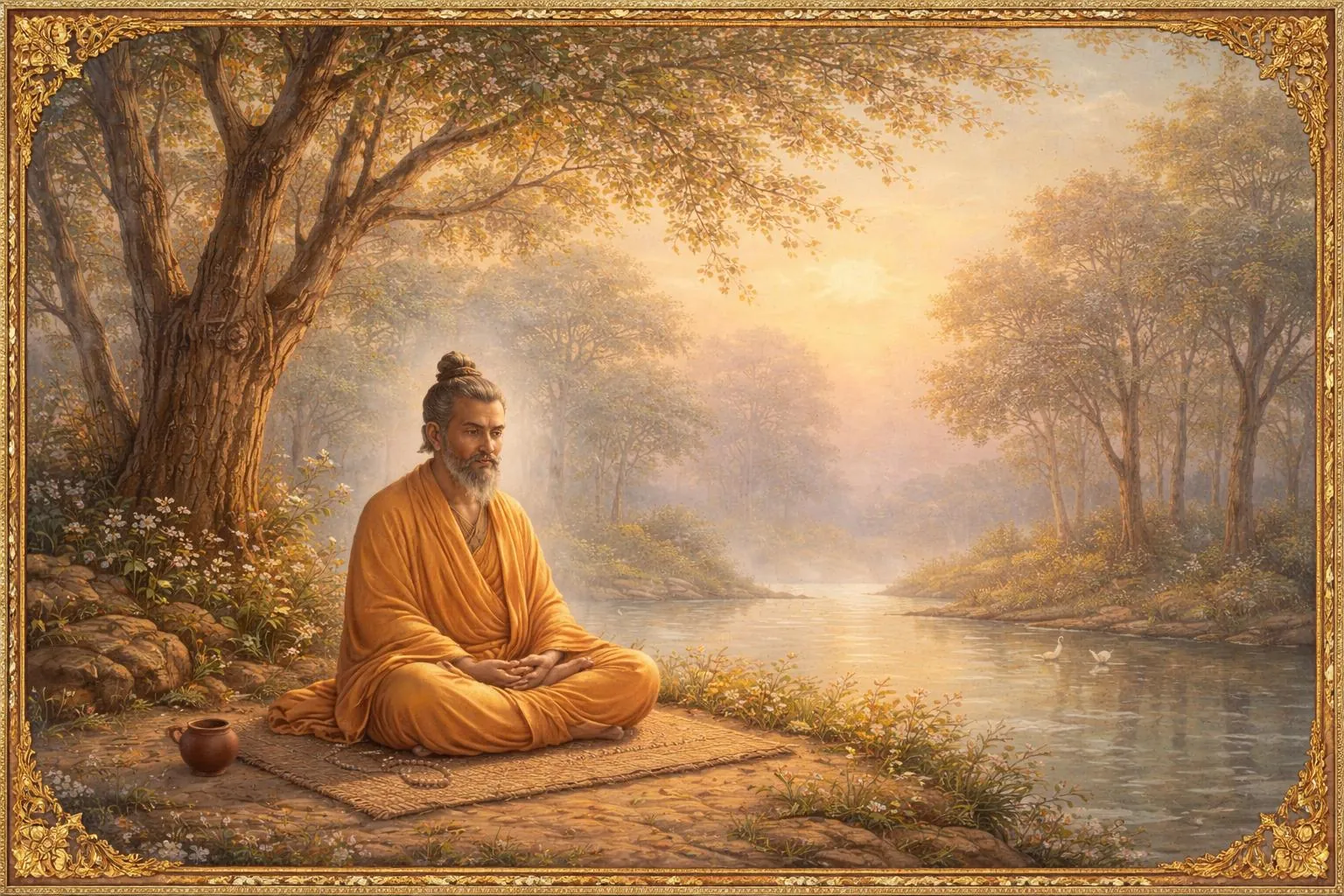
The country of Champaka received its name from a flower. The prince who lived there lacked neither means nor pleasures. He was so attached to enjoyments and so captive to his own pride that he gave no thought at all to the consequences. In his garden there was a house built—or rather, skillfully grown—from living champaka flowers. That was where he lived.
One day a yogin appeared in the garden. Seeing such an unexpected guest, the prince politely invited him into the house, washed his feet himself, and seated him comfortably. And after dinner, when the yogin began to preach as usual, the prince gathered more people from his retinue to bow to him. Then the prince said:
“Yogin, you have traveled through many countries. Have you seen flowers like these anywhere?”
The yogin looked at the wall of flowers before him and shook his head:
“Yes, these flowers are more beautiful than a human being. And they smell better. Perhaps the one who created this house is a genius, and your kingdom is more beautiful than everything around it. But when you die, you must go on without this.”
Something in these words stunned the prince, and he asked for instructions. The yogin told him about karma, cause and effect, and explained the practices of development and completion. But Champaka’s thoughts had already returned to the flowers, and meditation did not captivate him. Then the yogin chose instructions suited to what occupied the prince:
“Everything that appears is astonishingly empty. This is my flower for you. In your senses and consciousness the ground has been created. Concentrate on the single nature of the three rivers of pure nectar, and great bliss will come. These are Vajradhara’s words for you—hold them.”
The prince meditated for twelve years and, realizing that perception, experience, and the true nature of Mind are one, he attained siddhi. He became very famous under the name Champaka. He explained the Dharma to his companion and to the many people who gathered around them. In his body, Champaka departed into the Clear Light.
Thanks to the practice of correct instructions, you can make your entire life a continuous sadhana. Laya Yoga does not consist only of concentration or seated meditation, although this is necessary. Everything must be united with the path of contemplation: how we walk, eat, wash dishes, get dressed, go to the toilet, open and close the door, bow, sing before the altar, engage in work—all of this is practice of the highest order. For an experienced master of contemplation, all these things are inseparable; therefore it is said that he practices the yoga of non-meditation, that is, having learned to meditate, he enters the path beyond meditation, the path of abiding in the vision of non-duality.
First we discover such a vision through teaching and meditation, and then we blend it with everyday life. Waking up in the morning, you should remember the vision if you forgot it during the night. A good practitioner lives in such a way that at night he does not forget the vision. If you have forgotten it, then in the morning you recall it immediately with the first opening of your eyes. During the day you remind yourself of the vision, and before sleep you deepen it through the practice of the Yoga of Light. Thus, the yogin’s entire cycle of day and night is closed; he remains in continuous correct contemplation. If you doubt where to direct your mind, simply look at the instructions or ask for instructions.
The heart of a true yogin sings with joy, because if you are a contemplative, you cannot help rejoicing. To be dejected is the illness of separation from the center of Being. The center of Being itself, which we contemplate, is the source of joy. To be confused, uncertain, doubting, dejected, stunned, perplexed—all these are signs of distance from the center and of moving out to the periphery. To be peaceful, deep, spontaneous, joyful, clear, and light is a sign of touching this center. By how you become ever lighter and deeply aware, you can analyze how much you are approaching the universal center of Being.
To become so light means not only to meditate and concentrate the mind, although this is necessary; it also means to empty yourself, to let go, to open yourself to the primordial Source that transcends everything, to recognize your great “I,” to recognize that you are not a micro-being, but a mega-being encompassing all that exists. Having recognized that you are not micro but mega, you can relax. If you are mega, you have no problems; you encompass all that exists, you simply rejoice in your great discovery and continue to abide in it further. All those small earthly little problems, conditioned by name and form, are now no more than a speck of dust to you.
