

A sadhu bows to someone or something throughout his entire life, and this is not merely a religious or ritual habit for accumulating merit and purifying the mind — it is a very powerful sadhana that removes centeredness on oneself, on the relative “I.” It is precisely centeredness on oneself that creates problems. “Mine,” “I,” “to me,” “me,” “about me,” and so on, “I-I-I.” The source of suffering is centeredness on oneself.
Upasana as a Path to Overcoming Egocentrism
Upasana (worship) is centeredness on the other, on God. Since God has not been revealed within oneself, and viveka has not been cultivated enough to separate the ego (“I”) from God and discover the pure God within, external upasana is performed at first, called saguna upasana. In the process of saguna upasana, the student begins to understand that devotion, self-surrender, and openness to God free the soul from centeredness on oneself and from all the problems that arise; and very many problems arise — these are karmic problems.
In the process of external saguna upasana, the yogin acquires the habit of being centered on God. It is very important for a sadhu to acquire the habit of being centered on God always and everywhere: no longer on me, but on God; not me, but God; not about me, but about God; not for me, but for God; not mine, but God’s. It is very important to cultivate this habit and to realize, to feel oneself as belonging to God, not to oneself.
In the process of developing such a habit — this happens thanks to upasana. Upasana becomes increasingly refined, turns inward, becomes antar, and from bahir (external) becomes antar (internal). The yogin acquires viveka and the ability to recognize God within. The previous cultivation of centeredness on God, plus viveka and contemplation developed through yogic practices, makes it possible to continue being centered on God, but now in an inner way, recognizing where I am and where what belongs to God is.
The purity of the soul is determined by the extent to which it is centered on God, by the extent to which it is God-centered. An impure soul is always egocentric, since the ego is the aggregate of all obscurations and defilements. The ego is entangled in karma, and the ego abides in ignorance. A pure soul is always God-centered. You will not find a pure soul without God. A pure person who is an atheist, yet a saint — this is impossible, because the concept of purity presupposes access to the supra-individual, the suprarational, that which is higher than the soul.
Purity does not belong to the soul at all by definition; purity belongs only to God, therefore the inclusion of God in the perception of every soul is the very process of purity and purification. One way or another, the divine awakens in the soul when the soul, identified with ahamkara (ego) and the body, can no longer say: “I” — when, saying “I,” it means the divine “I.”
Once Brahma (the Creator God) and Vishnu (the God of equilibrium) started an argument between themselves to find out which of them was more important:
“I am the chief God,” said Brahma, “I created the entire universe and am the patriarch and progenitor of all living beings.”
“You are mistaken, Brahma; the chief God is I,” Vishnu objected, “everything rests upon me; if not for my power, neither you nor your creations would be able to exist for even a second.”
To resolve this dispute, these two deities turned to various authorities.
“Let a third party judge between us.”
However, all the authorities, one after another, said: “The chief God is Shiva.” Brahma and Vishnu were very annoyed. They did not believe the authorities and called upon, as a judge, the deity who is the personification of all the sacred scriptures. But this deity too replied: “The true God is Shiva.”
“How can that be?” Brahma became furious at last. “That cannot be. Just look at Shiva, at his whole unkempt appearance and dubious way of life. While I live in the heavens, in my precious palace, Shiva wanders through different worlds, spending the night wherever he happens to be. Like a homeless wanderer, he roams the icy mountains, dense forests full of wild beasts, and barren deserts. I am dignified, dressed like a king, my aura shines brighter than the sun. Shiva is unshorn, unshaven, rides naked on his bull, and all his clothing is the ash of burned corpses, with which Shiva sprinkles his body. I occupy myself with creating and establishing the laws of the universe, whereas Shiva either gives himself over to asceticism and meditations, as though he has not attained something, or dances and feasts in smashanas and cemeteries with a band of cannibals, spirits, and demons. I partake of divine ambrosia; Shiva devours whatever comes his way, both pure and impure, consumes mushrooms, datura, and constantly smokes hashish. No, such a being can in no way be the true God.”
Suddenly, at these words, a radiance appeared in the air and turned into a tiny infant. The infant began to cry, and Brahma said:
“Here is proof that I am the true and supreme God. I became angry, and my anger gave birth to yet another being. I shall name this infant Bhairava, since he is screaming so piercingly.”
Suddenly, increasing in size, the infant turned into a terrifying monster. His body became black, fearsome fangs gleamed in his maw, Bhairava’s three eyes burned with red hellfire, and his radiant aura turned into the flame of universal cremation. The monster leapt toward Brahma and, with the nail of the little finger of his left hand, cut off one of Brahma’s five heads—the very one that had reviled Shiva.
“I am Bhairava,” growled the terrible god. “I have come to punish you for daring to slander the supreme Lord of the universe. Your fifth head rose proudly above your body, but I have cut your pride down to size.”
Brahma fell to his knees in terror. But then the heavens opened, and the gods saw Shiva, who appeared in his form as Maheshvara—the great Maharaja and Lord of all worlds.
“O Bhairava,” said Maheshvara, “on the one hand, you have, of course, acted rightly, for you showed Brahma the true state of things. However, on the other hand, you have violated the sacred law and committed a sin. Brahma is the progenitor of all living beings, their patriarch and high priest. The law of the tribes says: a young man must not raise his hand against the elder of the clan; to cut off the head of a brahmin priest is an utterly terrible crime, and therefore you cannot go unpunished. You are invincible and capable of destroying everyone and everything with ease, while no one has the power to destroy you. However, I shall create the magical maiden Brahmahatya; she will be capable of destroying you.”
At that very moment the maiden Brahmahatya manifested from space, armed with enormous scissors. Seeing Bhairava, she rushed at him. Bhairava took to his heels. And so they ran: he away from her, and she after him, throughout the entire universe. Centuries passed, perhaps millennia—it is hard to say—but the chase did not stop for a single second.
One day Brahmahatya and Bhairava were running past Vishnu’s palace. The goddess of fortune and prosperity, Lakshmi, Vishnu’s wife, beheld what was happening from the windows of the magical palace and, greatly surprised, was left in complete bewilderment.
“Tell me, O dear one,” she addressed Vishnu, “how is one to understand what is happening? Shiva reviled Shiva, and for that Shiva appeared and cut off Shiva’s head. After that Shiva appeared and punished Shiva by creating Shiva, and now Shiva is running after Shiva across Shiva, in Shiva, and during Shiva, and now Shiva is fleeing so that Shiva will not catch him. All this looks very strange—I would say absurd. How is all this to be understood? What is the meaning of what is happening?”
“O beloved,” Vishnu replied, “in what you see, as in much else, there is not the slightest meaning. It is not for nothing that they say Shiva invented this world while drunk. After all, he is constantly in the ecstasy of narcotic intoxication caused by sex with his beloved Shakti—his inexhaustible, boundless, light-bearing power. Shiva’s consciousness is not determined by the karmic law of cause and effect, by logic, space, or time. That is why the universe is so bizarre and paradoxical: it reflects within itself the image of the creator himself. Here darkness becomes light, and light becomes darkness; good turns into evil, and evil into good. Purity becomes impurity, and impurity becomes purity. The highest beauty turns into ugliness, and the apogee of ugliness becomes beauty. Wisdom turns into madness, and madness into wisdom. Thus everything flows, changes, and passes into one another. This pulsation, these iridescent shifts, are the ecstatic love of Shiva and Shakti, the activity, the life of the holy Reality; and apart from this, O beloved Lakshmi, Shiva is utterly indifferent to what he does—it is all the same to him.”
The story goes on to say that after some time Bhairava found himself in the vicinity of the sacred city of Varanasi (Benares), located on the bank of the Ganges, and there Brahma’s head fell away from Bhairava’s hand, and he understood that his problem had finally been solved. The place where Bhairava parted with Brahma’s head is called Kapal Mochan by people. It is still revered by Hindus to this day.

The Conduct of Awakened Beings. “Yoga Vasistha,” Chapter 6, “On Liberation.”
Rama asked again:
“Why, O sage, did Shiva decide to appear as a naked dweller of cremation grounds, with a necklace of human skulls, smeared with ash and easily aroused by lust?”
Vasistha replied:
— The behavior of gods, perfect beings, and free sages is not determined by the rules of good manners — these rules were invented by ignorant people.
Then the question arises: “What, then, is it determined by?” Since it is not determined by karma, not determined by the rules of good manners, what is it determined by? Place, time, circumstances, abiding in Brahman, grace — all these three factors determine the behavior of the gods. They are in sahaja-samadhi, nourished by divine grace, and manifest in accordance with place, time, and circumstances. Awareness and the power that flows from it, which is integrated in accordance with the conditions of place, time, and circumstances — this is what serves as the guide for the manifestation of divine beings and the awakened.
Nonduality in Manifestation
When Shiva manifests in this way, he shows that the point is not in the manifestation, that nonduality is everywhere, consciousness is everywhere. Anger may manifest, tamas may manifest, but against the background of anger or tamas there is consciousness, there is contemplation, nonduality, and one can separate oneself from tamas and from anger, and abide in contemplation, in nonduality, and in a detached state. In this way one can subdue anger, tamas, if one separates oneself from it while abiding in nonduality.
Lust exists, but the transcendental state exists against the background of lusts; if one separates oneself from lust and abides in the contemplation of awareness, it will not bring problems, but will submit and disappear. If it does not submit, there still will be no problems, and if there are no problems, it means it has been subdued.
There are ambitions, power, greed, rivalry, attachment — a great many of all these human qualities and vices. In fact, they appeared from somewhere, and in fact they are expressions of various shaktis. These are universal shaktis packed into the human body: kriya, iccha, aishvarya, svatantrya, and others; only these universal qualities, having been reflected in Prakriti, in maya, became distorted. They acquired small, narrowed, limiting qualities, but in reality they are divine powers.
Shiva shows that if you separate yourself from them and discover Shiva-tattva, abiding in nondual awareness, then all these kleshas, vices, negative qualities, flaws, everything that limits you, will gradually begin to appear from a different angle. They will gradually begin to reveal to you their luminous, empty, illusory, and divine nature; they will become manageable, become subject to you, and cease to limit you.
Shiva seems to say: “Look, see how I can do it. Here is a snake on me, and nothing happens to me; I drink opium, and nothing happens to me; I do this, and nothing happens to me. Why? Because I am detached from it, because I abide in emptiness. That is precisely why all these things that are negative for you cannot harm me.”
The Criterion of Mastery
In the same way, when we abide in awareness and contemplation of the Absolute, in viveka and vairagya, the karmas embedded in us cannot harm us. We do not suffer, we do not become entangled, we do not remain in confusion, only if we abide in Shiva. As soon as we suffer, as soon as tears appear in our eyes, as soon as despondency arises in us — it means we are simply not abiding in Shiva, we are simply abiding in something else. It means we are not abiding in right contemplation. Any confusion, any suffering, any entanglement is a sign of not abiding in awareness and contemplation.
If you abide in empty, nondual awareness, then you easily solve any problems, and even if you do not solve them, you easily do not solve them. All your problems are easily untangled, untied, solved, and even if they are not untangled, not untied, it is still easy. You simply separate yourself from them, but you always feel light — this is the sign of a master.
Therefore, sometimes masters say this: “If something happens and a person suffers — if you are a master, you will take it easily,” — that is all. If you have understood these words, you no longer have the right either to complain, or to express yourself, or to say anything, or to fall into negativity, or to become darkened in any way, if you want to conform to this standard. If you are a master, you will take it easily, that is all — these two words are simple; but if it is not easy, then you are not a master, that is all, everything is clear. What can be expected from a non-master? A sakala, a samsaric being, is supposed to suffer.
But as soon as you declare that you are a master, that is it: you should be able to take it easily—what problems could there be? This is the criterion—these are the standards of the siddhas, and if you communicate with saints of such a level, with siddhas, they may casually test you in some way: in one situation, in another, in a third, with a smile: “So, if you are a master, it should be easy for you in general; and if it is not easy, then think why, what the matter is.”
Thus we must move toward mastery, telling our mind: “If you are a master, you will take this easily, because a master is a master precisely in order to take everything easily.” Easily does not mean lightly or superficially. Easily means allowing the one who contemplates to be liberated in natural clarity. This is a great thing, or allowing oneself to surrender it to God, if one follows the path of bhakti yoga, devotion and love for God.
The Secret of Self-Liberation
Somehow you know this secret: how to liberate your heart and live in happiness and joy, and never, nowhere, under any circumstances, become entangled in anything—neither in illnesses, nor fear, nor anger, nor lust, nor suffering, nor property, nor power, nor money, nor pride, nor status, nor service, nor relationships, nor mystical experiences, nor spirits, visions, nor manifestations of divine beings, nor anything at all.
You know this secret, and this secret is self-liberation and self-surrender to God, and this is the most important thing a sadhu should think about. He must not allow himself to become entangled in various kinds of maya.
If he becomes entangled in various kinds of maya, if it casts him down, if service entangles him, it simply means that the service was taken on not in accordance with his consciousness; he should take simpler service. If the service is complex, you become entangled and suffer—there is nothing terrible about it; there is a broom, there is simple service: sweep, be happy, you certainly will not become entangled. Either it is clean or dirty, the cleaning is done or not done—everything is very simple, but abide in awareness.
Complex relationships—simplify the relationships, observe mauna, do namaste, come to the Guru for darshan—that is all, no problems. Some other complex thing—also no problems, simplify it, but maintain consciousness, maintain awareness, abide in contemplation—this is the most important thing.
If it is difficult to self-liberate desires, to transform desires—renounce them, keep your distance, simply by the method of willful cutting off, but maintain consciousness, maintain contemplation.
One who strives to become a master must understand that only through devotion and faith, self-surrender, and maintaining the view and contemplation can he solve all problems. In general, the problems of human beings are first related to worldly desires and ignorance associated with the lack of clarity of consciousness. Then everything is gradually purified, and problems with desires go away.
A pure sadhu has no problems with desires, but he may have problems with consciousness. If there are still problems—anger, lust, attachment, pride, greed, avarice, and so on—these are still problems with coarse energies that have not been overcome. Most people on the planet have problems with energies; the energies of the body simply devour them, torment them, and these problems with energies, combining with problems of the mind and ego, create unique configurations of karma, where there is egocentrism, ambitions, and the energies of the body and mind all together form a conglomerate, the so-called ahamkara (ego).
Control of Energies and Problems of Consciousness
If a person is advanced, naturally he has fewer bodily energies, but more egoistic ones already arising from consciousness. But if he is a sadhu, then he controls and purifies desires, and there are no problems with energies. Energies can be controlled—everyone must understand this. Prana can be controlled—raja yoga, kundalini yoga; one can separate oneself from prana, but the question is how to do this skillfully so as not to freeze it, and so that the body is still in good condition, so that the energy circulates.
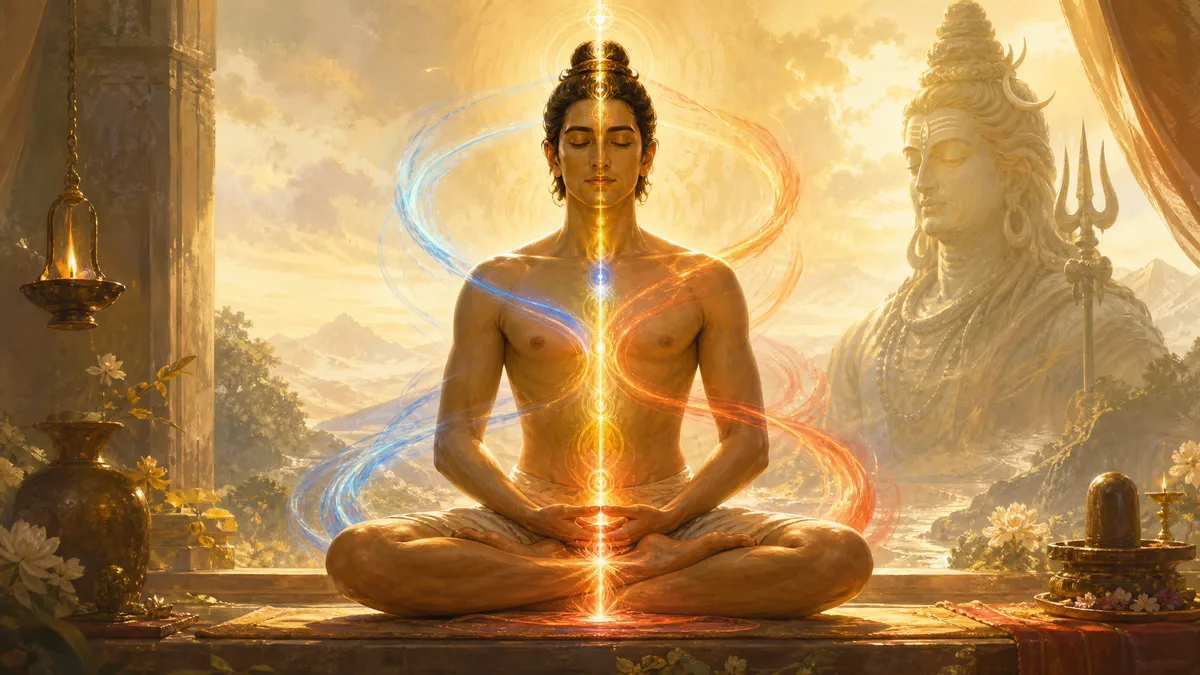
But then a layer of problems with consciousness opens up, since consciousness contains kleshas, subtle causes, samskaras, vasanas, motives, intentions, endless assessments and judgments, tunnels of reality in the subtle world, past incarnations. This is a vast world of which the sadhu is unaware. Hidden tendencies of the unconscious.
Bodily desires have been conquered, but the problems of consciousness—the sadhu purifies them for a long time. On the path of anuttara tantra, the sadhu tries to solve the problems of consciousness with a single snap, by directly entering the natural state and giving himself a vow to abide in the natural state throughout his entire life. This is the commandment of anuttara tantra—the single samaya.
But after some time, the sadhu is freed from the problems of consciousness, and he is freed either through devotion, divine grace, or through jnana (clarity) and contemplative presence—or, better still, when both are present together. This is an invincible configuration of spiritual liberation: bhakti, jnana, ishta-devata yoga, Guru yoga and laya yoga, contemplation and devotion.
When these two problems are resolved, there is no longer anything left from which one could suffer. There is no longer anything left in which one could become entangled. There is no longer anything that could bring suffering, confusion, and entanglement.
The Open Path of Liberation
The yogin enters the open path of liberation, the open road of liberation; he can no longer be obscured, his state cannot be disturbed, he cannot be knocked off course—neither karma, nor the opinions of others, nor events in the external world, nor planets, nor configurations of prana; nothing can trouble him anymore, because he possesses pratyaksha-jnana (direct vision of God). He is able to contemplate God and is able to find the point of God in any experience.
Here the Guru says to the disciples: “To attain this, do not be in clinging; be in detachment. Do not be in confusion; be in clarity. Do not be in pride; be in self-surrender.
The mind of an ignorant person is tightly conditioned; if he were not guided by the rules of decent conduct, chaos would arise, in which the big fish devours the small. Wise people, on the other hand, do not sink into what is desirable or undesirable, because their senses are under natural control; they are awakened and vigilant.
Thus, the senses of the wise (jnanis) are under natural control, and they are not conditioned by any patterns. A person is always conditioned by patterns. The wise one is not conditioned by a pattern, since he has an intuitive abiding in the natural state, and he is always able to have inner guidance; he has an inner harmonizer, simply by abiding in the natural state or by abiding in devotion and self-surrender. These are two sides of one process.
Applying Contemplation in Everyday Life
It is important for us to learn to use our contemplation even in everyday matters, to learn to use our self-surrender and devotion in current life. After all, this is what should work—this is what should solve any of our real problems.
For example, if there is a task in service, then by performing service from the presence of awareness, the service turns out well. Even if it does not turn out very well, at the very least we have no suffering or distress because of it. If there is some difficulty in relationships, then our presence and contemplation in awareness allow us to harmonize any difficulties, and our self-surrender as well, and to bring the difficulty in relationships into purity, into emptiness, into illusoriness, into lila and into grace. To make relationships grace-filled, illuminated by God, sacred, pure, and free from problems. If there is difficulty with some perception, then by using contemplation and self-surrender we can change the perception of something; and thus the maturity of a sadhu abiding in the state of awareness is determined by how much he can apply what he contemplates, by how much his self-surrender and contemplative presence work in a specific situation.
We must be able to use what we contemplate. If we do not use it, then its power—purifying and harmonizing—does not grow if we do not apply it and forget about it. What usually grows is what we constantly use. Thus we must constantly use the power of the natural state for our life. It must become so woven into our life, we must be so much in inner control of the sense organs, that we do not allow ourselves even a single eyelash to fall unconsciously, not a single thought to arise and flash through the mind without awareness, not a single emotion, not a single thought, not a single word to be spoken without abiding in self-surrender and without abiding in the natural state. Then this will be true self-control.
The sage lives and acts without intending to do so, without reacting to events in the habitual way; his actions are pure and spontaneous, like a coconut falling without any cause-and-effect connection from a tree on which a crow has at the same time landed—or he may do nothing at all. Thus even Brahma, Vishnu, and Shiva incarnate. The actions of the enlightened are beyond praise or blame, beyond acceptance or rejection, because they have no concepts of “this is mine” and “this is another.” Their actions are pure, like the heat of fire.
For example, you have been given a responsible service, you are doing it, and someone comes and does it as well, in your place. If you are a very responsible person, your reaction is that you express active dissatisfaction, because this service was given to you. But if you are in a state of awareness, you will not have such a reaction. After all, Shiva, through other hands, is doing the very same thing, certainly not badly, and you see this as a blessing that has entered your life; behind it you recognize Shiva’s play.
A sadhu who abides in true awareness never tires of recognizing the play of God in all phenomena, never tires of recognizing the emptiness, the illusoriness, the primordial innate purity of all phenomena. He uses his presence in order always and everywhere to be in harmony, and if something does not happen as expected, he does not say: “This is mine, this is for me, I do not agree.” He says: “I accept this as the play of God, I see it purely, I see it as an illusion, I see it as the empty play of manifested forms. I act naturally, without responding from the state of presence. Such a response is always harmonious and never brings me problems — this is the secret of how to always be in happiness.”
Such a sadhu will never allow himself to become entangled in anything — neither in relationships, nor in service, nor in concepts — and he will not even enter into an entangling situation, because his clarity will be sufficient for him to understand in advance whether he will become entangled or not. If he sees that he will nevertheless become entangled, he will not come so close to that situation as to become entangled. His clarity is total; it is so total that he always abides in happiness, and clarity presupposes both an understanding of measure and an understanding of balance (samyoga) in everything. For example, in relations with his kundalini energy, in relations with the desires of the body, in relations with prana, in relations with his method, in relations with others, with the hierarchy, with the ethics of a sadhu, with culture. Such is his contemplative clarity in relation to experiences and visions in the subtle world, to pure or other visions. His contemplative clarity creates around him such a pure, flawless field in which he is always harmonious, self-sufficient, and happy.
I did not wish to describe in detail another form of silence — the silence of the bodiless one, because you still have a body.
Such awakened sages have an empty consciousness and such a flexible character that you can neither wound them, nor darken them, nor upset them, nor give them anything, nor take anything from them. They are like walking emptiness, full of bliss and ecstasy. It is precisely toward such flexibility of awareness, and following that, of character and traits, that we must strive. Life constantly presents us with challenges, and our life, our future, depends on how we respond to these challenges. The best way to respond to these challenges is from a state of complete awareness, non-clinging, without evaluations or judgments, in the natural state. Things are assessed very differently if they are viewed from the ordinary mind, full of egoism, obscuration, and simply ordinary judgments, and from the contemplative mind — the assessments are completely different.
For example, someone gives you seva, then another seva; certain events simply occurred, and then they say: “This is no longer needed.” Then another seva, and then a third seva. If you are in contemplation, what is happening? Contemplation is happening, nothing else is happening. This will even evoke joy (ananda) in you: how diverse the world is, how changeable it is. But if you are not in contemplation, your mind switches on, past experience, and also the ego, and you think: “Why was I given this seva, and then this seva, and what is the point of this, and it would have been better if I did this seva, and I don’t really like this one at all, and whoever is assigning it, what is he thinking? What kind of monk is this, does he even practice? Then yet a third seva, this one, and that one wasn’t finished, and who will finish it? This is all a mess. Who does seva like that?”
You enter a completely different dimension; you enter a tunnel of reality that is somehow entirely non-contemplative, entirely impure, not allowing; you are in the human. You are in the layer of the mind, and the rajasic-tamasic layer holds you very tightly — these are your thoughts. You are in your thoughts, and at that moment in complete slavery to your thinking, whereas everything could have been resolved so simply — space, atma-vichara, pure vision, one “taste,” the twelve sankalpas. There are twelve sankalpas there, and here — how do they fundamentally differ? In the kitchen there were sankalpas of contemplation, on the second site sankalpas of contemplation, in the altar room the same sankalpas — how have they changed? In principle, nothing has changed, therefore in the lives of saints nothing changes, although events may be boiling, while in the lives of those who do not contemplate there are no real events, yet even small stirrings cause a great deal. All these are different minds that interpret reality in different ways.
Sometimes I am asked: “How are you, how is your life?” I do not know what to answer, because twenty years ago there were contemplative sankalpas, and twenty years have passed—they have not changed, so I answer: “Everything is fine with Brahman. Brahman is the same.” Nothing happens if you abide in primordial awareness. You do not allow yourself to enter the layer of identifications with shakti (energy).
The Relationship Between Shiva and Shakti
Because you are detached, separated from shakti, from energy, you control it; you are Shiva. You do not fall out of the first tattva—the Shiva-tattva. Because of this, all the other ones—Shakti-tattva and the rest—all of them arise from your consciousness, they are under your control, or at least are realized by you. This is vairagya—this is the art of abiding in contemplative awareness.
But if you lose the Shiva-tattva, lose contemplative awareness, and become subject to shakti, to various energies, then you will have to experience the whole cup that it offers you to drink, the whole cup of karma that it offers. For it is like this:
— How about we take a little pride?
— Well, let’s.
— How about we get a little attached?
— Well, let’s.
— How about being reborn in the next life as Indra?
— Indra, oh?!
— And here is another karma for you; perhaps as a human already?
— As a human?!
— No, well, there is also hell here; how about being reborn in hell too?
When we allow one thing, you must understand that shakti knows no boundaries in play; shakti does not tolerate patterns, does not tolerate limitations, it plays as it wants, and shakti does not listen to you if you are not Shiva. For it, all games are equal: to be born in hell, to be born in heaven—what is the problem? For it, this is an ecstatic game: “Let’s play, as an ecstatic game, in a body in hell—what is the problem?” But for an ordinary person this is very important, and here shakti can be controlled only from the position of Shiva; only by abiding in the state of Shiva will all the games of shakti be under control, pure, they will not rule over the soul. In all other cases shakti tramples Shiva, shakti rules over the soul, and the soul must decide; it cannot be in an undefined state, it must accept the protection of Shiva, because without the protection of Shiva, shakti will spin it in the whirlpool of samsara, and our birth, our present life, is precisely the consequence of shakti having taken us into its turnover. The shakti of the body, the shakti of karma, the shakti of the pranas, the shakti of the subtle mind—it has already taken us into its turnover, and this is already happening; that is, the very fact of our life in the material world, in ashuddha-adhvas, impure space-time continuums, is precisely the sign that shakti is turning us as it wants, because we have not understood how to build a relationship with it.
If you are in true contemplation, in true self-surrender, and shakti says to you:
— How about we get attached?
We say:
— Only with God, only through God, and in no other way, no way at all; either with God or not at all.
It will say:
— Yes, I respect such a position—this is a position of complete devotion; here I will serve you as my lord. And how about taking pride?
You say:
— Only in self-surrender and only to take pride in Shiva, not in oneself.
— Yes, you are like my lord; I respect such a position. And how about we obtain some abilities?
— Only with Shiva, only with God, and in no other way; either this way or not at all.
— Yes, perhaps my games do not impress you. You are like my lord; perhaps I will accept your exalted state and will respect it, I will serve you.
This is how shakti is pacified, and shakti must be pacified. Only pacified shakti turns the soul from pashu, as something subservient and bound, into Pati—the ruler, the lord of shakti. Pashu are all those who are bound by shakti; Pati are all those who possess shakti (shaktimans), the lords of shakti. Our task is to become the lord of shakti (a shaktiman). Shiva is the supreme maha-shaktiman. We are not to become the ruler of shakti in the way people in the world strive to become—none of this is true rulership. Money, power, wealth, fame—shakti deceives such people; it gives them toys to play with, creating the illusion of rulership, but in reality no one there possesses anything. For the duration of the life of this body, a person has the illusion that he possesses something, and then shakti very quickly destroys all of it. True rulership over shakti is the transition into the class of Pati, into the class of liberated shaktimans who possess shakti by abiding in the state of Shiva, in complete surrender, in complete unity with him.
Jnana Yoga and Hatha Yoga
I did not wish to describe in detail the form of bodiless silence, because you still have a body. But I will describe it briefly now. Those who are fully awakened, constantly abiding in samadhi, and sufficiently enlightened are considered jnana yogis. Those who have attained the state of bodiless consciousness through pranayama and so on are called hatha yogis. Truly, these two groups are essentially one and the same. The cause of the apparent world and of bondage is, indeed, only the mind. These two paths lead to the cessation of the mind; therefore, through constant and sincere practice of either path, the stopping of the movement of prana or the cessation of thoughts and liberation is attained. This is the essence of all descriptions of the paths to liberation.
Rama asked:
— O wise one, if the cessation of the movement of prana is liberation, then death is liberation, and all people attain it after death.
Vasishtha replied:
— O Rama, when prana is ready to leave the body, it already comes into contact with those elements from which the next body will be made. These elements are truly crystals of psychological conditioning, memory, past impressions, and predispositions of individual consciousness (vasanas).
When the soul leaves the body, earth enters water, water enters fire, fire enters wind, wind enters space, and this is accompanied by the experience of mirages, smoke, fireflies, thunder, light like that of an oil lamp—the so-called initial five signs—and then three colors; then begins the white radiance like a sky flooded with moonlight, the father’s drop. At this time, many dualistic notions dissolve; then the red overflow begins, like the sun at sunset, when the sun’s rays color the expanse of the sky and the vast space is tinted with such orange-red, yellow-red, crimson color. This means that the rajas-drop enters the sushumna-nadi, and many dualistic notions connected with worldly desires (the red bindu) dissolve.

Then begins the experience of darkness, the eve of reaching what is close to the Clear Light, in which the soul, if it is weak in contemplation, loses awareness—it is very difficult to maintain awareness in this state. Finally, the experience of the state of pure light (prabhasvara) arises, and this experience of pure light is the attainment of the state of dreamless sleep and the attainment of the state of turiya (Purusha-tattva). From this state Shiva is seen, Brahman is seen, the Absolute is seen, and nonduality is experienced directly beyond concepts; pratyaksha-advaita is experienced there purely.
But in this state the soul is not able to remain in the pure light. The state of complete transparency, of utterly pure nondual emptiness, emptiness, nonduality, the experience of the space of the Absolute at a high level—if the soul is able to remain in it, it begins to enter more and more into this pure light, to recognize different levels of space, different shaktis, and to enter further and raise its tattva up to the fifth, fourth, and third. But in this state of light, few souls are able to remain; this light is too transcendent to be realized.
But one who has trained all his life in the natural state, in the meditation of shambhavi mudra, in mahashanti—he recognizes this light. He recognizes it and merges with it, because all his life he has meditated on it; it is familiar to him. He will see it as something dear. This is described as: “Like a son who easily jumps onto his mother’s lap”—he unites with this light. But one who does not recognize it—for him this light will flash forth, and he will be unconscious, and then, after some time, he will fall out of it.
The Intermediate State of Becoming
Then the so-called antar-bhava (the intermediate state of becoming) begins—this means that, having fallen out of the state of this light, before that the soul also sees many different deities, hears roaring, thunder, sound, light, and deities that are its own nature. If the soul practiced visualizations and worship of deities, those deities to whom it practiced worship will appear. If during life someone had experiences, for example, in jyoti yoga, in nada yoga, at this moment he can attain liberation by merging with the sounds, the light, and the deities, recognizing them as the nature of his own Mind.
But usually, if the soul has not practiced, it does not recognize these deities, and it is frightened by the sounds, thunder, and light, and tries to find something gentler, and finds some dim lights of samsara. It tries to follow the path of the dim light, and gradually its mind creates a new future body.
Those doomed to hell, in the intermediate state of becoming, look like a charred log. Those doomed to the animal realm look like a smoky, subtle body. Those doomed to become hungry spirits look like water. Those doomed to become humans or gods of the desire realm look like pure yellow ones. Those doomed to be reborn as gods in the world of forms look like white ones in white garments or like an intense white color.
Also, those who will be reborn in hell walk upside down or head downward, that is, in an inverted state; they are seen in a subtle body according to various sacred texts and acharyas. Their subtle body is seen as inverted because their negative karma greatly outweighs and obscures them. Those who are preparing to become humans or gods of the desire realm walk with their heads raised upward; they walk in the subtle body. Those who are preparing to be reborn as hungry spirits walk backward, with their backs forward.
Question: Guruji, while a person is still alive?
No, everything is already over; the soul is already experiencing posthumous experiences.
Here there are three fundamental experiences that require purification: the process of dying, that is, the dissolution of the elements; then the process of experiencing the clear light (prabhasvara); and then the process of the intermediate state of becoming. Becoming means that the soul seeks ways and paths of embodiment, is cast into some form.
Rebirth usually takes place within forty-nine days. If the soul has not been reborn in the first seven days, it experiences a minor death, that is, it dissolves again into the clear light, and the body that had been created dissolves—that initial intermediate body that was preparing to incarnate somewhere.
It again experiences processes similar to dying, again enters the state of white radiance, the red outpouring, the state of blackness, enters the clear light, and then remains for some time in the clear light, and then again emerges from it, and so on up to seven times. But within forty-nine days souls usually are reborn; however, this does not apply to those souls that control their reincarnation, directing their mind and subtle body at will. Such souls can act however they wish, be reborn in pure lands, transform in an illusory body, and these standards do not apply to them.
Hidden Tendencies and Rebirth
When prana leaves the body, it takes with it all the hidden tendencies of individual consciousness. The mind cannot become non-mind until the hidden tendencies exhaust themselves and disappear. The intellect does not leave the life force until self-awareness arises. Through self-awareness the intellect and hidden tendencies are destroyed, and after that prana no longer moves.
Thus, the soul is reborn in accordance with hidden tendencies. These tendencies are hidden in the sense that they are concealed deep within in the form of sanchita karma (frozen karma), and they are difficult to detect while the soul lives in the body and does not practice or does not have samadhi. But they are revealed when the soul leaves the body, and when, having experienced the clear light, it manifests some of its energies.
What can be called tendencies? Tendencies are our concealed possibilities, our hidden preferences and inclinations, which cannot manifest in the environment that exists, because the secondary causes do not correspond. For example, someone has a tendency to become a great musician, but there are no external causes for this. In this life he is not destined to become one; this tendency is deferred to the next life, because the external cause of this life in no way stimulates this tendency, and it is impossible to know that this is potentially a great musician until he enters the appropriate environment.
But this tendency may manifest after some time; he may become a gandharva or someone else, if this tendency exists, but exactly how it will manifest depends on how the contemplative consciousness manages this tendency. If there is no contemplative consciousness, such a person will simply be born a musician in the next life, and the power of accumulated tapas will go into music. But if he has become a sadhu who has reached a high stage of contemplation, and this tendency opens in him, he will become a master of using sound, become a gandharva, become an enlightened deity using sound to transmit enlightened states.
Our task is, before future tendencies begin to manifest, to become firmly established in devotion, in self-surrender, in the natural state, so that none of our tendencies can knock us out of the correct state, both in view and in behavior.
For example, some people have a tendency to create problems for themselves; there are such people, any number of them, who can create such problems out of nothing, and the problem is not in the external, but in the tendency of the mind, when in the past impressions of fear, apprehension, rivalry, struggle for something, and insecurity were accumulated. But if such a person has discovered the natural state, these tendencies, even if they manifest, will not be able to influence him. He will simply make these tendencies his ornaments, just as Shiva made snakes his ornaments. They will dissolve, transforming, for example, into his ability to eliminate fears in others, and he will become a consultant for overcoming fears, because these tendencies have taught him. He will become capable of eliminating doubts in the minds of others, or of overcoming negative tunnels of reality in others, because the power of his light and contemplation will overcome his own tendencies; he will develop, as siddhis, the ability to help others through this. The tendencies will already be completely different. Our task is to become so established that no tendencies can confuse us.
The Exhaustion of Tendencies and the Attainment of the Supreme State
This is truly supreme peace. Awareness itself realizes the unreality of concepts in the objects of this world. This brings to an end the hidden tendencies (vasanas) and the connection between the mind and the life force. Vasanas constitute the mind, which is a repository of hidden tendencies and nothing more; if the tendencies cease, this is the supreme state. Knowledge is knowledge of reality. Inquiry (questioning, observation) is itself knowledge.
Thus, with the help of contemplation, diksha, and the arising of devotion, we move toward the great exhaustion of all tendencies. Such exhaustion is threefold:
Kriya-nishpatti (the exhaustion of actions) and relaxation beyond deeds
Bhava-nishpatti (the exhaustion of the emotional states of the subtle body) and relaxation in brahma-aham-bhava and divya-bhava
Jnana-nishpatti — the recognition of all the subtle knowing, inquisitive activity of the mind and relaxation in the primordial nondual state of omniscience
All these tendencies must be exhausted. Those who exhaust these three types of tendencies realize all kinds of nishpatti, attain a high tattva, experience a high tattva, and pass into the class of Pati — divine beings, lords. Lords of what? Of their own karma, which is exhausted; lords of their own shakti.
One-pointed striving toward a single goal, the stopping of prana, and the cessation of the mind — if one learns one of these three methods, the supreme state is attained.
One-pointed striving toward a single goal — Raja Yoga
The stopping of prana — Kundalini Yoga
The cessation of the mind — Bhakti and Jnana Yoga, self-surrender and self-recognition
The life force and the mind are closely connected with each other, like a flower and its fragrance, or a mustard seed and oil. If the movement of thoughts in the mind ceases, the movement of prana also ceases.
The secret of self-liberation is to stop the movement of thoughts. Following the movements of thoughts, the movement of incorrect samsaric prana will cease, and prana will begin to fill the sushumna nadi. Thoughts activate the movement of prana; prana activates blood circulation. Prana activates the movements of the indriyas; the indriyas move and perform actions, and in this way karma is accumulated.
If, however, the movement of thoughts is deactivated and thoughts are transformed into something else — for example, instead of a stream of mental activity, we experience playful self-liberation into the pure light of the natural state — then our thoughts are transformed into a peripheral play of the energies of natural awareness. Then our thoughts, which used to lead us into dead ends, our evaluations, our judgments, our patterns, which constantly brought us problems and led us into various incorrect states, become absolutely safe. They become garlands around Shiva’s neck; they cannot lead us into delusion or bring problems, they cannot move our prana.
For example, thoughts are experienced, but they are as though empty, and emotions do not arise behind them. As they are experienced, thoughts are quickly released into the pure light and offered to God. We experience the grace of the pure light against the background of any thoughts. Whether we have thought correctly or incorrectly, evaluated or not evaluated—all this is not important in truth, since all thoughts are, in their essence, empty and illusory, and are inseparable from the natural state, being its play. We are not attached to our own thoughts, we are not attached to the thoughts of others, because we know the value of thoughts, and thoughts cannot lead us into delusion, since they are a play.
That in which we are rooted is sahaja-nishtha, the very abiding in God and self-surrender—such is the state of the wise. One who attains this during life is on the path to liberation. He seeks nothing, yet finds everything; he strives for nothing, yet gradually discovers within himself the goal of all cherished aspirations. He does nothing, yet everything happens as he wishes. He is attached to nothing, yet he himself is a magnet toward which everything strives to come.
The Natural State as the Source of Divine Energy
Such a balanced, blissful, pure, naked, eternally youthful state the wise call sahaja, nirvana, maha-mudra, the natural state of shunya-ashunya, amanaska, niralambha (supportless), tathata (true suchness), sugatagarbha, that which contains within itself all sugatas (awakened ones), the source of all awakened ones. For us this is Shiva, Brahman, brahma-nishtha, nididhyasana, atma-nivedana (offering oneself to God).
This is the source of colossal divine energy, divine grace, happiness, and bliss. This is not only a conceptual state; it is not only a state of evenness and consciousness. One who has reached only the conceptual or the non-conceptual, so to speak, is looking at it from afar. This is a source of energy, a source of grace-filled, life-giving, spiritual, blissful energy; therefore to abide in it is not only to abide in calm and peace. To abide in it is also to abide in grace, in divya-bhava (divine love).
This is the source of divine love and life force not only for us, but for all people, all animals, all plants, all gods, all nagas, all gandharvas, all angelic beings, all siddhas. The difference is that nagas, the enlightened among them, gods, siddhas, angelic beings, rishis, are so close to this source that they clearly realize it, continuously meditate on it, and abide in it. Thanks to this, their powers are immeasurable; their understanding and wisdom are incomparable with those of humans; thanks to this, they live in divine, angelic dimensions created by the power of divine grace, and their bodies too consist of the purest sattva as divine grace. They draw from the natural state that energy of happiness, bliss, jnana, ichchha, kriya, aishvarya, svatantrya, which beginning sadhus in the human world cannot draw.
If the entire mind strives one-pointedly toward the single truth, the movement of the mind and, accordingly, of the life force ceases. The best method is inquiry (investigation, observation) into the essence of oneself, the supreme infinite consciousness. Your mind will be completely absorbed in infinite consciousness. Then both the mind and the inquiry will cease. Abide firmly in that which remains after this.
