

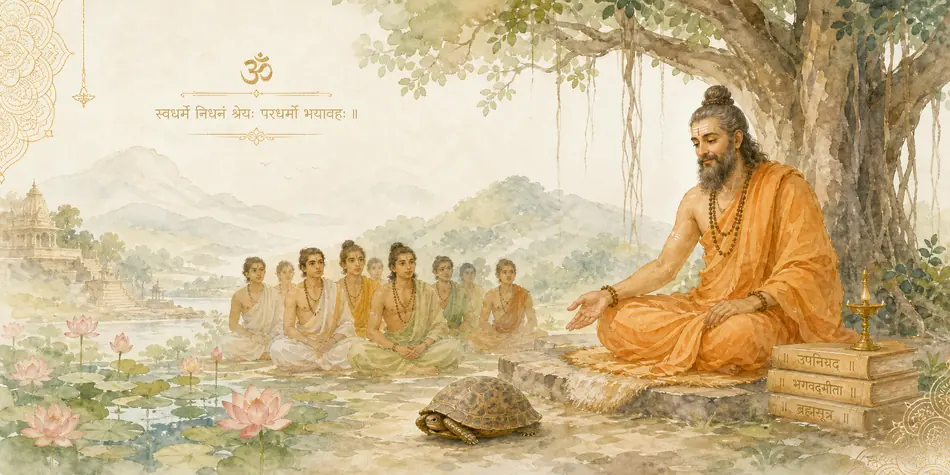
The Guru answers questions from seekers and disciples
Question: Om, namaste. What does it mean to transcend the six sense organs? Does it mean suppressing nothing, denying nothing, not blocking energy, while remaining fully engaged in perception? How can this be done, and is it possible to transcend love?
We have five sense organs, five jnana-indriyas: the nose, tongue, skin, eyes, and ears—that is, smell, taste, touch, sight, and hearing. They correspond to the five elements in the body. They are doors to the external world, like windows onto the external world. Our soul sits deep within the body and looks through the windows of the five sense organs to see what is happening in the world, and it sees everything that happens in the world through these windows. The sixth sense organ is the mind (manas), and what happens in this world endlessly impresses itself upon the soul, colors it, and strongly influences it.
To transcend the six sense organs means that this reaction is absent, while the same even state is always present—divya-bhava (abiding in the divine), or the contemplative state of brahma-aham-bhava (abiding in an expanded, space-like state).
How can we transcend them when the sense organs are constantly active, except during sleep? The mind works even while we sleep, which means that we must discover something deeper—we must discover awareness, the nature of Mind, conscious presence, and then, through contemplative practice, shift our entire perception to awareness. Whatever the practice may be—the threefold sankalpa, one of the twelve sankalpas, mindfulness, or the inner observer—we must learn to abide in awareness.
When awareness controls the senses, this means transcending the six sense organs. Awareness gives the command as to how to perceive and how to interpret sensory impressions. Suppose we perceive something through the senses, but awareness governs what we see. For example, it can give the command: “Regard this as an illusion. Regard this as emptiness. Regard this as pure.” The sense organs say, “This is a fact,” while we say, “This is an illusion.” It is not merely that we say it—we feel it, see it, and smile.
The sense organs say, “Ugh, what is this impure thing (jugupsa)?” while we say, “But this is pure.” We do not merely say it—awareness gives us the bhava. We say, “This is nectar.” The mind says something, while we say, “All of this possesses the nature of emptiness,” and do not react, remaining unperturbed.

To abide in the nature of Mind and directly contemplate God despite the activity of the sense organs, and to govern one’s perception—this is what it means to transcend the six sense organs. But until a yogi has learned to abide in the nature of Mind, they must control the sense organs through concentration and pratyahara. Pratyahara is simpler—even if you have not mastered awareness, pratyahara is the withdrawal of the senses, in which they are, as it were, slightly frozen, just as a tortoise withdraws its limbs beneath its shell.
Perception of Subtle Dimensions
Question: If your form at satsang is perceived in light, in radiance, rather than as a physical body, does this mean that consciousness is awakening from the three-dimensional plane at that moment?
Yes, that is so. The three-dimensional plane is the physical material world (bhu-mandala), which has length, height, and width. The fourth dimension is time, so in this sense our universe is three-dimensional or four-dimensional. Everything subtler lies beyond the four dimensions.
Seeing auras, seeing subtle events, perceiving past lives, reading thoughts, and seeing gods and spirits do not belong to the dimensionality of this world. For this, other dimensions within you must be developed. And what do other dimensions mean? It means that you learn to use not only the indriyas of the human physical body, but also the indriyas of the subtle body.
The subtle body has indriyas, but they are usually dormant and not separated from the indriyas of the gross body—that is, there are astral eyes, astral ears, astral smell, and astral touch; all of these exist, but they are usually blended with the physical sense organs. The indriyas of the subtle body and the indriyas of the physical body are blended, but when viveka arises and the indriyas in the subtle body are activated, we begin to perceive subtle dimensions, the subtle world.
How can they be activated? One must purify the channels, purify the mind, increase the level of prana, and conserve energy.

Kali Yuga and Time Cycles
Question: Om, namaste. Could you please explain how Kali Yuga is manifesting now, whether there will be the so-called golden interlude, and how asuric forces manifest in our world? Yogananda said that this is not Kali Yuga. What can you say about this? After all, he was enlightened, so why are there such discrepancies?
Time is not an absolute factor. Time is a factor of consciousness: whatever is conceived in consciousness is what occurs. There are astrological calculations of Kali Yuga and the interlude of Satya Yuga, as Vaishnava astrologers say. Yukteswar Giri of the Juna Akhara, a renowned Guru of the last century, also spoke of his own views. All these are different interpretations according to various systems of astrology and Vedic chronology.
In general, Kali Yuga is now in full swing. If this is not Kali Yuga, then it must be either Satya Yuga, Dvapara Yuga, or Treta Yuga. But then there should be no diseases, no bad relations between people, and no wars; dharma should be flourishing, yet we do not see this. It cannot be said that humanity is truly prospering. Humanity is in a troubled, acute, and currently critical state, and these are characteristics of Kali Yuga.
For in Kali Yuga, the elements of nature spin out of control, malevolent spirits harm people more than usual, the gods turn away from people and do not descend in response to their invocations. There should be many saints and darshans of the gods; people should communicate with the gods, and the gods with people, just as people communicate with one another, but we do not see this. Earthquakes, floods, natural disasters—these mean that the elements of nature are poorly controlled. Are these signs of Satya Yuga, Dvapara Yuga, or Treta Yuga? These are signs of Kali Yuga.

Manifestation of Asuric Forces
There are various forces and civilizations that live on Earth alongside humans. Humans are not alone on Earth, but they do not see these forces. People believe they are the masters of the planet, but this is not so.
For example, there are chickens in a henhouse. They live there and may believe that they are the masters of the henhouse and that the owner serves them by bringing them food. But one day a chicken ends up in the soup, and its picture of the world changes abruptly: it turns out that it failed to take something into account. The actual picture of the world is entirely different; everything was different. This is called Bertrand Russell’s inductivism, the phenomenon of the inductivist turkey that drew incorrect conclusions—general conclusions based on certain particular notions. In the same way, humanity is also mistaken about reality.
Earth does not belong to humanity in the way people think it does. Humanity uses and exploits it, perhaps like mice in a house. Mice, too, may think that the house belongs to them and was intended for them, but it was created for an entirely different purpose and has completely different owners. The same is true of people. People are mistaken about their own position on the planet.
Earth is a living being, and it has its own evolution and its own purpose, while people are only a part of it. Besides humans, there are many other civilizations, including some among humans, that live secretly, concealed or in their own niches. Some of them manifest as asuric beings, some as nagas, and some as divine beings, but this is a separate and extensive subject. You can always see for yourselves how asuric forces manifest. Everything that suppresses humanism, creativity, love, and beauty—all of this is the work of asuric forces.

Clear Light and the Perception of Objects
Question: How is the clarity of light experienced inwardly when perceiving objects?
The Clear Light is not connected with the perception of objects; it is not connected with sensory perception. It is separate from any perception of objects, although divine darshan may be perceived in objects, but that is not the Clear Light. This is what is called vishesha and samanya-spanda. It is the divine vibration emanating from external objects, whereas the Clear Light itself, the pure light itself (nityam-svayam-prakasha-brahma-jyoti), is absolutely separate both from perception and from the objects themselves.
It may be recognized within an object, but it is not bound by the object. Yet when we perceive external objects, we can perceive their illusory nature, their emptiness, and the grace emanating from them if our contemplation deepens.
Working with Physical Pain
Question: Guruji, please tell me, is there any method or practice that can help one work with physical pain? Due to illness, I have been experiencing pain for a long time, and it feels like a powerful, disruptive prana. Consciousness narrows, and I am unable to meditate or concentrate properly. Please advise what can be done in such a case.
Physical pain should be healed. It is an indication of imbalance, but if there is no way to heal such physical pain quickly, it should be worked through by means of practice.
For example, against the background of physical pain, we can ask the question: “Who is experiencing this pain?” When we discover the observer—when we see that despite the pain as an energy in the body, there is a consciousness capable of observing this pain—we discover that the observer is separate and that the pain affects the body but does not affect the observer itself. It is very important to understand this.
When we can separate the observer from the body’s pain and become the observer of pain instead of the one experiencing it, a certain space of freedom independent of the pain emerges: the pain exists by itself, and the observer exists by itself. If we understand that there is a gap between the pain and the observer, that is the first small victory. “I am not my pain; I am not my physical body.” The pain happens to the body, but the observer, the observing consciousness, does not hurt; it witnesses, it registers like a video camera, simply recording.
Identification with pain and the body is what brings suffering, but when disidentification occurs through understanding or observation, suffering begins to diminish, and one can be in pain without suffering. Some people suffer even from slight or imagined pain, while others experience severe pain without suffering. It depends on whether our consciousness is identified or not.
Once you have succeeded in separating pain from the observing consciousness and have become firmly established in the observing consciousness, a field for practice opens up, and you can advance very powerfully and rapidly. In the sense that you find yourself in a situation where you have no choice but to establish yourself ever more deeply in the observer; there is no salvation for you except in this observer, because any identification with the body is suffering. Through this, vairagya, viveka, and powerful concentration can develop rapidly.
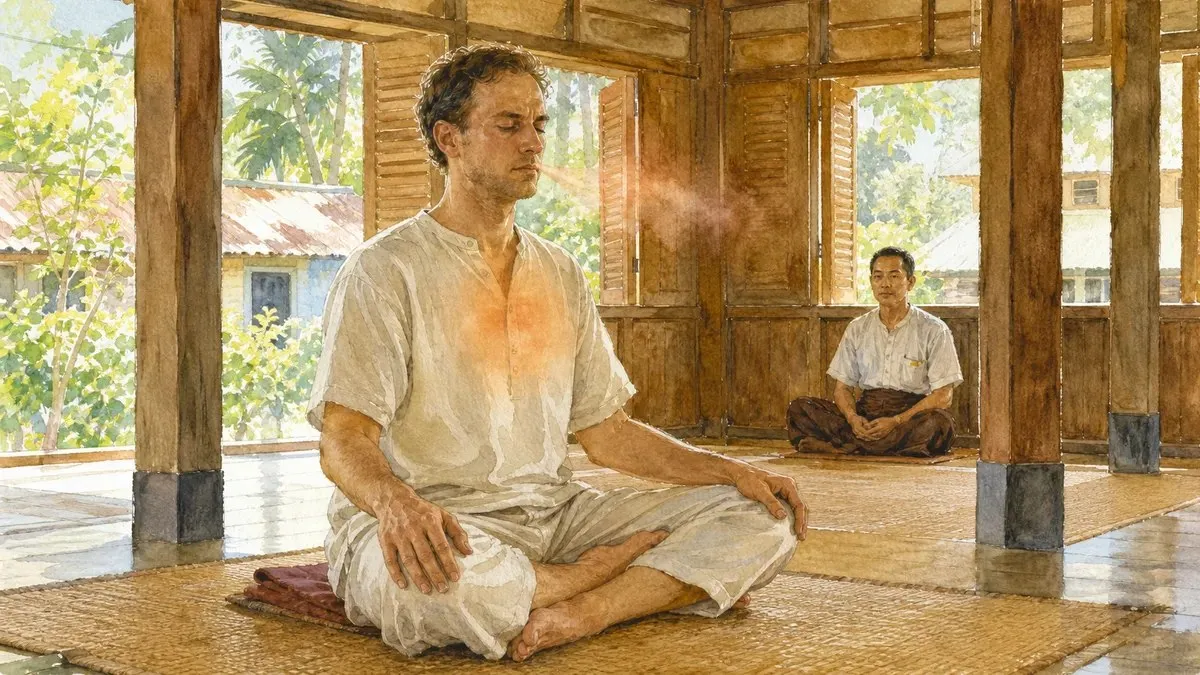
There was even such a master—and probably still is—about thirty years ago, I believe, in Burma: Mahasi Sayadaw, a teacher of the Theravada Buddhist tradition of Hinayana. He taught people to sit in an uncomfortable posture and breathe in such a way that it was uncomfortable, painful, and unpleasant, and through this to become aware of the breath and the body. He would say: “What is the point? You sleep when you feel pleasant and comfortable; you will fall asleep in such a state of prostration. But when you are in pain, when you feel unpleasant, when your posture is uncomfortable, you cannot fall asleep; you are compelled to register everything and expend all your resources to overcome and transcend this pain and discomfort.” He had entire courses devoted to practicing in uncomfortable conditions. It is difficult, but he maintains that this is the shortest path to liberation.
Working with the Mind and Pain
It is important to understand that a great deal depends on your mind: whether something is painful or not is not so much a factor of the body as of the mind. If a person is in a coma or asleep, they do not feel pain; when intoxicated by alcohol, they may not feel pain at all—their mind is elsewhere. Through dharana (concentration), the mind can be directed into yogic time, into yogic space, where the pain will hardly be felt; it will remain on the periphery.
Knowing this secret and having separated the observer, we must move further; we must find the observer’s space, which is independent of pain. We must establish ourselves in that space as our essence, as empty nature, and then direct this empty nature toward the pain and blend it with, unite it with, the pain. Then it will become possible to understand that there is also space within pain, that pain is energy, that it does not exist in and of itself, and that it is empty.
Recognizing the emptiness of pain is the second moment when we understand that pain can be worked with, that it can be made into the path. When we understand this, a sense of the luminosity and bliss of pain gradually arises; we understand that these are winds that have escaped the control of the sushumna. When we recognize the emptiness of these winds, they can re-enter the sushumna, and from this bliss arises, and even healing and the harmonization of prana may occur.
Realization of the Light Body
Question: What is the fastest way to realize the light body?
Become a sannyasi monk. After twelve years, become a hermit and spend your entire life in dark retreat, or at least half your life, about fifty years. It can be done this way: three years in dark retreat, three years in ordinary life, alternating like this, if you are able, if you are able to renounce everything, complete the training course, cultivate yourself—without the training course, cultivation will not work at all—and make your choice after twelve years. Or, if that does not work because some karma remains, then make a definite choice not after twelve years but after twenty-four years, having completed the second twelve-year cycle, or gradually increase the intensity.
It is not only a matter of dark retreat; it is also a matter of practice in the light. Gradually increase the duration: suppose you have completed six months, then complete a year, then three years, all according to the rules—that is, follow the retreat rule.
This is the retreat rule in our tradition, and if you follow it, this is the shortest path: become a sannyasi monk and simply follow the prescribed practice. It is structured so that, over the years, on the one hand, you increase the amount of retreat practice and, on the other hand, you learn to contemplate in daily life. During the retreat phase of the second twelve-year cycle, first six months, then a year, then three years, and after those three years you can consider what to do next. By then, there will already be certain signs of realization, and depending on those signs, the Guru will offer some advice.
Strictly adhere to the monastic tradition, strictly adhere to the retreat rule and the principle of training. That is the whole secret, but doing this requires tremendous courage, tremendous faith, tremendous strength, fearlessness, determination and patience, humility and boundless patience, because karma exists, and it must be transcended not for one year or two, but throughout one’s entire life.
That is, one who aspires to liberation does not transcend karma for a year, or two, or three; they transcend it throughout their entire life, but sooner or later they achieve success. It is an endless process of purification, but sooner or later purification reaches its goal, and when you have purified your karma, you discover that nothing remains except realization.
Rituals and the Spirit of Advaita
Question: Does the sheer number of rituals, vestments, and ceremonies in your tradition not contradict the very spirit of Advaita?
The question itself is fundamentally misconceived. To know the spirit of Advaita, one must attain samadhi. No one knows the spirit of Advaita except Brahman itself—no one at all—and to comprehend Brahman, one must attain samadhi. Without samadhi, various contradictions will arise, but when samadhi is attained, you see that nowhere, never, and under no circumstances are there any contradictions; everything is in its proper place.
As for tradition, the Shankaracharya tradition exists, and I will tell you this: in our tradition, adapted as it is to Western culture, there are very few rituals; in fact, there are practically none. I am not joking. Why? Because many rituals would mean, for example, an eleven-day Mahamrityunjaya yajna lasting six hours every day, and as soon as it ends, a nine-day Durga Navaratri begins; and as soon as Durga Navaratri ends, there is something else—a personal purashcharana or mantra recitation. That is what many rituals look like. We have very few of them, in fact, but they are very important.
That is, if you understand that ritual is a path that also leads you along the path of Advaita, that it is a method and that a method must be respected, that there is nothing superfluous in the tradition and culture given by the saints, and that it has its own value, mystery, sacredness, mysticism, and depth, that everything works toward your enlightenment so that you may comprehend the spirit of Advaita more quickly, then there is no contradiction.
Overcoming Apparent Contradictions in the Tradition
The contradiction exists for people who have not entered the tradition, who are not part of it, and who observe it from the outside, when they cannot integrate certain things. This happens mainly when people from the West study Advaita mostly from a philosophical perspective, without understanding how philosophy relates to life, when they study the view and contemplation but do not understand how these relate to conduct.
It is all about how to bring this into life, into conduct. And it turns out that there is a place for both orange robes and rituals, and there is no contradiction. These are methods given by the saints.

The Symbolism of Orange Robes
For example, orange robes are the traditional attire of a sannyasi. What were they created for? To protect or separate a sannyasi from non-sannyasis. Orange robes signify that a person has cut themselves off from secular society, that they have their own path, and that no claims or obligations should be placed upon them. One may bow to them from afar or make a donation, but in general, they follow their own path and should be left alone. They serve only their Guru—there is no need to marry them, try to make them work somewhere, or take part in anything. They follow their own path.
Orange robes indicate the sublimation of the sexual energy of the svadhisthana chakra. This is the energy of the fire element—everything has been deliberately thought through, because color affects us and our perception, and this color is auspicious for a sannyasi. Every detail of sadhu culture has been carefully considered, and each detail plays its part in attaining liberation.
The Relativity of Contradictions
There is no contradiction here, because one could then ask: “Doesn’t the abundance of tableware contradict Advaita—spoons, forks, plates?” One can find a host of contradictions and claim that everything contradicts Advaita because it is not Brahman and does not directly lead to liberation.
“Do your clothes—jeans, a jacket, a blazer—your car, apartment in Moscow, passport, iPhone, laptop, or spouse not contradict Advaita?” Anything can be called contradictory to Advaita, because Advaita is Brahman, and Brahman is connected with nothing, while people live in the relative earthly world. One could even go so far as to say that the body contradicts Advaita: “Brahman is one, but there are ten fingers—a complete contradiction of Advaita.”
But it is precisely when we understand what the view is, what conduct is, and how to unite absolute and relative truth (paramartha-satyam and samvriti-satyam) that we become sadhus.

The Sadhu as a Master of Resolving Contradictions
A sadhu is one who knows how to resolve contradictions. In the relative dimension, there are actions that lead to the realization of Advaita. Robes, rudraksha, and ritual practice are all actions that lead to the realization of Advaita by the shortest possible route, because your mind is conditioned and must somehow be wrested from its conditioning.
Jeans and a blazer are the uniform of a person from the Western world. Here are orange robes for you, so that you remember Brahman, and this is an entire culture. Since you are accustomed to performing a ritual at your computer every morning—Facebook, laptop, email—here is the morning sandhya-upasana for you, so that you may direct your mind toward Brahman in the form of Shiva. Since you cannot remember the spirit of Advaita in the formless, here is your ishta-devata, Dattatreya.
All this is called upaya—an skillful means of reaching Advaita by the shortest possible path. If a person already abides in nonduality, they may not need to use it, but those who abide in nonduality and do not need it are called saints. They usually either lead an ascetic life or sit upon thrones, teaching others, but in general, this question does not arise for them.
The Advaita tradition itself, including the way we present it, is intended to help all ordinary people attain Advaita by the quickest means possible. So there is no contradiction.
On Forgiveness and Karmic Laws
Question: Good afternoon, Guru. What is the inability to forgive, and how can it be overcome?
The inability to forgive means that we do not understand how this world works; we do not understand the essence of this universe. We are too firmly rooted in our ego, in our judgments and notions, and these judgments and notions obscure the overall picture of the world from us.
If we understood that an unforgiven grievance becomes our sin and damages our destiny, we would think, “Why do I need this? It will become my sin; it will ruin my destiny. Do I want to ruin my destiny because I took offense at someone and did not forgive them? Of course not—I forgive everyone, without exception.”
Because of unforgiveness, a sannyasi will not attain liberation. Forgiveness is on one side of the scales and moksha on the other—which will you choose? Obviously, with such a choice, one must forgive as much as necessary—everyone and everything.

Understanding the Reciprocity of Karmic Laws
When we understand that our destiny depends on the purity of our consciousness, on its inner harmony and beauty, and that unforgiveness is disharmony and impurity, we make sure to forgive everyone and take offense at no one. If something remains unforgiven, we make sure to perform certain practices and apply certain methods; we begin working on it.
The inability to forgive also means being completely fixated on our rigid beliefs, patterns, and ego-driven notions. But when we take this position, we must also accept that someone has the right not to forgive us and that someone also has the right to make such karmic claims against us.
For example, you ate meat as a child—someone’s offspring, some animal’s mother or father. Does the animal’s family have the right not to forgive you? Yes, it does. You ate fish—does the fish have the right not to forgive you? It has every right. You crushed mosquitoes and killed flies—yes, insects have the right not to forgive you. Do they have the right to demand retribution? According to your own logic, your own karmic pattern, they do.
There are many other people with whom you lacked mutual understanding. Do they have the right to take offense at you and not forgive you? They do. And if they do, all of this may be brought against you during your lifetime or after death, because the law of retribution is activated when we do not forgive. And if the law of retribution is activated and karmic claims are made against us according to such a scale, we will have to work all of it off: suffer in hell for every animal killed, and for every time another person did not forgive us—and thus we enter a tunnel of reality that we do not need at all.
Choosing the Law of Grace
What, then, should we do? We must decide that we do not need such a vision, such a law of retribution, such a consciousness. We need to develop a different kind of consciousness—not one based on the law of karma, but one based on forgiveness and grace. Not according to the karmic law of retribution, but according to the law of grace, love, and forgiveness. And to choose it, to enter this vision, we ourselves must work on our ability to forgive and cultivate this law within ourselves, because the universe presents us with the laws that we ourselves cultivate within.
If we cultivate the laws of love, compassion, and forgiveness within ourselves, the universe also turns this side toward us—the karmic law of retribution is nullified.
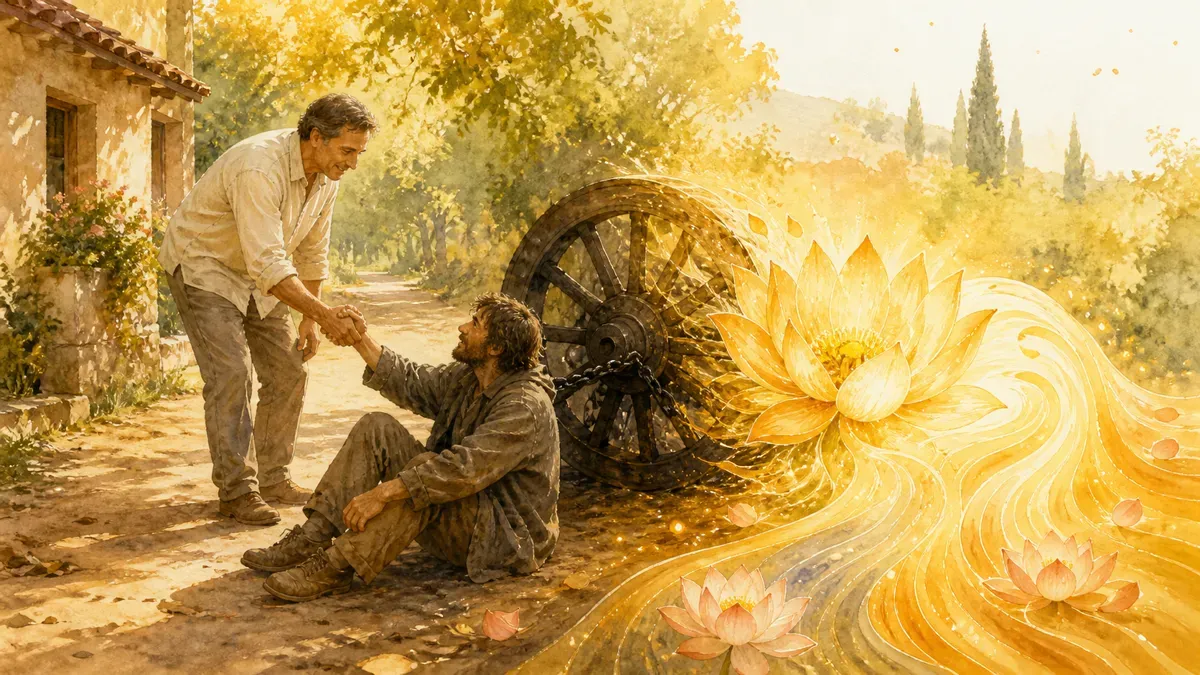
The inability to forgive means there is no understanding and that you simply have not worked on it. As soon as understanding arises, you gain the motivation and desire to forgive. You become very eager to forgive everyone because you understand that if you do not learn to forgive, no one will forgive you. As the saying goes, “Judge not, that you be not judged.”
You develop a very strong desire to forgive everyone, and that is why sadhus review everything in this way: “So, whom have I not forgiven today? Then I must make sure to forgive them,” because what remains unforgiven becomes a sin.
As soon as the desire to forgive arises, you begin to meditate on it, think about it, invest shakti in it, and learn to forgive—it is a particular method, an art. The ability to forgive means the ability to change your perception of a person from negative to pure. If you work on it, sooner or later you will learn, and forgiveness will become easy.
Question: Namaste, precious Guruji. Please tell us at what stage a yogi moves from illusory-body practices to the dissolution of the five elements, and whether there is a connection between them.
It depends on which system of practice the yogi follows and what stage he has reached. At what stage? Between the sixth and seventh grounds of wisdom. This cannot be conveyed in the format of this satsang. A disciple with twenty-four years of monastic experience, a sannyasi or karma-sannyasi, must come to the Guru for a consultation and ask this question.
It is impossible to answer in this format—this is an upadesha from Guru to disciple that can only be given in person, within a small group. The disciple must complete a certain practice and gain experiences, and only then will the Guru assess and determine whether this should be transmitted to him. Such teachings cannot be presented openly in this way—they are secret and sealed with the seals of samaya.
Question: Namaste, precious Guruji. Please tell me what can be done if I am afraid to reveal the full extent of my luminous potential. Thank you.
You need to work analytically with your train of thought. You need to explain to your mind that what is frightening is not revealing your luminous potential, but failing to reveal it. When we possess it but do not reveal it—that is what is frightening.
You need to study what the sacred scriptures say—for example, the “Yoga Vasistha,” the “Tripura Rahasya,” and the “Vivekachudamani.” The second thing you need to understand is that you will not be able to reveal it quickly; it will not happen in a sudden leap, so there is nothing to fear. The path must unfold gradually. Moreover, no matter how hard you try to reveal it, it will not be easy; you will have to overcome karma.
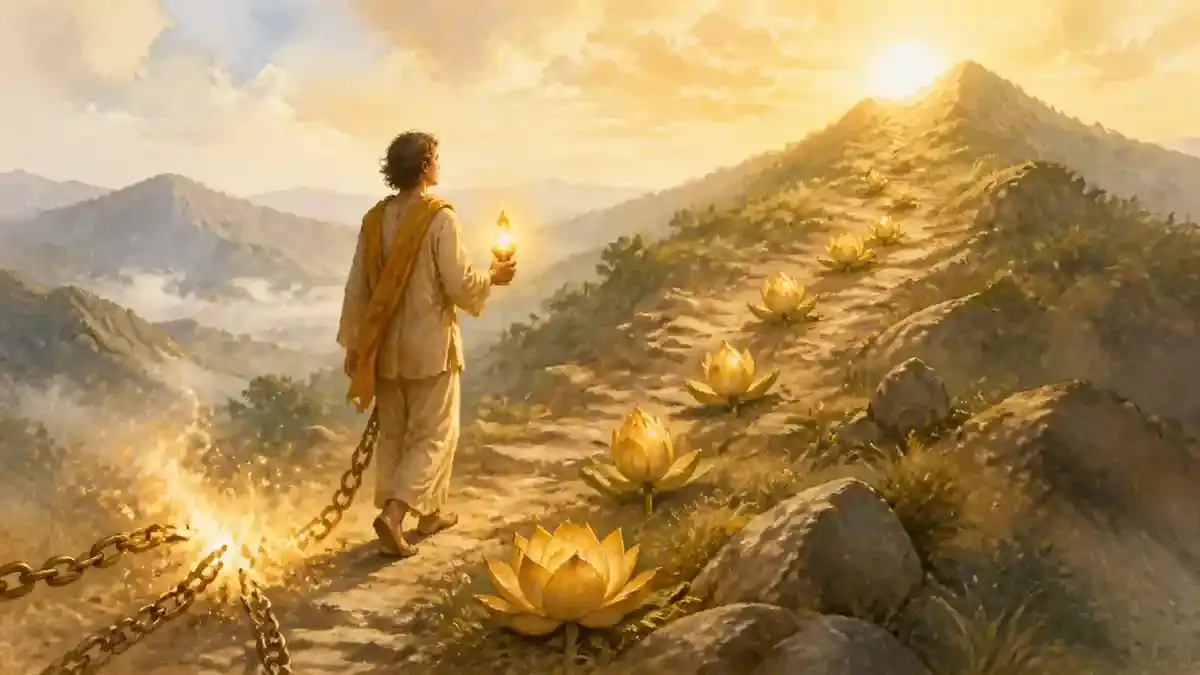
So do not be afraid—it is not a switch that you can simply flip and have your potential revealed. You will have to work hard for many years, your entire life, before it opens up, and your mind will change in the course of this work. There is nothing to fear because even if you want to, you will not reveal it so quickly, nor will it be revealed so quickly in the coming years.
It will unfold gradually, very slowly, millimeter by millimeter; there will be leaps here and there, and you will mature along with the unfolding of this potential. The person who is afraid now will change completely; his fear will disappear and his “I”-identity will change—you will mature greatly. That mature person will not be afraid at all to reveal his potential; he will have an entirely different way of thinking, different judgments, and different perceptions.
So do not be afraid of anything. It is like a three-year-old child saying that he is afraid to drive a car, and an adult telling him, “By the time you grow up and get your driver’s license, your perspective will have changed, and you will no longer be afraid.”
The Supreme Algorithm of Spiritual Practice
Question: Guruji, please explain a fresh and effective algorithm for the relationship between personal effort and the predestination of aggregates of vortices. Thank you, and may you enjoy longevity and prosperity.
There is such a fresh algorithm—it is called abiding beyond the mind (amanaska yoga). That is the whole point. When we understand the mind, understand the source that generates complex questions and seeks answers, and learn to return to this source every second, there is no better algorithm. This is the very best algorithm, and it is called self-liberation.
Self-liberation means that we constantly abide in the nature of Mind, and to abide in the nature of Mind means to abide in meditation on God. All mental algorithms dissolve in this supreme algorithm. The supreme algorithm in Laya Yoga, Jnana Yoga, and Advaita Vedanta is to always abide in Brahman, to always remain in atma-vichara. No other algorithms will produce this effect.
Abiding in the nature of Mind is an awareness that is always young and always fresh, an instantaneous, moment-to-moment, self-liberating remembrance, an empty remembrance of one’s divine “I.” We must master this algorithm.

Three Fundamental Principles
Traditionally, in Advaita Vedanta and Anuttara Tantra, this algorithm is described as shravana, manana, and nididhyasana—the three principal principles. We must learn these three principal principles by heart, understand them, and follow them throughout our lives. Whoever understands these three principal principles will understand the entire essence of Anuttara Tantra, Advaita Vedanta, and Shaivism. These are the three principles that permeate the entire Vedic culture. They are described in the Vedas and the Upanishads, and then one must live in accordance with these three principles.
Shravana means receiving a direct introduction from the Guru in Anuttara Tantra, and in Advaita Vedanta, receiving explanations and instructions on philosophy
Manana means eliminating doubts and uncertainties in order to set one’s mind in the right direction—toward the nature of Mind
Nididhyasana means always abiding in the nature of Mind without distraction
There is no better algorithm than this. All other algorithms will flow from your ability to follow this supreme algorithm.
Practical Questions of the Spiritual Path
Question: Om, pranam, Gurudev. What is the method for attaining nishtha and observing samaya so that no internal or external circumstances can provoke their violation? How can one attain this unshakable steadfastness?
First, samayas must be purified monthly: one should notice any deviations or violations and purify them every month during the Vinaya gatherings through prayashchitta (repentance), acknowledgment, and mental review.
Second, one must remain attentive in everyday life.
Third, it is beneficial to engage in reflection and analytical meditation on the samayas and on the principle of the purity of samaya.
Fourth, one must master the method of the single samaya, which purifies even minor faults that may have been committed, provided it is practiced correctly.
Question: Om, Guruji. Is it possible to deactivate one of the past samskaras that has already been activated in the course of practice?
Of course; that is precisely what we are doing. It is not merely one of the past samskaras—we must deactivate and dissolve all samskaras. This is called vasanakshaya, samskara-shuddhi, and spiritual practice is needed precisely for this purpose—to purify ourselves of samskaras. The question is how to choose the right method.
Question: Precious Guruji, please tell me: when it is said that a disciple is in nididhyasana at the gestation stage, does this mean that they are nurturing the Clear Light rather than the emptiness of the causal body?
Yes, exactly. They are nurturing the state of turiya, Brahman. Nididhyasana is meditation on Brahman, while the gestation stage is abiding in the understanding of Brahman, that is, the view and contemplation of Brahman. There are specific signs by which the gestation stage can be classified.
The disciple does not nurture certain conceptual ideas; rather, he abides in a state called jagrat-turya. But at the stage of nurturing, you begin with the causal body—you have no other way, because in order to enter the dimension of pure light, the dimension of turya, you must pass through the stage of the causal body. You begin with the causal body and then move further.
Question from Nirmaladevi: Which practices should be given special attention during the Sade Sati period? Thank you.
The Four Immeasurables and atma-vichara.
Question: Namaste. Om, precious Guruji, please tell me which mantras to Shiva should be recited to attain wealth. Thank you in advance.
To attain wealth, it is better to worship Lakshmi. Although there are also mantras to Shiva: “Om Shri Vardanaya Namaha” from the “Shiva Sahasranama Stotra.” “Om Nandakaraya Namaha” for attaining happiness (“Worship to the Creator of Happiness”).
Whatever mantras or upasana to Shiva you may practice, through such upasana you can create a sankalpa for attaining material shakti and even pray to Shiva in your own words.
