

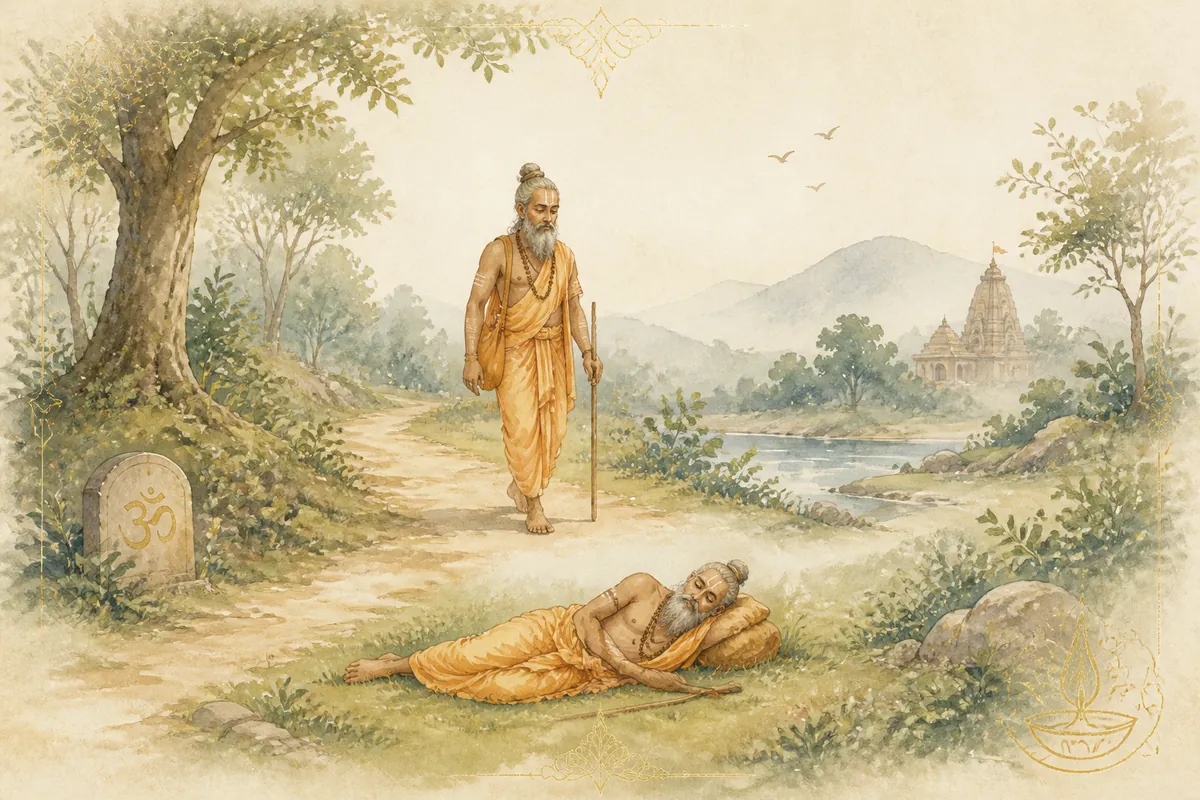
Question: “Swamiji, please answer how to act when depression strikes? Although one understands that this is the relative level, nevertheless there are periods when depression overwhelms one strongly because one has not attained a stable, definite method of practice, and there is no stable result of attaining dhyana. Because of this, there are difficult periods of depression.”
What should one do? Rejoice. Depression is the most wonderful state for practice. If one works with it and unites it with contemplation, the results come fastest of all. It is easy for the mind to become attached to bliss, clarity, emptiness, and dhyana; it clings to them, but the mind gains no benefit from depression, and therefore it should not become attached.
First of all, if depression arises, one must understand why it arises. Sometimes it is caused by inner obstacles, an imbalance of prana; sometimes it is caused by interference from spirits — these are shamanic causes; sometimes it is simply from the mind — this is already depression from you yourselves, not from someone or something external.
As long as there is a craving mind that desires stable practice and the result of attainments, depression will always arise. I will tell you that there are no results precisely because there is this grasping mind that is eternally craving something, and when it does not receive the object of its desire, it falls into panic. One should always look into the root of the problem and search for the one in whom it arises. And the root of the problem is the primordial mind. When we look into it, we see that there is no future there, but only the ultimate present. Once one enters this ultimate present, there is no greed for results and no depression itself. When we are ultimately aware in the present, joy arises, because we are wide open, and in this openness there is tremendous energy (shakti). Even if there is no energy at first, at the very least the mind is certainly calm and feels at home.
Depression arises because of clinging to oneself, self-pity; it is the “poor little thing” syndrome, when you consider yourself to be the body. You are placed in a cage and begin to pity yourself and lament that you have not attained what you desired, that the mahasiddhas are holy and great, while you are so foolish and insignificant that nothing works out in your practice.
Reflections on Gratitude and the Relativity of Suffering

First of all, one should think that many people are disabled, many did not live to your age but died in childhood or youth, many were killed in war, many simply remain in dullness and accumulate bad karma. Compared with billions of people, you are very fortunate, because you can accumulate merit, listen to the Dharma, and you have a sufficient level of self-control that others perhaps could not even dream of. Therefore, when you reflect in this way, you can transform your own misfortunes and sufferings, on the contrary, into joy and happiness.
There are other living beings, for example, pretas. They have a large belly, a small mouth, and a neck as narrow as the eye of a needle. When they want to eat something, even if they manage to do so, it begins to burn in their stomach. Their karma is so bad that they never receive satisfaction. What do you think it is like for them? They are probably constantly depressed. And the beings of the hell realm are bound with chains, crucified, and pierced with pikes and tridents; parts of their bodies are cut off, and then they lie for some time until their subtle body reassembles again. At the same time, they experience the same torments as in the physical body. Such beings must have very strong depression. But even in such worlds, people exist — only they are no longer people, but beings of hellish dimensions. There are many worlds of asuras who wage incessant wars. They have no time to practice the Dharma and attain enlightenment, because they have one task: to win, survive, and overcome. This is, in general, a world of constantly destabilizing prana.
That is, when we look at the world more broadly, we see that much worse conditions exist. The lot and karma that have fallen to us are not so bad; at the very least, we certainly have a certain amount of merit.
Methods for Working with Depression
So, the first way to overcome depression is to look into the root of the mind, into its source, and self-liberate it. This works if you are an experienced practitioner. For an experienced practitioner, depression is a stimulus to strengthen presence; he does not have depression from the mind—this is impossible in principle; otherwise, such a practitioner cannot be called experienced. Since an experienced practitioner no longer desires anything, he totally enjoys the moment he is in; he does not allow his mind to cling to anything or run ahead into the future.
If some obstacle arises, someone else’s karma or some influence experienced as a depressive state in the mind, an experienced practitioner is not at all afraid of it, but works with it. He finds the root of this experience and unites with it; he becomes the experience itself, and then reveals emptiness, clarity, luminosity within it and sees that it can be worked with, that flowers can be made from it. I read that one tantric master recommended molding black flowers from foul experiences when they appear and offering them to a wrathful deity.
That is, one should offer everything to the absolute Source, never separating one’s bad or joyful experiences from the absolute Source. Whatever comes forth, it all belongs first and foremost to the absolute Source, and therefore all of it is absolute. When we think this way, any experience grows to universal proportions and becomes absolute. And if it grows in this way, it loses its influence over our mind; it simply becomes part of the Absolute, in which everything exists. When we expand a problem in this way, the primordial Mind is laid bare, and the problem simply disappears.
But if one does not manage to work in this way, an antidote must be introduced—that is, a specific method or means must be applied. One must learn to turn unhappiness into happiness, to reflect in such a way that the mind moves from a negative experience to a positive one. One should think like this: “Suppose I have not yet achieved results in practice; nevertheless, this is good practice in humility; it shows what the ego is.” Or: “My hopes have not come true; nevertheless, this is an excellent sadhana for cutting off hopes and attachments. If not for such a practice, how long would my ego have continued to amuse itself with illusions? But in this way, in a short time, by cutting off my ‘I,’ I will be able to lay bare the primordial Clear Light.” Or: “My feelings are not being satisfied; nevertheless, this is a way to transcend my karma, to test my presence, to bring awareness into collision with the suffering that appears because of unsatisfied feelings.”
In other words, it is impossible for a true practitioner to be defeated and pinned flat to the mat. Such a thing simply does not happen. Even if he has been pinned flat to the mat, he still practices in that situation and derives benefit from it. He thinks: “How wonderful! My ego is pinned flat! It serves it right; next time I will not become attached.” The true Mind cannot be pinned to the mat, because it is always at its height; that is, this is impossible in principle. When the ego is pinned down, it is precisely then that a great opening of devotion takes place, and the understanding of the true Mind arises in the shortest possible time.
Liberation from the Mind’s Clingings
Often our mind simply clings to certain states. These may be bliss, clarity, or emptiness in the case of an experienced practitioner who has stable samadhi experience, or they may be certain karmic experiences. If you are a beginner and remain in this state for a long time, then your true face before birth becomes obscured; these experiences cover it over, and because you are not yet very skillful, you cannot disperse these experiences. But it is said that if you tear away the husk of these experiences—and all these experiences are truly just a husk—you will discover the purest natural state.
There is such a concept: “disturbing peace, smoothness, and clarity.” It is said that the principle of disturbing peace, smoothness, and clarity is very important for laying bare the natural state. What does it mean to disturb? There is an expression: “The power of a waterfall increases through falling.” In the same way, when we change the habitual flow of thoughts or the fixation to which our mind has clung, the power of awareness of the natural state increases.
There is such a method: when there is captivation by bliss, emptiness, or clarity, one must sharply cry out “phat” with the breath. At that moment the mind is paralyzed, the depressive state disperses, and we find ourselves again in primordial clarity, without any fixations or clingings. A practitioner must constantly pull his mind out of such clingings.
Why do bhakti (service) and retreats alternate for us? Because in this way we do not allow the mind to cling to anything: you come out of retreat, do bhakti in order to refine the natural state, and then you practice in retreat again. If you remain in retreat for a long time, the mind will cling to some state, but this must not be done, because it contradicts presence.

Often the Teacher places the disciple in situations that contradict his current state. Suppose a disciple wants to meditate in good conditions, but someone nearby is slamming a door; or he is absorbed in some inner state, and he is brought outward. In this way, the mind is, as it were, given the signal “do not become attached”; the mind is made to understand that, in principle, it should not cling to anything at all, because any clinging is samsara. Samsara and the clinging mind are one and the same.
It is said that the syllable “phat” is not recommended to be uttered often, since it can harm small spirits who are afraid of it. That is, if you are walking somewhere or suddenly shout “phat” in the kitchen, that is not very good. It can be used, but not often—only when it is necessary, when you truly have the intention to eliminate the mind’s clinging.
Mastery Instead of Results
As for the fact that there are no results of attaining dhyana and everything else, these results are possible for one who is a master of practice. You should not strive for results right now; you should simply refine your mastery. The results will come when you acquire the necessary mastery. If there is no mastery, then what results can there be? Therefore, one should pay attention not to results, but to one’s own mastery in practice.
If a person who has been practicing martial arts for only two years comes to a mentor and says, “I am so sorry, I still cannot defeat either Jackie Chan or Bruce Lee; I am a worthless practitioner,” the master will tell him, “It is too early for you to think about that; you must first acquire the same mastery. Why should you try to defeat them now?”
We have practice, so we simply need to work day after day; we have no time to remain in various states. There is a walking technique, and while you are walking from “Rainbow Light” to “Serene Ocean,” you can perform this practice, trying to do it impeccably. Or you can walk and simply look around like an ordinary person, forgetting about practice. But if you regularly perform the practice with full attentiveness, your mastery constantly grows.
The difference between a true practitioner and an ordinary person is that he possesses great flexibility and does not allow the mind to cling to any states; and if his mind does cling to something, he tries to work with it in order to make the mind alive and unattached again.
A Practice from the “Vijnana Bhairava Tantra”

Now we will perform one of the practices described in the “Vijnana Bhairava Tantra.” In the sutra, the shloka sounds like this:
“Wander nearby, and then allow the body to fall. In this falling, be all.”
This is one of the best practices for eliminating the mind’s clinging to any states. You can apply it to anything, for example, when your mind invents something and clings to it, or when you have depression because the mind is not getting the desired results. This practice is very deep; it is intended for entering the natural state. It is one of the forms of direct introduction.
