

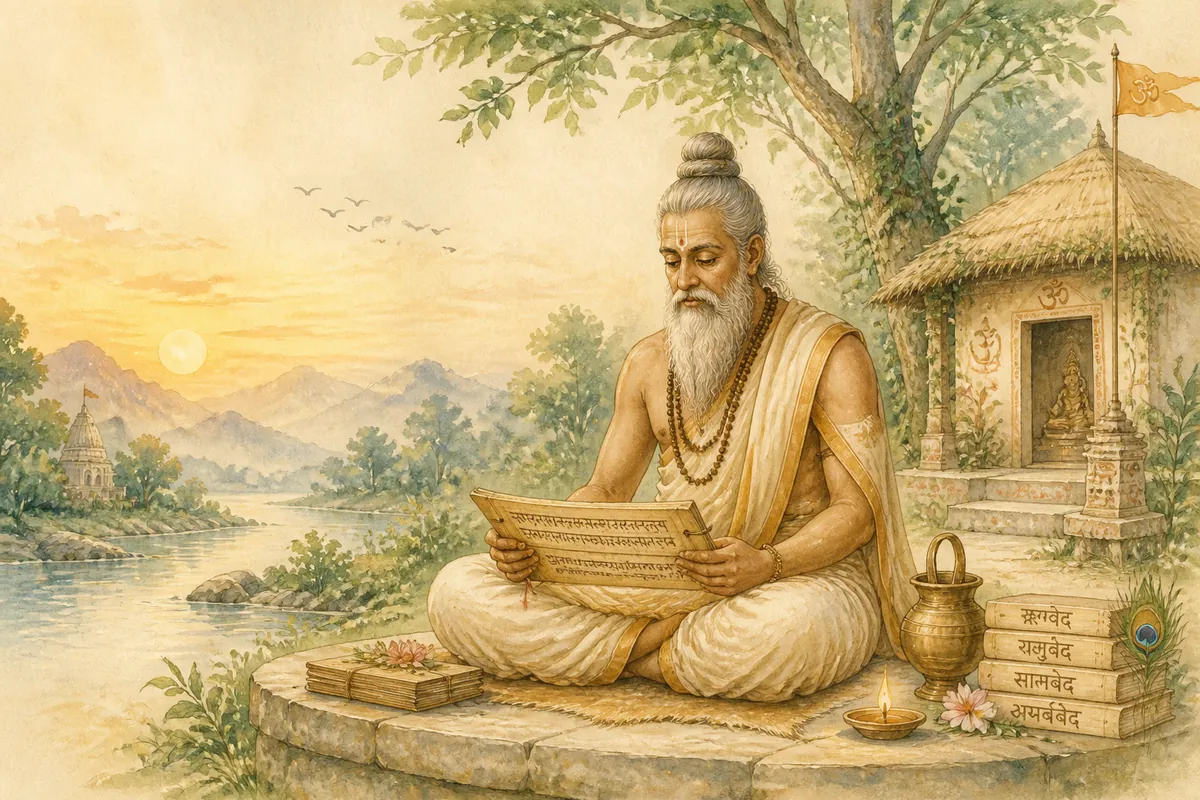
Commentary on the text "Shri Siddhanta-Shikhamani". Shivayogin Shri Shivacharya
“The thought of differences, the discriminating mind—this is the cause of all divisions. When the thought of non-differentiation is born, what talk can there be of divisions or classification? For one who has achieved the all-encompassing feeling ‘I am Shiva,’ who has become the limitless Atman, whence can come any connection with the body?”
Overcoming Attachment to the Dualistic Mind
Attachment to the discriminating mind, clinging to the discriminating mind—this is the basis of the dualistic perception of samsara. This is called maya-mala. If we establish ourselves in non-dual consciousness and attempt to contemplate, we must eliminate this attachment through the art of contemplation, through vairagya, vichara, and viveka.
Attachment to the dualistic mind means we do not understand what is primary and what is secondary, and we give great importance to the discriminating mind while giving none to non-duality, forgetting it. All living beings live in samsara because of such attachment to the dualistic mind. Their dualistic mind, possessing a certain potential, creates their subtle bodies. The subtle body itself is the embodiment of the dualistic mind's notions of discrimination. The very sense of ‘I,’ ‘I am such-and-such,’ identity—is a deep-rooted form of attachment to the dualistic mind.
A yogi does not encourage this in himself; he tries to discover a deeper, more subtle consciousness without attachment to this dualistic, discriminating mind. Even when he has to use the dualistic, discriminating mind, he remains in a deeper state of awareness, not becoming attached to his own discrimination.
The Path of the Sadhu and Liberation from Illusions
The whole world consists of such dualistic definitions. But a sadhu, when in contemplation, uses the dualistic notions of the mind without being grasped by them, without becoming attached, without falling under the power of these dualistic notions. Then he has no illusions; he does not live by illusions. People live by illusions, but for a sadhu, this is inexcusable. People can afford such luxury because they consider themselves immortal and free. A sadhu understands who he is.
This means that for him, it is an impermissible luxury to have attachments to dualistic notions. He must release and release his mind every second; he does not have the luxury to be emotional, to fall into resentment, into anger, to carry around fixed ideas, or to cherish certain attachments. In this sense, a sadhu must be ruthless—not to others, but to himself. Ruthless in a good sense.
Why? If he is compassionate toward himself, he does himself a disservice. What kind? The goal of his life will not be realized. That for which he embarked on this path will not happen. And why? Because he pitied himself. He carried around his ideas, his ego, his sense of pride, his attachment. He was not ruthless toward his illusions; he did not allow the soul to be liberated from them. He pitied the illusions, but he did not pity his immortal soul. Why? Because he did not understand what truly needs pity and what must be met with ruthlessness.
This is the fate of an unsuccessful sadhu. Therefore, a yogi must choose the fate of a successful sadhu and avoid the fate of an unsuccessful one. To do this, one must be strict with one's mind. Being strict with one's mind does not mean walking around tense, cramped, afraid of violating something every moment, then cursing oneself and falling into guilt at every step. Perhaps on the path of Sutra, in external behavior, this is suitable for beginners.
Being strict with one's mind from the perspective of Anuttara Tantra means incessantly recognizing its games, incessantly contemplating, allowing all arising dualistic notions to be liberated into the nature of the mind. Not allowing attachment to anything, even something the size of a pinky finger. We may engage in various things, manifest various things for the benefit of Dharma, but not at the expense of awareness, not at the expense of contemplation, not at the expense of the single samaya, not at the expense of what is most important, not at the expense of self-surrender.
The State of Thoughtlessness and Unity with the Space of Consciousness
“The yogin has discarded all other thoughts and feelings except for the sensation of his true nature. His mind is completely free from changes and disturbances. Such a state of the shiva-yogin’s mind is called thoughtlessness, the absence of thoughts. The feeling ‘I am Brahman’ is based on duality, as it assumes the existence of ‘I’ and ‘Brahman.’ Undoubtedly, this feeling is absent in one who has merged with the space of consciousness. For one who has achieved unity with the flawless space of consciousness, what does the difference of cultures and castes mean? Whence can come embodiment, whence can come wandering in the circle of births and deaths? The Atman of the great yogin has completely dissolved into the space of consciousness—formless, unattainable by speech and mind. What, then, can be felt, and by what means?”
When we renounce clinging to the discriminating mind, the space of consciousness begins to be recognized by us; it becomes the reality of our daily life, just as breathing is a reality for people. We discover it, realizing that previously we did not notice it. Now we have found it.
Having found it, we perceive it as the body of Bhagavan Dattatreya; we enter into contact with it, develop a relationship, a connection, become saturated with it, continuously contemplate it, making it our supportless support until it penetrates deep into the subtlest parts of our Self and changes us. It is not we ourselves who change, but the wisdom body of Bhagavan Dattatreya that changes us. But when we unite with it in the correct dimension, this wisdom body is also discovered within ourselves, as our own wisdom body, like another Dattatreya. First, coarse notions dissolve, then subtle ones, and then the subtlest.
The Subtle Nature of Spiritual Realization
Spiritual realization, awakening, is not something external, nor is it something coarse, visible, or large. In fact, spiritual realization is a matter of microscopic scales, very small values. It is very subtle and elusive; subtle processes take place in your consciousness, in your body. That is, from the outside, it may not be particularly visible.
Our illusions have a very subtle, dualistic nature. It is like internal information technology. Everything is very small at the level of nano-dimensions, at the level of bits and bytes of consciousness. In the same way, realization occurs internally at the micro-level; micro-processes must change within us. This doesn't mean something unprecedented must happen externally, something global, where you brush against columns with your shoulders and they fall because you have achieved such power or realization. Various miracles are possible if you have a lot of energy, but realization does not consist of this, and being preoccupied with miracles is generally not encouraged by saints, at least until realization.
Spiritual awakening in Advaita involves micro-levels, the subtlest layers of pure light that must be discovered, the subtlest layers of the mind that must be transcended. This means we need to cultivate such refined clarity and the art of dwelling in this clarity.
Our thoughts and illusions also have a subtle nature. By having a subtle nature, they have power over us. One can be liberated from their power only if we cultivate an even subtler nature, similar to the sky. If we discover a space of pure consciousness even subtler than thoughts.

Transformation through the Wisdom Body of Bhagavan Dattatreya
When we discover it, this space will begin to inspire us, give us strength, nourish us, and guide us from within. It will point to the right decisions, intuitively provide all kinds of knowledge wherever we turn our consciousness, and grant a sense of confidence, harmony, and inner integrity.
This inner body of Bhagavan Dattatreya gradually begins to take control over all unconscious manifestations of the mind; it also penetrates our hopes and changes them. Our hopes dissolve. Instead of hopes, sankalpas appear. Hopes were for the ego; sankalpas appear as seva, service. It dissolves our fears, and instead of fears, various kinds of clarity manifest. It dissolves our attachments, and instead of attachments, various kinds of wisdom appear.
Gradually, the inner body of Bhagavan Dattatreya, having awakened within us, softly, unobtrusively, and very subtly fills the entire field of our life, liberating us from many foolish, unnecessary, ridiculous, and unpleasant extra things. Moreover, these things may even remain with us if we wish. Но they will cease to be important; they will stop causing us problems and become something like ornaments, something like the snakes on Shiva's chest.
The Path of Anuttara Tantra and the Transformation of Kleshas
The path of Anuttara Tantra is such a path according to which even kleshas are not denied but are perceived as ornaments when we dwell in the space of unitary consciousness. This does not mean we indulge the kleshas. It means that the method of their transformation is different. The space of unitary consciousness does not attack the kleshas head-on, as in the lower paths. It says: “Come to me, I accept you, I am not afraid of you, I love you.” The kleshas go to it, but in the process, they dissolve and transform into something else, like a snowflake falling into the ocean.
The ocean says to the snowflake, to the snow: “Fall as much as you like.” Snowflakes fall and fall, but no one has seen a layer of snow on the ocean, no matter how much snow falls. The ocean is always the ocean; you won't find a single snowflake there. Such is the property of the ocean—to dissolve and transform. In the same way, all our illusions, when encountering the divine body of Bhagavan Dattatreya within us, are transformed without effort. We do not exert any effort, yet they transform, much like the sun exerts no effort to melt ice floes. The ice floes melt on their own under the sun's rays.
If you discover this body and dwell in it, a spontaneous vision of symbols, signs, deities, and the manifestation of pure vision may arise within you, even if you do not particularly recite mantras or visualize. This consciousness itself possesses the ability to manifest divine energies in the pranas and the mind.
Transcending the Human Part
It is within our power to transcend our human part if we constantly live while abiding in the awareness of Bhagavan Dattatreya, if we do not fall under the power of our human part. Our human part originates from the past. It can become attached, can take offense, cherish hopes, or become frightened—that is its nature as the human part. If we surrender the soul to the power of this human part, it sends us back into the circle of reincarnation.
When we discover within ourselves the wisdom body of Bhagavan Dattatreya, if we listen to it carefully and do not follow the human part, it gradually liberates us and becomes our inner support. Even when you sleep or are falling asleep, you are aware of this inner support. Against the background of dreams, you have a flawless part of pure consciousness. Even when the body is relaxed or sleeping, your spirit, dwelling in the body of Bhagavan Dattatreya, recognizes it as its own space of pure wisdom, full of light.
Becoming accustomed to living in the light-filled space of Bhagavan Dattatreya's body—this is Ishta-Devata Yoga, this is Guru Yoga, because the Guru lives in such a space, the Param-Guru lives in such a space, and the Ishta-Devata lives in such a space. Sooner or later, we too will wonder, “Why shouldn't I live in such a space as well?” Why should I live in limited thoughts? It is so heavy and inconvenient, when there is such a divine, great, inspiring, pure space where there are no contradictions.
Thoughts swarm, bringing restlessness, containing many contradictions, and limiting us with patterns, names, and forms; but the pure space of light limits nothing, it is full of Ananda, granting us unity with the entire creation. When we understand this, no doubts remain. This choice is made clearly and irrevocably, just as if you always had dirty water and then were connected to pure water from a spring. You wouldn't even have a doubt whether to drink the pure water or the dirty water. Of course, you will drink the pure water.
Equanimity and Liberation from Subordination
“The light of the sun falls equally on a holy place and an impure one. Likewise, a yogin who has attained non-duality with Shiva always treats everyone equally. The yogin does not fear old age, does not fear death, and is not subordinate to hunger. The yogin feels the sweetness of the perfect bliss of his Self and is therefore absolutely happy.”
The question is one of not being subordinate to many things. The physical body subordinates us. How? Through the craving for comfort, the craving for food, through sexual desire, through the desire to sleep, through the fear of physical pain or discomfort. When we dwell in awareness, we can overcome the movements of the human body. They are based on prana. If your channels are pure and your consciousness is pure, gradually the prana begins to listen to your awareness and is more or less controlled. For example, prana begins to saturate the sushumna-nadi, moving inward rather than outward.

Even when the energy body might be heavy or clogged, and you feel certain blocks—consciousness does not submit to it. There is also the subtle body, the astral body. To stop being subordinate to the astral body when various thoughts come, or certain impulses, desires to act, inspiring bhavas, moods, or images—very subtle things that control us. We are controlled by the subconscious. To stop being subordinate to this subconscious, impeccably discerning the divine body of Bhagavan Dattatreya against the background of all passions, all thoughts, all moods, and relying on it. This is the path of self-liberation.
But what often happens? The yogi forgets this principle and submits to something lower. For example, an emotion. When someone says something to him, he reacts emotionally. This emotion gains power over him. That's it, he has already lost. Or some thoughts capture him; he has already lost his awareness.
The Supreme State of Non-duality
“In the state of supreme awareness, all distinctions are completely absent. Here there is no trinity of the knower, the object of knowledge, and knowledge. When the knowledge of duality is completely destroyed—this is called the absence of distinctions. The consciousness of a yogin who has reached the supreme state is filled with the impression of the experience of non-duality. How can one who sees his inner Atman perceive anything else distinct from the Atman? I am not the creator, I am not the knower, I am bodiless and unattached to anything. He who thinks in this way shines as consciousness itself.”
Practical Strategy for Developing Awareness
Someone might think: “I would be happy not to be subordinate to all these bodies, but how do I do it practically?” Here, on one hand, faith and devotion are needed—we must direct all our faith and devotion toward this body of Bhagavan Dattatreya. On the other hand, unbending intent and determination are required. Both are scarce at the beginning. We start with a "starting capital" where there is very little of this. This means we must set the task of increasing them.
For example, there is a determination to contemplate, but I get distracted. What should I do? I should sit down, take a notebook, a pencil, a pen, a calendar, a clock; I should think about how many hours a day I am distracted and how many I am contemplating. Calculate it, estimate it roughly. Night is excluded, obviously. Meal times are excluded. Time for work and conversation is also excluded. It doesn't work out. I contemplate for half an hour a day while walking in chankramanam, and perhaps during mahashanti my mind is clear. At other times, it doesn't work. That is, in my active balance, out of 24 hours, I realistically get an hour and a half maximum. It’s different for everyone. So, an hour and a half is my asset; the rest is non-working time.
Therefore, I must think about how to make my consciousness aware during that other time as well. This means I must develop a strategy for how to win back hour after hour, minute after minute, second after second from my daily time. For example, increasing the time spent walking in contemplation. Or setting a goal to achieve awareness during meals, saying to myself: “Exactly now, exactly at this time, I will practice awareness, I will engage in sadhana.” Find methods that help, keep a practice diary of how my awareness increases. And if I win back half an hour from this unconscious space, establishing myself in awareness—that is my small victory. Then I must think about how to win back the next half hour—perhaps by reminding myself, perhaps by reading texts, choosing which sankalpa to use and how to apply it.
Analytical Approach to Practice Development
For example, we have divided our day into different types of activities: walking, eating, talking, meditation, work. I should list all these events in a column and assign points based on where I am most aware and where I am least aware. For example, meditation—10 points, best of all when I am in a state of thoughtlessness, in a calm state. Walking—7. Talking and eating—2 points each. Work—4 points. I must assess soberly where it is worse and where it is better and analytically develop a strategy for what I need to do to improve all these indicators, to pull them up. This is a pure strategy that allows you to develop your vector.
Once I have developed such a strategy, I begin to work further. Whatever is my weakest point, that is what I tackle. But one shouldn't always tackle the weakest point first; sometimes it's better to start with what is easiest first, if you want to make progress and increase your awareness. The weakest point is usually the hardest—the root causes of internal karmic poisons that are not so easily overcome quickly.
Thus, sooner or later we reach a point where out of 24 hours, we can remain at a good level of awareness for about 16-18 hours. And what about those intervals where consciousness simply drops away? Other methods must be applied. If awareness is thin, it simply doesn't work. It is beautiful, but if it doesn't work for us personally at a given moment, we are not ready to use it. We lack merit. One must use mantra or any other methods to support one's awareness.
Stages of Nurturing and Conception
When we have closed the circle of the day, we can congratulate ourselves—during the day we are "nurturing," we are at the stage of nurturing. However, that's not all. One can nurture full attention, or a certain bhava, or a blurred state of an imagined space, so it cannot yet be called full-fledged nurturing, because true nurturing begins after the stage of "conception."
This means we must meditate well during mahashanti, perform vichara, viveka, and analytical meditations to achieve a full stage of conception and receive confirmation from the Guru that this stage of conception has been fully realized. And only when we can fully nurture our own stage of conception throughout the day in the post-meditative period—that will be true nurturing. Only then can we claim that our nurturing is gradually penetrating into the dream state.

Unity with True Nature
“The shiva-yogin has rid himself of all ideas of duality and of desires. He is calm and immersed in his own greatness. What else remains for him to know? The yogin has become one with his true nature through the spiritual experience of non-duality. What else remains for the yogin to know, and in what way? And what, then, shall the knower be called? Great truth, great existence, and great all-encompassing consciousness manifest in the form of the world. For the yogin who has been liberated from the discriminating mind—that is, the idea of a plurality of objects—there is not a single object distinct from this.”
