

Anugraha as a Response to the Sincere Opening of the Soul
April 1, 2014
Anugraha comes in response to the sincere opening of the soul and transforms it. Sattva as the ability to hear the universe. A commentary on Ramalinga Swamigal’s text “Song of Divine Grace.”
“O you men and women who feud in your disputes, listen to just one word before the sun of your life sets. Think of God, pray to Him—the Lord who dances in the heart of the universe of grace. Conceal not a single evil deed or a single evil word, and truly, the Lord will save you. Could I be lying?”
The Structure of Consciousness and the Influence of Karma on Memory
We have the mind—manas; manas analyzes impressions, selects among them, and makes immediate decisions. There is the intellect—buddhi—which evaluates, weighs impressions, develops values and priorities, and makes strategic decisions. There is chitta—memory—which stores all previously accumulated impressions. It is believed that the connection between memory and the mind is governed by the planet Mercury; that is, it is responsible for the functioning of this memory, analyzing information, drawing conclusions, thinking logically, and establishing connections.
For example, if a person sins a great deal and commits many wrongful acts, this may cause them to lose their memory. Why? Because negative actions cause them suffering when recalled. They then develop a tendency to forget them, not to remember. They instruct their consciousness not to touch their memory, not to touch chitta. In this case, they forget their past lives and experience shock upon incarnating because they themselves do not want to remember them.
Conversely, if a person acts sattvically, in unity with the divine, they have greater viveka, greater clarity; they are aware of everything contained in the stream of consciousness, in chitta, and can remember or recall past lives.

As we become purified, as we begin to purify ourselves and act in sattva, everything we have accumulated in the past becomes accessible to us. It is as though memory files are being unzipped: past incarnations, various accumulated information, everything that exists in this life. But the condition here, Ramalinga says, is that you must hide nothing from the divine. You must fully entrust yourself to the divine within you, open yourself to it, and present all previously accumulated thoughts, deeds, and actions so that they may be illuminated by the light of the divine and transformed into a different state.
The Ego’s Fears of the Divine Light
But in fact, the ego is afraid of this; the ego has its own position, and it is frightened to expose all of this to the divine light. It feels too insignificant, too petty, too impure before the divine. And the ego’s train of thought is roughly this: “If the divine light touches me, what will remain of me? I am unworthy to stand before it, and I am ashamed before it, because everything will immediately be revealed in the divine light.” This is because the ego maintains a strong division: here is the divine light, and here am I. I am I, and the divine is the divine. The ego has no understanding of Advaita; the ego does not understand that it, too, is part of Brahman. It is just as we separate ourselves from others during our lives, thinking well of ourselves while thinking of others: “This is such a bad person; I am a good person, but this one is not.” This, too, is dvaita; this, too, is division.
In the same way, the ego loves to divide within itself; in its understanding, the divine and certain attitudes, kleshas, and perceptions cannot be united—they are incompatible. But Ramalinga says that this incompatibility must be removed, that we must not be afraid and must surrender everything to the divine, rely on the divine in all things, be absolutely sincere before the divine, hide and withhold nothing, and trust the divine completely. This is because self-surrender to the divine, such an attitude, immediately begins to change us. As soon as we adopt such an attitude, processes of transformation begin. But the ego fears this transformation. It immediately asks: “What will happen to me?”
And here it is very important to be guided by the sacred scriptures. “Nothing bad will happen; only good will come, because only good can come from God, because God, Brahman, the Absolute, is profound goodness—sat, chit, ananda—the purest perfect being, pure self-knowing consciousness, and all-pervading bliss.” There are also shivam, satyam, sundaram—absolute goodness, absolute truth, absolute beauty.
Anugraha as a Response to Sincerity

When we are not afraid to stand before God, before the Divine, with complete sincerity, and are not afraid of the answering flow, this answering flow is guaranteed—it is always there; it is an attribute of the Divine, and we call this flow Anugraha. Such sincerity itself already becomes a transformation. Sometimes a person has undergone no transformation for decades, but when they understand this principle and become sincere before God in their soul, such a transformation begins to take place. And suddenly they see that the fears of their ego were false and unfounded, that the ego had simply become deeply entrenched in its position; it does not even know why it became entrenched there. It adopted a certain point of view, and that point of view was limited and mistaken.
That is precisely why, when a person is bound by their ego, they have no access to their true self. This means that they have no access to their potential or their inner resources; they have no access to the vast universe. It is like something narrow and encapsulated.
The Encapsulation of the Ego and the Loss of Connection with Reality

When a person lives in a state of ego, it is as though they live behind an iron curtain, in their own imagined reality. They do not feel the universe or its interconnectedness; they do not feel others and are too fixated on themselves. They are rooted in themselves but know nothing else; they do not understand the subtleties of time and do not see the world of the gods. Indeed, never mind the gods—they cannot even understand the person beside them or come to an agreement with them. There is a person standing or sitting nearby, but to them that person is an alien; they do not understand the principles by which that person lives, what sustains them, or how to build a relationship with them at all. They try to build a relationship, and suddenly there is conflict; they try again, and there is conflict once more. They think, “What is going on? This is a bad person. I am good, but this person is somehow abnormal.” Yet that is not the reason; the reason lies precisely in this encapsulation of consciousness. And the other person thinks exactly the same way. They are in exactly the same position, likewise encapsulated within themselves, and think, “I am right; I am good. There is something wrong with this person; I cannot find common ground with them.”
But the reason always lies precisely in this ego, which has lost touch with reality. And as soon as the light of divine grace touches the ego, when it presents itself with complete sincerity, the boundaries of the ego suddenly begin to break down and expand. This is a difficult process; it is like the birth of a child. One must be very careful and help this child. But it is a good process, because it is the restoration of the original order, when the soul establishes connections with the infinite. Values and points of reference change, as though a veil falls from one’s eyes.
But there must be one condition here—complete sincerity. If we are not sincere before God, then we also cannot be open and sincere before the world, the universe, creation, or other people. We always divide and isolate ourselves. And if we separate ourselves from others, we will never understand them. What, then, are we left with? Instead of understanding others, we are left to paint images of them—good or bad, intelligent or foolish, beautiful or unattractive. We create at least some points of reference for ourselves, so that we can somehow define them. And we build relationships accordingly. But when this encapsulation disappears, we understand that in reality we are all one and that we all live by virtue of the divine principle within. We are all one Consciousness. And this separation disappears.
When we know that we are all one, what serious contradictions can there be? I cannot be angry with myself, take offense at myself, or think impurely of myself; that is impossible. I can only love myself. Since we are all one, I can only love everyone; I can only have compassion for others.
Realizing the Unity of All Humanity

“Can I lie? Never, never will I speak an untruth, for you are my kin and friends; we are of one blood.”
Ramalinga lived in India in the 19th century, while we live in Russia in the 21st, and he says, “We are one family with you.” Why does he say this? Because he realized this level of unity. For him, there is no such separation; even people of the future are his kin, as are people of another nation, bloodline, culture, or language—everyone is family. And the principle of realizing the divine within oneself, the principle of enlightenment, always leads to the understanding that all humanity is one large family. Of course, some parts of it may be misguided, and some may even be unfriendly. But you still understand this fact. There are no enlightened people or people who have realized God who do not recognize this fact, because enlightenment and realization of the divine mean seeing the divine within everyone and respecting that divinity.
But what happens before enlightenment? We do not see the divine, so what do we see? We see the body, intellect, personality, character, gait, and clothing, and we form a kind of false impression of another person and base our judgments on it. Therefore, our judgments are always mistaken if we base them on such impressions.
Coming into Contact with the Divine and Acquiring the Qualities of Sattva
“You and I are of one blood, and therefore all I want is to share the true good with you. Alas, men and women of the world, understand the true essence of what I have experienced—sleep, sorrow, fear, and all obstacles have vanished forever. Evil, despair, illusion, ignorance, and darkness became afraid and left me forever. Divine prosperity, divine grace, divine intelligence, divine love, the divine immortal body, divine bliss, and divine courage have come to dwell within me in all their fullness.”
At the moment of such self-surrender, such sincere standing before God, contact with the divine occurs, and contact with even the tiniest particle of the divine begins to transform the soul, which gradually starts to acquire the same qualities. Therefore, contact with the divine is, on the one hand, a collapse for the ego. The ego comes into contact with infinite power, with universal energy, and it feels that it is not the king, that it is not the most important thing here, that it is not the ruler here, that its place is second at best, but never first.
But on the other hand, every soul discovers within itself the potential of another level, the possibility of vision on another level, and understands that the collapse of the ego is very good and very beneficial. It is like dropping a heavy backpack to the ground, and beautiful qualities begin to flourish in the soul: compassion, pure vision, intuitive wisdom, and flexibility without attachment. In other words, meditation and contemplation will never make you less intelligent and should never make you less capable. Contemplation and self-surrender always make you more generous, more flexible, and more tolerant. If years pass and a person continues practicing, but their tolerance diminishes, it means something is wrong; or if their pure vision does not increase, it likewise means they have missed the mark.
Sattva as the Ability to Hear the Universe

Compassion, love, and tolerance are all qualities of sattva. Sattva—silence, clarity, calmness, and serenity—should increase. Sattva is the guna of goodness, regardless of astrology or karma. In sattva, a person is able to listen to others, and not only listens but also hears them. But in rajas, a person may listen to others only if it benefits them, and even then not for long. When it goes on too long or affects their ego, they stop listening to others. In tamas, a person does not want to listen to others at all because they want to listen only to themselves. And when a person is in tamas and listens only to themselves, they are out of touch with reality; they perceive the world and the universe inadequately. This is where suffering comes from: you do not understand how life works, how the world works; you do not even understand how the sangha works. In rajas, selfishness becomes mixed in, and there is always rivalry and a desire to assert oneself. This is also an unfavorable state for living in the universe; it is like a veil over the eyes.
But in sattva, you truly abide in silence and calmness, and you listen. You no longer want others to listen to you; you humbly listen to the universe, not only to other people—you listen to everything. For example, in the morning grasshoppers fly about, birds sing, and you listen to them; you are able to hear them. You hear the music during the bhajan mandala. And when you hear the music, the channels vibrate differently and the pranas move differently. Another person speaks, and you do not interrupt them or try to impose your opinion on them. You seek to understand what they want to say and what their mood is.
Sattva is the ability to hear the universe. For example, when the planets exert their influence, you listen to that planetary influence. When the sun and moon radiate their energy, you hear their rhythms and understand that it is good to go to bed early and rise early, moving in rhythm with the sun and moon. But ignoring the sun and moon and going against the rhythms of the universe and cosmos is not very beneficial for the body. You listen to the body, and the body gives you signals. If you hear its signals, you change your diet, begin practising pranayama, or change your lifestyle. But if the body sends signals and you do not hear them because you are absorbed in something of your own and have no time for the body, it continues sending you signals until that signal becomes a headache. In other words, it says, “Pay attention to me, take care of me; something within me needs to be adjusted.”
You also hear subtle things, the subtle world, and this sensitivity and ability to hear are signs of sattva. When you become sensitive and capable of hearing, you can also hear God and care for others. You can see the subtle essence in everyone and everything: in a person, in the entire universe, even in the most ordinary things. You are able to sincerely wish spiritual growth and spiritual awakening for everyone.
A Call to the Spiritual Path and Compassion for Those Who Suffer
“O men and women of the world! Understand the true essence of what I have experienced. O men and women of the world! Follow this path. The Supreme Merciful Light, which has neither beginning, middle, nor end, has filled my mind with grace. And I have become eternal Being. I shall establish you in the clear light of the one supreme eternal Being. The Transcendent Lord will free you from all that is superficial—from castes, dogmas, and sects. The truth has been spoken.
O men and women of the world! Hasten to follow this path. My Lord, who dances in the light, dispels the ignorance, illusions, and vices of petty people who cultivate the melodiousness of their speech and the cruelty of their hearts.
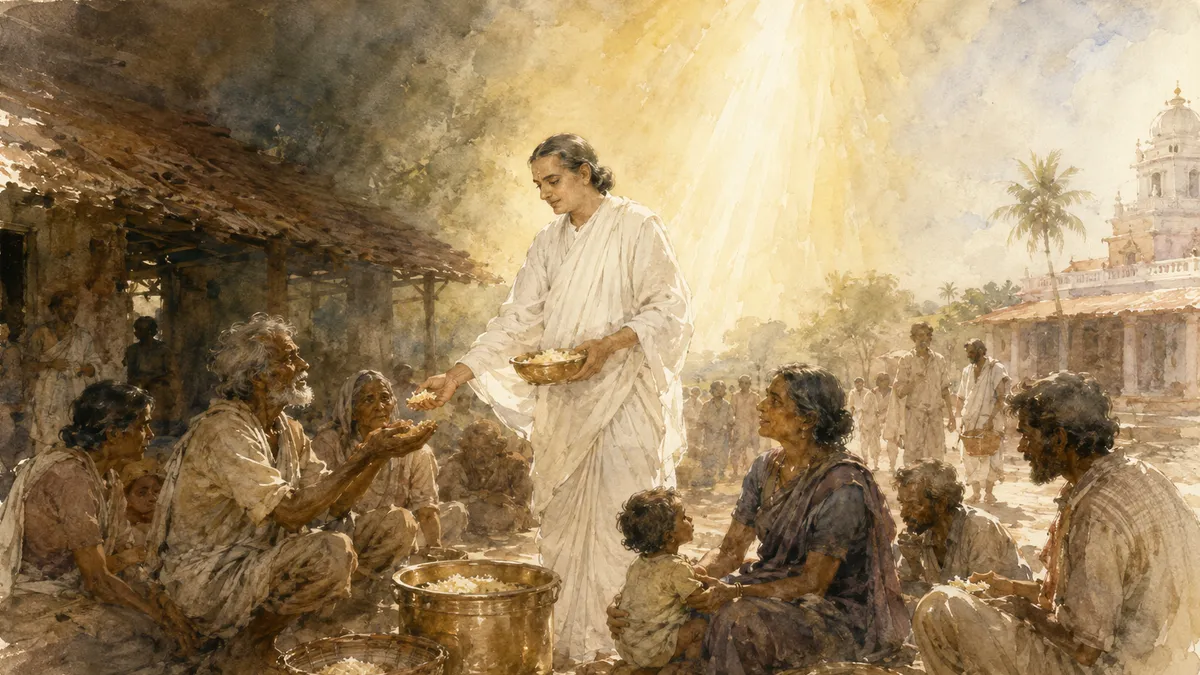
I have tempered my heart like steel. Must I forever bring food and appease the burning hunger of these poor people? Alas! Here I am, powerless to move even a blade of grass. My Lord! I beseech You, be gracious enough to appease the hunger of these poor people. I can no longer bear this agonising sight and these sounds. My Father! Supreme Light filled with grace!
I can no longer bear the sight of the oppressed, sorrowful, and suffering faces of the people around me.”
People in samsara are always suffering in some way, limited in some way, oppressed or confused in some way. Why does this happen? Because their connection with the divine essence has been largely lost, because separation is so strong, and the mind has gained power over the soul. In itself, the mind is insignificant before the divine essence. But its power to enchant is great, and when, through this power to enchant, it gains control over the soul, the soul—divine, infinite, and immortal by nature—falls completely under the sway of this enchantment. It is as though a great and mighty God or king, endowed with wisdom and power, has fallen under the influence of such sorcery and is now afraid even of a mouse. This is the condition of a person bound by samsara.
And people suffer; people seek happiness in this world and try to find the meaning of life. But even when they try to do so, they encounter insurmountable walls: the mind, separation, concepts, information, desires—all these prevent them from touching their divine essence. A person spends their entire life on logical investigation—for example, of the scriptures—and philosophical analysis, instead of directly touching the divine essence. They attach importance to concepts and notions that, to another, are merely a game. They take a concept and begin examining it without seeing the source from which it arises.
Ramalinga says: when you go beyond all this, you will see the unity that will cleanse you of this separation. Then living simply will become easy; it will become natural.
Signs of Knowing God
A sign that a person is beginning to know God is that harmony takes root within them and they become established in sattva-guna. They conquer their tamas and rajas; living becomes easy for them, building relationships is easy, and living without relationships is easy too. In fact, everything becomes easy for them. Performing service is easy—and any kind of service at that. They have no preferences: high status or low status, simple service or difficult service. In other words, absolutely everything is easy because there are no divisions.
If there are distinctions and you act from the ego, you always think: “Prestigious service will raise my status, while less prestigious service... will make me fall in the eyes of others and in my own eyes as well.” And then it becomes difficult. You have to overcome yourself. “A high position immediately inspires me, but in a low, ordinary position, I feel somehow humiliated, as if I am nobody, needed by no one, and no one considers me important.”
But when pure consciousness awakens within you, then whether the position is high or low, the service complex or simple, you draw inspiration from everything, you rejoice in everything, and you understand that all these are merely fabrications, illusions of the conditioned mind. Reality is infinite, and most importantly, you are aware of this infinity. Then you understand that there is simply nature and there is karma; every body and every mind has its own inclinations, but neither one is bad nor the other good—all of it is equally divine.
And you develop respect for every living being, even for a street cleaner shoveling snow. You know that outwardly he is a street cleaner, but who knows what is within him? He may be a Buddha who simply does not wish to reveal himself. That is why it is said: “Saints regard kings and commoners as one; they regard gold and pebbles as one.” This distinction disappears.
But as long as we make distinctions, it is difficult for us to live; we are constantly engaged in rivalry, judgment, self-opposition, and reflection, and this devours all our energy. Simplicity of life comes from abiding in the natural state, from coming into contact with the divine; then everything is easy. We do not evaluate all of reality with the mind; instead, we simply grasp it intuitively, simply understand it intuitively. And when someone reads something or asks a question, I say: “Try to understand it beyond the mind, not at the level of the mind, but beyond it; you will understand immediately—it is easy to understand. Do not be captivated by the superficial meaning; read between the lines, and you will understand everything at once.”
Ramalinga’s Prayer
“In the holy name of your grace, I pray to you. I can no longer listen to the harsh words that heartless people around me toss about so carelessly. O my Father!
By your radiant name, I pray to you: I can no longer endure this agonizing sight and these sounds. My Master! From you I learned that true knowledge is the knowledge of immortality. And so I have resolved to become devoted to your wondrous, radiant Universe. My Master! Whatever your will may be concerning me, I pray, fulfill it.
My loving Master! From you I learned that the true Refuge is your radiant feet, and therefore I seek no other salvation.”
The Master of whom Ramalinga speaks is the Sadguru—his refuge, his loving feet. Within each of us there is a Sadguru, and it is this that constitutes the essence of the root guru, the Paramguru, and the Guru-Acharya alike. That is, in duality, in the relative world, they appear to be different individuals, and in different eras entirely different people are active. But this is how it appears only within a dualistic vision of the world; within an absolute vision of the world, we discover that all of them are one and the same essence. Ultimately, we must discover this Master, the Sadguru, within ourselves.
