Overcoming the Illusion: How to Beat Samsara at Its Own Game
11.08.2026
0 мин. чтения
0
Share
copy
search
add
share
Commentary on the text “Yoga Vasistha.” King Janaka’s reflections on the nature of illusion
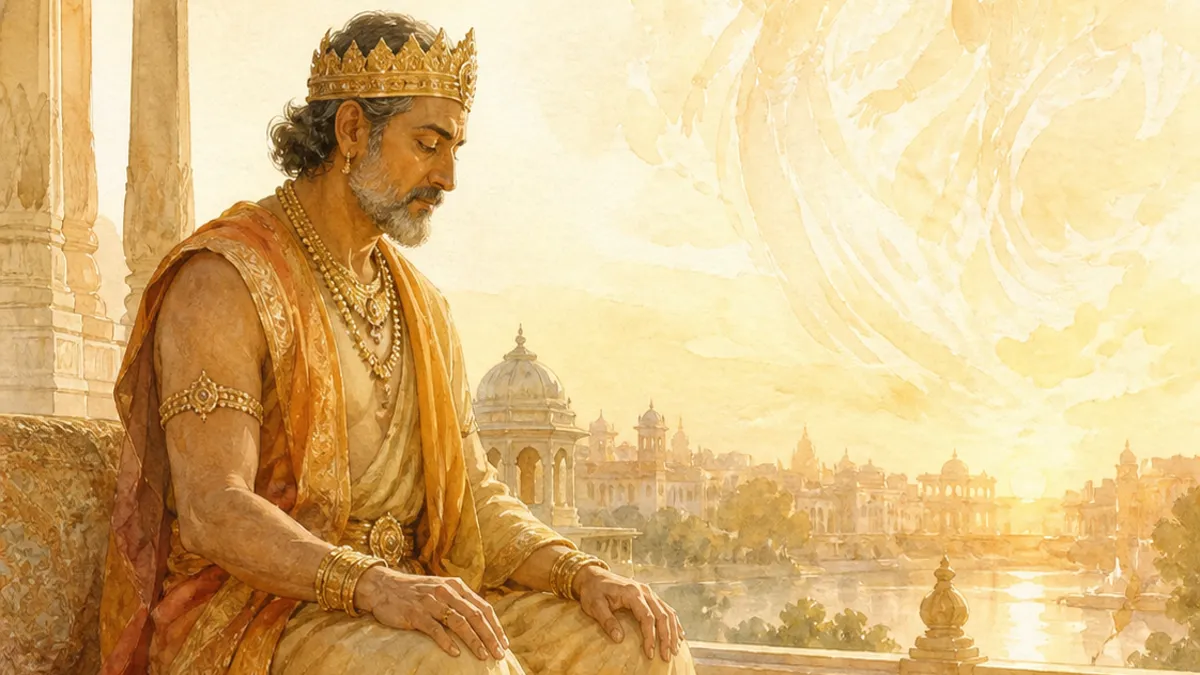
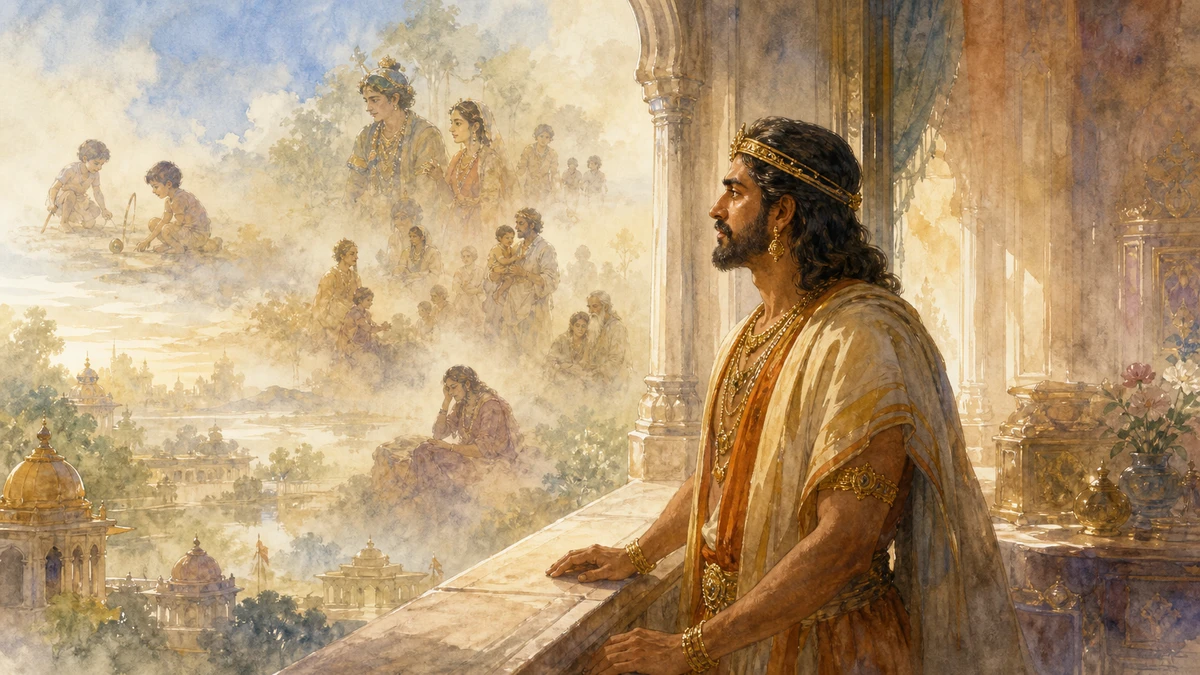
“King Janaka continued: ‘Alas, I am bound without a rope, stained without dirt, and trampled underfoot even though I reign. O God, what a mystery! Like the sun obscured by a cloud that has suddenly drifted across it, I see this strange phantasmagoria before me. Who are my friends and relatives, and what are these pleasures? Just as a boy is frightened upon seeing a ghost, so too am I deceived by these fanciful illusions. Knowing that all the pleasures of samsara are ropes that bind me tightly to old age and death, I still continue to seek them.
Great events and great people come and go, leaving behind only a brief memory—what is there to hope for? Even the gods, including the great Trinity, have come and gone millions of times. What, then, exists eternally in this Universe? Futile hope binds everyone to this nightmare known as the existing world. Like a fool, I am deceived by the phantom of self-importance, which creates the false sense that “I am someone.”
These are Janaka’s reflections, his remorse after he received a spiritual experience from divine beings that appeared in space. After engaging in deep contemplation, Janaka attained Enlightenment. He is known in history as one of the most outstanding enlightened kings (raja-rishis).
The “Yoga Vasistha” as a text is very important for understanding the Teaching, since Advaita is its foundation. Vasistha himself says that it contains the quintessence of all Vedic, Tantric, Vaishnava, and other knowledge.
If you spend your entire life studying only the “Yoga Vasistha,” that alone is quite sufficient for Liberation. One who studies it with faith, devotion, and understanding is reborn in the World of the Gods. And after returning to the human world, that person attains Liberation within three lifetimes. Such is the value of the Teaching set forth in the “Yoga Vasistha.”
The Philosophy of Reflection and the Nature of Reality
Vasistha’s philosophy, as set forth in this text, is known as pratibimba-vada—the philosophy of reflection. Vasistha says that the world we see and inhabit is unreal, and that this must be realized. For when you become convinced of the unreality of the world, all your ignorance disappears. But as long as we believe in the reality of the world, this blind belief in its reality prevents us from knowing the Truth, God. He speaks at great length about the illusory nature of the world, about how universes are created by the power of consciousness and how they disappear, explaining the mechanism behind it all.
He says that the Universe is not a material creation governed by certain laws of physics and so forth. That is a lower view. He says that the Universe is simply a vision; it is simply a meaning, a particular meaning generated by some consciousness. There are meanings that we create ourselves, and there are other, external meanings whose influence we fall under. Some meanings are favorable, enlightened, and pure, while others are unfavorable, imposing limitations on us and causing us to suffer.
The Nature of Samsara and Maya
At present, we are in the world of samsara. This means that our consciousness has fallen under the influence of certain erroneous meanings. It has fallen under the influence of the meanings of birth and death, identification with a body of flesh and blood, identification with the law of karma, and causal relationships. These are particular meanings, and consciousness has become subject to their influence; that is, it has come to believe in them. It has believed in what it should not and must not believe in, in what is false. For belief in these meanings is belief in maya, illusion, bewitchment, enchantment; in other words, maya has, as it were, enchanted, bewitched, and hypnotized us.
When we are bewitched by maya, we act within the framework of maya’s meanings, develop maya’s values, and remain entirely under its hypnosis and influence. It is like a boa constrictor: it does not chase rabbits but sits still, and the rabbit approaches it on its own. Yet the boa has an unblinking gaze, and it stares at a rabbit, mongoose, or small animal, hypnotizing it. Unable to tear itself away from this hypnotic gaze, the animal slowly moves toward it and into its jaws, while the boa simply waits for it to come closer. This is what samsara and maya are. It is the continuous hypnosis of illusion that powerfully captivates our consciousness. That is why we say, “We must free ourselves from this.” When we begin to free ourselves from the meanings of samsara and maya, knowledge of God comes naturally.
Self-Deception and the Power of Maya-Shakti
“Knowing perfectly well that Time has trampled countless gods and heroes, I still deceive myself through my love of life. Days and nights are spent in futile desires rather than in awareness of infinite Consciousness. I journey from suffering to even greater suffering, yet no disillusionment arises within me.”
King Janaka is amazed at himself. He says, “How can this be? I am such a successful, intelligent king, endowed with every virtue. Why, then, do I deceive myself?” And this is astonishing. He analyzes his own state and comes to the following conclusions: “I understand everything. But why do I lead myself into illusion?” Because all living beings deceive themselves. They are hypnotized by the power of maya-shakti. Maya-shakti is a particular power of the Absolute, the power of illusion that veils and conceals the truth; it is also called tirodhana-shakti, meaning the power of concealment.
The Five Divine Powers
The power of concealment is neither bad nor good in itself. No power can be unequivocally bad or unequivocally good. There are five different powers: the power of creation, the power of preservation, the power of destruction, the power of concealing the divine, and the power of divine grace, Anugraha. These five powers operate continuously in the Universe.
Sometimes the power of concealment is beneficial, for example, in preserving the secrets of the Teaching. At other times, the power of concealment acts as maya, as illusion, hiding the divine truth. Why? What is it? It is a particular darshan of the Absolute, of Brahma the Creator; it is a kind of trial, test, or examination for all living beings. Only those living beings who can overcome the hypnosis of maya are entitled to Liberation, to ascend into the highest dimension.
The Mechanism of Identification and Maya’s Hypnosis
Maya’s hypnosis manifests through numerous factors from birth to death. For example, it includes the consciousness, “I am a body of flesh and blood—Aham Deha Asmi.” It also includes a limited perception of one’s consciousness, the sense of ego, ahamkara—that is, “I am me, I am a human being”—identification. There are many other identifications, foremost among them identification with the mind and the process of thinking. From these three—ahamkara, the ego; the body, Aham Deha Asmi, the feeling “I am the body”; and “I am thought,” identification with vikalpas—springs the entire diversity of other, lesser identifications. As these three branch out, they give rise to ever more subtle and profound identifications. I am a man or a woman; I am Russian or American; I hold such-and-such a concept—all this diversity ultimately compels one to believe in the reality of this world and become entangled, losing meaning, purpose, and direction, and simply falling under the influence of these meanings.
The Whirlpool of Samsara and Predetermination
All living beings are carried along by the river of time. Time constantly compels them to move and flow. And they all fall under the spell of samsara’s shifting meanings, of the cause-and-effect relationships that continually arise, and of the sequences of events that occur again and again in such chains. And what remains for living beings? They can only be participants in this entire whirlpool—that is, passive participants. This whirlpool moves—the sequences of events, causes and effects, the flow of time—and it spins all living beings around until death itself. Nothing specific can be done within this whirlpool; or rather, something can be done, but very little.
Many think that living beings earn money, make history, start families. No, no! They spin in this whirlpool. Everything is present in this whirlpool, but none of it matters. They simply spin, that is all. Nothing can be done in this whirlpool, because this whirlpool is predetermined from the outset; it is set by Brahma’s sankalpa. The sankalpa of God the Creator is such that the destinies of living beings have already been described; the order of development, the course of the Universe’s development, has already, as it were, been laid out. And for each class of living beings, there are certain tunnels of reality. For beings hypnotized by maya, the tunnel of reality is like this—that is, a whirlpool.
The task is: how can one free oneself from this whirlpool? The path to liberation from this whirlpool is disillusionment with such a vision. Therefore, we say that it is very important to cultivate disillusionment with samsara, with samsaric meanings and values, and to reflect. One who does not reflect wastes their life in vain. That is, a jnana yogi is one who constantly reflects. Perhaps you do not yet know very well how to meditate or contemplate, but everyone can reflect. Therefore, it is right to ask yourself: “What is the meaning of my life? What is the meaning of such actions, such ways of acting? Is it right or wrong?”
Life as a Chess Game with Samsara
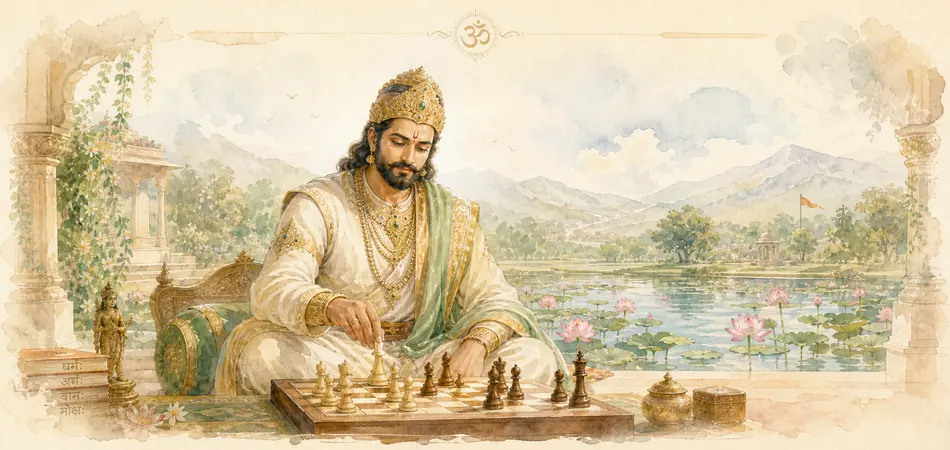
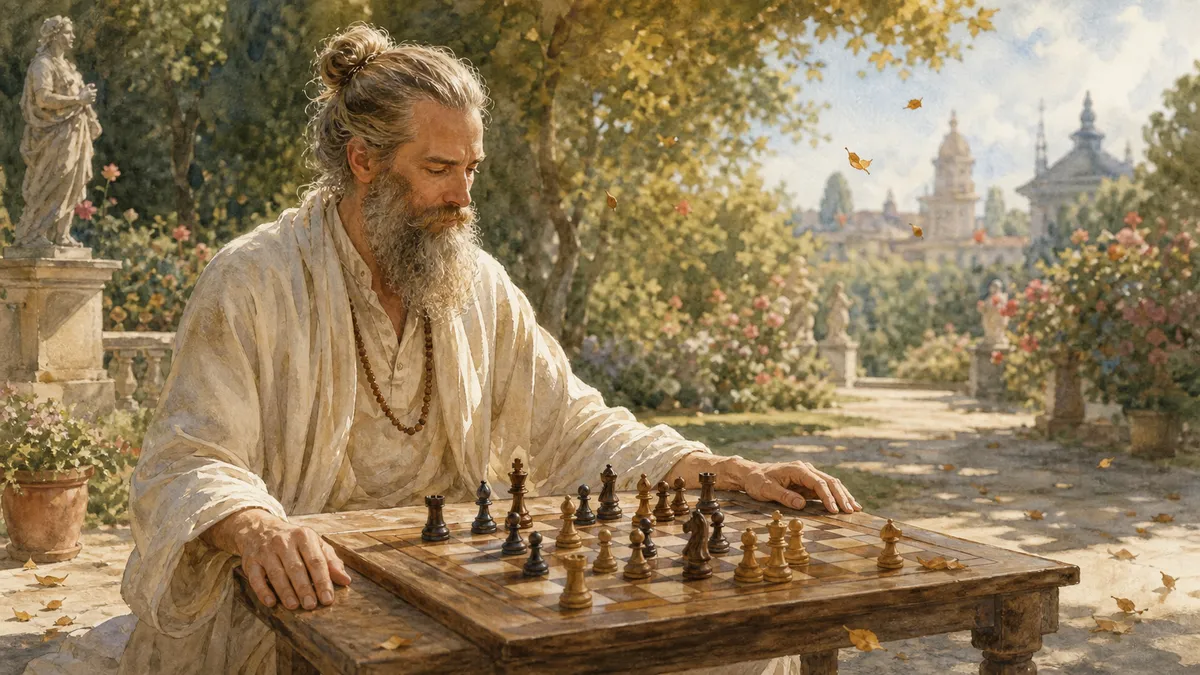
A sadhu should be like a brilliant chess player who constantly calculates the game seven moves ahead. For life is like a game of chess. The situation is constantly changing. Samsara constantly makes moves, new moves, and throws challenges at us. For example, if yesterday the pawns were standing still, now it is E2, E4, and we must respond appropriately to these moves.
In order to respond appropriately to these moves, we must constantly think. We should not be distracted: “Oh, I will do this, I will do that, I will buy myself a new suit, a car, meet that person, watch a program.” But samsara has already made three moves—a knight move, brought out the queen, and is already preparing to deliver check. And we are thinking about something entirely different. This is what the state of samsara is.
The state of samsara is when we think about the wrong things, when we are carried away by samsaric meanings, while samsara continues to make its moves. If we miss one move, then another, then a third, eventually we receive checkmate. And we think: “Why do I suffer? Why am I unhappy? Why must I die? I have not yet managed to do anything, and how impermanent this world is.” Because this is the nature of life in samsara—it throws challenges and makes moves. If we are good players, we make counter-moves; we must make counter-moves. Our moves must be adequate; we must learn to outplay samsara.
The Strategy of Spiritual Confrontation
Samsara moves its bishop and says: “There is suffering and death here.” We bring out the queen. “But I have faith in Dharma, and I will practice”—this is my answer to samsara. Samsara says: “You have little time and many distractions.” We bring out our bishop and say: “But I will enter into a retreat discipline and plan a retreat.” It says: “You have bad karma, few merits from the past. You do not know what is inside you, how many demons are within you. You have bad memories; you have committed many sins.” And we respond: “But I will recite the mantra a million times and purify myself; I will build a temple, print texts, perform Samskara-shuddhi. I will purify all this. And I will learn self-liberation”—this is my answer. Samsara then says: “You have such and such attachments, and so many unfulfilled debts as well.” We say: “But I will practice sankalpa in motion, the contemplation ‘this is a dream,’ and none of this will affect me.” And this is constant.
Samsara constantly throws challenges at us, and we must constantly respond adequately, respond continuously, without distraction, every second. For samsara is a very complex and diverse system; that is, it is an exceedingly, exceedingly sophisticated illusion. It is so sophisticated that we do not even know how sophisticated it is, because it is divine by nature. It is not bad; it simply has such games. It is like training for our consciousness and perception. It is like an extraordinarily complex supercomputer game.
Liberation as Mastery of the Spiritual Game
Liberation means being attuned to reality, constantly making appropriate, correct moves, like a good chess player. A poor chess player is checkmated in three moves at the very beginning; an average player lasts until halfway through the game. We need to become excellent players; we need to start pushing samsara back across the entire board, forcing it to play on its own territory rather than ours. And we must not run away from samsara when we are put in check from all sides by the ego and desires, but instead devise our own plans for putting samsara in check.
When we strive in this way, such aspiration is also called spanda. Spanda is vibration—that is, a certain vibration of aspiration generated by our consciousness that constantly moves us forward. It is also called sahaja-spanda. It is our inner warrior, constantly prompting us to think strategically and make the right subtle decisions at the level of consciousness. All this is possible if we practice contemplation. To keep making such correct moves, we need vichara, self-inquiry and contemplation, the study of sacred texts, and an understanding of the rules of the game.
Studying the Laws of the Universe
It often happens that we embark on the spiritual path without understanding the rules of the game; we make mistakes and break those rules. Then we wonder why we cannot accomplish something. It is because we have not properly studied these rules. We should always understand them well so as not to make such mistakes. We must become experts in these rules. In fact, there are very many of them. It is like deciding to work on a computer and become a proficient user: you need to buy a textbook, learn how to use programs and operating systems, and know which buttons to press. You need to devote time to this.
Spiritual life is a teaching about how to become a proficient user not merely of a computer, but of the Universe, your life, and your own self. We must study these rules, the laws of the Universe.
When a person is confused, ignorant, or suffering, you ask them: “Do you know about this?” “No.” “And do you know about that?” “No, not that either.” “What about this?” “No.” How can you live if you do not know the rules of life or the laws of the Universe? You come into dissonance and conflict with them. Naturally, they come into conflict with you as well. It is impossible to experience happiness this way. These laws must be studied. Here is the textbook: the laws of the Universe, the laws of creation for proficient, novice, and advanced users of this universe.
This is far more important than millions of books about various samsaric concerns, because they never take us beyond samsaric concerns.
King Janaka’s Further Reflections
“What here can be considered desirable or remarkable, when I see that everything anyone has valued in this life has passed away, leaving only suffering behind? Day after day, people in this world live in sin and violence, and with each passing day more and more people sink into suffering. Childhood is lost in incomprehension, youth in the pursuit of pleasure, and the rest of life in family worries. What, then, does a fool attain in this life?
By performing religious rituals, one may reach heaven—and nothing more. What is heaven? Is it on earth or somewhere far away? Is there any place at all untouched by anxiety? Suffering gives way to happiness, and happiness to suffering. The whole earth is filled with the dead bodies of various beings—that is why it appears solid!
In this Universe, there are beings for whom a single moment lasts an epoch. What is my life? Of course, it seems that there are pleasant and permanent objects in the world, but they bring endless cares and anxieties! The mind alone conceals within itself the seed of this world; it is from the mind that the false notions of “I” and “mine” arise.
The world seems to have been created just as a coconut falling from a palm tree appears to have been knocked down by a crow that happened to land on it at that very moment. In this world, ignorance alone gives rise to the ideas, “I need this, but I do not need that.” It is better to spend all one’s time in solitude or in hell than to live in this superficial world of illusions.
Intention or motivation is the only real cause of this world. I must dry up the source of these motivations! I have enjoyed and suffered from various sensations. Now I need to rest. I must suffer no more. I have awakened and will kill this thief (the mind, the ego) who stole my understanding. The sages have given me good instructions. From now on, I will practise only self-knowledge.”
This is the true and proper motivation that should always be cultivated when we receive the Teaching. It is through such motivation that Liberation truly comes.
The Teaching you are studying is truly precious. The methods you are receiving truly lead to Liberation. But for them to work, faith and proper, genuine motivation are needed. We ourselves must understand what we want in this life and what price we are willing to pay for what we want in this life.
Advaita
Consciousness
Liberation
Samsara
Maya
Janaka
Spanda
Vichara
Yoga Vasistha
Pratibimba-vada
Author Гуру
Read 15 times
Articles
Vidya AI
Search
Lectures
November 2, 2026
Mantra of the day
ОМ САХАДЖАЙА НАМАХ ОМ Естественному – поклонение!
Auspicious Times(Rome)
Brahma Muhurta:
04:53 - 05:48
Abhijit Muhurta:
11:33 - 12:14
Sayam Sandhya:
16:44 - 17:25
Mokshada Ekadashi (6 November)
Ekadashi of liberation. Helps to achieve spiritual enlightenment.