

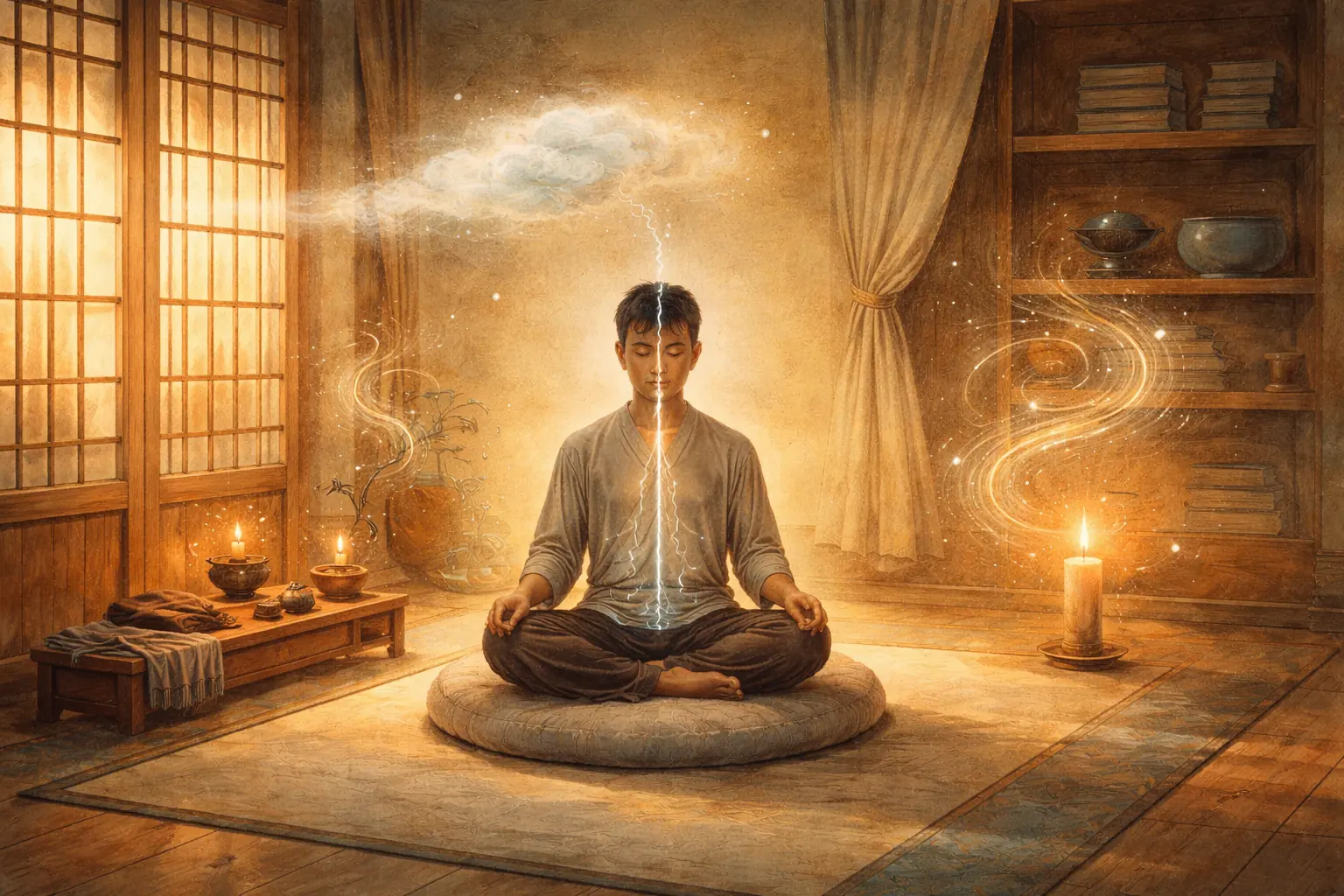
Let us discuss some aspects of Shakti Yantra and how to avoid an imbalance of the pranas during intensive practice.
If a yogi meditates intensively for a long time, but his mind does not remain at rest because of agitation, it is believed that he may slip into the dangerous gorge of dualistic thoughts. When meditating for a long time in retreat, you should carefully study the instructions on dullness and agitation, which are partly included in the foundational practices of Laya Yoga.
A true meditator is one who clearly understands what dullness and agitation are in meditation and knows how to stop and avoid them. If we do not know how to stop them, we may spend even ten years in retreat without ever achieving results. What matters to us is precisely this friction, when meditation begins to produce sparks in the consciousness, when every session brings a breakthrough to a new level. And such a breakthrough is possible only when we have eliminated errors in meditation, namely dullness and agitation.
Overcoming Dullness and Agitation
Dullness is a state in which your mind turns inward, you become lost in a stupor, and drowsiness and dullness of perception are present during meditation. You seem to feel comfortable, you can sit for a long time, there are no thoughts, and there may not even be any sensation of the body, but you are either dozing or expanding. It is a somewhat unclear, suspended state. A yogi should avoid such a stupor.
If dullness occurs, you should open your eyes and visualize a bright object, such as the sun or the moon, or an inspiring object, such as Dattatreya, the Buddha, or a saint. You can rub your face and invigorate yourself, and if none of this helps, you should make some movements.
Agitation is a state in which you sit in meditation and, instead of contemplating emptiness or practicing Atma Vichara, you think about how you will go home and work there, when the next retreat will be, and so on. Instead of maintaining the focus of meditation, you become drawn into the images that arise. You barely manage to catch yourself becoming distracted. You promise yourself that you will not become immersed in the images but will meditate, yet three minutes later you become drawn into new visual or mental images.

To avoid becoming drawn into such agitation, you should reflect on the harmfulness of distractions, the suffering in samsara, and impermanence. You need to tell yourself, “What are you doing!? If you keep losing yourself like this even in retreat, you will simply waste a great deal of precious time and still attain no realization.” You need to bring yourself into a proper state of alertness, as if constantly slapping this fantasizing mind on the hands or cheeks.
One very radical Teacher, while in seclusion, instructed his disciple and said, “If you do not meditate properly, you may sit in retreat for even twenty years, but your practice will yield no result other than a pile of excrement at the foot of the mountain.”
We should remember very clearly how we must approach retreat meditations. We should have the attitude that now is the ideal time for practice, when all causes and conditions have already come together, and therefore everything depends solely on me.
It is usually said that there should be two aspects: alertness and mindfulness.
Mindfulness is a kind of operational consciousness that holds the object of meditation with which we work most of the time; for example, in Mahashanti we maintain the state without thoughts, we maintain Atma Vichara.
Alertness is the power behind the throne that emerges only when needed. Alertness is strategic consciousness, the part of the mind that observes mindfulness. When mindfulness can no longer sustain the meditation and switches off, alertness comes into play and awakens mindfulness. Alertness is an aspect of consciousness whereby, as we sit, approximately every fifteen or thirty seconds—or every five seconds when distractions are strong—we check where our mind is. We check mindfulness, aham vritti; that is, it is a certain subtle consciousness that awakens and checks.
The following example can be given. A train has a special vigilance device that the driver must press periodically. If, for example, the driver falls asleep and the vigilance device does not send a signal to the dispatcher, a siren sounds and an alarm is triggered. The driver represents the primary awareness, while the device in the driver’s cab represents the awareness that checks attentiveness, and it is called vigilance.
Another example can be given. Attentiveness is a soldier standing guard, while vigilance is the officer on duty who periodically makes the rounds of the sentries; in other words, there is a double check.
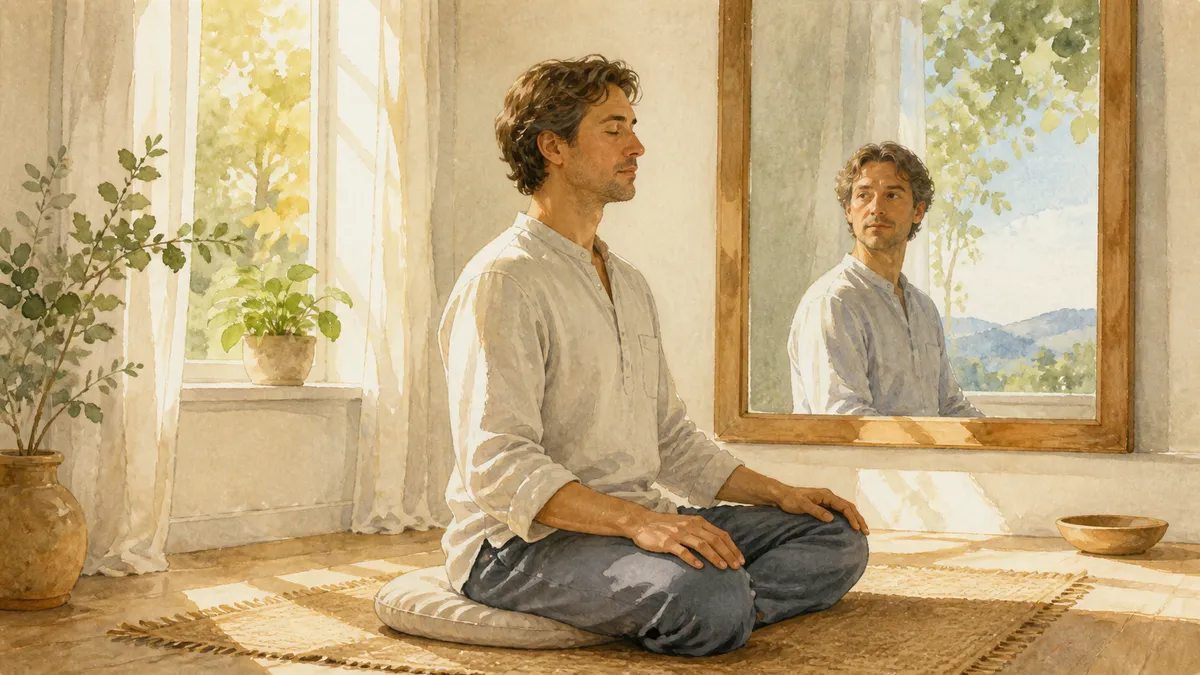
Thus, if we have vigilance and attentiveness, we meditate correctly and can overcome strong dullness and agitation.
At first, we must apply subtle effort. If we experience dullness or agitation but make no effort and simply let things take their course, this is an error called “failure to apply effort in meditation.” However, once we have stabilized the mind to the point where we can sit one-pointedly for a long time without any problems—that is, with neither dullness nor agitation—such effort, on the contrary, becomes an obstacle and must therefore be removed.
Pranic Imbalance: Causes and Signs
If, during contemplative meditation, a yogi grasps at emptiness and his spirit becomes lost in it; if he works diligently with the winds and channels without the guidance of a Teacher; if, unable to control the pranas, he concentrates for long periods on the upper chakras at the brow and crown in order to enter samadhi quickly; or if he has a wind constitution, all these causes may disrupt the harmony of his energy, resulting in an imbalance of the pranas. This is called a wind disorder.
Likewise, if a yogi is obsessed with fixation on certain mental ideas, or if he experiences intense mental tension—for example, about attaining liberation as soon as possible—this is also a sign of pranic imbalance.
Other signs of pranic imbalance include:
Strong tamas, lethargy, and weakness in the morning, with a feeling of fatigue or heaviness in the body
A feeling of pressure in the head, while the abdomen and genitals, on the contrary, feel empty and devoid of energy
Food brings no joy and is poorly digested
The yogi loses enthusiasm and the joy of bliss arising from the red bindu in the genitals because his connection with this bindu has weakened
An unpleasant noise may be heard in the ears
Visions may arise that do not bring the same joy as visions experienced in meditation
Frequent dizziness occurs, and the body feels as though it is being carried by the wind
The yogi’s mind is agitated, restless, or depressed
The yogi may develop an aversion to meditation; he may be unable to perform breath retention or asanas, and the duration of kumbhaka decreases because these practices increase his weakness
All these signs indicate wind disorders, showing that the yogi has lost his connection with his earth and water, with the red bindu in the genitals, and that he has an excess of wind and space. If this continues to be ignored, it becomes a serious obstacle.

Methods for Restoring Pranic Balance
If signs of such a disorder appear, the yogi must practice diligently to balance the pranas, restore the connection with his red bindu—the red essence in the genitals—and strengthen the elements of earth and water.
To do this, one should:
Keep the mind relaxed, abandoning the pursuit of attainments and everything that drives it to work feverishly
Learn to relax and keep the mind in its natural state
It is even permissible to replace seated meditation with walking
Stop any bodily sadhanas that cause discomfort, such as asanas, pranayamas, and mudras
Engage the body in service and physical labor
Stay near bodies of water and work the land in order to alter the flow of the pranas, that is, to integrate with the lower elements
Then one should begin correcting the imbalance of the pranas through the soft butter meditation; one should also practice walking to strengthen the connection with the earth, and, while seated, concentrate on the two lower chakras—the muladhara chakra and the svadhisthana chakra—as well as on the area below the navel, the yonisthana. One should practice integration with the water element while sitting by a body of water or while walking, and likewise with the earth element while sitting or walking. It is also beneficial to spend more time bathing in water or working the land so that the physical body becomes tired, to receive massages, and to engage in enjoyable activities.
Once the pranas have recovered, one should continue concentrating on the two lower chakras, adding concentration on the anahata chakra to achieve the final balance of the wind. After applying these methods, the balance of the pranas will certainly be restored, the body will feel strength in the areas of the muladhara and svadhisthana, meditation will also be restored, and the yogi will once again be able to perform advanced practices.
This may not be relevant to you, but such problems generally arise in meditators who practice very long and intensively in retreat but have deviations in meditation. Nevertheless, one should not wait until this becomes relevant. If you know how to prevent an imbalance of prana, you will always understand the principle of grounding and rooting in the lower part of the body by concentrating on the lower chakras and regulating the wind.
Perception of the Elements in Meditation
When you meditate, various sensations arise in the body. These are primarily perceptions of either the five pranas or the five elements and tanmatras—the subtle constituents of the elements. If a yogi has purified the nadis, opened a chakra, and activated one of the elements, then changes occur in their breathing and in their perception of colors and forms.
When the earth element is activated, a pleasant sweet taste is felt in the body, yellow light or a yellow square is seen with spiritual vision, and the breath flows evenly through the center of the nostrils.
When the water element predominates in the body, a slightly bitter taste is felt, bringing subtle pleasure to the body. White light is seen with spiritual vision, bringing joy and clarity. A crescent moon is seen between the eyebrows.
If the fire element predominates in the body, a stronger bitter taste is felt in the body, bringing pleasure. A red color or a red triangle is seen with spiritual vision, and the breath flows through the upper part of the nostrils.
When the wind element, air, predominates in the body, a subtle sour taste is felt, while blue colors or a blue sphere are seen with spiritual vision between the eyebrows. The breath flows along the edges of the nostrils.
When the space element predominates, a strong bitter taste is felt, smoke is seen, a smoky-gray color with points of light is seen between the eyebrows, and the breath becomes barely perceptible and flows easily.
The various experiences that arise are explained by the perception of the subtle constituents of the different elements.

Pure and Impure Vision
When you meditate, it should lead you to perceive a different way of life, a purer vision. In other words, moving toward liberation means striving to leave behind impure karmic vision, at least on the level of consciousness. Until you have the intention to leave the impure karmic world through consciousness—that is, to break with the civilization to which you are attached—it is impossible to attain liberation.
This means breaking with civilization at least within yourself, at least mentally, until all hopes, plans, attachments, and clinging to the material world, social ties, and anything else apart from the spiritual path have been severed, since the world in which we live is regarded by the saints as unawakened and impure. At the same time, the word “impure” is not a moral category with a disparaging connotation; it is a category related to the elements and consciousness.
There is pure vision and impure vision. Impure vision is conditioned by duality. A pure world or pure vision is abiding in non-duality. To enter pure vision means to break with samsara, to break with dualistic vision. Therefore, it is said that it is impossible to attain liberation without leaving samsara.
Samsara is not a geographical concept. To leave samsara means to break with dualistic vision. And until you realize that you must break with samsara within yourself, with the dualistic vision of the world, it is impossible to free yourself from it. Therefore, wherever you may be, you must have the intention to leave samsara.
It is impossible to leave samsara simply by putting on a monk’s kurta or by doing something. Leaving samsara is a subtler state.

One man served a Master. He was illiterate and did not practice much, but sometimes, together with the other disciples, he listened to the Master’s lectures, in which the Master constantly said, “One must leave samsara.” He saw monks in orange robes and thought that he needed to put on the same kind of robes and shave his head, and that this would mean that he had left samsara.
