


Commentary on Sathya Sai Baba’s text “Commentary on the Mandukya Upanishad”
The Mandukya Upanishad describes the foundation and the view for us. In the teaching there are always three components: the foundation, the path, and the fruit.
Sambandha — the foundation
Abhidheya — the path
Prayojana — the fruit
The foundation is the Absolute itself, Brahman, God. The path is what we do in order to reunite with Him: our contemplation, meditation, our understanding. Prayojana is the fruit, the goal, the final point, the point of arrival.
The Mandukya Upanishad reveals to us the principle of the foundation. When we listen a great deal about the foundation, we develop the view — Jnana. The path can be divided into three categories:
Jnana — the view
Dhyana — meditation, contemplation
Kriya — action
The view is how we have understood the foundation. The foundation is Brahman, and we must form a view of Him for ourselves. Contemplation and meditation are what we do in order to abide in Him. Kriya, action, is how we connect the teaching with life, how we live in the relative dimension. Thus, the path consists of view, meditation, and conduct, while the foundation, path, and fruit themselves are Sambandha, Abhidheya, and Prayojana.
Parabrahman and Aparabrahman
One who is immersed in deep contemplation of the sound Om, always aware of its immense significance, can confidently move further — toward the realization of the reality behind the unreal appearance, that is, toward the comprehension of the very Paramatma-tattva.
In the first part of the Upanishad, a general concept of the Atman as the one and nondual is given, in accordance with the essence of Advaita. In the second part, the erroneousness and impermanence of opposing two essences — the world and God — are shown.
The Absolute is explained in different aspects so that it can be understood. It is usually said that there is Parabrahman and Aparabrahman.
Parabrahman is God in His purity, the perfect pure light. The primordial fundamental creative emptiness whose property is radiance, manifestation, self-radiance — Nitya Svayam Prakasha. The primordial, eternal, self-existing luminous space capable of radiating.
Aparabrahman is material energy, maya, shakti. This is His gross aspect. For Brahman Himself, both His subtle and gross aspects are one; for Him there is no division. But for us, beings who are in duality, the energies of Aparabrahman, the gross shaktis, are not suitable for realization. This is maya — it draws us in and leads us astray. The energies of pure Parabrahman, on the contrary, are extremely important for us.
- The energies of Aparabrahman are the forces that destroy and conceal the truth: Samhara and Tirodhana.
- The energy of Parabrahman is Anugraha, the enlightening force.
We must understand which energies to serve and which to open ourselves to.
The world of samsara is a world where samyoga is disrupted, where concealing forces and gross energies veil reality. Where reality is not seen as it is. Where living beings are hypnotized, as if lulled to sleep by the energies of Aparabrahman, and they need to disenchant themselves and break free from their power.
Pure Vision as a Daily Practice
Living souls in samsara are characterized by impure vision. A sadhu tries to purify his mind in order to cultivate pure vision. Pure vision is when we see the pure energies of the source, Parabrahman, amid the play of the energies of Aparabrahman. This means that every day you need to exercise yourself in pure vision. This is a heart instruction.
Do not even think that you will be able to rise higher without becoming established in this view. Whatever happens to you, learn to block and dissolve negative reactions, thoughts, emotions, and to give rise to emotions that come from pure vision.
Suppose you are walking in the dining hall, someone is carrying a plate of porridge and spills it on you. The first reaction is to get angry. You must instantly see this reaction, and then the principle of pure vision must come into effect. You should think like this: “If this is a mandala, if this is a deity, then what kind of lila is this? Perhaps the porridge is a blessing nectar. The deity has blessed me with nectar. I have received darshan.” And immediately a feeling of compassion, gratitude, and love toward this person should arise in you: “This is very good for me. Perhaps I do not fully understand what kind of blessing this is, but in any case, the blessing has been received.”
You will bring great benefit to your spiritual life and to your next life. You should practice this constantly. If someone opened the door and spoke angry words to you, you must understand again: “If this is a mandala, this is lila, and this is a deity, then these angry words are blessing mantras. Undoubtedly, there is something coarse in me that can perhaps be liberated only by such mantras. Perhaps my mind is so deeply mired in duality that I need some inspiring push.” And once again generate pure vision. In this way, you must accustom yourself always and everywhere to perceive everything as pure.

This does not mean that you need to go into the thick of negative energies and do something there. You can simply step away if you feel uncomfortable. You can simply turn away from these energies, move aside. But in your soul, never give rise to impure vision; on the contrary, become ever more firmly established in pure vision. Because impure vision leads to a clouded, sinful consciousness. And everyone will have to answer for sins! Do not think that because the view is Advaita, there are no sins. Demons with photographs will come close, and you will not be able to talk your way out of it with the view. If you cannot dissolve it, consciousness will change, dissolve, and you will have to go to hell for your sins. They will drag the soul away without any discussion. In the subtle world, no one persuades anyone. Unless the guardian angel and the Guru intervene and fight for your soul. You yourselves must learn to fight for your soul.
Pure vision will allow you to easily disperse any demons. These demons are your own projections, your subpersonalities, thought-forms, alter egos, created by your stream of mind at the moment of impure vision. Consciousness is a skilled glassblower: it can blow any number of forms, projections, subpersonalities in the subtle world. The subtle world is infinite. Instead of blowing a subpersonality in the form of a demon, a preta, you will create devatas, deities, in moments of experiencing pure vision. And then no one will be able to accuse you of any sins, because you see everything differently. Even if demons come and say: “Look, this is your sin, and this one too,” in pure vision you will say: “This is a blessing, this is nectar, this is lila, this is a manifestation of the deity. I am going to the heavenly worlds.” That is all.
Brahman as the First Cause. Atman and Paramatman
In the section specifically devoted to Advaita, the foundations of the teaching are supported by arguments and proofs. Originally, the world was in a state of rest and unmanifestation. Brahman the creator is not the cause, but the effect. Therefore, attempts to penetrate the essence of the effect will not lead to knowledge of the nature of things. But the Brahman spoken of in this Upanishad is not an effect. He appears as the primordial cause, the first cause. He is unborn and boundless.
Brahma—the creator of the Universe—is an effect of Brahman. The creator himself is, as it were, the illusory body of Brahman for the creation of the Universe. Brahma creates Hiranya-garbha. From him are born the rishis, manus, and prajapatis, who perform their functions in the Universe. This is the divine administration that carries out the laws of the cosmos at the beginning of the creation of the Universe.
Atman is like Akasha, ether—it is all-pervading. It may only seem to be enclosed within certain limits, like air in a vessel or a room. In this sense, it is spoken of as endowed with individual traits. But there is no truth in this limitation. The body, too, is like a vessel creating apparent boundaries for the sky within it. However, in essence there is no difference between the sky in a jug and the sky outside. Once the limiting factor is removed, they become one. When the body dies, the jiva merges with the universal soul—Paramatman.
The Path of the Jiva: Dissolution and Transformation
Which jiva merges with the universal soul? Every one. But an impure jiva merges for a fraction of a second and then comes out again. And then the path of bardo begins for it, which in Christianity is called toll-houses. A pure jiva merges definitively with the universal soul, dissolves in the light, realizes itself, and in about six months attains final enlightenment. Then it begins to emanate manifestations — many divine illusory bodies, sending them in different directions. Through the power of meditation, it creates pure lands and realms in which it manifests in a pure state, where samyoga is fully observed. Energy manifests and does not hang in emptiness — it continues to function on the plane of shakti. Its Jnana, Svatantriya, Iccha, Aishvarya, Kriya gain the fullness of their powers, manifesting in the form of manifestations, emanations — Pranava-deham, Siddha-deham.
Such a jiva can manifest as a deity of the pure lands, as a deity in various dimensions, as an avatar in this world. An impure jiva, however, which has failed to dissolve itself, inevitably falls out of this light, and the processes of Antar-bhava begin for it. It sees many forces — peaceful and wrathful deities, their servants, their retinue. It is accompanied by its Ishta-devata, its guardian angel. It meets deceased relatives or friends and seeks its path. It encounters many advisers, various souls — demons or angels — who advise or tempt it. And the path it chooses will depend on its clarity.
Only limitations compel one to attribute various properties to the Atman. Once the limitations are removed, the Atman becomes Paramatman itself. The jiva must under no circumstances be regarded as a part of Paramatman, as its derivative or instrument — vikarma. Both the birth and death of the jiva and its wanderings from one world to another are completely unreal.
The impure jiva is the fruit of karma. It is a manifestation of Brahma the creator, but for the Atman it is not yet pure, and therefore it cannot be regarded as an instrument. Our task is to dissolve this impure jiva without clinging to it. And then, if it so wills, the purest playful ahamkara, the purest illusory body, will be manifested. This is called Pranava-deha, Siddha-deha — enlightened, pure bodies.

When we perform the transformation into the body of Dattatreya, it is important not only to carry out the transformation itself, but also to perform the phase of dissolution. By repeatedly transforming in meditation or in sleep, we must learn to enter the space of emptiness and luminosity, reunite with the Atman, and dissolve this body. And then we must learn to emerge from this light and manifest it again, like a fish leaping out of the water. In this process the jiva is purified and learns to dissolve in the higher Self. The impure illusory body is gradually transformed into a pure divine illusory body endowed with 36 divine marks.
For this process to truly work, we must purify our soul. We must live in everyday life in such a way that our emotions never darken us and samaya is impeccable. We must always have harmonious relationships, and in our soul we must condemn no one. We must always check ourselves: “Are our thoughts pure?” We must learn to accept everything joyfully, with a pure and light heart, so that our inner work is never disrupted.
Vairagya: Detachment as the Foundation of Spiritual Life
We must learn to live with detachment. To live with detachment means that you have no attachments, no strong clinging to the external world. You have begun building cells, but you do not worry too much about what they will be like — beautiful or not. It is simply a form of service. You eat prasada: today it is tasty, tomorrow you do not like it. No one has abolished detachment for a monk. But it happens that we begin to do something in service to the Dharma — to present the monastery in a good light before people, to spread the Dharma — and yet we ourselves forget about detachment. Then attachments arise, emotions begin, and we lose the necessary level of detachment. And having lost detachment, we also lose pure vision. We need to remember detachment: “I did not come here for this. I came here for realization, for spiritual purity. And all this is simply service, different kinds of obedience.”
If a monk loses the spirit of renunciation, his spirit weakens and his ego grows stronger. The spirit should grow with the years, not weaken. Renunciation does not always mean denial. Renunciation means that within you there is vairagya. Sometimes I am offered delicious prasad — I eat it because what is offered should be eaten. When I live alone and no one offers anything, I eat whatever there is. That is also fine with me. When you have vairagya, you do not choose — you accept everything as it is.
In order to look dignified before people as a representative of Dharma, I wear the beautiful garments prescribed for mahamandaleshwars. But it is not my desire to wear them. I myself used to go around in clothes that were not very beautiful. One layman, seeing the clothes in which I went to a lecture, was horrified and said, “People will not understand you; let me buy you some kind of suit.” I do not reject beautiful clothing. If I reject it, it means I have no vairagya; it means something is important to me. If it is prescribed by status, then it is all service. Vairagya is needed. Great vairagya is needed. Not to cling to service, nor to statuses, nor to positions, nor to cells, nor to food, nor to relationships. Always remember: “I did not come here for this.” All of this exists in the world in far greater quantities. Whoever wants can earn money, and there will be much more of everything. Here, all of this is skillful means for Dharma, so that it may spread, so that people may accept it. Sometimes it is needed for people, in order to establish a connection with them. For Dharma to be accepted in a foreign culture, different things must be done. But within you there must be complete vairagya: “This is not for me. This is for Dharma.” Then it is easy for you to remain focused. You will not be distracted. For you, there will be nothing but Dharma.
Advaita and Dvaita: the Union of View and Conduct
All of this is only appearance, not reality. Reflect more deeply on this question, and you will understand that Dvaita does not contradict Advaita. The contradiction exists only between the various religious and philosophical teachings of Dvaita. For an adherent of Advaita, everything is Parabrahman, and contradictions are unknown to him. A follower of Dvaita constantly dwells in an atmosphere of personal attachments, false pride, and hatred, for wherever there are two, there is always fear, attachment, and therefore the other emotions generated by them.
Advaita is the highest truth. Dvaita is a certain mental construction. Therefore, dualism can attract you only as long as the mind is active. In sleep or samadhi, notions of two disappear. When avidya prevails, multiplicity grows unchecked.
The greatest problem for a sadhu is to unite view and conduct. The paradox is that in our view we strive to abide in Advaita, while in conduct there is nothing but Dvaita. But this paradox is easily resolved if one understands the principle of uniting view and conduct, and the principle of lila. We accept Dvaita, but as a convention of this world. We do not ignore it. We respect these laws while we are within them. We respect them, but in spirit we ourselves abide in the view of Advaita. With the relative mind we are in conduct, taking into account various dualistic laws. We accept them not as a given, but as energy, shakti, which must be reckoned with. This is what lila consists in.
Lila means that a saint, deity, or avatar sends his emanation or descends himself, but plays the role of a human being supposedly subject to all limitations — in order to help people find the path or fulfill some mission. He, as it were, conceals himself, acting within limitations. So it is with us: we conceal our view in conduct, acting in the relative world. But in the soul we contemplate and do not lose the view.
Controlled Folly: View and Conduct in Everyday Life
Castaneda used the term “controlled folly.” Folly is ajnana, ignorance. Controlled means that it is completely under control. A good term. This means that we consciously play with the principle of ajnana without losing it. We ourselves abide in jnana. But we behave as if we are in ajnana when we discuss relative aspects.
For example, when we buy a train ticket, we do not say at the station: “Actually, all of this is an illusion. The train is an illusion, and the ticket is an illusion. And you are an illusion too.” If you say that, they will say goodbye to you, and you will not arrive in Divya Loka. Because we are within energies. We cannot control these energies. These are very powerful energies of Aparabrahman. But we remember: “Yes, all of this is an illusion.” Although they are illusory, their power is great. They must be respected. We conceal the view and speak with the cashier about the ticket — in duality, in Dvaita. This is what is called separating view and conduct.
Some sadhus, not having fully understood this principle, say: “Why should I separate them? That is duality. We are Advaita! I will not separate them! I will unite view and conduct.” To this one can reply: “Best of luck to you. But when you come to the airport, tell everyone that it is an illusion. And try to get to the plane not through the turnstile, but around it. The airport security service will quickly catch you and explain where Dvaita is and where Advaita is.”
We separate them not because we have dualistic concepts, but because there is no other way. Such is reality, such is life. If we do not separate them but mix them, we will constantly get into foolish and ridiculous situations. One must always know one’s measure of self-liberation among different shaktis. If you have shakti like Brahma the Creator, you can do this. But if you lack shakti, then you must play with these laws, understanding how they work, conditionally supporting them, but without losing the view. This very principle is called the separation of view and conduct.
Jnana-kanda and Karma-kanda
The triumph of vidya gives rise to unity. Therefore, there are neither contradictions nor enmity between Dvaita and Advaita. The rope mistaken for a snake is the cause of all delusions and illusions. Brahman is the cause of all delusions and of that illusion as a result of which the word and the manifested world — Jagat — arose.
It would be incorrect to assert that Paramatman manifested as Jagat. For how can the inherent essence of anything — Svabhava — be changed?
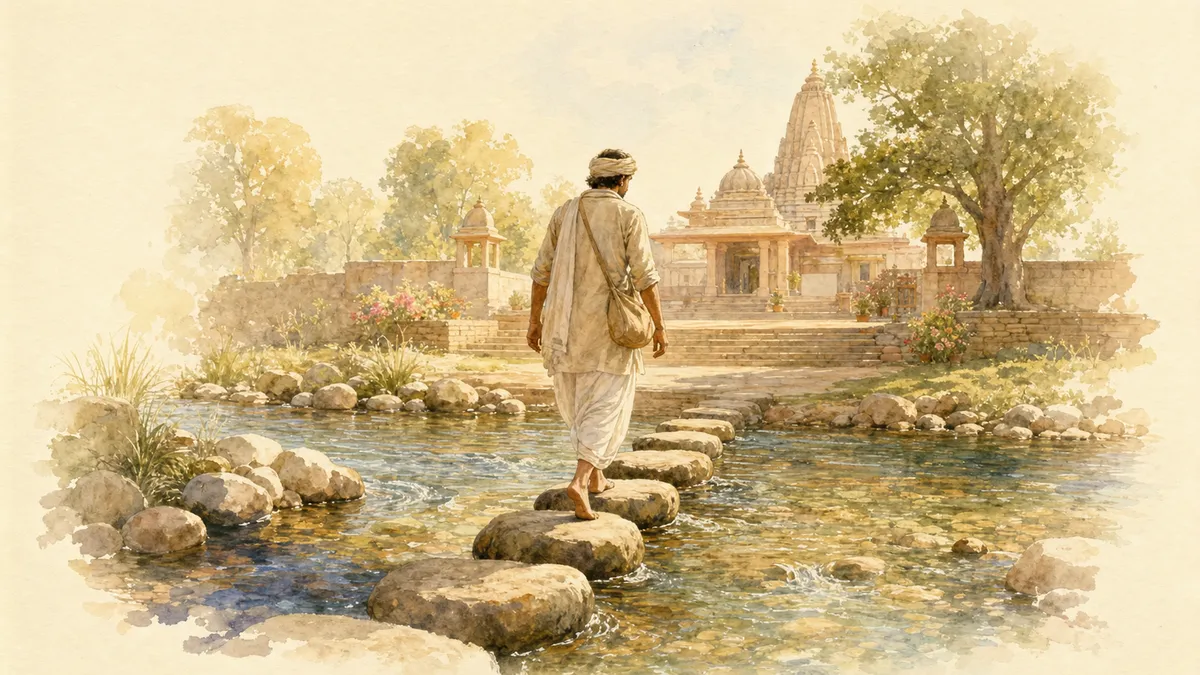
In the Vedic tradition, the principle of view is called Jnana-kanda — that which pertains to wisdom, to the nondual. And the principle of conduct, of ordinary life and interaction, is called Karma-kanda. It describes rituals, ethics, relationships between people, and so on. In Indian culture, the principle of Karma-kanda is preserved to this day. Sometimes it seems that Jnana-kanda is not visible at all — only Karma-kanda. People go to temples, perform worship, and so forth. But only teachers, Masters, and good sadhus know the essence of Advaita. Ordinary people come to the temple simply to perform Karma-kanda. That is enough for them.
For us, our Karma-kanda is our life, vinaya, samaya, our relationships, ethics, and culture. All of this constitutes our section of Karma-kanda. And we unite these two paths: Jnana-kanda and Karma-kanda. Karma-kanda is for living well and harmoniously in this life. Jnana-kanda is for attaining realization, liberation from illusion. One does not contradict the other.
Atma Chaitanyam Satyam: the nature of the witness and the practice of contemplation
Multiplicity is not a property of Paramatattva. This is repeatedly proclaimed by the shruti — the heard sacred scriptures, including the Vedas. Moreover, the scriptures condemn those who attribute diversity to Paramatma-tattva. The mind can never know that which is the witness of all changes of the mind and, ultimately, of its disappearance. Only this witness is eternal, unchanging, subject neither to time nor to space. This witness is Atma Chaitanyam Satyam: the consciousness of the Higher Self, the truth. Everything else is unreal.
Atma Chaitanyam Satyam — in these words lies the entire essence of our practice of contemplation. Through vichara we must discover this consciousness. And through contemplation — sustain it, expand it, and deepen it. Our dualistic thoughts, obscured parts, various inner projections, and subpersonalities will resist for a long time. But one should not despair. Sooner or later they will exhaust their power and weaken. And our inner purity, our pure vision, will begin to become stronger and stronger, will begin to penetrate into prana, into energy.
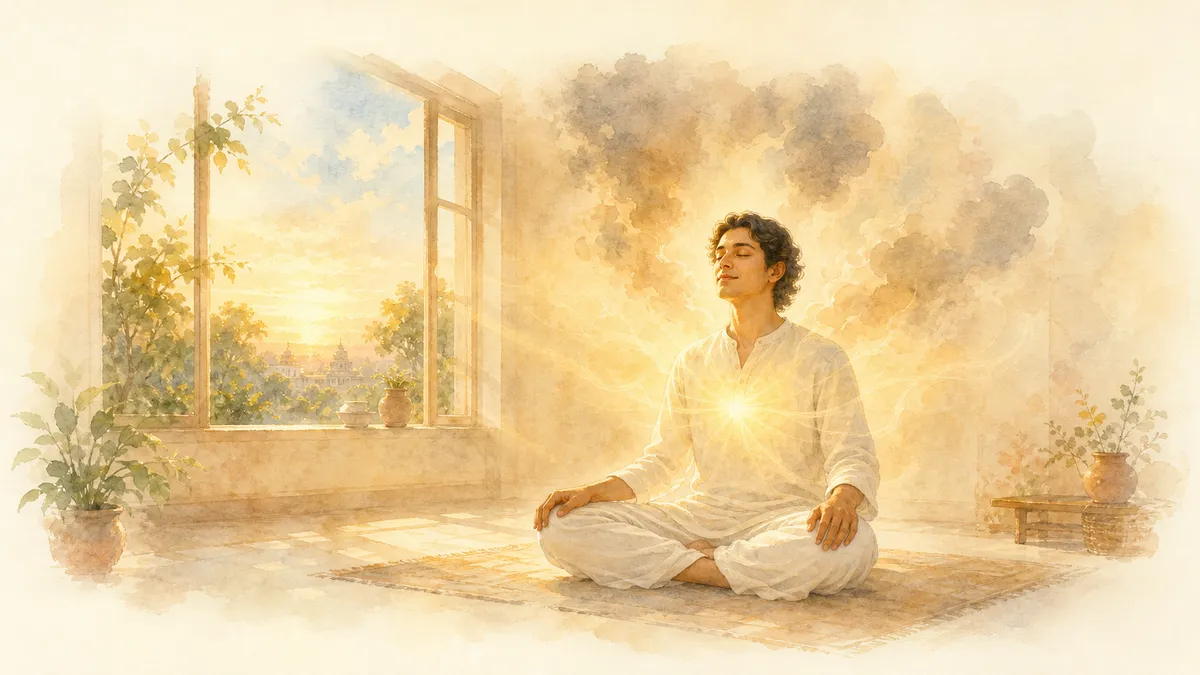
Renounce attachment and, using the power of discrimination, turn your mind away from the world of sensations. Then you will attain the stage of Amana-bhava — an experience beyond the mind. In doing so, you must remember one more thing. All your attempts to restrain the mind will prove to be a vain and useless waste of time if you do not clearly understand the nature of the sensory world. Otherwise, it will be very difficult for you to free yourself from restlessness, and attachment will not disappear — at the first opportunity it will increase with renewed force. It is necessary to ensure that the state of temporary inertia in which the mind abides during deep sleep passes into the stage of permanent passivity. When your conviction that all sensory experiences are unreal becomes final and complete, the mind will cease to act as a distracting factor. The mind will become helpless, like a paralyzed part of the body. However hungry a person may be, he will never have the desire to taste excrement, will he? In order to realize that the Atman, which is the goal of realization, is characterized neither by sleep, nor birth, nor name, nor form, that it is eternal self-radiance — Nitya Svayam Prakasha — it is necessary to overcome all the wanderings of the mind.
If the power of discrimination is not developed, any attempt to restrain the mind and comprehend the truth about the unreality of the objective sensory world will prove fruitless and just as unreasonable as trying to drain the ocean with a bundle of grass. Establish yourself firmly in the faith that the world is a myth. Then you will be able to attain supreme peace and fearlessness.
The World as the Materialization of the Mind
There is a saying: people of a lower order discuss other people, average people discuss events, and higher people discuss ideas. The higher your spiritual level, the more you become convinced that the world has an informational, ideational nature, that everything gross and material, all events, are materialized myths, ideas, ideologies. That the world itself is the creation of many minds, many intellects, materializing thoughts.
Gradually, you will begin to become more and more established at the level of ideas, at the level of understanding that the world is the materialization of the mind, that the world is mythology. The history we were taught at school is a manifestation of the mind. It can have many variants. The past can change, and scenarios of the future are born from consciousness. Even what is experienced in the present can have different variants.
The course of time is, in fact, a creation of the intellect. It does not necessarily have a linear nature. Distances, intervals in space and time — all this is not an immutable law of physics. It is a manifestation of consciousness. Now our consciousness establishes such physical laws, but they can change.
One man appeared on the American stock exchange who, in 6 months, turned $800 into $300 million. Even with insider information from internal sources within corporations, it is impossible to achieve such success. The services that monitor people who make deals investigated and said that this is impossible even with secret data. This man was arrested — he had not suffered a single losing trade. He said about himself: “It’s very simple. I arrived from some year in the 2020s.” He had information about stock prices and successful companies. He simply used this information. He arrived in a time machine to make money. FBI specialists spoke with him. After some time he was released, and he disappeared — he was not found in any records anywhere.

There have repeatedly been cases in history when people traveled through time. In 1896, in Saint Petersburg, a man was caught who identified himself by a Russian surname. He said that he had arrived from the 21st century and worked as a programmer in the city of Angarsk on an electronic computer. He was interrogated by the tsarist security service — there are records of this in books. During the reign of one of the Russian tsars, a man appeared in strange clothing who also said that he had come from the future. He was executed just in case — such were the times.
This means that there are certain glitches and holes in time, when consciousness can pass from one world to another. Because time is the materialization of consciousness — it does not have an absolute character. The same is true of space.
Once, in Mexico, a man with a rifle appeared, looking around in fright — right in the officials’ chambers. He was immediately seized by the royal guard. It turned out that he was from the Philippines: he had just been standing guard with a rifle, something happened, and he flew across the ocean, finding himself in another place. Teleportation.
The laws of physics are a consequence of the processes of our consciousness. If the processes of our consciousness change, the laws of physics change as well — they are not obligatory. All of physics is the so-called samsaric law of karmic vision. Gradually, we must overcome the laws of physics, the course of history, enter the alternativity of history, and then psychohistory — the ability to choose different historical branches by the power of our consciousness and glide along them as we wish.
Karana, Karya, and Vikara: Cause, Effect, and Liberation from Kala-shakti
Prashanti and Abhaya. At the basis of any phenomenon, birth, or creation there must be an impelling force, whether Sat, Asat, or Sat-Asat (truth, non-truth, truth-non-truth), must there not? What transformation actually takes place?
Karma unfolds in such a way that the cause undergoes changes and the effect unfolds. The cause is Karana. The effect is Karya. The process of change is Vikara. In time there is a certain vector of direction from the past into the future, when the cause necessarily undergoes change and becomes the effect. For example:
- a seed was planted — this is the cause, Karana;
- the seed sprouts — this is transformation, Vikara;
- a flower appears — this is the effect, Karya.
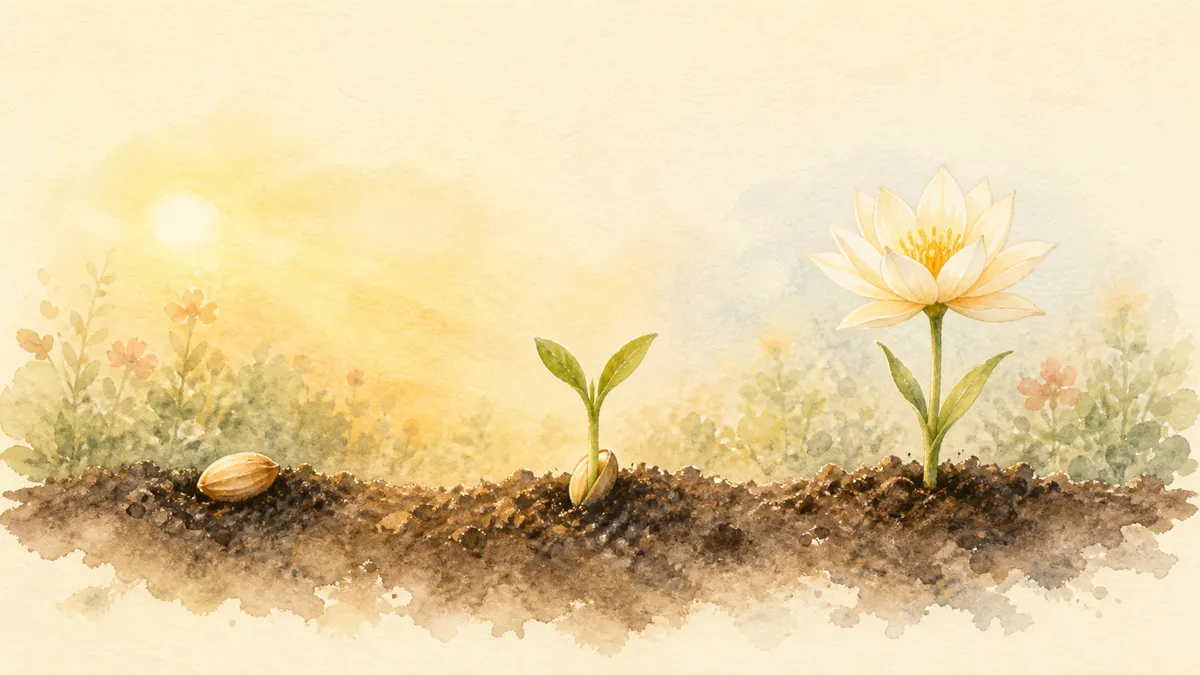
Karana, through Vikara, turned into Karya. We all live between causes and effects, moving from causes to effects. This happens because there is Kala-shakti — the pressure of time, the vector of time. For us, this manifests as karma.
But divine beings, siddhas, and rishis are not subject to Kala-shakti to the same extent. The pressure of time, Maha-kala, is not so powerful over them. Therefore, for them, a cause does not always become an effect — they do not accumulate karma. A cause may remain only a cause. Or a cause may produce an effect that is not the generally accepted one. There is a multiplicity of possible effects; one can choose: whatever you have done, you can choose the effect — bad, good, or neutral.
There was once a rishi who saw that his son had meditated for a long time and had left the body. He became angry and wanted to curse the god of time — Rishi Bhrigu. And when the god of time came, he said: “Why, sage, like a child, do you want to curse me? Your curses are nothing to me. This is simply the course of time. I am not to blame here — the law is simply operating.” The rishi understood and apologized: “My mind fell into identification because of attachment to my son. But I can change everything.” He sprinkled water on his son’s body, and with divine vision found his son’s soul — by that time it was meditating in another body. He was already a brahmin ascetic in another body, and he told him that in his previous life he had been his son. They went to that body — by that time it had decayed. The sage sprinkled water from his pitcher onto that body and recited a mantra. The bones became covered with flesh, and the son’s soul returned to that body.
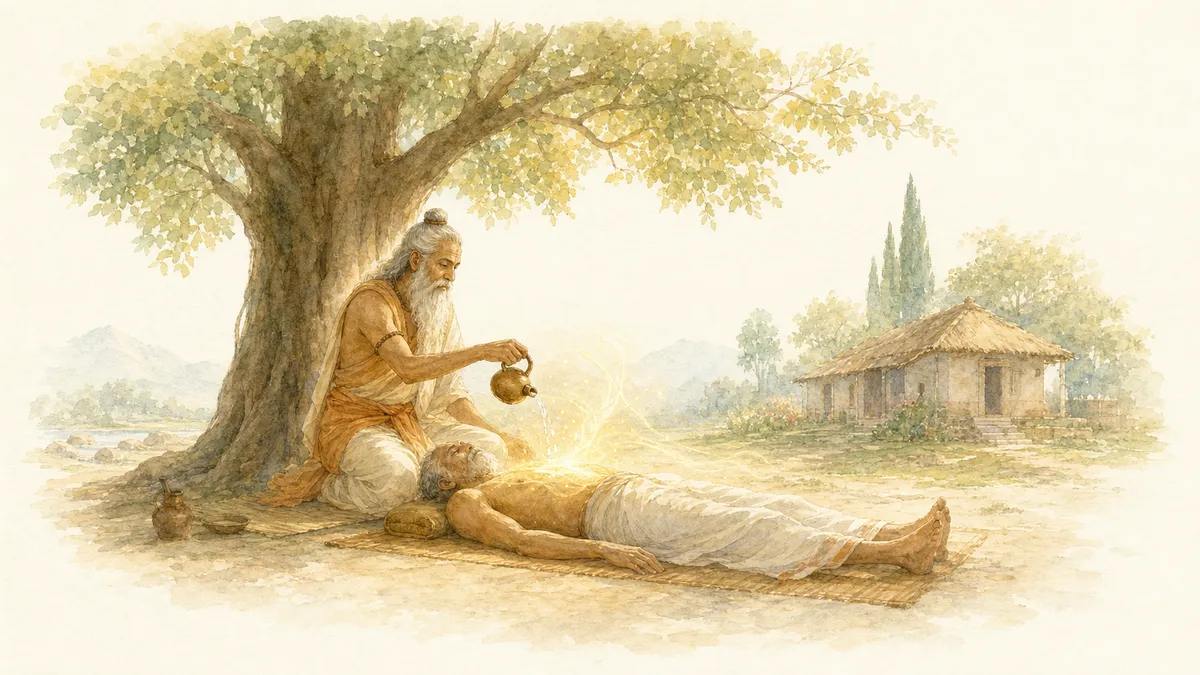
Kala-shakti acts differently upon sadhus — there is multiplicity of possibilities, because their Jnana-shakti and Ichchha-shakti are very strong. They can intervene in the process of Vikara, changing cause and effect. This story is described in the Yoga Vasistha.
Gradually, by discovering the divine within ourselves and the principle of view, we free ourselves from the law of causes and effects, from the law of time, from the pressure of Kala-shakti. The most important factors of this world are the pressure of time and karma. And in order to defeat these opponents, we need pure vision and view.
