

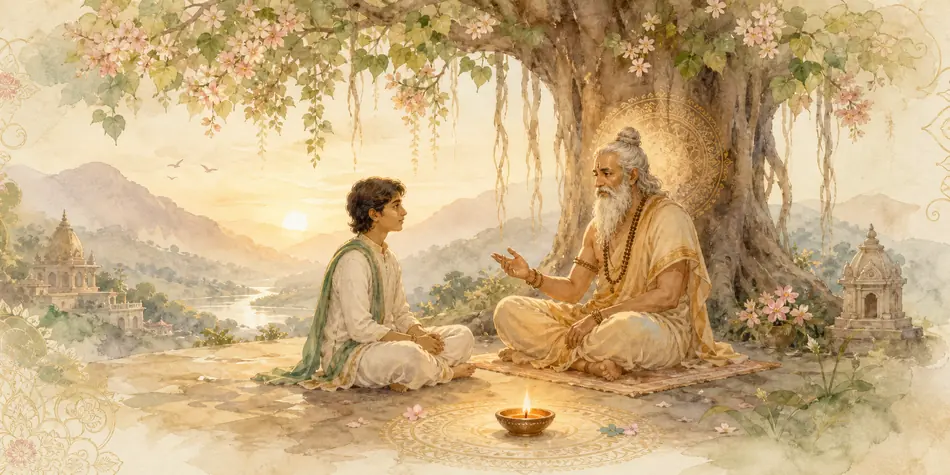
We will discuss the principles and ideals of spiritual discipleship, since these principles are of great importance to us and are, in fact, the cornerstone. As you know, from the moment the words of Refuge and commitment are spoken, the disciple trains in upholding and following the yogic principles and instructions until enlightenment is attained.
What distinguishes discipleship from non-discipleship?
If you are not a disciple of any master and do not belong to any school or spiritual system, you practice according to your own ideas. But when you decide to enter a spiritual school and establish a connection with a teacher or master, you enter a powerful system of training that has certain principles. Your spiritual growth depends precisely on how well you adapt them to yourself and assimilate them.
What is the advantage of practicing in a spiritual school or under a master compared with personal, spontaneous, free, and undefined practice? The difference is the same as between teaching yourself to play the piano and studying under an acclaimed maestro. Or as if you decided to study martial arts on your own using books and videotapes, or instead found a coach and the renowned school of a world champion who holds a fifth-degree black belt.
It is difficult to become a champion by training on your own. But if you train in a spiritual school or under a master, there is a strong possibility that you too can become a master. This is precisely the value of establishing a connection with a spiritual teacher—as all saints and mahasiddhas emphasize. Therefore, it is very important to establish such a spiritual connection at the outset. Once we establish such a connection, we are considered to have become disciples.
But becoming a disciple does not mean merely proclaiming, “I am a disciple of such-and-such a school, a disciple of such-and-such a master,” so that you can show off to your acquaintances somewhere. To truly become a disciple means to undertake spiritual training exactly in the manner prescribed by the school. Of course, whether or not to become someone’s disciple and whether or not to follow the instructions is your own decision. But if you decide to benefit from progressing within a particular spiritual school or studying under a particular spiritual master, this is extremely important for your own benefit.

When we embark on the path of yoga, identify ourselves as yogis, and declare ourselves disciples of Laya Yoga, certain principles immediately come into effect: yama, niyama, and others. Our task is to learn to embody these principles in our lives.
The Main Yogic Principles of the “Yama” Group
Nonviolence, causing no harm (ahimsa). This principle also includes refraining from even the slightest violence, including killing small insects. It also applies to refraining from psychological violence. When you believe that you can benefit another person because you think you know what is best for them, you may exert some kind of psychological influence on them—this is a form of subtle violence. A yogi strives to avoid both gross and subtle violence.
Vegetarianism. Once you have embarked on the path of yoga, you should forget about meat products if you wish to succeed. Why is this so? If you are a vegetarian for six years and then try eating meat, you will feel a foreign vibration entering your body, the muladhara chakra opening and anger (the energy of rajas) arising, and gross material substances beginning to dominate the body. And if you eat meat regularly, gross material substances will also dominate your body.
Some teachers say that all the animals whose meat you have consumed have the right, under the law of karma, to consume you in future lives, so it is better not to give them that right. This is logical. Why should they not have such a right if you consume them as food? Has that never occurred to you?
Abstaining from alcohol, drugs, cigarettes, and all intoxicating substances. There are some people who call themselves Tantrics, although in reality they are pseudo-Tantrics, who like to experiment with drugs, mushrooms, hallucinogens, and other substances, justifying this by claiming that some Tantrics in India supposedly use them and that they quickly induce mystical experiences. They may indeed induce mystical experiences rather quickly, but they will also cause you problems for the next twenty years. Mystical experiences that have not been earned generally do not lead to genuine spiritual growth.
Indeed, some Siddha yogis used opium-based substances for spiritual growth. However, such substances can be helpful only if the yogi has already attained a high level of mastery and can control their energy. If the energy is not controlled, the body simply deteriorates, which is why a yogi categorically rejects all stimulants.
Control and conservation of sexual energy. For many people, this is a difficult issue, but it must be clearly understood that either you expend sexual energy or you follow the path of enlightenment. There is no alternative. If your sexual energy is leaking, if you engage in sexual activity with orgasm, then all the vital force you have accumulated is wasted; a vortex-like funnel, a kind of trail, opens in the area of the Svadhisthana chakra, through which your vital force escapes. And the first thing a yogi must do is seal this funnel by not wasting their vital force.

As for monks, they simply follow the principle of brahmacharya. The term “brahmacharya” consists of two words—“Brahman” and “charya.” That is, it is conduct carried out in Brahman—abstaining from sexual activity. Laypeople are not subject to such a strict prohibition. If a person has a family, they may continue their sex life so as not to create problems; however, they must refrain from losing energy during orgasm and must regulate their sex life so that it does not adversely affect their energy system, so that the channels in the lower part of the body do not become blocked and the energy does not descend.
They must master the art of sublimating sexual energy so that during sexual intercourse the energy does not flow outward but is conserved, enters the central channel, rises through the central channel to the brain, and then circulates throughout the body. They must take care to maintain the purity of their energy channels. This is a solution if it is not possible to observe the principle of brahmacharya. But if it is possible to observe brahmacharya, then, of course, it is better to do so. The rishis and ancient yogis who had families lived in precisely this way.
Regardless of whether you are a layperson or a monk, it is important that sexual energy remain in the body; it must not be dissipated outward, and the energy channels must be purified.
A self-respecting yogi is always aware of the condition of their channels and pranas and ensures that they remain pure at all times. For example, if you can sit easily in the lotus posture, sukhasana, or siddhasana, this means that your apana vayu and the channels in this part of the body are clear. If you feel lightness in the body and knees, and no heaviness after walking for a long time, this means that your channels are clear.
After engaging in sexual relations, especially when energy is lost through orgasm, apana vayu (the descending energy) moves downward and clogs these channels. You feel as though raw rubber has been injected into your knees: heaviness arises, your level of awareness decreases, external events begin to slip out of control, your willpower diminishes, and your spiritual strength and inclination toward yogic practice decline; mystical experiences also become weaker. This is an ironclad law. Any experienced yogi will explain this to you.
Sincerity and truthfulness (satya)
Freedom from material attachment to possessions (asteya, aparigraha). When we embark on the path of yoga, it means that we choose the path of enlightenment, and compared with this path of enlightenment, all worldly or material pursuits cease to be important. Our path of enlightenment is the most precious thing we have, and the genuine path to enlightenment is incompatible with seeking meaning in anything else. This is expressed in the words: “You cannot serve two gods: God and Mammon.”
This does not mean that you need to meditate on poverty. As laypeople, you may possess material means; this is not forbidden. However, your heart must be devoted to the path of enlightenment. If you artificially try to meditate on poverty, it will be difficult for you to practice yoga as well.
The Yogic Qualities of a Disciple
Trust and Openness
Having embarked on the spiritual path, a disciple should cultivate the qualities of trust and openness. When you come into contact with a spiritual teacher and the teaching, you must develop openness and trust, because without them the process of spiritual transmission is impossible. Sometimes the teachers of old tested their disciples for a long time before admitting them to the teaching or, indeed, even allowing them to communicate with them. What they tested was precisely their ability to be open and trusting.
In our rationalistic age, this is a very rare quality. People’s minds today are very sharp and sophisticated, but they are also very selfish and have little trust. In ancient times, people’s minds were simpler and they had more trust. But there is no other way to practice Guru Yoga than to learn to cultivate such trust.
It is said that there are disciples who resemble several types of vessels: full vessels, leaky vessels, and contaminated vessels—all of these are types of unsuitable vessels.
What is a full vessel? It is a vessel overflowing with its own contents. It is difficult to explain anything to such a disciple because they are already overflowing with their own knowledge and are unable to accommodate anything else.
What is a leaky vessel? Such a vessel has leaks. When it receives the teaching, everything flows out, so the teaching is of no benefit.
What is a contaminated vessel? A contaminated vessel means that there are obscurations or attachments. Even if it receives the teaching, these obscurations prevent it from engaging in spiritual practice.
A vessel free of these three flaws is a clean and empty vessel, which represents the ideal disciple. Of course, we are all far from perfect. There are no ideal disciples, just as there may be no ideal teachers.

There is a story about a disciple who was searching for the ideal teacher. He traveled for a very long time and made his choice very carefully, believing that a teacher had to be perfect. He traveled for twenty years. Finally, someone told him, “Over there is an ideal teacher who meets all your expectations.” With great delight, he approached this teacher and said:
“At last I have found you. Now I want to be your disciple. You are the ideal teacher.”
The teacher said to him:
“I am sorry, but I accept only ideal disciples.”
In the same way, we too may chase after certain imagined ideals, only to discover later that we have wasted a great deal of time.
The process of becoming ideal is not actually something static, but rather a dynamic concept that points to pure vision. The process of becoming ideal unfolds within us over the years as we develop profound contemplation and pure vision. To begin with, one should simply learn to perceive the teacher, as well as one’s Dharma brothers and sisters, with pure vision.
Understanding
Understanding means that when you hear something, you reflect on it and try to apply it to yourself.
Diligence
Diligence means that every day you genuinely try to train in what you have been instructed. If you lack willpower, determination, the desire to move toward your goal, and the mindset of a victor, a vira yogi, it is impossible to achieve anything in yoga, because spiritual practice is like a struggle for your highest qualities, a struggle for self-transformation. When engaging in spiritual practice, you should be prepared to fight for your own freedom. It is like sports—if you do not fight for your own freedom, you will not achieve results.

Attentiveness
Mindfulness means that from the very beginning, we strive to cultivate awareness in all our actions. If we are mindful, we cannot have disharmonious relationships, we do not make mistakes, we understand the learning process, and everything works out favorably for us. But as soon as we lose mindfulness and our consciousness slips into lower programs, to the level of emotions or conceptual thinking, the entire situation gets out of control.

Disciples often encounter various problems or difficulties. But these problems do not arise on their own; they are simply a consequence of inattentiveness. Various difficulties arise especially often in interpersonal communication. But this happens simply because we are not aware when communicating. If we are mindful, however, all problems begin to dissipate, because mindfulness gives rise to clarity within us—a special type of consciousness that automatically harmonizes the space both within and without.
Willingness to Cooperate with the Teacher
This is also called the principle of self-surrender or service.
To call oneself a fully-fledged disciple, there must be interaction and contact between teacher and disciple. The disciple must be personally interested in maintaining this contact. This is logical, since it is not the teacher who must be transformed through this contact, but the disciple, because it is the disciple who is learning. The disciple must be the one primarily interested in transformation, and such transformation is achieved very easily through cooperation with the teacher.

If there are only a few disciples, personal communication ensures such interaction. But when there are many disciples, they must find certain ways to maintain such cooperation. The teacher should not be merely an icon that the disciple hangs on the wall, looks at, and thinks, “Yes, this is my Teacher!” That is not enough. To be a disciple, you must cooperate more closely in some way with the Teacher, with his energies, and with other disciples. You must come into closer contact in some way and not be afraid of such contact.
If you have any selfish problems or attachments, then, of course, this may be a challenge for you. It is not easy. Nevertheless, it is precisely through such cooperation that you resolve the problems of your own ego and your own “self.” Until these problems are resolved, they will remain, and sooner or later they will still have to be addressed. The yogi’s greatest enemy on the path to enlightenment is the ego, and through such cooperation the ego self-liberates. Some saints say that the ego is the greatest evil spirit hindering the yogi.
The Qualities of a Yogi According to Shankara
Viveka—the Ability to Discern
The ability to distinguish lofty goals and actions that promote evolution from those that are mundane and obscuring.
When you practice, you must clearly understand what leads to spiritual growth and what impedes it. Accordingly, what impedes spiritual growth should be reduced, while what promotes it should be increased. If you lack such discernment (viveka), your spiritual path is very unclear.
For example, if you engage in distracting activities and absorb a great deal of unhelpful information, this impedes spiritual growth. A yogi must be clearly focused on increasing everything that promotes spiritual growth, so that his way of life gradually flows in that direction. For example, practicing in classes is beneficial for spiritual growth, while visiting entertainment venues is not; undertaking retreats is beneficial for spiritual growth, while taking part in secular rock parties is not.

You evaluate every action precisely from this perspective. This is especially relevant for laypeople. If a person becomes a monk and enters a monastery, they simply follow the established routine. The routine in a monastery is such that there is nothing there that is unhelpful for spiritual growth. But in the world, you choose your own course of conduct. This is viveka.
Vairagya – Dispassion, Detachment, and Equanimity
Vairagya is a quality that does not come immediately. Detachment and equanimity mean that you stop attaching importance to what you considered important before. For example, if you are a yogi, it makes no difference to you whether you stay in a super-luxury hotel or in a hotel with cockroaches, whether you have luxurious amenities or not. Whether you are served exquisite dishes as prasad or a plate of congealed porridge, you learn to accept both with gratitude and do not complain, because the yogi's principle is detachment, dispassion, and equanimity.

Whether others insult you or, on the contrary, praise you to the skies, you regard it calmly. How many of you are capable of remaining dispassionate when, for example, someone treats you in a way you do not like, or praises you? But a yogi regards all of this with equanimity.
Mumuksha – an Ardent Aspiration for Liberation
Mumuksha, or mumukshutva, is an ardent aspiration for spiritual transformation, personal growth, liberation, and enlightenment.
As long as there is no such ardent aspiration, we are still in a transitional stage, but a true yogi possesses mumuksha. In other words, mumuksha is precisely the aspiration for liberation, when you resolve: “I will attain liberation in this lifetime. Without a doubt, I will practice as the ancient saints did.”

This does not mean that everyone must necessarily become a monk or a hermit. Even if you live in the world, if you aspire to liberation and practice contemplation, you can significantly develop your practice, and we will discuss this in greater detail later. It is important that you perceive every moment as a path to Enlightenment. If you do not have such an aspiration, you will not attain the goal.
The Principle of Ardent Aspiration for Liberation
The aspiration for spiritual transformation and personal growth means that you have done a great deal of work and changed your own values, and now God-realization has become the most important thing for you. Moreover, it is not merely declared to be the most important thing; you do everything to attain it.
For example, if you look at a scientist devoted to their goal, they constantly meditate on it. They are so absorbed in their goal that all other goals are not as important to them. Or a martial arts master absorbed in training devotes themselves entirely to it for many hours every day. In the same way, you should learn to devote yourself entirely to spiritual practice.

Shat-sampat – Six Special Qualities
Shankara lists six special qualities known as shat-sampat:
Dama – self-mastery, control over the senses and emotions.
This is the quality we lack. Why do we not have the same self-control as the saints? Because we lack awareness. Even if we try to be mindful but then lose ourselves for a while, our mindfulness deteriorates and our emotions come to the fore. But a true yogi has astonishing control over the senses, astonishing self-control. For example, I sometimes say in lectures, “Even if you slap me, I will not get angry with you.” I may stop communicating with you, but I will feel no anger; I will think, “Poor fellow, he is suffering. Apparently, he has some serious problems. But those are not my problems.”

When I was conducting a retreat or seminar in Simferopol, there were many people there who found the practice quite difficult. I felt rather intense pressure—this is also called “karmic discharge.” That is, when a person practices, their stress and impurities emerge through the subtle body and are directed toward the teacher. I understand what karmic discharge is because I have been transmitting the teaching for ten years. A teacher can often act like a vacuum cleaner. This is especially so if he gives many transmissions to disciples, if they practice intensively but are not yet firmly established in samaya. Such karmic discharge used to be quite intense. It is less intense now because the disciples have become established in their samayas.
I was conducting a retreat for laypeople, and the karmic discharge was quite intense. When karmic discharge occurs, external reality responds as well. When I went out to the bus stop, I felt a certain agitation in my subtle body—an angry energy that had passed to me through the subtle body. This agitation was even projected outward: an intoxicated man came up to me and began showering me with abuse. But because I did not react to him and instead thanked him for his priceless blessings, he became even more enraged and decided to start sparring with me. Since I had practiced martial arts, it would not have been difficult for me to neutralize him, especially as he was unsteady on his feet, but I deliberately chose not to do so. He swung and struck me in the face. Smiling, I continued talking to him and tried to raise his consciousness a little. The fact that I did not react shocked him so deeply that he simply turned around and ran away. Observing my own consciousness, I found no judgments in it—thanks to mindfulness, it was simply a practice of play and compassion.
Uparati is the reduction or abandonment of meaningless activity.
More specifically, it is the renunciation of all worldly actions. When you live in the world, there is no need to renounce action. Moreover, you can never completely renounce all actions, even if you live in a monastery; at the very least, you need to prepare food and earn a living. Rather, it is the abandonment of meaningless actions unrelated to the teaching and practice of Dharma, as well as the abandonment of unmindful, unconscious actions.

Shraddha is faith in the master’s instructions and trust in the teaching and training methods.
If you meet a spiritual teacher and develop faith and trust, it is quite enough for you to begin practicing in his school according to his system and method. If you do this correctly, you will certainly obtain results and experience spiritual growth. In general, the principle of faith is also connected with samaya. It is believed that when you have met a spiritual teacher and decide to become his disciple, you should regard him as a fully enlightened being.
Milarepa once said to his disciples, “Whether I am a Buddha or perhaps even a hungry ghost, if you see me as a Buddha, you receive blessings as if from a genuine Buddha.”

This is the principle of pure vision and the principle of samaya. In other words, before we become disciples, we must critically analyze the teacher's personality and the teaching in order to make a choice. But once we have made our decision and declared ourselves disciples, we shift our perception toward pure vision; that is, we view the teacher's personality specifically through pure vision. This is necessary for the disciple to receive blessings, because whether we see something as holy, pure, or wrong depends on our own vision.
There are no things in the world that are unequivocally one way or another—unequivocally bad or unequivocally good. Depending on your vision, a thing will be one way or another, because there are no objects separate from subjective perception. For example, if you regard a clock as Brahman, as the Absolute, prostrate before it, see it through pure vision, and respect it, then over time this clock will begin to bestow blessings upon you and appear in your dreams, and you will have very profound experiences from it. If you view the clock simply as a household object, it will be a household object for you. If you view the clock as a weapon or as something diabolical, you will begin to feel that it exerts a corresponding influence on you. This is the principle of karmic vision.
There is a saying: “The gods see a river as nectar, the asuras as a weapon, hungry ghosts as pus and excrement, beings in hell as molten lava, animals as a habitat, and humans as ordinary water.”
The world depends on our consciousness; the world is as we perceive it. Therefore, it is better to look upon the world with a sacred gaze, through the eyes of pure vision.
This is also how we should perceive our Dharma brothers and sisters. For example, if you consider a person limited, you will most likely encounter situations in which that person interacts with you as a limited personality. But if you consider a person a manifestation of some deity, then your relationship with them will be divine, and they will manifest and reveal some divine aspect of themselves to you. This depends precisely on your own attitude. Your consciousness determines everything, because in reality there is no reality separate from our consciousness. We ourselves create reality through the power of our consciousness.
Titiksha—fortitude, perseverance, and determination.
One could say that titiksha is the will to win, to achieve a goal, and determination. To be a yogi means to possess tremendous determination. You must be prepared to practice a great deal and work for your spiritual growth, so determination must be cultivated if you lack this quality. Determination can manifest itself in anything. It can be described as the focus of consciousness on something and the ability to give up a great deal for the sake of that focus.
The ancient saints demonstrated tremendous fortitude in their spiritual practice. When we set goals for our spiritual growth, we should take such ancient saints as our ideal and follow their example. Milarepa, for instance, spent his entire life in a cave, while Naropa underwent a tremendous practice of self-surrender as he studied under Tilopa. The ancient siddhas performed mind-boggling tapas, subjecting their bodies to ordeals for the sake of liberation.

From the perspective of Tantrism, we should not torment our bodies, but the principle of determination remains; fortitude and perseverance are very important to us. It should not be the case that as soon as our mood drops slightly, we think, “That's it! I'm incapable of anything.” Regardless of the state we are in, or how events or relationships unfold, we must move toward our goal, believing that it is very great and worthy of being pursued. This is titiksha.
If you have the mentality of a failure, the mentality of a “poor little thing,” the mentality of a weak and limited person, you are unlikely to succeed in spiritual practice. You should cultivate the mentality of a winner, the mentality of a god, a deity—one who succeeds in everything. It is similar to what is taught in “How to Get Rich” courses and personal growth training programs: “You must change the way you think.” They say: “You are poor not because you are underpaid, but because you have the mentality of a poor person. How can you become a billionaire with such a mentality? You are simply setting these limits for yourself. You need to change your consciousness in order to become rich.” Such courses teach people to change their consciousness. They teach them how to think in order to become a billionaire, how to allow themselves to be rich, to live in luxury, and to possess the commanding demeanor and manners of a billionaire. One could say that this is the same yogic practice, only skillfully adapted to material life.
In the same way, in the spiritual sense, you need to learn to acquire the mentality of a spiritually wealthy person. If you have the mentality of a spiritual pauper, then naturally neither spiritual practice nor service will work out for you.
Often, when doing something, we act from our limitations. For example, we say, “I can’t do this,” or “It can’t be like that,” or “It must be this way,” but that is merely how it appears from the standpoint of our mentality. If we change our mentality a little, everything may be different, and everything may work out. Such situations often arise during service, when organizing seminars—when doing anything at all. If you have the appropriate mentality, you can rent a hall for classes even in the Palace of Congresses. You have no limitations, because this is merely a manifestation of your consciousness; when you change your consciousness, the world responds to it. If you have the appropriate mentality, you can establish a Dharma center in the middle of St. Petersburg, in a huge building. But if your mentality is limited, you cannot turn even a small room into a Dharma center; you encounter difficulties. This is nothing other than a manifestation of consciousness.
Samadhana is the ability to maintain prolonged concentration on something.
To acquire this ability, one should practice concentration. Beginners should do this daily (for a minimum of half an hour and a maximum of one hour). The basic practices include concentration on a point or on a candle flame. At least one year should be devoted to this practice.

Shama is tranquility of mind.
These are the basic qualities that a practicing disciple must cultivate and possess.

Principles of Conduct
There are also other principles called “niyama”—conduct.
A disciple should adhere to the following principles in their conduct:
Shaucha is the maintenance of bodily and spiritual purity.
While bodily purity is self-explanatory, spiritual purity means that one must constantly maintain elevated thoughts, elevated speech, and elevated relationships, and never slip into any impure manifestations. Even if you have to sacrifice something in a material sense, you should still maintain an elevated state. The more often and the longer we remain at an elevated frequency of consciousness, the deeper our contemplation becomes and the faster the purification process takes place.

Spiritual purity means never allowing negativity toward others, negative judgments, anger, envy, malice, or hatred, and never allowing impure thoughts or impure wishes. Sometimes a person engages in spiritual practice, mindfulness, and contemplation, but from time to time it is as if a little devil jumps out from within and, on the subtle plane, shakes its fist or twirls a finger at its temple, and then the person thinks: “That one is really such-and-such!” But you must spot this little devil before it has time to influence you. You must see it and subdue it, put it in its place, and mentally say: “Go ahead, twirl your finger at your temple and shake your fists, but I am not with you; I am separate from you.” In other words, you must learn to self-liberate such thoughts as they arise.
Of course, we are not gods; we have plenty of negative emotions. Nevertheless, if you practice pure vision and self-liberation, you can notice them. The moment you simply observe negative emotions instead of following them—that is, when you remain in awareness, in presence, and do not develop this theme any further—they disappear on their own. Alternatively, you replace them through pratipaksha-bhavana—with the opposite feeling: as soon as a negative emotion arises, you generate within yourself the state of the four immeasurables. For example, if you develop a negative attitude toward someone but mentally attune yourself by saying, “I love this person,” this attitude begins to block the negativity toward that person, and in this way you free yourself from that state. This is spiritual purity.
Shuddha-vidya—Pure Vision
In the absolute sense, spiritual purity means entering the state of shuddha-vidya—pure vision. Pure vision is not something artificially created. Spiritual purity means that we see the entire world as a sacred dimension, as holy; we see all people as deities; we hear all sounds as blessing mantras, as bhajans; we see everything that happens to us as the play, the lila, of the Absolute; and we regard ourselves as a deity. This is precisely how saints and siddhas see the world—as a sacred dimension, as a mandala, as the world of the Absolute.

To abide in pure vision does not mean repeating to yourself, “All of this is pure, all of this is pure.” It is something natural. For example, if you are deeply immersed in contemplation, then when you look at an ordinary person, you see that there is a deity within them. You may not see it with your eyes, but you feel it as a subtle, superconscious, superintelligent, creative energy. And although this deity is unmanifest and not apparent, you see it, and by respecting this deity, you also see that person purely; you understand their boundless potential. But if there is no pure vision, you do not feel this subtlety, this deity, and perceive only the person’s gross coverings; then you develop certain identifications with them and negative judgments.
Pure vision means that you see the deity in everything, even in negative sounds, even in animals, because in the absolute sense everything is holy, everything is sacred. Completely pure vision arises at the stage of ekarasa, the single “taste.”
Once I was talking with a lay disciple in a hotel. As soon as we began our conversation, someone started drilling into a wall. It was a very unpleasant sound that spoiled the enjoyment of our conversation. We continued talking, but the drill kept boring into the wall without stopping. The disciple disliked it, and it greatly distracted him. I tried to explain to him:
“Look at it differently—in pure vision.”
He said:
“But how? It is impossible to regard such a nasty sound with pure vision.”
“You see only the sound, but that is merely its outer aspect. Try to discern its subtler component. Sound is vibration, rigid and coarse. Yet every sound itself, whether coarse or not, comes from something subtler. Try to discern the subtler principle of sound in general, the sound of all sounds. Try to hear it as the primordial principle of all sounds, as the sound from which all the sounds of the world arise, as the king of all sounds, as the deity of all sounds. And if you discern the deity of all sounds, you will see that this sound is a manifestation of some wrathful emanation of that deity, yet it is still a deity. It is superintelligent and creative. In fact, this is not an unpleasant sound, but the darshan of this wrathful deity. It is some unresolved karma of yours, and the wrathful deity, knowing this, sends you its blessing or gives you its lesson. And everything depends on whether you recognize this lesson or not. If you do not recognize it, these sounds will continue to accompany you, but if you do, they will cease.”
For a moment, something seemed to break through to him, and he understood a little. As soon as he understood this, the sound immediately ceased. This happened because the world around us is a manifestation of our consciousness. As soon as we recognize something as pure and divine, the situation becomes pacified and harmonized.
Santosha is contentment, the ability to be content at all times.
The yogic principle of santosha means that we develop within ourselves the ability to accept the world and other people as they are, and learn to be content with what we have. In general, this principle implies abiding in the natural state. If you are in the natural state, you abide in contentment. If you fall out of it, you are dissatisfied; you project yourself into the future or drag the past along with you. You are anywhere but here.
Contentment means that you are, as it were, at the center or at the summit right now. You have nothing to seek and nothing to strive for. You are at the highest point right now—you simply need to remain there.
Contentment does not mean simply lying on the sofa and feeling satisfied, resting on your laurels. You may do many things and perform practices, yet inwardly you abide in a state of complete harmony. Such complete harmony comes only when, through contemplation, you connect with the Supreme Source.

The Supreme Source can be likened to a global field of information. If you connect to it through contemplation, it gives you such contentment. If you are unable to connect to it, you should keep trying.
If you spend time with a yogi who is experienced in practice, you will see that he is always content with everything; he remains content regardless of his circumstances or how events unfold. He is very light, joyful, serene, and calm. There is no conflict within him anywhere; he always abides in harmony. In fact, it seems that he does not live but plays. He simply remains in a continuous flow of play and interaction: when needed, he manifests in one way; when not, in another. When you come into close contact with him, you will find no sharp edges or protruding character traits that could catch on something, such as selfishness and the like. He becomes, as it were, smooth, transparent, invisible, and fluid. This happens through the practice of contemplation, because a true yogi always relies on the Supreme Source within himself, rather than on anything external. But until we have discovered this Supreme Source, it is difficult for us to accept the world and other people as they are. We have not yet recognized the principle of play. To recognize the principle of play and to abide in pure vision are one and the same.
Tapas means the capacity for ascetic practice, the conscious desire to practice intensively in order to burn away all desires and obscurations that hinder Liberation. For example, sitting in the correct lotus posture or sukhasana even when your legs hurt during meditation or a retreat, or getting up early in the morning and training in the practice even when you do not feel like it—this is tapas.
“Tapas” is translated as “ignition,” “kindling.” Without tapas, nothing can be achieved. A yogi constantly strives to maintain his level of practice so that he always remains in a state of concentration and self-discipline.

Svadhyaya means self-education and self-study. It means regularly studying philosophical sacred texts, instructions, traditions, and methods. For example, I recommend that students write scholarly religious and philosophical treatises on the teachings. I recommend that everyone who considers themselves a candidate or student write at least one short treatise and one extensive treatise within twelve years. A short treatise may be five to ten pages long, while an extensive one may be thirty pages or more. When you work on a treatise on a particular topic, you concentrate deeply on it. This opens up an entire dimension of the Dharma that you had not previously known existed. For example, it is very useful to write treatises on the lives of saintly siddhas or on those aspects of the teachings that you do not understand very well. If you concentrate and devote a certain amount of time to it, that aspect of the teachings will reveal itself to you, because writing a treatise means practicing dharana and dhyana, that is, concentrating and meditating. In addition, it brings you merit for elucidating the teachings.

Ishvara-pranidhana means trust in the higher intelligence of the Creator. For us, such trust is always associated with immersion in the Source, the practice of contemplation, and Guru Yoga.
Students are also advised to limit their consumption of distracting secular information and their participation in gambling.

The Principle of Samaya
In addition, upon entering the teachings, a student makes various commitments: to practice in accordance with the teacher’s instructions, observe the principles of samaya, respect the Three Jewels (the teachings, the masters and the spiritual school, and the community of students), and uphold the honor of the masters, that is, to conduct oneself with dignity so as not to tarnish the honor of the school and spiritual lineage. The principle of samaya is especially important to us. It is said that on the path of Anuttara Tantra, samaya is the root principle through which realization comes.
There are fourteen root vows that a yogi strives to observe on the tantric path. We have already mentioned some of them.
In brief, samaya means maintaining a respectful attitude toward the teachings and everything associated with them, and maintaining sacred relationships with the teachings, with the teacher, with one another, and with all living beings. If samaya is inadvertently breached to a minor degree, it must be purified immediately rather than dismissed as something insignificant. One should perform acts of repentance, make offerings before the altar, or internally reassess one’s position—this always helps. But if samaya is breached and no such purification is performed, spiritual practice goes off the rails. To break samaya means to sever the energetic and informational connection.

The principle of samaya means the purity of the energetic and informational connection. By interacting with the teacher, the teachings, the saints, and one another, you inevitably establish energetic and informational connections. Whether you know it or not, such connections are established at the level of consciousness. And if you lack sensitivity, you may wonder, “What are these energetic and informational connections?” They are like a subtle astral wind flowing from one consciousness to another: from teacher to student, from student to teacher, from one practitioner to another. One could say that it resembles wireless radio communication. Samaya is the ecology of thought; it is the principle of a pure energetic and informational connection.
The Fourteen Root Vows
Of the fourteen root vows, the first four are the most important.
The first vow concerns one’s relationship with the teacher. It means respecting the master and treating his methods with respect, that is, never acting contrary to the instructions.

The second vow concerns the teaching. One must persistently improve oneself in the teachings received, regarding them as a valuable means of realization. That is, if you practice Laya Yoga, receive transmission, and then think, “What kind of teaching is this...,” this cannot be called a samaya-based attitude. In that case, it would have been better not to practice at all. In other words, when we receive transmission into any teaching, we must regard it as a precious treasure, as something to be cherished always.

The third vow concerns our relationships with our Dharma brothers and sisters. When you receive transmission into the same mandala and study under the same teacher, you become samaya brothers and sisters, that is, those who share the path of spiritual practice. Relationships among samaya brothers and sisters should be based on love, trust, and harmony. Confrontations, quarrels, criticism, and ill will are unacceptable—all of this contradicts the commitment of samaya. If this occurs, the yogin must recognize it, perform purification, and transform their consciousness.

The fourth vow is associated with compassion for all living beings. Developing an unjust attitude toward others or harming living beings also constitutes a violation of the samaya vow.

The fifth vow is associated with preserving sexual energy. If sexual energy is expended and orgasm is permitted, this constitutes a violation of the principle of samaya, and you then come into conflict with your spiritual practice: your spiritual experiences deteriorate, siddhis disappear, and signs of realization vanish.

The sixth vow concerns a respectful attitude toward other religions, teachings, and spiritual systems. Even if you do not particularly like a certain spiritual school, you should not develop negative or critical views about it. Perhaps you simply do not know its true depth. By developing such critical views, you may come into conflict with the deities or siddhas of that school, which will create obstacles for you. In fact, there are no contradictions whatsoever among the saints of different traditions. Contradictions arise only among neophytes, among unenlightened followers of different traditions, because these contradictions concern not the very heart of religious teachings, but some peripheral aspects of them.

The seventh vow is associated with preserving the purity of the transmission of the teaching. This means that we must accept the teaching exactly as it is, without changing it until we ourselves have become masters. In other words, we cannot reinterpret the teaching in our own way, because this will distort it. The essence of the principle of the purity of the lineage lies precisely in preserving without distortion the teaching transmitted through the lineage, because our realization depends on it. One might say that it is like a trade secret that is carefully guarded and passed on. If we violate the purity of the transmission of the teaching, it will most likely not lead to liberation.

This vow is also connected with not revealing profound secret practices to people who are not ready for them. For example, if you have received the transmission of the Brahma mantra, you should not explain this transmission to other people, because your practice would then lose its spiritual power. The same applies to other techniques. All transmissions are intended specifically for you, because another person's subconscious mind may interfere with them. Anyone familiar with magic and shamanism understands what this means. When a person practices magic and shamanism, there are many things they must keep secret. Keeping something secret does not mean developing some kind of egocentric views. The reason for such concealment is that by revealing your goals, you may hinder their attainment, since another person's subconscious mind may intrude into the process and influence it, and your signs of realization may disappear.
The eighth vow is connected with maintaining pure vision in relation to one's body. In the teachings of tantra, the body is considered divine because it contains creative divine energies. This is how the body should be regarded. In the sutra teachings or the teachings of Buddhist Hinayana, the body is regarded as a source of suffering and is therefore viewed as something negative. In Christianity, too, the body is viewed as a “stupid donkey” that hinders one from pursuing lofty goals, as a bag of bones. But the teachings of anuttara tantra regard the body precisely as a manifestation of the deity, since it contains subtle vital energies, bindu, and divine powers that must be respected.

For example, one disciple told me how he once experienced sexual desire in a bathhouse. He thought it was a devilish temptation, since by that time he had spent a great deal of time practicing Christianity, so he scooped up some hot water and splashed it on his body. He later proudly recounted the tapas he had performed. Perhaps, from the standpoint of the qualities of a vira yogi, this says something about him, according to the principle, “If your hand tempts you, cut off your hand; if your eye tempts you, tear out your eye.” But from the standpoint of tantra, this is a manifestation of inflexible behavior, since we solve problems not through external means but through awareness.
The ninth vow means having faith in the power of the practices being used. If you practice something while doubtfully thinking, “Does this practice liberate or not?”, this cannot be called adherence to the principle of samaya.

The thirteenth vow is connected with maintaining pure vision in relation to tantric practices and rituals. When performing various sadhanas, you should respect the teaching you follow.

The fourteenth vow is connected with treating women—sisters in the Dharma and women in general—with respect. This is not related to overcoming male chauvinism; rather, it is connected with respect for the feminine principle of universal energy, Shakti, which abides in all women. It is believed that a yogi who practices Kundalini yoga should treat women with respect. Why? Because Kundalini is energy, and energy, Shakti, has a feminine aspect. If a practitioner treats women in the external world disrespectfully, they will not be able to awaken Kundalini. Kundalini Shakti, as the feminine aspect, abides in all bodies; therefore, you should rid yourself of any disrespectful or negative attitude toward women if you wish to awaken this energy, this goddess, within your body. For example, if a person sees a deity in a woman, they will also be able to see a deity in their own Kundalini energy; but if they see something else in her, then their awakened energy will become a temptation and enticement for them, and various worldly desires will constantly arise.

Thus, if you follow the path of samaya, it is important to remember these root vows.
Basic Practices
Once we have understood the qualities of a disciple and the principle of samaya, we proceed to the basic practices. During their first two years, disciples are advised to perform the following basic practices daily:
Guru Yoga with the syllable OM
prostrations
recitation of the OM mantra (one million times)
concentration on a point and a candle flame
meditations on Mahashanti (the Great Peace), self-inquiry, anapanasati, and the four boundless states (love, compassion, joy, equanimity); one of these basic meditations should be practiced daily for one and a half to two hours
analytical meditation and reflection on the four contemplations (impermanence, the law of karma, suffering in samsara, and precious human birth)
In addition, this assignment includes the following:
perform ten thousand rounds of Chandali Yoga
master continuous mindfulness in motion
attempt to attain the first dhyana in concentration
while reciting the OM mantra one million times, perform one hundred thousand recitations with Ashwini Mudra, sitting in Sukhasana or Siddhasana
complete a retreat on the meditations of the four boundless states and the four contemplations (at least three days)
Daily Practice
Once you understand how to practice, you should then structure your day as a yogin, planning it from morning to evening.
I would recommend that disciples structure their day as follows.
You should wake up early—at five or five thirty, that is, during sandhya. This time is also called brahma-muhurta. In fact, many yogins wake up even earlier—at four or four thirty. This depends on your energetic state.

Then you perform Guru Yoga with “Om.”
Next, you perform ablutions and jala neti, and begin whatever yoga practices suit your inclinations and the transmissions you have received. For example: a kriya sequence, asana sequence No. 1 or No. 2, basic pranayamas (anuloma-viloma, sahita-kumbhaka, sukha-purvaka), and wind control.
After completing the technique, you practice Chandali Yoga for some time and conclude your morning session with one of the basic meditation practices.

This is how monks practice daily for years.
Afterward, you eat, consecrating your food in one of eight ways.
As you go about your activities throughout the day, you practice contemplation while walking, standing, sitting, working, speaking, dressing, and so on, working with one of the eight sankalpas in accordance with the teaching on the eight sankalpas.
Finally, during the day or in the evening, you perform at least one session of the basic meditations lasting one and a half to two hours (atma-vichara, Mahashanti meditation, or anapanasati), while those who have received the transmission may practice divine pride and niralambha meditation.

Before going to sleep, you remain awake for some time and practice dream yoga or the yoga of light in accordance with the transmission you have received. Those who have not received the transmission can practice Guru Yoga with “Om” as it was explained: visualizing “Om” in the center of the chest, concentrating on it, and mentally repeating “Om” to themselves. Guru Yoga performed before sleep is one form of dream yoga.

At more advanced levels, the disciple is instructed to learn how to project the subtle body, control dreams, direct dreams, and practice the yoga of light—this will be described in the third volume of the book “The Radiance of the Precious Secrets of Laya Yoga” (Yoga Nidra). But for now, this is sufficient.
For example, if you practiced in a monastery, then once a month the following practice would be held for monks and laypeople who had received the transmission: four times during the night, you would awaken and perform visualizations and special lying postures to maintain awareness in dreams.
Generally, dream yoga, sound yoga, and the yoga of light are more advanced forms of sadhana that are taught after you have undertaken the basic practices.
Karma Yoga and the Accumulation of White Karma
In addition to observing the samayas, developing the necessary qualities, and practicing daily, disciples are also advised to accumulate the seeds of white karma by engaging in karma yoga. Personal practice alone is not enough. To purify and overcome selfishness, purify one’s destiny, and invoke the universal forces of enlightenment (Anugraha Shakti) into one’s life, the yogi or disciple is encouraged, whenever possible, to engage daily in the practice of so-called good deeds, or the accumulation of the seeds of white karma. This is also called purifying one’s destiny through the methods of karma yoga.

Incidentally, this practice was widespread in China when Taoism and Confucianism were dominant. When a government official wanted to attain a high-ranking state position, he was required to perform at least one thousand good deeds, and officials of that time even had tablets on which they recorded the deeds they had performed. If they committed any negative or improper act, everything was annulled and they had to start over. Anyone who wanted to become immortal was required to perform two thousand good deeds.
The Influence of Good Deeds on Destiny
Why should good deeds be performed? Because they change one’s destiny. In fact, all external actions alter the flow of energetic and informational currents in our bodies. When we do something externally, it is also reflected in our inner state. By performing good deeds and accumulating merit, we change our karma. If a person only practices without accumulating merit (the seeds of white karma) and without invoking the universal forces of enlightenment into their life, then no matter how much they practice, they cannot annul the long trail of karma. Even if they practice, old identifications often throw them off course, preventing them from succeeding in their practice.

What is meant by good deeds? They may include selfless social service to others. For example, if you simply go to the store to buy groceries for your home, it would hardly be appropriate to call that a good deed; it is an ordinary activity you perform for yourself, merely as a family and social obligation. The accumulation of the merit of white karma should refer specifically to that which is connected not with your own selfish gratification, but with service to higher powers or, at the very least, to other people—with social service. Only then is transformation possible.
How are the seeds of white karma accumulated? When you make offerings of sacred objects, create statues of saints, translate Dharma texts, offer food to monks or fellow Dharma practitioners in retreat—in other words, when you engage in activities that help enlighten the minds of others, when you serve certain forces associated with the dissemination of the Dharma and with enlightenment.
Serving Different Energies
It is very important to understand whom you serve. I recently wrote a book called “The Yoga of Non-Doing,” which discusses this.
If you serve creative energies and invoke them into your life, your next life will unfold among creative energies. For example, if you support or serve creative people—artists, poets, musicians, and so on—you invoke creative power (srishti-shakti) into your life, and your destiny changes.
If you serve sustaining energies (sthiti-shakti), you invoke them into your life. For example, if you distribute food, buy clothes for the poor, provide medical assistance, and so on, then, according to the law of karma, your next life will unfold under favorable conditions: you will be constantly supported, cared for, and guaranteed safety. Universal forces will protect or watch over you because you invoked them in this life.
If you serve destructive energies (samhara-shakti), they enter your life. And then, in your next life, you will also have to face them; for example, you may be sent to a conflict zone. Therefore, it is better not to serve such forces.
If you serve veiling forces (tirodhana-shakti) that conceal enlightenment—for example, by distributing drugs, alcohol, or information that leads people away from the spiritual path—you invoke the power of concealment into your life. In your next life, the Dharma will be hidden from you, your mind will constantly be diverted, and everything will happen in such a way that the Dharma will always seem to remain out of your reach. You will not necessarily have to wait until your next life to experience these results; they may manifest in this very life.
If you serve the enlightening forces of Anugraha-shakti—that is, if you do something to further enlightenment—then the enlightening forces of divine revelation enter your life and surround you. After some time, your present life will change, and your next life will also unfold among enlightening divine forces.

The Importance of Conscious Service
What does it mean to serve?
Once I was talking to a disciple, and he said:
— I don’t seem to be making any progress.
I asked him:
— Whom do you actually serve?
He was surprised:
— What do you mean, whom do I serve? I don’t know.
I said:
— Well, that’s something! You do so many things and do not even know whom you are working for. You need to decide.

When we analyze our lives, we may discover many interesting things. We may find that we give part of our attention and part of our life force to some energy—that is, we serve it without even realizing it. We need to determine whether we are serving the right energy and whether this service corresponds to our evolutionary goals.
For spiritual practice, for example, it is beneficial to serve only enlightening energies (Anugraha-shakti). If you invoke these energies into your life, they enter it even if you do not practice. This is a magical principle. For example, your kundalini energy may awaken even if you do not practice pranayama but concentrate intensely while translating a sacred text. Such cases have occurred. Conversely, if you practice pranayama intensively but your life lacks these energies that could enter your destiny, you may fail to awaken kundalini for many years.
The Magical Nature of Actions
Service means that you do something. One could say that every action is a magical offering. We should not think that our actions concern only ourselves, because every action is, as it were, a provocation in the subtle worlds and an invocation of certain universal energies.
For example, if you steal something, you perform a magical act and invoke the energies of theft; therefore, the energies that govern theft, or hungry spirits (pretas), begin to take notice of you. Through your action, you have established a connection with them, asked for their blessing, and they have noticed you and marked you: “Right, this is one of ours.” They will begin to take notice of you at even the slightest opportunity. And when you are reborn in the bardo (the world after death), these beings will come and say: “You are one of us! You made an offering to us and invoked us! You yourself wanted to play with us. Why would you go to the saints? Come with us.”

And each of our actions is, in fact, such a magical offering. Many monks practicing during retreats have said that they had corresponding experiences: they went out in the subtle body and encountered certain subtle energies that began to lay claim to them, saying: “You are from our circle! You are one of us!” If a person generates impure thoughts, demons (called evil spirits in Christianity) take notice of them and begin to regard them as one of their own. And what does “begin to take notice” mean? It means that a person’s consciousness can gradually be drawn into this realm.
In the same way, if you serve certain enlightening forces, the saints begin to take notice of you; that is, you enter into resonance and harmony with them, doing the same work they do. They then begin to regard you favorably and consider you their spiritual son or daughter. A true yogi always strives to be a son of his patriarchs, so it is very important for us to invoke precisely the enlightening force and to serve the energy of enlightenment (Anugraha Shakti).
The Five Principal Forces
The goddess Anugraha, or the universal force of enlightenment, is very important to us. That is precisely why we engage in this activity.
As you know, there are five principal forces:
the force of creation (Srishti Shakti);
the force of preservation (Sthiti Shakti);
the force of destruction (Samhara Shakti);
the force of concealment (Tirodhana Shakti);
the force of enlightenment (Anugraha Shakti).
It is Anugraha Shakti, as well as the forces of creation (Srishti Shakti) and preservation (Sthiti Shakti), that are kindred to us. We consider ourselves their servants and conduits. And when you serve them, it is very important to feel that you are precisely a conduit for such forces. Then the gods and holy siddhas also begin to send you their blessings.

The Retreat Practice System
Finally, I would like to discuss the rules of retreat practice recommended for disciples.
As you know, we have a retreat system. I compiled it on the basis of ancient sacred texts and incorporated it into the monastic training program. I recommend the same program to lay practitioners, with certain qualifications.
To raise their level, every disciple is advised to undertake intensive group or individual retreats. A retreat is a period when one has the opportunity to engage in intensive meditation. Each month, retreat practice should last a minimum of three days and a maximum of seven days. If lay disciples are unable to practice for three days, they should practice for at least one day. Monks undertake seven-day monthly retreats, while novices undertake five-day retreats. I am fully aware that, while living a worldly life, it is not so easy to spend seven days in retreat, but three days, or at least one day, is entirely possible. You may gather as a group or practice individually at home or at your country house. You can obtain a retreat schedule from the Dharma guardian or draw up a similar one yourself in order to undertake such solitary retreats. Each year, it is advisable to undertake one longer retreat: a minimum of two weeks and a maximum of three months. Three months is the maximum period observed by monks. Over the course of twelve years, it is advisable to undertake a long retreat: a minimum of six months and a maximum of three years.
A retreat is a special period when we practice intensively. It is like an athlete preparing for a world championship and training intensively at a training camp.
For example, as a child I practiced martial arts. When I was invited to participate in the Ukrainian championship, I was excused from attending school and trained in the morning, at midday, and in the evening—it was a golden time for me. The training was so intensive that after two weeks of such preparation, I felt as though I had been practicing for several years; in other words, my level rose very high due to intensive practice. Unfortunately, I never managed to take part in the Ukrainian championship. This is an example of how intensive practice raises our level.

In other words, a retreat really does resemble a sports training camp, where we practice in the morning, at midday, and in the evening; we do nothing except eat and attend to the body’s other needs, devoting all our time solely to spiritual practice.
Yoga Disciple Etiquette
There is another principle called “yoga disciple etiquette.” It overlaps with the principle of samaya. As practitioners, we should always observe the following etiquette:
in our conduct, we should be friendly, restrained, harmonious, tactful, polite, and considerate; that is, we should remain in the state of sattva-guna;
when communicating with spiritual persons, our Dharma brothers and sisters, and simply with more experienced practitioners, we should always strive to be as restrained, tactful, polite, and considerate as possible;
we should remember that all disciples in the World Community of Laya Yoga are connected by the principle of samaya, that is, by a subtle spiritual kinship and sacred relationships, and are spiritual brothers and sisters to one another; to share samaya means to treat the teachings, the community, and the saints with profound respect;
we should regard constant meditation on the Supreme Source, modesty, humility, attentiveness, and self-control in all situations as the chief virtues of a true yogi.
This is what may be called yoga disciple etiquette.

Among monks, etiquette is more refined and includes many more rules, since monks lead a particular way of life. For laypeople, even these principles are quite sufficient, since your circumstances are somewhat different.
Thus, one who strives to observe all these principles practices worthily as a disciple.
