

Sri Punjaji’s method was essentially limited to direct introduction. One could say that he emphasized the first aspect of practice—shravana, or pratyabhijna-darshan.
Because his disciples were mostly laypeople, some understood the teaching and some did not. Some thought there was no need to practice when he said, “Your mind is enlightened right now.” Others took it this way: “Sri Punjaji said that I am enlightened, so I can teach others and sit on a throne with my head held proudly high. After all, the mind is enlightened right now, and I know it.” But genuine seekers received real instructions from Sri Punjaji.
These instructions are very simple; they are given in simple language, because the people who came to him were not trained in philosophy, terminology, or complex subjects for awareness. Nevertheless, they hit the mark precisely.
Sri Punjaji had practiced since childhood, especially asceticism and worship of Krishna. For some time he was a householder, but then, as soon as he was freed from family obligations, he began living in a cave.
Once several Western people came to him and asked him to accept them as disciples. They said to him: “We will become your disciples, but you must show us the stopping of the breath. That is, if you show us the stopping of the breath, it will mean that you are a saint, and then we will definitely become your disciples.” Sri Punjaji showed them the stopping of the breath, but drove them away afterward. He told them: “You are not yet suitable vessels.”
The Question of the Nature of the “I”
– Who are you? – the person who entered was asked.
– Who are you? You are Indian, so I give you five minutes. Others may think that I treat you better because you are Indian and they are foreigners; let them. I give you five minutes to answer.
– I have been working on this question for two and a half years.
Teacher:
– You are right, five minutes is too much. You are a guest, and I am trying to treat you well. Listen, how far is it from here to Kanpur, where you came from?
Disciple:
– About 90 kilometers, approximately three hours.
Teacher:
– Three hours, and why does it take three hours?
Disciple:
– Because of the distance.
Teacher:
– Good, good, then where is the I that is asking this question, and where is the I in “Who am I?” I gave you five minutes out of politeness.
Often, when we are inattentive, a stream of anxieties and worries can rush over us, and we begin to identify with them in earnest. Then the world becomes mundane, everything thickens, we become solid, the world becomes ordinary. We feel that our karmic vision has become denser, and once again we have become shrunken, as if in a cage; problems, hopes, fear, and confusion have appeared again. Then we ask the question: “How do I get rid of this? How do I develop this?” forgetting that we simply need to change the karmic vision and find the source from which everything appears—the “I.” A simple little forgetfulness instantly creates samsara and nirvana.

True Obedience
Disciple:
– I was very moved by what You said yesterday about obedience. Obedience every second—obedience to this very second.
Teacher:
– Yes.
Disciple:
– But obedience implies duality, does it not?
Teacher:
– This is your own “I”; where is the duality here?
Disciple:
– Only the “I”?
Teacher:
– You love your “I”; is that not obedience?
In a relative sense, obedience can be interpreted as submission to certain rules, dogmas, or hierarchy. This, for example, is how Christianity or teachings for beginners are interpreted. However, the meaning of obedience lies in the submission of our lower nature to our higher “I.” True obedience is not external; it is internal. It consists in our becoming completely empty, free from ourselves. Therefore, external obedience is only a method, a form that leads to inner obedience.
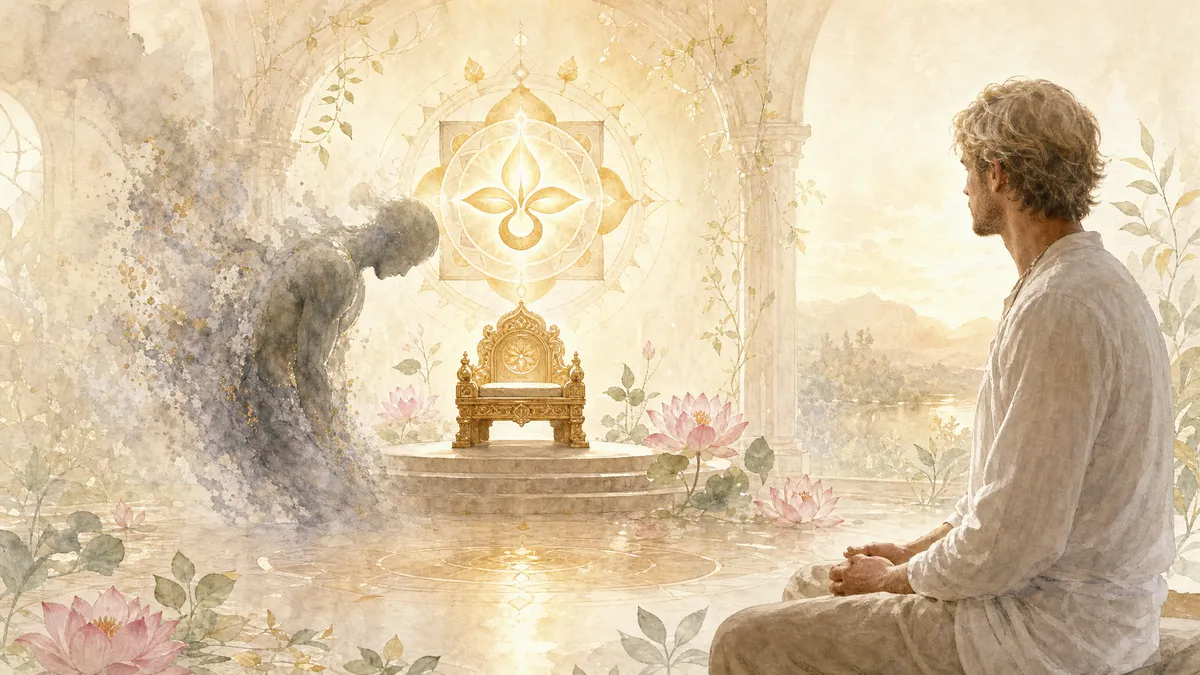
Inner obedience is very subtle; it cannot be recognized immediately, because we often make mistakes, confusing our parts—the higher “Self” and the false ego. It is as if we cannot yet fully determine where the king is and where the impostor is. Therefore external obedience is easier; it allows one to quickly understand what the emptiness of the “I” means. For example, if you accept the dharma or the Guru as your “Self,” then the higher “Self” inspires its higher energy into your lower “self,” teaching it how to subordinate the lower “self” to the higher “Self.” And then an understanding arises in you: “Yes, these parts of mine must be subordinated. But perhaps these parts can still be kept? Perhaps this is something real, true?” But you are told: “No, these parts too must be completely, unconditionally subordinated.” You think: “And these subtle parts are probably definitely my true ‘Self.’ For example, my inner voice, my creativity.” You are told: “All of that is nonsense; this too must be unconditionally subordinated to the higher ‘Self.’” You are bewildered and think: “So it turns out that I must subordinate absolutely everything?” You are told: “Yes, you must subordinate absolutely everything!”
When you understand this, you feel that nothing of you is left. And suddenly you burst out laughing, because you understand that you never were all of that. You were simply in illusion, considering all of that to be yourself. When you have become completely empty, you are nowhere, only the body exists, you cannot be found anywhere; suddenly you see that you are all of this. And that you were all of this from the very beginning, only you could not subordinate your lower nature, you did not understand this. Then the deepest feeling of absolute devotion and gratitude awakens in you toward this great Source, which has laid bare and shown you this process of resubordination.
For example, one Anuttara Tantra Teacher told his European disciple to go and defecate under a monument to Lenin. This disciple had various fixed ideas about communism, propriety, and social and moral norms. And while studying the dharma, he tried to drag them along and preserve them. No one denies that these rules should be accepted as rules of the game, but he accepted them as something immutable and unequivocal. His Teacher saw this, and therefore gave him such an assignment. When he reluctantly carried out this assignment, everything turned upside down inside him; he discovered a great deal within himself, and a great deal was resubordinated and surrendered in a single instant.
Unity and Multiplicity
Teacher:
– A river flows into the sea and merges with it—is this not obedience? From the outside, it can be called obedience, a return to oneself. Depending on your temperament, you may call it obedience and a turning back to the source, and the ocean is happy to accept you. If you are obedient to someone else, then this is called duality, but where is the duality here? You have two arms, two legs, ten fingers, a nose; there is so much in your body, yet you say “I”—what does duality have to do with it? When you look in the mirror, are there two people present? When you see the truth, you understand that there is no duality from the beginning to the end of the universe.
Disciple:
– I was just thinking about that “I” which creates diversity for its own enjoyment.
Teacher:
– Having crossed the ocean, you will see the emptiness of unity. In a dream you see many different people of different ages, you see mountains that are millions of years old, stars and all that; but then comes awakening, and what did you see in the dream? Unity or multiplicity?
Disciple:
– A dream within unity.
Teacher:
– When you awaken, unity goes away and duality goes away, so when you awaken from this waking dream, you return to emptiness. If we see any objects, this is a dream; if we see dreams, it means we are asleep, therefore we must awaken and cry out: “I want to be free.” With this cry you will wake up, and everything will go away; otherwise you will have to be born again and again in the endless cycles of kalpas.
The Path of Instant Enlightenment
We follow the path of instant enlightenment. Many people misunderstand the path of instant enlightenment. They think: “The path of instant enlightenment is the path where the Teacher looked at you or struck you with a stick, and you became a Buddha. Now that’s great!”
No, the path of instant enlightenment means that we immediately orient ourselves toward nonduality, toward the Supreme Source, and then, according to our abilities, we apply more dualistic methods without losing the principle of nonduality. On the paths of gradual enlightenment (except Zen, which is also a path of instant enlightenment), the student first accumulates merit, cultivates wisdom and concentration, studies the teaching, observes the commandments, takes various vows, follows the rules of discipline, and then is gradually led to an understanding of the principle of emptiness.
There are even rules that say one must not teach emptiness to those who are not ready for it. Nevertheless, when we practice the path of instant enlightenment, it means that, while orienting ourselves toward nonduality, we can also apply any dualistic methods.
In order to balance our relative and absolute dimensions, we must first reach a higher level, one that is above the human. Then we need to rise from what is above the human level to the divine. And then we must completely transcend it and reach the absolute level.
Awareness of Being
Student’s question:
– Enlightenment, self-awareness—is it simply awareness, the self-evident awareness of being?
Teacher:
– Yes, it is awareness, the same as fully being aware of being. That is exactly how it is: complete awareness; everything is in it, and you yourself are this awareness.
Student:
– I have this awareness, and yet anyone would say that your realization is deeper than mine. What is the difference?
Teacher:
– You create the differences yourself; there are no other differences.
Student:
– If I were sitting in your place, in a week no one would come here anymore.
Teacher:
– Try it then. Sit here. When I asked about the difference, my Teacher removed my differences, and I accepted it.
The Teacher urges the student to recognize his absolute nature immediately. It is like a lion showing a lion cub its reflection in the water. The cub cannot believe in its lion nature because it feels like a sheep. Because it has always considered itself a sheep, and it has too many karmas that prevent it from believing in its absolute nature. The Teacher pushes him to believe in his absolute nature and to accept it unconditionally.
However, simply believing in one’s absolute nature is not enough. Someone may think: “Oh, it is simply a matter of faith; I’ll just believe, and that will be all.” No. Now you must eliminate all misunderstandings; you must become fully convinced of the truth of this nature, even after receiving such a glimpse of faith in self-recognition. You must no longer have any doubts; all mental self-digging must go. You must acquire unshakable faith in it.
And when you have acquired unshakable faith, everything is only beginning. You must nurture it. That is, it is like having climbed the highest mountain. We have already reached its summit, but we need to remain on it, hold on, and not fall off. Therefore the student nurtures it, trying to maintain it from minute to minute, trying not to fall from this high summit.
In the practice of the lower paths, one never ascends to the summit. People either pray, or recite mantras, or circumambulate statues. Nevertheless, they hope someday to discover that very summit. The method of anuttara tantra is this: one must immediately leap onto that summit. But simply leaping onto it is not enough; one must also hold on there and not fall off it. It is like being dropped onto Everest by helicopter. You do not need to assault it with ice axes and ropes. But you understand very well that after you have been dropped onto this very highest point, you must still secure yourself there so that you are not blown away, and remain there for your whole life. No matter how strong the winds may blow, you absolutely must secure yourself there in order to remain.
Making the Great Decision
Student:
– Perhaps the whole point is precisely that I have not fully accepted it.
Teacher:
“I accepted completely. I accepted, and there were no more problems. If you have accepted, there will be no problems. If you have accepted ‘I am free,’ then you are free. If you accept ‘I am not free,’ you are not free.”
Disciple:
“Yesterday You said that everyone will one day have to encounter the truth. If I freely believe, does that mean I am none other than enlightened?”
Teacher:
“No. For the ‘I am,’ your belief or disbelief has no significance. From the position of the ‘I am,’ there is no difference between them. Fully accept ‘I am,’ and that is all. If you have invented stages of acceptance: gradually I will try to accept; in order to accept, I will do this and that, then you will accept gradually. Everything depends on you. In reality, however, nothing changes.”
In Laya Yoga this is called “accepting the great decision.” When we accept this great decision, we already have a certain amount of experience behind us. It is as if we have approached this natural state from all sides; we have thought about it for a long time and were resolving to do it. We had received certain experiences, but we still did not have enough courage to accept this decision. But when we accept this great decision, it is like making a quantum leap from one level to another. When we have made such a leap, we constantly look at the world through the eyes of the natural state. This means that everything that manifests, we can self-liberate.
Of course, we have complete freedom to continue working in the relative dimension as well, polishing our qualities. This gives our natural state flexibility, fullness of energies and manifestations, and variety in manifestations. But such a quantum leap has already been made, and everything seems to manifest from another level—from the level of nonduality.
The minds of those who have not yet made this quantum leap and have not accepted the decision are in the plane of choice, in the plane of the future and the past, hope and fear. Even when they perform certain practices, this is a continuation of egoistic efforts with hope for the future. The whole difference lies in whether there is the subtlest discriminating vision with awareness or not.
Even if a person sits on nails, fasts and mortifies the flesh with severe tapas, holds the breath for twenty minutes, but has not yet accepted such a decision, he should be considered a beginner. He is not yet performing the highest tapasya, the austerity. But if a yogin has accepted such a decision and steadfastly holds to it, then he is a true ascetic who performs his tapas day after day. Outwardly he may not stand out in any way, but he is just as much a tapasvi as the yogins sitting in Himalayan caves.
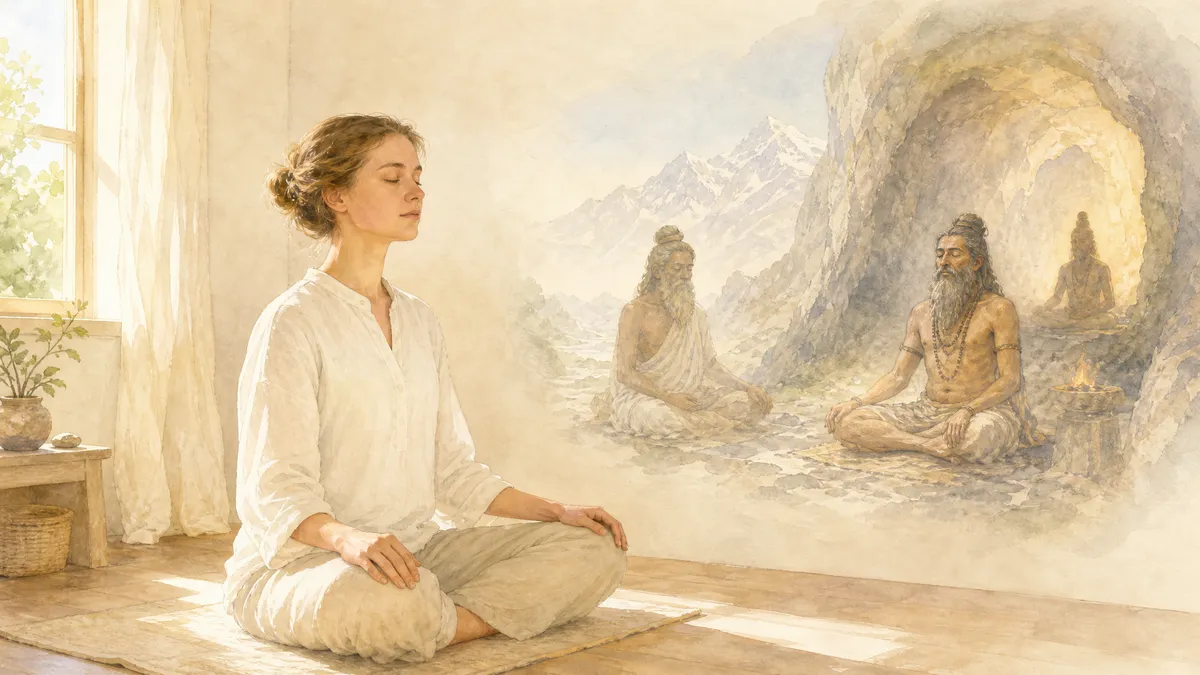
Such a yogin can always be distinguished from other practitioners because he has an unshakable mind and is always immersed in immense joy. He has neither confusion, nor hope, nor fear, because he has accepted this great decision.
The Immutability of Enlightenment
Teacher:
“Enlightenment will not change today, tomorrow, or the day after tomorrow. It is one and the same. You can attain it now, in a year, or at the end of your life, but it will be the same. You do not accept it—accept it completely; what is the problem? You are already free. Who told you that this is not so? But you do not open yourself. You are afraid even to say ‘I am free’; I do not know what kind of fear this is.”
A yogin must say “I am free” when accepting such a decision. This does not mean that you need to go around telling everyone at every step, “I am free.” It means saying this within, accepting freedom through the empty nature of your own mind. To turn your attention to that space of freedom that exists in our mind beyond thoughts, desires, and kleshas.
We are afraid to accept our own freedom because we do not know that it exists, and therefore we do not trust it. Kleshas and thoughts conceal this freedom, but as soon as we look further, beyond the kleshas and thoughts, we discover that this freedom exists implicitly day and night. Why not accept it right now?
When we accept this freedom, we have something to work with; we are no longer in the usual confusion connected with kleshas and thoughts. We constantly remember it; it gives us tremendous strength and inspiration.
The Power of Self-Perception
People are not ashamed to say “I am bound,” “I suffer,” “I am unhappy,” but no one says “I am free,” “I am immortal.” So who is to blame? Whatever one says, whatever one thinks, it must happen. Sooner or later it will happen. If you think “I am free,” then you are free.
The “Brihadaranyaka Upanishad” says: “A person becomes what he thinks about.” Making the great decision is connected with a radical change in one’s sense of self. If a person is used to feeling himself in a certain bhava—for example, wretched, humiliated, downtrodden, foolish—then he gradually forms a corresponding idea of himself, which he himself continues to support. Even if people appear who treat him as very exalted and wise, he will still think of himself in the old way.
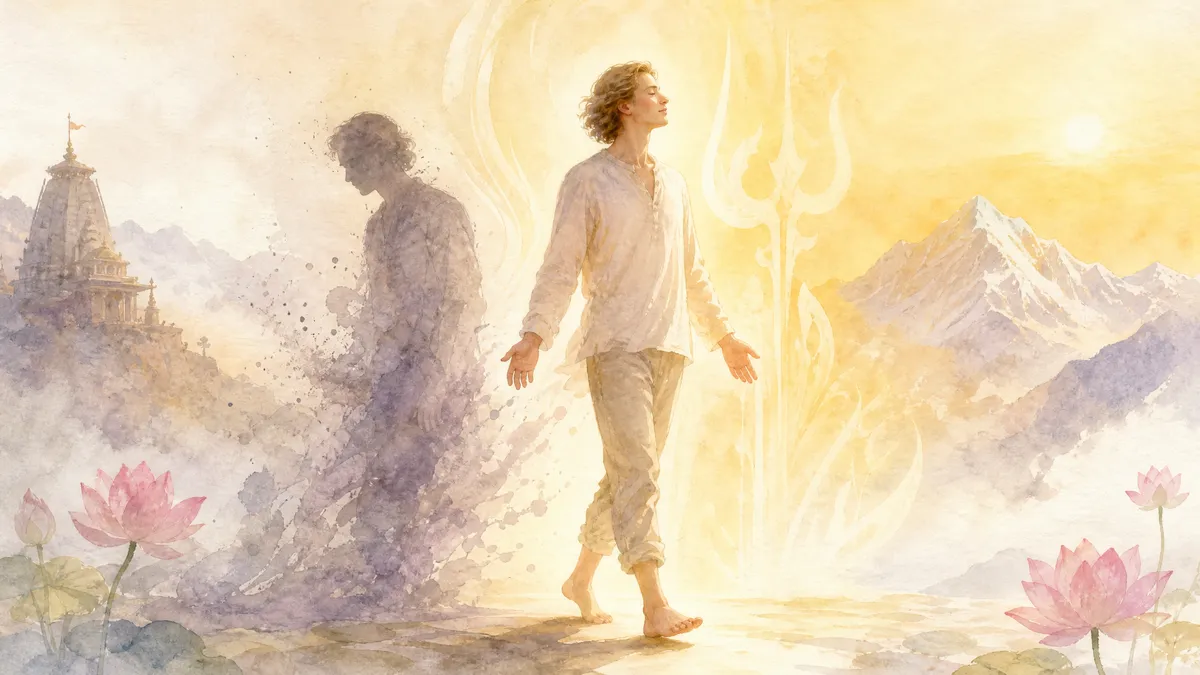
Making the great decision is a change of such a feeling, of bhava, a change in self-perception. We must acknowledge and accept the greatness of our own “Self” and allow it to emit its luminous rays upon our lower “self” constantly, until our lower “self” completely evaporates.
Even when we work with the lower “self,” the false ego, using lower methods—purifying the pranas, practicing concentration, observing discipline—this is not enough, because in this way the personal “I” is still working with the personal “I.” When we make the great decision, we are, as it were, requesting the absolute support of our higher “Self.” We acknowledge the higher “Self” and accept its holiness, freedom, and absoluteness. We begin to open ourselves to its radiance, as if throwing ourselves open to its light and beginning to trust it. And then, in response, it also begins to answer and send us its rays.
Of course, rays, response, sending—these are all dualistic concepts hinting at the processes that take place in consciousness. When we do not make the great decision, do not trust our higher “Self,” we do not have this feeling of freedom, this feeling of absoluteness, which means we have no one to turn to within ourselves.
We can, of course, rely only on the Guru’s instructions outwardly, on the scriptures, and so on. But inwardly we have not yet been accepted; we are not at home. We have not yet come into being within; we have no deep trust in ourselves, we are not self-sufficient, we still cling and consider ourselves to be the kleshas, the mind, and something else; we have not yet made peace with ourselves, with our absolute “Self,” because we have not made such a decision.
Reunion with the Source
When we make such a decision, everything changes. We reunite with the Source, and it takes us under its protection. It is like joining some powerful organization. As soon as you join it, you are immediately provided with documents, clothing, money, protection—that is, you receive a powerful influx of shakti. You feel that immense forces stand behind you, and whatever happens, they will guide you, look after you, and help you. Now you are not on your own; a very powerful force stands behind you.
And when such a person, having joined this powerful organization, encounters circumstances, he gradually transfers his own difficulties to the force that looks after him, knowing that he is no longer on his own. The same thing happens at the moment of making the great decision. Instead of solving the problems of the mind at the level of the mind, the problems of emotions at the level of emotions, we know that it is enough to resubordinate them to this great force. It is enough to remember: “I am awakened, I am free.” One should bring the feeling of the greatness of “I am free” downward and manifest it in all aspects of life.
The Meeting of the Clear Light with Matter
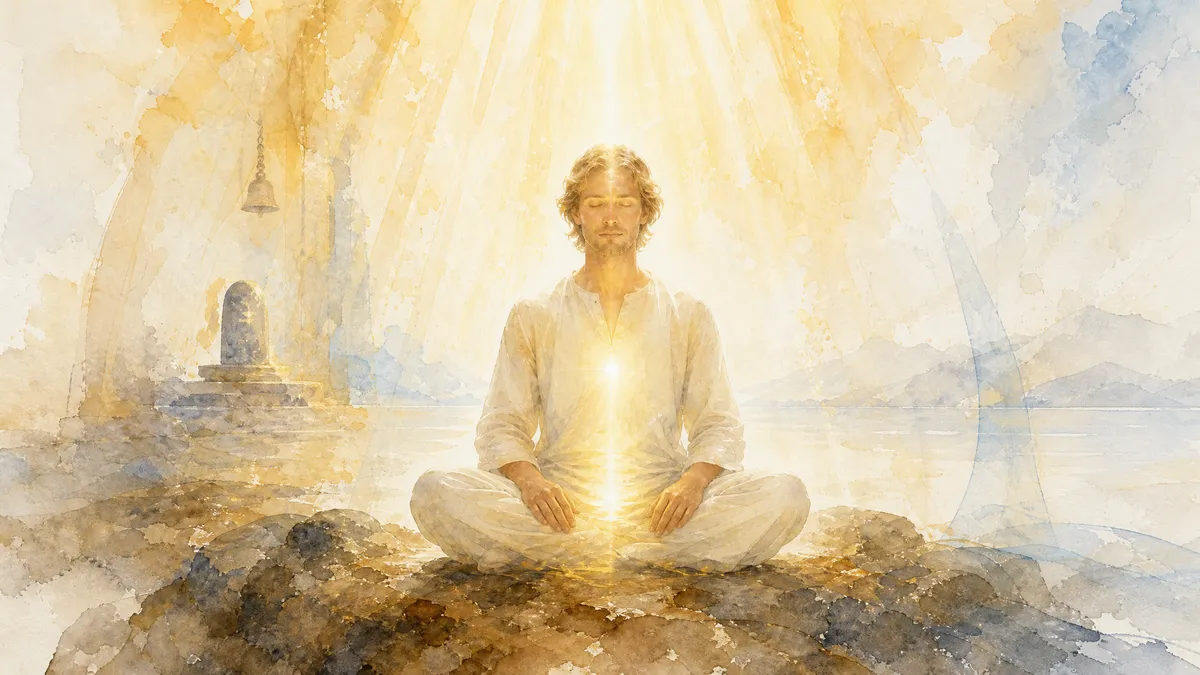
When they collide, it is like light and darkness coming together. Worldly desires, kleshas, fear or confusion, restless thoughts meet the Clear Light. As it descends into condensed matter, the Clear Light loses its power, because coarse matter obscures it. But as we accustom ourselves to making such a great choice, descending into the dense layers of our matter, our mind, astral or physical body, the Clear Light gains ever greater strength if we begin to trust it. Since saints trust the Clear Light unconditionally, the Clear Light, descending into their bodies, can even transform them.
Teacher:
— People are not particularly eager for freedom. Are there many who desire it? I tell you that you are already free, but you do not agree with this; you want to undertake something. But freedom requires no effort. Efforts may be needed for something else, but freedom is in freedom. Free yourself from effort.
Student:
— So there is no struggle? Just accept?
Teacher:
— Then enlightenment will be present. You will give up effort and there it is; but when you try to catch it, it slips away, because you are straining to bring here what is already here.
Student:
— I learned this from You. I am so grateful.
Teacher:
— Wonderful, you learned this here, which means your work is finished. If you make no effort, you are That Itself.
The Path Without Effort
It is usually said that a yogi must overcome within himself the idea of the meditator and of meditation itself. Of course, if you have not yet become a meditator, then there is nothing to overcome. Therefore, in the beginning, of course, one must become a meditator in order to overcome this idea.
The path without effort means that, in order to make this leap, or quantum transition, one must move from the level of the mind, the astral and causal bodies, where efforts exist, beyond them, that is, to the level of nonduality, to the level of the dharma body. And then awareness is present, but there are no gross efforts connected with the mind and other parts.
Question:
— Is this striving for freedom and the thought “who am I” one and the same?
Teacher:
— One, one. If you have a striving for freedom, “who am I” brings you back. For whom does this striving arise? You say that it is for me.
O Lord, Clear Light, descend upon these unfortunate ones who are asleep, who do not hear You! O Lord, descend upon them so that they may fall neither into hell, nor into the world of hungry spirits, nor into the world of pretas! So that they may open themselves to You and be completely obedient to You! When, at last, will You awaken their sleeping souls? Can it be that their stone hearts have grown dead? Can it be that they are going into the three impure worlds?
Perhaps this is how lectures should be given...
When the Clear Light descends into the gross layers, it is completely blocked. Here it encounters strong tamas. Some kind of penetrating, cumulative shakti is needed. One must lay hands on each person, pray for him, break many bamboo sticks so that the Clear Light can finally break through. Otherwise, when people listen like this, I see that the Clear Light has entered very dense layers, and it has little chance here at all.
