

Commentary on the text “Sanatsujata Parva”
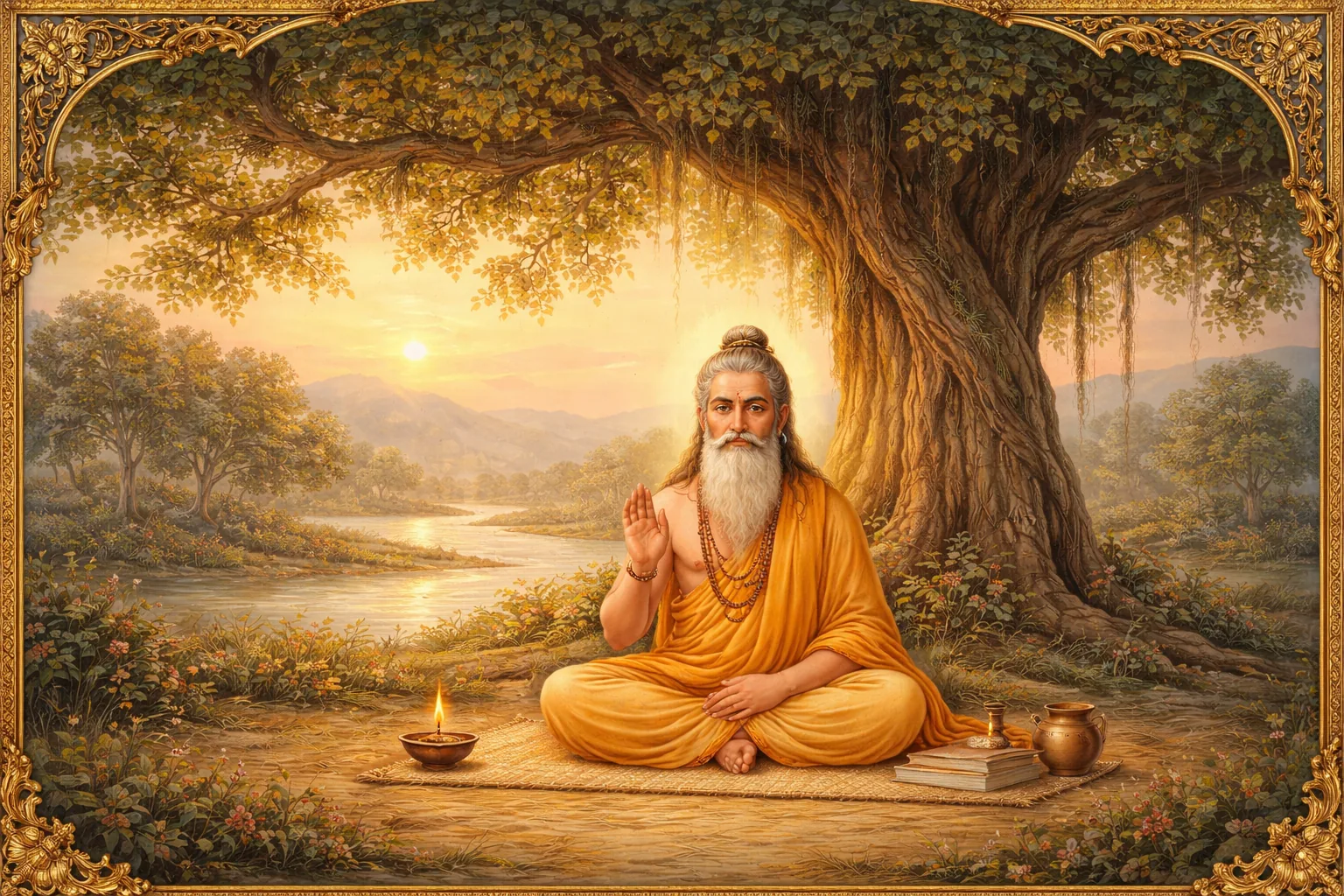
“Sanatsujata” begins with Dhritarashtra wishing to receive the darshan of the great deity Sanatsujata, meeting him, and conversing with him.
Of course, Sanatsujata did not manifest on the gross physical level, but on the level of pure vision, that is, on the level of the dimension of energy as pranava-deha, meaning a body consisting of subtle vibration. Since Dhritarashtra possessed awakened and devoted consciousness, he was able to come into contact with Sanatsujata.
Principles of Spiritual Communication
In order to come into contact with someone and build a relationship, one should possess two qualities. The first is to choose the necessary language of communication, and the second is to choose the necessary role that you occupy in communication. By the language of communication, what is meant is not English or Russian, but the language of communication as a way of karmic vision.
For example, sometimes you communicate in a relative language, discussing everyday matters; if it concerns dharma, it is also called the “language of method.” Sometimes we communicate in an absolute language; if it concerns dharma, it is also called the “language of wisdom.” And these are different kinds of languages. When we speak the language of wisdom, we self-liberate everything; when we speak the relative language, we use an understanding of circumstances and discernment.

The choice of language is connected with karmic vision. And it is said that when you choose the language of communication, you must choose it so that it is adequate to the circumstances and to the being with whom you are communicating. In other words, it is necessary to correspond to the style and vision of communication that you share. If you do not choose a language of communication, then communication is impossible, especially with beings from distant karmic dimensions.
For example, even in a monastery, if a monk comes up and says, “We have run out of groats; what shall we cook for lunch?” And the manager replies to him, “Whether the groats have run out or not — these are all illusions of your mind.” Different languages of communication are evident. The manager chooses the language of wisdom, of non-duality, while the cook speaks in the relative language. And if they communicate like this, they will not agree on anything. Or, conversely, the dharma guardian says, “Today the vinaya is at such-and-such a time.” And you reply to him, “The Primordial Mind is beyond observances and violations, so who is to repent?” And what, then, should the dharma guardian answer you? If this is a dharma guardian who “won’t let anyone put a finger in his mouth,” he may answer you in the same spirit. All of these are examples of how the languages of communication become confused.
When we communicate, it is necessary to understand that communication should be built on the level that corresponds to the circumstances or to the interlocutor.
Or, for example, an intellectual teaching is being presented to you, where it is said that there are such and such philosophical concepts, and you think, “This is all an illusion of duality, these are all concepts.” And you do not even try to penetrate the philosophical vision. But the point is that these are simply different languages of communication. If you want to understand the teaching, you accept the conceptual language.

The second thing that is necessary is to determine your role in communication. Even if you have decided and are communicating in one language, it is very important to understand what place you occupy in the communication. For example, one can define the role of the one receiving instruction. One can define the role of the one giving instruction. One can define the role of someone interested in some particular question. That is, it is very important in communication to understand what role you are taking on.
For example, when communicating with deities, one takes the role of receiving instruction and blessings, or of asking about the teaching.
But if a person practices self-liberation in the Zen style, he may take on a different role. Suppose a cook who was preparing food in the kitchen saw a vision of Manjushri, grabbed a ladle, and hurled it at him, saying, “Manjushri or not Manjushri, the true nature is the same everywhere.” That is, he took on a different role in communication — the role of the Absolute, the role of absolute self-liberation. Such things exist in Zen. They are not accepted among us; for us, this is more likely connected with mental understanding. But in Zen, this is connected with the expression of the active side, shakti.
There is an even funnier story about the invulnerable master Ji Shi.
Master Ji Shi once gathered with the immortals in a clearing, and they discussed questions of the supreme law, the supreme limit. And the Buddha, seeing that they were discussing such profound matters, decided to descend to them from the heavens in order to give instructions. When he descended and appeared before Master Ji Shi, he said: “You are speaking here about the great limit, so know that it is I. You should ask instructions from me.”
And then Master Ji Shi thought: “Buddha or not Buddha, before the fist of a great master all are equal.” And he struck the Buddha. Since he was a great master of martial arts, for him the expression of totality was such an act of self-liberation. What is meant here is a subtle play, because the invulnerable Master Ji Shi himself was also a living Buddha. It was a play of two Buddhas — one having a body, and the other dwelling in the heavens. Then, when that Buddha came to his senses, Master Ji Shi said: “When you speak of the great limit with a master, you must understand that if you are the great limit, then the master is the fist of the great limit.” The Buddha wanted to object and say to him: “But does the fist of the great limit not enter into the great limit?”, but then he looked at the master’s large fists and thought: “Yes, perhaps it does not.”
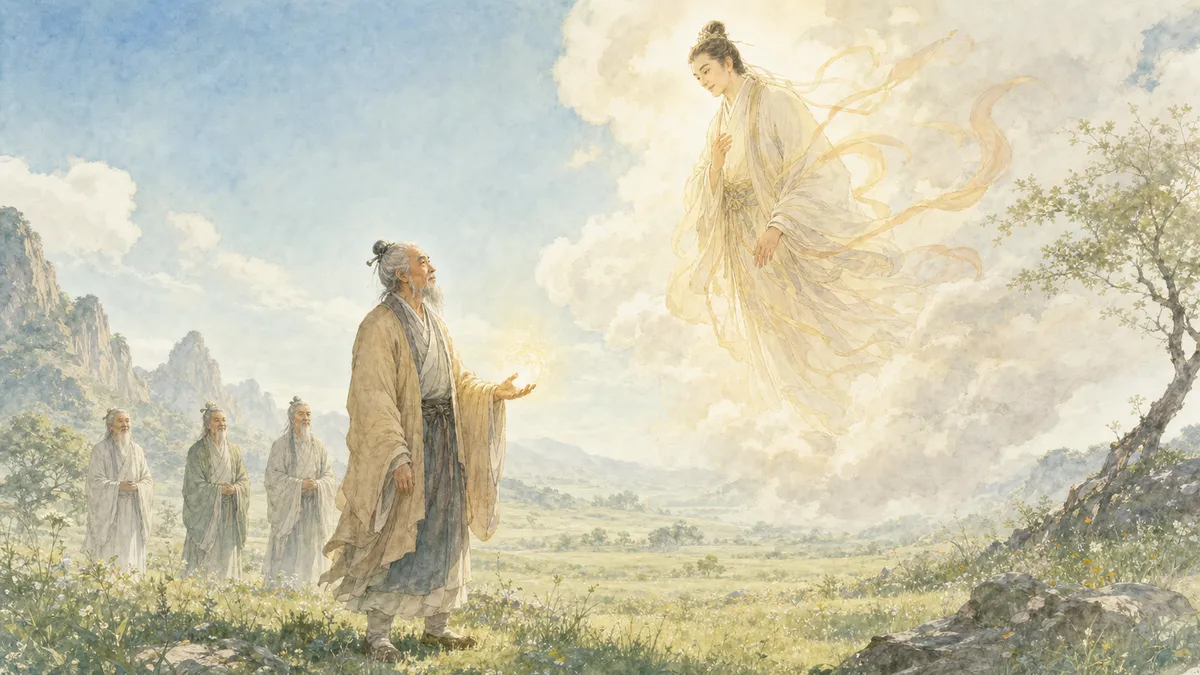
This is another language. These are already the games of self-liberation inherent in deities and saints.
Sanatsujata’s Instructions on the Nature of the Absolute
Dhritarashtra questioned Sanatsujata about the teachings. And at first Sanatsujata gave him unusual instructions on how a king should conduct himself and how to inquire into the Dharma from the point of view of a kshatriya.
In particular, he said:
“A disciple should always approach the teacher with a bow and, with purity and reverence, ask him for the teaching, not exalt himself and not conceive evil — this is the first stage (of practice) in brahmacharya.”
Then he explained to him the process of discipleship.
After this Dhritarashtra asked:
“In what form does the knowing righteous brahmin contemplate that immortal, imperishable abode of which you speak? Does it shine with a light color, or red, or black, or dark?”
In his simplicity, Dhritarashtra asked: “What does this immortal abode of which you teach look like?”
Sanatsujata is a great deity of the divine universal hierarchy, one of the sons of Brahma, born from his mind. His name is translated as “beautiful image.”
There were seven great Kumaras in all, although more often four of them are spoken of as guardians of the directions. When you perform the dance of purification of the element of space, you honor these deities of the four directions, the four Kumaras.
Sanatsujata said:
“It does not shine with a light color, or red, or black, or with the brilliance of iron and the sun. It does not abide on the earth or in the air, nor is it clothed in the waters of the ocean. This abode is neither in the stars nor in lightning. Its form is not revealed in the clouds. It is not seen in the wind, nor in divinity, nor in the moon, nor in the sun. It does not manifest itself either in the words of the Rigveda, or in the sacrifices of the Yajurveda, or in the hymns of the Atharvaveda, or in the pure sounds of the Samaveda, or in the collection of hymns; not even in the great vows is That, the eternal, visible, O king.”
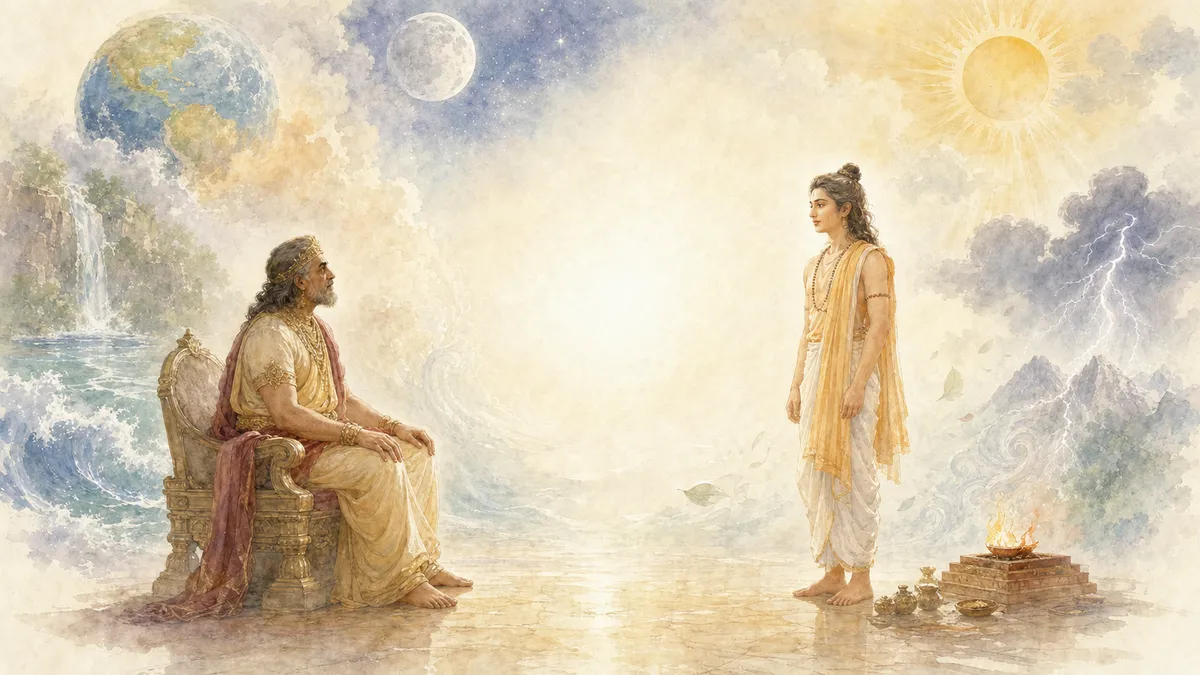
What is happening here is the transmission and direct introduction of Sanatsujata to Dhritarashtra, when Sanatsujata explains to Dhritarashtra the principle of the primordial Mind.
“It is invincible, beyond darkness, and death dissolves in it at the hour of destruction. In form it is subtler than the subtlest, like the edge of a knife, yet it is also great in form — greater than mountains. This is the Foundation, this is Immortality, this is Glory. Beings have emerged from It and come to dissolution in It as well.
It is painless, great, most glorious, exalted, changing only in words (in the relative), so say the awakened ones. The entire world that comes into being is founded upon That. Whoever knows this becomes immortal.”
Sanatsujata explained the principle of the foundation.
The Great Foundation and the View
The Great Foundation is that upon which we build the view, the principle of vision. And it is very important first to awaken to the foundation, to the view, before engaging in spiritual practices. For if we have not formed a sufficient view, we will be as if wandering in the dark, even while performing numerous sadhanas.
View means knowing one’s own “I,” one’s own state, and applying it, being guided by it in everyday life.
Our own mind is something amazing, something astonishing, a great miracle. Of course, this does not refer to the superficial conceptual mind that functions while we live in this body.
The conceptual mind is connected with the human karmic vision, which lasts exactly as long as we abide as a human being in a physical body. When we cease to be human, the karmic vision of a human disappears and another vision opens.
But we are speaking of the mind as such, which in Sankhya, Yoga, or Vedanta is called buddhi and atman. Although this mind is very great, nevertheless it is located within us just like the heart and everything else, only it is very subtle. It belongs to us by right. It is naive to think that we can create it. Rather, it is important to gain trust in it. This mind is wondrous because it is beyond time and space.
Once I was riding in a car with a disciple who was driving me from one city to another. Before getting into the car, I had been doing a great deal of concentration on the Vishuddha chakra and was in a very deep presence, periodically immersing myself in various kinds of samadhi even while we were driving. And there was such a paradoxical state that, when I meditated, a few minutes passed in the ordinary world, but within me perhaps several hours or even a day passed. I would immerse myself in meditation like that for a few minutes, then come out of it and think: “Well, he is still driving. When will he finally arrive?” Then I would immerse myself in meditation again, and according to my subjective sensations about five hours would pass; then I would come out of it and think: “Good heavens! How has he not grown tired of driving for so long?” And this happened many times in a row, so my consciousness actually began to leap from one state to another, and these leaps were paradoxical. When I leapt inward, subjectively several hours passed. And when I came out, outside a few minutes had passed, and then this even went down to seconds. Ultimately, this short road seemed to me like some very long journey, even longer than when I traveled by train across the entire country.

I thought: “How difficult it must be for him to drive for so long. So much time has already passed, and we have covered only a few kilometers.” And the next leap was completely paradoxical: when we had almost arrived, I leapt, and again several hours of meditation passed, but in the outer world only a few seconds passed, and it was very strange, like slow-motion filming. So many events had passed within me, but outwardly the disciple with whom I was traveling made only a couple of movements. The quality of time in these two states was very different.
When you come into contact with this timeless essence, human events are seen differently. This is precisely another karmic vision. In one second you can live through a span of time perhaps half a lifetime long. All of this is connected with our wondrous mind as such.
Direct Transmission on the Nature of That
Sanatsujata goes on, giving a direct transmission to Dhritarashtra:
“That is the pure great light, blazing, manifold in glory. Truly, That is revered by the gods; from it the sun shines.
That which is existent and eternal is perceived by yogins.
From the pure That, Brahma arises, and through Its purity Brahma grows. The pure That abides in the luminaries; not blazing, it kindles the sun.”
Pradhana—the universal foundation or primordial luminous clarity, being the basis of everything—nourishes with its light the gods, the deities who govern the universe. Brahma, the creator of our universe, grows forth from it. He is nourished by the purity and light of this universal foundation.
When it comes to practice, it is usually considered that the line of contemplation is connected with shravana. That is, we must receive some kind of “taste,” and for this we perform the practices of the line of contemplation—reliance on sankalpa, and so on.
The line of divine pride is connected with manana. We need to come to faith, cut off doubts, and become rooted. For this we generate divine pride, that is, we manifest the corresponding qualities.
And finally, the line of space is connected with nididhyasana, with maintaining this state. That is, when we have already gained confidence, self-sufficiency, and divine qualities, our task is to continuously maintain and develop this; therefore, we then work with space, visions, sound, and so on.
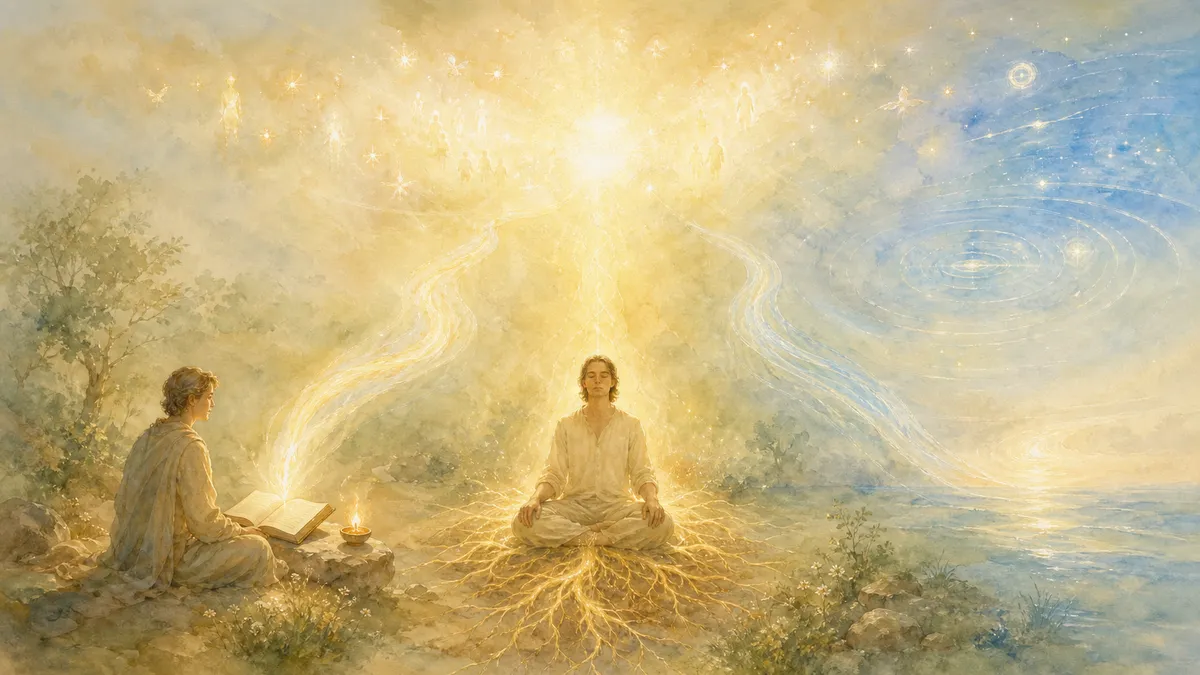
Although these divisions are conventional. Rather, they reflect the logic of practice as such.
“The yogins behold That which is, the eternal.
That pure One encompasses both gods, Heaven and Earth, as well as the space between them and the directions of the world. From It, rivers flow out toward the four directions of the world; from It the Great Sea arose.
The yogins behold That which is, the eternal.
The imperishable, active, standing upon the wheel of the eternal chariot, radiant THAT is drawn by horses, heavenly, ageless in the sky.
The yogins behold That which is, the eternal.
There is no form in which That can be contemplated. No one’s eyes can see It, but whoever knows It mentally, with mind and heart, becomes immortal.”
Beholding That and Acquiring the Center
Beholding That is connected with liberation from limitations. It is connected with the fact that we already have the perfection of That, we possess it, but there are certain temporary limitations and obscurations that must be removed in order to become fully rooted in this Being. These limitations are mainly connected with the fact that we attach importance to emotions and conceptual thinking while remaining at the level of peripheral awareness. When we cease to attach importance to them, we gradually become the center. Beholding the basis means becoming the center more and more.
When we abide in the conceptual mind (manas), we are not the center; we are, as it were, an eccentric who has lost his center. And to behold the basis means to become the center more and more. If, while practicing, you discover that you are becoming more centered, becoming the center, this means that your practice is correct. Conversely, if you discover that you are losing the sense of the center, that the center is gradually forming somewhere outside you, this is a sure sign that your practice is going down the wrong path.
When we are in ordinary conditions and engage in contemplation a little, it is not difficult to maintain the sense of the center; but when we encounter deep experiences of the subconscious, which are very subtle, even subtler than our own states, it is difficult to maintain the sense of the center. We become lost as to where we ourselves are and where the experiences are.
Therefore Sanatsujata says:
“There is no form in which That can be contemplated. No one’s eyes can see It, but whoever knows It mentally, with mind and heart, becomes immortal.”
The True Understanding of Advaita
To behold this center does not mean to dissolve.
One often encounters this understanding: “The I must dissolve in Brahman; nothing must remain. There is only Brahman, which means that I will not exist.” But I would say that this is a rather superficial understanding of Advaita.
From the point of view of the Advaita of the siddhas, or para-Advaita, or purna-Advaita, the jiva (soul), ahamkara (personality) are full-fledged parts of the Absolute. They should not be denied; moreover, it is precisely through them that the Absolute manifests itself, expresses itself, and plays in the fullest way. Therefore, I would say that it is not a matter of dissolution, but of an ever greater acquisition of the qualities of individual personality. We go from the limited jiva to the mahapurusha — to the great soul.
Of course, the mahapurusha is no longer a soul separate from Brahman; Brahman already manifests it through itself, yet all its personal individual qualities are preserved. That is, one should understand that we do not lose ourselves as an ego, as a personality; rather, we change our self-identification. The qualities of the ego and personality, in the service of the Absolute, only flourish, becoming its obedient servants.
Many saints, after attaining liberation, did not disappear; that is, one cannot say that there was Gorakshanath, then he attained enlightenment and disappeared, became Brahman; since he became Brahman, there is nowhere to look for him, no trace remains. Or that there was Matsyendranath, then he attained liberation and dissolved; only Brahman remained, and Matsyendranath no longer exists.
But we say that Gorakshanath even now abides in his own abode. He is immortal and lives in his own universe, surrounded by deities, tantric yoginis, his disciples, and other beings. Likewise, Matsyendranath lives surrounded by a retinue and a mandala, abiding as the central deity.
We can say the same of the Buddha, of Dattatreya, and others. All of them preserved their individualities, their unique personal qualities. In the same way, various gods abide, such as Indra, Vayu, Varuna, the four Kumaras, Brahma, Vishnu, and Shiva. All of them live in their abodes and lokas. They have attained purna-advaita, the full realization of the Absolute—there is no doubt about this. And anyone who doubts it may try to verify it for himself.
Personality and individuality in the state of liberation
Nevertheless, they exist as persons, as personalities in the relative sense, of course. In separate tunnels of reality, in their own universes, they have their own play, history, qualities, attributes, and so on.
This means that even after merging with Brahman, they manifest certain differences inherent in their personalities and individualities. Their personality has not been lost; on the contrary, it has blossomed, become deep, multidimensional, and incomprehensible. It has become no longer a mode of egoistic existence, but a form of lila, a manifestation, a creative play of the Absolute.
In the same way, attaining awakening means that our personality and ego become a non-egoistic mode of perception, a form of creative manifestation of the Absolute, but they do not disappear. Of course, at the essential level, Dattatreya, Matsyendranath, and Gorakshanath are completely one; in their essence they are Brahman and no one else. But at the relative level, differences always exist. There are various deities of power, possessing different factors of will, and each of them abides in their own dimensions.
The difference between deities and limited beings
So, how do deities differ from limited human beings, if both are emanations of the Absolute? Deities are not different from the Absolute. Through deities, the Absolute itself speaks. This is now His creative manifestation.
Someone may say: “If we are strict followers of Advaita, then people are the same as well. Through people, too, the Absolute speaks; people, too, are its emanations.” And no one can dispute this; it is indeed so. Then what is the problem? Why do gods and siddhas not need liberation, since they are already free, while people seek liberation?
The point is that people abide, for themselves, in impure karmic vision, whereas deities and siddhas abide, for themselves, in pure karmic vision.
For deities, the term “for themselves” means that their jiva and ahamkara are likewise completely integrated with the Absolute. There is no separation; their external energies (emanations) are already like a mandala (a pure dimension) that does not bring suffering.
For us humans, the term “for ourselves” means that our external energy manifests as impure karmic vision and, as it radiates, brings various limitations.
