

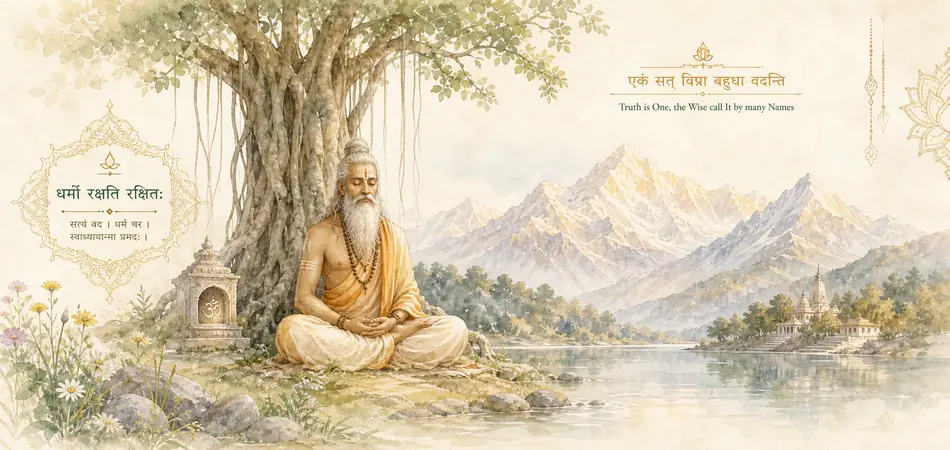
Commentary on Sri Ramana Maharshi’s text “Be As You Are”
Question: What is reality?
Ramana: That which underlies everything is reality. It lies beneath limitations while being boundless. It is unlimited and, being itself real, is obscured by unrealities. Reality is That which Is.
Reality, which is pure Consciousness remaining after ignorance and the knowledge of objects have been destroyed, alone is the Atman. In this Brahma-svarupa (the true form of Brahman), the abundance of knowledge of the Atman, there is not a trace of ignorance.
Reality, shining in all its fullness, free from suffering and the limitations of the body, whether the world is perceived or not perceived, is your true form (nija-svarupa).
The radiance of Consciousness-Bliss in the form of the one Awareness, shining equally without and within, is the supreme, bliss-filled primal reality.
Primal reality is synonymous with the natural state, the ultimate cause. To practice yoga means to reunite with the ultimate cause. Yoga is translated as a yoke, or yuj (reunion). The term “yoga” implies an awareness of vi-yoga (separation). There is a single space of the pure light of primordial Wisdom. However, for us as human beings, this space is divided. Usually, three principal kinds of space are spoken of: outer space (bhuta-akasha) and inner space (chit-akasha). These two spaces are separated within and outside us by the body and mind. The process of yoga means uniting these two kinds of space; then the third kind of space—hrid-akasha—is attained.

The Nature of Jnana
Know that jnana alone is non-attachment, jnana alone is purity, jnana is the attainment of God, jnana, which is free from forgetfulness of the Atman, alone is immortality, jnana alone is everything.
Jnana is the self-born Wisdom inherent in us. It exists primordially in every human being, yet it is as though asleep. Until we awaken to it, it is as good as nonexistent. Although a dog possesses buddha-nature, it nevertheless freezes in the street and ingratiates itself with people to obtain a piece of bread, suffering in a dog’s body because the wisdom within it is asleep. From Brahma to an ant, every living being possesses the nature of Clear Light. Yet through the power of karma, consciousness is obscured by identification with “aham dehasmi” (“I am the body”).

The Method of Self-Inquiry
Question: What is this Awareness, and how can it be attained and developed?
Ramana: You are this Awareness. Awareness is another name for you. Since you are Awareness, there is no need to attain or cultivate it. All you have to do is relinquish awareness of other things, that is, of the non-Atman.
Ramana’s method differs slightly from the method used in our tradition. He gives direct introduction through self-inquiry. In our tradition, direct introduction is given through transmission of the state, while self-inquiry by seeking the “I-thought” is one of the many ways of introducing one to this state. In general, however, the teaching at the sutra level is no different. He says, “You are awareness.” In other words, our mind in its simplicity is this ultimate reality. Although it is not yet known to us, when we relinquish concepts and clinging to the “I” and abide in naked awareness, it is immediately laid bare; it can be experienced instantly. There is no need to do anything artificial. The issue is that it is very difficult to stabilize this from the outset, and therefore years of purification are required.
Ramana says, “All you have to do is relinquish awareness of other things, that is, of the non-Atman”—simply make a choice. Relinquishing awareness of other things does not mean ceasing to look at this or that, or diverting your mind and concentrating it on something. Rather, it means relinquishing dualistic perception. In other words, it means leaving the path of unconsciousness, distraction, and non-abidance in the natural state, and embarking on the path of abiding in the natural state.
If a person discards awareness of the non-Self, only pure awareness remains, and that is the Atman.
When we cast aside duality, distractions, and unconsciousness—the perception of the world as separate from the natural state—everything remains included in the natural state. We discover that this all-encompassing fullness within the natural state is our very Self. Atman is not some philosophical label; it simply means the Self, our state in its true form.

Absolute and Relative Awareness
Question: If the Atman is itself aware, why am I not aware of It even now?
Ramana: There is no duality between you and the Atman. Your present knowledge is conditioned by the ego and is only relative, requiring a subject and an object, whereas awareness of the Atman is absolute and needs no object.
Even when we are not aware of the Atman, our primordial state still exists, and when we remember this, we can immediately return to that natural state. One could say that our very consciousness is this primordial state, except that it is constricted and directed toward objects.
The Atman is always present. Every person wants to know the Self, the Atman. What is required to do so? People want to see the Atman as something new, but It is eternal and remains so at all times. They yearn to see It in the form of a radiant light, and so on. How can It be like that? It is neither light nor darkness. It is only what It is. It cannot be defined, and the best definition would be “I am that I am.”
Abiding in Absoluteness
When a person is immersed in the natural state, it means that they abide in choiceless awareness, so that everything becomes absolute rather than relative. When there is selective awareness, discrimination, conditioned experience, clinging, and all this duality of the conceptual mind, various problems arise. When choiceless awareness truly deepens, everything in the natural state is perceived as the Absolute. This is the all-encompassing fullness of Being, in which the subject is reunited with the object.

When such a person eats prasad, they take an absolute spoon and use the absolute spoon to eat absolute rice from an absolute bowl. When they eat, they experience an absolute taste; when they become satiated, they are absolutely satiated after the prasad. When they hear the bell rung by the monk on duty, they hear the absolute ringing of an absolute bell rung by an absolute monk. When they go outside after prasad, they see the absolute whiteness of the snow and feel the absolute breath of the wind. They also see absolute mountains and absolute clouds. Whatever they encounter, everything becomes absolute—such is the nature of Being. They understand that absoluteness is the normal, true nature of Being. Whatever they do, everything that comes from their hands and feet is absolute, just as they themselves are.

When they meet another person, they see that person as an absolute illusory body. When they hear the sounds of speech, they hear them as absolute speech. When any actions are performed, they too are absolute. This is immersion in the Absolute, which the Vedas described as “Sarvam Eva Brahman”—everything is Brahman. In such absoluteness, a person does not divide themselves from the Absolute; they see that such a division is inappropriate, nothing more than a fiction. If one does not accept the idea “I am this body,” then everything is absolute. When everything is absolute, one understands that in the Absolute there is no singling out of bad or good aspects. They do, of course, exist conventionally if one adopts the relative point of view, but in the absolute sense there are no such things.
Deepening Contemplation
When a yogi first enters this state, he simply tries to prolong it. At first, it lasts no more than an instant, and then the yogi falls out of it because the relative dimension compels him to acknowledge himself and become distracted. But the true meaning of contemplation is that one must relinquish awareness of all distractions—that is, of everything that is not absolute—and firmly abide in the absolute state until it penetrates one’s flesh and bones.
At first, the yogi does not believe in this absolute state because he is too accustomed to the relative. There is a saying: “When an ordinary person is told about the Tao, the ordinary person laughs; otherwise, it would not be the Tao.” Even when a yogi has heard a great deal about it, he still does not believe; otherwise, how can one explain the relationship problems that arise among spiritual practitioners? They simply do not yet have firm faith. Suppose a practitioner can easily be upset, confused, or angered because he does not yet believe that everything that happens is absolute and that the person who upsets him is himself the Absolute. Since everything is absolute, whatever emotion, feeling, or thought may arise, there is no need to become upset; instead, it should be accepted as absolute.
A saint was wandering through India. He was an avadhuta who walked about naked (I believe it was the yogi Bhusunda, a great siddha). One day, he accidentally entered the women’s quarters of a Muslim palace. A guard summoned the lord (the Nawab), who flew into a rage, thinking that the saint had entered his harem. He drew his sword and cut off the saint’s arm. Laughing, the siddha tucked the arm under his other arm and walked away without saying anything to the Nawab. When the Nawab recovered from his astonishment, he realized that he had acted wrongly, because this was a great saint. He became afraid that the saint might curse him, so he caught up with him, began apologizing, and made the appropriate offerings. The saint said nothing; he simply reattached the severed arm and continued on his way.

Faith and Understanding on the Path of Jnana
When our contemplation is continuous, we become rooted in such faith in the Absolute. This faith in the Absolute differs greatly from faith in dualistic religions such as Christianity or Hindu bhakti in tantra. This fundamental distinction should be understood: in dualistic religions, faith is based not on understanding but simply on self-transcendence, on the irrational. It is self-transcendence through irrational perception: “I believe because it is absurd.” In other words: “I understand that awareness and the mind do not function here; I simply believe.”
On the path of jnana, the principle is different: here, faith means understanding (jnana) rather than mere belief. Here, not only the causal body but also the mental body is enlightened; that is, not only buddhi but also manas is involved. Understanding means that your intellect has become completely clear and purified, conditioned by nothing. In other words, the difference is that there is an additional layer—a subtler layer of awareness—that participates in spiritual practice. For bhaktas, this subtle layer does not participate in spiritual practice; they have only self-surrender through faith. Jnanis have an additional layer of awareness that participates in spiritual practice—namely, understanding.
Being Beyond Definitions
Atman is Being, but distinct from both the real and the unreal; He is Knowledge, but distinct from both knowledge and ignorance. How can He be defined at all? He is simply Being.
When such understanding becomes rooted in us, our practice becomes inseparable from contemplation. In fact, knowing, understanding, and contemplating become one and the same. This is why the path of presence is said to be the yoga of non-meditation. It is more a matter of becoming accustomed to the view than of engaging in any fixed meditation. Becoming accustomed to the view means continuously maintaining our understanding, whatever we may be doing. There is a great difference between seated meditation, in which we try to stop the mind, and the state after meditation, in which we once again perceive everything dualistically. Another approach is to abide continuously in this nondual view: we meditate in nonduality, then emerge from meditation but still see everything as nondual; that is, we abide in absoluteness, whatever we may be doing.
As the yogin practices, his faith and understanding become clearer, and he no longer has any doubts in the light of self-born Wisdom. He has established contact with this light; he has restored his connection with this Source. At first, it is like turning the dial of a radio, trying to tune in to the right frequency. Once you have found the desired broadcast, you need to hold the frequency and ensure good reception quality—this is all that is now required of you. When the reception is good, you receive a continuous broadcast. This continuous broadcast is obscured by the stream of dualistic thoughts, attachments, and selfish desires. The point is to continually surrender your consciousness to the light of self-born Wisdom, cutting off clinging to the “I.” Then two tendencies arise in the yogin: the first is clinging to the “I,” his own ego, which wants to live in the old way, and the second is the open light of self-born Wisdom.

Vision After Realization
Question: What will a person see after realizing the Atman?
Ramana: There is no seeing here. Seeing is only Being.
The question itself is naive, since after realizing the Atman there is no one left to see, for that old person disappears completely. Seeing akin to Being remains, but the conditioned personality ceases to exist in its former way. Statements such as “we will meet in Mahanirvana,” or hopes that we will attain realization and be good Dharma friends in Brahman, are meaningless; they are an illusion. Of course, on the relative level there may be relationships with others and so forth, but before the absolute level is attained, the sense of ego disappears, all friends, relatives, and one’s own “I” are absorbed into nonduality and disappear, so the yogin no longer sees either friends or relatives. In nonduality, he sees a Brahmin and an untouchable, a dog-eater and a dog, and a cow in exactly the same way. He sees everything with the same eyes; for him there are no longer either friends or enemies.
This Being alone exists; it is beyond division into one thing and another. Therefore, through realization we become the center of the universe, which is always one and encompasses everything. One not in the sense of loneliness or lack, but in the sense that it is absolute fullness; it encompasses everything, and apart from it there can be nothing else, and if anything does exist, that too is it, because Advaita (nonduality) means “one without a second.” Whatever arises, everything is included in the fullness of the yogin’s awareness. There can be nothing that is not included in the fullness of the yogin’s awareness, and if something could remain excluded, then it would not be fullness.
The Simplicity of Self-Realization
The state of Self-realization, as we call it, is not the acquisition of anything new or the attainment of some distant goal, but simply Being—what you have always been and are.
This is expressed here in very simple words. When the fullness of Self-realization is revealed, the yogin discovers that he is not gaining anything new. Of course, everything changes radically, yet the yogin feels that this is the recollection of something long forgotten. It is not something he did not possess; rather, it is something that has always been inherent in him. It is like awakening from sleep: when we awaken, we cannot say that we have attained something, that we are creating something new, and so forth. We understand that what came before was a dream and that now we have awakened, but this wakefulness has always been inherent in us. In the same way, we discover that we have always been the Absolute, but there was the illusion of duality, in which we considered ourselves separate from Being and believed ourselves to be the body and mind.

The Method of Self-Surrender
All that is required is to abandon your understanding of the untrue as true.
Here Ramana speaks of the method of self-surrender. One must abandon the understanding of the untrue as true. We take that which is an illusion to be true. We must abandon false perception, discrimination, and attachment to the ego.
What does it mean to abandon?
This means that when you remain in presence, but something arises that tries to disrupt it, you should patiently continue to remain in presence, relying on it alone. You should develop such faith in presence that, no matter what happens, you could leave everything behind yet continue to remain in presence. Therefore, a yogin is prepared to lose anything except presence. He knows that if he loses something else, it is not so terrible, but if he loses presence, it is the end of everything.
Why?
Because presence is the root of Being; it is its consciousness at its very foundation, the very essence of everything that exists.
