

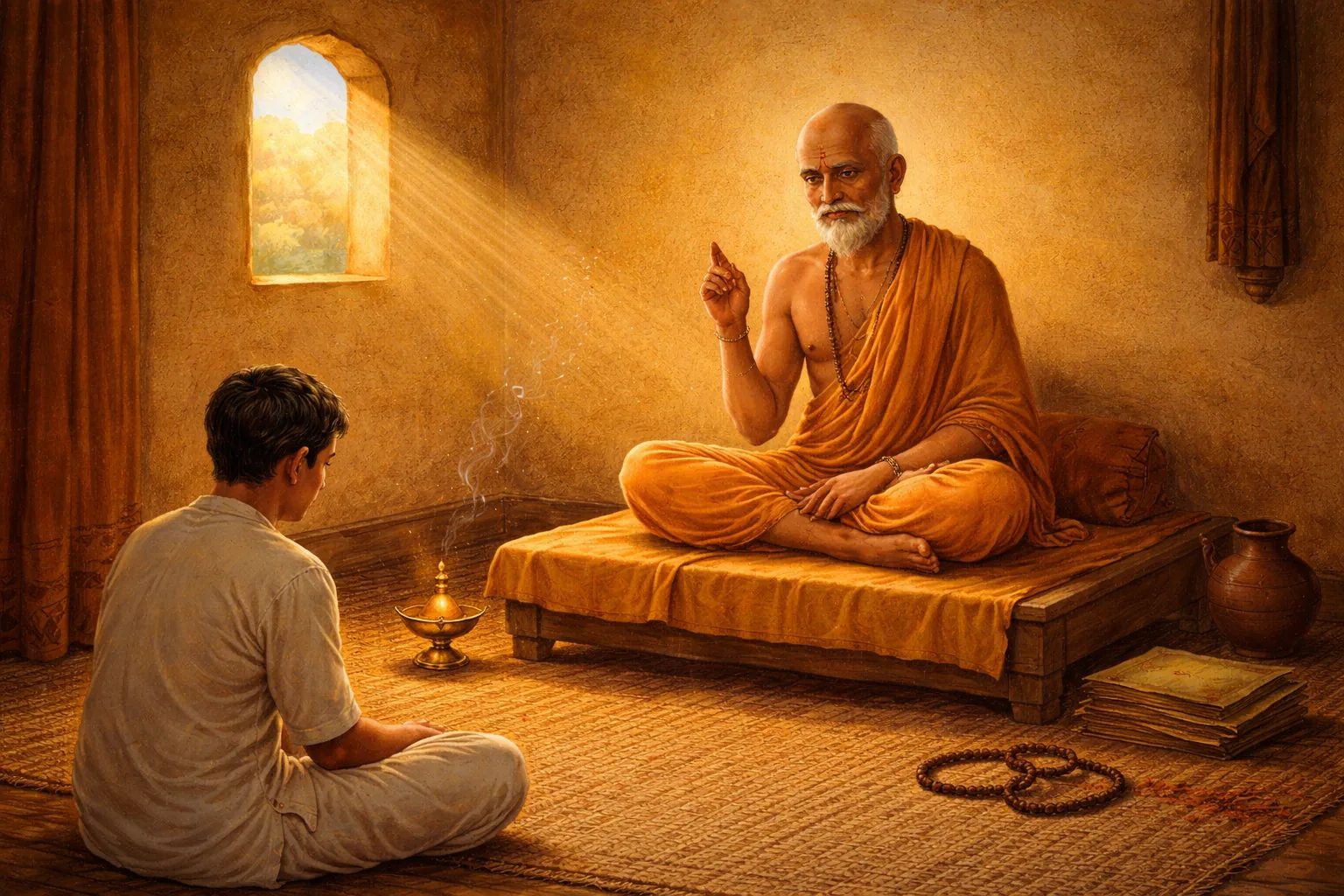
Commentary on the text of Sri Ramana Maharshi, the chapter “The Nature of God.”
In Ramana’s interpretation, at the highest level of his teaching, the terms Atman and God are synonyms for the all-pervading reality that is discovered through Self-realization. When we speak of the nature of God, we speak of revealing a view, or vision. For us, the nature of God is always connected with nondual vision. Vision is what must be revealed before we begin to meditate. There is a saying: “If the vision has not been revealed, further meditation will be erroneous.” One could say that vision is a way of relating to the things of this world, a way of perceiving this world.
From Ramana’s point of view, the realization of the Atman is the realization of God. For the yogi, it manifests not as the experience of some separate God, but rather as the understanding that he himself is God. Such understanding comes at the highest levels of realization. It is the realization of nonduality, of self-recognition. Again and again the saint says: “Find out who you are. All your questions arise because you do not know who you are. Find out who you are, and do not ask another about it. You ask this only because you do not know who you are.”
For example, a disciple comes to a teacher and asks: “Who is the Guru?” The teacher says: “Find out who you are. Then you will know who the Guru is. Until you know this, whatever you may be told, you will not understand it.”
Three Aspects of Vision
When we speak of vision, we speak of three aspects of vision. The Absolute possesses qualities, or essence. It has a nature that manifests as energy. Its essence is inconceivability (achintya), infinity (ananta), stainlessness (niranjana), purity, formlessness, self-perfection, and all-pervasiveness. Its nature is spanda, that is, the ability to emanate, to manifest.
This means that manifestation always appears within it through its power, but it itself is not the creator; it is separate from this manifestation. Rays come from the sun, but the sun is separate from the rays. The sun has no will to shine, to send forth its light, to choose, and so on. This happens spontaneously. In the same way, the Absolute has no conditioned will or desire. It happens in a self-perfect way.
Separate being is an illusion, the illusion that we are separate from the Absolute. When illusions disperse, there is only the Absolute. Usually this is the conceptual description. But we say that even such a conceptual description cannot be satisfactory, because it is unable adequately to describe the qualities of the Absolute; therefore, we accept this concept simply as a working description.
And if we speak of direct vision, then all these descriptions can be replaced by a single expression: the sound of one hand clapping. The one who hears it understands all the words that were spoken earlier. But one who is unable to hear it, even if there are many words, they will still remain only words. Therefore our school emphasizes direct vision, direct experience. Such vision is called pratyaksha, or the shunyata of the mahasiddhas. This means vision that bypasses conceptual explanation.
When we acquire the correct vision, then even if we are not awakened, we are still walking the right path. It is simply a question of time. Until we acquire the correct vision, even if we receive many experiences, we may be moving in a deluded direction, sometimes even backward altogether. That is precisely why it is so important to acquire the correct vision.
Before you, novices, receive monks’ kurtas, you will take an exam in verbal self-liberation. One could say that verbal self-liberation is your initial vision. At least at the level of words and mind, we must have such a vision, such an understanding of how to relate to everything.
Let us ask the monk Atma Nadi. For example, you are the guru, and I am the disciple. Demonstrate the vision. For instance, I come to you in the morning for a consultation and say: “I had a dream; you, my Guru, came to me in the dream. You performed some magical passes with me. It was so strange and interesting. You gave me a green little box radiating brilliance. Could you explain to me what this little box is, and what was inside it? I am very intrigued by this dream.” What would you answer as the Guru in order to clarify the correct vision for me?
Atma Nadi’s answer: This vision experienced by you is merely a play of the imagination of the dualistic mind. Therefore, first it is necessary to find the one who experiences all this.
Question: And how am I to find him?
Atma Nadi: Concentrate on the feeling of “I,” on the aham-vritti.
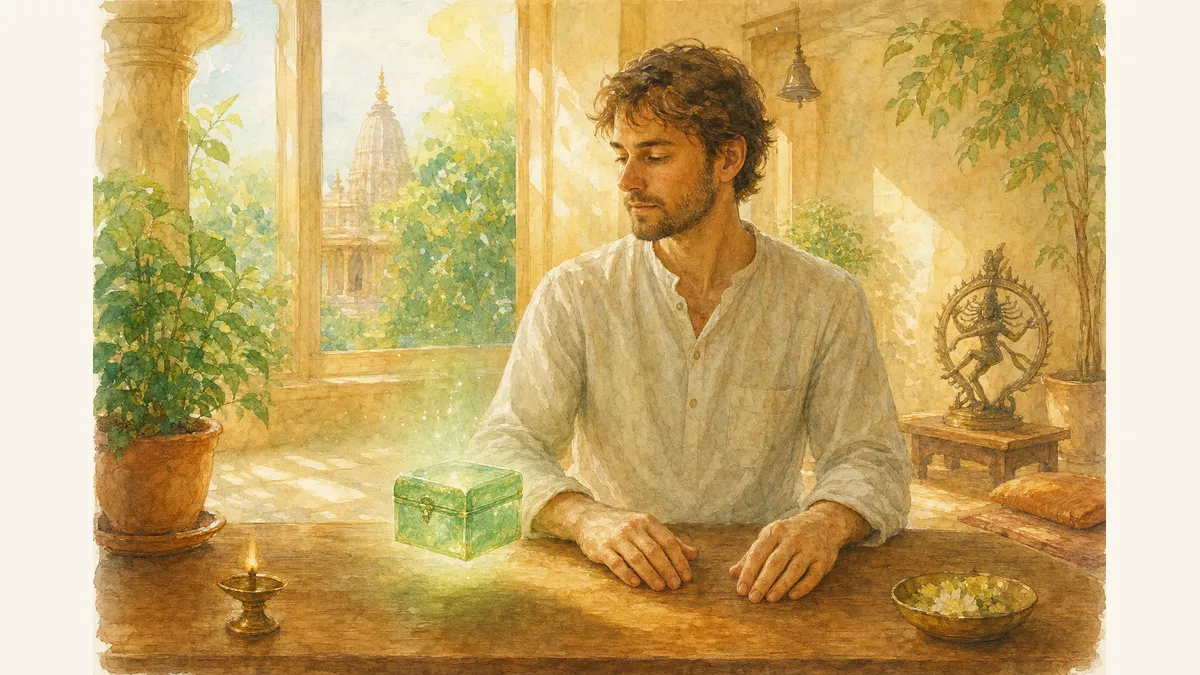
Question: I concentrate, but somehow it is not working very well. Perhaps this practice is not suitable for me, or I have no karmic connection with it?
Atma Nadi: The “I” is always present. But we always forget it. And only by turning our gaze toward it do we realize that the “I” is not images, it is not experiences.
Question: All right. But what about the little box? I cannot believe that such an interesting dream is merely an illusion. You came to me in reality. I saw all of it. I would very much like to look at it once again.
Atma Nadi: And who, after all, is the one who received this little box?
Question: Who? I did.
Atma Nadi: And who is this “I”?
Question: I… I have never thought about this.
Atma Nadi: This is the most important question that must be resolved through practice. When it is resolved, everything else will immediately fall into place. Everything will be realized: what this little box is, what the world in which this little box was received is, and who the one was who gave this little box.
Question: It seems everything has already fallen into place.
In approximately this way, the teacher explains the principle of vision. He shows how to relate to all phenomena of the psyche, consciousness, and the external world; how to seek and find the heart essence in everything perceived; what to consider important and what secondary; what to develop and what to discard. This vision is called viveka-vidya, discriminating wisdom, when we are already able to separate the wheat from the chaff.
Text by Sri Ramana Maharshi
Seeker: God is described as manifest and unmanifest. In the first case, it is said that he includes the world as part of his being. If this is so, then we, as part of this world, should easily be able to know him in his manifested form.
Maharshi: Before resolving questions concerning the nature of God and the world, know yourself.
Ramana tries to turn the seeker toward pratyaksha-advaita — toward the direct vision of emptiness. He says: “Leave all your concepts behind. Everything you have read does not work now. All of that is your further thoughts. Better know the depth of your consciousness, break through the layer of conceptual thinking. No matter how much I explain to you in words everything you are asking about, it will not satisfy you. It is like saying the word ‘halva’ over and over again — your mouth will not become sweeter. Better shift your consciousness, and suddenly you will see that a Source has opened within you, which itself answers all questions.” This is pratyaksha-advaita.
The disciple does not understand this, because the layer of non-conceptual consciousness is still closed to him. Then the teacher simply gives him a method and says: “Work with it, and it will lead you.”
Here, great trust in the method is important, because thoughts will tempt us, visions will enchant us again, and our own mind will once again lead us by the nose.
Ananda Dhyana, for example, now you are the Guru, and I am the disciple. I come and say: “I meditated, and I had a vision of a certain monk. He had a body made up of tigle. He was showing me some mudras, calling me to follow him, and wanted to show me some secret place. Should I have followed this monk, and what were those mudras?” How would you explain the principle of the view to the disciple?
Ananda Dhyana: Turn your attention inward, toward the subject.
Vasudeva: And what did you dream before that? And what do you think you will dream tomorrow? And when all of this ends, what will remain?
Everything we perceive is the dreams of our subconscious and superficial mind. And this is the only correct attitude toward all of this until we awaken. It is precisely the one who has revealed the vision who has such an attitude toward everything, this kind of view. He knows: “Nothing below nonduality interests me.” And he trains himself to shift his consciousness to nonduality. We must choose once and for all: either we are interested in the paths of this world, or we are interested in the Absolute.
Nondual Vision
If we are interested in the Absolute, detachment from all the paths of this world arises in us. The paths of this world are not only the world left behind in worldly life, but also the entire world that is within us. Our petty desires, our visions, our fantasies and thoughts — all of these are paths of this world, located within us, which we must also leave behind in order to open that absolute vision.
And here, whatever the student may ask, the teacher will always answer him uncompromisingly, saying: “You may see, think, and say anything you like, but all of it is only your dreams. Discover the one who speaks, find the one who thinks, and then you will awaken. Then knowledge will arise within you yourself as to how to relate to all of this.”
This does not mean that we cannot speak about relative topics. We can. But the point is that when vision is revealed, conversation on relative topics already loses its significance. It is already perceived as a game. It is no longer dharma or anything else. It is simply a play of thoughts and energy. It is entirely subordinate to the nondual. At any moment we can dissolve all of it.
Seeker: Does my self-knowledge include knowledge of God?
Maharshi: Yes. Because God is within you.
Seeker: What, then, stands in the way of my knowing myself or God?
Maharshi: Your wandering mind and perverted way of life.
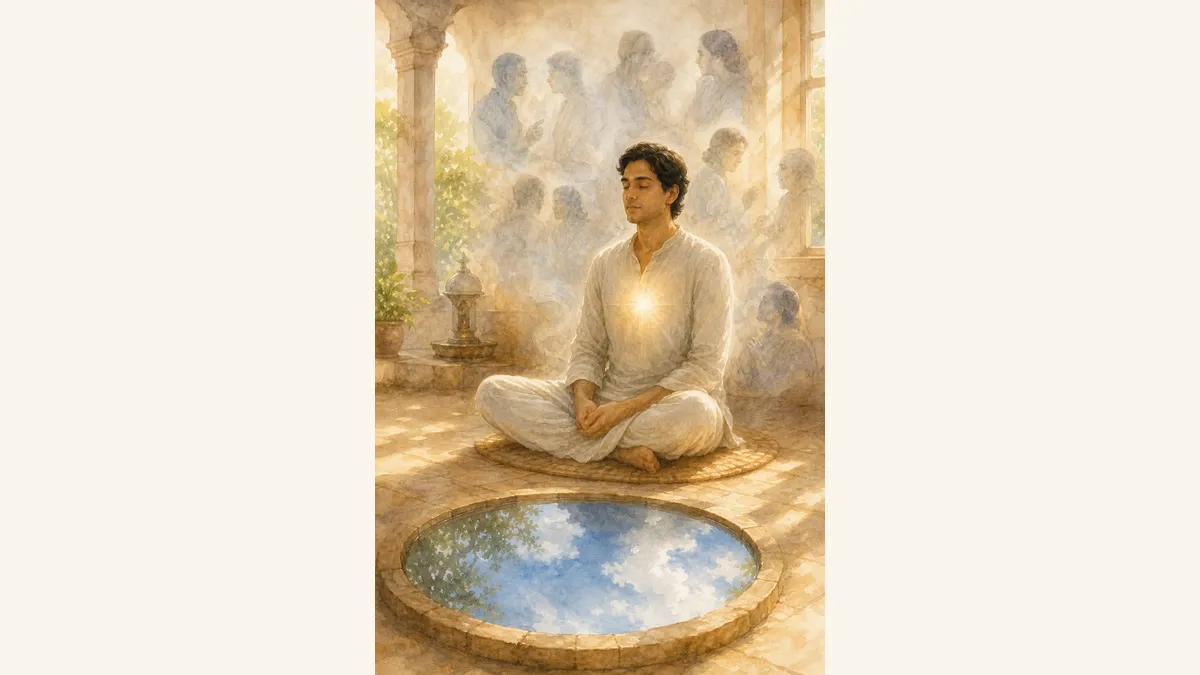
On the path to knowing God, our wandering mind and inattentive, perverted—that is, distracted—way of life always lie in the way. When our mind is inattentive and wanders, thoughts arise that lead us into illusion. And we try to resolve the conflicts or questions that arise because of these thoughts, without noticing that if the main question is resolved, it resolves all the minor questions.
For example, Vasudeva—you are the Guru, and I am the student. I come to you and ask: “Tell me, how was your trip to India? Was it interesting there? Whom did you see? I have come to you for enlightenment.”
“Guru” Vasudeva: If you have come for enlightenment, then you can drop all the other questions.
“Student”: And what should I do?
“Guru”: Everything will be stated point by point: from rising to shavasana.
The “student” thinks: It seems this Guru does not support my illusions at all. He does not even want to hear what I am asking him about.
The “student” says: All right. And how can I be closer to Vasudeva? I am confused.
“Guru”: Everything is fine.
In the process of training, the student calms down for a while. He thinks about this for some time and enters non-conceptual consciousness. But then, as usual, he forgets himself again and becomes distracted; his karmas bring forth new questions. He comes again with these questions. Here the Guru acts as a sublimator. In principle, it is as if he does not hear you. Or rather, he hears, but he hears your heart. He hears your illusory questions too, but he does not want to hear them. Why? Because they are the great horns of a poor rabbit. All that needs to be done with them is to knock them off, not answer them.
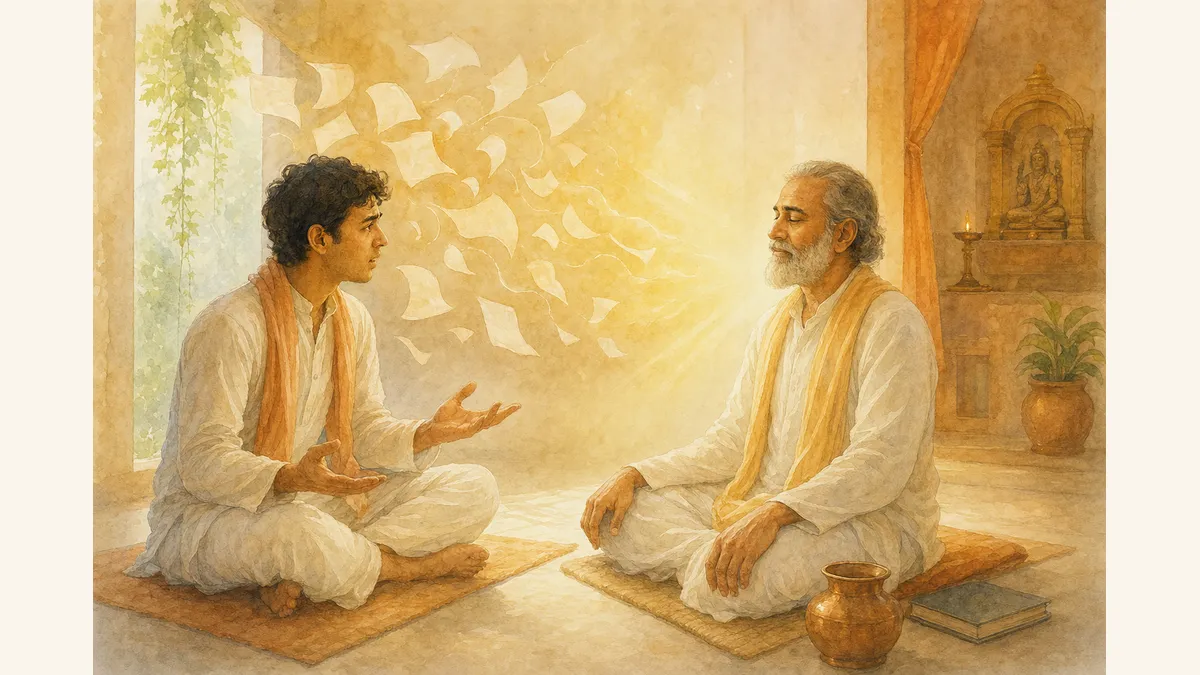
Here the student is required to have very great understanding, sensitivity, the state of an empty vessel, in order to attune to the spirit of the Guru, the Master. Such attunement ensures direct transmission, when you suddenly understand that it is not a matter of words, but of the energy of awareness beyond words. It is like one radio station tuning in to another. By attuning to the consciousness of the Guru, you attune to the emptiness of the mahasiddhas. This is the main principle.
To expect conceptual answers from the teacher means to forget who the Guru is. To expect the Absolute to be described in the form of concepts means to be in a dream. Breaking through concepts, we break through to the vision of the Absolute. Each such answer is like the sword of Manjushri, which cuts off illusions. Imagine that you are in this state continuously, and then all arising thoughts cannot withstand such an uncompromising gaze. When you have opened such a gaze and mastered it, it is said that you have revealed the vision, and now you simply need to train it.
This gaze is not connected with a particular person. It is connected neither with anything external, nor with the form of God, nor with a specific method. It is connected with the depth of the presence of awareness.
God as the True “I”
Seeker: Is God a person?
Maharshi: Yes. He is always the first person, the “I,” constantly standing before you. But because you give preference to the worldly, it seems that God has moved away from you. If, however, you cast everything aside and seek only him, he alone will remain as the “I,” the Atman.
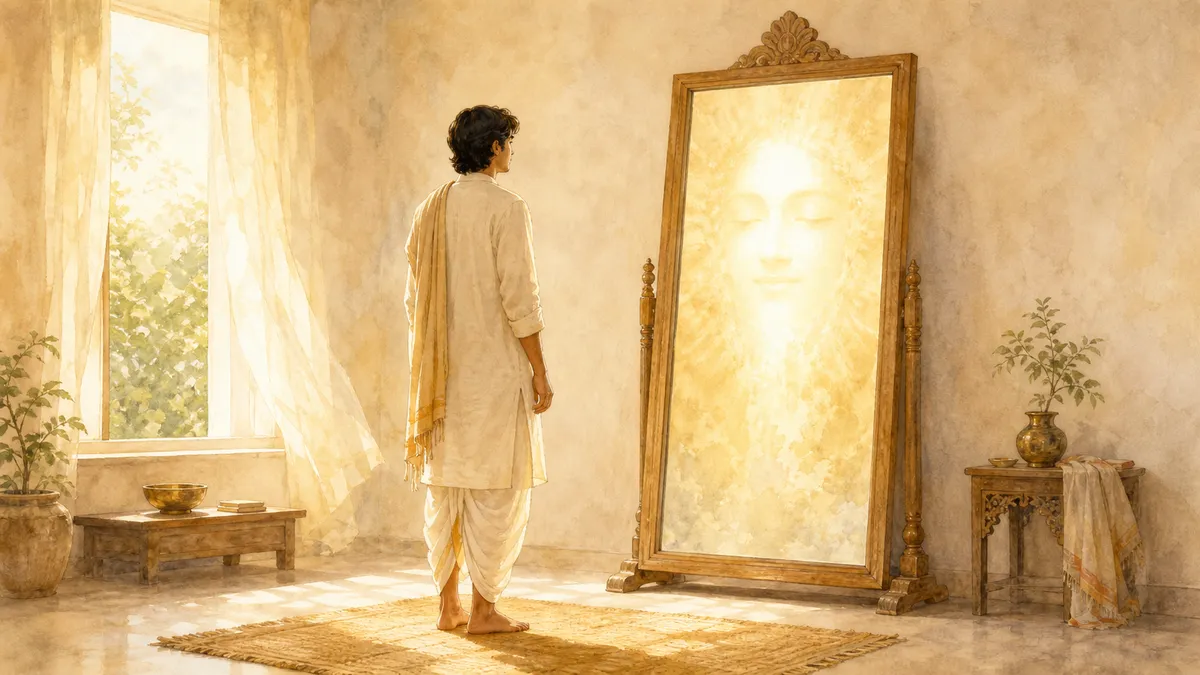
When we discard everything, what remains is the naked, stainless mirror of the pure “I.” And when we begin to look into this mirror, we can see the face of God. Only in such a mirror can the face of God be seen. To see the face of God means to directly experience the bhavana “Aham Brahmasmi.” We cannot see the face of God through someone else’s mirror or through words. Only in the mirror of the pure “I” is the face of God visible.
Seeker: Is God separate from the Atman?
Maharshi: The Atman is God. “I am” is God. Such a question arises because you are attached to the ego. It will not arise if you hold to the true “I,” for it does not want and cannot ask about anything.
It is the conceptual mind within us that wants to ask. This mind is like a little monkey accustomed to jumping from tree to tree. But when we discover the deep “I,” it does not want to ask about anything.
Bhagavan Shree Rajneesh, after enlightenment, said: “I have no questions. There are only answers.” This means that all questions come to an end when the deep “I” is discovered. At the same time, I am not saying that you cannot ask. You may have questions, but they will concern simple things: service, the subtleties of performing a technique, a method. But questions concerning the nature of reality disappear completely. That is, for the rest of his life the disciple asks questions concerning only technical details. It is like when the bride has been chosen, and only questions about buying one wedding dress or another and the nuances of organizing the celebration are discussed, while exactly who has been chosen as the bride is already clearly understood by everyone; this question is no longer discussed.
Until you have revealed vision, the bride, one might say, has not yet been chosen; you are still in doubt. But when she has already been chosen, only the subtleties are discussed: the dress, the ring, how many relatives to invite. That is, only the details are discussed, while the most essential matter has already been decided. Of course, for monks this is not a very good example, but it is simply very illustrative.
The Disappearance of Individuality
Maharshi: If God were separate from the “I,” then he would have to be a God without an “I,” and that is absurd. God, who seems to man not to exist, alone exists. Whereas the individuality considered real never exists.
When we look into the pure mirror of the “I” and see the face of God as bhavana, we see that he alone exists, while our individuality, which we previously considered real, never existed.
This is a direct literal perception: “I do not exist.”
You can literally feel: “I do not exist. Everything that is perceived as ‘mine’ is ignorance, an illusion.” All my thoughts, preferences, visualizations, dreams, and desires used to arise from a false center. But now this center has dispersed, and the pure “I” has shone forth. And there is no me at all as the one who chooses. There is only the Absolute.

At this stage, your thirst for discrimination falls away. Equanimity appears: blame and praise, good and evil, sorrow and joy. When you are not there, you see that others are not there either. Others exist only when you exist. All the numerous connections and relationships exist only when, in your perception, there is you and there are others. When you are not there, there is not a single other being either, and this means that all connections, all relationships also disappear. There is only one supreme Being, which plays.
Self-Transcendence and the Cutting Off of Hope and Fear
You understand the complete futility and illusory nature of your own choices, preferences, and thoughts, and you leave them behind. This is also called cutting off hope and fear. Since you are not there, there is nothing to worry about. This is self-transcendence.
It sometimes happens that a practitioner, diligently practicing awareness, begins to care too much about himself, to think too much about himself. He becomes literally obsessed with himself. He becomes so deeply immersed in the inner universe that every careless thought, every careless word spoken to him shakes him and gives rise to thousands of associations. He is so strongly oriented toward himself that the whole world begins, as it were, to close in around him. Under the influence of spiritual practice, his ego becomes subtler and inflated.
But then a moment comes when it is as if it is pricked with a needle, and the ego sees: “I do not exist; there is only the Absolute. There is no need to tremble, nothing to cling to, nothing to worry about. Everything that happens is the triumph of the Absolute. If I feel good, it is the Absolute manifesting its glory. If I feel bad, it is also the Absolute triumphing. Events unfold in a wondrous way — this is the glory of the Absolute. Events unfold in a dreadful way — this is the wrathful glory of the Absolute. Whatever happens — in any case, the Absolute triumphs.”
When there is no “I,” then there is no evaluation, no choice; then everything is absolutely perfect.
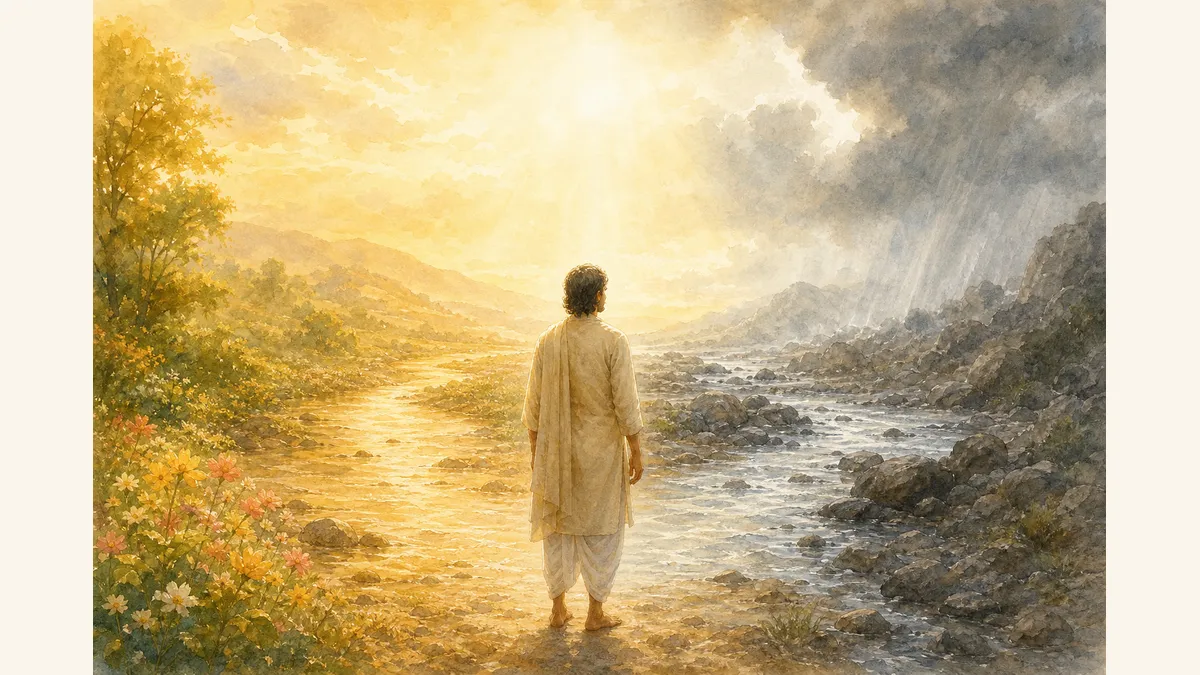
At first, when our “I” exists, we choose too much; we refuse to acknowledge the triumph of the Absolute in everything. When our “I” likes something, we say, “This is good.” When it dislikes something, we say, “This is bad” — and reject it. But even when something happens that we do not like, if there is no one evaluating it, then this too is the triumph of the Absolute. When the “I” disappears, evaluations also disappear, and then we see that everything that happens is the triumph of the Absolute. And since this is the triumph of the Absolute, our personal attitude toward reality completely falls away. We can no longer complain about anything or feel ourselves to be suffering; we can no longer become attached to anything. We become all-accepting. We take roughly this position: “Since everything is the Absolute, who am I to correct the games of the Absolute? Everything has the right to manifest.” That is, we no longer have our own model of reality. We no longer tell God how to make two times two equal five.
All of a person’s egoistic prayers are like requests such as this: “O Lord! Make it so that two times two is not four, but five.” Why do they ask this way? Because they proceed from the illusory “I,” which craves this or that. At first it craved worldly things: power, gold, women, and so on; and now it craves spiritual experiences, freedom. But it still craves egoistically, passionately, with attachment, clinging to itself, because the root of the ego has not been severed. That is, samsara becomes subtler, but it does not disappear anywhere. But if the “I” has disappeared, then we suddenly discover that our most cherished prayers have been fulfilled, and they have been fulfilled precisely because our “I,” which so craved, has disappeared. Suddenly we see that there is no liberation for the “I.” There is liberation from the “I.” Therefore it was not in vain that the saints called the ego the greatest evil spirit, that is, that which gives rise to duality.
Maharishi: The sages say that the state in which one’s own non-being, shunya, is known is itself the magnificent highest knowledge. Now you think that you are an individuality, that there is a universe, and that God abides outside the cosmos. Therefore there is the idea of separateness. It must go, for God is not separate from you or from the cosmos. The Gita also states: “I am the Atman, O Gudakesha. I dwell in the heart of every being. I am the beginning and the middle, as well as the end of all beings” (“Bhagavad Gita,” X, 20).
If we exist, then there is confusion, suffering, uncertainty, identification, anger, resentment, attachment, and so on. And we tend to project the causes of these things onto external objects. For example, we may imagine that the problem behind our troubles lies in another person and become angry with them. But when you come to the teacher with a complaint about this person, and if he sees that your mind is truly disturbed because of it, he may say: “The problem is different. It lies in the fact that you think you are an individuality, that you are you. Remove this problem, and you will no longer see a single problem in all the vast universes, in all the three worlds.”

When we understand this, it is said that we have opened vision, that we have opened the view.
At this stage, any problematicality conditioned by the mind goes away. Some subtle karmas in the subtle body, pranas, and relative karmas may remain. But all problems of the soul go away forever. They simply can no longer exist. We no longer try to seek the source of our problems in external circumstances or shift them onto other people. We fully accept responsibility for ourselves.
Seeker: I understand this. Brahman, of course, is indivisible.
Maharishi: The essence is that Brahman is everything and remains indivisible. It is always realized; however, a person is not aware of this and must come to such knowledge. Knowledge implies overcoming the obstacles that hinder the revelation of the eternal truth that the Atman is identical with Brahman. These obstacles, taken together, form your idea of separateness as a certain individual.
Life in Lila — the Play of the Absolute
What, then, remains for the yogin who has revealed the vision and who contemplates well? For him there is no longer an “I,” no others. For him there are no ordinary actions. For him there is no attachment, no acceptance, no rejection. For him there is no goal, no path, no attainment. Nevertheless, everything manifests through him. What, then, remains to exist for him? For him there is lila, play, life in the pure dimension. Life in pure vision is life in a mandala. It is life beyond concepts, life beyond a coarse attitude toward reality. It is a very refined, free, playful, spontaneous life among an infinite multitude of energies. It is life when ignorance, suffering, and the like have already gone. And there is simply the living out of residual karmas in a pure form.
Sahaja-yogini-chinta spoke as follows:
In order to liberate someone, whether you laugh or cry, sleep or remain awake, display constancy or fickleness, flirt or are dispassionately detached, are capricious, insatiable, dance or sing spiritedly, gamble, perform ablutions or go about dirty, appear naked among people, are rich, generous, or utterly destitute, mock the Buddha’s teacher, speak the truth, sin, lie, talk nonsense, or simply remain silent—since everything is originally pure, an enlightened person has complete freedom in his behavior. An enlightened yogin is always pure, and his actions and body are entirely sacred and like a dance. All bodily movements, spontaneously arising from the enlightened mind, are pure by nature; they become sacred actions. Everything uttered becomes sacred speech. Merciful, heroic, terrifying actions, passion, anger, pride, greed, envy—all of this without exception is the essence of the perfect form of pure self-born wisdom.
Here the final state of an awakened yogin is described. Life in play, lila, when body, speech, and mind are completely purified and become the pure qualities of the play of the energies of the Absolute.

In order to enter the pure dimension, we must develop the corresponding pure self-liberating consciousness. In essence, we must become a deity while alive.
It may be said that such a yogin lives both in the world and not in the world. He both considers himself the body and does not consider himself the body. He says “I,” but means something else. He speaks and does not speak. He acts and does not act. He sees and does not see. He achieves goals, yet he strives for no goals whatsoever. All of this is in fact the spontaneous play of an awakened yogin.
Of course, this does not come at once. True spontaneous play arises from abiding in presence. If there is no such presence, then, of course, no play takes place; rather, there is duality, conditioning.
When I hear some people say that they are playing at their work, that this is lila, while being preoccupied with this or that, I simply smile. Lila means complete non-attachment. For example, you have established a relationship with the Guru, and he says to you: “Well then, have you played enough? Tomorrow move on to another job.” If a person can do that, it is lila. If he has difficulties or even the slightest confusion, it is karma.
In ancient times, siddhas gave such methods to disciples, when a saint would say: “Go, work for such-and-such a vaishya. Achieve success in this work.” For three years the disciple works diligently, achieving success. Suddenly the Guru comes and says: “That’s it, good. You have succeeded. Now you no longer work here. Leave all this right now. Take everything you have, and we will go further.” Tilopa taught Naropa in precisely this way. Once he gave Naropa the task of going down from the mountain and becoming a householder for a time. Then, a couple of years later, the teacher came down and again told him to leave what he was doing and begin another practice.
Lila is complete non-attachment, complete non-identification. You do nothing; one might say that you are only portraying it.
The Pure “I” as the Absolute
Seeker: Is God the same as the Atman?
Maharishi: The Atman is known to everyone, but not clearly. You always exist. This being is the Atman. “I am” is the name of God. Of all definitions of God, there is truly none better than the biblical statement “I am that I am.” There are other formulations, such as “Brahman am I,” “Aham Brahmasmi” (I am Brahman), and “So Ham” (I am He). But none is as direct as the name that means “I am.” Absolute being is as it is. It is the Atman. It is God. By knowing the Atman, God is known. In essence, God is nothing other than the Atman.
Our pure “I,” in its depth, is the Absolute. Outside this pure “I” there is no other Absolute. Our pure “I” in its depth is not at all what we consider our “I” to be. We consider our “I” to be the body and a little bit of consciousness. But our pure “I” in its depth is like boundless space. It is like a dazzling space of light in which there is no duality.
Contemplation is nothing other than attunement to this space.

Vision is nothing other than understanding the principle of this space.
To contemplate the Guru, to receive instructions, is nothing other than an attempt to see this space in him.
The disciple’s relationship to the Guru is built on the disciple seeing this space in him. Moreover, it does not matter whether he actually sees it or not, or what feelings he has. Feelings cannot be trusted: today you may be inspired, and tomorrow you may be in a gloomy state. But the practice consists in training oneself to see it constantly, since this space exists in every person, even in a dog. This is the principle of Guru yoga.
Over time, we become accustomed to seeing this space everywhere, including within ourselves. Of course, at first we try to discern it in more exalted beings: in saints, in siddhas. But such contemplation must lead to our discovering this space within ourselves, and not in someone else. In the end we see that there are no others and no “I,” that there is only this one space, and that all duality was a delusion. There is no “us” who worship the gods. There are no saints or gods in themselves whom we worship. All this is the play of one space.
We perceive this space when we become completely empty, when emptiness enters our heart, when lightness appears in the soul, when neither joy nor sorrow can strike us any longer, when we relate lightly to all events, thoughts, and desires and self-liberate them.
An inexperienced practitioner, when he remains at the level of the subconscious, is easily disturbed. The subconscious is very sensitive, very subtle. Literally the smallest thing can throw it into a completely wild state. But an experienced practitioner cannot be disturbed or knocked out of presence.
The Name of God “I—I” and the Inquiry into “I”
Seeker: God is known by a multitude of different names. Is there proof for any of them?
Among the many thousands of names of God, none corresponds so well to God dwelling in the heart, free of thoughts, none is so precise, fitting, and beautiful as “I,” or “I am.” Of all the known names of God, the name “I—I” alone will resound triumphantly after the destruction of the ego, arising like the silent, supreme word (maun-paravak) in the space of the Heart of those who are turned toward the Atman. Even if a person continuously meditates on this name “I—I,” attending to the feeling of “I,” it will sink into the Source from which thoughts arise, destroying the ego—the seed joined to the body.
The task here is not to place the personal “I” on a pedestal, but, by investigating consciousness and penetrating beyond the personal “I,” to find the Supreme Source that absorbs the personal “I.”

The personal “I” always lays claim to dominating, to commanding, and to considering itself real. However, it is simply a jester playing the king. You know that a monk must be dispassionate. He must not take offense at anything. Even if someone spits in his face, insults him with the filthiest words, or beats him, he must not lose his dispassion. I do not mean that this is done in the sangha. This is simply a kind of hypothetical supposition. A monk must be dispassionate; he must be indifferent to his small “I.”
For example, once, when one of the Buddha’s disciples was going to preach, the Buddha said to him:
— Do not go to that region. Unclean people live in that region. And if you preach, they will drive you away or insult you.
But the monk said that he would still like to receive a blessing to go to that region. Then the Buddha asked:
— And if they insult you?
The monk replied:
— I will thank them for it, because in this way they will wash away my karma of slander, and I will continue preaching.
The Buddha asked:
— And if they beat you with sticks?
The monk replied:
— I will thank them, because they will wash away my karma. After all, they will not kill me, and that will be very merciful of them. With my bad karma, I would deserve more.
The Buddha asked:
— And if they beat you so badly that you die?
The monk said:
— I will thank them anyway. In this way they will wash away my bad karma of sins accumulated in the past.
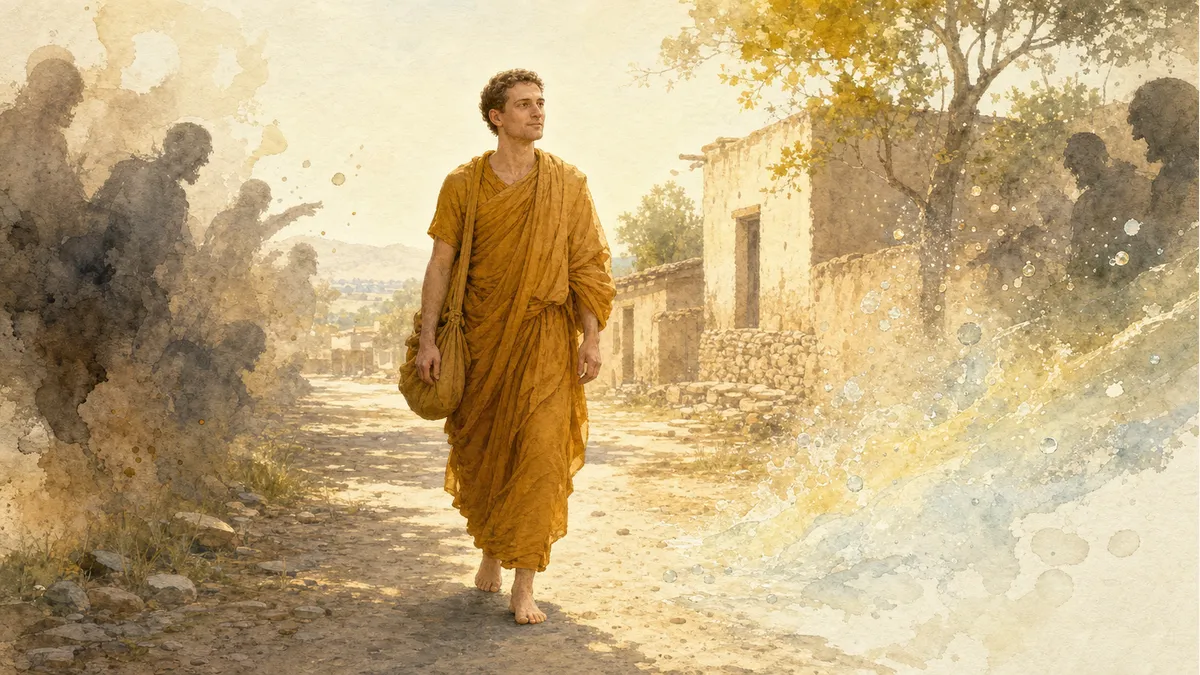
That is, this monk could have been killed, but he could not have been shaken in all-acceptance, in gratitude, in the vision of the purity of the Absolute, in the vision of the absolute play. He no longer had his own “I”; he was not attached to it, he was fearless and dispassionate. He did not cling to his “I,” and therefore learned to thank reality for everything. It is easy to thank reality for good things, but even a dog does that. If you carry prasad, it joyfully wags its tail.
And only an awakened one or a saint can thank reality in any situation: in good, neutral, and even negative ones. He thanks reality not for the situation, but simply because the state of gratitude is the only possible state of his own. Because he is full of this feeling, he constantly abides in abundance from unity with reality. He does not see at all that there is some separate “I” that has the right to be offended and to judge. He sees that there is no “I,” but only the Absolute, whose games are perfect. In the Absolute there is not even a milligram of anything impure or vile. And since the Absolute plays in this way, it does not matter whether these games are peaceful or wrathful, because the only appropriate approach with such a perception of reality is gratitude. Such gratitude toward being arises from liberation from the sense of “I.” It is precisely from such love and gratitude toward all aspects of the Absolute that dispassion and detachment arise.
Dispassion without awareness, which is produced simply as a result of suppression, or immature courage is, of course, not it. True dispassion is born from all-acceptance of any games, any aspects of the Absolute, from the ability to be boundlessly devoted, in love with reality, and constantly grateful to it, without judging whether this reality is good or bad.
In a relative sense, we strive to protect our personality, for example from bad weather. The personality should be protected for the convenience of practice. But it should not be what is defended.
Therefore, one who has seen the illusoriness of the “I” always has a light and free consciousness. Even if something happens, he thinks that these are not his problems. He never has problems, since he knows that problems exist only in false identification.
Acceptance as the Play of the Absolute
There is a story that two psychiatrists lived in the same building and met every morning in the elevator as they went down. It was a wealthy building, so there was a doorman in the elevator. And every day this doorman saw the same scene: one psychiatrist angrily spat in the face of the other, while the other took out a handkerchief, wiped his face, and giggled. The doorman was always very confused, because this scene kept repeating itself. He could not understand what was going on, why there were such strange relations between them. Perhaps they had some great rivalry? Perhaps they were two famous scientists who hated each other. One day he gathered his courage and asked the psychiatrist who was being spat in the face: “Why does this happen every day? Why does that man spit in your face, and you do not even react, but simply wipe yourself off and laugh?” This psychiatrist answered him: “I do not know why he spits in my face, but I know for certain that it is not my problem. That is exactly why I laugh.”
This story contains a very deep meaning. You do not need to know why this or that happens. You know that it is not your problem, and therefore you giggle in your soul.

If someone spits in your face, then, of course, it is not your problem. The main thing is that you do not spit in anyone’s face. You love and are filled with gratitude even when someone spits in your face, because you know that the one who does this is not satisfied, that somewhere deep in their soul they are suffering greatly. And you are not suffering, so you are able to accept it. This is the fullness of all-acceptance from a state of gratitude, where there is no ego at all.
This happens when the “I” is completely lost, when there is no longer any distinction. For one who has entered the state of play, nothing is real anymore. Whatever happens, he only chuckles. He knows that if one abides in awareness, everything is seen as pure and perfect, everything is perceived as the play of the Absolute.
Seeker: What is the relationship between God and the world? Does God create the world or only sustain it?
Maharishi: All beings, sentient and insentient, perform their actions only thanks to the mere presence of the sun, which rises without any desire of its own.
