

Commentary on the text “Yoga Vasistha,” Chapter 6, “Reflections on Brahman”
Vasistha continued:
“Again and again I repeat the same thing to you.”
This is what a spiritual teacher does—he repeats the same thing again and again, only from different angles. If you listen to lectures for one year or five years, they will be about the same thing. I intend to continue giving lectures on Brahman in the future as well, and I do not think that anything will change in Advaita. Of course, there are various methods and their subtleties, but the essence of the teaching itself does not change. And you are now hearing what Vasistha said perhaps tens of thousands of years ago.
“O Rama, in order for you to awaken spiritually, understanding does not arise without such repetitions (special practices). Ignorance has become so dense and impenetrable because it was repeated, expressed, and experienced through thousands of incarnations in this body and beyond it. But self-awareness is unattainable for the senses.”
Rama asked:
“I beg you, tell me what is the nature of the self-awareness possessed by these sages.”
Vasistha replied:
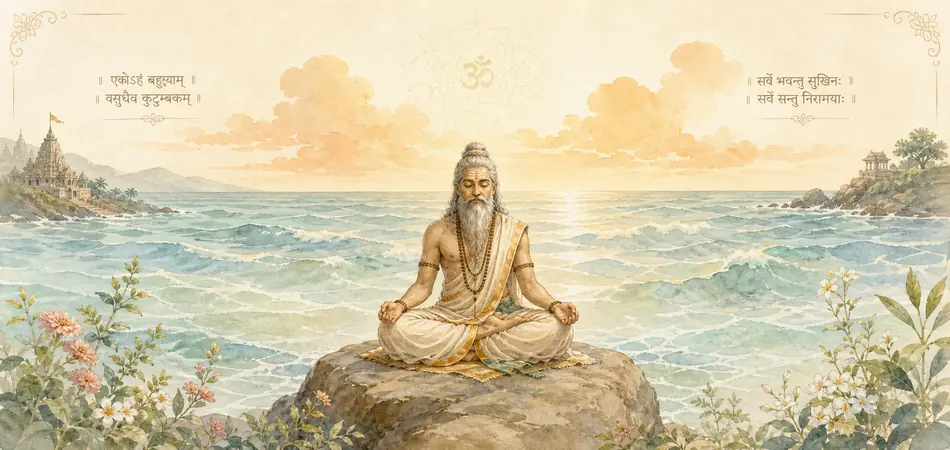
“Rama, you already know this. But to make it even clearer, you ask about it again. Everything that is here and appears to be the world is only pure Brahman, or absolute consciousness, and nothing else. Consciousness is Brahman, the world is Brahman, all the elements in it are also Brahman. I am Brahman, my enemy is Brahman, my friends and relatives are Brahman. Brahman is the past, present, and future; everything has its beginning in Brahman. Just as the ocean appears fragmented because of the waves, so Brahman appears to be multiple because of the infinite number of different substances. Brahman reaches Brahman, Brahman experiences and enjoys Brahman, Brahman manifests in Brahman through the power of Brahman itself. Brahman is the form of my enemy, whom I, Brahman, hate—in this case, who does what to whom? States of mind such as attraction and repulsion, liking and disliking, are the result of imagination. They cease in the absence of thoughts.”
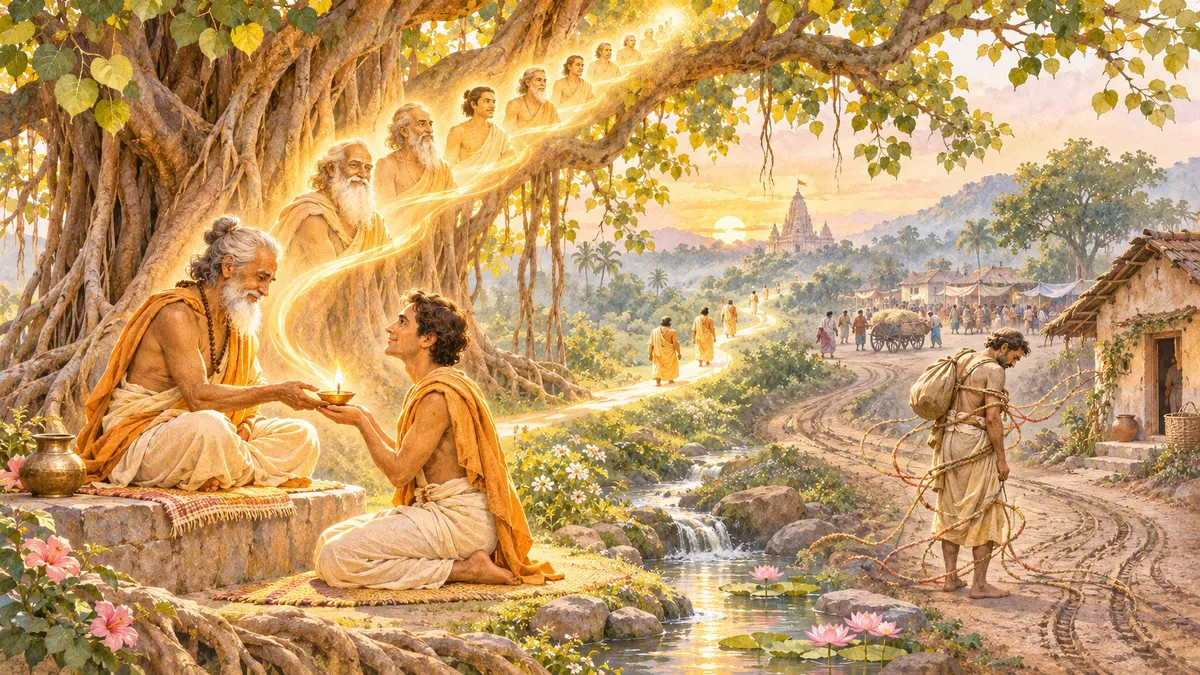
Again and again, Vasistha gives Rama a direct introduction, relying on the three golden rules. First comes śravaṇa, when Vasistha gives teachings about the view, about the nature of the Mind. Then comes manana, when Rama reflects and says: “Still, something is unclear to me. Please clarify it,” that is, the time comes to comprehend these teachings. Then Rama enters samadhi and realizes some understanding. After that, doubts arise in him again, so he once more engages in clarification (manana). Vasistha explains the view to him again and helps him clarify these principles. This is precisely how the education of a disciple took place in Vedic times.
“When only Brahman moves in everything that is only Brahman, and only Brahman manifests as Brahman in everything, where are joy and where is sorrow? Brahman is satisfied with Brahman, Brahman is within Brahman. There is neither ‘me’ nor ‘other’.”
The Conditioned and Absolute Viewpoints
From our human point of view, it seems to us as though you have come to the retreat, I am giving a lecture, the monks are “being monks,” and the laypeople are “being laypeople.” At present, it seems as though a lecture is taking place, but all of this appears so only from our position as conditioned outside observers. Such a viewpoint belongs to the dimension of ignorance (avidya), or not knowing our true nature (ajnana). This viewpoint is conditioned, ignorant, illusory, and incomplete. If we continue to adhere to it without a higher viewpoint, it will continue to be a source of suffering. We have not yet freed ourselves from suffering.
Because if we had freed ourselves from suffering, we would probably be sitting on lotus thrones in the dimension of pure vision, we would be mandaleshvaras, and we would be discussing not issues of personal liberation, harmonizing the pranas, pacifying desires, or renouncing attachments, but questions about creating a new universe through the power of the mind, arranging it, and populating it with various beings. Or perhaps we would not be discussing anything at all, but would simply be bringing things into reality through an effort of will and having as many immortal bodies as we wished. We would not be thinking about how to build another hall because there is not enough space for retreats when people come; we would simply materialize, through the power of intention, versions of realities, spaces for living, and mandalas where all of this already exists. We would not be bound by time, nor would we think that a certain amount of time had been allotted for the retreat and that afterward we had to go home; we could stop time or set it to the desired mode, loop it, or accelerate it—whatever we wanted, we would do.
But all of this would be possible only if we had realized the absolute viewpoint “I am Brahman,” had ourselves become Brahman, and manifested some active function of our own. But since this is not the case, we discuss the issues of our personal, individual liberation. Why? Because it seems to us that we are human beings, that we are practicing, that we have come to a seminar, and that a lecture is now taking place. But all of this is itself already ignorance, a certain form of illusion.
The Unified Metasystem of Brahman
In reality, it is Brahman who is playing here; we are one Being—many-armed, many-headed, and multilingual. This Brahman has initiated various lilas, or games; that is, we are one vast, super-self-organized metasystem. At different levels, this metasystem has different forms of manifestation: gods, rishis, saints, apsaras, gandharvas, asuras, rakshasas, demons, human beings, lower spirits, and the great demons of the hellish abysses, who also perform their respective functions. But all of this is one super-self-organized metasystem, developed to such an extent that it provides its various parts with artificial intelligence and freedom of choice, endowing them with personal will.
Of course, this is, as it were, pseudo-freedom, pseudo-intelligence, and pseudo-will. By endowing its parts with such functions, it allows them, while deluded, to think of themselves as separate beings. We are precisely parts of such a unified metasystem. But since we are endowed with freedom of mind and freedom of choice, we think something else about ourselves; in other words, we have “lost our way,” and this delusion has continued for a very long time, through many lifetimes, and now we are searching for the way back.
If we were already awakened, we would not need to meditate or make efforts; we would be engaged in some other, creative activity: creating illusory bodies, thinking about how to enlighten other beings, or creating our own universes. But that is precisely the point: our free will is constrained, and our creative activity cannot manifest until we have fully realized the state of nonduality and discovered within ourselves this unified metasystem of which we are a part.
Sometimes there are people who say: “I have read such-and-such books, so I am quite familiar with the Advaita view. I know that I am God. I would like to talk and clarify a few things.” I reply to such people: “I have great respect for you; I hold you in very high regard. I simply do not understand what you are doing here or what you want to clarify with me. If you are God, you should be in your own universe or, at the very least, be creating it. You should simply astound all of us with your enlightened qualities and create many creative energies. By now, you should already be serving the welfare of living beings wholeheartedly. But it is unclear what you are seeking by asking us such questions if you are God. You ought to be abiding in a state of omniscience. But why do you need interaction? Why do you have questions? You should have all the answers. You should already be solving the problems of others at the center of your own mandala, if, of course, you have enough shakti to create it.”
Realizing Advaita always implies that we realize not only the state of jnana, but that our energy also manifests—and this energy manifests actively. But until the state of jnana has been fully realized, we strive to work diligently, engaging in inner practice in order to realize this state.
The Nonduality of Good and Evil

Vasishtha continued:
“All objects in this world are Brahman. The ‘I’ is Brahman. In this case, both desire and aversion, aspiration and repulsion are merely concepts.”
Dualistic religions think in terms of absolute good, absolute evil, absolute sin, or absolute virtue. In dualistic teachings, you will be told clearly: “This is good, and this is evil. This is right, and this is wrong.” But from the perspective of nonduality, all of this is nothing more than “a rabbit’s horns”; it is a mental concept fabricated by the mind, since any moral, ethical, or righteous categories are derived by the human mind, and the human mind, by definition, is not absolute but relative, and moreover, it exists in a conditioned state.
In absolute reality, there are no categories such as right and wrong, good and evil, and so on, since these categories are themselves eternalist. Eternalist means that we acknowledge self-existence in certain conceptual notions, in certain structures imagined by the mind, but in reality there is no reality behind them. And this is how the teaching of Advaita differs from dualistic teachings. In Advaita, there is neither absolute sin nor absolute virtue, and the only virtue is abiding in primordial awareness. There are no unambiguously prescribed right actions, just as there are no unambiguously wrong actions. The only truly right action is abiding in nondual awareness beyond all concepts.
The Unity of Brahman in Manifestations
“The body is Brahman, and death is also Brahman. When they meet, is there any reason for distress? Likewise, the body is Brahman and pleasure is Brahman; when they meet and the body experiences pleasure, is there any reason for rejoicing? When waves on the surface of the ocean become agitated, they do not cease to be water. Likewise, when Brahman appears to be restless, as in this seemingly existing world, its essence remains unchanged: there is neither ‘me’ nor ‘you.’”
One cannot say that there is absolutely nothing. Of course, energy exists as the active aspect of Brahman. The point is that there is neither “me” nor “you” as eternalist, self-existing concepts. Rather, one could say that the concepts of “I” and “you” are one being. This is like saying that there are no separate fingers as distinct individuals: both fingers are the hand, and the hand is the body. In the same way, you and I are not separate beings but a single meta-organism.
In this case, right now, this single meta-organism is manifesting its creative energies by playing at a retreat, at a seminar. If we are talking about great, global games, then these are the lives of beings, human civilization, and the creation of the universe—all of these are unfathomable games of the Absolute. Following the path to liberation means gradually beginning to participate in these games. Becoming a disciple, practicing the spiritual path, and moving toward jnana means reaching a new level of understanding of this meta-organism, as if connecting to its subtle structures, uniting with them, and receiving the blessing of the subtle structures of this meta-organism.
The Nature of the Ego and Transcending It
We often say: “The ego causes great problems. All illusions and suffering come from the ego.” Why? Because the ego is a knot that fixes us within the cocoon of individual perception and prevents us from opening up and seeing ourselves not as a body and a shrunken, tiny mind, but precisely as a metastructure, a vast organism. The ego is a kind of false restraining center that prevents consciousness from refocusing.
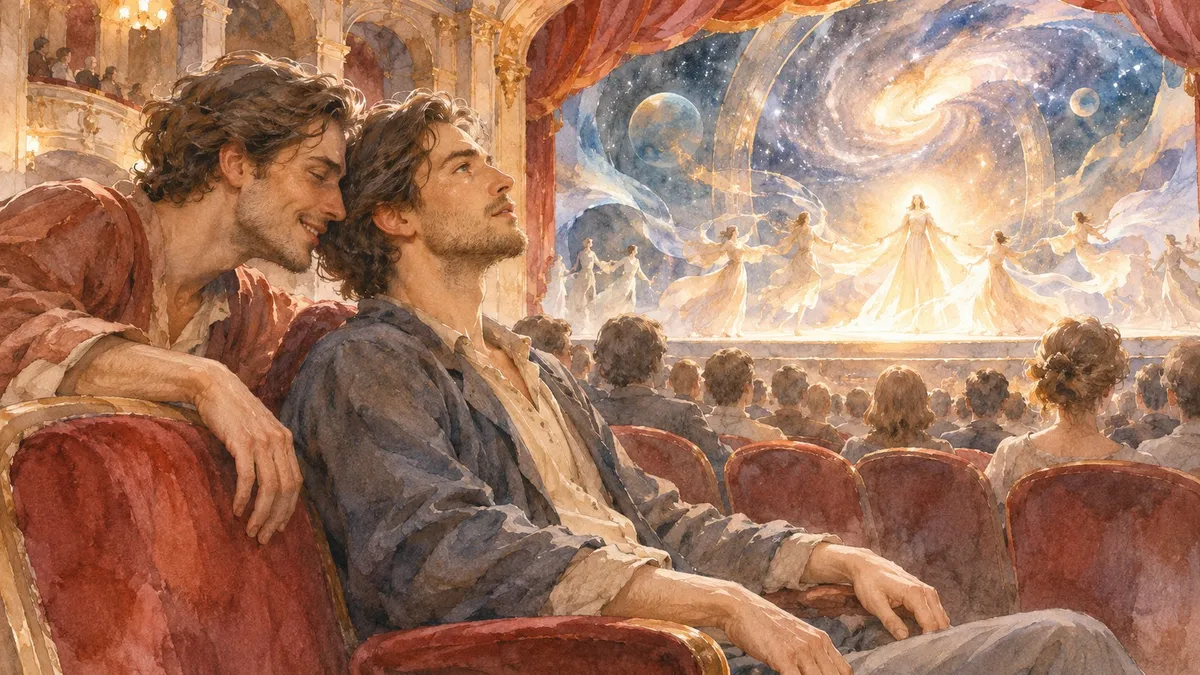
This resembles the following situation. Imagine that you have come to a mystery, a wonderful performance, but a hypnotist is sitting next to you. He looks very much like you and copies all your traits, so the effect of his influence on you is intensified, and he makes a powerful impression on you. Instead of watching the wonderful performance or mystery, you listen to this person and gradually forget that you came here for an entirely different purpose; you begin doing what he wants you to do—experiencing various desires and everything else. This is an example of how the ego operates. This hypnotist-person is, as it were, a part of our consciousness that takes our attention upon itself when we identify with it.
Immortality in Unity with Brahman
“When a wave dies in water, nothing dies. When death-Brahman comes to body-Brahman, nothing is lost.”
How should this be understood? If we are not a separate individuality or a body, but a metasystem, one great metaorganism encompassing all beings, then the appearance or disappearance of any one body and small individuality endowed with personal mental programs, free will, and intelligence does not constitute any loss for it. It is like cutting a hair from your body: you do not think that you yourself have disappeared along with that hair. The hair is simply a part of a vast organism.
And at the moment when we understand the fact that we are one vast meta-being and that, as consciousness, we manifest in countless bodies endowed with different wills, intelligences, understandings, and visions, attachment to the individual personality contained in the body disappears. The fear of death also disappears.
When we eat prasada, it seems to us as egos that we are eating prasada. In reality, the play of the Absolute is unfolding. When we go somewhere or communicate, the play of the Absolute continues. When we walk, rejoice, suffer, or fall ill, experience pleasant or unpleasant sensations, all of this is a continuation of the play of this single metaorganism in various illusory bodies.
Free Will and Responsibility
Of course, this does not absolve us of personal responsibility. It is not as some people who have superficially understood the principle of advaita may sometimes think: “Since everything is Brahman, I absolve myself of all responsibility. After all, it is all Brahman playing, so let Him deal with it.” To some extent, such a person may indeed have grasped the advaita view. On the other hand, genuine development is development through the discovery of free will and personal responsibility.
The metaorganism does indeed play, but as individuals and bodies, we have been granted free will, the freedom to choose whether or not to develop, and the freedom to manifest consciousness. And a great deal depends on how we use this free will. The global interest of this metaorganism lies in our making the right choices within this limited mind and body—that is, manifesting clarity, integrating with current and long-term situations, and constantly demonstrating free will, which is realized precisely through our acts of choice.
The more we manifest free will through acts of choice, the more not only our clarity grows, but also our personal will, manifesting through a specific personality as the energy of the Absolute. This is called icchha-shakti. As clarity and enlightenment increase, free will grows stronger. Personal will also grows stronger and becomes an expression of the Absolute as a single metaorganism.
If we put it in terms of dualistic concepts, Brahman as the metaorganism does not want us to shift the responsibility for making decisions onto it. As if to say, “There is God in heaven, so let Him think for me.” But in fact, God will not be pleased by such a decision on our part. He says: “I gave you reason and free will, and you are telling Me to think for you.” This is wrong.
It is like a spiritual teacher saying to a monk: “You are entrusted with this particular area of service. I am entrusting this to you. You need to apply your own wisdom, will, concentration, and clarity.” The monk thinks: “I am devoted to the guru; I do not need to apply anything of my own. I will let it all go, and the guru will do everything for me.” But free will consists precisely in our ability to make decisions independently and take responsibility for them. And in this case, devotion consists in manifesting our own will, our own wisdom, and our own clarity.
It is precisely when these two wills manifest that we truly grow; it is then that this metaorganism begins to manifest through our body as well. It is then that we become passionate beings, or, in the terminology of the teaching, deities, mandaleshvaras, saints, and siddhas.

The Nature of Brahman and the Perception of the World
“Water can be calm or agitated; likewise, Brahman can be calm or restless. Such is its nature. It is ignorance and misunderstanding that divide the One into ‘this conscious being’ and ‘this insentient matter’; the wise do not adhere to such erroneous views. Therefore, for an ignorant person, the world is full of suffering, while for a wise person, that same world is full of bliss. For the blind, the entire world is immersed in darkness, whereas for one who sees, the world is full of light. The One Brahman pervades everything; therefore, there is neither death nor anyone who lives. Waves play on the surface of the ocean; they are neither born nor do they die. The same applies to the elements of this creation.”
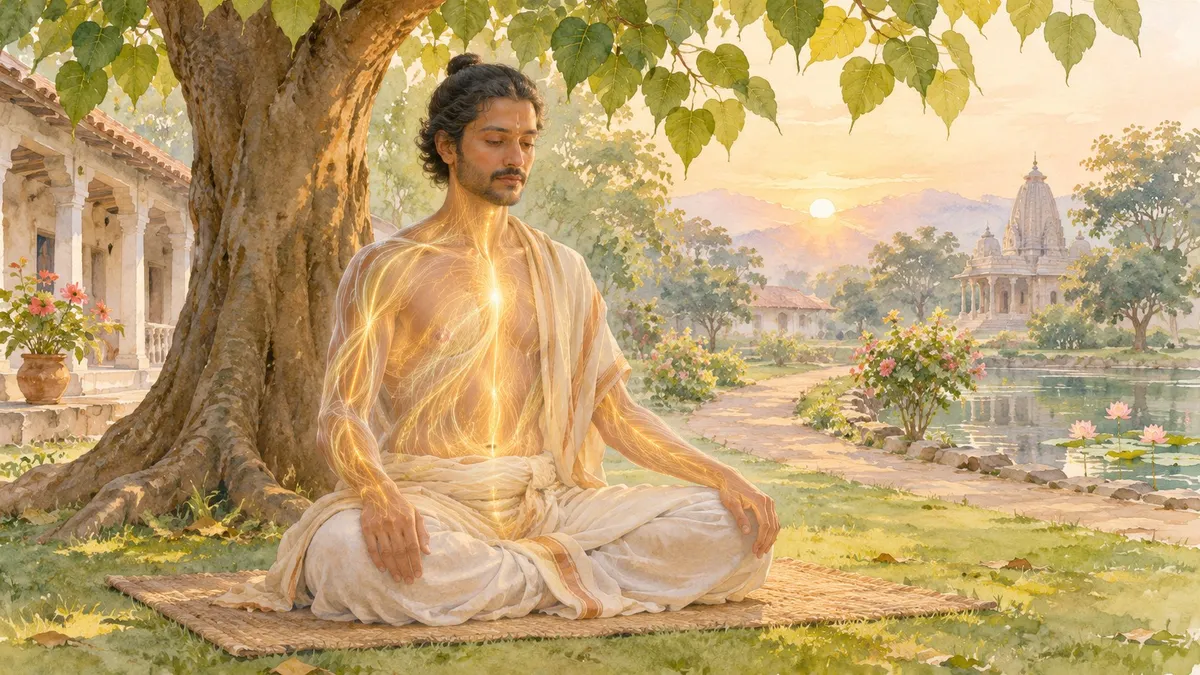
Before engaging in contemplation, atma-vichara, and other sankalpas, mahashanti meditation, or the practice of divine pride, one should become established in the view. This is similar to laying a good foundation before building a house. The foundation is the view (jnana-drishti). The view is the basis, while contemplation is the path. When we walk the path relying on the basis, we arrive at the fruit.
What is the fruit? The fruit means that we realize what we contemplate. In a certain sense, we can be compared to builders when, through the power of our consciousness, we build and model ourselves and our future. We constantly recreate a certain state of consciousness, and as a result, realization is attained, manifesting as a wisdom body like space; as an illusory body endowed with various abilities; and as a perfect relative body—these are the three bodies of the fruits of realization.
The Basis of the Fruits of Realization
The basis of these fruits of realization is the view, or vision. In other words, the view is the meaning, the source code of reality that you perceive and maintain—the original vision. The view is expressed through concise phrases—the mahavakyas—for example: “Sarvam Eva Brahman” (All Is the Absolute), “Aham Brahmasmi” (I Am the Absolute), “Prajñanam Brahma” (Awareness Is the Absolute). The entire essence of the view is contained in these succinct phrases.
Before undertaking serious techniques, one should reflect deeply and engage in analytical meditations on these mahavakyas. You can contemplate them, go on a retreat, or at least have a reflection session on each of the mahavakyas. When we begin to reflect on the basis and become established in it, our entire vision gradually changes and is turned upside down. Then the practices and techniques will truly be effective.
For example, you have not yet realized the view, but you are already trying to practice meditation on divine pride, meditating on “Aham Brahmasmi” for some time. Then doubts arise, you come out of meditation, and at the level of meaning and view you think: “I am an ordinary person, I am a man, I am a woman.”
But mastering the view means that you have reflected so deeply that, at least at the level of intellectual and intuitive understanding, you have arrived at the conclusion that the world truly is Brahman, that everything is Brahman. You have done a great deal of work, and you no longer have any doubts about this. It is another matter that you have not yet attained this realization, and that you still have a long way to go on this path. But at the level of the view—that is, at the level of faith and fundamental meanings—you have fully realized this.
The View as Background Contemplation
This view itself, once you become accustomed to it, already becomes a kind of meditation and contemplation. It supports you in all circumstances of life; you rely on it, and it does not allow you to become attached to anything, experience confusion, or suffer. It has not yet been fully realized, but it already liberates everything by itself, harmonizes it, and puts everything in its proper place. Gradually, if you reinforce it with the genuine practice of maintaining presence and with sankalpa, it smoothly develops into a kind of background contemplation.
Of course, this is not yet enlightenment or the end of spiritual practice, since a sufficient amount of ignorance and karma has accumulated, and these also exist, but this is already the foundation on which you can move forward. The next stage consists in developing contemplation with the help of the view and endowing it with such powerful divine force and purification, making it so creative and multifaceted that it penetrates all the “capillaries” of your subtle energy body, permeates and purifies them, so that all pranas and various areas of consciousness are transformed into creative energies, and so that a space of pure vision, of pure reality, gradually begins to form.

The Importance of Establishing Oneself in the View
So, everything begins with the view. I have seen many people who had problems with the view. Without fully resolving the question of the view for themselves, they tried to meditate and practice intensively. Then spiritual experiences arise, clarity appears, or, on the contrary, obstacles and difficulties emerge. Suddenly, they feel that they are confused. If a spirit or deity appears, how should one relate to it? Suffering arises, or, on the contrary, consciousness expands and bliss is experienced. They try somehow to relate to this or to find models and interpretive frameworks based on their habitual experience. But none of this works here. And then the question is asked: “Where is your advaita? Where is your understanding of the view? You are supposed to apply the view, but you are not applying it.”
This is like explaining to a good warrior for a long time: “Here is a horse. You need to ride the horse swiftly, and then you will outrun all your enemies.” But when the time for battle comes, this warrior runs around, not knowing what to do. He does not mount the horse because he is not accustomed to it; he has not developed this skill. Then the enemies catch up with him, and he suffers defeat. In the same way, we too must have such a “horse” of the view, which it is better never to “dismount.”
If you have established yourself in the view, then in fact fifty percent of spiritual practice has already been accomplished. Even if you do not feel realized and do not yet have the signs of realization, it will inevitably come if you trust the view, hold to it, and apply the methods correctly.
Possibilities of Deviating in Advaita
Of course, there are various ways to deviate and make a mistake. And such a powerful teaching as advaita contains possibilities for serious deviations, misconceptions, abuses, and errors. The more complex the teaching, the more opportunities there are to make mistakes. It is like studying how to drive a VAZ 2101: it is not difficult, and even a schoolchild can master it. But if you are studying complex methods for controlling a fighter jet or a spacecraft, there are many opportunities to make mistakes or fail to take certain factors into account, and therefore the risk is also greater. In the same way, the teaching of advaita is very powerful, but there are many different illusions concerning it.
Of course, it is possible to absorb a conceptual understanding of the view and be satisfied with that. Or to hold to the view but make no effort in contemplation. Or not to accelerate your development by using skillful means, relying solely on the view when the view has not yet matured and is still very weak. The path has been chosen correctly, but the amount of time required for realization depends on which means and method you apply.
From the perspective of eternity, five lifetimes, five hundred lifetimes, or five hundred billion lifetimes are essentially the same span of time. This may be difficult for us to comprehend, but from the perspective of the Absolute, it is an utterly insignificant amount of time, like a flash. Five lifetimes, five hundred lifetimes, or five billion lifetimes are nothing from the perspective of eternity, since the laws of large numbers operate here. But from our perspective, it is very important whether we attain realization in this life, in five lifetimes, in five hundred lifetimes, or in five billion lifetimes. Our realization depends precisely on how skillfully we work with the view, contemplation, and method.
Becoming Accustomed to the View as Meditation
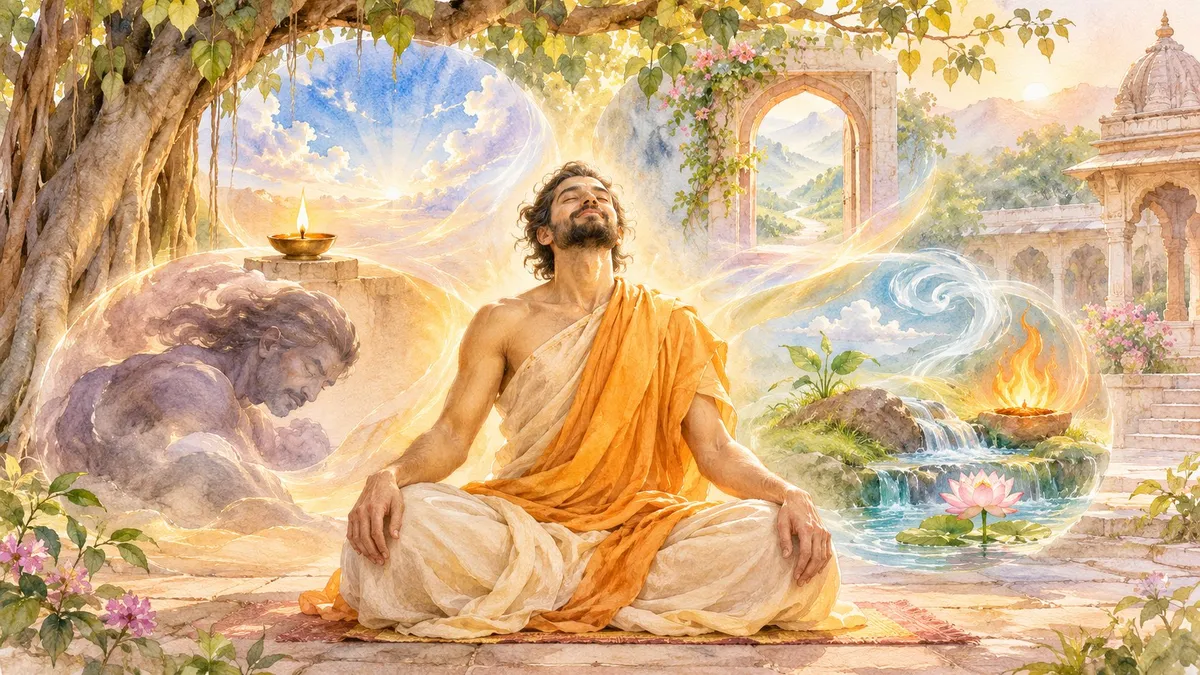
Usually, the teachings of laya yoga say that the whole essence lies not so much in meditation as in becoming accustomed to the view. The point is that becoming accustomed to the view itself already becomes meditation if it is done correctly. Becoming accustomed to the view naturally develops into a state of contemplative presence.
“This is that” and “this is not that”—such incorrect concepts arise in the infinite Brahman. These concepts have neither cause nor motivation, just as a crystal reflects multicolored objects without any motivation. The Supreme Self remains itself, even if the energies of the world cause endless disturbances on the surface of the Ocean of Consciousness. In this world there is nothing independent of Brahman that can be called a “body” or anything else.
When we become established in the view, this initially happens at the conceptual level; that is, at the conceptual level, you can always explain to yourself: “Everything is Brahman. There is nothing separate from Brahman. Everything that is unmanifest is the one Absolute.” Gradually, the conceptual understanding of the view develops into a feeling of awareness and into bhava, when you understand this not through the mind and words, but intuitively. Then you simply cultivate this feeling. And through such cultivation, if you apply the path of contemplation or the path of space, the true view opens up.
The Jnana of the Path and the Jnana of the Fruit
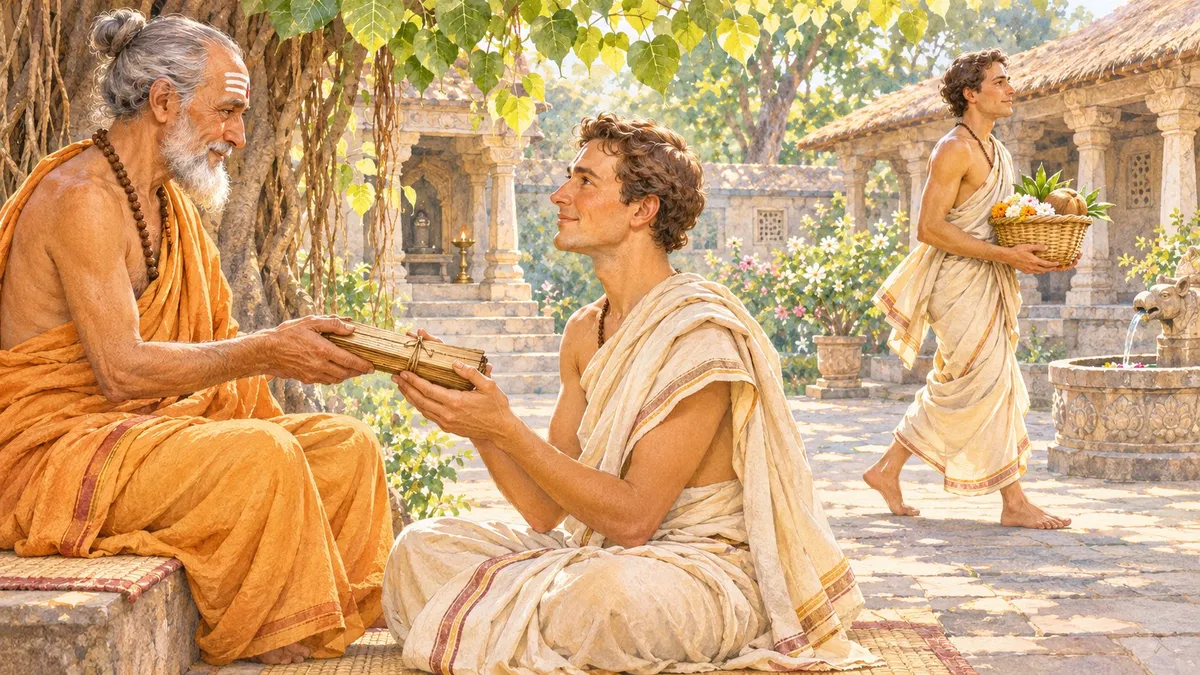
There are two kinds of view. The first is the untrue view, the so-called jnana of the path. The jnana of the path means that you have not yet realized advaita, but have only confidence in your conceptual understanding of advaita. The jnana of the fruit means that you reveal the true view through samadhi and penetrate into jnana-deha—the infinite body of wisdom. And the attainment of the body of wisdom occurs precisely when we become accustomed to constantly thinking in terms of the nondual view.
It is not necessary for us to express this outwardly. In fact, expressing it outwardly is not recommended until you have become a mahamandaleshwar, since this can lead to confusion, disharmony, and even obstacles. Rather, it means that the view exists within you as a subtle underlying layer. For example, when you eat, on the relative level there is no need to say: “The one who eats and the process of eating itself—everything is Brahman.” It is assumed that you maintain awareness in this understanding. That is, if on the relative level you distinguish between cold food and hot food, then from the standpoint of the view this is not a sin, but on the absolute level you adhere to the view.
When someone comes to me, I see from the outset that it is not a person who has come, and I do not consider myself a person either. The situation is clear to me from the very beginning: Brahman has come to play, and I play along with it in this game. At the same time, on the relative level I speak with this person in the relative human language. Thus, the view is combined with behavior. Penetrating into the view means that you hold the view at a deep, subtle level, but do not yet rush to express it in your behavior. Why? Because, by acting unskillfully, you can create many negative causes that will hinder your realization.
That which is seen as the body, and that which is seen as concepts, objects of perception, the perishable and the imperishable, thoughts, feelings, and their meanings—all this is Brahman in Brahman—infinite consciousness. Duality is seen only by the eyes of those who do not understand.
The View and the Energy of Liberation
Even if we grasp certain truths about the view and are convinced at a subtle level that everything is Brahman, our spiritual work does not end there at all, because we need to translate the view into continuous maintenance of presence, so that this presence gains strength, gradually pacifies the energies, and reveals a new level of energy. The view by itself, without an active function and without energy, liberates only halfway.
Let us suppose that you are firmly convinced that everything is Brahman, and that you even possess intuitive clarity and a living experience of your own samadhi. But then, in a dream, you encounter a powerful rakshasa spirit who wants to take your prana or something else. You tell him, “Everything is Brahman...,” but he does not believe you at all. Instead of honoring you for such priceless teachings, he tries to seize you, and you have to run away from him somewhere or frantically recall: “What incantation should I recite to pacify him? What can I come up with?” And then you become convinced that your view has not yet become complete realization.
The state of realization “Everything is Brahman” means operating energies (shaktis). This means:
Manifesting jnana-shakti, that is, changing consciousness
Manifesting svatantrya-shakti, that is, changing the dream, choosing another reality in which this rakshasa does not exist at all, and effecting a change in the current reality
Manifesting iccha-shakti — freedom of will, when you give the rakshasa an order and he freezes as if paralyzed, falls unconscious, or becomes pacified, takes refuge, and vows to study the teaching
Manifesting aishvarya-shakti — the energy of divine sovereignty and power, when the elements of the five elements and various energies are pacified and subdued by the power of your nondual mind
As the rishi Agastyar said: “Everything must submit to me.” He did not say this because he had an inflated ego or dictatorial ambitions. He meant pacifying inner demons and subduing inner illusions and obstacles so that all of this would become manageable. Yogis have no desire to subdue any external beings. They are peaceful people and have never been conquerors. When it is said that something must “submit,” this means that the ego, the five elements of the body, and the pranas must submit, and that all harmful beings and entities must take refuge in subtle essential awareness. This is an example of the manifestation of aishvarya-shakti.

The Unity of Cosmic Consciousness
That which is seen as the body, and that which is seen as concepts, objects of perception, the perishable and the imperishable, thoughts, feelings, and their meanings — all of this is Brahman in Brahman — infinite consciousness. Duality is visible only to the eyes of those who do not understand. Mind, intellect, the sense of ego, the primordial cosmic elements, the senses, and all diverse phenomena are only Brahman; pleasure and pain are merely meaningless words and illusions. Just as a sound in the mountains produces numerous echoes, so the one cosmic consciousness experiences multiplicity within itself through notions such as “this is me,” “this is my mind,” and so on. The one cosmic consciousness sees multiplicity within itself, just as a person who is dreaming sees various objects within themselves.
When we sleep, we see cities and people in dreams, within our minds. Through the power of the mind, a temporary illusory body is created in which we act and communicate with others, walk through cities and palaces, but all of this is only our consciousness; none of it truly exists, but is located within our stream of mind. We create all of this ourselves; all these cities, palaces, and beings do not actually exist.
Sometimes, even in a dream, you can conduct the following experiment: approach the beings inhabiting your dreams and ask them a question, and then you will see for yourself that they act unconsciously, stumble over their words, or cannot answer you. One monk, for example, asked, “What is today’s date?” And since he himself did not remember the date very well, the beings of his subconscious could not say it either. Another monk approached each of the beings in the dream and asked, “Who are you?” The being could not utter a word, became paralyzed, and disappeared. In the end, all the beings disappeared, and he was left alone.
This is indeed the case, because in a dream our thought-forms and our body are objects of the same order. That is, our subtle body as a living and conscious entity, and the subtle bodies of our mental projections, are of the same order (the same density). Therefore, deluded, we think that all these bodies in dreams are supposedly beings independent of us.
What does this resemble? For example, when you go online, you can meet and correspond with other people on forums. But now there are hacker programs, chatbots that, posing as people, can engage in context-dependent dialogue. Moreover, they communicate with people in such a way that it is even difficult to determine whether there is a real person behind the username and avatar or a bot. On some forums, they even lure gullible users into “private rooms” and extract from them, supposedly on a confidential basis, account numbers, codes, and passwords. At the same time, when communicating with such a program, a person does not know that there is no living person behind it, that it is a robot, pure information, because the illusion of individuality arises. Behind some names there are living people, users with souls, while behind others there is nothing—it is merely information, the power of the creative mind of some demonic genius.
Something similar happens in a dream. Our subtle body has a living soul, while our thought-forms do not have living souls, but sometimes they appear in the guise of spirits, deities, demons, other beings, or people. Not knowing this fact, we become confused in dreams, sometimes frightened, and sometimes attached. An experienced yogin, however, knows that everything happening in dreams is indistinguishable from his own mind, and therefore remains calm about it.
Manifestation of the Unified Metaorganism
In the same way, the example of a dream must be transferred to this reality. In this reality, the only genuine, authentic essence is Brahman. All other beings that supposedly have an independent, separate existence are expressions of this Brahman and do not exist by themselves.
The further development of this view consists in manifesting this unified metaorganism through our individuality, so that each of us becomes a deity similar to Brahma the Creator, a mandaleshvar who has mastered the powers inherent in a deity. This is a return to the Original Source.
When you have mastered the advaita view, attachments, serious delusions, desires, false goals, and motivations no longer exist for you—all of this no longer plays an important role for you. You may rely on these things only in a relative, utilitarian sense, but inwardly, at the existential and psychological level, you no longer rely on them, because new meanings and, accordingly, new goals have opened up for you.
Outwardly, one should play a role according to the karma and circumstances given to us, gradually changing them for the better. But inwardly, when we master the advaita view, there is no longer anyone who does anything, becomes attached, experiences pride or jealousy, or is caught up in anything. This is precisely how one becomes accustomed to the view. To become accustomed to the view means to empty oneself, to free one’s mind from dependence on the ego and illusions.
The Effectiveness of Practices When Established in the View
If you have prepared your consciousness by becoming accustomed to the view and have become rooted in an analytical understanding of it, all practices begin to produce results; everything you undertake will genuinely work. Conversely, one who has not become established in the view has great difficulty mastering both divine pride and the teachings on contemplation and space, because uncertainty is always present.
That which is seen as the body, and that which is seen as concepts, objects of perception, the destructible and the indestructible, thoughts, feelings, and their meanings—all of this is Brahman in Brahman—infinite consciousness. Duality is visible only to the eyes of those who do not understand.
Even if we grasp certain truths about the view and, on a subtle level, become convinced that everything is Brahman, our spiritual work by no means ends there, because we must translate the view into the continuous maintenance of presence, so that this presence gains strength, gradually pacifies the energies, and reveals a new level of energy. The view by itself, without an active function and without energy, liberates only halfway.
Realization of the View Through the Principle of Service
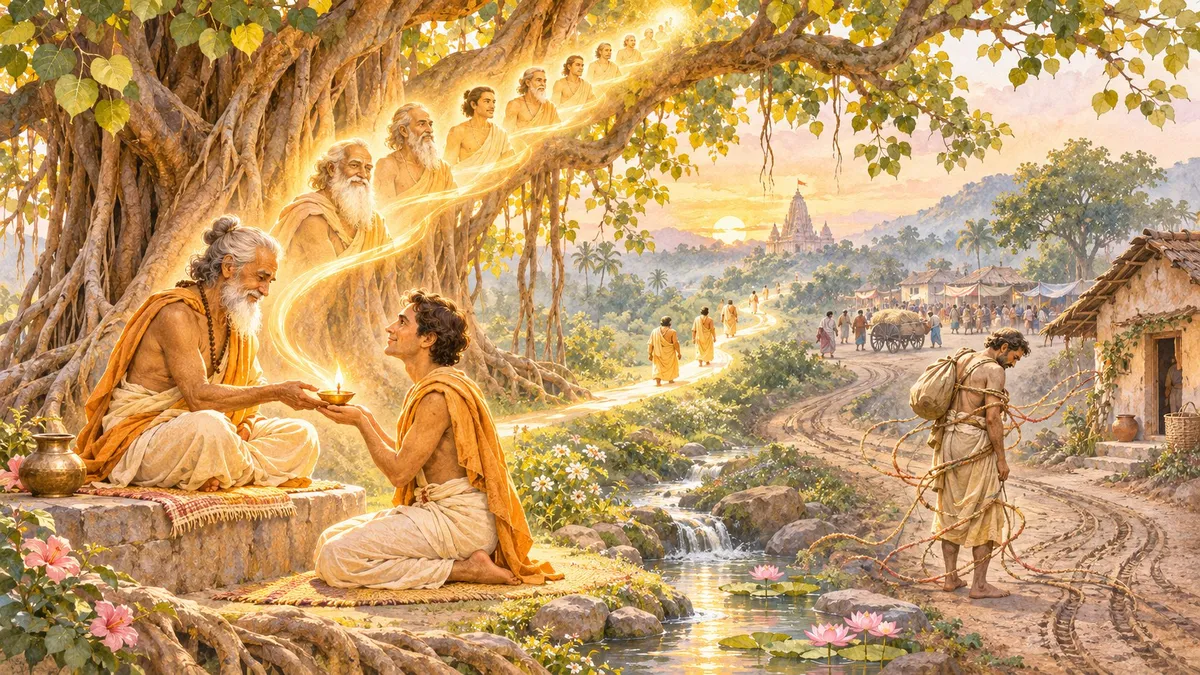
Thus, the yogin builds a foundation based on an understanding of the view through śravaṇa—the explanation provided by a spiritual teacher and the study of sacred texts. This view must permeate you and penetrate very deeply, so that you can say to yourself: “Everything is Brahman, and therefore, deep in my soul, I am not worried.”
Once, a layperson said the following:
— In terms of my view, I am convinced that everything is Brahman. I no longer have any problems.
I said to him:
— If everything is Brahman, then evidently you can do without all attachments and social conventions. Will you experience any problems if you abandon them? If everything is Brahman, then you must truly be free from any attachments, from any conditions and conventions.
Then he began to speak as follows:
— Everyone is conditioned in the relative dimension. You, for example, are conditioned by monasticism, while I am conditioned by being a layperson.
I objected:
— We are not conditioned by monasticism. This is a form in which service manifests.
— I see, and I have such a form of manifestation.
Then I said to him:
— The form of service through monasticism is dictated by higher meanings and goals. It is not invented, but transmitted through the lineage of spiritual succession from teacher to disciple. As for your being a layperson, I am not sure that it was transmitted to you through a lineage of spiritual succession. Perhaps it was transmitted to you through the lineage of your karma.
He pondered this. These are very subtle questions. Sometimes our ego seeks various self-justifications so that we can indulge our desires or selfish motivations. But the true view is always uncompromising; it does not indulge desires or selfish motivations. You may manifest anything, but it must arise not from a selfish motivation, but from a state of self-liberation.
The best way to manifest our relative energies is to dedicate our lives to serving all living beings, to serving the enlightening power of the Absolute—Anugraha-shakti, to cultivate compassion within ourselves, and to truly make our lives an offering to the Absolute.
Understanding Our Place in the Metasystem
If everything is Brahman, we must know why Brahman sent us here, into this world. If we understand this and realize that we are part of a single metasystem, a single metaorganism, then, as its small parts, we must understand that we should no longer act on our own, or have false motivations and false goals. We should truly serve this great Being, which is what we ourselves are. I would say that it is not we who should serve, but these bodies, hands, and minds. The process of serving the enlightening forces of the Absolute begins by itself, naturally. This is the only normal, healthy, and correct decision.
It is like a finger that, after long periods of practice and meditation, suddenly understood that it was part of the body, and that if it benefited the body by serving it, it too would be well. But if the finger did not understand this and continued to pursue its own selfish policy, it could harm both the body and itself.
Thus, in the relative dimension, the realization of the Advaita view always manifests as the principle of service. It does not matter how it manifests, but this principle always exists, because a part cannot live outside the whole, and a part cannot pursue its own course of life while ignoring the tasks of the whole. Since a part cannot separate itself from the whole, it cannot declare itself to be something independent if it is a particle of the whole. A leaf cannot pursue its own way of life outside the tree. A cell cannot pursue its own way of life outside the entire human body; it must perform its function in accordance with the circumstances.
The Vow of Service as the Realization of One’s Purpose
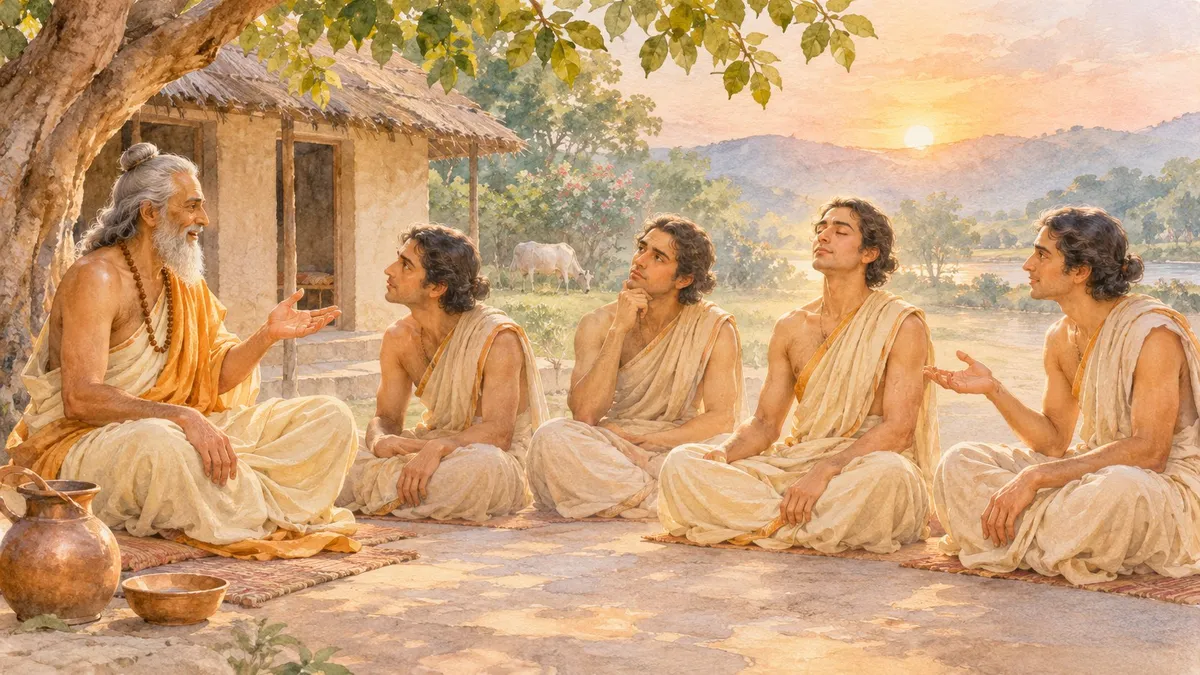
In precisely this way, everyone who realizes the principle of the Advaita view always sets out on the path of service. Therefore, we say: “I vow to serve all living beings. I undertake to save living beings from conditioned states.” What does this mean? It means that this cell has realized its purpose, its place in this vast system, established a connection with higher metastructures, and understood why it is here, in this world, and what its purpose is.
If from the very beginning we accept this great principle of service and Anugraha-shakti, the unfolding of the Absolute’s energy, then our own practice accelerates tens and hundreds of times over. In other words, within this view, we are already continuously abiding. But if we say that we have realized the view “Everything is Brahman,” while still having desires and continuing to pursue our own selfish policy, then it turns out that we have not truly understood it, that we are manifesting incorrectly. And this is what slows down realization.
So, if we truly want to establish ourselves in this view, we need to understand the high and noble principle of service; we need to genuinely dedicate our lives solely to the great cause of serving living beings. And if we make this the refrain of our lives, the guiding thread running through them, then all the signs of realization come to us properly and without obstacles when we think about serving higher powers. Serving higher powers means that this body, having realized its connection with Brahman, remains constantly “connected” and sees its mission as simply carrying out these lofty aims.
