Commentary on the text by Sri Ramana Maharshi “Be As You Are”
Chapter “The Jnani”
“Question: It is said that the behavior of a jnani is marked by absolute equality toward everything?
Maharishi: Yes. You are asking about jnanis. They are the same in any states or conditions, because they know Reality, the Truth. In the daily routine of eating, moving about, and so on, jnanis act only for others, doing nothing for themselves.”
Who is a jnani? A jnani is a symbol of one who has known the Truth, a synonym for enlightenment. Generally speaking, all living beings can be divided into two categories—jnanis and ajnanis. Jnanis are those who have awakened, who have attained enlightenment. Ajnanis are those who have not awakened to true Reality, who have not attained enlightenment. A jnani is one who has entered into resonance with absolute Reality, who drinks from the Source, who continuously contemplates the primordial Source, the great boundless Creator, essential Being. An ajnani is one who does not contemplate Him because of his lack of skill or ignorance, or because of his karma.
“Question: What is the difference between a baddha and a mukta—an ordinary person and a liberated one?
Maharishi: Baddha and mukta are the same as ajnani and jnani. A baddha lives in the head, unaware of himself in the Heart, while a jnana-siddha lives in the Heart. When the latter moves about and interacts with people and things, he knows that what he sees is not separate from the one supreme Reality, Brahman, which he realizes in the Heart as his own ‘I,’ Reality.”
The Difference in the Perception of Reality
A jnani is one who is in continuous resonance with absolute Being. Having once established such a connection, he never loses it again. An ajnani sees the world in black and white; for him it is either this way or that way, either good or evil, either truth or untruth, either maya or God, either life or death, either you or I, either subject or object, either man or woman—this is the ajnani’s way of seeing. According to the logic of an ajnani, he rejects one thing and becomes attached to another. If this is a non-practicing ajnani, then he divides things even more primitively. For him, the world is divided into what satisfies his worldly desires and what prevents their satisfaction. What satisfies his selfish desires is good for him, even if it is bad for others. What does not satisfy his selfish desires is bad for him. This is an even more primitive, more animal form of seeing reality: those who love me are good; those who do not love me are bad.
The mind immediately gives an assessment, attaches a label, and in accordance with this label it then perceives reality. The mind of an ajnani in fact comes into contact not with the real world, but with its own labels, its own projections. And since these labels are assigned completely arbitrarily, conditionally, on the basis of ordinary upbringing, experience, and one’s own karma, naturally there comes a moment when one’s own system of labels no longer matches reality. For example, one lives thinking: “I am this body.” But suddenly the body grows old or becomes ill, even dies, and then the entire system of labels collapses, is shocked, everything falls apart. Or one considers external life to be reality, while impermanence exists.
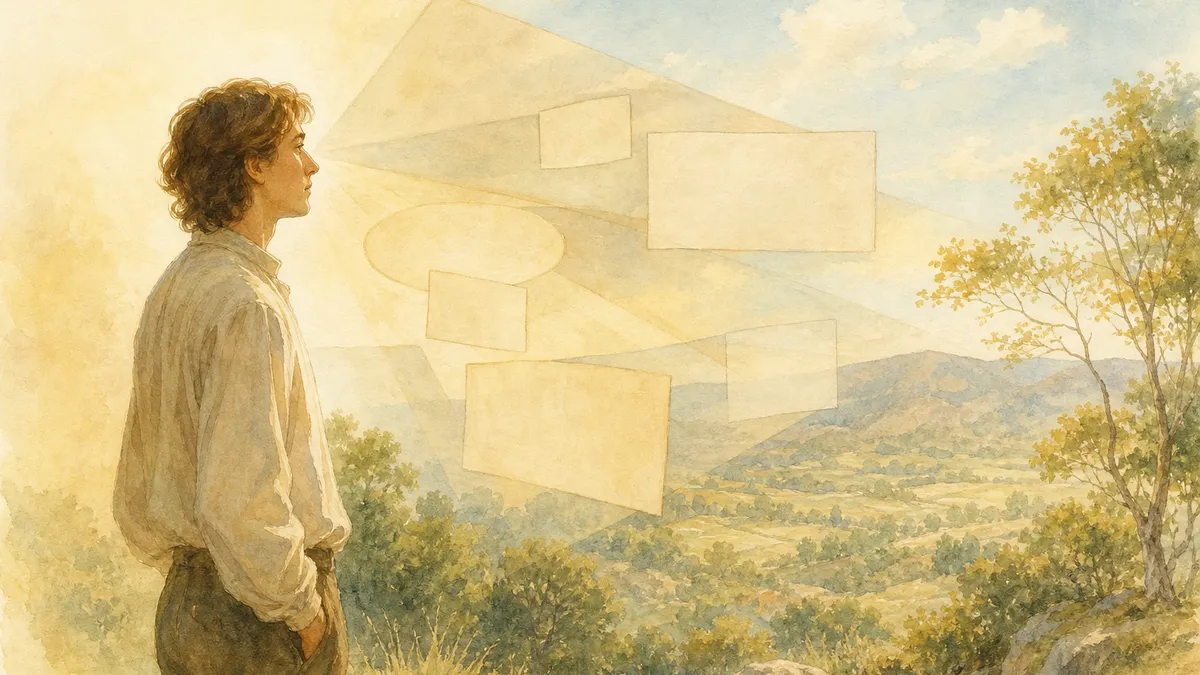
A jnani lives in a different way: he does not divide reality, he does not attach any labels to reality, he lives beyond concepts and takes the middle position.
In physics there is a phenomenon called “Schrödinger’s paradox.” The German scientist Schrödinger put forward the following thesis: since the theory of the electron has still not been proven and no one can say exactly whether it has a wave nature or is a particle, one can hypothetically imagine the following model: there is a cat in a chamber, a tube with gas is connected to it, regulated by a Geiger counter, and periodically an impulse is sent to this counter, that is, a radioactive particle is emitted. If the particle behaves like a wave, the counter will not be triggered; if the electron behaves like a particle, then the counter should be triggered. And if it is triggered, the valve opens, poisonous gas enters the chamber and kills the cat. Then he asked the question: “What will happen to the cat?” No one can say. The behavior of the electron is unpredictable—either particle or wave. Therefore, one can say that Schrödinger’s paradox has still not been resolved.
Reality does not correspond to our concepts; therefore a jnani does not live in concepts, that is, he does not live by his mental projections, but lives in awareness.
Life Beyond Concepts
How can one avoid living in concepts? On a simple level, the principle is this: when you encounter any assertion of your mind, you must immediately find its opposite. Or when your mind tries to condition something external with some concept, you must find the opposite of that concept, and then stand aside, seeing that neither one nor the other is the truth. This is the method Lin Chi gave to his disciples.
For example, you are asked: “Do you love God?” This is immediately a concept for your consciousness; that is, it appeals to your experience, which means that you must know about God, about love. That is, it is assumed that you have already assimilated dualistic notions of love and hatred, of God and the devil, of “you” and “I”; in other words, this already presupposes your ignorance from the very beginning. But the instantaneous path consists in abiding beyond concepts in awareness. If we do not abide beyond concepts in awareness, then most likely there is no question of God, because God is not words; God is precisely awareness, if it is even possible to speak of this in words at all. Those who reason about God are dealing merely with a rational god, with labels. This should be understood. In other words, until we understand this awareness beyond concepts, our god will be one created by us: false, unreal, rational.
Therefore, from the point of view of liberation, to such a question any true saint would say: “God or Satan, love or hatred, I or you — these are all illusions of your mind, like the horns of a hare. And if you were aware more deeply, such questions would not arise in you.” Because a true saint, abiding in awareness, always sees reality more deeply. Seeing one thing, he sees the other; when he speaks of God, he immediately sees Satan as well and understands that the true God includes both God and Satan. In other words, true awareness neither accepts nor rejects anything. When a saint speaks of love, he also sees hatred. He sees that hatred is a form of love, and love is purified hatred. For him there are no opposing pairs of categories. When he sees another, he also sees himself; he understands that the other is the very same I. When he speaks of himself, he understands that I is everything around, and also others. When he says that this is good, he sees that bad is simply another form of “good.” And when he sees in this way, he is no longer drawn into the game of opposites, into the game of duality.
When he says “Guru,” he implies that there is also a disciple, and that in essence they are one; it is not some wise man outside, it is a part of me, my own nature. In other words, all opposites, when he is deeply aware, are liberated in his mind in this way. Then he suddenly comes to a state where there are no opposites at all, but only one awareness, which no longer divides into this or that and is not grasped by the mind or by labels. Suddenly this awareness is discovered as the purest, as the most magnificent and the most holy. It is so holy that it is capable of absorbing any kinds of manifestations and will still remain pure and unstained.
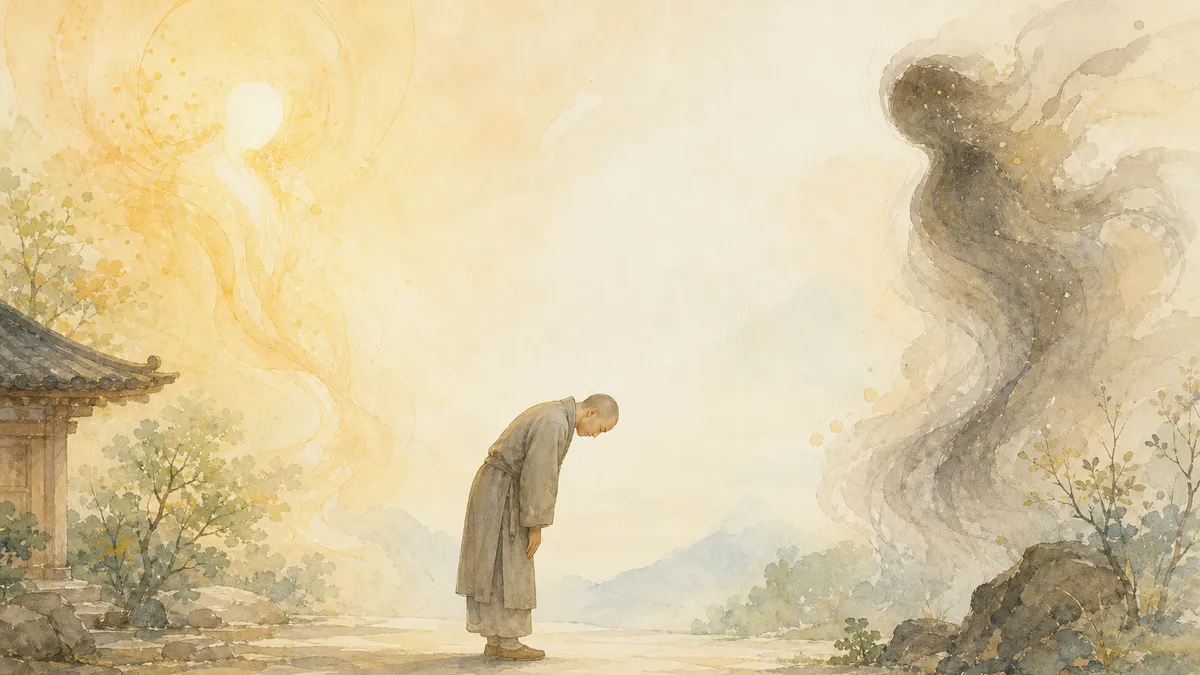
Seongcheol Sunim once said: “When you see the Buddha, you prostrate before him. But I want to say: when you see Mara, you should also prostrate before him and say: ‘O Mara, you are so great, you are as great as the Buddha.’ Because if you see only the Buddha and cannot understand that Mara also possesses Buddha-nature, then your vision is dualistic.”
The Principle of Absoluteness
In other words, from the point of view of Advaita, there is no essential evil, there is no ignorance, and everything is the Absolute. The Buddha and Mara are different forms of the Absolute. Enlightenment and unenlightenment are different forms of absoluteness, and everything is absolute. In this Absolute, good is absolute and evil is absolute. In this Absolute, the correct is absolute and the incorrect is absolute. In this Absolute, the pure is absolute and the impure is also absolute. As soon as there is the Absolute, there is awareness; therefore, It instantly purifies and awakens everything. When we understand this principle, we stop living in a world of ideas and thoughts; our mind turns toward empty awareness. We no longer have ideas we could be seized by; we have no questions at the level of thoughts that would interest us. We have only the path of awareness and the way to develop it. And when we have cast off such opposites, our mind is no longer grasped by illusion.
Of course, we are speaking about the absolute. In relative life, however, opposites exist and should be respected. In the absolute sense there is nothing either pure or impure, but in the relative sense the dining hall must be clean, the deities must stand in their proper places, and the firewood must lie in the woodshed. That is, one should not mix the absolute and the relative. If we say: “To eat or not to eat—at the level of the nature of the Mind there is no difference whatsoever,” then most likely our body will object. Here we are speaking about the absolute dimension.
“Question: If the jnani and the ajnani seem to perceive the world in the same way, then what is the difference between them?
Maharishi: Observing the world, the jnani sees everywhere only the Atman, which is the Substratum of everything that is seen, whereas the ajnani, whether he sees the world or not, is ignorant of his true being, the Atman.”
If you want to manifest the absolute nature, you must constantly liberate all pairs of opposites in the mind. For example, if someone tells you that you are a fool, you may think: “In the primordial awareness of the Atman there are no such concepts as fool or sage. The one who understands this is the true sage, and the one who does not understand is a fool.” If you are told that this is bad, you may think: “In the absolute sense there is no difference between good and bad; in primordial awareness such illusions are absent. When one understands this, then it is good, and if one does not understand, then only this alone is bad.” This radical perception is what distinguishes the jnani from the ajnani. For the jnani, awareness comes first; the ajnani perceives the world in an ordinary way.
For example, we once had a brahmachari who thought that if carrots were planted not according to the rules, then it was bad. I constantly tried to explain to her what is truly bad: it is when you see “bad” or “good,” when you are not aware and are unconscious, when you are concerned with the wrong thing. To discover such awareness while staying in the ashram is much better, because if you discover it, you will learn to plant carrots well; with such consciousness you will not be able to plant them badly. But if you do not discover it, after some time you will abandon everything and become a conditioned being. Again, this is not a method for speculation in the relative sense; rather, it is an inner understanding meant to eliminate illusions.
At first we had monks who thought like this: “Whether to perform service or not—in the absolute sense there is no difference whatsoever, so I will rest.” But self-liberation is absolute and implies that we liberate everything, and first of all ourselves, our egoistic ideas and inclinations. That is, between your will and the will of the Guru or the manager, in the absolute sense there is no difference whatsoever, so why not perform service? This is precisely what we must understand first of all when we carry out self-liberation. The higher Teachings are very subtle, and it is very easy for them to tempt us; therefore, while self-liberating, one should first of all self-liberate oneself, one’s egoism, one’s kleshas, one’s ignorance, one’s will, and so on. Otherwise, we will consider ourselves easygoing avadhuta practitioners who self-liberate everything, while instead we will be accumulating mountains of negative karma. However, when we practice and are guided by such understanding in the inner sense, our awareness is no longer grasped by opposites, and then we truly apply awareness to everything; then this first principle becomes the most important thing in life for us.
The State of a Jivanmukta
A jivanmukta, nitya-siddha, jnana-siddha has nothing in common with the understanding of ordinary people. He is as distant from them as heaven is from earth. He shares not a single idea with them. He may not manifest this or may hide it, but to him the thoughts and conversations of ordinary people are like the babbling of a madman; he only laughs at them. Sometimes he may support them, but only for the sake of play or for the sake of helping others. But in reality he does not share a single one of such thoughts. Sometimes he may not manifest this and may even mislead other living beings. It is like a father sometimes playing with children and fussing about with them, exactly like a child, simply in order to please the child; nevertheless, his mind is in fact in a completely different state.
If we take the example of a motion picture on a cinema screen, the screen exists before the film begins. Then the film is projected, and the images seem real. And at the end the film disappears, and once again only the screen remains.
Reality is a similar projection, and if we want to know reality as it is, and not projections, then we seek this nondual awareness in which there is no dichotomy, duality, or division. Even if we have not yet found such awareness, if we unlearn extreme views, it begins to awaken within us by itself.

I read about how one student came to be taught by two old Daoist sages. In fact, two immortals descended from the mountains, found a five-year-old boy, and led him away by the hand to make him their disciple, because the signs had pointed to him. While he was growing up, they taught him nothing; he simply performed his duties. But gradually various traits of his character were revealed: when he was impatient, became angry, or had different ideas. His two teachers did not explain anything to him; they simply laughed at him and behaved as if he were very frivolous. They ignored him for many years and never once spoke to him seriously until he himself stopped taking himself and his ideas seriously. His anger and jealousy kept flaring up, but not once did they take it seriously. When many years had passed, he understood why they had communicated with him in that way.
“It is the same with the Atman. It alone IS, while phenomena, images, come and go. If you hold on to the Atman, the appearance of images will not mislead you.”
When we do not know the Atman, we have only the Guru’s instructions and a certain awareness of our own. In fact, it is to these that we hold on at the beginning.
“It does not matter at all whether images appear or disappear. Ignoring the Atman, the ajnani thinks that the world is real, just as, ignoring the screen, he sees only the film frames, as if they existed separately from the screen.”
Working with Emotions Through Awareness
When we have no awareness, we always ignore the Atman. Anger arises — we get angry. Joy or jealousy arises — we rejoice or become jealous. When feelings and emotions color our consciousness in this way, it is always the consequence of our ignoring the Atman. Suffering arises — we sincerely suffer, pity ourselves, thinking about how unhappy we are. But both this and that are simply the result of ignoring the Atman. When we are aware, however, at least we can work with emotions and thoughts. We understand: “Here is awareness, and here are emotions. Emotions may manifest, but awareness remains. And if I am aware, then I see that the play of emotions cannot touch me, my awareness.” Gradually, we bring all egoistic emotions under control. Therefore, an advanced monk is one who is aware and has brought all emotions and thoughts under control. He has a master — awareness. An inexperienced one is someone who does not yet have such a master.
The Difference in the Perception of the World Between the Ajnani and the Jnani
The ajnani thinks that the world is real. The jnani knows that only awareness is real, and the world is merely its consequence; that compared with the reality of awareness, the world is like a dream. And if it is like a dream, then it is foolish to build any kind of relationship with this world — to become attached to it or, on the contrary, to reject it, to be angry with it. It is like dreaming about something and then being angry about it. It is also foolish to place hopes in this world, since it is like trying to build a house in a dream.
For example, many people hear the teaching of Advaita, but when attachment arises, they think: “How wonderful it would be to meet a friend or a relative.” However, until we understand that friends and relatives, including ourselves, are only part of dreams, we will experience ordinary human feelings. If you have awareness, however, then even if you meet someone, your awareness will suffer no loss. You may manifest various relationships, but your awareness will not be affected.
“When a person knows that without the seer there are no objects of seeing, just as there are no images without the screen, then he no longer falls into delusion.”
This must be understood. “Without the seer, there are no objects of seeing” means that without the subject, without us, without awareness, the external world does not exist. The external world does not occur on its own; it is, as it were, permitted by our consciousness. It is said that a saint can destroy a great Universe in the blink of an eye. Of course, he does not destroy it with nuclear weapons. He can instantly stop his perception and enter a state where there is neither space nor time, and for him the Universe disappears.
There is a special practice of concentration on sound. When, while listening to a sound, we try to trace its source. If we train in this way, after some time we discover that the sound is not external, but comes from within ourselves, that it is a vibration that exists in our body. External sound is connected with our body and mind.
Self-Transcendence through Understanding the Unity of the Screen and the Image
“The jnani knows that the screen and the image are only the Atman.”
Now the next important point. Simply being conscious is not enough. Even when we are constantly attentive and aware, our mind is still contracted; there are egoistic and individual perceptions of “I.” Perhaps we are aware, but here it is said that “the jnani knows that the screen and the image are only the Atman.” It should be understood that awareness is God Himself, awareness is Brahman Himself, the Great Source. When we understand this, self-disclosure, self-transcendence occurs. Between simple awareness, self-liberation, and self-transcendence there is as great a difference as between heaven and earth.
For example, a yogin has attained awareness beyond concepts, and in principle he no longer holds any extreme views; he is constantly attentive and maintains awareness. Then suddenly, if he makes his mind simple, he opens to the true suchness of all things and discovers that in the depths of his awareness there shines a great absolute Something.

If you now imagine the Sun, then the Earth, compared with the Sun, seems like an apple, and the Sun, compared with the Universe, seems like a grain of sand. Now imagine that the Universe is boundless. This is a reality that you, as a subject, cannot in any way shake or create. If you are a subject, then you are lost in this reality; in it you are like a speck of dust. However, what happens if you become aware of this reality without separating yourself from it, if you do not establish yourself as the subject and reality as the object, do not make any judgments, but simply abide in the presence of this reality?
When you perceive the boundless field of the Universe without words, with living awareness, as if concentrating on a point, it happens that suddenly you feel there is no difference between you and the Universe, that the Universe is a part of you and you are a part of the Universe. If you do not make judgments, do not grasp with thoughts, but simply abide in presence, in the absolute simplicity of the mind, you perceive reality in its true suchness. Suddenly you discover that there is no distance between you and the Universe, and there is none right now. There is no distance between the Absolute, Brahman, and you if you do not activate your conceptual thinking.
And when there is no such distance, you can no longer say who you are: whether you are the Absolute, or the Absolute is you. Suddenly you understand that the Absolute has always been inherent in you, that you have always been the Absolute, and for this there is no need to do anything; one should simply relax and abide in such sensitive perception, making one’s mind utterly simple. One should empty one’s ego and let oneself go. Then the awareness that was there before begins to unfold, and now we see that it has grown into something new, has acquired such astonishing depth, breadth, openness, and perspective that it has become all Being, and we cannot even draw the boundaries of this Being. The distance between us and Being is broken, and this Being flows into us continuously as spontaneously and causelessly self-radiating Grace, and not as a consequence of practice or method.
The Non-Duality of the World and the Atman
Question: Does Bhagavan see the world as a portion or part of himself? How does he see the world?
“There is only the Atman and nothing more. The world is not ‘another Atman’ similar to the Atman; it is not different from Him and is not a part of Him.”
When self-transcendence and self-disclosure occur, everything suddenly changes. Even your practice changes. Yogis who had spent thirty years in intensive sadhanas wept with happiness and danced with joy when such a change occurred, because at that moment there is a complete elimination of ignorance; the doer, the ego, the practitioner disappears. Before, you were a small, shriveled person, bound by the mind and body, practicing and striving for enlightenment. Now, when the mind has opened wide, you contemplate mega-worlds. Mega means beyond everything conceivable, when the Universe can fit on the tip of your finger. And this is no longer you in the individualistic sense.
When you contemplate in this way, suddenly your practice becomes supremely inspiring, everything becomes workable, and you enter the greatest path of liberation. Without such understanding, the accumulation of merit, methods, effort-based practice, reading sutras, and following certain rules will continue for dozens of lifetimes. But with such understanding, the path of spiritual liberation is like the highest soaring, like a leap.

The Perception of Pain and Embodiment in a Jnani
Question: Does the idea “I am the body” (dehatma-buddhi) exist for a jnani? Does Bhagavan feel pain from insect bites?
“Yes, there is both sensation and dehatma-buddhi. The latter is common to the jnani and the ajnani, with the difference that the ajnani thinks he is only the body, whereas the jnani knows that all is Atman or Brahman. Pain is pain—it too is part of Atman. Atman is purna (perfect).”
An awakened one, a jnani, perceives the world in the same way as an unawakened one; that is, he tastes food, he feels pain if he steps on a thorn. However, the difference between them lies in how this is understood. When emotions, feelings, and sensations arise in the body, in an ordinary being such experiences contract his mind even more if he clings to the shell of his perception and body. He suffers because his consciousness narrows. Whenever consciousness narrows, a living being suffers. But when a jnani experiences such things, his mind opens even wider, because he has no egoistic idea “I am the body,” and his nondual, choiceless awareness constantly abides in absolute resonance with this supreme Source. If there is pain, then this pain is sacred; it is perceived as a blessing.
Going Beyond the Doer
“A person becomes a jnani when he goes beyond dehatma-buddhi. In the absence of this idea, there is neither doing (kartritva) nor a doer (karta). Then the jnani has no karma (that is, he performs no actions). Such is his experience; otherwise he is not a jnani.”
What does it mean to go beyond dehatma-buddhi? It means to go beyond being caught by the idea “I am this body.” How can one go beyond this? First, by training in raja and kundalini yoga through samadhi. However, you will not go beyond this idea until you attain samadhi, and therefore there will always be separation and a passionate desire to attain in the future.
In laya yoga there is another way—contemplation, when we are in resonance with the absolute Source. As soon as we establish such resonance, this absolute Source sends us its responsive rays, or emanations. One could say that this too is a certain concept that does not express it in any way. But when we are constantly in such resonance, the idea “I am this body” is overcome through continuous abiding in it. If someone abides in such resonance, then he is already, as it were, liberated, even if this state is not yet complete. At the very least, superficial thoughts and emotions, suffering and illusions, as it were, no longer touch him, although subtle illusions may still remain.
To be in such continuous resonance means to be immersed in God, to be immersed in the great ecstasy of contemplation. If you could do this right now, your sahasrara chakra would open. You would feel great joy and lightness in the body, as well as the deepest understanding of such resonance.

The Absence of the Doer in Awakened Consciousness
Question: I see that You are doing something. Why then do You say that You never perform actions?
“A radio receiver sings and speaks, but if you open it up, you will find no one inside. In the same way, my existence resembles space, and although this body speaks like a radio, there is no doer within it.”
Only to others does a jnani seem to be a person performing an action. In reality, his own consciousness is in no way connected with this; there is no egoistic motivation, no doing within him.
In the “Kularnava Tantra,” avadhuta yogins who have attained awakening are described in various ways. It is said that at times he resembles a learned pandit, and at times a mad beggar, wandering and dressing in tree bark, living wherever he happens to be. Sometimes he looks like a rogue, and sometimes like a swindler. Sometimes he looks like a holy man, sometimes like a sage inaccessible to ordinary people. When consciousness is constantly in resonance with the great Source, no doing in this world is important for the yogin, because the great importance has already been found — abiding in resonance. And since the prarabdha karma of the body has not yet been exhausted, the yogin experiences various activities; nevertheless, he himself no longer does anything. He does not strive for fruits or results, but even if he does not strive for them, he may try to do everything with quality.
Action Without a Doer as a Sacred Act
If such peace settles in the heart and the mind is wide open, then you act as though doing nothing. If you act in the usual way, you may grow tired, for example, when you work in the kitchen or chop firewood, because you are doing. “Doing” means that for you there is an action, a result, and an attitude toward the action: you like one action and dislike another. When you are doing, your mind is folded in, limited, contracted; there is no openness in it. But if you do not do, and your mind is not contracted, then you abide in great openness, and then whatever you do gives you energy (shakti), because the doing is, as it were, no longer real; it is like a dance. It is not work; it is a sacred act, a magical ritual, a dance, sorcery, creativity. Moreover, such creativity can be applied to anything. It is not only music or something similar. Creativity can be made even out of chopping firewood or washing dishes, because it does not depend on external actions; it depends only on the applied awareness, on the factor of clarity.
An Italian female disciple came to Haidakhan, to Babaji’s ashram. Then she asked:
— Babaji, what will you teach me?
Babaji said:
— I will teach you to wash dishes.
For her, washing dishes had been the most unloved activity in Italy, when she lived in a commune, in a community. There, this work was considered the dirtiest task, and every time she washed dishes, she hated it. Therefore Babaji, seeing this, told her that he would teach her to wash dishes.
For two years she did nothing except wash dishes. Gradually all her illusions and duality were blown out of her mind, and one day she felt that washing dishes was a true blessing.
The question is whether there is a doer or no doer. Every action is absolute. Every act of Being is sacred and transcendent. Every tiniest object is infinite. When we abide in such peace and openness, when there is no doing, then all our actions enter into universal resonance with the Source. We seem to become an open channel through which the light of this Source enters us. Then we act as though not acting, while our spirit is constantly directed toward the One. The only way of life for a practitioner of contemplation is to empty the heart, keep the spirit in serenity, abide beyond the doer, and surrender ever more to this Source.

Dangers and Integration on the Path of Contemplation
In the beginning, when we are inexperienced, this One will shock us; we will sob and weep from a single glimpse of this One. Sometimes it may even seem to us as though we are going mad or the world is turning upside down; sometimes we may feel that we are losing everything that was beneath our feet, that we ourselves do not understand what is happening. This happens when we practice without a Guru, without instructions, without sutras. Therefore many independent practitioners stop at this stage. Nothing can be done with it; it cannot be brought under control, and our “I” (ego), if it has not been prepared by renunciation and training, falls into panic.
Therefore it is said that at first the yogin’s mind erupts like a waterfall. However, if we understand the principle, remain quiet and natural, and continue our practice as if nothing were happening, then our mind becomes like the Ganges, slowly rolling its waters onward. When we deepen this state, we become like the ocean. Therefore, the yogin, contemplating the great Source, does not lose himself. Emptying himself, he does not lose his energy; he preserves his wholeness and individuality. Coming into contact with the great emptiness, he does not allow emptiness to conquer him, does not become seized by it, abiding neither in emptiness nor in non-emptiness. Having attuned himself to resonance with the great Source, he does not become a dancing madman, but can adequately integrate into ordinary life, into everyday actions.
A Zen master was receiving a disciple. This disciple wanted to test the degree of his realization. He handed over a letter from his mentor. In the letter, the mentor wrote: “This young monk thinks highly of himself, yet he has not uprooted his illusions, so be stricter with him.” But the monk himself had not read this letter. When the master read the letter, he began shouting loudly at this monk. Suddenly the monk’s mind became clouded, and the master never saw him again. This monk was unable to cope with himself, and so his reason became damaged. He had a room where he lived alone. And at times when there were retreats, he would gather cats and children there, seat them in meditation posture, and conduct retreats. And when they tried to run away, he would beat them with a stick for violating the rules of discipline, imitating a Zen master.
It is difficult to say whether this monk attained enlightenment. But it can be said that emptiness devoured him; he became a madman, unable to integrate adequately into ordinary life and remain himself. A true practitioner of contemplation, however, continuously maintains resonance with the Source. At the same time, he indulges himself in nothing: neither in desires, nor in being seized, nor in egoism. He has complete control.