


November 26, 2025
Commentary on the Shiva Purana. Shatarudra Samhita
Chapter Thirty-Nine
Arjuna was performing his tapasya when Indra came to him, tested him, and then ordered the ganas to protect him. Arjuna performed tapasya on Krishna’s advice in order to protect his family, his lineage, and his clan, and to receive certain worldly blessings from Shiva.
Text:
The demon Muka is slain in the story of the Kirata incarnation.
Nandishvara said: “He duly performed ablutions and nyasa, mystical gestures, and so forth, in accordance with the injunctions of the shastras. With great devotion, he meditated on Shiva in the manner explained by Vyasa. Like a great sage, he stood on one leg, gazed at the sun with one eye, and recited the mantra. Reciting Shiva’s five-syllable mantra, the most excellent of all mantras, and mentally recollecting Shiva, he joyfully practiced austerity. The splendor of his austerity was such that the gods were astonished. They went to Shiva again and told him about it in detail.”
The Nature of Proper Tapasya
Austerity means tapas, and tapas means kindling the inner fire, awakening the inner tejas, when energy unties the knots in the channels, overcomes the granthis, and fills the higher chakras. When we change the flow of our energy, we intensify the light of sattva. Finally, when the energy rises higher toward the sahasrara chakra and activates the dvadashanta region, supraphysical perception and the ultrasubtle energies of our subtle body and mind become accessible to us. Sattva begins to predominate.
In other words, the result of proper austerity is that sattva predominates within you. And in a state where sattva predominates and you are receptive to shaktipat, you can receive the darshan of deities, the darshan of saints, the refuge tree, Shiva’s blessing, and the descent of anugraha and shaktipat. Subtle changes take place within you: what is called the capacity for self-surrender, the revelation of the nature of the Self, shivatva, being filled with Shiva, samavesha, merging with Shiva, and Shiva sayujya at one level or another. Ultimately, all of this leads to Shiva Pratyabhijna. In other words, proper tapasya fills you with the light of sattva and expands your awareness.
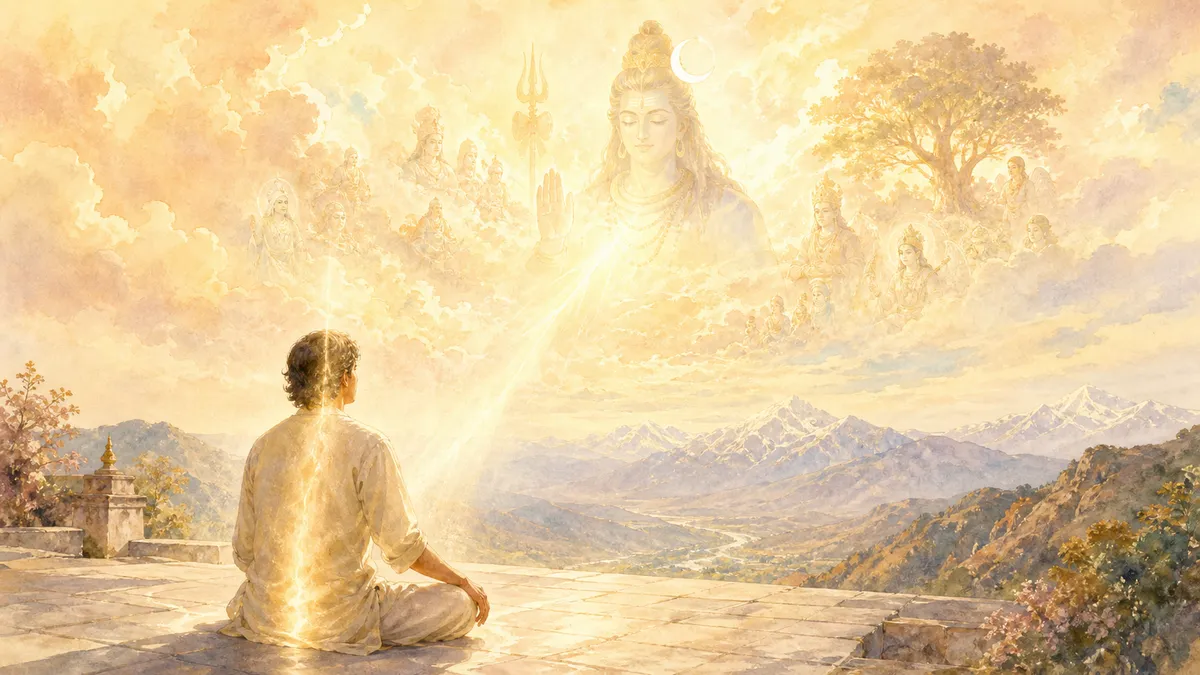
But there are a great many reasons why one may fail to enter into proper tapasya. Many obstacles arise when energy moves not through the central channel but through the lateral ones. Proper tapasya always leads to the filling of the sushumna nadi. Improper tapasya, accompanied by obstacles and worldly motives, causes prana to move through the lateral channels and activates lower energies. Then, instead of the light of sattva being revealed, rajas intensifies or tamas may increase. And the entire essence of sadhana is to intensify the light of sattva and deepen the perception of the empty, luminous nature of the mind by performing proper tapasya.
Proper tapasya means that it is accomplished through contemplation, work with prana, and divine grace. It cannot be attained with selfish motives. It cannot be attained by invoking any spirits or using any substances. All of this is impossible. We rely solely on awareness, faith, devotion, and the control of energy. This is proper tapasya.
A great many—millions of—sadhus perform various kinds of tapasya for worldly or spiritual purposes. But not many people succeed in attaining proper tapasya and obtaining its results. This is because proper tapasya is accompanied by what is called “the release of karma,” by various disturbances and obstacles, when karmic creditors, gods, spirits, demons, and parts of our “self” that we had not previously known about are revealed in the process.
The Foundation for Tapasya
Therefore, before undertaking tapasya, we must establish a foundation. Training in this foundation is called sadhana chatushtaya, the fourfold preparation: viveka, vairagya, mumukshutva, and the six qualities of sattva. These are the basic qualities. No one can attempt to perform tapasya and succeed without the fourfold preparation. Shankaracharya writes about this clearly and unequivocally in the Vivekachudamani and other texts.
Another, higher foundation, even after we have acquired the fourfold preparation, is certainty in the View and the presence of contemplation. Once you have gained certainty in the View and established contemplation, your tapasya cannot be improper. Your energy always fills the sushumna; you cannot fall into any delusion because you abide both in the View and in proper contemplation. This is where the path to proper tapasya begins.
The third point is guru yoga, ishta-devata yoga, protection, the support of the Refuge Tree, the capacity for self-surrender, faith, and devotion. When this component is present, it means that all the components have come together and you are ready to undertake proper tapasya, which will certainly yield the right results. Those who lack these components do not obtain the right results. It is like alchemy: you must gather all the ingredients, then grind them and put them through the process of sublimation and transmutation. Then, in the end, you will obtain the philosopher’s stone. If something does not work out, it means that the proportions were not observed or some stage was not completed.
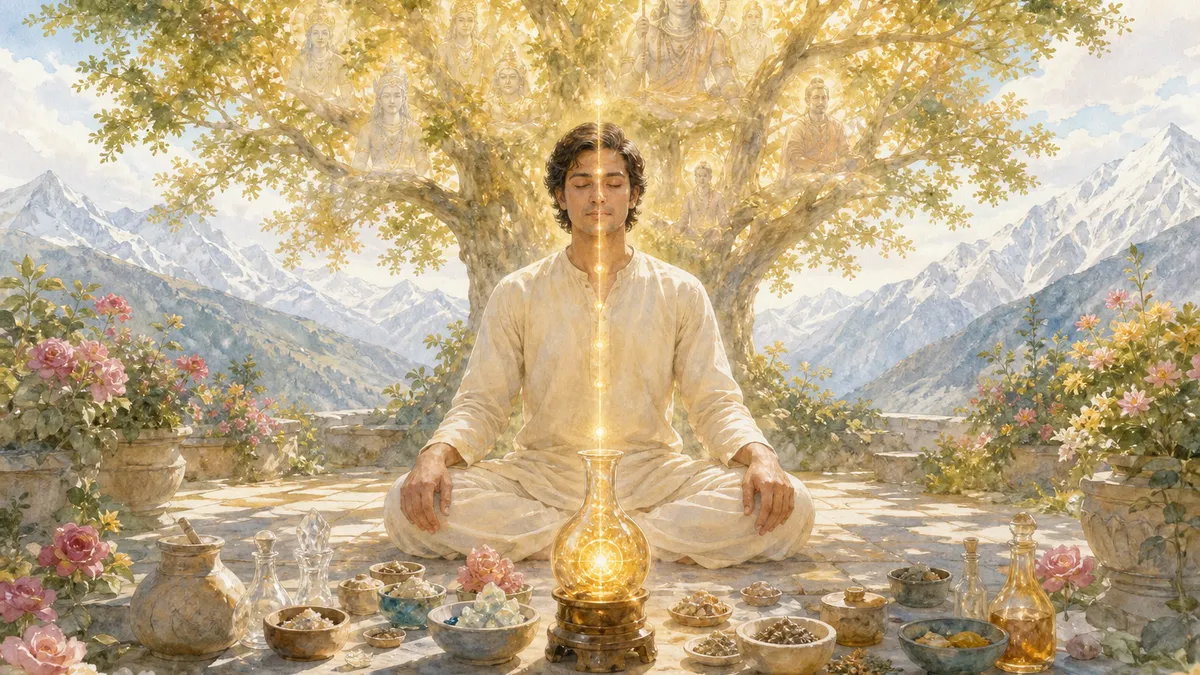
In the course of practice, we must develop an understanding of the logic of proper tapasya and proper sadhana. And once we have removed all obstacles to proper tapasya and understood the principle of proper sadhana, blessing is inevitable. The revelation of shivatva is inevitable. The descent of shaktipat is inevitable. The dissolution of karma is inevitable. The attainment of the two enlightened bodies—the body of wisdom and the illusory body—is inevitable. And liberation is inevitable.
A wise, strategic yogin, a sadhu, arranges the course of his life and sadhana in such a way that he leaves karma no chance. He makes liberation inevitable. And we must practice in such a way as to make liberation, the realization of purnahanta, the fullness of divinity, simply inevitable. We must gather all the missing conditions. Gathering the missing conditions takes years of one’s life. For many, it takes more than one lifetime. Nevertheless, if we possess a good teaching, wise guidance, and viveka, we can gather these conditions not over several lifetimes, but in a single lifetime or even within a few decades, and make the state of liberation inevitable. There is a section of the teaching called the philosophy of sadhana, the logic of sadhana. That is, the logic of sadhana takes into account the process through which we pass, with all its details and nuances.
Arjuna performed tapasya with worldly motivation. Nevertheless, he performed it like a true kshatriya, and did so very well. Therefore, within a short time, he began to receive blessings. First Indra, and then Shiva, soon came to him.
The Gods as Intercessors
Text:
The gods said, “O Lord of all! A man performs penance to propitiate you. Lord, why do you not grant him what he desires?” Nandishvara said, “Having said this, the gods praised him in various ways, fixing their gaze upon his feet. They stood there in agitation. Hearing their words, the lord of auspicious wisdom, the delighted Shiva, addressed the gods with a smile.” Shiva said, “O gods, return to your abodes. I will undoubtedly fulfill your task in every respect.”
The gods who went to Shiva to intercede for Arjuna were impressed by his tapasya. And they became his intercessors before Shiva, saying, “Shiva, why do you not bless him? Look at the austerity he is performing.”
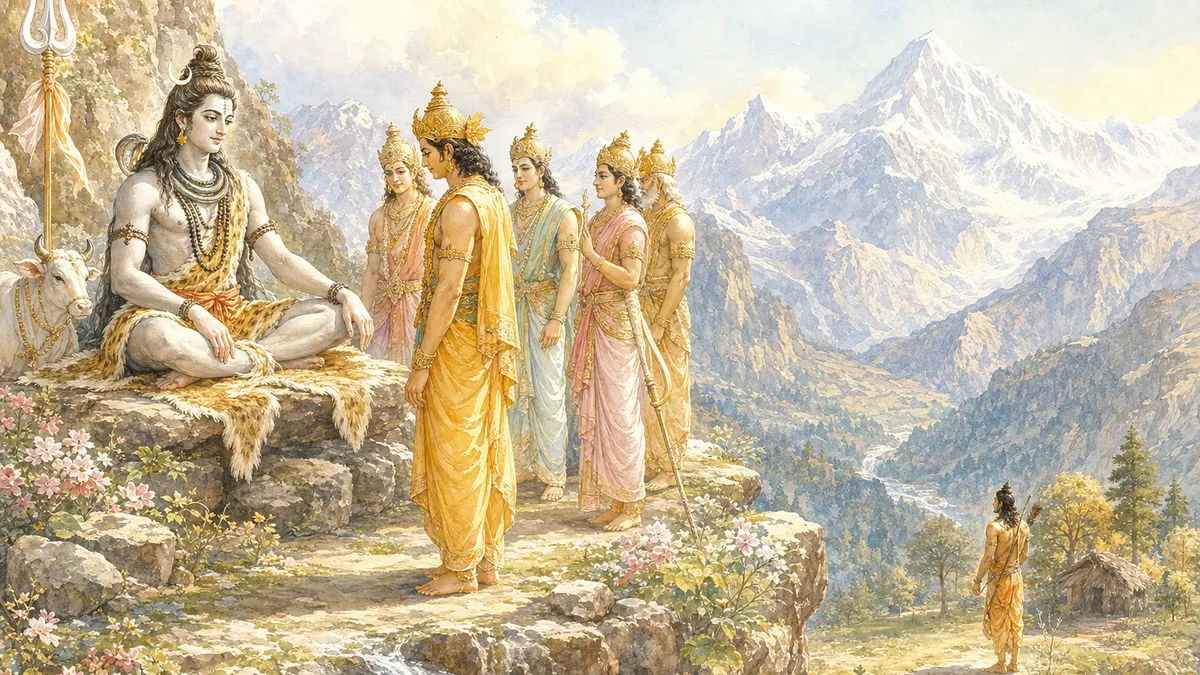
What does this mean on the inner level? The gods represent the subtle inner creative, pure divine forces within us: those of the five sense organs, the five karmendriyas, the five jnanendriyas, and the subtle body. When they become refined and purified as a result of our sadhana, they become sensitive and capable of conveying our sankalpa to the Divine Self. That is why they become intercessors. Our buddhi becomes very sensitive, perceives our request, our sankalpa, and conveys it to the Higher Self. Our other sense organs, manas, ahamkara, the entire antahkarana—all of them become imbued with our tapas, and they become a connecting link with our Higher Self, with our nature, our shivatva. And they convey it, as it were, to Shiva. Shiva then says, “Very well, calm down, I understand everything; I will bless this sadhu.”
The Appearance of the Demon Muka
Text:
Nandishvara said, “Hearing these words of Shiva, they were reassured, and so they returned to their abodes. Meanwhile, the demon Muka appeared, incited by the evil Duryodhana, who raised maya against Arjuna.”
Meanwhile, Duryodhana, having learned that Arjuna had gone to the Himalayas to perform tapas, hired sorcerers or performed some kind of sorcery rituals himself. He created a demon named Muka to obstruct Arjuna’s tapas. Here Duryodhana plays the role of the ego. And the ego begins to work its sorcery and create obstacles. It is the selfish, unpurified part of our “self,” consisting of tamas, rajas, kama, krodha, lobha, moha, mada, and matsarya, which, sensing the heat of our tapas, begins to resist. This is the inner resistance of our subconscious, which wants everything to remain as it was, wants karma to continue, and begins to obstruct our tapas.
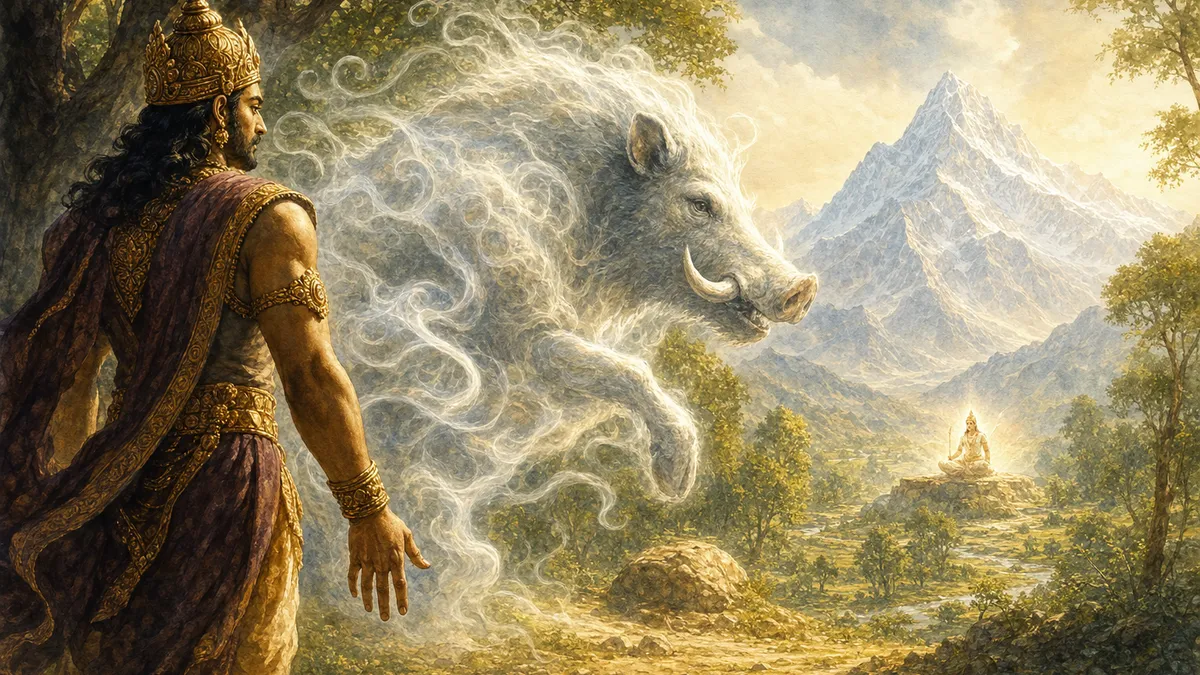
That is, when people speak of an “obstacle in sadhana,” it is often not a matter of spirits coming to hinder us or gods coming to interfere with our tapas. Often our tapas is not powerful enough to impress the gods. These obstacles are simply created by our own subconscious, our ego. Its unpurified nature simply resists our tapas. It seems to break free from our conscious control. Our fears, our desires, and some unpurified parts of ourselves conjure up images that interfere with our tapas. And so the demon Muka, who obstructed Arjuna, personified such obstructive subconscious forces.
Question: Guruji, is this an indispensable part of the path of every sadhu, or does there come a point, perhaps on the fourth bhumi, when such hidden subconscious tendencies no longer manifest? Or will this always continue even up to the seventh bhumi because it is part of our soul’s development program?
On the fourth bhumi, there are no longer any obstacles arising from the subconscious because they cannot coexist with jnana. The fourth bhumi is jnana, which burns away all obstacles. But if a yogin on the fourth bhumi performs powerful tapas, and his tapas can alter the magical fabric of reality around him, then it may no longer be his subconscious that takes notice of him, but the gods. And if they deem his tapas inappropriate or disruptive to the balance of energy, obstacles may arise from certain external forces, but not from the subconscious. And often, when great rishis and great saints performed ghora tapas, terrifying tapas, the obstacles no longer came from the energy of their own subconscious; rather, other forces in this Universe took notice of them, concerned by their excessively intense activity.
Encounter with the Demon
Text:
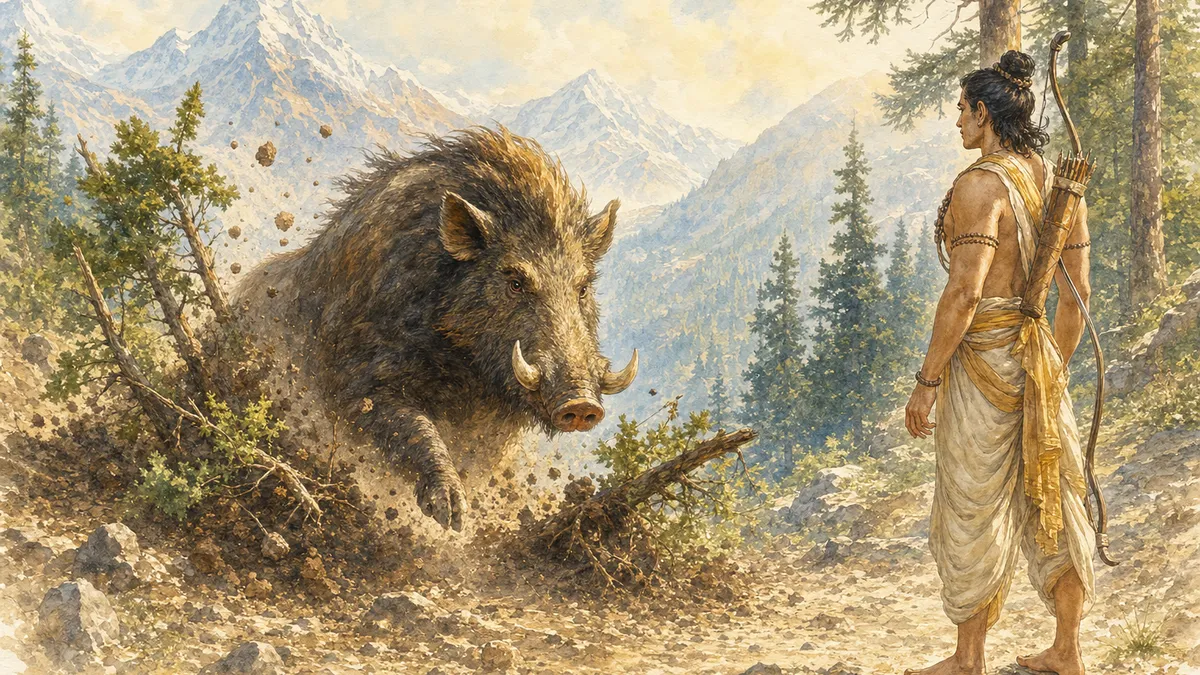
O great Brahmin! He assumed the form of a boar and walked along the path where Arjuna had stopped. He uprooted mountain peaks and trees. He roared and grunted in various ways and rushed forward at tremendous speed. Seeing the demon Muka, Arjuna remembered Shiva’s lotus-like feet and reflected. Arjuna said: “Who is this? Where did he come from? He seems utterly ruthless in his actions. Surely he is coming here to harm me. I think he is undoubtedly my enemy. In the past, I killed many Daityas and Danavas. He may be one of those who have come here to take revenge, or he may be some friend of Duryodhana acting for his benefit. Truly, a person at whose sight the mind becomes pleased is a well-wisher. If the mind becomes agitated at the sight of someone, that person is undoubtedly an enemy. Conduct is determined by one’s family, the body by one’s diet, one’s manner of speech by education, and one’s attitude by the eyes. The hidden mind is revealed by one’s overall appearance, manner of walking, actions, and speech, as well as by the features of the eyes and face.”
What is Arjuna reflecting on here? This is not merely his train of thought. Arjuna is reasoning in accordance with his preparation and training. As a prince and a great kshatriya, he underwent the training traditionally given to kings in those days. There are texts describing dhana-lakshana, the signs of a great king. And one of those signs is that he has been trained in more than a dozen sciences, including archery, the art of politics, the art of diplomacy, trade, medicine, astrology, and the art of memorizing texts. One such art is discerning intentions from bodily signs. And here he is reflecting in accordance with his training. So that you understand why he thinks this way: it is an entire art in which Arjuna was trained in his time as a kshatriya prince.
Text:
“There are four kinds of eyes—shining, passionate, narrowed, and red. These characteristics also differ, O learned ones. The gaze is radiant when friends meet, delighted at the sight of a son, narrowed when encountering one’s beloved, and ruby-red at the sight of an enemy. My senses are aroused in response to him. He must be an enemy. He will undoubtedly be killed. Now I recall the words of my teacher, O king: ‘The man who causes suffering will be slain by you at all costs. There is no doubt about it.’ It is solely for this purpose that I carry a weapon; there is no doubt about it.” Thinking thus, he readied an arrow and stood up.
Shiva Appears in the Guise of a Hunter
Text:
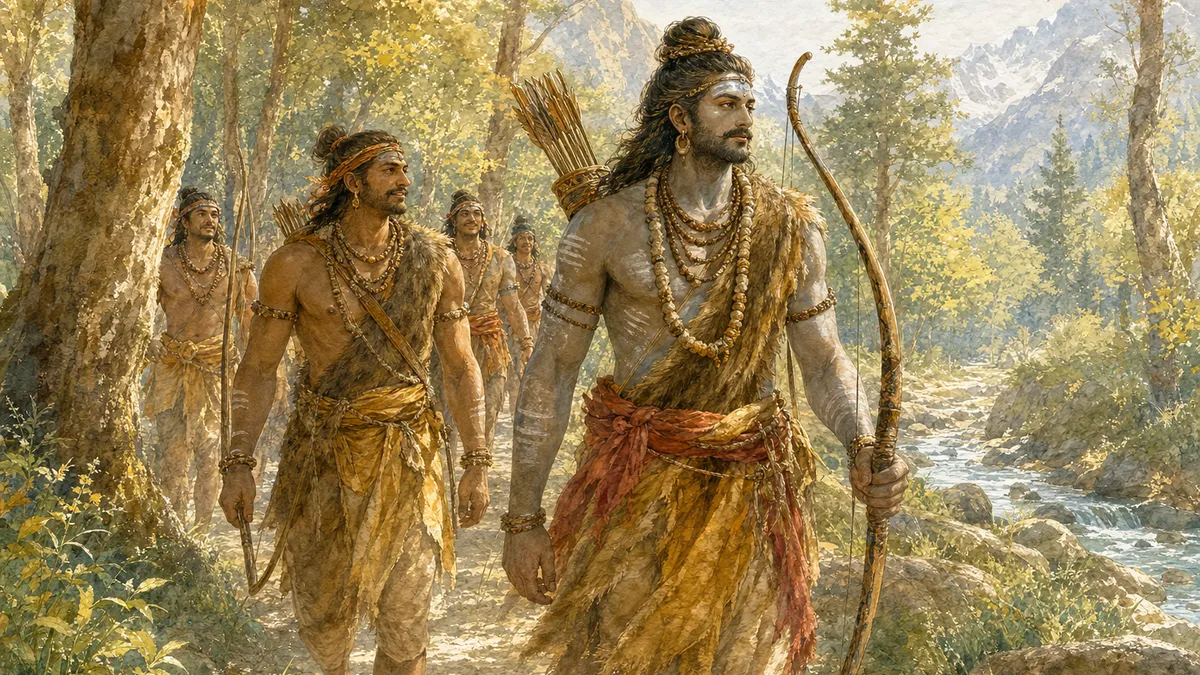
Meanwhile, Shiva, benevolently disposed toward his devotees, assumed the wondrous form of a skilled hunter and came there with his ganas to kill that daitya, protect Arjuna, and test his devotion. The hunter adjusted his loincloth and folded Shiva’s banner. His body was covered with a layer of white ash. He held a bow and arrows in his hands. He carried a quiver slung across his back. The ganas likewise assumed the guise of hunters. Shiva became the leader of the Bhils. The commander-in-chief began making various sounds, and the grunting of a boar also echoed through the surrounding area. Arjuna was stirred by the sounds spreading through the forest. Even the mountains were shaken by those sounds.
Shiva appeared in this area with the leaders of the ganas, and they all assumed the guise of hunters, while Shiva assumed the guise of their chief, the king of the hunters, the Bhils.
Arjuna’s Reflections on Shiva
Text:
“Oh, could this be Shiva, the Benefactor? I heard Krishna mention this. Vyasa also mentioned it, as did the gods. Shiva is referred to as the Benefactor. Shiva is the cause of happiness. He is called the ‘bestower of liberation’ because he grants liberation to his devotees. Prosperity undoubtedly comes to those who remember his names. Even in dreams, misfortunes do not befall those who worship him with devotion. If they do occur at all, it is due to their previous actions. This must happen, whether it is something great or insignificant. The cause, in particular, lies in those actions that have begun to bear fruit. Shiva can dispel suffering at will after a person has experienced the fruits of their great or minor actions. He can turn poison into nectar and nectar into poison. Whatever he desires, he will undoubtedly do. How can anyone hinder him?”
Shiva can turn poison into nectar and nectar into poison. This means that the nature of our consciousness is such that it is capable of purifying the impure. Poison becomes nectar. For example, a klesha can become wisdom. Impure perception can become pure. Ordinary food, once consecrated, can become prasada. An ordinary situation can be recognized as darshan. Ordinary activity can be recognized as lila. A locality can be recognized as a pure land, and the entire Universe can be recognized as Shuddha-tattva—the pure dimension. A man can be recognized as a male deity, and a woman as a female deity. All this happens when we engender pure vision. And what transforms the impure into the pure? Our capacity for perception, for the realization of shivatva, Shiva’s inner nature.
On the other hand, it is said that Shiva can also do the opposite, turning nectar into poison. If Shiva manifests his veiling power, then even certain exalted things may become obscuring under particular circumstances. Certain spiritual, divine things may be misinterpreted by us in a worldly, material way and become a source of obscuration. For example, divine play may be misinterpreted as karma. Divine beings may be interpreted as ordinary beings. Enlightened saints may be interpreted as limited karmic worldly beings. Shiva-Shakti-dham, this universe, the abode of Shiva and Shakti, may be interpreted as samsara, as an impure material dwelling place. Our life may be interpreted in a worldly way. Certain energies within our body may be interpreted as kleshas. Certain perceptions arising within the stream of our consciousness may be interpreted as limiting and obscuring—for example, as kanchukas or ashta-pasha, the eight bonds.
Ultimately, the world we perceive is a particular interpretation. This interpretation is produced by the Supreme Consciousness within us in accordance with our karma. When this Supreme Consciousness within us limits itself through the veiling power by its own free will, svatantrya, it is the veiling power of Tirodhana Shakti, Maya Shakti, which conceals pure reality. And so the path between samsara and nirvana always lies in how we interpret.
The Power of Interpretation and Its Limits
Someone might say, “Well, I am trying to interpret things purely, but samsara does not disappear as a result.” Yes, your pure interpretation has little effect so far. Even if, for example, you interpret a pig as something divine, it will not cease to be a pig. But that is only because your interpretation does not yet have power. As soon as your interpretation gains greater power, transmutation and transformation will actually begin to take place. Yet our interpretation has no power externally, although it has real power within us. You can change your thoughts, sensations, and perceptions by changing your interpretation. For example, the sankalpa of pure vision is nothing other than a change in interpretation. The same applies to any other sankalpa. And here the question arises: Do we want to change our interpretation? Do we have the intention? Do we know how to change it by applying the method? Do we remember, amid the current flow of events, that it must be changed right now, in the moment? Do we believe in our ability to change our interpretation by relying on the method?
Question: Om Guru. Namaste. I have a question. If, for example, one succeeds in profoundly changing a pig so that it is no longer a pig but something pure, the ego is nevertheless very afraid to change and transform it and the Universe, not from the standpoint of habitual karmic vision but from a more elevated standpoint, and there is a kind of deep-seated fear that you are going insane or something like that...
It is more likely the fear of losing your support, the ground beneath your feet, control, and your habitual vision. And you do not know where this interpretation will take you. What is important here? First, you need to distinguish between pure vision and ordinary samsaric vision. Tell yourself that your interpretation concerns your inner understanding, practice, and the logic of the Dharma. For now, I will not extend it to relative everyday life, to solving current tasks, to common sense, logic, and so on. I leave common sense and logic, yukti, and the ego’s points of support untouched. I do not try to interpret things literally on the outside. I change only my inner perception, while all of the ego’s points of support remain fully intact. If you make this distinction, you will not be afraid or fear losing your footing. And pure vision within you will simply grow naturally and naturally transform your vision.

And changing your interpretation toward an increasing degree of pure vision does not mean abandoning relative common sense. It does not mean falling into an exalted state of vision, walking around and saying, “Ah, everything is deities, everything is divine play!” while understanding nothing. No, you can think very soberly and clearly and, on the relative level, also see demons as demons, people as people, and gods as gods—only even more distinctly and clearly. But overall, this will no longer cloud your mind, because you understand that Shiva’s Universe is primordially pure, yet it contains different energies and different roles, and all of them have the right to exist through svatantrya, Shiva’s free will. Demons remain demons, asuras remain asuras, people remain people, and deities remain deities, but none of them ever leave Shiva’s pure dimension.
Question: What is the criterion? Where should one, as they say, stop, and where should one go all the way? Suppose this boar is about to be killed. Yet, in theory, Arjuna could have invoked infinite power and transformed the kleshas into wisdom and, as they say, turned it into a vahana, as many gods did with such utterly base creatures. Where is the boundary at which there is no longer enough energy?
Arjuna could not invoke that power to transform the boar. Arjuna could kill the boar.
Question: But what is the criterion: to kill the boar or, through inner transformation, through outer transformation, to transform it into what it primordially is—pure light?
No, no. The criterion here is simple: do you have the power or not? Arjuna did not have the power to turn the boar into light or anything else. He had the power to shoot it with a bow. That is an external matter. And when it comes to external matters, no criteria are needed here. You understand: either I have the power or I do not. If inwardly you have a choice, then external reality leaves you no choice. Right? And there are things you can change, and there are things you cannot change. It is like the laws of physics, which prohibit you from doing certain things. And then you have to accept external reality as it is and deal with it externally. But inwardly, you can change your interpretation of it. Nevertheless, you will still have to interact with it according to the laws of impure reality. That is, inwardly you can transform the boar into anything you like, but outwardly you will still have to interact with it according to physical laws. Or, if you have the power, you can harmonize the boar’s mind using the methods of shanti karma. It will calm down and sit, as happened with certain saints. They would sit while wild animals, tigers, and sheep around them remained peaceful. Yes. It is a question of whether you possess the power.
Question: To keep following the path in this way... after all, through this situation one can become—well, if one seriously practices tapas, invokes seva-service and guru yoga—one can become a siddha or even a mahasiddha in a single lifetime, so as to make even such a boar one’s, well, vahana, as I called it, or something else. After all, this is a method; it is a dumbbell. The question is: can you lift it or not? Well then, practice!
Generally speaking, yes. And sometimes the siddhas did exactly that, placing their disciples in difficult situations and giving them such a “dumbbell.” And life, too, often throws such “dumbbells” our way. We interpret them as troubles, but they are simply dumbbells for you to train with. And what should you train? Pure vision, for example. If you manage to strengthen it, you will emerge victorious. If you do not, you will emerge defeated and afflicted. Life itself often presents such situations; that is true.
Arjuna’s Reflections on the Nature of Suffering and Trials
Devotees of the past and future should keep their minds steadfast after considering all these aspects, regardless of whether a person is in favorable circumstances or not, whether death is inevitable or not, whether he is praised or condemned. Misfortune will be suppressed. Shiva always bestows happiness through the merits and sins of individual people. Sometimes Shiva makes us unhappy in order to test us. Since he is full of compassion, he is ultimately regarded as the giver of happiness. A gold coin can become pure only when it is placed in fire and refined. I heard this from a sage; therefore, I shall attain blessed happiness only by worshiping him.
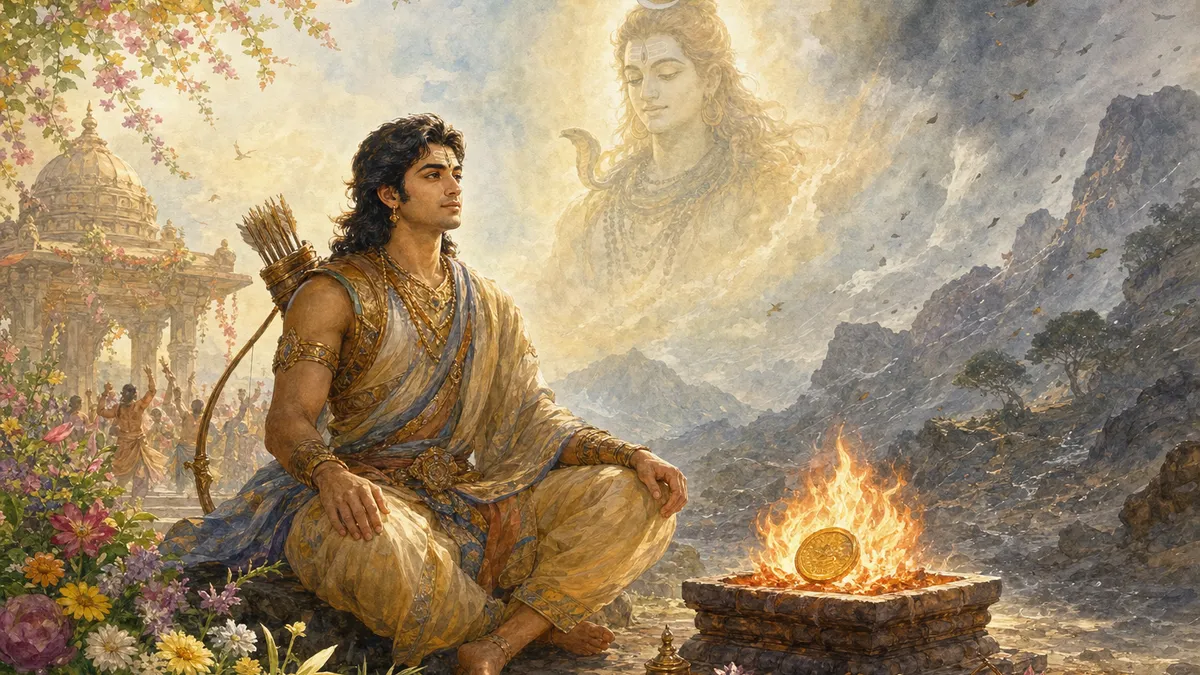
While he was reflecting in this way, the boar came within range of his arrows. To protect Arjuna, Shiva, benevolently disposed toward his devotees, came there in pursuit of the boar. The animal rushed between the two of them and stopped. An astonishing event of destiny was witnessed. Then they both released an arrow. Shiva’s arrow struck the tail, while Arjuna’s arrow struck the snout. Shiva’s arrow entered the tail and stopped right at the nose. Arjuna’s arrow pierced it all the way through, emerged from the tail, and fell to the ground. The boar, who was a Daitya, fell dead upon the earth. The gods were greatly pleased. They showered one another with flowers, bowed and offered praise, and cried out in victory. Seeing the Daitya’s ferocious form, Shiva rejoiced, and Arjuna was happy. With his mind overflowing with joy, Arjuna said, “Oh, this is a mighty Daitya! He assumed this astonishing form and came here to kill me. But Shiva saved me. Lord Shiva has endowed me with a keen intellect; there is no doubt about it.” Thinking thus, Arjuna repeated Shiva’s name. He bowed to Shiva and praised him again and again.
Thus ends the thirty-ninth chapter, entitled “The Demon Muka Is Slain,” in the story of the Kirata incarnation, in the third Shatarudra Samhita of the sacred Shiva Mahapurana.
Dialogue Between Kirata and Arjuna
Shiva Purana. Shatarudra Samhita
Chapter Forty
Dialogue Between Kirata and Arjuna
Nandishvara said, “O omniscient Sanatkumara, listen to the account of the lilas of the Great Soul Shiva, who is filled with love for his devotees and tests their steadfastness.”
Shiva immediately sent his servant to retrieve the arrow. Arjuna also went there. The Gana and Arjuna simultaneously reached the spot where the arrow lay. Arjuna rebuked him and picked up his arrow.
The Gana said, “O great sage! Why are you taking this arrow? This arrow is mine. Leave it.”
O glorious sage! Addressed by the Bhilla Gana, Arjuna remembered Shiva and began to speak.
Arjuna said, “O forest wanderer, what are you saying without understanding anything at all? You are simply a fool. This arrow was shot by me just now. How can it be yours? My name is engraved on it. And now it is mine. How did it become yours?”
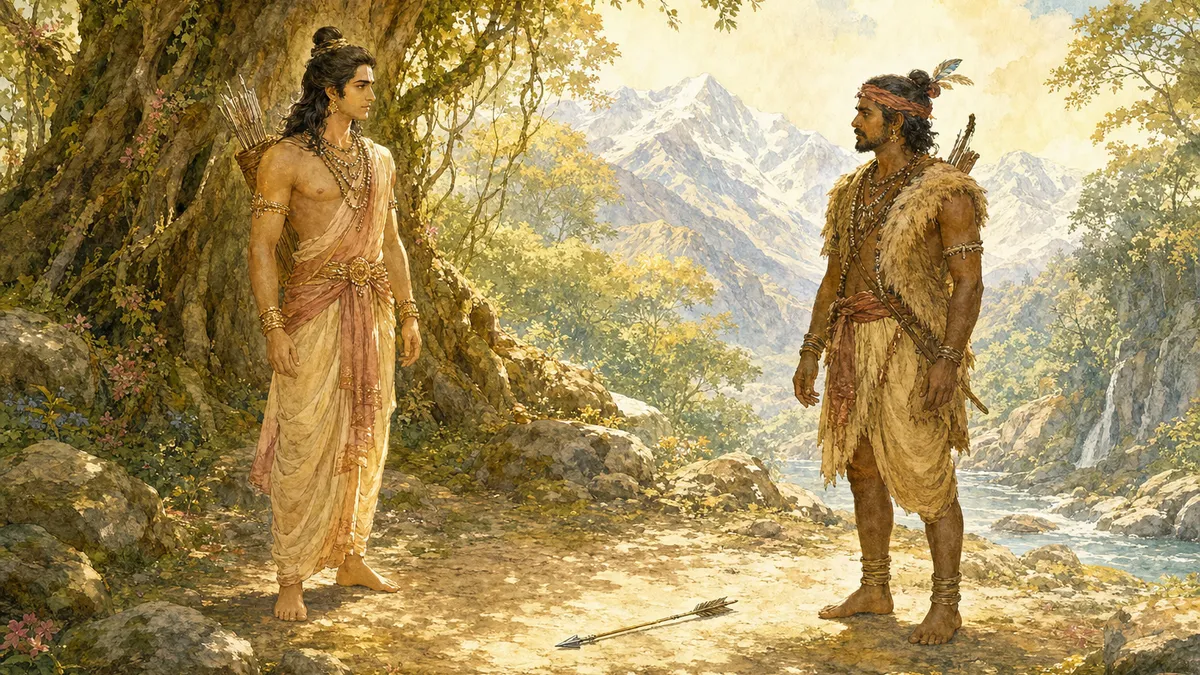
Thus, Shiva sent his gana, a hunter, there, and the hunter claimed that the arrow belonged to him. This was a lila orchestrated by Shiva down to the last detail in order to test Arjuna and then bless him. We often think that the situations in which we find ourselves arise accidentally, spontaneously, simply because we happen to be in a particular set of circumstances. Or, if we reflect more deeply on karma, we reason as follows: “Surely this is the law of karma. I created the causes earlier, and now I am reaping the fruits. What is there to be surprised about? I created the causes before, and now this situation is arising because of my sins, or because of my merits, or because of some neutral karmas.” From a higher perspective, what unfolds neither arises by chance nor is it karma; rather, it is a form of the manifestation of spanda—the dance, play, and energy of Shiva, Shiva’s divine play—which, through his immanent aspect, is unfolding with us right now, right here in our lives, here and now, in the stream of events, in the pure dimension. And, being immanent, Shiva constantly gives us opportunities. Either we see everything as Shiva’s play. Or we see by exercising discernment, clarity regarding karma, and attentiveness toward sins and merits. Or we understand nothing, analyze nothing, and act haphazardly, thinking that situations simply happen to us and that we must somehow react according to the “stimulus-response” principle, as in behaviorism. Everything depends on how much discerning wisdom there is within us to recognize one layer or another of the present reality.
Levels of Interpreting Events
“You insist in accordance with your wild nature,” Arjuna thought. Nandishvara said...
And so Arjuna thought, “Well, he is a wild hunter, a fool who understands nothing and is making some sort of claims.” In other words, his level of interpretation was the very first, the lowest one. His interpretation of the situation was that a foolish hunter simply understood nothing and, as they say, was pestering him. We often interpret things this way: “This person understands nothing; he is foolish and wants something from me.” We lack the clarity to understand: why did this arise? Could my karma be the cause? Perhaps the balance of merits and sins has ripened in such a way that this situation is manifesting like this? Or perhaps, at an even deeper level, could this be Shiva’s lila, intended to awaken, test, and bless me? This multilayered interpretation of events, this penetration into the depth of what is happening—this is the sign of viveka, the sadhu’s discerning wisdom and understanding of all this.
Upon hearing his words, the leader of the ganas laughed and addressed Arjuna, who was dressed as a sage.
“O sage, listen! You are a sage in disguise. You are not a true sage. You are not performing penance; you are deceiving people. How can a holy man utter a lie? Do not take me for a wanderer. Know that I am the commander-in-chief. My master is there with many hunters. He is fully capable of destroying you and blessing you.”
Thus Arjuna called him a foolish wandering beggar, while the hunter said, “What kind of holy man are you? You are nothing but a fraud. You do not understand what you are saying. You are pretending here, wearing the robes of a sage, while no one knows who you really are. My master is over there. I am, as it were, the leader of the hunters, and my master sent me.
“It is his arrow that you have taken just now. This arrow will never remain with you. O sage, why do you wish to lose the fruits of your penance? Indeed, I have heard that the merit gained through penance is tainted and lost through theft, pride, deceit, and the breaking of vows. Therefore, O sage, how will you obtain the fruits of your austerity? If you do not return this arrow, you will prove yourself an ungrateful companion.”
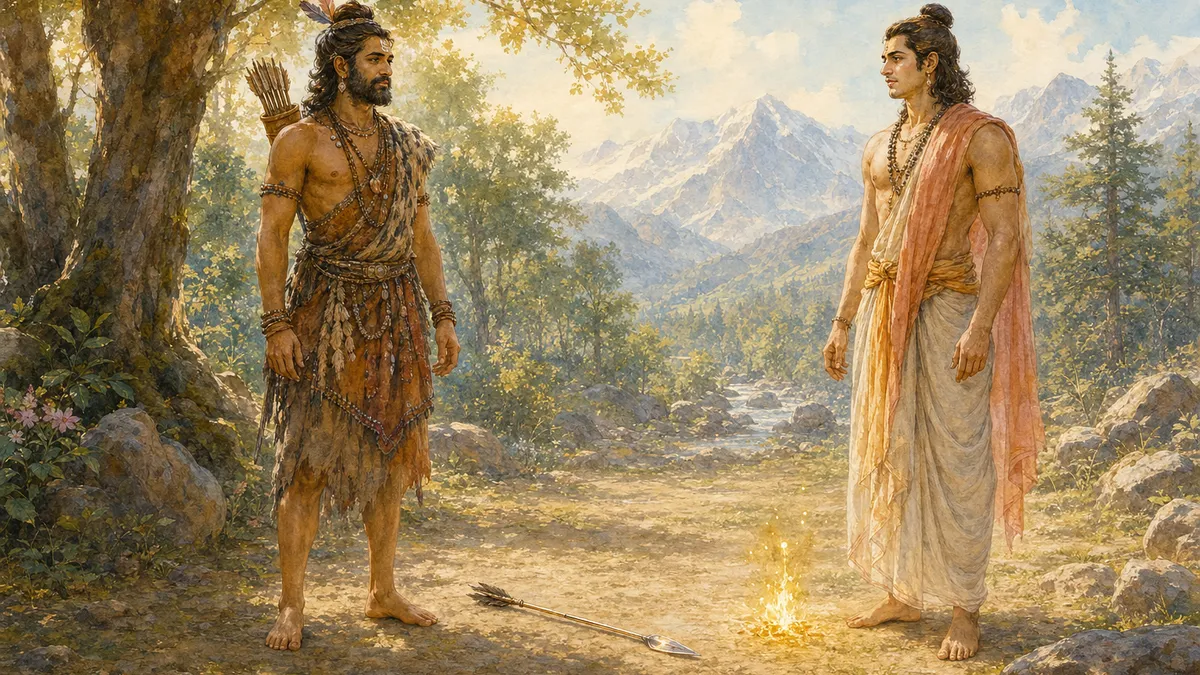
Thus, tapas bestows merit, but merit can also be lost. He lists the conditions. That is, the hunter displays an extraordinary viveka here. Merit is lost when vows are broken and when kleshas, pride, and deceit are manifested. When we practice tapas, we accumulate merit. Our daily sadhana is the accumulation of great merit. But a sadhu must always remain attentive so that this merit does not dissipate—then it will continue to accumulate.
“It was precisely to save you that my master shot this arrow. Your enemy was killed by him, yet you want to keep the arrow for yourself. You are truly very ungrateful. You are rendering your own penance fruitless. You are not telling the truth—what do you hope to achieve by this? If you need an arrow, you can approach my teacher and ask him for one. He can give you many arrows like it. My master is here, so why not ask him? Without considering the help he has given you, you wish him harm. This does not befit your status. Give it up.”
Hearing his words, Arjuna, the son of Pritha, became angry and, remembering Shiva, spoke these measured words.
Arjuna said: “O hunter, listen, and I will explain everything to you. Your words do not correspond to reality. O forest wanderer, I know you. You are true to the caste into which you were born. I am a king, whereas you are a thief. How can the battle continue? I must fight men equal to me in strength, not lowly people. Your master must be just like you. We are generous givers, while you are forest dwellers and thieves. How, then, can I ask anything of the king of the foresters? O forest wanderer, why do you not ask me for an arrow? I will gladly give you arrows. Indeed, I have many of them. If the king refuses to return what has been taken, then your objection will be valid. But then, O forester, how can I simply give away the arrow when what I intend to do cannot be understood? Why should we talk for so long? Let your master come and fight me. Having defeated me in battle, let him take the arrow and return to his dwelling. Why should there be any delay?”
Nandishvara said: “Hearing these words of Arjuna, who drew his strength from the grace of Lord Shiva, the forest dweller spoke these words.”
The forest dweller said: “You are ignorant. You are no sage. Why do you invite death? Give up the arrow and remain here happily, or else you will fall into trouble.”
Nandishvara said: “Thus challenged by this forest dweller, who had received his power from Shiva and was a gana, Arjuna, the son of Pandu, remembered Shiva and said:”
Arjuna said: “O forest wanderer, listen carefully to my words. If your master comes here, I will show him my strength. It does not befit me to fight you. I will fight your master. A fight between a lion and a jackal is utterly ridiculous. You have heard my words; now you see my strength. O Bhilla, return to your teacher and do as you see fit.”
Nandishvara said: “O sage! Thus spoke Arjuna, and the Bhilla returned to the place where the leader of the Kiratas, in the incarnation of Shiva, stood. He gave Lord Shiva, the Great Soul in the form of a Bhilla, a detailed account of his conversation with Arjuna. Hearing his words, the Lord of the Kiratas rejoiced greatly. It was Shiva, dressed as a Bhilla, who came there with his army. Seeing Kirata with his army, Arjuna, the son of Pandu, took up his bow and arrows and turned to face him. Then Kirata again sent a messenger and through him conveyed a message to Arjuna, the Great Soul.”
Kirata said: “O sage, behold this army approaching. Give up the arrow and leave. Why do you seek death over a trifle? Your brothers are in distress. Your wife is stricken with grief. I am certain that your kingdom will slip from your hands.”
Nandishvara said: “The Great Lord said this precisely to test Arjuna’s resolve. The Great Lord Shiva assumed this form in order to protect Arjuna by every means. Approaching Arjuna, Shiva’s gana recounted to him in detail what the Lord had said.”
Hearing this, Arjuna replied to the messenger: “You must tell your commander that the opposite of what he says will happen to him. If I surrender the arrow that belongs to me, I will bring disgrace upon my family. Very well. Let my brothers be distressed. Let all my knowledge prove fruitless. Come, then, let us fight!”
Thus, the messenger came and conveyed Shiva’s message: that you are practicing here for the sake of your lineage and your family, and that if you are killed, all your brothers will be deeply grieved and you will not attain your goal. But Arjuna paid no attention even to the forest dwellers’ awareness of these things. He disregarded it entirely, but his caste pride had been wounded. And he said: “Very well, let my family grieve over my death; let him come here.” In other words, Shiva subtly played upon the klesha of pride, his caste pride, in order to provoke him into a duel.
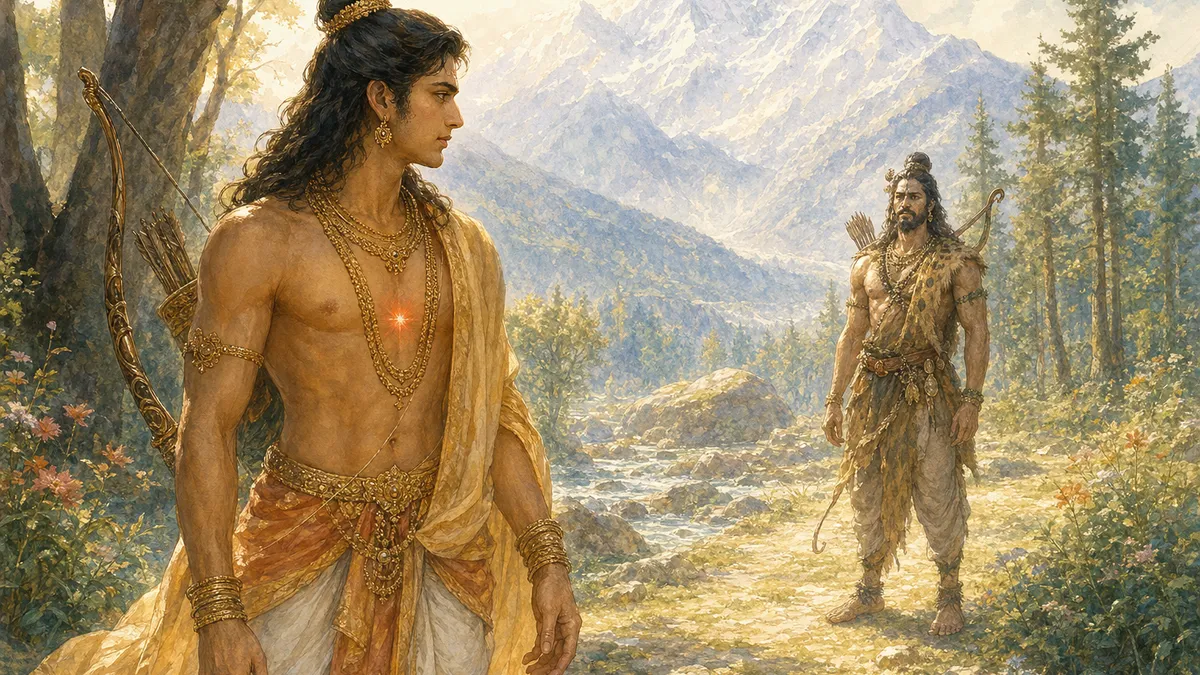
No lion ever fears a jackal. A king never fears a forest wanderer.
Having received this reply from Arjuna, the Bhilla returned to his teacher and conveyed to him everything Arjuna had said. Lord Shiva-Kirata heard this message and approached Arjuna together with his army.
Thus it is in the sacred “Shiva Mahapurana,” in the third section, the Shatarudra Samhita, Chapter Forty, entitled “The Dialogue Between Kirata and Arjuna.”
Shiva’s Maya and the Limits of Adhikara
Question: So Arjuna’s adhikara at that time did not allow him to see the essence of what was happening; he was simply looking from the ordinary manushya-bhava, from his loka-drishti? And with such... did he have any chance at all of understanding anything, of grasping its true depth? It seems to me that this is like trigonometry problems far beyond the reach of a schoolchild in the first grade.
It was not only Arjuna’s adhikara that played a role here, but also the fact that this was Shiva’s lila and a certain maya of Shiva. When Shiva wishes to lead someone into illusion, he will do so, and even adhikara may not help. It is a certain enchanting energy.
It should also be remembered that Arjuna, Krishna, and the Pandavas—all of them, although they were Kshatriyas and seemingly worldly people, were various manifestations of deities, and they were also siddhas. When, for example, the battle took place on the field of Kurukshetra, they possessed many astras. Those who wield astras, magical weapons, are called astradharis. These were the most powerful astras, controlled by mantras; that is, by human standards, they were mahasiddhas.
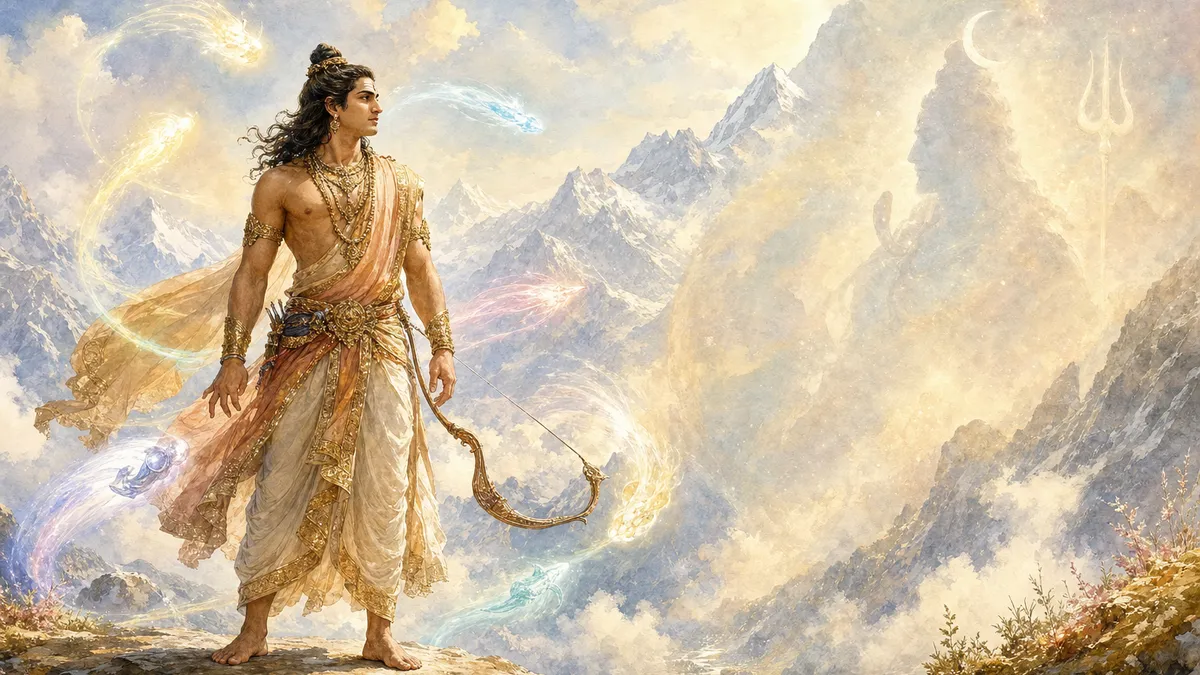
But the possession of siddhis does not yet indicate the fullness of realization, and when Shiva’s play, which leads one into illusion and delusion, also intervenes, Arjuna truly had no chance.
