The Nature of Shiva and the Path to Liberation in Shaivism
11.09.2026
0 мин. чтения
0
Share
copy
search
add
share
Commentary on the text “Shri Siddhanta Shikhamani.” Chapter 20, Sthala “The Disappearance of the Living and the Non-Living”
Throughout our lives, we are to study two philosophies: Advaita Vedanta and Siddhanta. Advaita Vedanta is Brahmavada Shaiva; Siddhanta is Advaita Ishvaravada. In Advaita Vedanta, one should study the texts of Shri Shankaracharya, then Gaudapada’s “Vedanta Panchadashi,” followed by the pinnacle, the “Mandukya Karika.” Naturally, also the “Avadhuta Gita” and the “Yoga Vasishtha.” Then one may also study the “Vedanta Sara.” And, of course, Vedavyasa’s “Vedanta Sutra.” If you study these texts and the basic concepts, the philosophy of Advaita Vedanta will become clear to you. Likewise, in Shaiva Siddhanta, one must study the basic concepts. And the “Siddhanta Shikhamani” is a condensed summary of the philosophy of Siddhanta. It is as though all the Shaiva Agamas had been taken and condensed into a concise outline.
Shiva Beyond Everything: Sarvatita, Sarva-Ashraya, and the Divine Paradox
“This perception of the world’s existence is based on beginningless ignorance. When ignorance is destroyed through the realization of the unity of the Atman, whence could the world arise?”
God abides beyond everything; He is transcendent. This is called Sarvatita—beyond everything known. There was an Indian philosopher named Jiddu Krishnamurti, and a book based on his series of lectures was published under the title “Freedom from the Known.” He sought to convey that the Absolute Truth is something Absolutely Free from everything known to you. None of your associations are the Truth or God, because associations arise from the known, from the past, from karma, from conditioning. Any thoughts, any images, any ideas—all of this is known to you as a limited human being. But God is beyond everything known, beyond absolutely everything conceivable and inconceivable—this is Sarvatita. Our notions of God are conceptual, intellectual, and figurative. All this is, as Nietzsche said, “human, all too human.” From the standpoint of the Teaching, “human” means being connected with the five sheaths, with karma, and with identifications. All this is maya—ignorance, a conditioned view of the world. Both Advaita Vedanta and the philosophy of Shaivism say that all this is a dualistic conception of God—one that we sometimes use and sometimes discard. But God Himself is Sarvatita.
Another definition isSarva-Ashraya. This means that while being beyond everything, He contains everything within Himself: all ideas, all names, forms, concepts, kleshas, desires, sins, bodies, the five elements, everything conceivable and inconceivable. All of this is within Shiva and does not depart from His nature by even a micron or a millimeter, despite the fact that He transcends everything. In other words, we live within the body of Shiva, yet within Shiva’s body we remain in ignorance; we are deluded. Some are born, some die, some marry, some embrace monasticism, and some attain liberation, all without ever leaving Shiva’s vast universal body.
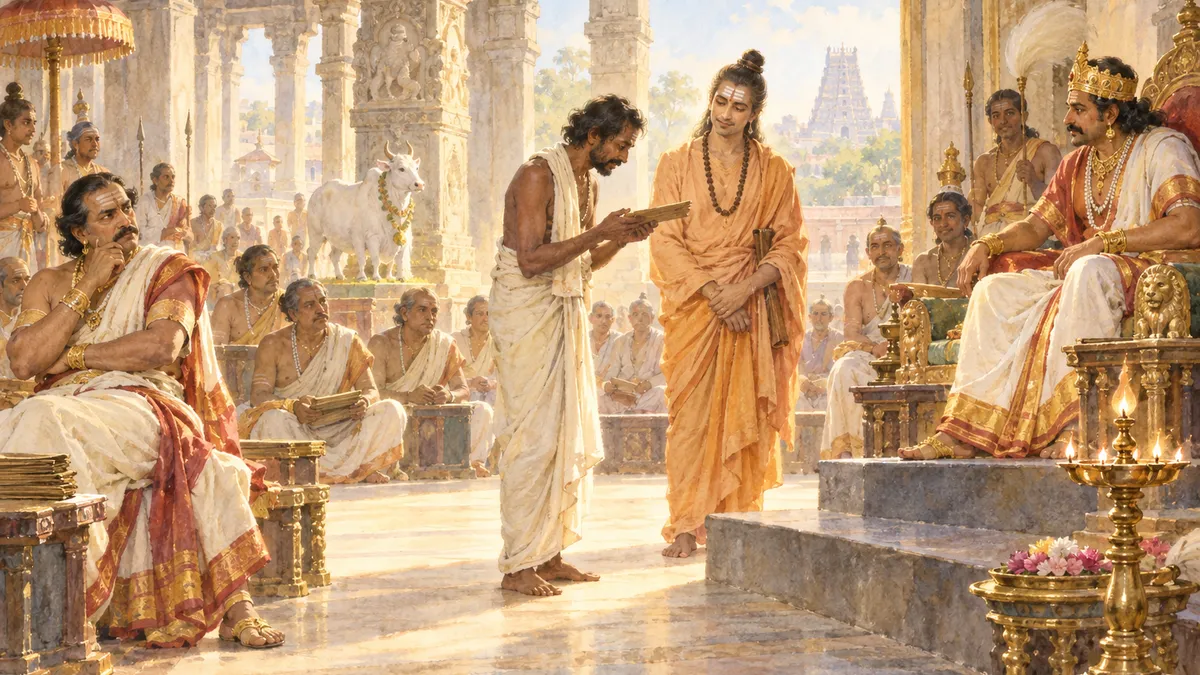
The third quality is Sarva-achintya-ashcharya. He (God) is supremely wondrous, illogical, and paradoxical—that is, beyond our human logic. There is a text called the “Tiruvilayadal.” It describes how the Pandyan king in the city of Madurai wanted to know: “Who can best explain whether the fragrance of my wife’s hair is natural or artificial?” A king can afford such whims. First, he spoke to his wife about it, but she said that she did not know. Then he said: “I will gather scholars—they are connoisseurs of poetry and philosophers—let them express their views. And whoever sings the best song on this subject will receive 1,000 gold coins.” One poet named Dharmi was in dire need of money. He began praying in Shiva’s temple. Shiva came to him in the guise of a learned pandit named Shokanatha, gave him a poem, and said: “Go to the king, show him this poem, and he will give you 1,000 gold coins.” But the king’s court included a rather egotistical chief poet of the Tamil assembly, Nakkirar. He even refused to take part in the contest. When the king asked, “Why aren’t you composing a shloka to please me?” Nakkirar replied: “Well, you did not invite me simply for the sake of it, but for money, and I have enough money not to compose poems for payment, so I will abstain.” And when Dharmi came to the assembly and recited the shloka given to him by Shiva Himself in the guise of a pandit (whom, of course, he did not recognize—he thought that some learned poet more accomplished than himself had given him these shlokas), it contained a hidden meaning, and many things had to be taken into account: first, an answer had to be given; second, a particular poetic bhava had to be conveyed; third, it had to be interpreted and its hidden meaning revealed. In other words, it was no simple task. He recited this poetic shloka beautifully. The king liked it. But the chief poet did not; he found an error in its interpretation. He said that a woman’s hair could not have a natural fragrance, even if it were the hair of the king’s own wife. Therefore, Dharmi should not be given the 1,000 gold coins. Dejected, Dharmi went to the temple and began praying to Shiva again. Shiva once more appeared before him in the form of the pandit and asked: “Why weren’t you given the 1,000 gold coins?” Dharmi replied: “They found a flaw—an error—in the poem you gave me.” The pandit became so enraged that he went to the palace to settle the matter. Upon arriving at the palace, he began questioning Nakkirar. The latter replied that, yes, the poem was flawless, philosophically and literarily impeccable, but its answer contained a logical contradiction. For even the queen’s hair could not possess a natural fragrance, since she used perfumes, ointments—various artificial substances. That was why the reward had not been given. Shiva continued: “What about celestial women?” The counselor replied: “What difference does it make? The same applies even to celestial women, even to Shiva’s own consort, Parvati.” Shiva then flew into a rage and said: “Look into my eyes!” Shiva’s third eye opened, but even then the counselor remained extremely obstinate, insisting on his intellectual notions and saying: “You are the Great Lord, I can see that; perhaps you are almost Shiva. But even if Shiva Himself were to appear here, it would still be an error. I will not agree!” Enraged, Shiva released fire from His third eye, reducing the king’s counselor to ashes. Seeing this, the king fell at Shiva’s feet, glorifying Him and imploring His forgiveness, and gave Dharmi the 1,000 gold coins. Shiva, turning His wrath into mercy, lowered the burned Nakkirar into a pool and restored him to life. Nakkirar repented and admitted his defeat, saying that the poem had been flawless. And in fact, the point was not the poem, but that Shiva had appeared on this occasion.
That is, God is not logical; He is paradoxical. No matter what logical errors, philosophical contradictions, or flaws in reasoning one may seek, it is all futile.
Self-Liberation and Freedom from One’s Own Energies
“Just as clouds appear and disappear in the sky, so too the objects of perception disappear in the atman of a yogi who has attained the spiritual experience of directly perceiving his Self.”
All objects of perception—thoughts, feelings, and desires—disappear into the Atman of a yogi who has experienced direct perception. They are naturally released into their original nature, but only in the Atman of a yogi who has gained sufficient experience of abiding in his own nature. In the Atman of a yogi whose experience is insufficient, they do not disappear. Where do they go? They settle like a kind of dust, like scale. They become his impressions (samskaras), cause the vibrations of deities, give rise to spanda, a responsive movement, and enslave such a yogi. Thus, self-liberation is the art of not allowing oneself to be enslaved. It is not external things that enslave us, but primarily our own thoughts and notions, as well as energies, of course.
In this connection, Shaiva philosophy has the concepts of pashu, pasha, and pati. Pashu are those who are bound by their energies and notions. Pati is the cosmic sovereign. If pashu is an animal possessing an animal nature, then pati is the universal Lord, endowed with freedom of will and freedom from his own energies. This is not about any external things; it is about one’s own energies. Pashu is bound by his energies, while pati is free from them. For example, it is easy to arouse anger, greed, attachment, envy, or pride in a pashu; it is enough to play on certain feelings and push the right buttons. They are very easy to manipulate. Spirits, asuras, and demons take advantage of this. All rajasic and tamasic beings make use of it. Even in the mundane world this is often exploited, for example, by politicians. They are easy to manipulate because they have so many of these buttons. They easily fall under the sway of their own energies: anger is easily aroused, and pride is easily aroused—one need only praise them, and that is enough. Attachment, envy, and pity are easily aroused by playing on something. All of this is the state of pashu, because they quickly fall under the sway of their own energies. Pati is one who occupies a dominant position in relation to his own energies and possesses freedom of will. His freedom of will (iccha shakti) arises from his wisdom (jnana shakti). His inner energy does not manipulate him, and therefore his consciousness is equanimous. He loves all living beings equally. No demons, spirits, or asuras can manipulate him. Nor can his own karmas manipulate him, because he is the Lord.
The Bonds of Conditioned Consciousness
In Shaivism, pasha means bonds, ropes, nooses, and attachments that hold a living being captive.
The first rope is called ghrina—pity for oneself and pity for others. This is not compassion, but pity specifically. It is a kind of shriveling pity that constricts consciousness. Why is it a limitation, such a noose or rope? Because when we pity others, we falsely deny their Divine consciousness and Divine potential. In relation to oneself, it is the “poor little me” complex: “I am so unhappy, so unfortunate; no one loves me. I am so small; I cannot do anything. Pity me, love me—someone, anyone—help me.” From the perspective of Shaiva philosophy, this is a sin. You do not respect your Divine potential; you do not believe in it. And if you treat others in the same way, it means you do not respect another person’s Divine potential and do not see God within them. You judge them from the standpoint of the physical body and the limitations of the mind. This is not compassion. Compassion means that you understand another person’s potential and try to help. But here, by displaying only this ignorant pity, you effectively deny them their Divine potential.
The second such rope is called shoka (despondency). Despondency is the tendency to contract consciousness with or without cause. Feeling depressed over anything. Falling into negative thoughts and various states of obscuration: “I am suffering, nothing works out for me, no one needs me, and so on.” Shoka means that instead of recognizing our Divine potential, taking pride in it, and rejoicing in our precious human birth, Refuge, and Faith, we allow ourselves to be obscured by our states and thoughts. We do not believe in our Divine potential—this too is a sinful state. All these limiting bonds are what contract our consciousness. If you have ever experienced such states, you have probably felt that in these cases your consciousness always contracts.
The third is bhaya (fear). During fear, consciousness also contracts. And everyone has some dominant fear: the fear of not getting what one wants, the fear of losing face, the fear of being caught off guard doing something wrong. And the deepest fear is the fear of death. All living beings—people, animals, birds, and beasts—experience fear on an instinctive level. Fear also lowers consciousness and contracts it. None of these states are open or infinite. They are joyless and constricting. Under certain conditions, they arise when a person finds themselves in unfavorable circumstances and situations.
The fourth such rope is called lajja—shame. This also causes consciousness to shrivel. For example, the opposite of fear is fearlessness, while the opposite of despondency is constant ananda, a joyful state. These are all open, infinite, and free states in which the mind is expanded. The opposite of self-consciousness and shame is naturalness, spontaneity, and ease. This does not mean being brazen, immoral, or rejecting the ethics and moral standards of a sadhu. It means not falling into false states regarding oneself and thinking: “I am so miserable, I am so unlucky, I am so incapable, nothing will work out for me, I will not be able to do it.” In other words, in these situations we invariably do not believe in our Divine potential.
The fifth bond is called jugupsa. Jugupsa means aversion or disgust, when we think: “What a vile thing, what a nasty, disgusting, filthy thing.” At that moment, instead of uniting and contemplating, our consciousness contracts. We establish a strong distance between ourselves and what we dislike. At that moment, we do not experience infinite, expanded consciousness; there is no union. Once again, we remain in a contracted state, and this affects our mind.
The sixth is called jati—caste, varna (origin). This may not be relevant to us. It was relevant in the days of Tsarist Russia, when there were serfs and masters, or in the Indian context, when there were castes. But it is mentioned in the texts. Today, we are all of the same origin, more or less. Since 1917, everyone has been a proletarian; that is, there are no masters. Although now, thanks to consumer culture, there is once again an elite, and once again there are commoners. And the elite has its own pride in belonging to a certain class, while everyone else is regarded as penniless losers—this also exists. In other words, it is the same whenever we identify ourselves with a particular group. This is not a Tantric or Shaivite view of the world. We contract our consciousness; we divide reality.
And the seventh bond is called shila—norms of social behavior. Sometimes these norms help, but sometimes they also enslave the soul. Shila is an attachment to and dependence on social clichés, stereotypes, and standards. When a person's life is shaped from birth, their path has already been laid out for them. They have not even been born yet, but their parents already know how they will live. They will attend a certain extracurricular club, graduate from school, then graduate from university, and then work in an office. They will buy a car and an apartment on credit, then spend their entire life working to repay the loans. Then they will grow old and retire. In retirement, they will travel around Europe with a video camera. Then they will leave the body. In other words, the social environment and culture condition them so thoroughly that they do not even have a chance; they are already subject to everything in the world. They will go shopping, take selfies, and so on. All these are norms and stereotypes of social behavior; there is not even any room for dharma, for Truth. They are completely conditioned by these relationships.
And the eighth is kula (family). This means that a person is born into a family in which parental authorities or senior family members hold sway over them, raising and teaching them from childhood. For example, they want to become a football player, but they are forced to study music. Their free will is constantly suppressed, and they cannot follow the path of their heart. We are not speaking here about families of karma sannyasins who try to raise their children differently, but in general this too can be a problem when creative potential and the spiritual path are severely restricted.
Thus, according to Siddhanta philosophy, the eight pashas are what constrict our consciousness. When we free ourselves from them, our consciousness is no longer constricted; it abides in an expanded state.
Turya—the Highest State of Consciousness
“Just as something seen in a dream disappears upon awakening, so everything worldly disappears upon realizing one’s Atman. The yogin has attained the highest state, which is beyond waking, dreaming, and deep sleep. Now, what do the validation of knowledge, the knowable, and the means of knowledge mean to him?”
When a yogin attains turya, they attain the essence of the Vedas, the essence of the Tantras, the essence of the Agamas, the essence of all sacred scriptures. Turya dissolves karma; turya burns away all vasanas, samskaras, and bijas.
Everyone has their own karma, and karma influences the mind. The mind is actually highly susceptible. Even those who think their mind is not susceptible—their mind is the most susceptible of all. They are simply so unfamiliar with their own mind that it seems to them that their mind is not susceptible to anything. But those who are more familiar with their mind understand very well that the mind is always susceptible to something.
For example, in medicine there is the “placebo effect.” Everyone knows what that is, right? A doctor gives a patient a sugar pill and says, “This is the latest development, a very expensive medicine. I’m giving it to you as a personal favor; it works 100% of the time.” The person takes it, and all their symptoms disappear. This is because they believed it, and their mind activated a subconscious mechanism of self-regulation; that is, the subconscious received a sufficiently convincing motive to engage the hidden mechanisms of psychophysical self-regulation. The psychosomatic system began to rebalance, the mind activated counteracting mechanisms, and the illness went away.
But doctors also know that, in addition to the placebo effect, there is the nocebo effect. This is because the mind is susceptible to both good and bad influences. The nocebo effect means that the mind is capable of becoming ill for no apparent reason by activating a negative mechanism—a psychophysically negative mechanism. In other words, if a sufficiently suggestible person, or a person prone to self-inflicted evil eye, self-cursing, or self-hypnosis in magic, is given the same sugar pill but told that it is harmful, after taking it they will feel unwell because that is what they believe. And because at some point they made an unconscious decision to feel unwell, they do feel unwell and believe in it more and more. Even when they are told, “You need to think differently; you need to think that you feel well,” they resist because they have already grown accustomed to feeling that way. They have reinforced it to such an extent that the mind becomes subject to certain energies.
Mechanisms of Self-Healing and Upasana
This is the basis of the siddhi of long life and the siddhi of healing through magical means. We must activate other mechanisms. We must give the subconscious the right command. The subconscious itself cannot receive commands. The subconscious is a force, a great force, but commands are given by the mind—the conceptual mind, the superficial waking consciousness that we control. The subconscious can be likened to a cassette tape, if you had a cassette recorder as a child. It is the person who inserts the cassette.
Therefore, the mechanisms of self-healing consist in giving the mind the right commands. For example: health, longevity, the siddhi of long life, the siddhi of well-being. The mind must constantly receive the right commands, the right attitudes. This is why we perform upasana—worship of Divine beings. When we perform upasana, we integrate with a positive state.
Everything is always well with the Deities. Our mood may be good or not so good, but Lakshmi is always smiling; everything is always well with her, and she is always in Ananda, in bliss. We may be angry, clouded, or joyful, but Shiva is always at peace, and Saraswati is always in wisdom. We may be in tamas, rajas, or sattva, but Saraswati is always solely in light and wisdom.
And upasana means that, by worshipping the Deities, we give the mind an opportunity to experience these states for a short time, giving it a positive impression and the right commands. This is grace. Grace means that, as a result of worship, you have activated the subtle mechanisms of the mind, and the mind has begun to move toward the divine, toward sattva.
Karma, Merit, and Inner Deities
And what does karma mean? It means that the nocebo effect is constantly at work. Something is always wrong, always bad. Since the mind generates these karmas, it attracts them. Spirits and negative beings are drawn to these karmas. And one feels that the practice is going badly, with obstacles.
Someone with a great deal of merit, on the contrary, lives under the placebo effect, as though always taking a placebo. Everything is always well for them, always joyful, always fortunate, always unfolding so wonderfully. They do not even know why this happens. It is simply their merit. Yet it seems like some kind of miracle to them. Their mind generates positive reality tunnels, positive situations, and joyful bhavas. Subconsciously, they are already trained to construct favorable scenarios in the subtle body. Wherever they look, they see favorable scenarios.
There are those who construct favorable scenarios connected with material things; this means Lakshmi has awakened within them. They see everything as pure and beautiful. But if Alakshmi has awakened in someone, then wherever they look, everything is somehow awry, somehow unsuccessful. The inner Lakshmi is capable of structuring everything, improving everything, and making everything prosperous.
There are those whose inner Durga has awakened. They are victorious everywhere. They defeat all enemies, put everyone in their place, and achieve everything through willpower. And there is the inner Saraswati—wherever they look, they see wisdom everywhere. Everything is neatly arranged, everything is very clear and reveals nonduality.
This is merit. Merit means that we are trained to think like Lakshmi, think like Saraswati, or think like Durga. When our inner deities are awakened, these bonds—the eight pashas—have no power over us. And we can move from the state of pashu to the state of pati.
The State of Turya-Tita
“The state of turya-tita lies far beyond speech and mind. Upon entering this state, the yogin no longer sees the world. After the lord of yoga has seen and realized the supreme Shiva—Being, Consciousness, and Bliss—he sees nothing else, knows nothing else, and hears nothing else.”
Approaching the state of turya-tita implies that we cast off the veils, that our soul casts off its veils—the veils of identification with the physical, energetic, astral, mental, and causal bodies. Without casting off such veils, and therefore attachments and impressions as well, it is impossible to approach the state of turya.
Therefore, approaching the state of turya means self-transformation. It is as though we cleanse our soul layer by layer. And in place of what has been cleansed away, we discover the subtlest consciousness, pure light, an infinitely expanded state of joy, bliss, and presence that cannot be expressed.
The Right Attitude in Practice
In the process of casting off these veils, we must adopt the right attitude. This is the attitude of view and contemplation, self-liberation and self-surrender. We must not adopt a lower attitude, no matter what happens. If we have decided to follow the path of contemplation, self-liberation, and self-surrender, we must remember the teachings, no matter what happens to us in life!
It often happens that a lecture is given on controlling the mind, subduing the mind, and self-liberation, but two hours later a person finds themselves in some situation, and anger arises in them, attachment arises in them. I ask: “But why? There was just a lecture! It has already been twelve years... So why is it not working?” It turns out that at that moment they were unconscious; they were not applying the method: they were not applying self-liberation, they were not applying contemplation. Quite simply, they forgot.
And this is where we must begin to apply everything—to apply it in earnest, to work in earnest, to subdue the mind in earnest. That is why I recommend certain secrets to students, especially during retreat. You draw a circle and divide it into 24 hours. Half of the circle is day, and half is night. And in this circle, for each hour, you should note whether you were conscious, whether you were unconscious, or whether you were somewhere in between, in terms of the fullness of your attention. You should observe the conditions under which the mind was conscious: when you were eating, walking, or performing techniques. And under which conditions it was unconscious. Then you should create a chart using different colors; you must learn to track your mind and monitor how well you are working with the method—whether or not you are becoming distracted from it.
“The entire world is unreal. It does not exist apart from Shiva. The world only appears to be real, to exist separately from Shiva. When Shiva is realized, this ignorance assumes its natural form.
Thus ends the sthala ‘The Disappearance of the Living and the Nonliving.’”
Shaivism
Pashu
Self-liberation
Ignorance
Turya
Pati
Siddhanta Shikhamani
Pasha
Eight Paths
Advaita Vedanta
Author Гуру
Read 18 times
Articles
Vidya AI
Search
Lectures
November 1, 2026
Mantra of the day
ОМ НИТИМАТАМВАРАЙА НАМАХ ОМ Лучшему из нравственных – поклонение!
Auspicious Times(Rome)
Brahma Muhurta:
04:52 - 05:47
Abhijit Muhurta:
11:33 - 12:14
Sayam Sandhya:
16:45 - 17:27
Mokshada Ekadashi (6 November)
Ekadashi of liberation. Helps to achieve spiritual enlightenment.