

Commentary on the text “The Hundred Thousand Songs of Milarepa”
Then Jetsun returned to the Bodhi cave in Ragma. His former benefactors served him and brought offerings. And he remained there in good spirits. One day two young shepherds came to him. The younger one asked:
“Dear Lama, do you have a companion?”
Milarepa answered:
“Yes, I do.”
“Who is he?”
“He is called the friend Bodhi of the heart.”
“Where is he now?”
“In the house of the consciousness of the universal seed.”
“What do you mean?”
“My own body.”
Then the elder one said:
“Lama, we had better go, since you cannot explain it to us.”
But the younger one asked:
“Does this mean that this consciousness is the mind itself, and the physical body is the house of the mind?”
“Yes, that is correct.”
The young man continued:
“We know that although a house usually belongs to only one person, many can enter it, and therefore there are always several people in the house who live there. But what about the body? Is there only one mind? Or many? If there are many, how do they get along with one another?”
Although primordial consciousness exists as one, in the relative sense there are many such consciousnesses; they are also called chaitasika. If primordial consciousness, the mind, is primordial intelligence, like a space of light, then chaitasika are little intelligences that reside in the body and are fixed there by means of pranas. Such little intelligences act unconsciously. Perhaps you understand how, during meditation, various strange thoughts that you did not think can arise, words can drift by that emerge from within, visions, or simply diverse movements of consciousness — all of this is chaitasika, that is, little wills that inhabit our body and want to live on their own. One could say that this is also us, but only in an unconscious form; these are the parts of the unconscious mind that are undisciplined and do not strive for liberation.

“Good. As for the number of minds in the body, you had better examine this yourself.”
“I will try.”
With that, the boys said goodbye and went home. The next morning the younger of them came again to Milarepa:
“Dear teacher, last evening I tried to find out what my mind is, how it works. I observed it attentively and discovered that I have only one mind. Even if someone wanted to, he could not kill this mind.”
The young shepherd, thanks to his sharp faculties, immediately understood the essence of the matter. Despite the fact that we have many little intelligences, our true mind is only one. And a yogin of high capacity immediately awakens and opens the understanding of this one mind.
One who opens the understanding of the one mind, even if he has not yet attained samadhi, is distinguished by the unshakability of consciousness and great faith.
No matter how strongly a person may wish to part with it, it will not go away. If you try to catch it, you cannot grasp it, and when you squeeze it, you cannot hold it. If you want it to remain in one place, it will not stop, and if you let it go, it will not leave. If you want to gather it, it cannot be caught; if you try to see it, it is not visible. You try to know it, but it cannot be known. If you think that it is something truly existing and reject it, it does not leave you. If you think that it does not exist, you feel how it continues its course. The mind is something luminous, aware, and ever-watchful.
The Superconscious Potential of the Mind
What should be understood from the words “the mind is something luminous, aware”? This means that our superconscious mind surpasses our present awareness. For example, if you imagine some brilliant musician, writer, or scientist, then our primordial mind is such a brilliant scientist or musician. The abilities of our deep mind surpass our own abilities. In worldly medicine, it is considered that a person uses only five percent of the billions of brain cells. If he uses ten, he becomes talented, and if he uses more than ten, he becomes a genius. If we speak of saints, they use approximately from thirty to eighty percent of the brain’s potential. If we speak of mahasiddhas, they use from ninety to one hundred percent.
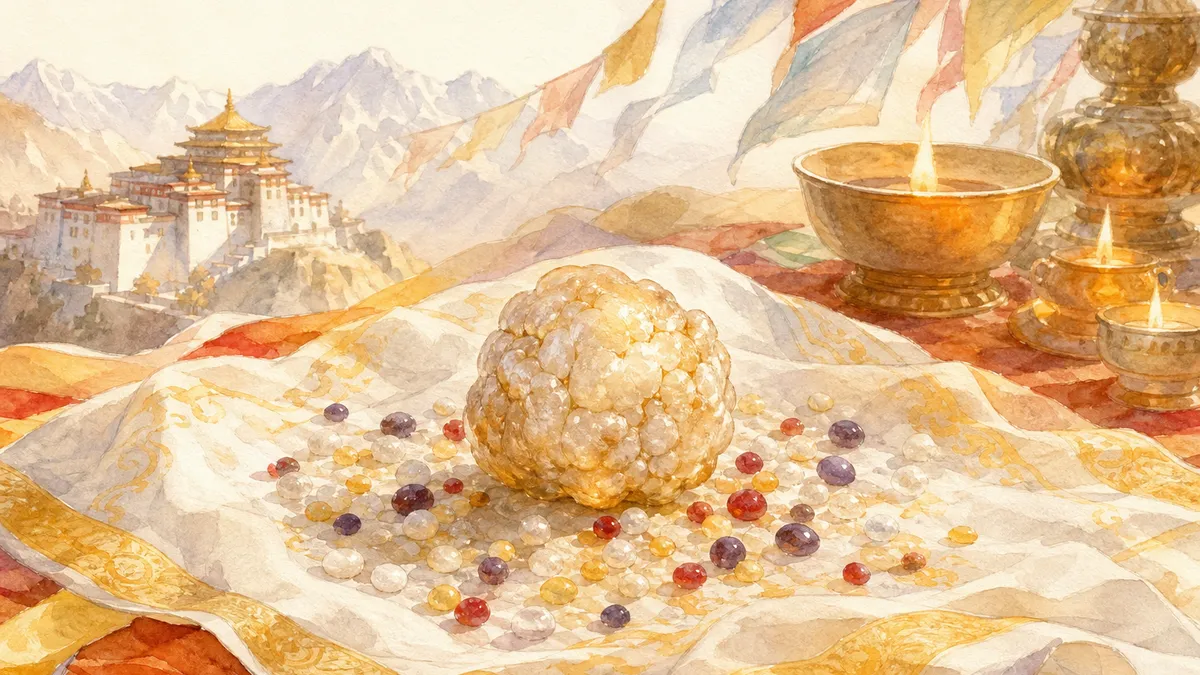
For example, there was a saint in Tibet named Longchen Rabjam. When he died and his body was burned, a luminous stone of an unusual color, resembling a brain in shape, formed where the brain had been. Usually, after the body of a saint is burned, sharira, or ringsel, remain—small stones. These are the essential creative drops located in the body, which we spoke about. And in the body of a saint who performed special practices, they concentrate and condense. Depending on which practice was performed, they may be red, black, yellow, or white. Zen practitioners also said that after the cremation of a saint, sharira remain.
But after this saint’s cremation, one large sharira remained. His brain had turned into a single luminous stone. And when monks from one monastery chipped off a piece of it as a relic, after some time the missing piece grew back in that place, as if it had never been chipped off. By these signs, it could be determined that this saint had realized one of the levels of liberation—the illusory body.
What does it mean to realize the brain’s potential by ninety or one hundred percent? It means that the maximum amount of prana is in the sahasrara chakra. Energy generously irrigates the soma chakra, ajna chakra, lalana chakra, and sahasrara chakra, and then unprecedented abilities begin to blossom. How does this manifest? For example, such a person always hears pleasant sounds during meditation, he always sees beautiful images, wondrous pictures, majestic mandalas, and astonishing landscapes arise before his eyes. If prana is concentrated in this chakra, then he encounters only wondrous or divine manifestations. Illuminations come to him; he experiences revelations, each better than the last. Suddenly he feels that understanding awakens in him in any field to which he applies his consciousness: inventions, music, painting, philosophy. Whatever he casts his gaze upon, he is suddenly struck by the deepest clarity. Such is the state of a saint when he has sufficient energy and is in samadhi.
Or, in the subtle body, he constantly sees blessings, when deities or other living beings, some souls, make offerings to him, give him nectar, place a flower on his head, or hang a garland on him. For example, many saints say after awakening that they dreamed of gods making vast offerings to them.
Inner Deities and Protector Gods
What do deities or gods mean? They are pure subtle energies in the body of the yogin himself. For example, when you pray to Dattatreya or turn with a request to Ramalinga, then Ramalinga outside and Ramalinga within are inseparable. And in the stream of your mind there is also a pure channel, pure consciousness, a superconscious state that takes on the form of Ramalinga. It is wiser than you, possesses clairvoyance, and can do certain things in the astral world. This is not yet Ramalinga himself; it is a subtle part of your mind that arises through reverence for or an appeal to Ramalinga. When it becomes fully enlightened, it becomes inseparable from Ramalinga. The same can be said of the practice of venerating other saints.
Once, the mother of a soldier who was fighting in Chechnya prayed to Xenia of Petersburg. When this soldier was standing at his post, he was called and told that his mother had come. The soldier thought that his mother could not have come, especially since she did not wear a green sweater and a red blouse and skirt. When he came to the checkpoint, there was already no one there, but at that very moment a shell struck the place where he had been standing guard, and an explosion occurred. He thought that a miracle had happened. When he later told his mother about it, she said that she had been praying to Xenia of Petersburg beforehand. Through such an appeal, Xenia of Petersburg and the mother’s consciousness projected an image that saved the soldier. Such manifestations are called protector gods or inner deities that inhabit the stream of our consciousness. They are parts of our “I,” only wiser and more aware.
Milarepa says here that the mind is self-luminous and self-radiant. Therefore our mind, its primordial nature, is even higher than such manifestations. It possesses an even greater conscious potential, since even these protector gods and inner deities that manifest arise from the superconscious state of Clear Light. In other words, to put it more simply, each of us is potentially a genius hidden beneath the shell of the physical body; it is just that we have not yet reached our potential.
“In a word, it is difficult to say what the mind really is. Please be so kind as to explain to me the meaning of the mind.”
Milarepa’s answer was a song:
“Listen to me, dear shepherd, protector of sheep! By listening to talk about the taste of sugar, one cannot feel its sweetness.”
The mind possesses self-radiance and superconscious potential. For example, when your potential increases, your ability to perceive information becomes very great. At first, when you listen to lectures, you grasp about fifteen percent of what is being said, because the capacity of memory or of the perceiving consciousness is small. When your level of energy and clarity increases, you can understand about eighty percent, ninety percent, and even more.
When your level of energy becomes even higher, when you are directly in the Source, you can understand even more than what is being said to you. What does this mean? You may be told ordinary, even worldly, information, but you will understand it from the absolute point of view. At this level, a saint receives darshan from worldly people, cows, stones, trees—that is, from everything he perceives. His degree of understanding is much deeper, because he sees everything as the Absolute.
“By listening to talk about the taste of sugar, one cannot taste its sweetness, although the mind can understand what sweetness is. The mind is not capable here of direct experience. Only the tongue can know this. In exactly the same way, it is impossible to see the nature of the mind fully, although one can catch a fleeting glimpse of it when it is pointed out by others. If one does not grasp at this fleeting vision and continues to search for one’s mind, then in the end one sees it completely. Dear shepherd, in this way you must observe your mind.
Then the young man said:
“In that case, please give me instructions, and this evening I will look into the mind. Tomorrow I will come again and tell you the result.”
The Practice of Looking into the Mind
In essence, to be in the natural state and to contemplate is to look continuously into the mind. Suppose that if you have lost control of awareness, fallen into anger or attachment, if confusion or irritation has arisen in you, this means that you have forgotten the main practice and have stopped looking into the mind. When we look into the mind, we discover this boundless space and see that only our inattention had been ignoring this boundless space. However, looking into the mind does not mean seeing only this space and nothing else.
If we think that there is a mind within us, a luminous space, and we draw the senses inward, as in pratyahara, no longer wishing to see anything, then this means that we are not truly looking into the mind. We are merely understanding the principle of the nature of Mind superficially. When we look more deeply into Mind as such, we discover its quality of all-pervasiveness. This means that it is equally present both within and without, that this Mind is nothing other than Brahman itself, the Absolute, since apart from it there is no other mind.
What prevents us from seeing this absolute Mind within or without? The loss of awareness, which is caused by acceptance or rejection. Instead of being aware, our mind often jumps onto another track—the track of the worldly mind, connected with rejection or attachment. As soon as opposition to something or attachment, attraction, or captivation arises within us, this clearly indicates the slipping of the mind, the loss of the natural state of Clear Light.
Sometimes we do not even understand at first how such slipping occurs; we think that nothing special has happened. That is, we do not notice this process, since it can be noticed only when we are in a deeper state of awareness.
Milarepa replied:
“Very well. When you come home, try to find the color of the mind. Is it white, red, or something else? What is its shape? Is it elongated, round, or something else? And also try to determine in which part of your body it dwells.”
The next morning, when the sun rose, the shepherd drove out the sheep and went to Milarepa. He asked him:
“Did you try last night to determine what the mind is like?”
The boy answered:
“Yes, I tried.”
“And how did it go?”
“Well, it is transparent, luminous, mobile, unpredictable. It is impossible to grasp. It has neither color nor form. When it unites with the eyes, it sees; when with the ears, it hears; when with the nose, it smells; when with the tongue, it tastes and speaks; and when with the legs, it walks. If the body is agitated, the mind is agitated as well. Usually the mind governs the body. When it is in good shape, the mind can command it through will. But when the body becomes old and is broken by decrepitude and paralysis, the mind will not drag it along with itself, but will cast it away without a thought, as one throws away a stone after cleansing oneself. The mind is a great realist and adapts easily. On the other hand, the body does not remain calm or obedient and often brings the mind trouble. It is the cause of suffering and pain, which drives the mind to the loss of self-control.”
When we look at one another or at ourselves in the mirror, we certainly identify ourselves with the body; that is true. However, from the point of view of saints or gods, the body is only the visible part of the iceberg, while the largest or enormous part lies beyond the body. And if one remembers this, it is always possible to tune in better to the natural state.
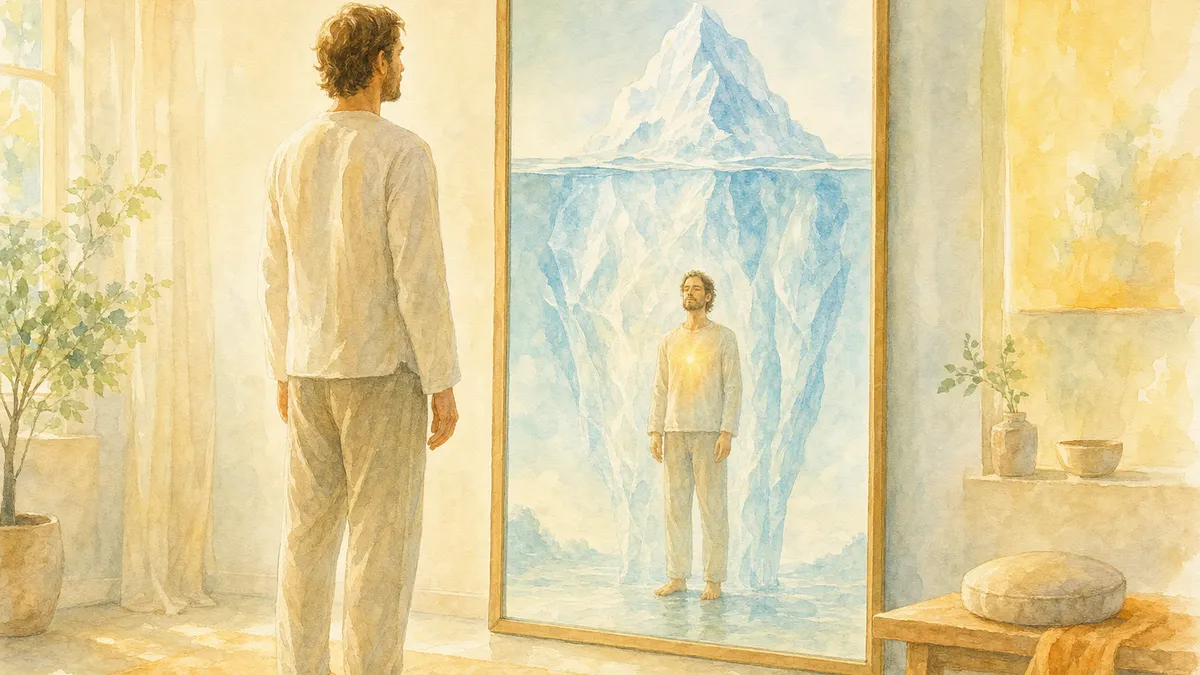
Although the greater part lies beyond the body, this body is precious because contemplation can be refined within it. It is believed that only great saints can refine contemplation in the higher worlds of form after reaching the heavens. Ordinary people cannot do this because tendencies toward enjoyment are strong there, and consciousness becomes attached to them. Therefore advanced practitioners wish to incarnate in worlds similar to the human one, so as to possess the physical body of a human being in which contemplation can be refined.
“At night, when a person sleeps, the mind departs. Yes, it truly is very diligent and hardworking; it is always occupied with something. I realize that all my suffering is caused by it.”
To this Milarepa sang:
“Listen to me, young shepherd! The body is situated between the conscious and unconscious states, whereas the mind is the decisive factor, the point of intersection. The one who endures suffering in the lower worlds is a prisoner of samsara, and the mind can free you from samsara. Do you truly wish to reach the other shore? Do you really need the city of prosperity and freedom? If you want to go, dear child, I can show you the path and give you instructions.”
The shepherd replied:
“Of course, dear Teacher, I have decided to set out in search of it.”
Then Milarepa asked:
“What is your name?”
“Sangzhi Chhab.”
“How old are you?”
“Sixteen.”
After this, Milarepa gave him teachings on taking Refuge, briefly explaining to him the advantage and importance of it. Then he said:
“When you return home this evening, do not stop repeating the words of Refuge. At the same time, try to understand what takes Refuge—the mind or the body? Report the result to me tomorrow.”
True Refuge
At first the disciple takes Refuge at the level of the body: he recites the Refuge formula or makes a prostration. But his mind is not yet in true Refuge. Only when the mind takes true Refuge does some understanding of the nature of the Mind and Guru Yoga arise in the disciple, and a glimpse of enlightenment is born.
The next morning the shepherd came and informed Milarepa.
It is very important to take such Refuge at the level of the mind. Otherwise, even while wearing monastic robes, our mind will try to take refuge in something insignificant, non-Dharmic, yet in its thoughts, in its own ego, in personal plans and hopes, it will think that this is important and Dharmic. I am not speaking about the external, since monks usually do not take refuge in external things; this is more characteristic of laypeople. But internally there are also very many worldly things, and through inexperience the mind may take them as refuge. For example, the mind may take refuge in different kinds of clarity, in subtle mystical experiences that in reality are simply another form of spiritual delusion, in personal desires connected with selfishness. Even emptiness can become a kind of spiritual delusion. All of these are partial, untrue refuges.
Ultimately, when our mind gains an understanding of the primordial Clear Light, it becomes established in the refuge of the Clear Light and never doubts again. How can we check whether the mind has taken true Refuge or not? Is there attachment to anything or not? If attachment remains, whether to an inner state or to some external object, then this is not yet true refuge, and one must continue to seek a more complete, deeper Refuge. Only that state of mind in which there are no real attachments or any fixation is genuine, true Refuge.
Question: “Please tell us, how can a novice attain true, deep Refuge? Apart from the simplest things we can do, what else can be done in order to become rooted, to go deeper? In a few words...”
Without prolonged guidance from the Guru, this is impossible, and it is impossible to describe it in a few words. Do everything you do without selfishness and always be attentive. As you practice, everything will be purified, and this state of true Refuge will come to the forefront, while untrue refuge will be discarded, cut off like a spent stage in a multistage rocket. Someone may still be clinging to the second stage and moving on it; for someone else even the third has not yet fallen away, but the greatest treasure in the rocket is located in other compartments. Something similar happens to us in spiritual practice.

Deepening of Instructions as One Progresses
The further we go, the more we need to listen to the instructions. In the beginning, the instructions have a coarse form for us, because we cannot grasp the subtle form. For example, they say: “Become a monk, do not eat meat, do not have sex, observe the daily routine, do namaste, chant the Gayatri mantra, do kumbhaka, purify the nadis.” That is, at first general instructions are given, which at the initial stages are quite sufficient. And in the first two years, even with such simple instructions, one can make good progress.
But the further we go, the more subtle the instructions become, and they require special understanding. For example: “Practice self-liberation, abide in the natural state, manifest flexibility, unite contemplative presence with external objects.” These instructions already require your understanding.
Not understanding certain instructions can lead a disciple to go astray in his practice. The further you go, the more subtle the instructions become. For example: “Perform union with light, perform the saturation of the bhavana of the natural state, integrate presence with the elements.” That is, this is an even higher level of mastery. Therefore, we must always penetrate into the essence of the instructions, striving to understand what they mean, and do so until we understand how to apply them so that our spiritual practice will be victorious.
When, for example, a student is told: “You lack flexibility,” one should pay attention to this and try to understand what “flexibility” means. Or they say: “You are fixated on inner data.” And then one should think with all seriousness: “Indeed, what am I fixated on?” Or they say: “You are sitting on the mind. You have not yet understood the non-conceptual nature at all. For now, you are still at the level of words.” In this case, the yogin should reflect: “What does ‘at the level of words’ mean? How can I go beyond words, what must I do for this?” Or they say: “Your breathing is frequent. How can one contemplate with such breathing? You need to work with the channels.” Then the yogin pays attention to this. And such subtle points, if we use them, can shorten the path of our realization by decades.
Investigating the Nature of the One Who Takes Refuge
– Dear Teacher! Yesterday evening I tried to understand which of the two takes Refuge—the body or the mind. I understood that it is neither one nor the other. First I observed the body. Each part, from the head to the tips of the toes, has its own name. I asked myself: “Is that which takes Refuge the whole body?” But this cannot be so, for as soon as the mind leaves the body, it no longer exists. People call such a body a corpse, and of course it cannot be the seeker of Refuge. Moreover, when it decomposes, it is no longer even a corpse; therefore, that which takes Refuge is not in the body.
Then I asked myself: “Is that which takes refuge the mind?” But the mind cannot be the seeker of Refuge, since the mind is the mind and nothing else. If one says that the present mind, or the mind at this moment, is the real mind, and the mind that follows it is the one that takes Refuge, then there would already be two minds, and then both of them would have to be given names, such as “present mind” and “future mind.” Moreover, during the seeking of Refuge, both the present and the subsequent minds have already passed. If one says that they both take Refuge, then the mind would appear as something unchanging, something that never grows and never ceases to exist. If this is so, then in all past and future lives, in the six worlds of samsara, we need precisely this seeker of Refuge and nothing else; but I remember nothing of my past lives and do not know what will happen in the future. The minds of last year and yesterday have passed. Tomorrow’s has not yet come; the present, current one does not stop. O my teacher, have mercy, please give me an explanation. I submit everything to your judgment. You know everything, you know what I need.
In response to the request, Milarepa sang:
– I sincerely turn to my Guru, who has understood the truth of “non-self.” I turn with body, speech, and mind.
It is very important, when you practice as novices, to be attuned to the teaching so as to gain the maximum benefit from it, to absorb it like the heart within your chest. If your attunement to the teaching is weak, then even after five years you may have gaps in your knowledge. If you are attuned to the teaching, the essence of the Dharma is laid bare.

Being attuned to the teaching does not mean only reading books, because the teaching manifests directly in our life. For example, if a person is not harmonious with others, I know for certain that he is not attuned to the teaching, but to some of his personal data; that is, the spirit of the teaching has not yet penetrated him.
