

Commentary on Longchen Rabjam’s text “The Precious Treasury of the Dharmadhatu”
“Its all-encompassing fortress is spontaneously present beyond directions. The wide-open fortress of primordial space has no top, bottom, or middle. The fortress of the unborn Dharmakaya fills everything without limitation. The fortress of the precious mystery is spontaneously present without change. All that manifests and exists in samsara and Nirvana is perfect in the primordial fortress of single equality.”
The shlokas describe, one after another, the state of the nature of Mind. Here it is compared to a fortress: “an all-encompassing fortress that is spontaneously present beyond all directions.” This wide-open space has no points of orientation, such as top, bottom, or middle—all these are our own notions, conditioned by fixation on “I am this body.” Because we feel ourselves to be in the body, we have a sense of heaviness, we feel gravity, and then there is the concept of top and bottom. As soon as the feeling “I am the body” goes away, the sensation of weight also goes away. Top and bottom are conventional concepts.
This “fortress of the precious mystery exists spontaneously without change.” Many things happen outwardly; nevertheless, from the point of view of the fundamental state of the Atman, all these things have no significance. Therefore, when you are confused and do not know how to deal with a problem, think in this way: “There are no problems; there is only an absence of meditation.” Enter the state of contemplation, deepen it, and then your problem will be resolved.
One person practiced dream yoga. In dreams he constantly forgot himself, yet a certain mindfulness still remained. When he forgot himself, he had clashes with other people; tangled labyrinths arose from which he could not escape. But from time to time he remembered that this problem could not be solved; he would simply sit down in the dream and meditate. Then his clarity was instantly restored, and the dream immediately disappeared.
The Principle of Perfection and Single Equality
“All that manifests and exists in samsara and nirvana is perfect in single equality.” The principle of perfection, of holiness (arya), is a fundamental principle that must be understood. Whenever we see any imperfection, impurity, or flaw anywhere, we are seeing the imperfection of our own vision; in the absolute sense, everything that manifests is absolutely perfect. Therefore, the yogin trains to see everything, always, as absolutely perfect. The point is that things, situations, and everything else are perfect from the very beginning, but our accepting and rejecting mind endows certain things with imperfection.
When you contemplate, this is, of course, not metaphysics. It is mistaken to think that the teaching of laya yoga is metaphysics. The path of contemplation is very precise and is not connected with concepts. It is a tuning of consciousness, an attitude that the student must clarify for himself and maintain. Until the student has clarified it, he, of course, needs concepts; he must clarify for himself what this very contemplation means, so as not to fall into deviations. At the initial stage, it is very important to clarify for oneself as many things as possible connected with the Dharma, so that there are no gaps in spiritual practice. Because it may happen that we have already been practicing for the ninth year, yet much that is new is still opening up for us.
The Dangers of Deviations in the Higher Teachings
There are various kinds of contemplation; nevertheless, the instructions of the Teacher and the teaching are very important so that we contemplate without deviations. Remember that no teaching gives rise to as many deviations as higher tantra. On the lower paths it is difficult to deviate. The Teacher says: “Perform arati, recite japa, partake of prasad, perform service.” Here it is impossible to make a mistake, because everything is literal. There is no free will of your own here; you simply do, year after year, what has been recommended to you, and you become purified. On the path of kundalini yoga it is also impossible to make a mistake: “Do sahita-kumbhaka in the ratio 1:4:2.” But on the path of laya yoga it is very difficult to convey this process in words; moreover, you have a great deal of creativity and inner freedom, since, after all, it is your own consciousness. Therefore, the yogin must be very circumspect and vigilant in his practice until he attains the true state.
There are, for example, such cases. In Kyiv there is a man named Igor Kalinauskas. He is a disciple of Osho, a sannyasin, a master of the Golden Flower school. He also trains in contemplation. His words “to be here and now,” “not to become attached,” “without past and future” repeat word for word what we say, what the saints say. His method of training was this: every day he drank alcohol and remained aware of himself so as not to become drunk. This went on for three years. In the end, he ended up in intensive care. After leaving intensive care, he said that he had fully tried, exhausted, and completed this method. But there are people who, without sufficient awareness, say that they practice according to Kalinauskas, when in fact they are simply drinking.
When we contemplate, many such deviations can arise in us. We may think that we are already mahasiddhas or avadhutas. But it is important to understand the following: when Dattatreya drank alcohol, he first transformed it into nectar. Who would drink raw alcohol in order to spoil their pranas? In his pure vision it had already been transformed into amrita (the nectar of immortality). If one does it differently, then it is a big problem, but this is an extreme case. We may think that we are already buddhas, and therefore we do not need to do anything. Such a philosophy is often encountered. “If you are aware, then it does not matter where you are,” these are Saraswati’s words. But when you begin to explain to her what “being aware” means, what the awareness that the mahasiddhas have in mind is, her eyes widen, she learns a great many new things and agrees.
The words are the same, but the depth that stands behind the words is different. Therefore, when we practice high teachings, we must be three times more vigilant than when practicing lower teachings, because in high teachings it is very easy to make a mistake and misinterpret the sutras or the words of the saints. There is too much freedom in inner understanding. For example, when a student studies with a teacher, the teacher knows what stands behind these words. He says: “Yes, yes, wait, you will still see everything yourself. I will come to you in the dark retreat, when gods the size of the entire Universe appear before you, when your mind becomes so agitated that you yourself will not know where to hide from it. We will talk about this again. Everything is still ahead of you, so be calm.” The teacher knows what depth stands behind these words, but the student may not know it. If he is not studying with a Teacher, he may grasp something superficial and then spend his whole life comforting himself with illusions that he has realized something. Of course, this is a lamentable failure in practice.
On this matter Padmasambhava said the following: “Many people say that they practice Dzogchen, but in fact they practice nonsense.” And I have never doubted Padmasambhava’s words, since he is one of a kind in all of Tibet. He gave Yeshe Tsogyal the following instructions: “To think that you will attain through the view of the supreme natural state is the mara of view.” It was not without reason that he said that mara can come to you in the guise of a view or outlook and soothe you when you think that you will realize through such a superficial approach (only the approach of view), and you as if freeze in a state of self-satisfaction.
We must take the words of the saints very seriously. The further we advance, the more we value the teaching and know that misunderstanding some words, some nuance, may cost us decades of practice, and perhaps even dozens of lives. Some mistake or omission in the Dharma can cost us very dearly; we have no right to ignore instructions if we desire deep realization.
The Boundless Ground of the Awakened Mind
“On this boundless ground, spreading in all directions, the citadel of the awakened Mind, leaning neither toward samsara nor toward nirvana, rises as the peak of the open space of the nature of phenomena.”
The foundation of our mind is the boundless ground that spreads in all directions. It inclines neither toward samsara nor toward nirvana, since samsara and nirvana are categories of separation and duality that exist in the minds of the individual, the subject. It is said to be “the peak of the open space of the nature of all phenomena.” The peak means the highest radiant point. It is the space that permeates the nature of all phenomena.
A Sermon in the World of the Gods
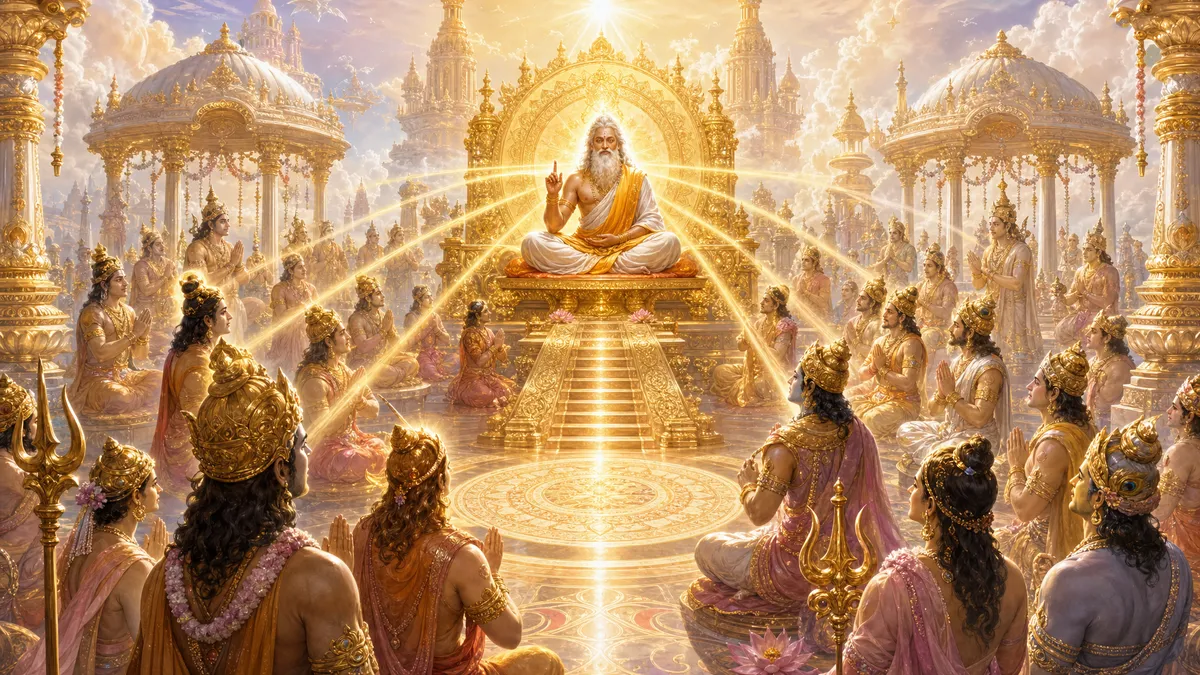
When some great saint is about to preach in the world of the gods, the gods know about it in advance, and therefore, thanks to a mystical connection, they gather for the assembly. When this great saint descends, they cannot see him immediately. The most advanced among them see his approach with spiritual vision, while those with fewer merits do not see him. But when he draws near, it is like an immense luminous glow arising in the sky. When he comes even closer, it is like a vast radiant light. When he preaches, seated on his throne, he descends, materializing instantly, and each of the gods sees him directly before himself, as if he were preaching to him alone, yet at the same time he also sees him seated on the throne.
When someone preaches in the world of the gods, he does so at the level of subtle speech, and the speech arises at once in several directions, as if many living beings were speaking simultaneously. This speech is very melodious; it forms a very harmonious sound that performs POA for the listening gods. Sometimes this great saint says nothing at all, but merely abides in presence. Nevertheless, this presence penetrates each god who listens to the sermon at the assembly so deeply that his consciousness changes and the light intensifies.
Each god, by virtue of his merits, possesses mystical powers. Even among gods living on the same level, these mystical powers differ. However, when a great saint who has realized the nature of the Mind comes, no one can compare with him. He comes not as a body, but as space, as a radiant presence, and from it arises a materialized form that can be seen and heard. The teaching preached to the gods is precisely the teaching on the nature of the Mind, which is like space. This is considered the most heartfelt spiritual secret of all teachings.
