Zen Parables: The Path to Direct Realization Without Mental Constructs
15.07.2026
0 мин. чтения
0
Share
copy
search
add
share
Commentary on the text “Zen Parables”
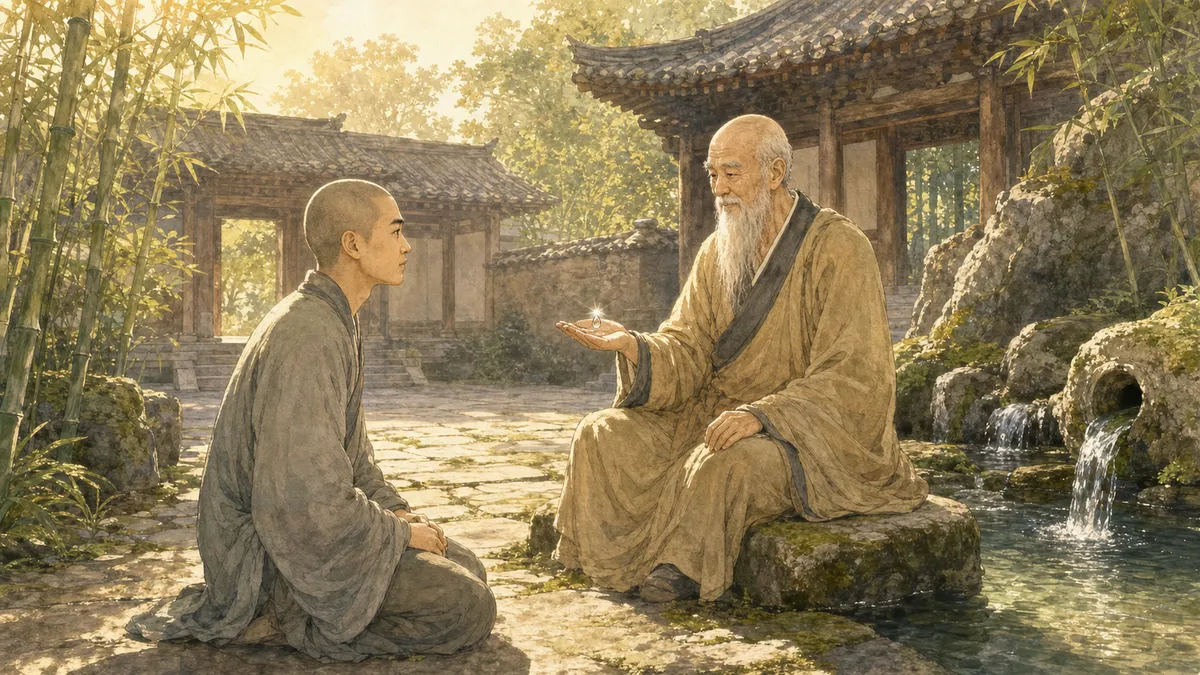
One day a monk came to Yushu and asked:
“How should I live alone on the top of a mountain?”
Yushu answered:
“Why do you leave your Zen in the valley and climb the mountain yourself?”
From the point of view of the teaching, these stories are for us a kind of symbolic and non-sign transmission.
The monk asked: “How should I live in solitude on the mountain?” The teacher answered him: “Why do you leave your realization in the valley and climb the mountain?”
What did the teacher want to say? He wanted to tell him the following: “What is here is everywhere; what is not here is nowhere. You will not find the primordial Essence on the mountain or anywhere else except in the state in which you are right now.”
In the same way, when we build illusory plans and cling to them, we need to ask ourselves: “Why do we leave our realization in the valley and try to climb the mountain? Why do we not abide in the primordial Essence right now, but connect it with some hopes for tomorrow?”
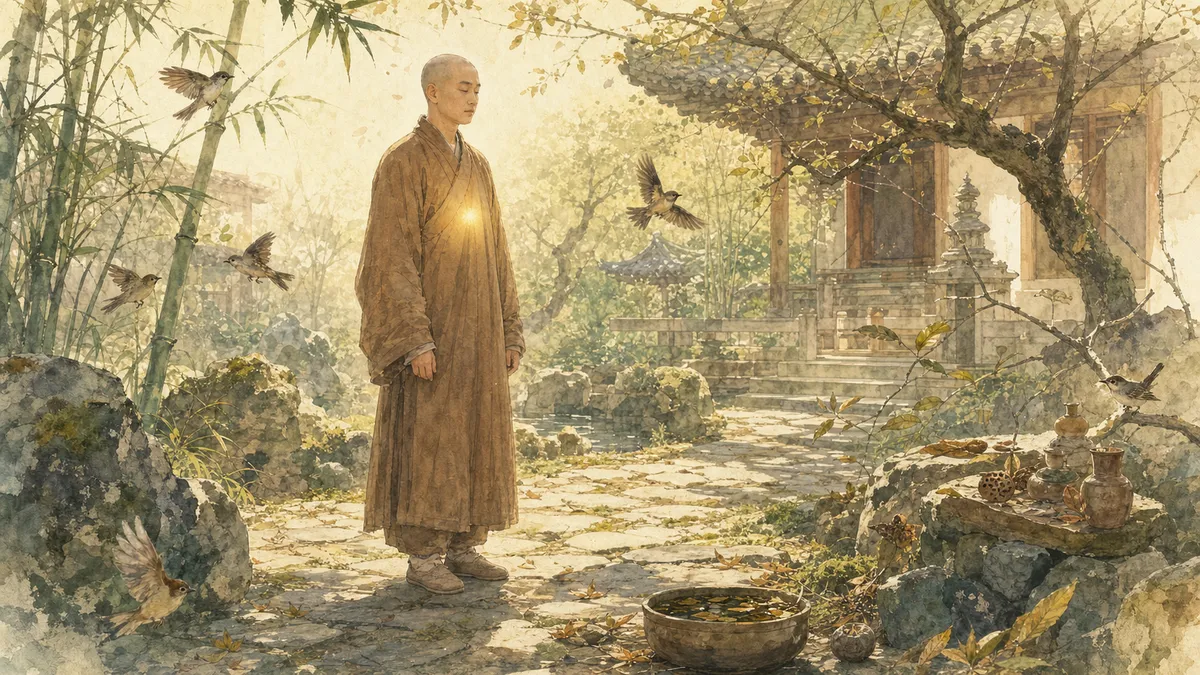
One monk asked Fayan:
“What is a drop of water from the spring that is in the valley of the six patriarchs?”
Fayan said:
“This drop of water is from the spring in the valley of the six patriarchs.”
“The spring of the valley of the six patriarchs” is not some geographical spring, but the Supreme Source. All patriarchs drink from it, regardless of which tradition they belonged to.
The monk asked: “What is a drop of water from this source? What is one’s own realization?” The teacher answered him: “This drop of water is from the spring of the six patriarchs.”
This means that there are no commentaries, no fabrications, no constructions, no discussions. It is an extremely simple, yet at the same time profound, state. The teacher simply reflected it, responding to the monk’s question.
When we reflect events and situations with the mirror of the mind, without interpreting them based on our own concepts, then we drink from the Source in the valley of the six patriarchs.
When we begin to give commentaries and evaluations, and grasp at them, we already stop drinking from this Source. The primordial mind is certainly simple, but our small conceptual mind tries to complicate everything by creating comparisons, summoning memory, and so on. At the moment of such complication, it gets entangled in it and stops drinking from the Supreme Source from which the patriarchs drink.
If you can relate to any problem without complicating it, that is, without giving it mental evaluations, without analyzing it (at least, without grasping at analysis), without falling into dependence on your own evaluations, but simply looking at it directly, with the eyes of intuitive consciousness, then you will not lose this Source, and then any problem will be solved. It will not necessarily be solved based on the notions in which you live. It will be solved in principle, primordially. Perhaps it will disappear altogether, and therefore it will not even need to be solved.
The teacher answered: “It is simple consciousness without thought-constructs that confuse you. It is the naked consciousness in which you abide right now. So why not see it for yourself in order to receive the answer to this question?”
However, if the mind does not feel it, then it tries to build these thought-constructs. Then it becomes entangled in them. The task is to see, behind the thought-constructs, simple, pure clarity and to gain trust in it.
Chaoxuan said:
“Do not follow the path of the bird’s mind.
Do not dress before you have come into the world.
Do not consider the present moment to be eternity.
Do not express yourself before you are born.”
The first instruction: “Do not follow the path of the bird’s mind.”
The “bird mind” is a shriveled, constricted mind that is very restless, always distracted, jumping from one object to another, having lost the essence. Such a “bird mind” is very dependent on the external; a monk must not follow it. A monk who follows the path of the “bird mind” is in constant anxiety. He has lost his center.
The second instruction: “Do not dress yourself before you have come into the world.”
What does this mean? Before we came into the world, we had the unborn, primordial nature — sahaja-tattva, our original Essence. But when we came into the world, we began to put coverings over it — subtle bodies, gross ones, and so on. Along with this appeared and developed the ego (ahamkara), memory (chitta), consciousness as a whole, manas (the evaluating mind), the five karma-indriyas (organs of action), and the five jnana-indriyas (sense organs). We began to connect ourselves with all these complex things; we clothed ourselves in them and began to identify ourselves with them.
This teacher says: “Do not identify yourself with anything except that which was your nature before birth — sahaja-tattva. Do not put anything else on yourself; everything else is not yours.”
We are mortal when we identify ourselves with what was born. But if we identify ourselves with what was not born, with what is unborn, then we acquire the body of immortality.
The third instruction: “Do not consider the present moment to be eternity.”
This teacher says: “Do not blindly immerse yourself in events. The world is impermanent. Eternity exists, but it is not in time; it is beyond time. If you want to attain eternity, then leave the past, present, and future for the place where there is no time. Do not identify with the momentary.”
If you attach importance to the present moment in the sense that you immerse yourself in some fabrications, unconsciously get involved in relationships, then you lose eternity.
The fourth instruction: “Do not express yourself before you are born.”
This is a very important instruction. What is the point of expression if you have not yet attained realization? It will have no meaning, because it will be like expression in a dream or the expression of a blind person. In other words, having received some inner realization, protect it; do not spill it out, do not try to boast before others or imagine yourself as someone who possesses attainment. Until you have not yet been born, do not express yourself; protect yourself and your realization. If you begin to express yourself prematurely, even the small realization that exists within you will leave you.
I once came to a person who had invited me as a guest. He showed me his altar, told me how he practices, what magical powers he had acquired.
I said: — This is all good, of course, but you should meet with a master.
He objected: — But I am a master.
I said to him: — No, you are not yet a master, but an apprentice. You are simply still a simpleton. Until you receive confirmation from a true master, you will continue to wander in the dark.
He was even a little offended. But when, on the second day, he received the direct transmission, his opinion changed completely. He looked at me in surprise and said: — Do you have any other monks who can do this too?
I answered: — In fact, this is only the very beginning. Now do you understand why I said you were a simpleton?
If you call yourself a master prematurely, without having received realization, then someone will certainly tell you that you are a simpleton. That is the point. But if your realization is true, it will itself attract gods, people, and spirits to you and inspire them to the spiritual path.
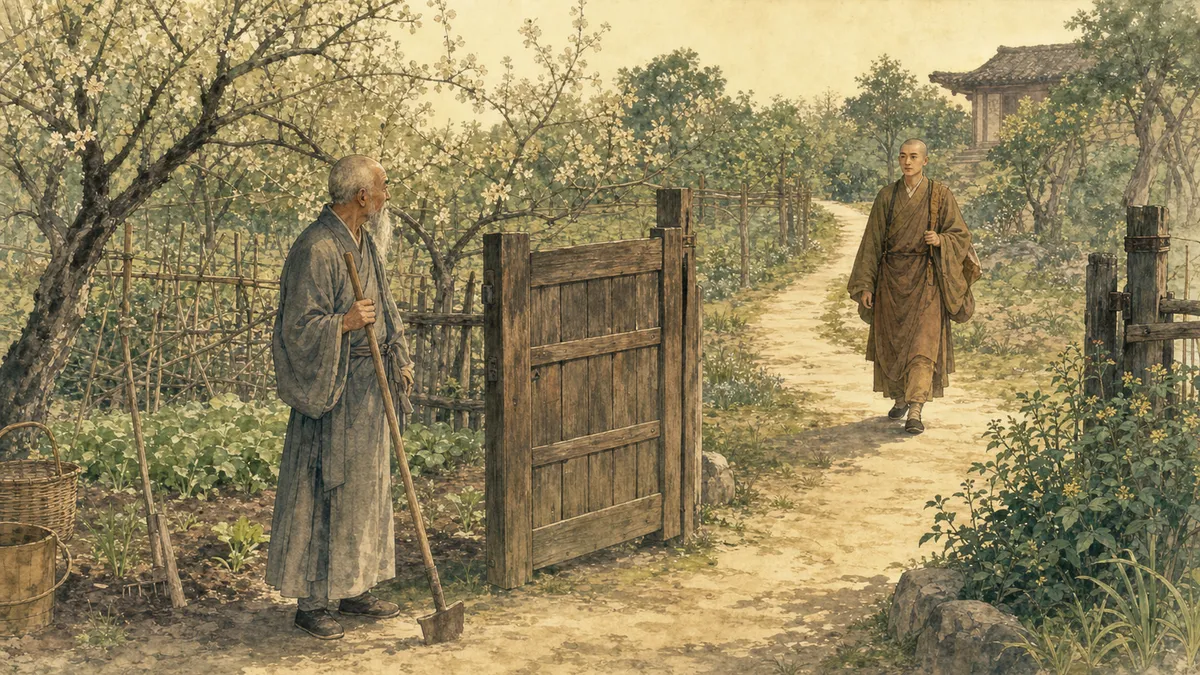
Once, when Deshan was working in the garden, he saw a monk approaching him along the road. Deshan locked the gate. The monk knocked at the gate.
Deshan asked:
— Who is it?
The monk replied:
— A lion cub.
Deshan opened the gate. The monk bowed to the teacher. Deshan jumped onto his back as if he really were a little lion, knocked him to the ground, and said:
— Oh, devil, where have you been?
The Master was working in the garden at the monastery, and a monk was walking along the road. When the Master saw him, he locked the door, trying to test his awareness. When the monk knocked, he asked, “Who is it?”, thus trying to turn the disciple’s mind inward, toward the subject. The disciple was somewhat aware, already had some “taste” of natural contemplation, so he wanted to demonstrate that he was vigilant and said, “A lion cub.” He had not yet fully realized the lion nature; nevertheless, he already had some understanding, so he said that he belonged to the lions. But if you say something to a Master, you will have to answer for those words, because the Master’s reaction is total. And Deshan immediately tested the monk, jumped on top of him, and knocked him to the ground. At that moment the monk lost awareness, that is, his lion nature was thrown off by this test. Then Deshan said, “Devil, where have you been?” In other words, he seemed to ask, “Why did you allow your lion nature to go away? Why did you lose awareness because of this?”
A guru will not necessarily jump onto your back from behind a door. There are enough ways to test vigilance. Each school has its own.
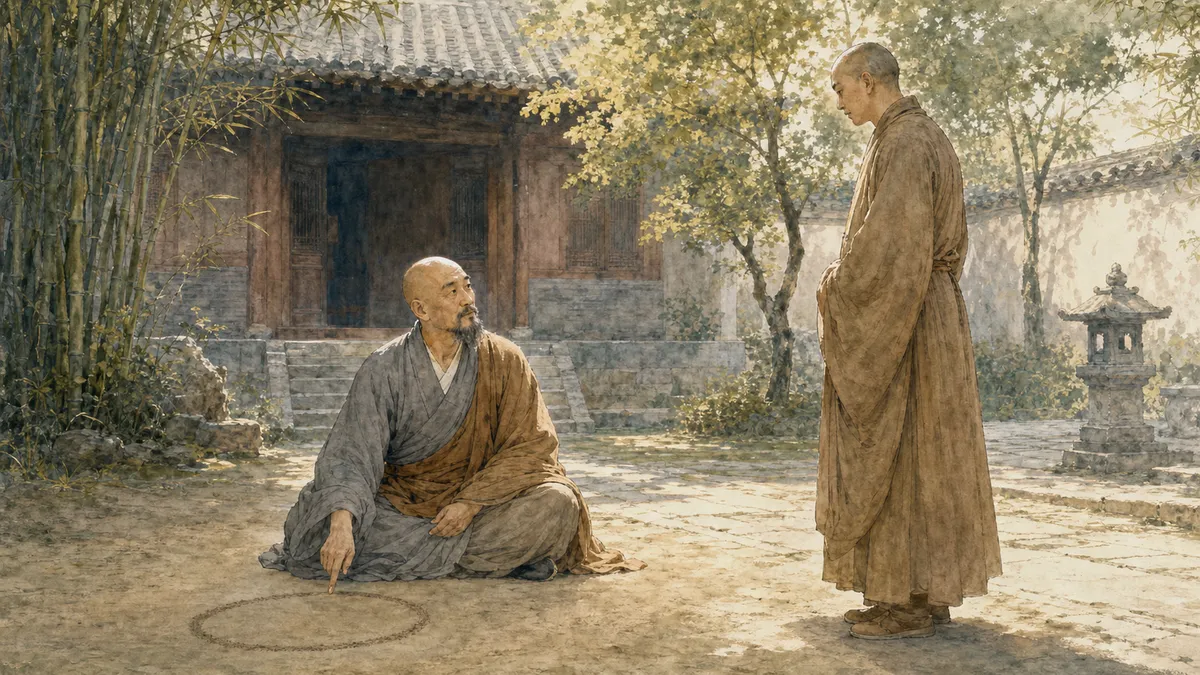
When Yanshuang was sitting in meditation, a monk silently approached him and stood beside him. Yanshuang recognized the monk and drew a circle in the dust, then looked at the monk. The monk was unable to respond.
A clairvoyant from Ukraine said about five years ago: — Swami Vishnu Dev, I know why you understand koans so easily. In your past life you were the Sixth Patriarch. I can say exactly any person’s past life, down to the year.
I replied: — You may believe it or not, but it is enough for me to be who I am now.
Three Principles of the Teaching
Why do we use these stories? There are three principles in the teaching.
The first principle in the teaching of the tantra of the siddhas is called “Instruction, Dharma,” that is, intellectual understanding, which is very important. Nevertheless, this is not the main principle.
The second principle is called “Siddha.” This is intuitive experience, inner realization.
The third principle is called “Malini” — the flexibility of the teaching, the ability to use any situations for transmission in a teaching setting.
These three principles were formulated by the great saint of Kashmir Shaivism Abhinavagupta, who was a disciple of Gorakshanath. The principle of flexibility in transmitting the teaching implies that any situations may be modeled and any things may be used to transmit and explain the teaching. Therefore, I use these stories based on this principle.
Read 14 times
Articles
Vidya AI
Search
Lectures
November 5, 2026
Mantra of the day
ОМ ЭКАЙА НАМАХ ОМ Единому – поклонение!
Auspicious Times(Rome)
Brahma Muhurta:
04:56 - 05:51
Abhijit Muhurta:
11:33 - 12:14
Sayam Sandhya:
16:40 - 17:21
Mokshada Ekadashi (6 November)
Ekadashi of liberation. Helps to achieve spiritual enlightenment.