

Namo Guru Deva! Namo Satya Dharma! Namo Arya Sangha!
I wish to pay homage to Sanatana Dharma, to Bhagavan Avadhuta Dattatreya, to Shiva Prabhakara Siddha Yogi Guru Brahmananda, and to all the saints of the Tree of Refuge!
Non-recognition of the supremacy of God as the cause of suffering
Non-recognition of the supremacy of God is the cause of suffering. Avoiding suffering is inner alchemy and the path of inner asceticism. Vidyaranya, in the text “Panchadashi” (he is a famous Advaitin, second after Shankara and Gaudapada), says that a person following the path of Advaita needs discriminating wisdom capable of separating his Higher “Self” (Atman) from the five sheaths — pancha-kosha-viveka. Pancha-kosha-viveka has the ability to recognize the supremacy of God, to discern God within oneself, in order to merge with Him. God, Brahman, Atman — these are one and the same.
If we lack such an ability, if we cannot recognize the supremacy of God, then padatmiya occurs. Padatmiya means the false identification of one’s divine essence with that which it is not, for example, with the body, thoughts, feelings, or one’s will. And then we transfer the qualities of God, the qualities of our selfhood, onto something else, and such a transfer is called chitabhasa. That is, it seems to us that our selfhood, our Higher Divine “I,” is our thoughts, or our will, or our body, and then delusion sets in.
If the soul does not recognize the supremacy of God over itself, it is deluded, like a fish swimming in water but not recognizing the supremacy of the ocean, or like a foolish bird that flies in the sky and does not know the supremacy of the sky above itself, or like a restless drunkard who, in his intoxication, does not recognize the authority of the law over himself.
The reason for the non-recognition of the supremacy of God is the soul’s inexperience in observing itself, its spiritual blindness with regard to God. The soul becomes filled with thoughts and errs, recognizing the supremacy of the mind, or it experiences the sensations of the body and recognizes their supremacy, experiences emotions — and mistakenly recognizes the supremacy of emotions, or it manifests will and mistakenly recognizes the supremacy of the will; but all these are erroneous states of the soul that lead it into bondage to the body, the senses, the mind, or the will.
It is precisely the erroneous state of the soul that forms the world of samsara, the cycle of births and deaths, and leads to the emergence of karma, because in the true state, when error (ashitva kranti) is absent, there is no karma — there is lila; there are no rebirths — there is eternity without rebirths; there is no samsara — there is a mandala of pure universes, of the playful energies of universes.
Thus, the soul (jiva), having mistakenly recognized the supremacy of these states, enters their service and begins to serve them. What does this mean? It becomes their conduit, the expresser of their interests, and it goes into service like an illiterate worker who mistakenly enters the service of a bad master, because the ego, the senses, the mind, the will — all these are bad masters, not true ones. But if the soul enters their service, it becomes, as it were, a slave of these bad masters, because a worker under a bad master will receive nothing for his work except reproaches, no matter how hard he tries.
It is precisely the stubborn non-recognition of the supremacy of God that prevents the soul from submitting to God, surrendering itself to God’s mercy, and merging with Him. Without recognizing His supremacy, how can the soul hope for liberation from karma? And one can analyze this: if we suffer and are in confusion, are dissatisfied or distressed by something, or sad, or think that there is some external cause of our suffering, this is a sure sign that right now we are stubbornly not recognizing the supremacy of God over ourselves.
That is, if we suffer and are dissatisfied with anything, the reason for this is, of course, not the world, nor fate, nor other people who hinder us; the reason for this is our stubborn non-recognition of the supremacy of God at every moment. Someone may say that karma is the cause. One may say so, but karma is not the main cause; the main cause, after all, is the non-recognition of the supremacy of God, because at the moment when we recognize the supremacy of God, even karma has no power over us. It remains as energy; it does not disappear at once, but our attitude toward it changes, and we are no longer under the power of karma. Karma becomes something like playful energies, but they can no longer rule over us.
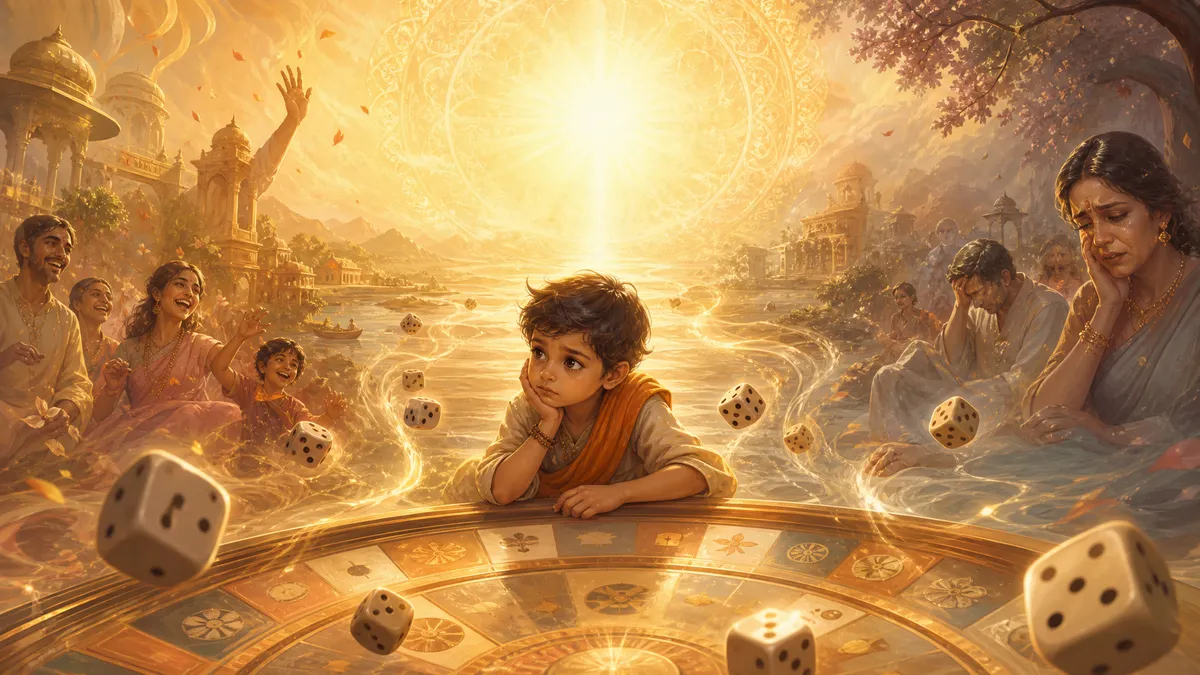
And such a soul is like a small child who stubbornly believes that everything must happen according to his will, that the world must recognize the supremacy of such a soul, but at the same time the deluded soul does not see the supremacy of God. And a person who does not recognize the supremacy of God lives now rejoicing, now cursing fate, full of hopes and fears, like a dice player who sometimes wins and sometimes loses; his life is very unstable: today things are good, tomorrow they are bad; today he is cheerful and happy, and tomorrow everything goes downhill, and he suffers terribly.
This is an indication that the soul clearly does not recognize the supremacy of God, because in God such changes are impossible, in God such fluctuations are impossible, in God such losses and gains are impossible as in a casino, as in roulette, as in slot machines. If you have seen a person passionately playing something: a second ago he was rejoicing because he had won, and now he has placed another bet, and now he is crying because he has lost everything. It is the same in life: if a person lives without recognizing the supremacy of God, his current situation constantly changes, his train of thought and consciousness constantly change, his joy and sorrow are highly dependent on external circumstances, material things, the states of his mind, the planets, the state of his body, and relationships with other people; he is very unstable.
Life in God
On the contrary, a soul that lives in God lives a completely different life; its life is very stable and there are never any fluctuations; there is no sorrow in it, no worldly happiness such as happens in a casino. One could say that when the soul lives in God, it has continuous, subtle, quiet happiness. Such happiness grows, grows, grows... It becomes ever more refined, and at the same time it gains ever greater strength.
All of samsara is a big casino, where some win, others lose, and they constantly change their position in the standings. But life in God is something entirely different. It is life in a very even, happy state that deepens and deepens; it is life in happiness: from a small happiness to an even greater one, from a shallow one to an even deeper one, deeper, deeper, deeper, deeper, and there is no end to it. From happiness to rapture, from rapture to divine ananda; there is no end to this. And this is possible when we begin to recognize the supremacy of God everywhere and in everything.
But if we do not recognize it every moment, then we are like a fisherman who has sailed out into a stormy sea in a flimsy little boat, such a small boat: his fate is unstable. It is unknown what will happen to him in the next moment. A gust of wind may come, the waves may rise, and his little boat may be overturned.
So, when we follow the spiritual path, we must make a decision: we must decide once and for all, always and everywhere, to recognize the supremacy of God, in order to live in happiness and wisdom, and not live in such states of fluctuation. Such a decision is also called making the great decision to abide in contemplative non-doing. But contemplative non-doing is already a technology; it is an explanation of exactly how to be in God, exactly how technically to recognize supremacy with consciousness. But before going into the depths, into the subtleties of the methods of contemplation, we need, in principle, to decide for ourselves whether or not I recognize the supremacy of God, in principle.
That is, if I recognize it in principle, then afterward it is only a matter of technologies: contemplative non-doing, self-liberation plus sankalpa—these are subtleties, but in principle we must first decide whose supremacy I recognize: either I recognize the supremacy of God, or I recognize the supremacy of my ego, or of thoughts, or feelings, or forms. And such supremacy cannot be recognized by the mind; it can only be recognized by one’s spirit, by that which is higher than the mind; it is an irrational act of faith. This choice is not mental, not logical, not volitional; it is irrational. It can only be felt at the level of spirit and faith.
The Divine Structure of the Universe
The world is arranged by Brahma, the creator of the universe, so that not our supremacy but his may triumph, and so that a person always submits to him and serves him as a conductor of his will, because a person is not the creator of nature, not the crown of nature, and in general not the center of creation—as they say, not the navel of the Earth. And the universe was not conceived by Brahma for the sake of human beings; the universe was conceived as a certain intention, as the enactment of the Divine will, and Brahma the creator generates a vibration, spanda, the primordial spanda in his consciousness, and he generates it in accordance with the will of the Absolute, so that souls, jivas, as particles of the Absolute, could awaken, arise from the unmanifest state (pralaya), could begin to manifest activity, interact with the gunas (tamas, rajas, and sattva), and grow, evolving through this.
That is, Brahma the Creator creates the universe in order to give souls the opportunity to evolve and develop. And these souls are sparks of the Absolute itself, individualized sparks. That is, in fact, the Absolute itself places some of its as-yet unenlightened energies in such conditions where they could grow, and creates a playground for them. And this playground is created so that souls may develop, find God, and become conductors of the Divine Will, become conductors of this Divine Light. And even having entered into matter, into tamas, into rajas, into sattva, into a body made of the five elements, they nevertheless awaken and perceive this Divine Light, this Divine Will, and begin to conduct it. This is what the universe is arranged for.
But it was not created so that our supremacy as human beings should triumph—certainly not. Our universe is not anthropomorphic and not anthropocentric; the universe is God-centered, Absolute-centered; at its center stands God, not man. Man is a derivative of God. And accordingly, the entire law of the universe is attuned so that not only humans, but all living beings—all rishis, rakshasas, asuras, pishachas, pitris, vidyadharas, gandharvas—so that all of them may know God, develop, and all of this is called Sanatana Dharma—the eternal divine, cosmic law of the universe.
But we can follow this law precisely when we begin to acknowledge the supremacy of God, to acknowledge the supremacy of the Absolute. It is precisely this acknowledgment that leads the soul (jiva) to self-surrender, to prapatti, atmanivedana; it leads to the descent of the light of divine grace, the descent of Anugraha, and to merging with them, so as to abide in happiness and freedom. Merging is moksha, in order to abide in ananda and svatantrya.
Thus, one who acknowledges the supremacy of God clearly sees His feet in his heart, like a bird that flies high and sees the clouds nearby. But if we do not acknowledge the supremacy of God, we cannot see the feet of God in our heart, just as, standing on the earth, we cannot see the clouds; we need to rise up there. But if a person acknowledges the supremacy of God, he is gradually filled with faith, strength of spirit, and joy, just as the sail of a ship is filled with a mighty wind. And then he can easily understand the Divine Will and submit to it, and entrust his cares to Him.
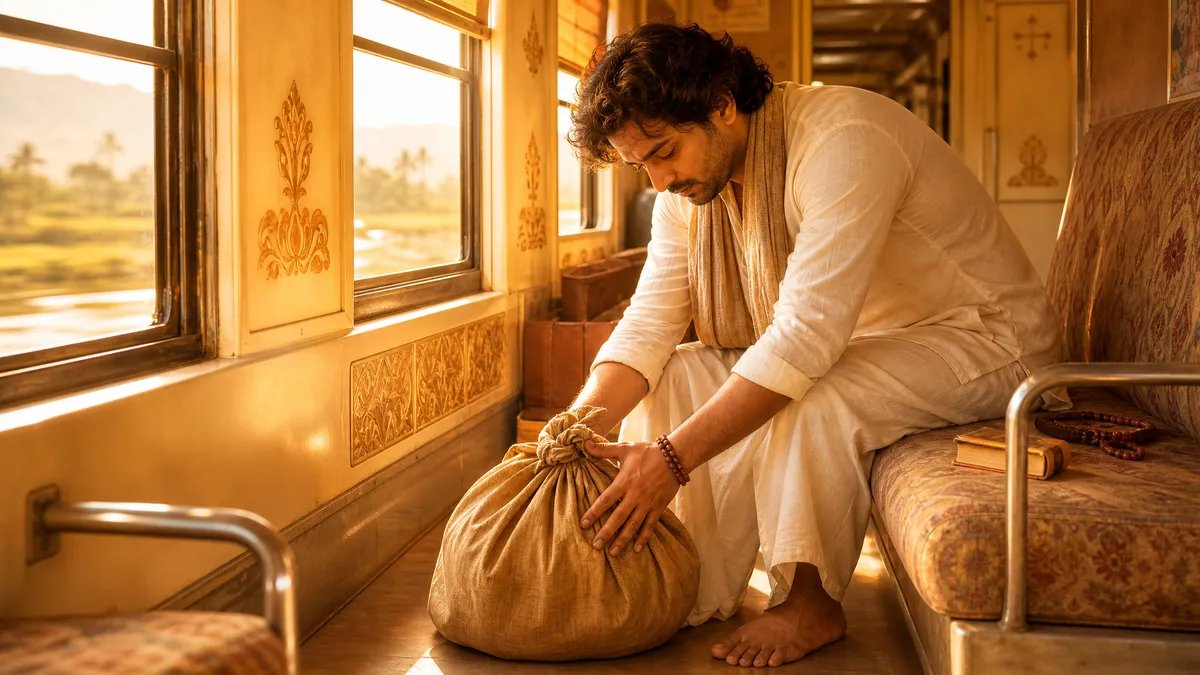
Sri Ramana Maharshi gives the following example: when a person is traveling by train, he holds a bag of luggage on his head; it is hard for him to stand—this is a foolish person. Ramana Maharshi says this: the train is carrying both the person and his bag; he does not need to hold it on his head, he can put it down, he can entrust his bag to the train, but the foolish person does not understand this and does not trust the train. He thinks that only by holding the bag on his head can he keep his bag safe.
In the same way, by not acknowledging the supremacy of God, we often do not entrust Him with our problems, our cares, our karmas; we do not rely on Him; we want them to hang over our heads; we want to solve our problems ourselves; we have either pride or a lack of understanding of this. And then God, as it were, says: since you are so foolish, please, you may solve it yourself with the resources, the limited resources of your mind, karma, will, body, and everything that has been given to you in your life. God acts, as it were, so delicately, in a gentlemanly way: if you want to do it yourself, please, I will not interfere; it is your personal matter. But when we decide in this way, this is precisely the state of ignorance. And the point is that we should understand this voluntarily, of our own will, acknowledge the supremacy of God, and take this burden off our head and place it on the floor of the train. That is, to surrender to the Divine blessing, Divine grace (Anugraha), Divine wisdom, Divine power all our karma, all our ideas, all our claims, ambitions, all our preferences, our entire life, all our future, past, and present.
Acknowledging the supremacy of God everywhere, always, and in everything, renouncing oneself for His sake—this is the condition for the liberation of the soul.
There is neither liberation (moksha) nor enlightenment outside the acknowledgment of the supremacy of God. There are many asuric souls who perform tapas, austerity, yoga, carry out tantric sorcerous practices, and acquire magical powers, but they can never attain liberation, they can never attain enlightenment, because they fall into the seed of matse. For example, there were the demons Hiranyaksha and Hiranyakashipu, enormous beings possessing immense magical power, performing terrible tapasya, but they all performed tapasya out of ego (this is called asura tapasya), and none of them were able to unite their soul with God; they accumulated mystical occult powers (siddhis), but they did not manage to attain the most important thing. And there were many other asuras, for example, Taraka and others.
One who has truly acknowledged the supremacy of God over himself confidently entrusts to Him all his cares and sorrows, and lives in eternal joy. He goes through life easily and naturally, just as a person walks along the road after transferring his load to a strong and enduring horse. He is always happy, although he does not think about happiness; he is always joyful, although he does not specifically seek joy. He always smiles, sometimes laughs or sings in the ecstasy of love, or dances with happiness, or cries with happiness, like a mother who has seen her beloved son after a long separation, or like a soldier who has returned home to his family unharmed after a terrible battle.
Thus, at the moment when we acknowledge the supremacy of God, we discover a great truth. We discover that the point is not in any external things, but in God, and in the fact that we did not see Him before, but now we can see Him. That the solution to problems is not in some actions, and not even in practices, but in God; that if we see Him, all problems are resolved, and if they are not resolved, it means we do not see God. This does not mean that, by some miracle, you had no vegetables for lunch, then remembered God, and they immediately appeared. In the relative world, relative laws operate, but no relative problems, no relative laws will disturb you any longer, agitate you, or deprive you of your happiness. As long as there is a body, they will, of course, remain, but they will simply become a game, and this game will never again mislead you, deprive you of freedom and happiness.
How to Acknowledge the Supremacy of God
If you are angry or proud, envious or hateful, at that very moment remember and acknowledge the supremacy of God over yourself and your feelings. If you abide in happiness, joy, delight, or love, acknowledge God as the supreme recipient of these feelings. When you suffer, acknowledge the supremacy of God over you and your sufferings; give Him what has always been His, and little by little they will begin to leave you.
If you know from the course of the Teaching, there is a section called Antahkarana-panchaka — a Teaching that examines the fivefold structure of the ego according to the philosophy of the siddhas, Mahasiddha Gorakhnath, and according to the philosophy of Samkhya. And there, one of the functions of the ego, or one of the manifestations of the ego, is described as mama-idam, that is, suffering and pain belong to me, when the ego constantly appropriates: pleasures and enjoyments belong to me. And such a mentality, when our ego appropriates everything to itself, translates everything onto itself, connects everything with itself, while not recognizing God behind all this, is precisely the state of the ego. And when we begin to acknowledge the supremacy of God against the background of any impressions, experiences, joys, or sufferings, this function of the ego begins little by little to dissolve. Mama-idam begins to dissolve, and the state of Aham Brahmasmi arises.
When you experience pleasure, or enjoy anything, acknowledge the supremacy of God, and give Him all the joy from pleasure and enjoyment, as a faithful servant gives the king the prey caught during the royal hunt.
Every time our ego wants to attribute something to itself: praise, to receive the fruits from the results of service, we must remember — all this belongs to God, this is His universe, I am not even my own, I am God’s. All actions belong to God, and we should not try to attribute all this to ourselves. Say to yourself: this is all His play, all this belongs to Him, I myself belong to Him. If you can do this, neither sorrow nor happiness will strike you any longer; you will truly understand that the whole world is lila, the play of Bhagavan, the play of God, the Absolute.
Do not make yourself the supreme enjoyer, the one receiving supreme experiences, and the taster; instead, acknowledge only Him as Supreme and give everything to Him.
How should one give?
Simply remember Him and acknowledge that He is above everything you are experiencing right now.
What does it mean to “remember Him”? It means that we must enter into contemplative presence and direct our mind not toward experience and thoughts, but direct our mind toward God, toward the Absolute.
Look at Him in every moment of experience, and not at your feelings.
The Path from Duality to Advaita Through Self-Surrender
The whole point is that right now there is strong duality. We follow the Teaching of Advaita, we have registered ourselves, study texts, wear the signs of the Advaita school, belong to an Advaitic order, worship divine beings who teach Advaita, study the philosophy of Advaita, sing the mahavakyas of Advaita, practice sankalpas; nevertheless, duality is still there, we are not in Advaita. Moreover, it will remain for a very long time, because to realize Advaita truly means to become liberated. And time is needed for us to walk the path and completely eliminate our ignorance.
Vasishtha speaks in such a way that only a fool would speak about Advaita with newcomers and beginners, people who understand nothing. He says that only a fool would say that everything is illusion and that only Brahman exists, because he will never be understood. The one who speaks in this way falls into hell together with those to whom he speaks in this way. The Buddhists have a similar tantric precept: not to speak about emptiness with arhats who are not ready.
And when we analyze ourselves, we see that our mind is not ready for the truths of Advaita. The truth of Advaita is too shocking, too transcendent, so much so that we do not even know how to approach this truth, let alone live in it. Nevertheless, we set ourselves the goal of realizing Advaita; the realization of Advaita is pratyabhijna (self-recognition). However, such self-recognition will not happen by itself, it will not happen spontaneously; we must go through a certain path of purification and self-surrender. Therefore we say that pratyabhijna is preceded by prapatti (self-surrender). We must necessarily follow the path of self-surrender.
When we give everything to God—all experiences, all enjoyments, all pleasures, and all sufferings—we follow the practical path of prapatti-yoga (the yoga of discarding oneself). And throughout our life we need to learn such lessons of discarding oneself very well, so that Divine Grace (Anugraha) may truly touch us. Divine Grace (Anugraha) descends upon everyone, but if we have not discarded ourselves, then we are like a sealed vessel. If such a sealed vessel is placed under a stream of nectar, that nectar may flow for millions of years, but not a single drop will enter such a sealed vessel.
In every moment of experience, look to Him, not to your feelings.
One must say to oneself: my feelings are not important; God is important; my thoughts are not important; God is important; my will is not important; the Divine Will is important, and the extent to which I can be a conduit of that will.
Life as a Great Sacrifice
Acknowledge His power over the soul, not the power of the feelings; acknowledge His greatness and importance, not that of the feelings; consider your body to be a temple for sacrifices, your senses to be the priests-ritualists singing within it and the gods blessing this place, your mind to be the sacred sacrificial fire into which sacrificial butter is poured and sacrificial mixtures of herbs are thrown, and everything visible to you in the world to be the sacrificial butter and sacrificial mixtures, while God is the recipient of these offerings.
In sacred texts, in the tantras, one and the same allegory is often repeated: our body is a kunda (a place for sacrifices); our home is a yajna-shala; our sense organs are the brahmins, the priests through whom the sacrifice takes place; our consciousness, our mind is the sacrificial fire; all objects of perception (everything seen, heard, smelled, touched) are ghee (sacrificial butter) and the sacrificial mixtures themselves. We throw them into the fire so that this fire, accompanied by the singing of the sense organs of Brahma, may convey all of this through the sense organs to the Divine Source. And our entire life is such a maha-yajna (great sacrifice) or a constant havan.
We must turn our life into such a constant great sacrifice; we must not try to appropriate anything from what is being offered. For example, if during a yajna or havan someone comes up and starts drinking the ghee, or the brahmins want to take the offered fruits for themselves, this would be wrong; the cosmic order of the yajna would be violated. In the same way, when we try to appropriate for ourselves anything seen, heard, smelled, touched, thought, or done, we violate the order of this yajna.
Yajna on the external level is intended to restore the cosmic order of things. Everything that we have disturbed with our selfish consciousness, everything that we have appropriated, we sacrifice, but on the external level, because it is easier to do this externally. When yajnas are performed, the yajna restores the balance of forces in the universe, the balance of equilibrium in the universe; it aligns our energies, aligns the subtle spiritual currents between God and the soul (jiva), because if the soul does not give itself to God, it often falls out of this balance of the universe.
If a person has completely surrendered himself to God, and his whole life is a great sacrifice, he does not need virtual yajnas; such a yajna is constantly taking place within him. But until we have given ourselves to God completely and entirely, this yajna that we perform outwardly, the havan, is important. But we must learn this inner yajna.
Surrender of the Soul to God
Allow Him to possess your soul completely, to rule over it, not thoughts and feelings.
Sometimes we need to ask ourselves: who owns my soul, what owns my soul? Thoughts, emotions, the body, the will, perhaps something from outside, or God? To what extent does God own my soul? To what extent do we entrust our soul to God? It often happens that our soul is possessed by emotions, sometimes by thoughts, sometimes by feelings, and through our inexperience we miss this moment and allow them to take possession of our soul; then the spiritual path becomes difficult and usually impossible.
When you think, at that very moment acknowledge God’s supremacy over thoughts, and thoughts will lose their power over you.
This is another name for the principle of self-liberation. By what means do thoughts lose their power over us and self-liberate? By the fact that we do not look at the thoughts, but look at God at the moment the thoughts unfold.
When you speak or listen, acknowledge God’s supremacy over words, both your own and those of others, and no one’s words will ever mislead you again, nor become a cause of suffering, but will bring you only happiness.
There is a story about the disciples of a certain saint: when they came to him, he would usually scold them for all he was worth. And the disciples would laugh and say, “Bhagavan, your words are like nectar to us.” Why? Because at the moment when he was scolding them, they were not looking at his words; they were looking at his realized, divine essence. His abusive words were a play; they had no significance. They would say, “Bhagavan, we know you will not mislead us with your lila; you may scold us as much as you like.”
From Karma to Lila: Turning Actions into Play
When you do anything, continuously acknowledge God’s supremacy over your actions, and all the great deeds of the world will become for you like a child’s game and will no longer enslave you.
The question of doing, of action, is always a very complex question. When we meditate, live in retreat, in a simple life, actions cease. And when we do nothing, it is easy for us to be sattvic, peaceful, to control the mind; but as soon as we begin to do anything, we feel that our sattvic state disappears somewhere, our peacefulness is lost, and we are constantly falling under the power of action. Action has a tremendous, hypnotic power over us, because we think: since we are acting, it means this is ours, this is us, and all of this is real, and our mind immediately changes.
But if we continuously acknowledge God’s supremacy over our actions, no great deeds of the world will ever enslave us or seize us again; they will simply be a play. And God never works, God never does: work, doing—these are properties only of ignorant people, of souls (jivas). God only plays. And the difference between play and doing, between play and work, is the difference between acknowledging and not acknowledging God; it is the difference between karma and lila, samsara and nirvana.
But if we want to be not slaves of action, but divine players, conduits of the divine play, we must continuously acknowledge God’s supremacy over all actions. We must recognize that it does not matter what I do; what matters is whether I acknowledge God at the moment of action or not. Are my actions of the nature of play, or are they of a karmic nature? If, at the moment of action, I acknowledge God’s supremacy, then gradually actions begin to take on the nature of play, and gradually I become a conduit of the Divine Will. But if I do not acknowledge God’s action, then my actions are karmic in nature; I act from the ego, I act selfishly, all of this is done by my ego, and I am the doer.
Thus continuously perform this inner sacrifice; in this lies the path of inner asceticism and of the Soul’s fulfillment of the Divine Will.
And so the task of our soul on the spiritual path is to learn to fulfill not our own will, but the Divine Will; to learn to submit not to our own will, but to the divine will.
The Fruits of Acknowledging God’s Supremacy
What is the benefit of the soul’s acknowledgment of God’s supremacy?
As soon as you acknowledge God’s supremacy, your sufferings and troubles will begin to depart, just as the sufferings of a destitute beggar depart when the king, for his own amusement, decides to give him half the kingdom.
Our suffering, problems, and limitations exist precisely because we do not acknowledge the supremacy of God. A pauper, a poor man, may work as much as he likes, but he will still remain poor. Even if he sells something profitably, he will not radically change his economic situation; only a king can bestow gifts upon him on such a scale. A soul that relies on itself and does not acknowledge the supremacy of God, whatever it may do, will always be a destitute pauper; its situation will never radically change. But as soon as we begin to acknowledge the supremacy of God, unexpected gifts begin to follow; God begins to bestow gifts upon the soul. And these are not gifts of a material nature; they are gifts of an inner and spiritual nature, but they are such that they are more precious than the entire material universe.
As soon as you fully and unconditionally acknowledge the supremacy of God and surrender to Him, all your sins depart or cease to be yours and become His play. All your delusions and suffering depart and become His amusements. All your plans become His will and providence (niyati). Acknowledge the complete supremacy of God over yourself without reservation, and all your fears and suffering will depart, as snow departs in spring.
Snow in spring goes away by itself. In winter we have to work hard to remove the snow—either we do, or tractors do. In winter, snow always depends on our efforts, but when spring comes, there is no need to go out with scrapers and shovels or call a tractor; the snow melts on its own, all this happens by itself under the influence of the sun. In the same way, when we begin to acknowledge the supremacy of God over ourselves, constantly and without reservation, our problems, fears and suffering, desires, kleshas, and limitations go away by themselves; they depart on their own under the influence of the sunlight of God (Anugraha).
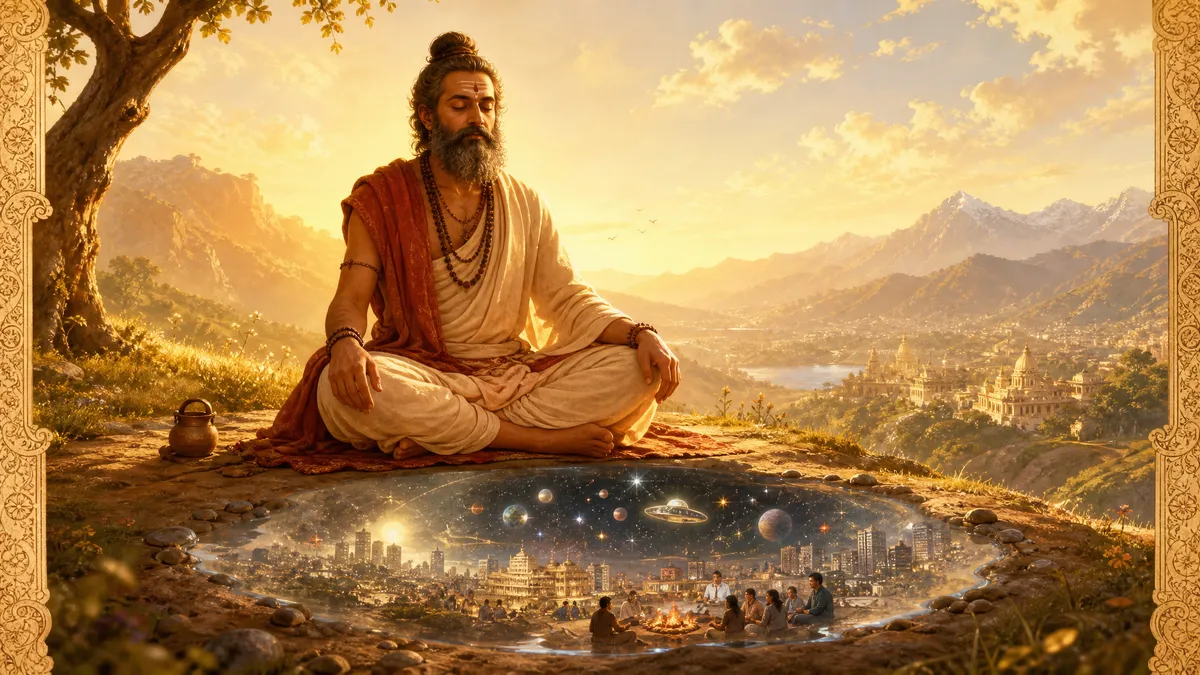
Acknowledge the supremacy of God over everything you perceive, and the whole world in this vast universe will become a small puddle for you.
People live in the world, in society, in a social culture, in a certain coordinate system, in meaningful values, in a value-based coordinate system, in a certain mythology, in history and education; they identify themselves with the body, the nation, culture, social events, and news, and monks are no exception either, and all this is called the human world. And especially ordinary people who do not practice are endlessly impressed by the external world; they are very impressionable. There was communism, perestroika arose, and this made a great impression on people. There were neither rich nor poor, then the rich and the poor appeared; something happened. And everything that happens in the world makes a very strong impression on people.
But a sadhu... For a sadhu, nothing that happens in the universe ever impresses him, because the whole universe seems to him no more than a small puddle. A sadhu is not impressed or amazed by the most incredible things; the most transcendental things do not impress a sadhu, if this sadhu lives in God. Even if tomorrow an unidentified flying object lands in the center of Moscow and little green men come out of it, this will not impress a sadhu, because a sadhu sees the whole universe as a small puddle.
Acknowledge the supremacy of God over the senses, and everything that once caused suffering will make you laugh, for what will not pale before the greatness of God? Acknowledge the supremacy of God over everything you see, and all that is visible will be no more than frost’s play on a windowpane in winter. Acknowledge the supremacy of God every moment throughout all the days of your life, and for you there will no longer be joy or sorrow; hells or heavens; good and bad things; scholars and fools; men and women; past sins and future merits, but always and everywhere there will be only one God, who is the light of infinite life for the soul, its highest happiness, the supreme goal, and the wondrous abode—Satya Loka.
