

Commentary on the “Yoga Vasistha,” Chapter Five
The story of King Janaka. Vasistha continues instructing Prince Rama. He tells him that there once lived a great monarch whose wisdom knew no bounds. His name was Janaka, and he ruled the kingdom of Videha. To those who sought his protection or help, he was a source like the sun. To some he was a horn of plenty, to others a light, and to still others a friend.
One day, Janaka entered a beautiful garden and saw certain holy celestial beings there. These celestial beings were singing a song of contemplation. They sang of consciousness, which manifests itself as pure bliss in the experience in which the experiencer and the experienced are one and interact with each other without the mediation of the mind and concepts. These divine beings sang of consciousness in which objects are reflected spontaneously, like a play, and in which there is no division between them into subject and object. They also sang of the light that illuminates everything that shines, and of the consciousness that transcends the dual concepts of “is” and “is not,” which seem to lie between them.
These beings sang: “Alas, people strive for something else, foolishly forsaking God, who dwells in everyone’s heart.”
They sang of their contemplation, of the consciousness from which all words and languages have arisen, which is the Alpha and the Omega, the beginning and end of everything, which encompasses everything from A to Z, and to which the word “I” points; of that reality in which everything exists, to which everything belongs, from which everything proceeds, which is the one cause, which is everything.
These beings sang in this way, and through this spontaneous song they bestowed direct transmission.
Transmission from Divine Beings
Cases in which saints and siddhas receive transmission from divine beings are often described, especially in Tantra. These divine beings often manifest not in a physical body, but through subtle vision; alternatively, they may use another person’s material body, or they may manifest their own divine illusory body. For example, some tantras are believed to have been transmitted by the Buddha (the “Guhyasamaja Tantra” and others) to King Indrabhuti. But this king lived at a different time from the historical Buddha Shakyamuni, so he could not physically have received them from the historical Buddha Shakyamuni. However, it is said that King Indrabhuti received these tantras from the dimension of pure vision. And since the Buddha is not confined to his physical body or to his historical manifestation in a particular place and time, but exists eternally in the pure dimension, it is entirely possible that King Indrabhuti, while in Uddiyana, received the “Guhyasamaja Tantra” through a darshan of pure vision. Another matter is that this is not available to every human being. Many tantric siddhas received transmission and blessing in precisely this way.
To us, this seems somewhat ephemeral. Someone might say, “I received a darshan of pure vision from some saint.” Another person might think, “Yeah, right—tell me another one!” It is like telling someone who does not practice that you had experiences while abiding in contemplative presence or mahashanti. They would think, “What on earth is he talking about?”
Likewise, until we have experienced pure vision ourselves, it seems to us like some ephemeral realm that cannot really be trusted.
Nevertheless, as our practice progresses, this realm gradually begins to reveal itself to us. We begin to understand that the dimension of pure vision exists just as this human world exists, simply in its own loka, and that it is indeed possible to communicate with beings in the invisible dimension; that this may be neither delusion nor illusion, but an equally real experience in a state of clarity and contemplation. We can receive teachings, instructions, darshans, transmissions, and sutras from them if we are in the proper state of mind. Of course, if we are in a state of being captivated by illusions, this may be a kind of demonic state. But an experienced practitioner will have little difficulty distinguishing a demonic state from genuine communication with the dimension of pure vision. The fundamental question here is whether the liberating awareness of nonduality and contemplative presence are present or absent.
And King Janaka received such a transmission from divine beings from the dimension of pure vision.
They sang:
“One who, having realized the emptiness of all goals in this world, still remains attached to them in the depths of his heart is not a human being. With the club of wisdom, strike down every desire that has already arisen in the heart or is merely about to arise. Enjoy the joy that flows from tranquility. A person who can control the mind will never lose its peace and balance. When the heart is calm, the pure bliss of awareness arises without delay.”
These were the teachings King Janaka received from the divine beings; in other words, they gave him a genuine direct introduction.
However, Janaka was not ready for such a direct introduction.
Janaka’s Awakening to Reflection
“Upon hearing the words of this song, King Janaka fell into a terrible depression. He quickly returned to the palace, dismissed his servants, and secluded himself in his room. In a state bordering on agony, he asked himself:
Alas, alas, I am helplessly swinging like a pendulum in this world of suffering. Short as life is compared to eternity, I have nevertheless managed to grow fond of it! Alas for my mind. What does ruling a kingdom, even for an entire lifetime, amount to? Yet, like a fool, I think I cannot live without it! My life is but a moment, while infinity lies before and after it. How, then, can I attach importance to it?”
He then continued to reflect:
“Who is this magician and sorcerer who created this illusion called the world and deceived me with it? How did it happen that I fell for it?”
These are very fundamental questions, and each of us can ask ourselves them often.
Janaka received a genuine transmission, for the song of the divine beings shook him to the depths of his soul. He immediately proceeded to the second principle: reflection (manana), in order to clarify what he had received. It was very important for him to think all of this through and clarify it, because his mind was not prepared for such a vision, and he was horrified by his own ignorance.
We often fail to understand these things.
For example, our life is but a moment. Before our life, there was infinity in the past; after our life, there will be infinity in the future. Yet we are often so identified with the material body and with a materialistic concept of life that we turn away from infinity, allowing the mind to become mired in bustle. If a person constantly gave their mind greater breadth, expansiveness, openness, universality, and scope, if they constantly remembered the factor of kala (time), they would never have any problems in this life. They would constantly look at everything with great joy, openness, and non-attachment. Even if someone condemns you, does it really matter compared to infinity? All of this is like an instant; all of it will pass.
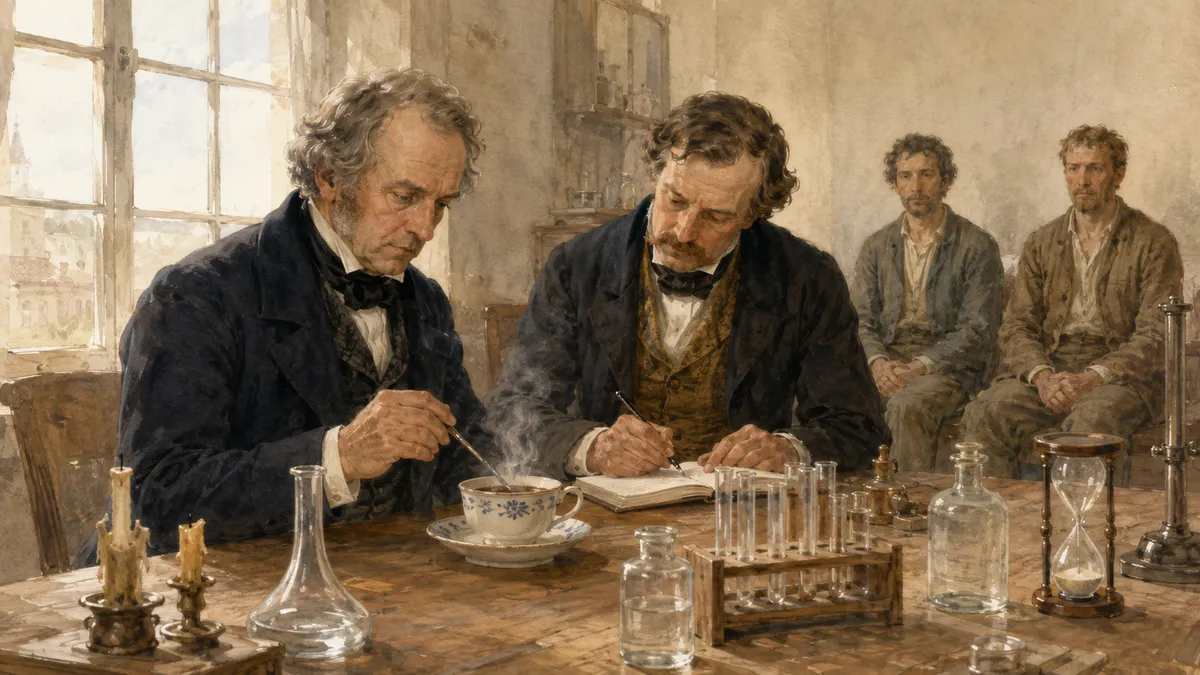
I read that in the 19th century there were debates about whether coffee was beneficial or not. To reach a final decision, the authorities in one country decided to test the drink on criminals sentenced to death, giving them coffee and recording medical data. The experiment was conducted by two professors. They reasoned: “They have been sentenced to death anyway, so whether coffee makes things worse or better for them makes no difference.” The criminals were given coffee, and its effects on their bodies were recorded. Ironically, however, both professors died before those criminals who had been sentenced to death.
Human life is merely a brief flash, merely a fragment in the flow of infinity. What do we know about the civilizations of the Atlanteans, the Hyperboreans, the ancient Aryans, about civilizations that existed a million years before us, rose and vanished, about the ancient gods and their battles? We know nothing about any of this. What can we know about a future that may be so extraordinary that we do not even have enough imagination to envision it? Some time will pass, and we will become merely the past for future generations, a line in an encyclopedia, a few entries in historical references saying that there once was such a monastery and such monks, and that they practiced something. Perhaps no one will deeply understand exactly what you did or what kind of relationships you had, because the people of that time will already be preoccupied with their own lives unfolding in the future. Perhaps no one will even remember that past which is now such an important present to us, or even understand what it was really like, because there will be no eyewitnesses left.
However, people do not fully understand this, and so they identify very strongly with a particular moment; and when identification with a particular moment occurs, the mind becomes constricted and limited.
And Janaka began to reflect:
“All activity in this world leads only to endless suffering; how can I hope for happiness? Day after day, month after month, year after year, moment after moment, I see that happiness brings unhappiness in its wake, and unhappiness continually returns to me!
Everything here that can be seen and touched changes and is ultimately destroyed—in this world, there is nothing for the wise to rely upon. Those who are on top today will be trampled tomorrow—O my dull mind, what can we hope for in this world?
Alas, I am bound without a rope, stained without dirt, trampled though I reign as king. O God, what a mystery! Like the sun suddenly obscured by a passing cloud, I see this strange phantasmagoria before me. Who are my friends and relatives, and what are these pleasures? As a boy becomes frightened upon seeing a ghost, so am I deceived by these elaborate illusions. Knowing that all my relatives are ropes binding me tightly to old age, death, and so on, I still strive toward them. Let my family and acquaintances live or perish—what are they to me? Great events and great people come and go, leaving behind only a brief memory—what can one hope for here? Even the gods, including the great trinity, have come and gone millions of times—what, then, is permanent in this universe? Futile hope binds everyone to this nightmare known as the existing world. Alas for all of this.”
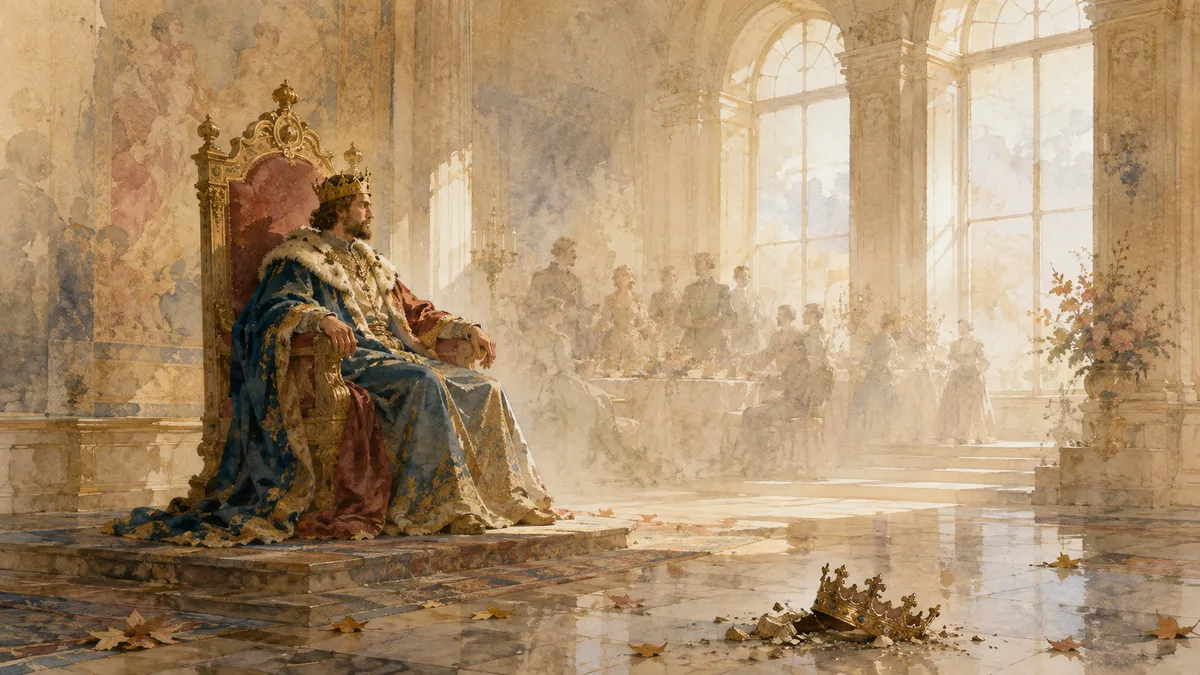
King Janaka continued:
“Like a dull-witted fool, I am deceived by the specter of self-importance, which creates the false sense that ‘I am this or that.’ Knowing perfectly well that time has trampled countless gods and heroes, I still deceive myself with a love of life. Days and nights are spent on futile desires rather than on realizing infinite consciousness. I journey from suffering to even greater suffering, yet no disillusionment arises within me.”
Thus Janaka, sitting in deep contemplation and having set aside his royal duties, reflected in this way.
“What here can be considered desirable or wonderful, when I see that everything anyone has valued in this life has passed away, leaving only suffering behind? Day after day, people in this world live in sin and violence, and with each passing day they sink ever deeper into suffering. Childhood is lost in incomprehension, youth in the pursuit of pleasure, and the rest of life in family worries. And what does a fool achieve in this life?
Even by performing religious rituals, one may attain heaven—and nothing more. What is heaven? Is it on Earth or somewhere far away? And is there any place at all untouched by anxiety? Suffering brings happiness in its wake, and happiness brings suffering. The entire Earth is filled with the dead bodies of various beings—that is why it appears solid!
In this universe, there are beings for whom the blink of an eye lasts an epoch. What is my life in comparison?
This world seems to have been created in the same way that a coconut appears to have been knocked from a palm tree by a crow that happened to land on it at that very moment. In this world, only foolishness gives rise to notions such as “I need this” and “I don’t need that.” It is better to spend all one’s time alone or in hell than to live in this superficial world.”
And then Janaka began to awaken. He thought:
“Intention or motivation is the only true cause of this world. I must dry up the source of these motivations! I have enjoyed and suffered from various sensations. Now I need to rest. I must suffer no more. I have awakened. I will kill this thief (the mind) that has stolen my understanding.”
By the thief, he meant the mind, which leads one into false identifications.
As Janaka reflected in this way, servants approached him and reminded him of his royal duties, but Janaka continued contemplating and did not hear their words. He thought:
“What use are my royal duties and the entire court to me? I know that all of this is ephemeral. They are of no use to me. I would renounce all activities and duties and remain immersed in the bliss of awareness.
O mind, abandon your striving for sensory pleasures, and then you will be able to avoid the horrors of recurring senility and death. Whatever the circumstances in which you expect to find pleasure, those very circumstances also provoke suffering! Enough of this sinful, limited life spent pursuing pleasures. Seek the delight and joy that are inherently within you.”
The Search for Inner Pleasures
Limited understanding compels us to seek pleasure in the external world. Failing to understand that the source of all pleasure lies within, a person reaches for those things that seem capable of giving them a sense of enjoyment. Yet when they experience them, they feel nothing but emptiness, even if they enjoy those pleasures for a time. This happens again and again. Often, a person is unable even to tear themselves away from them, despite recognizing their powerful dependence on them. But when they experience repeated suffering, it leaves an imprint. They think: “Stop! This can bring me suffering. I will no longer seek these pleasures outside myself or rely on them. I will try to find pleasure by being self-sufficient, by being whole within myself.”

The first important aspect of the teaching is the first link in the five-part formula, which is called “reducing everything to the mind.” This means that we try to become self-sufficient and to regard ourselves as possessing the limitless potential of all experiences and all pleasure; we try to cease being dependent on anything. Instead of being dependent, we try to become self-sufficient and draw energy from our own inner awareness.
One of the Shakta Tantras contains the following lines: “Following the external is foolishness and illusion. Only the dharma that is internal can awaken; the mantra is internal, the puja is internal, and all rituals of worship are internal for the true Kaula yogi.”
When we understand that following the external is foolishness and illusion, when we understand that mantra, worship, and everything else are internal, we can truly awaken to the teachings of Laya Yoga. “Internal” does not mean that we reject the external or enter into some kind of conflict with it. Rather, through contemplation, we seek to dissolve the inner–outer dichotomy altogether. We adopt a completely different attitude toward spiritual practice, regardless of whether it is performed inwardly or outwardly. Everything performed inwardly and everything performed outwardly becomes internal because we integrate it into the mandala of presence. It is precisely this inner understanding of the teaching that distinguishes the teachings of Laya Yoga.
A person may often formally take refuge or formally belong to a particular religious group, asserting their affiliation with one school or another, one philosophy or another. This affiliation becomes their distinguishing mark, a means of identifying themselves with a particular group. But in reality, this may be an excellent way merely to entrench their false self and false understanding, to nourish the “cosmic gorilla” (the false ego), and to make it more powerful and firmly established.
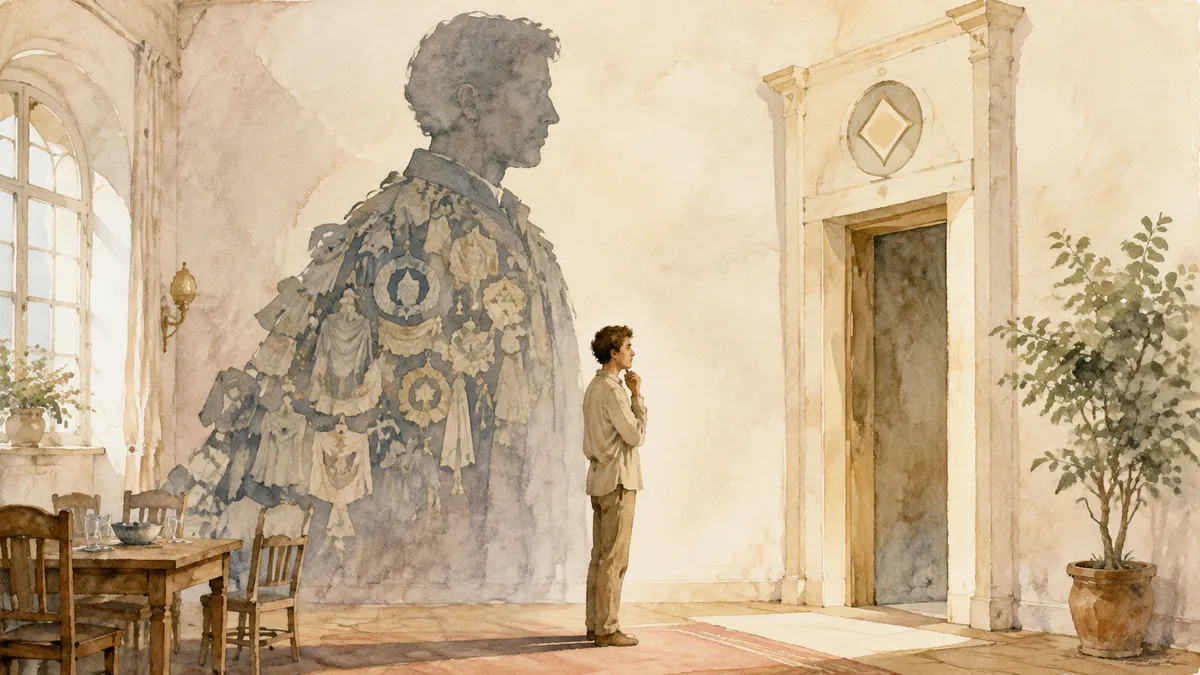
Some may go on pilgrimages for the same purpose, while others may perform practices and prostrations, but in fact, if all this is done without integration into the mandala of presence, these are merely different ways of escaping from oneself, different ways of calming oneself by relying on external things, of subtly falling into delusion in sattva. And delusions in sattva can sometimes be even more alluring or soporific than those in tamas or rajas. At least someone who is deluded in tamas and rajas understands it perfectly well. There is no pleasure in it, so they know: “Yes, I am deluded. I may not have the strength to leave all this behind, but I know clearly that I am deluded.” But someone who is deluded in sattva may not even realize it, because life is beautiful, everything is harmonious and good, and they are content, yet this is a kind of subtly soporific state.
However, when we approach the inner state, such delusion becomes impossible, because the restless monkey of our mind can no longer bind us. We expose it directly, placing it before the darshan of infinity.
Janaka’s Inner Work: Making the Great Decision
When Janaka fell silent, his entire court fell silent as well. And Janaka said to himself:
“What should I seek in this universe? What eternal truth in this universe can I confidently rely on? What difference does it make whether I engage in endless activity or remain inactive? Ultimately, nothing in this world is eternal. Whether in action or inaction, this body is impermanent and constantly changing. When the intellect is in equilibrium, what can be lost, and how?
I do not strive for what I do not have, nor do I wish to abandon what has come to me of its own accord. I know my true nature; let what is mine be mine!”
Thus, Janaka is undertaking immense inner work. This is the process of manana—rethinking and acquiring faith after direct transmission. He is doing what we call in the teaching making the “great decision.”
He says:
“I have no reason to act, but neither do I have any reason not to act. Whatever I attain through action or inaction is all false. When the mind desires nothing and seeks no pleasures, the body and all its limbs perform their natural functions, and then action and inaction become equal in meaning and significance. Therefore, let the body perform its natural functions; without such activity, the body will wither. When the mind does not amuse itself with the notions ‘I am doing this’ and ‘I am enjoying this’ in relation to the actions it performs, action becomes inaction.”
Here Janaka comes to understand action in non-action and makes the “great decision” to renounce all action.
The Practice of Non-Action in Laya Yoga
For us, making the “great decision,” renouncing activity, is the cornerstone, the starting point from which we actually begin our practice. This is the moment when the world stops. That is, until we stop, cease our activity, and cease identifying with the sense of doership (“I am doing this,” kartritva-buddhi), we are not in contemplation, within the teaching of Laya Yoga. And the doer can often be recognized by a restless mind or inner dissatisfaction. That is, the doer acts but becomes attached to the results, or acts while the mind is elsewhere; therefore, the doer is not present in the action, finds it burdensome, and wants to be rid of it as quickly as possible.

But one who has stopped, who abides in non-doing, is in no hurry, because he knows that everything has already been done and there is nothing more to do. All that is needed is simply to allow the body to move according to circumstances, and circumstances vary. But he never strains himself, feels dissatisfied, or becomes attached to results. At the same time, of course, he does not act carelessly or inharmoniously; in fact, everything turns out even better for him than for those who are attached to results, because for him activity is a form of play, a way of manifesting the enlightened state in motion. As long as there is a body and fluids, pranas, and energies move within it, he still has to do something. But since such a person abides in presence, he cannot act inelegantly, inharmoniously, crudely, or undivinely. And when he acts while abiding in presence, results arise by themselves, just as music flows from beneath a musician’s fingers, yet one cannot say that the musician has worked up a heavy sweat.
“Having resolved this, King Janaka rose from his throne like the sun rising above the horizon and began to perform his royal duties without attachment to them. Casting aside all concepts of desirable and undesirable, free from all psychological conditioning and intentions, he acted spontaneously and according to circumstances—as if in deep sleep, though fully awake.”
As long as we have prarabdha and this body, we remain in the relative dimension, and in the relative dimension there are various dual circumstances. And in these dual circumstances, sometimes one must act one way and sometimes another. There is no single pattern for them; everything is determined solely by clarity.
The Transition to Nididhyasana
“He completed all the day’s tasks, and at the end of the day retired to his room, where he spent the night in deep meditation, which was easy and natural for him. His mind spontaneously relinquished all delusions and rested in equilibrium. And rising in the morning, King Janaka thought to himself:
O wayward mind! Life in this world does not contribute to your true happiness. Therefore, attain the state of equilibrium. Only in this equilibrium can you experience peace, truth, and happiness. As soon as, out of idleness, you begin to think wrongly, the illusion of the world immediately begins to expand its reach. When you crave amusement, the illusion of the world grows endless branches. Thought alone gives rise to this web of the external world. Therefore, abandon this whining and these whims, and find equilibrium. Weigh on the scales of your wisdom sensual pleasures on one side and infinite, blissful serenity on the other.”
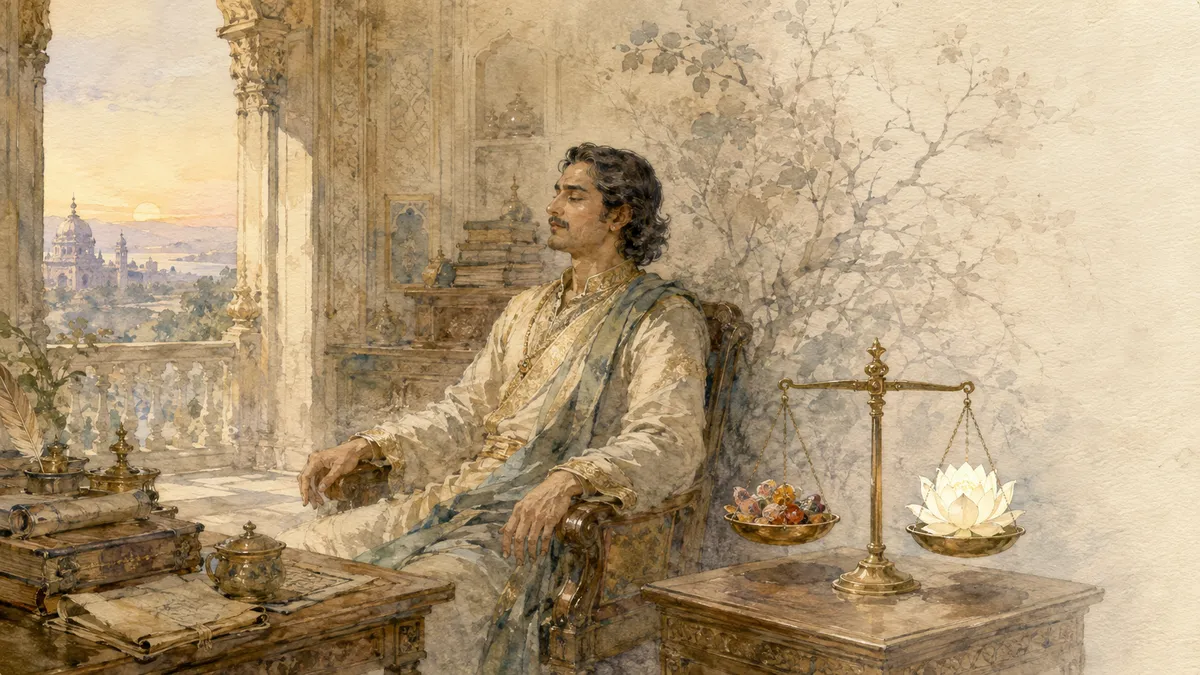
In practice, when we enter into deep understanding, into the dimension of knowledge of our “Self,” we always have the possibility either of losing it or of remaining in it. As soon as we begin to think wrongly, illusion begins to expand its reach. A single thought is enough to enter into dualistic vision and become enchanted by it. Conversely, when we maintain clarity and deepen our understanding, such illusion has less and less power over us.
And here Janaka describes his practice in the state of transition to the third principle—nididhyasana. That is, he describes what to do next.
Having received direct introduction and made the “great decision,” he cut off all doubts and resolved to abide in the state of nididhyasana—continuous presence. To abide in it, one must understand how to do so.
Through reflection, Janaka arrives at the following conclusions about how to do this. He says to himself:
“Abandon all hopes and expectations and, relinquishing the desire either to seek or not to seek, live freely. Whether this world of forms is real or unreal, whether it appears or disappears—it all seems so only because of foolishness. Therefore, summon your courage and overcome your wanderings.
Having attained the understanding described above, Janaka continued to be king and performed all the necessary work without difficulty, yet with heartfelt care and intelligence. His mind was not distracted by amusements. In fact, he did everything as if from a state of deep sleep.”
From then on, Janaka remained in a very deep meditative presence.
If his brain waves had been measured using modern methods, one could say that his brain was generating delta waves corresponding to the state of deep sleep.
The State of Liberation While Living
“From then on, he was interested neither in accumulating anything nor in squandering anything. Free from doubt and hesitation, he lived in the present. His wisdom was uninterrupted, and his intellect was no longer cluttered with nonsense. The light of self-awareness shone in his heart, without the slightest taint of anxiety, just as the sun shines above the horizon. He regarded everything in the universe as a manifestation of cosmic power; in everything he saw infinite consciousness. Knowing that everything that happens happens by itself, he was neither overly elated nor depressed and remained in continuous equilibrium. Janaka became liberated while still in this body.
He continued to rule the kingdom. The truth or falsehood surrounding him did not affect his self-awareness. He remained constantly in infinite consciousness and therefore did not perform actions as such, although to those around him he appeared immersed in royal affairs. All his tendencies and inclinations had ceased, so although he appeared active, he was constantly as if in a state of deep sleep.
He was not overcome by thoughts of the past, nor did he worry about the future; he lived in the present, always smiling happily.
Janaka attained what he attained through his contemplation. Therefore, everyone should inquire into the nature of truth until they reach the limits of such inquiry.”
How can you determine whether you have reached a certain level of inquiry or not? One important criterion is the ability to maintain contemplation during dreamless sleep. Another criterion is the ability to maintain such contemplation while moving through everyday life. The subsequent criteria after that relate to becoming a deity.
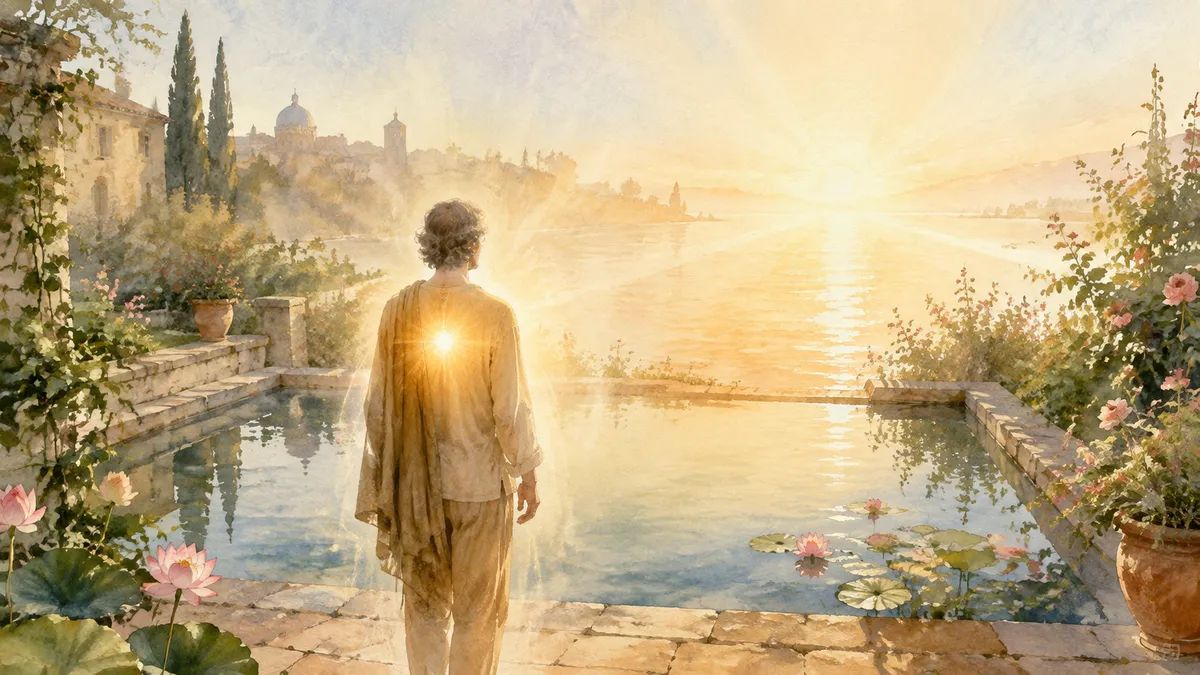
Having given this example, Vasishtha instructed Rama. He recommended that Rama contemplate and investigate his own essence just as Janaka had done.
Vasishtha said: “One who is devoted to Truth, like Janaka, will experience the inner light in their own heart, and the ignorant caprice—the illusion of the world—will immediately disappear. When the limited and conditioned sense of ‘I am so-and-so’ disappears, awareness of all-pervading infinity arises.”
