

Commentary on the text “Siddha-Siddhanta-Paddhati of Goraksha”
We continue the instructions on shat-chakra yoga.
In the “Siddha-Siddhanta-Paddhati of Goraksha,” in the chapter “The Five Places,” Gorakshanath says:
“One who meditates on the nine chakras, the sixteen adharas, and the three lakshyas comes to know these five places, becoming a master of yoga.”
Here there are terms or symbols that are not immediately clear: the sixteen adharas, the three lakshyas, and the five places. This is a rather esoteric topic, which should be practiced and understood after you have already, to some extent, mastered concentration on all the main chakras and have had some experiences.
Sixteen Adharas
The sixteen adharas, or sixteen foundations, are sixteen points on the body that are also used for concentration, for control over prana.
“At the tip of the big toe is the first adhara. One should meditate on it with a steady light.
The second adhara abides at the root of the muladhara chakra. In it one should visualize a blazing fire.
The third adhara abides in the anus, where apana resides.
The fourth adhara is located in the phallus, where, it is said, the brahma-granthis unite.
The fifth adhara is located in svadhisthana.
The sixth adhara is located in the center of the navel, where the sound Om pours forth.
The seventh adhara is located in the heart, where prana resides.
The eighth adhara is located in the throat, where the ida and pingala channels unite. The ninth adhara is located in the ghantika region, at the root of the tongue, from where nectar arises.
The tenth adhara is located in the talu region (talu chakra), behind the root of the tongue.
The eleventh is located at the tip of the tongue. By meditating here, one overcomes disease.
The twelfth adhara is located between the eyebrows. Here one should contemplate the lunar disk.
The thirteenth adhara is located at the root of the nose. By meditating here, one realizes great concentration of mind.
The fourteenth adhara is located behind the root of the nose.
The fifteenth adhara is located on the forehead and, as the sages say, is the center of light.
The sixteenth adhara is located above the brahmarandhra and is the cosmic chakra. Here abide the two lotus feet of Shri Guru.”
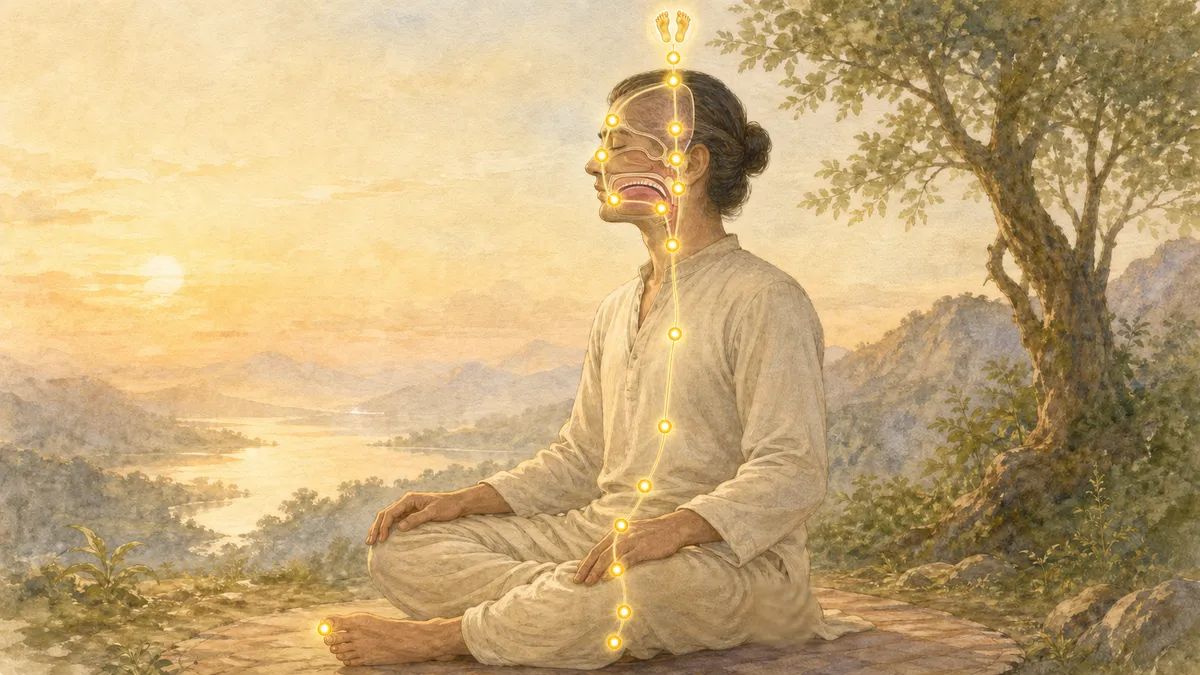
Sometimes this sixteenth adhara, located beyond the body, is also called shodashanta (the sixteenth limit). That is, it is a chakra located not in the physical body, but in the astral body. It is situated approximately fifteen centimeters above the crown of the head. By concentrating consciousness in this area, a prepared yogin can enter deeply into the state of samadhi, losing the sensation of the body. By uniting contemplative presence and moving consciousness to this point, the yogin can expand consciousness very deeply. However, concentration on this point above the head is not a practice for beginners, but for those who have already mastered control over the pranas.
Three Lakshyas
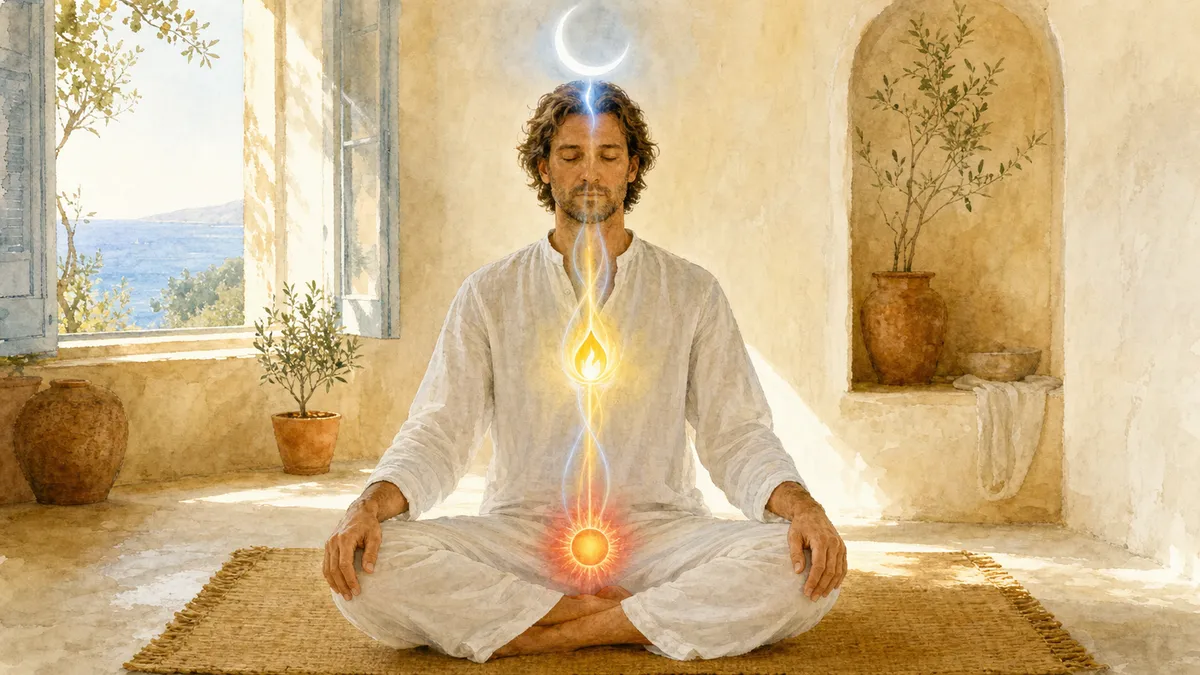
What are the three lakshyas? The three lakshyas are three places of contemplation, that is, special places on which the mind should be focused at the higher stages of yoga. It is said that they are connected with the moon, the sun, and fire, abiding in the head, the heart, and the genitals.
The moon, the sun, and fire are esoteric names used in yoga and tantra for the channels pingala, ida, and the central channel sushumna. The moon is the left channel ida (for matajis it is the opposite), the sun is the right channel pingala, and fire is sushumna (in particular, the fiery chitrini nadi). It is also said that the moon abides in the head. The lunar channel and the white drop are connected, that is, we always associate the white drop with the head. The right channel and the red drop in the sexual organs are also connected. Finally, the heart and fire (or the central channel) are also connected. Such are these three places for concentration.
Five Places
What are the five places Gorakshanath speaks of? They are the five mandalas that arise as a result of the union of contemplative presence with the elements: the mandala of all-earth (prithivi-mandala), the mandala of all-water, the mandala of all-fire, the mandala of all-wind, and the mandala of all-space. They arise as a result of a good union of presence with the elements in the chakras or through integration with the external elements.
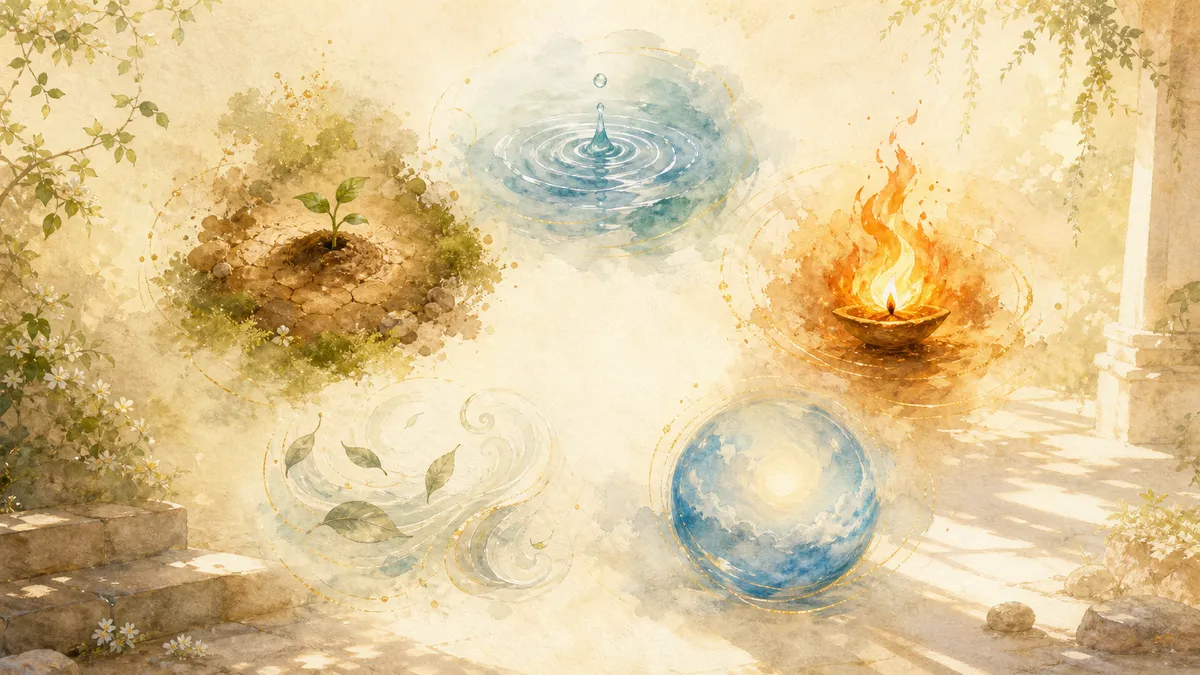
When a yogin unites contemplative presence with the five elements and truly saturates the energy of the element, the energy of the element appears in pure vision as a mandala. What are the signs of this? He may see the deities of the element blessing him. For example, on the ordinary worldly level we perceive a river as water. But a river has its own subtle prototype, its own subtle component, which we do not see. And, for example, the gods see the subtle component of the river, but do not see the gross one; that is, for them the river is something different.
If your water element is purified, you may see that the river is the physical body of the deity of the river or of the deity of the water element. And then you see the deity of the water element, the subtle forms accompanying it, and all this, in pure vision, already appears as a mandala. Then it is said that you open the apas-mandala — the state of all-water. When, through contemplation, a yogin feels the great union with universal water, duality disappears for him.
These five places are connected with the five fully purified elements with which presence is united.
The Esoteric Teaching of the Siddhas
The teaching of the sixteen adharas, the three lakshyas, and the five places is a teaching described in many tantric texts of the Baul, Nath, and Siddha traditions of other schools. But in reality, few yogis who practice yoga understand not only how to realize this, but even what is actually being discussed. Since these teachings have always been regarded as the quintessence, they were deeply concealed and kept secret.

Thus, in the text, the mahasiddha Gorakshanath says:
“Only one who meditates on the nine chakras, the sixteen adharas, and the three lakshyas comes to know these five places, becoming a master of yoga.”
The Sequence of Practice
In the section of shakti-yantra, we begin the practice of shat-chakra yoga. First you meditate on the seven chakras, then you add secondary chakras such as the manas-chakra, talu-chakra, and hrid-chakra. Then you learn to meditate on the secondary chakras below, and then concentrate on all sixteen adharas. In this way, you completely subdue the pranas in your body. Having trained yourself to unite presence with these pranas, you gain the ability to control the pranas. When the ability to control prana reaches a high level, concentration on the three channels takes place: ida, pingala, and sushumna. Concentration on each of the channels gives certain abilities and experiences. Finally, when all these practices have been completed, contemplative presence arises, capable of uniting with the elements. This is what is called the “five mandalas” or the “five places.”
