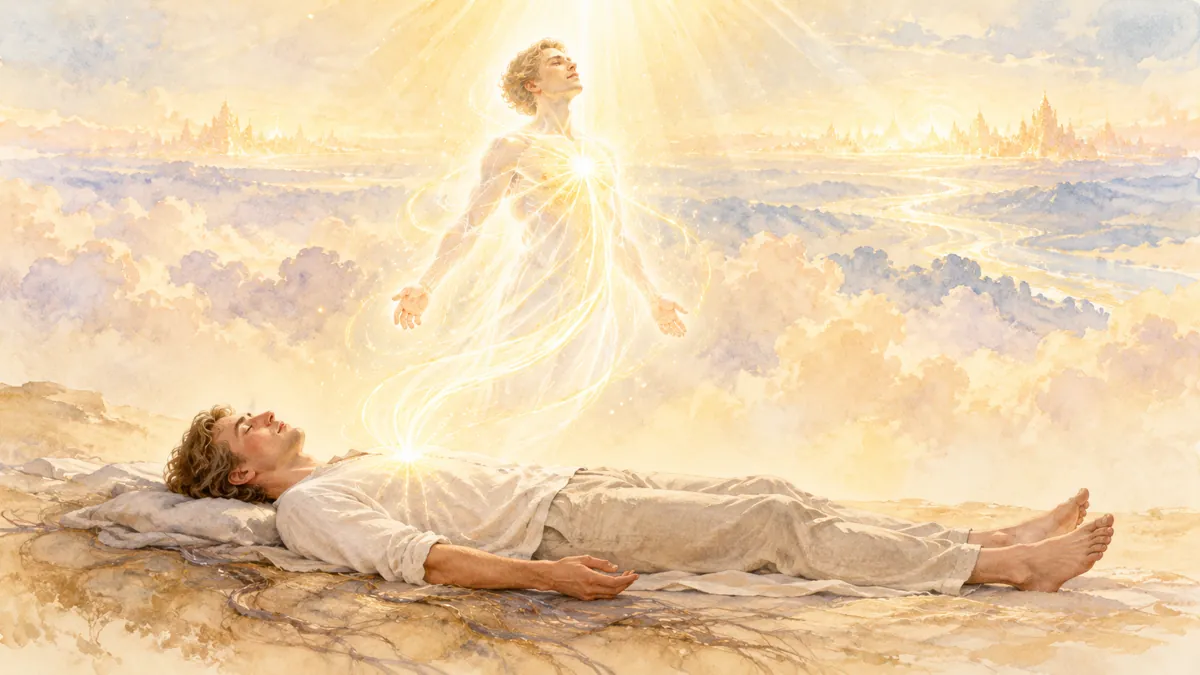
We will continue discussing the intermediate state and its significance from the perspective of illusory body yoga. As we said yesterday, spiritual practice consists in constant purification, and anyone who does not engage in it falls out of the process of spiritual practice. We purify our own unconsciousness, obscurations, and karmic pranas through the light of clarity that arises as a result of contemplative practice. It is precisely the absence of the light of clarity that causes living beings to remain in obscurations and illusions and to be reborn. Conversely, the emergence of this light sooner or later leads to the purification of everything that has been defiled.
A lack of clarity regarding the physical body leads to the physical body becoming ill, having a short lifespan, or lacking flexibility; that is, you have no understanding of what to do with it at all. A lack of clarity regarding prana leads to feeling a deficiency of prana, having blockages, being unable to perform technical practices, and not understanding what to do with these pranas or how to regulate them. Or desires remain uncontrolled; you lack clarity about how to sublimate sexual desire, how to purify the svadhisthana chakra, how to reverse the flow of the pranas and make them rise to the head. All these are examples of a lack of clarity. A lack of clarity regarding the rules of monastic discipline leads to confusion in relationships, hierarchy, and one’s own practice, when a person is not fully oriented in all of this. A lack of clarity regarding one’s own consciousness leads to confusion in the intermediate state: different kinds of light arise, and the person does not know where to go, what to follow, whether to enter a womb, acquire a new body, follow the path of the gods, or remain in that state. In other words, the person experiences profound confusion. Conversely, when the light of clarity within us intensifies, all inner confusion is purified, and everything becomes harmonious, whole, divine, and right.
Transition from the Clear Light to the Intermediate State
Thus, when the mind abides in the state of clear light, it remains motionless in the supreme state of emptiness. This state of emptiness is called brahmajyoti (the radiance of Brahman), turiyatita (the transcendent state). But sooner or later, a slight fluctuation arises, a kind of subtle tremor in consciousness.
If a person is not sufficiently aware, they begin to experience this tremor and fall out of the clear light. This is a sign that the stage of pure clear light is coming to an end: the subtlest pranas and the mind leave the small white-and-red bindu in the heart and begin to move outward. At this time, the ordinary physical body is abandoned, and the body of the intermediate state begins to appear.
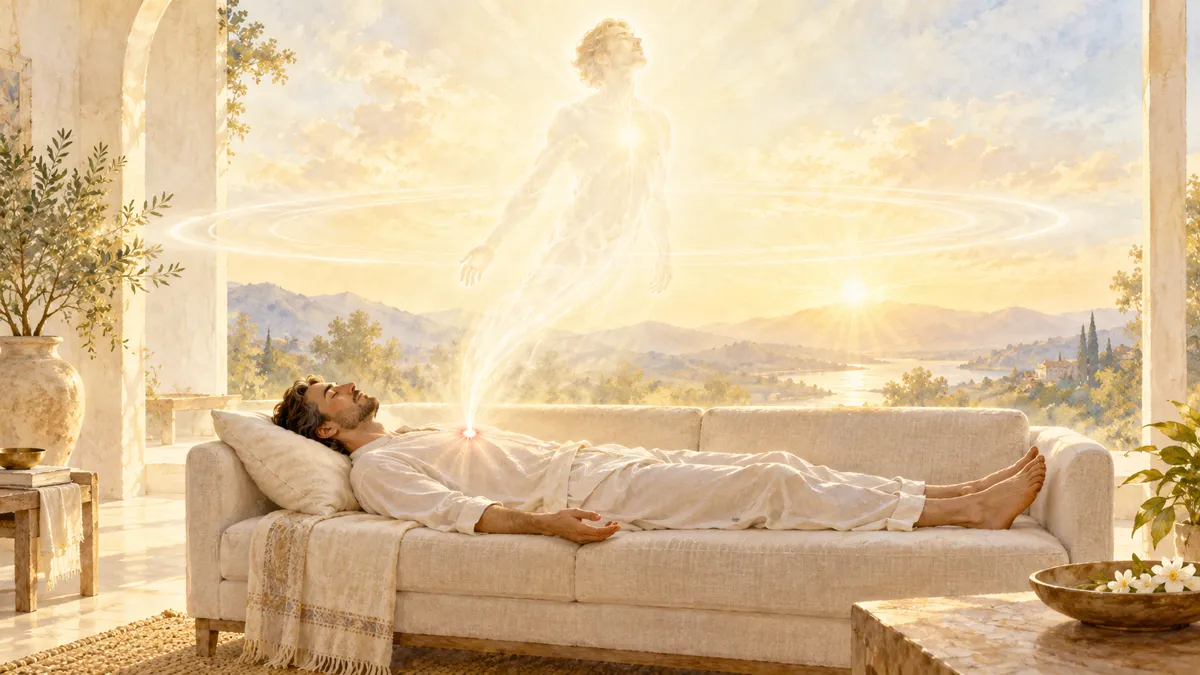
In what case will the intermediate-state body not appear? If a person has entered nonduality, fully realized the primordial light, and does not wish to emerge from it, or if they are trained in the practice of the fifth, sixth, or seventh dhyana—that is, if they have meditated extensively on infinite space, infinite consciousness, or the state of nonexistence—and have decided to become a long-lived god, a formless deity resembling a cosmic spirit. However, if they do this, they will make a mistake, because even such an exalted state in the form of a long-lived god is not liberation; in essence, it is still an “exalted realm of samsara,” since subtle duality has not yet been overcome. In this state, it is impossible to abide in contemplative presence, because dhyana (absorption in the formless) and presence are two different things. Someone may think they are the same, but that is not at all the case. As you know, dhyana is still a “fixation” of the mind in a particular state, a kind of one-pointedness. Presence, by contrast, is an open, unconditioned state. To become an inhabitant of the formless realm by entering the fifth, sixth, or seventh dhyana means forming one-pointedness in consciousness. It is a very subtle and exalted one-pointedness; nevertheless, it is not the natural state, because form is denied in it, and there is only a one-sided attachment to formlessness. The true natural state is the ability to perceive the infinite and the finite, form and formlessness, simultaneously. The siddhas say that rebirth in these realms is unfavorable for one seeking complete liberation. You may spend many billions of years there in bliss, yet your true progress will come to a halt; you will not grow while in this state, because states of dhyana are unsuitable for growth—they are absorption in one particular vision. It is said that only highly evolved souls with multidimensional consciousness can continue to develop while in states of dhyana.
Formation of the Intermediate-State Body
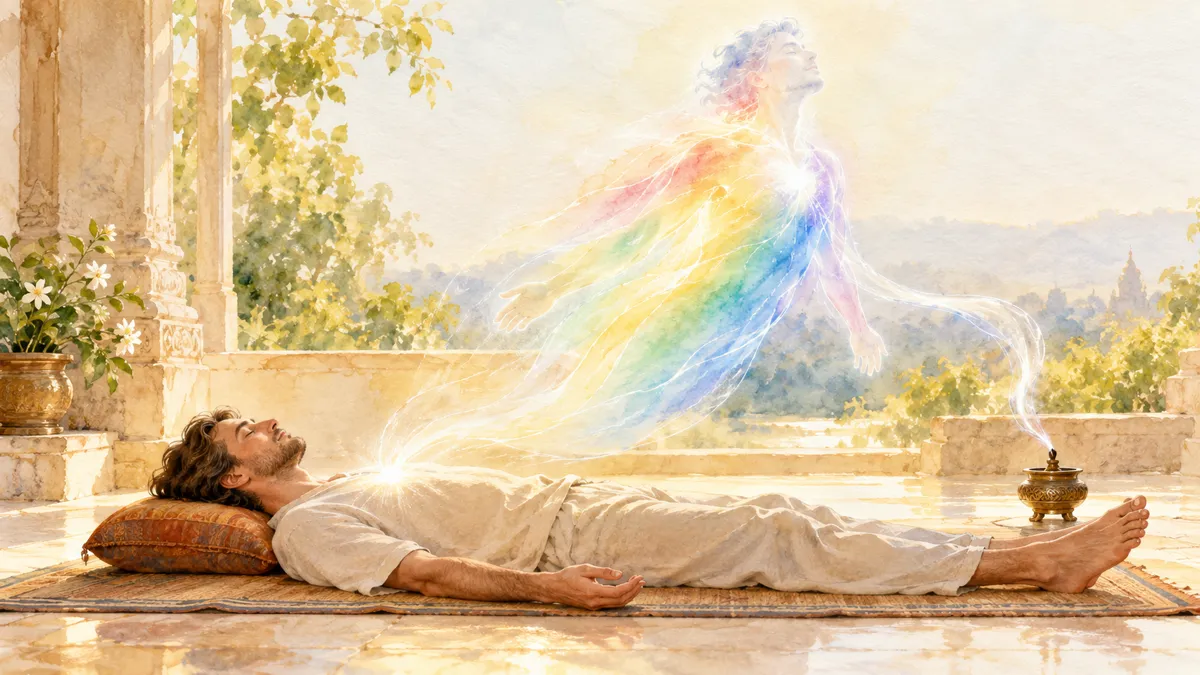
Thus, at this moment, the white essence in the heart moves downward and exits through the sexual organs, while the red drop exits through the nasal area. It is believed that subtle prana appears and becomes the basis for fundamental consciousness. Its color is usually said to be white. But this light radiates a five-colored glow—white, red, yellow, green, and blue. On the basis of this subtle prana, the form of the intermediate-state being is created; it has a body made of prana.
For example, spirits in the intermediate state feed on scents because scents emanate a certain prana. By drawing in these scents, the spirits replenish their prana. Therefore, when offerings of incense are made or when any offerings are burned, they can receive them. A being in the intermediate state has the appearance of the being as which it is destined to be born in its next life. For example, if it is destined to be born as a preta, it will have the body of a preta, and if it is destined to be born as a god, it will have the appearance of a god.
At this moment, the white mind of subtle appearance, the red increase, and the black near-attainment appear in reverse order. The black light of near-attainment and the attainment of the intermediate state are experienced so rapidly that a non-practitioner is not even able to notice them. All this happens in the snap of a finger. These states are so subtle that only an experienced practitioner trained in recognizing these lights can remain in them for a long time and be aware of them.
A living being begins to be born immediately in the intermediate state when it falls out of the fundamental light. At this time, limbs, organs, and various parts of its body also appear. Then, in reverse order, various signs manifest that are also characteristic of the processes of kundalini yoga. They are described in the Upanishads and various tantras.
How does this process occur in reverse order? From the clear light, black space appears; from black space, the space of subtle redness appears; and from that, in turn, the space of subtle whiteness appears. Then comes the vision of a flame like that of an oil lamp, followed by visions of sparks or fireflies, then visions of smoke, and then visions of mirages. Thus, in the intermediate state, the elements unfold in reverse order.
Such a living being then sets out in search of a place for a new birth and in search of scents, since at that time it feeds on scents. A subtle body forms within it. A subtle body forms in everyone; it consists of consciousness and is generated by prana alone. It is a subtle, immaterial psychic body.
The gross body consists of the primary elements, which manifest as the flesh and blood visible to us.
This subtle body is the basis of the illusory body that we intend to attain. If we have purified our consciousness, a pure, divine, immortal illusory body will arise from it. Various texts describe beings in the intermediate state as having different abilities: they possess clairvoyance, can see into the future and the past, and travel to different worlds. Of course, each does so according to its abilities. Even spirits and less developed beings possess clairvoyance.
The different parts of its body appear simultaneously. This subtle body cannot be harmed by any material objects, but it can be influenced by the power of magic and visualization. It can freely pass through walls and mountains. The only place it cannot enter is the womb of the mother of its future birth, unless the time has come. It can also travel wherever it wishes through the power of thought alone.
It is often difficult for a living being that has entered an intermediate state to change it to another one if that being is not developed, because it is heavily conditioned. However, one who has the proper level of awareness can change the intermediate state they enter. In general, this is connected with the ability of self-liberation, the ability to draw inner space, bhava, and divine pride from the depths of one’s own consciousness.
Cycles of the Intermediate State
It is believed that the maximum lifespan in the intermediate state is seven days. After this, if rebirth has not occurred, a so-called minor death takes place, followed by a new intermediate state. This continues seven times, until the causes of a new rebirth compel the being to enter a new body or until the living being becomes some kind of spirit.
How does such a minor death occur? The subtle body of the being in the intermediate state begins to contract from above and below, gathering in the heart, and then gradually disappears, starting from the edges. At this time, various subtle dualistic states dissolve, and the various signs we have discussed arise once again. When these signs appear, the different kinds of light we have discussed also manifest, up to and including the clear light, and another minor dissolution occurs. However, at this time they are not experienced as distinctly. The four emptinesses arise, and once again the primordial luminous emptiness, the primordial clear light of emptiness, appears.
All these minor deaths are experienced in the intermediate state, but they are not the true death that occurred in the physical body. Others say that both these minor deaths in the intermediate state and physical death are the same processes, except that in the physical body these processes are more pronounced because the gross elements provide more energy during the experiences. From this point of view, this is not really death at all, but death as a physiological process of the successive dissolution and manifestation of subtle elements, light, and prana, which form the basis of our fundamental mind.
What people call birth and death is simply the successive manifestation and unfolding of subtle pranas, the creation of these elements or their dissolution. The primordial clear light is immortal, and fundamental consciousness is also immortal. The problem, however, is that this consciousness forgets and identifies itself with the manifestations of gross elements; it creates a foundation for itself in something temporary—the physical body and dualistic concepts.
When a yogi attains clarity and becomes established in the state of the fundamental clear light, there is no death as such for him, but only a process of absorption and unfolding, which he can fully control. There are no longer any uncontrolled processes in which he unfolds and his clear light uncontrollably assumes the form of a demon or a being of hell. Rather, the processes by which the subtle pranas unfold from the fundamental light are completely pure and under his control; that is, he can enter the light, then unfold his pranas and transform into whichever deity he wishes, and afterward enter the light again, unfold the pranas, and transform into a human being.
This process of the pranas unfolding from the state of fundamental light is compared to a fish leaping out of the water. If the water, the surface of the lake, is the primordial ground of our consciousness, then the unfolding pranas—the illusory body that manifests—are like a fish that temporarily leaps out of the water.
Points of Consciousness Exit and Rebirth
One who is destined to be born as a being of hell leaves the body through the anus; one who will be born as a hungry ghost, through the mouth; one who will be born as an animal, through the urethra; one who will be born as a human, through the eyes; one who will be born as a god of the desire realm, through the navel; one who will be born as a sorcerer-god, through the ears; if one is destined to be born in the form realm, through the middle of the forehead; and if in the formless realm, through the crown of the head. This is how the teaching on the points in the body and their relationship to rebirth is presented.
This is true for ordinary people. But a yogi who has succeeded in shat-chakra yoga, for example, can direct his prana himself and exit through any chakra in the physical body. Depending on which chakra he exits through, he may be reborn in one realm or another. Naturally, the highest chakra is the sahasrara. It is believed that one who exits through it attains liberation. Alternatively, if a yogi is stable in presence or has a profound level of bhava, then regardless of which point he exits through, he can change his state through the power of his awareness alone. But for everyone else, this is indeed the case.
It is believed that if a person has bad karma, lacks merit, and is destined for an unfavorable rebirth, consciousness first ceases in the head, in the upper parts of the body; that is, apana-vayu predominates in him. But if a person has merit and a pure consciousness, the circulation of prana first ceases in the legs, while remaining in the head. A bad person with powerful obscurations is, as it were, dragged downward by his sins through apana-vayu. The consciousness of an exalted practitioner, however, moves upward because it is subtler.
Visions in the Intermediate State
Also, in the intermediate state, living beings who are destined to be embodied in unfavorable types of realms see a black cloth spread out before them or simply experience a state of darkness. Sometimes they have visions in which they see themselves upside down. Conversely, those who are destined to be born in the higher realms as humans or demigods see a white cloth spread out before them or a white moonlit night.
It is sometimes said that, in the intermediate state, those heading to the lower realms fall as though headfirst, those heading to the higher realms move vertically upward, and those being reborn in the human realm move straight ahead. Beings of hell are also described as having bodies the color of charred wood; pretas, the color of water; animals, the color of smoke; gods of the desire realm and humans, the color of gold; while the gods of the form realm appear transparent, as though composed of white radiance.
To be born in the desire realm or the form realm, one must pass through the intermediate state. It is believed that for those whose state was extremely obscured and who are candidates for the hell realms, the intermediate state does not exist; that is, they are reborn there instantly. Nor is there an intermediate state for those reborn in the formless realm. If a person has attained the fifth or sixth dhyana and become deeply established in it, he does not pass through any visions; he instantly enters emptiness and abides in this expanse of emptiness.
The Practice of the Illusory Body and Continuous Consciousness
Thus, these are various descriptions of the intermediate state, which the yogi purifies through the practice of the illusory body.
When clarity begins to permeate everyday life and dreams, then, naturally, it also permeates the intermediate state. And when this clarity is sufficient, it saturates the yogi’s subtle energies and purifies them. Through the yoga of the illusory body, we finally restore this missing segment in our consciousness and purify it, so there are no longer any gaps in our awareness. Suppose you practiced contemplation during the day, and your state was steady and profound, but then you slept for six hours in an unconscious state. Various things happened to you in your dreams, but you did not control them—this is precisely a gap in consciousness, like a dark spot in your day that you cannot control.
But through the practice of the illusory body and the introduction of clarity, all such dark spots are completely eliminated, and the yogi possesses continuous, twenty-four-hour consciousness. If you simply practice contemplation while abiding in the natural state, that alone is sufficient. Without visualizations, mantras, or worship, you can realize the pure dimension, the complete transformation of your pranas into the mandala of pure vision. And the practice of the illusory body aids such a transformation.
Question: Does the state of the pranas during life ultimately affect the formation of the body in the bardo, or does it not matter? Or does the state of your pranas not matter? In other words, does the dominance of certain pranas in this life affect the formation of the illusory body in the bardo?
It affects those who are not advanced in the practice of contemplation. It does not affect those who possess great spiritual power, bhava, or contemplative clarity.
There is a story about a king who performed a sacrifice by offering his own head into the ritual fire. He was an outstanding yogi and magician. When he made this offering, four illusory bodies appeared at once. These illusory bodies possessed reason and intelligence and lived independently. In one illusory body he practiced tapas, in another he visited the realms of the gods, while a crocodile devoured the third illusory body, and he lived inside the crocodile. When the crocodile died, he emerged from its body in the form of a small crocodile, crawled all the way to the Arctic Ocean, and entered the realm of the gods, which was located there at the time. It was there that he left his body. Since that place was highly saturated with energy, he was also reborn as a god through the action of that place’s prana. In other words, the prana of the place influenced his rebirth in one illusory body.
However, if there is profound bhava and profound presence, then the state of the pranas does not particularly affect one’s future birth or subtle body in the bardo. On the other hand, prana is an expression of the mind. That is, one should not think that prana and mind are different things. Over time, if the mind is purified, the pranas are also purified.
In the practice of the yoga of the illusory body, we create a duplicate of our body, formed not from the impure karmic pranas of our father and mother, but arising from the pure natural state and divine pride. For example, in this body there are white and red drops as products of our parents’ karma, of paternal and maternal passion. Entering this body is a symbol of our immaturity.
The Nature of Human Incarnation and the Illusory Body
Why are we humans rather than gods? We could be in the heavens of Indra or the heavens of the god Brahma, but we entered precisely this body, which corresponded to our level of maturity, except for those who did so consciously as part of a specific mission.
It is the body that carries the karma and immaturity of our “self.” The illusory body, by contrast, manifests our merit; it arises from the pure awareness of clear light and from divine pride, and it consists of the mind’s subtle prana. And infusing the illusory body with the fundamental light and divine pride is the cornerstone of the practice of the illusory body.