Enlightened Activity: View, Meditation, and Conduct
28.05.2026
0 мин. чтения
0
Share
copy
search
add
share
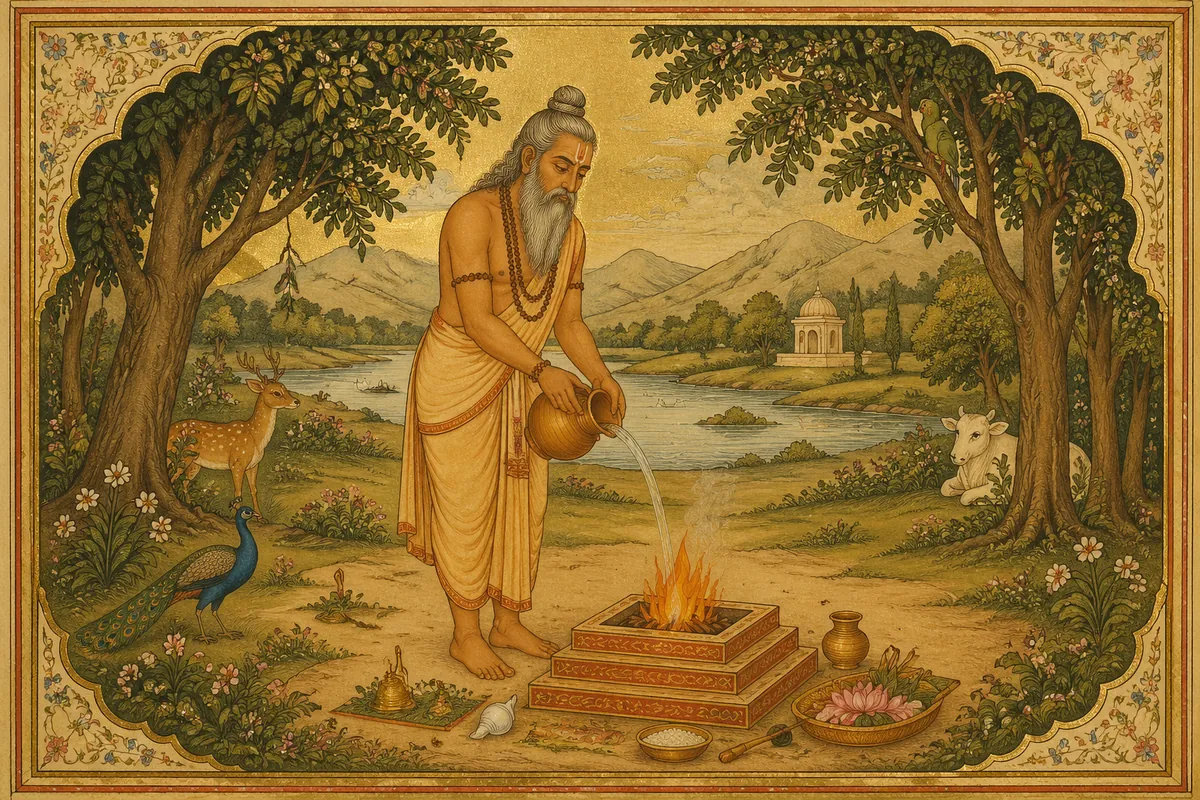
Today, February 1, is the day of the manifestation of Rishi Vasishtha.
Rishi Vasishtha is one of the rays of creation and infinite consciousness. It is said here that various problems arose in the kingdom because of inaction. When we live in the material world, we must act correctly. We must not misunderstand the doctrine of non-action.
The Correct Understanding of Non-Action
Non-action concerns that layer where there is no doer, no fruits, no karma — the transcendental layer. To act in this transcendental layer would be a delusion, an absurdity. This is view and contemplation. In contemplation, when you act, you are mistaken. In contemplation, on the contrary, one must let go of the mind, relax, be in the natural state, add nothing, embellish nothing, tweak nothing. Even effort must be made lightly — then it will be contemplation, contemplative non-action.
In the view, there truly can be no doer, no action. In contemplation there can be no action, but in relative behavior there is always action, and it must be correct. If we do not undertake certain actions in the relative, that is also a mistake.
As for the view: if we lose the view and begin to act there, it is said — you have lost the view, the loss of the view in action; you began to act — you obscured the view. If we begin to act in contemplation, that is, instead of contemplation we begin to invent something with the mind in the subtle layer of awareness, then it is said — you have lost contemplation in action. And conversely, if we do not act where action must be taken correctly on the physical level, then it is said — you have lost action.
As sadhus, we must live in such a way as to lose nothing: neither action, nor view, nor contemplation — this is the ideal of a sadhu. Correct view, correct contemplation and meditation, correct action.
Atma jnana is the view, atma dhyana is contemplation, and atma kriya is action. In the relative dimension one must act correctly. If we take a position of non-action altogether, we are also mistaken — this is called atma kriya.
The Art of Conscious Action
How should one act correctly? The saints say: one must act from the view, one must act from contemplation. They do not say that one should not act. They say that one must act in accordance with place, time, and circumstance. But they say: one should not act from the mind, one should not act from the ego. If you act in that way, your action will be karmic. One must act from the principle of awareness.
When we act from the principle of awareness in accordance with place, time, and circumstance, this is called lila (play). This is how gods and divine beings act. We need to learn the art of conscious action no less than the art of meditation and contemplation.
Our meditation, our awareness, our view must manifest correctly in life. It cannot be that here you are a great meditator, while next to you there is some person and you cannot even come to an agreement with them — as soon as you open your mouth, you have some conflicts, emotions. Is that great meditation? That is zero meditation.
Your meditation must manifest in life; it must be brought into your perception, into your personality, into your actions, into your service. It cannot be that I am a great meditator, but there is some small task and I cannot even understand how to do it. This means my clarity is floating somewhere out there in the center of the galaxy, it got lost somewhere there, and it did not come here. It was with me somewhere in meditation, but when I came out of meditation, I did not take it with me or left it behind, and here I am like a five-year-old child. This is also incorrect action.
The Enlightened Activity of the Saints
True sadhus are able to act. They act intelligently, not foolishly at all, very skillfully, very subtly, and not like people who are karmically conditioned. This action is lila, play.
If we look, then everyone except the inactive Absolute knows how to act: Rishi Vasishtha, Rishi Vishvamitra, Lord Shiva, Lord Vishnu, Dattatreya — all of them are masters of action; they are not only masters of meditation. If they were only masters of meditation, we would not tell various stories about them; we would hang up such static icons — there they stand, they sit, and that is how we should be.
But there are biographies, testimonies of their enlightened activity. There are various games, and their actions are described not as karma, but as lila (play). This is an incredibly subtle, incredibly skillful, very deep enlightened activity, incomprehensible to human consciousness.
All of us need to learn proper enlightened activity. We cannot do without karma yoga, without seva, without service, without chankramanam, without contemplation. How can contemplation be brought into life, into actions; how should one act, communicate, follow ethics and culture; how can contemplation be brought into rituals, into meditation? All of this gradually begins to reveal itself as a divine mystery, and then our life ceases to be our life and becomes divine providence manifesting through us ourselves, while we become conduits of divine energies.
Signs of Right Action
We need to pay attention to right actions. But what do right actions mean? After all, there are no universal formulas for right actions. Many ethical codes have been written: the 10 commandments on the tablets, the Sermon on the Mount, the Buddhist Tripitaka, the code of yama-niyama, various ethical codes of sadhus—but these are pointers. What lies behind all of this?
The saints say that right actions arise not from the mind, but from your awareness, from your self-surrender to God, from your presence. When your self-surrender, your presence is not lost, but is alive and manifests in action in everyday life—these are right actions.
The First Sign Is Inner Emptiness
When you are in right action, the ego as such is absent in you. Take you, lay you at someone’s feet, someone walked by and wiped themselves on you, did not notice, thought it was a rag, but it was you—and nothing even arose in your soul; say “namaste” to him. Inner emptiness exists in you; you have no emotions, negative judgments, condemnation, or attachments at all. You become like the illusory body of God.
Inner emptiness is the first sign that you are in right action, in right awareness. You do not suffer. At the very least, you have no suffering. Others may have suffering, but you cannot, because emptiness filled with divine awareness and contemplation cannot have suffering.
You think more about how not to cause suffering to others, how to reduce the suffering of others, and as for yourself—why should you think about yourself? You are always okay. This is the first sign. Such a sadhu is always okay; he himself is always okay. There is nothing in him to suffer; he does not have those mechanisms and gears that suffer in people. His karmic mechanisms have been dissolved, offered to God, and then he helps others. He takes on an additional burden, additional responsibility—how to help others not suffer if these karmic mechanisms are still functioning in someone.
The Second Sign Is Service to the Divine Will
Such a sadhu is always charged with service, always. He directly feels the divine will; he has no personal goals in life, no personal motivations in life. He has one goal: how to catch the signal of the divine will, how to conduct it even better in this place, at this time, in this circumstance.
He thinks of God all the time, and he himself is already one with God, and he takes only the divine will into account. He does not take his preferences into account—there is a higher command. He does not take into account any attachments, worldly principles, conventions—he always listens to the divine will. He always wants to conduct it clearly and precisely. He always serves as a conduit, a medium of divine light.
This is the second sign that you are correctly abiding in the view, in meditation, and manifesting it in behavior. This is a sadhu without a personal ego, an enlightened sadhu. At some stage, such a sadhu ceases to be a human being, a person in the sense of karma. He becomes an illusory body of the divine, an empty channel, a medium of the divine.
Freedom from Personal Goals
He himself no longer suffers, and he himself, if he is not liberated, is almost liberated while alive. Freedom exists for his soul; he has no goal of personally attaining liberation. Those who strive for liberation are those who are bound, who have personal goals and have not freed themselves from personal goals.
A personal goal is not freedom. As soon as you have even a small personal goal—that’s it, a cage, you are caught. Values that come from the ego, some mental attachment, any attachment—as soon as it appears, all of these are different forms of unfreedom. And he is free from all of this.
Those who are bound by all these things need to be liberated, whereas he is free from them. Perhaps his liberation is not perfect, but for the most part he is already free from the majority of those human things by which karma restricts people. He does not set personal liberation as his goal as such — personal liberation already appears to be a lower goal, a lower status.
What is higher? Higher is the flawless carrying out of the divine will, the flawless manifestation through oneself. This is the lofty principle of service. Service in the absolute sense is not for ordinary people, not for bound souls; it is already for liberated souls. They already have nothing to do, like the gods in the heavens — they do nothing except carry out the divine will.
The state of such service is the state of liberation here and now. If you have a personal goal, you are not liberated. If you have attachment, you are not liberated. If you have preferences, you are not liberated; someday you will have to get rid of this, to become free.
But if right here, right now, you have only one goal — to be an impeccable conduit of the divine will, having completely removed yourself — then right here and now you are liberated. Of course, there are different qualities, different levels of this freedom.
When you are liberated, you have no desires, no personal desires, apart from the desires of the body. The body has its own physiology, its desires — it has to be maintained: food, sleep. But the mind has no desires, the ego has no desires, not a single one, except to be a conduit of the divine will.
When you are a conduit of the divine, you understand that nothing prevents you from being a conduit of the divine except the mind. In order to be a conduit of the divine, nothing is needed, absolutely nothing. It is not a question of other people, it is not a question of conditions, not a question of anything whatsoever — it is only an inner question.
The key to solving our own problems lies in how to become such a perfect conduit of the divine, how to become liberated here and now, how to free ourselves from all the petty goals, the petty tasks of the ego — this is great work, and it does not come at once.
The Story of Vasishtha and the Royal Dynasty
One must be very attentive. When listening to the stories of beings such as Vasishtha, great saints, we must see that these are no longer souls striving for liberation; this is a liberated emanation of the Absolute, playing in different forms, in different bodies, in different situations, according to place, time, and circumstance.
The very act of listening about such great souls purifies. And whatever you may hear — there will be stories that are truly wild, one cursed another, and so on — whatever you hear, perceive it as the play of liberated souls, of the liberated soul of Vasishtha. Because they cannot be perceived in the human sense.
“And the army of the enemies, crushing the descendants of Bharata and shaking the earth with its forces consisting of four divisions of troops, the king of the Panchalas swiftly passed through the entire country, subduing it. And with ten armies he defeated that king in battle. Then King Samvarana, together with his wife, advisers, sons, and relatives, fled in great fear. And he began to live by the great river Sindhu in a grove located near a mountain and washed by the river. Thus the descendants of Bharata lived for a long time, settled in a fortress, and when they had lived there for a full thousand years, the great sage Vasishtha visited the descendants of Bharata. And when he had lived there for the eighth year, the king himself addressed him: be our household priest. And Vasishtha gave his consent to the descendants of Bharata.”
“Subsequently, Vasishtha was the guru of the god Rama himself, the son of the famous King Dasharatha, a representative of the solar dynasty. In those times, all rulers had spiritual mentors and did not take a single serious step, either in governing the state or in their personal lives, without their blessing. Because of this, their kingdoms always prospered, and it was Vasishtha who became the outstanding teacher who gave Rama the instructions in the ‘Yoga Vasishtha,’ thanks to which the entire world was able to receive the holy darshan of that conversation. Wise Vasishtha, to whom both the past and the future were known, knew that the scene being enacted by Rama was an act of universal dharma, but despite this, he himself played the role assigned to him in this divine play.”
The Divine Lila of Creation
The point is that the world is a very complex system. In scientific terms, it is a quantum nonequilibrium stochastic system in which different energies play. The energies in the universe are a great lila, a play. All of creation is one being, although it seems to us to be separate. But in this creation, despite the fact that it is one being, there are energies.
For example, the energy of Lakshmi (iccha shakti), the energy of Saraswati (jnana shakti), the energy of Durga, Kali (kriya shakti), and many other shaktis. Each deity is a particular force. These forces are superintelligent, independent; they conduct their own game, their own policy. They have their own sphere of influence, their own mandala, their own duties given to them by Brahma the Creator.
The entire world, all of creation, is a very complex mandala in which life does not unfold according to the law of karma. Only people live according to the law of karma, because they are limited. But life in the great divine universe unfolds according to the principle of lila.
Lila is not a law. A law obliges, whereas lila does not oblige—it is a principle, the principle of creation. Nevertheless, this lila continues; everyone has their own role in this lila. And holy sages humbly accept their role in this play. Vasishta also accepted his role. He accepted the role of being Rama’s guru, the role of being the mentor of the royal solar dynasty, and many such roles.
Unlike ordinary people, they do not identify with these roles and play them as people play roles in a performance. Likewise, in life, if we want to emulate the saints, we must accept such a role—our conscious role in this universe: the role of a sadhu, the role of a monk, a karma-sannyasi, the role of a manager in the sangha, the role of a cook—it does not matter which.
Whatever it may be, there are no great or small roles in the universe. Whether something is great or small depends only on your mind. Whatever this role may be, we must respect it and play it well. It does not happen that in a performance someone takes the role of a king and they say, “This is an important role; you must play it well.” And someone else plays the role of a soldier, and they say, “And this is the role of a soldier—you can mess it up, you can be false, it doesn’t matter.” No, that is not allowed.
Both the role of the soldier and the role of the king must be played equally—equally authentically, with complete dedication. Because the whole performance is a divine mystery. We can be participants in this divine mystery if we ourselves play our role perfectly.
The Roles of Saints and Service to the Divine Will
All saints, such as Vasishta, are those who have perfect mastery of their role, who play their role perfectly. There is the role of a novice—this is a certain role, not difficult to play. There is the role of a monk—a certain role; the role of a sadhu—a certain role; the role of a mahamandaleshwar—a certain role; different roles. We do not identify with these roles, but this role is a certain power, the role of a guardian of dharma, a certain power, a certain function in creation that makes it possible to benefit living beings and manifest the divine will through it.
Why is a role given to us? This role is given to us, first of all, in accordance with our inclinations, with our karma. Secondly, it is given to us as seva, as service. Through this role we can benefit living beings, manifest the divine will, and become conduits of the divine will through this role. That is, in accordance with our karma, our role is such.
Vasishta as the Family Mentor of the Solar Dynasty
“Vasishta, a knower of the Vedas and Shastras, exerted a strong influence on the royal dynasty; thanks to his wisdom, the rulers of the solar dynasty were able to rule in accordance with dharma. Once Vasishta confessed to Rama that he had resolutely refused the position of mentor to the dynasty when Rama’s ancestors offered it to him. But Brahma the Creator himself appeared and said: ‘My son, you know what the future holds; take on these duties without hesitation. In the years to come you will attain something great, for Parabrahman has incarnated in the solar dynasty.’ Hearing this, Vasishta bowed his head in agreement and became the family mentor in the solar dynasty.”
The Story of Vasishta’s Incarnation
“Vasishta was the son of Brahma, but as a result of King Nimi’s curse he lost his body and was born again from the seed of the gods Mitra and Varuna, who had become inflamed with passion for the heavenly apsara maiden Urvashi. There is a story about the sacrifice of Maharaja Nimi. Intending to perform a great sacrifice, Maharaja Nimi decided to appoint Vasishta as the chief priest, but he refused, since he had already accepted a similar invitation from Lord Indra. Vasishta asked Maharaja Nimi to wait until he completed the sacrifice entrusted to him by Indra, but Maharaja Nimi did not do so. He reasoned that life is very short and that there was no point in waiting. So he entrusted the performance of the yajna to another priest. For this, Vasishta became angry with King Nimi and cursed him: may your mortal body fall lifeless. Maharaja Nimi also became angry and cursed Vasishta in return: may you die as well. As a result, both fell dead. Vasishta was born again from the seed of Mitra and Varuna, who were later seduced by Urvashi.”
“This is how Vasistha himself describes his origin in the Yoga Vasistha: Rama, the omnipresent consciousness or cosmic being, shines eternally in all beings. When a vibration arises in this cosmic being, God Vishnu is born, just as a wave arises on the surface of the ocean when it is stirred. From this Vishnu the creator Brahma is born and begins to create in the universe an infinite variety of living and nonliving, intelligent and unintelligent beings, and the universe is created, as though it had never been destroyed. The Creator saw that all living beings in the universe suffered from disease and death, pain and suffering; compassion arose in his heart, and he sought a path that could lead living beings away from this. Therefore he established holy places and noble qualities on earth: asceticism, mercy, truthfulness, and virtue, but this was not enough. All this gave people only temporary relief from suffering, not final liberation. Reflecting on this, the Creator created me; he brought me close to himself and cast a veil of misunderstanding over my heart. Immediately I forgot who I was and what my essence was. I begged the creator Brahma, my own father, to show me the way out of these sufferings. Drowned in suffering, I could not and did not want to do anything, and I was lazy and inactive. In response to my pleas, my father revealed true knowledge to me, which instantly removed the veil of misunderstanding that he himself had cast over me. The Creator said to me: my son, I hid knowledge and then revealed it to you so that you could feel its greatness, because only then will you be able to understand the suffering of ignorant beings and help them.”
Communication with Divine Energies
Within you exists Brahma, the universal meta-consciousness that created this universe, manifested it from the quantum unmanifest state, from the point of singularity, began to move the elements, set time in motion, created the metric of space, the topology of this world. This is a superintelligent, all-encompassing, omnipresent consciousness. But for you personally it can manifest as a specific deity, resembling a human with one head, two arms, or four arms; it can also speak—there are no limitations for it. For any being it can take the form that is close to them; the yoga of worshiping deities is based on this.
And when you have sufficiently purified your mind through mantra, meditation, and theurgical practices, someday Brahma may come to you as well, just as he came to Vasistha and to other beings, and you may have communication with him. It is as if your divine Self, having taken a certain form, will descend to you. Of course, one should not think that everything one sees means Brahma is coming to me—this is the lot of saints; great sobriety is needed so as not to confuse one’s own mind with the true manifestation of the divine wisdom of the universal deities of wisdom.
At first, it will simply be your mind coming to you, perhaps taking various forms; this is also normal. But sometimes in samadhi divine energies come to saints, and these divine energies are inseparable from them and separate at the same time. Because Brahma, the creator of this universe, can tell you all your past lives, your destiny, the future, the various nodal points of karma, and how to turn these karmas into lila. He can bless, just as the goddess Gayatri blessed Vishvamitra by giving him a mantra, by making some kind of transmission; all this is possible because the inner divine light is present within you—the question is to open it and reach it.
The gods appear only when we deserve it, that is, the gods have such a principle: do not ask, but deserve.
Therefore, when we recite a mantra, we recite it, but we do not count on the gods, divine energies, divine forces appearing before us. They will appear before us only when our consciousness becomes equal to their consciousness, when we become sufficiently purified, sufficiently nondual, empty, so that they can communicate with us, so that we can see them. Perhaps they would have appeared earlier out of compassion, but our perception is often obscured, clouded; we simply will not see or hear them.
Even if some deity appears, it will do this (snaps fingers): do you hear me? How are you? Connection? We will stand there— I see nothing, I hear nothing, there is no perception. Because the mind and the senses must undergo purification. But when we become sufficiently pure, this is possible: our innermost, most subtle part of our divine Self will connect even with our relative mind, with our relative perception, with the physical body—this is one of the kinds of realization, one of the kinds of siddhis and darshans.
The Path of Service as a Direct Way of Connection with the Divine
When we adopt such an attitude—service to the divine will, the flawless carrying out of the divine will—this is one of the direct ways to have a connection, such contact with the divine dimensions.
It is one thing when a person sits down to meditate and thinks: “Now I will stop the mind, I will abide in thoughtlessness, someday I will enter dhyana, from the first dhyana I will rise to the second, from the second to the third,” and he proceeds; the meditation ends, he enters the ordinary state again. This is a very long path, the path of effort, the path of separation. But when you abide in thoughtlessness, without a goal, as a conductor of the divine will right now, as one completely free from everything.
Yes, and such a person thinks: when I attain the fifth dhyana or the seventh, perhaps I will receive the darshan of a deity, the darshan of nondual light, of a deity in form, or of the inner formless deity, the Satguru within, of shunyata (emptiness). But when you abide without expectation in service, such darshan occurs continuously. Because the principle of conducting the divine will is the darshan of the divine here and now, right here, right now, without a break, without division into meditation and non-meditation.
But how can one be a conductor of the divine will?
Conducting the divine will is not primarily connected with a specific relative action; a specific relative action is also present, as a form of the manifestation of lila. It is connected with the ability to listen to the divine will with a pure mind in a state of self-surrender, and then this flows into action. Vasistha and other rishis are those who continuously hear the divine will, and when they hear the divine will, Brahma appears; Brahma calls him his son, speaks with him, gives instructions.
But how does one listen to the divine will? When you listen to the divine will, you must cast aside your ego, cast aside your mind, cast aside attachments, your preferences, evaluations, become empty, like a leaf carried by the wind, and accept that will which is higher than you, no matter in what it manifests, but accept it, and accept it completely, without any sort of murmuring, without evaluations, judgments, without clinging—simply accept it, place the sahasrara chakra above; only then can you be a conductor of the divine will.
The True Nature of Liberation
And when we live in such a state of constant acceptance, and this acceptance is accompanied by awareness, by contemplative presence, then the state of liberation comes; we feel that we are truly being liberated. That is, liberation is not some imaginary rainbows in the heavens, although rainbows may also be there; liberation is the real feeling that there was an attachment—and it has been released; here, one percent of liberation is already there. There was pride, and you became free of it—now you have already earned two percent of liberation. There was a tendency to slander, to condemn others in thought—you became free of it—three percent of liberation—and in this way you quantitatively accumulate these percentages.
You are truly becoming liberated not somewhere in the heavens, but in life, right here, from what bound you. All your life programs inscribed in your subtle body, the karmic tasks that maya, prakriti gave you to fulfill—this, this, and this—you are becoming free from them. This is liberation. It is not that we dream and simply create an image of liberation as something so inexpressibly beautiful in the heavenly worlds, something that happens to us somewhere there, while here in this life we remain limited by various karmic programs and by our ego—not quite so. All these things are interconnected.
And liberation itself comes when we truly liberate our personality: one thought of oneself as a woman—female behavior, female logic, the female path, self-assertion through femininity—and then one becomes free; it no longer matters to you whether woman or man, I am not the body—this is where you have become liberated, and you have added another three percent to your liberation. And there are many such identifications; as we become free from them in this way, true liberation comes. And all inner experiences, all inner lights, are experienced as the result of liberation.
“Armed with this knowledge, I am here, and I will be here until the end of this creation. In every age, the Creator wishes for and creates several sages and me for the spiritual enlightenment of all. In other cycles of creation, he incarnated differently.”
The Meeting with the Wise Crow Bhusunda
Further in the “Yoga Vasistha,” it is told how Vasistha met the wise crow Bhusunda. Bhusunda told Vasistha about his incarnations. This is what the crow Bhusunda, the famous long-lived one who had lived through several cycles of the world’s creation, says about it.
“At different times, universes were created by different gods; sometimes it was Vishnu (regarded as the protector), sometimes Brahma, and at other times it was Shiva. Of course, I remember sages like you, goddesses, demons, kings, of the recent and distant past. O sage, this is already the eighth time you have been born as the sage Vasishtha, and the eighth time you and I have met. Once, you were born of air, once of wind, of water, of a mountain, and of fire. Everything that has happened in this cycle happens in exactly the same way in the three previous cycles, but I remember the events of ten such cycles. In every cycle there were sages proclaiming the truth and revealing the Vedas, again and again creating sacred scriptures.”
Vasishtha and Arundhati
Vasishtha had a wife, Arundhati. Vasishtha is considered a true master of self-renunciation and the destruction of desires. No one could imagine that this great man lived a family life, had a wife, a home, and a household. His wife Arundhati was a very devoted wife; from the outside it seemed that she was very attached to him. But Vasishtha strictly observed the vow of celibacy; on a subtle level, these were the relations of a disciple and a teacher, but everyone considered them an ordinary loving family. In this way the great Master concealed his practice, honing it, not being under the observation of the god Indra and unbelieving people.
Vasishtha’s house was on the bank of the Sarasvati River; his wife faithfully served him, preparing food and taking care of the household. There is a story about how the Sarasvati River... quarrels often flared up between Vasishtha and Vishvamitra. Once Vishvamitra became angry upon learning that Vasishtha was performing austerities on the banks of the Sarasvati River. He summoned Sarasvati and ordered her to bring Vasishtha to him immediately. Sarasvati was in a difficult position: if she delivered Vasishtha to Vishvamitra, Vasishtha would curse her; on the other hand, if she did not bring him, she would be cursed by Vishvamitra.
Finally, she decided to deliver Vasishtha to Vishvamitra. Little by little eroding her bank near the place where Vasishtha was performing his austerities, Sarasvati arranged it so that he ended up in her current. Then she brought him to the place where Vishvamitra was waiting. When Vasishtha appeared before him, Vishvamitra rejoiced, but, not allowing Vishvamitra to seize Vasishtha, she carried him westward in her current. Angered by this, Vishvamitra pronounced a curse according to which blood was to flow in the Sarasvati River. Thus the water in the river became blood-red. The great sages who later passed there sympathized with Sarasvati’s misfortune, and in response to their prayers Shiva made her Anapurnatirtha.
Stories from the Life of Vasishtha
The Story of Harishchandra’s Yajna
Once King Harishchandra was performing a yajna in which Vishvamitra was the priest. Angered at Harishchandra, Vishvamitra took all his property, which was due to them as payment to the priests, or dakshina. Vasishtha did not like this, and a quarrel broke out between him and Vishvamitra; both became so embittered that they cursed each other. One of them exclaimed: turn into a bird! And the other said: become a duck. Thus they both became birds and continued to fight for many years.
The Curse of King Saudasa
For a misdeed in a past life, Saudasa was cursed by Vasishtha and turned into a rakshasa. The story began when King Saudasa once went to live in the forest, where he killed a man-eating rakshasa, but he forgot to kill his brother, who was also a man-eater. This brother decided to avenge his brother’s death on Saudasa. Wishing to harm the king, he became a cook in his house.
Once the king’s spiritual teacher, Vasishtha Muni, was invited to dinner, and the rakshasa prepared for him a dish made of human flesh. Having examined the food offered, Vasishtha Muni, who possessed mystical power, determined that the food was unfit for consumption, since it had been prepared from the flesh of a human being. He became very angry and immediately cursed Saudasa, wishing him to turn into a man-eater. When Vasishtha Muni realized that the human flesh had been prepared by the rakshasa and not by the king, he undertook austerity for 12 years to atone for his guilt.
Meanwhile, King Saudasa took water and recited a shapa-mantra, preparing to curse Vasishtha. But Saudasa’s wife, Madanti, forbade him to do so. Once, while walking through the forest, Saudasa saw a brahmana in sexual union with his wife. Since Saudasa had become a rakshasa, he wanted to eat the brahmana despite the pleas of his wife. Saudasa killed him, and then the brahmana’s wife cursed Saudasa and said: as soon as you enter into intimate relations with a woman, you will die.
After 12 years, when King Saudasa was freed from Vasishtha’s curse, he wanted to have a son, but the queen reminded him of the curse of the brahmana’s wife. After this reminder, the king was forced to give up intimate relations with his wife and, by the will of fate, remained without a son. Later, with the king’s permission, the great sage Vasishtha conceived a child in Madanti’s womb. Madanti carried the child in her womb for 7 years and could not give birth to him. Then Vasishtha cut open her belly with a stone and helped the child be born. For this the boy was named Ashmaka — a child born by means of a stone.
Vasishtha as a Teacher
Vasishtha was the teacher of 10,000 disciples; over time, many students thirsting for his guidance came to him. The sage’s hut turned into an ashram, where thousands enjoyed Vasishtha’s wise words, his poems, and his explanations of the verses of the Vedas. The disciples affectionately called Vasishtha “ulapati,” which means the primordial teacher. Under his roof he sheltered more than 10,000 disciples, giving each of them oral instructions and recommendations for practices every day. Vasishtha was a master of absolute calm; he had completely subdued anger and all desires.
The Spiritual Legacy of Rishi Vasishtha
Rishi Vasishtha left us a rich spiritual legacy. The knowledge transmitted to the world by Vasishtha is found in the Vedas, the Upanishads, and the literature of the Puranas. He is the author of several hymns of the Rigveda. Vasishtha transmitted the Lakshmi sadhana (a method for attaining prosperity), which is also practiced in our tradition. Thanks to this method, the sage’s disciples never faced poverty or sorrow throughout their lives.
Vasishtha also wrote the Davidhadhyana Shiva Stotram — a Shiva stotram that destroys poverty and misfortune. Whoever constantly recites this stotram, composed by the great Vasishtha, three times a day destroys all diseases. The stotram quickly brings good fortune and success, and increases progeny. Whoever recites it will certainly attain heaven.
Vasishtha transmitted the great Mahamrityunjaya mantra, which grants immortality. This mantra can be used for meditation at any time, for protection from any evil. There are many mantras for protection from evil, such as death and other suffering, but the Mrityunjaya mantra is extolled in the holy scriptures as the best. This mantra is addressed to the three-eyed Lord Shiva and is included in the Rigveda, as well as in the Yajurveda, with the indication that it was received from Maharishi Vasishtha.
“Yoga Vasishtha” — the Main Text of the Teaching
The most complete essence of Vasishtha’s teaching is set forth in the “Yoga Vasishtha,” the Vasishtha Samhita, and in certain parts of the Vedas. Yoga Vasishtha is a unique creation of Indian philosophy and is a text included in the main canon of the texts of our teaching — the practical Advaita of the siddhas, among which texts such as the Tripura Rahasya and the Moksha-dharma stand on the same level.
The sacred text is a systematic exposition of the ideas of yoga and Advaita Vedanta, transmitted in the symbolic language of parables and allegories in the form of conversations between the young Rama and his spiritual mentor Vasishtha. It is also a highly artistic work, full of richness and profound imagery.
Vasishtha said: in truth, reality is realized simply by studying this book, the “Yoga Vasishtha”; there is nothing difficult in this. By studying the “Yoga Vasishtha,” a person attains infinite peace. Leave behind all mental agitation and devote every moment of your life to studying and understanding this scripture.
When some situation arises for you, when you need advice, some guidance, or an answer, you may take up the “Yoga Vasishtha.” At the same time, the “Yoga Vasishtha” should never lie on the floor; it should be kept in a tidy place, and respect should be shown to it. Having turned to the Tree of Refuge, mentally turn to Vasishtha for guidance — establish a mental connection, ask for the blessing to receive instructions, and then open the “Yoga Vasishtha” to the needed page and read the instruction that appears.
The teaching set forth in this book is close in spirit to Advaita and Kashmir Shaivism. It is considered one of the main texts of Indian philosophy, presenting the teaching from an intuitive point of view. The book explains the principles of the teaching and illustrates them with a vast number of stories. The text itself was recorded by the sage Valmiki — the legendary sage who is the author of the epic poem the Ramayana.
The Foundations of Vasishtha’s Teaching
Vasishtha’s teaching concerns all questions related to the inner knowledge of one’s own nature, as well as the cycle of the creation, destruction, and maintenance of the world. In brief, the teaching consists in the fact that everything is a manifestation of infinite consciousness, including the material world.
In his instructions, Vasishtha transmits many teachings, among them:
pratyavimba-vada — the theory of reflections
ajata-vada — the theory of non-creation
maya-vada — the theory of illusoriness
drishti-srishti-vada — the theory of the instantaneous creation of reality
sphota-vada — the theory of vibrations
Vasishtha says: the reflection of an object in a mirror cannot be called real or unreal; its reality is indescribable. In the same way, the body reflected by the higher Self is unreal, nor is it real.
The study of this sacred text gives an understanding of the saying “Aham Brahmasmi” (I am Brahman) through the explanation of the existence of a single infinite consciousness by means of many examples and comparisons.
Vasishtha says that the world is merely a projection of the mind and does not exist in itself. The mind creates a certain world and makes one believe in its reality. Rishi Vasishtha says that a strong belief in the reality of this world gives a sense of stability, immutability, a certain self-existence of its separateness. And the stronger this belief, the longer this world exists.
However, if consciousness manages to recognize its own tricks, then faith in the reality of these projections will cease, the process of projection will cease, and instead of being dependent on the external world, we become independent of it.
Subtle Layers of Consciousness and Projections of the Mind
There is a layer of the conceptual mind, of surface consciousness, a subtler layer of the subconscious, and beyond the subconscious an even subtler layer, which is precisely responsible for projections. This layer of the mind is very subtle; it is subtler than our ordinary perception. It is from it that all our karmic actions arise. This layer of the mind is very subtle and very mobile. Even if with our mind we do not want something, it can think just a little and already draw something.
We have not even yet set out to comprehend something, and it has already evaluated it, it has already created some image. This may be not only a small image; it may even be a large image—demons as tall as a nine-story building, or deities. This layer of consciousness is very creative, and it draws with tremendous speed. It is precisely this subtle layer of the mind that is connected with reincarnation, with rebirth. It contains all our subtle karmic imprints, karmic traces.
During rebirth, when the subtlest layers of a person’s mind are exposed, he enters this dimension—it is called antarbhavavidya in Tibetan Buddhism—the bardo of dharmata. In texts, for example, the Tibetan Book of the Dead, the Bardo Thodol, it is described how a person sees various spheres of light. Rays emerge from these spheres of light and enter his heart; enormous deities appear, terrifying sounds, thunderous peals, rays of light. And the person does not understand that all this is the projections of his own mind. Brocade unfolds there, various patterns, and for each element, each day, over the course of the 49 days of the Bardo, an entire, fully developed picture of experiences unfolds.
A wise person, if he was a sadhu with serious meditative experience, a state of contemplation, self-surrender, and the ability to integrate, may find that this becomes the moment of attaining the body of light, the moment of liberation. Instead of being frightened by these deities, he can abide in a nondual state, in a state of self-recognition, and recognize the energies of these deities as his own Self. Then they will dissolve.
If, however, this is an uninformed person, one who does not meditate, he will be frightened by these great manifestations, thunderous peals, rays of light. It is said that he will want to hide somewhere, to find something simpler, some dimmer light. Then the dimmer kinds of light of the six worlds of samsara will arise, and he will begin to cling to one of the lights:
dim white — the light of the world of gods
dim blue — the light of the world of humans
dim red — the light of the world of asuras
dim yellow — the light of the world of pretas
black — the color of the world of hell
dim green — the light of the world of animals
He will be frightened by these projections of his own mind; he will grow weary and tired, and they will be very deafening and immense for him, although they come from him—this is he himself in a certain sense. And then he will want to sink into the dim light, and will plunge into this light. Thus rebirth in one of the six worlds of samsara will occur.
Self-Surrender and Liberation
A sadhu reaches this layer of the mind, and his mind no longer projects. He dissolves all projections of the mind, and the mind no longer draws a future body, no longer unconsciously draws a future loka. If it is done consciously, then it is only an illusory body, only a pure land as a mandala—this is a fully controlled rebirth, when savupya-mukti or salokya-mukti occurs. This is one of the kinds of liberation: the projecting power of the mind has been curbed, it is under control, and it has been liberated.
By what is it liberated? By the habit of being in sahaja samadhi, by the habit of being in a state of self-surrender, by self-surrender to the divine.
Self-surrender means that this subtle layer of the mind... I do not follow the lead of my conceptual mind, I do not follow the lead of my subconscious. I subordinate all these subtle layers of the mind to something even subtler. The subtlest within us is God, Brahman, the Absolute, Lord Dattatreya. And I can recognize this subtle layer, and obey it, and I can surrender to it, give myself to it completely. I trust it wholly; I allow my mind to be liberated—this is self-liberation, self-surrender, self-recognition. This is the essential instruction of the teaching of Laya Yoga.
At any moment I can give all of myself, my emotional activity, my mental activity, to this very subtle layer. This form of speech—that this layer of mind is mine—but it is not only a layer of my mind or yours; in principle, it is a layer of the universe’s creation, the subtlest quantum level of the entire universe. And when you enter it, it of course becomes your layer of mind as well, because you too are immersed in it, like a fish in water. You too are right now directly within it.
The state of meditation does not need to be done, it does not need to be created—it already exists. Not through dhyana, dharana, or visualization—this divine, luminous layer of supermind already exists. You do not need to make it, and you cannot make it even in a thousand years of reciting mantras. You are already immersed in it; you are already sitting in it right now. How impressed are you by this? You are already liberated in a certain sense, but your mind does not understand this; you cannot make use of it, and therefore you are also not liberated.
This can be compared to a billion-dollar bill—it is in the lining of your coat. We gather money there, search for it there, while it is already here, but you cannot use it either; you still have to extract it. In the same way, this luminous layer of the Supreme Mind—we are immersed in it right now, but we cannot use it, cannot reunite with it, cannot realize it. That is the whole point.
Nevertheless, it does not become any worse because of this. It is as if it thinks: well, whether you can make use of me or not is one thing, but I am always pure, I am always perfect. In a certain sense it makes no difference whether you can use it or not, whether you can realize it or not—it still does not change its nature; it is immutable, it does not depend on you, does not depend at all. It does not depend on how righteous, pure, or obscured you are, how tapasvin you are or, on the contrary, how hedonistic you are. It is as if it says: you can be whatever you like, no problem, I will still remain the same, you are still in me. It is like a fish in water—whether the fish flicks its tail to the right or to the left, it is still in the water. In the same way, we are within this.
The Path to Realizing the Divine Layer of Consciousness
Question: how can one realize and surrender to this divine layer of consciousness?
Then these projections of the mind cease, the ones that lead to future rebirths and create future karma. And in order to surrender to this layer of consciousness, one must be attuned to it, devoted to it, because it is God Himself, the most divine part within us. Attunement, faith, devotion, and the ability to remain in awareness, contemplation, vigilance, avadhana—all of this together.
Humility, forgiveness, obedience—these are the virtues that lead us to be attuned to this innermost luminous layer of mind. At the same time, it must be true humility. External humility is when a person is outwardly humble, while inside the mind is dancing. What is meant is inner humility. Sometimes a person may not outwardly display this inner humility, but inside he is truly humble, very humble. That is, before this divine luminous layer of consciousness he surrenders completely to it, although his karmas may not always allow him to be outwardly humble—this is first and foremost an inner quality.
The same applies to obedience—he fully hears, listens; he is attuned to this divine layer, he is not deaf, he listens into it, he listens into it very sensitively. For him, the most important thing is that he hears the voice of God.
Moreover, Vasishtha says: we ourselves can now govern this world. Practically speaking, the “Yoga Vasishtha” is a unique spiritual encyclopedia; its level is very high, yet it is very accessible.
Connection with the Spiritual Lineage of the Teaching
The Guru says: by taking Refuge and becoming disciples of our tradition, we connect to the spiritual lineage of the Teaching, establishing a connection with the siddhas and rishis. The rishis and siddhas, dwelling in the dimension of the Vedic tradition... this tradition itself is based on the teaching of the ancient rishis, the ancient sages, and the ancient rishis themselves are presented as descendants of the civilization of the ancient Aryans.
The siddhas, the rishis—they are already on the other side of the mirror, they have crossed over there, they live there. Most of their energies and consciousness have been transferred there, into this very subtle luminous layer of consciousness, because they all possess brahma-jnana. To possess brahma-jnana means to realize completely and entirely this divine luminous layer of consciousness, this quantum uncertainty of the universe, and to live on that level.
And on the physical level they live, as it were, from time to time, sometimes appearing, incarnating in the form of avatars, manifesting as illusory bodies, or performing certain plays, but this is no longer the main part of their personality—these are their manifestations. And when we establish a connection with Dattatreya, Vasishtha, the seven rishis, the saints and deities, it is assumed that we are calling upon this part, the divine part in which they have become established—this very subtle divine layer of consciousness.
When we come into contact with the Teaching, we partake of the civilization of the ancient Aryans, the civilization of the gods, which existed in the Treta Yuga and the Dvapara Yuga. If we want to understand what their view was, we need to understand the view of the rishi Vasistha. If we had such a worthy past, then it is very important that we ourselves be worthy successors to such a civilization of the god-man and the gods themselves.
The Vedic civilization of the ancient Aryans is the mandala of the god-man and the gods, whose aim, unlike that of modern society, was the sacred goal of knowing the Absolute and self-perfection, the constant development and perfection of the soul. Such a civilization was built upon the view of the rishis, its founders. Rishi Vasistha is one of these founders. If a devotee turns to Vasistha with a sincere heart, he invariably receives his grace.
Prayer to Rishi Vasistha
The Guru transmitted to us the prayer of Rishi Vasistha. A prayer for the removal of ignorance, for blessing, and for wisdom:
O Great Rishi, guardian of the universe, son of Brahma the Creator himself, O wisest among the wise, O holiest among the holy, O Vasistha, we call upon you with love and faith. To the one whose wisdom illuminates myriad worlds, who with mighty words, with the true power of speech, roaring like a lion in the royal assembly, awakened Prince Rama, whose blessings flow in an unbroken stream.
O lord among sages and immortals, revered by gods and humans, I ask you to pour upon us the magical nectar of your wisdom; a single drop of it will dissolve all illusions, karma, and kleshas. I pray, grant us the blessing of wisdom, faith, and strength. Send your rays of compassion, dispel the darkness of ignorance, drive the inner Maras from the mind and heart.
I ask you, awaken in us pure vision and the majesty of the deity, illumine us with the flawless understanding of the single taste, grant the greatest good, the knowledge of our divine identity, which all saints and gods seek.
Om Vasisthaya namaha!
Read 14 times
Articles
Vidya AI
Search
Lectures
October 31, 2026
Mantra of the day
ОМ НИТАЙЕ НАМАХ ОМ Добродетели – поклонение!
Auspicious Times(Rome)
Brahma Muhurta:
04:51 - 05:46
Abhijit Muhurta:
11:32 - 12:14
Sayam Sandhya:
16:46 - 17:28
Mokshada Ekadashi (6 November)
Ekadashi of liberation. Helps to achieve spiritual enlightenment.