

Perception of Phenomena and Existential Entanglement
We continue to examine excerpts from the tantras that explain the principle of the natural state.
“If you perceive phenomena, including the subjective feeling of your ‘I,’ as if they were an independent, self-existent being or objects, you are entangled.”
When we perceive an external phenomenon, including even such a phenomenon as our own “I,” as something independent, existing in and of itself, the saints tell us: “You are entangled.” Such deep existential entanglement, which stretches back from past lives, is called karma. By and large, all living beings are entangled. Beings in hell, animals, pretas (hungry ghosts), asuras, humans, and even gods absorbed in refined pleasures are entangled. The only way to untangle this knot of karma is to change one’s vision.
In the lower teachings, such as the teachings of the Buddhist sutras or the teachings of Vedachara, it is said that this knot must be untangled gradually; that is, you free yourself from desires, from kleshas, eliminate sinful tendencies, accumulate pure, positive states, and little by little this knot will someday be untangled. That is, if in this life you accumulate merit, then in the next life it will be easy for you to find a teacher, become a monk or a good practitioner. If you serve the principles of enlightenment, then in future lives these energies will be present in your karmas.
However, if we are speaking about the path of enlightenment in this life, then this is not enough, because this existential entanglement cannot be dispelled by such a simple approach. We say that this must be dealt with right now, that is, without postponing it to some future time; otherwise there will be no end to it. If we do not begin dealing with this entanglement right now, we will continue to act in an entangled state, and how can we act correctly if we are entangled?
Such entanglement is also called ignorance, maya, avidya, ajnana. The best way to rid oneself of this entanglement is to enter right now into such a liberated, untangled state. Such a liberated state begins to arise if we try to enter into a different karmic vision and look at the world not from the periphery, but from the center, through the eyes of contemplative presence.

Laya Yoga: The Unity of Goal, Path, and Fruit
“To be empty aware space, to always abide in the nature of Mind—this is the goal, the path, and the fruit.”
Laya Yoga is the culmination and the cream of all preceding yogas. This is not only my assertion, but the assertion of the Upanishads and many saints. In Laya Yoga, a radical, swift, one might say instantaneous path is proposed for eliminating such entanglement. If one cuts away entanglement little by little, there will be no end to it, considering that one entanglement begins when another ends. Therefore, we immediately try to cut through this “Gordian knot.” To be empty aware space—such is the main principle of the teaching. To always abide in the nature of Mind is simultaneously the goal, the path, and the fruit (the sought-after result).
Usually, in the lower tantric teachings, the goal, path, and fruit are different things. The fruit is already realization, that is, some specific point. The path is how we move toward it. That is, we must traverse a certain path in order to attain this fruit. And the goal is a kind of scheme or map that we draw in the mind in order to attain this fruit. For example, if you practice methods of worshiping deities, tantric methods of transformation, then your goal is the attainment of clear light, the complete nonduality of bliss and emptiness. The path is the recitation of mantras, control of the winds, and visualization of oneself in the form of a deity. The fruit is the manifestation of oneself in the empty illusory body of the deity, which contains clear light within itself.
However, on the path of Anuttara Tantra, goal, path, and fruit are merged; that is, they are something that is not divided. In other words, the goal is the path, and the path is the fruit. The goal already contains both the path and the fruit within itself, if you have understood everything correctly. The path is the goal; movement itself is already the goal; within the path itself, the fruit is already present right now. Therefore we say: “Not attainment, but self-recognition.”
This is an incredibly subtle path, transcendental, wondrous, incomprehensible, like the flight of an eagle above snow-covered peaks. Perhaps only one in a million can understand it immediately. It is truly an incredible, incomprehensible, transcendental path, which is why it is called the path of liberation in one lifetime. It consists in entering the nature of the Mind right now and working with it, maintaining presence every second, increasingly clarifying and manifesting this state. Although we have many limitations and often abide in the karmic dimension, nevertheless we have this feeling of soaring, like the flight of an eagle, thanks to maintaining this awareness. We already know how to move toward it.

Three key points of practice: recognize, dissolve, and abide
What should we do when we practice? There is such a term: “recognize, dissolve, and abide.” These are the three key points in the practice of contemplation.
What does it mean to recognize? It means to recognize the nature of every desire, thought, emotion, or object as empty, inseparable from the nature of the Mind. When can we recognize this? If we are vigilant and attentive, if we are already in a conscious state.
What does it mean to dissolve? It means to self-liberate. When we maintain presence, if thoughts or desires arise, we do not allow them to transfer us to peripheral consciousness, to draw us into the whirlpool of karma. On the contrary, we use our contemplative presence as the solvent of all karmas. We connect presence and experiences (karmas), and then dissolution takes place.
At first, the dissolving power in relation to karma is not great, because our presence is incredibly weak, subtle; it is like a fluff and moves even from a slight breeze. We can dissolve only some thought, and even then only for a short time, because we ourselves are not yet very sure of it. We do not know whether this is presence or whether it only seems so to me.

Then we discover that this light-bearing layer, this subtle awareness, is increasing, that we have truly acquired some new vision beyond concepts, that we are no longer taken in by various concepts and intellectual constructions, but can dissolve them. In our soul, we no longer have faith that concepts are something self-existent, and therefore our dissolving power increases. The seed of the body of wisdom (jnana-deha) is already arising in us, that is, awareness like space.
Then the ability to dissolve increases. And even if emotions arise, certain experiences connected with energy, we feel that our inner strength has grown, and therefore we can cope with them without difficulty. It is enough for us to look at them, and they will instantly dissolve. That is, our presence gains strength and becomes like a kind of smelting furnace. If before we were strongly dependent on the purity of the channels, practices with the wind, and a calm state, now this state lasts continuously; it can dissolve even if we have become defiled or have encountered anything. If you are a good practitioner, then even if your consciousness encounters anything, you can dissolve it.
Finally, at the high stages, the ability to dissolve is very strong; that is, a yogin can dissolve even some very heavy karmas, some very dense states, even demons and harmful spirits. He can encounter very strong experiences that go beyond the human and dissolve them without losing himself.
The next principle after dissolution is to abide. To abide means that after the dissolution of thoughts or emotions has occurred, we remain (abide) in this space.
Abiding in the nature of the Mind and merging with space
“If we abide in the nature of the Mind, merge with space, and do not identify ourselves with what arises in it, then the result is reflected in life. Joy or sorrow, anger or love may arise, but the practitioner does not lose connection with the space from which they arose.”
This is a very important shloka. Abiding in the nature of the Mind is very much like merging with space. Although space itself is not literally the nature of the Mind, it is the closest to it; it is a good symbol. Space always exists, and the things that arise in it also exist, but in a confused state we do not see space; we pay attention to the things that arise in it. In essence, that is all we do. And when we pay too much attention to the things that arise in it, we lose the single spirit, the root of all things. Naturally, in doing so we lose our inner freedom.
On the contrary, if we do not identify ourselves with the things arising in space, but seek their single root, then the result begins to manifest already in this life. Here it is said: “Whether joy or sorrow, anger or love arises, we no longer lose connection with this space from which all these objects arise.”
One could say that a saint sees God in everything and never loses connection with this vision. An ordinary non-practicing layperson, that is, one who abides in ignorance, sees objects simply as objects. A practitioner of middling capacity sometimes sees God, and sometimes sees objects. His consciousness is changeable. But a yogin never loses connection with space; for him God is space. The Supreme Source is like an expanded, inexpressible presence, and it is never external, but always connected with the principle of awareness.

The Method of Clear Light and the Great Transition
“Try right now to pay attention to the experience as if everything around you were only clear light.”
This method is one of the sankalpas used in the Teaching. It is also described in the “Vigyana Bhairava Tantra.” When you are in contemplation, you first try to visualize, and then effortlessly attune yourself to the boundless space of light, imagining that everything around you is infinite light. When we imagine in this way, we come a little closer to reality.
Simply becoming established in the principle of presence is not an end in itself; it must manifest in our life. The principle of presence always manifests as some kind of creative activity, as an emanation of energy. And you may notice that one who is in presence always manifests himself deeply, vividly, impressively. And he can do this precisely because he is in presence. This does not mean that he somehow expresses himself excessively; outwardly he may even be humble. Nevertheless, his inner wholeness and maintenance of awareness allow him, even in small things, to manifest a very deep level. In the future, this principle of manifestation will become very important.
With the help of this principle, the yogin carries out the “great transition” from the impure dimension of samsara into the dimension of pure vision. One could say that this is all we are doing here. Practicing individually and collectively, we create such a state in order to accomplish this “great transition.” The “great transition” occurs naturally when the principle of the Supreme Source opens within you.
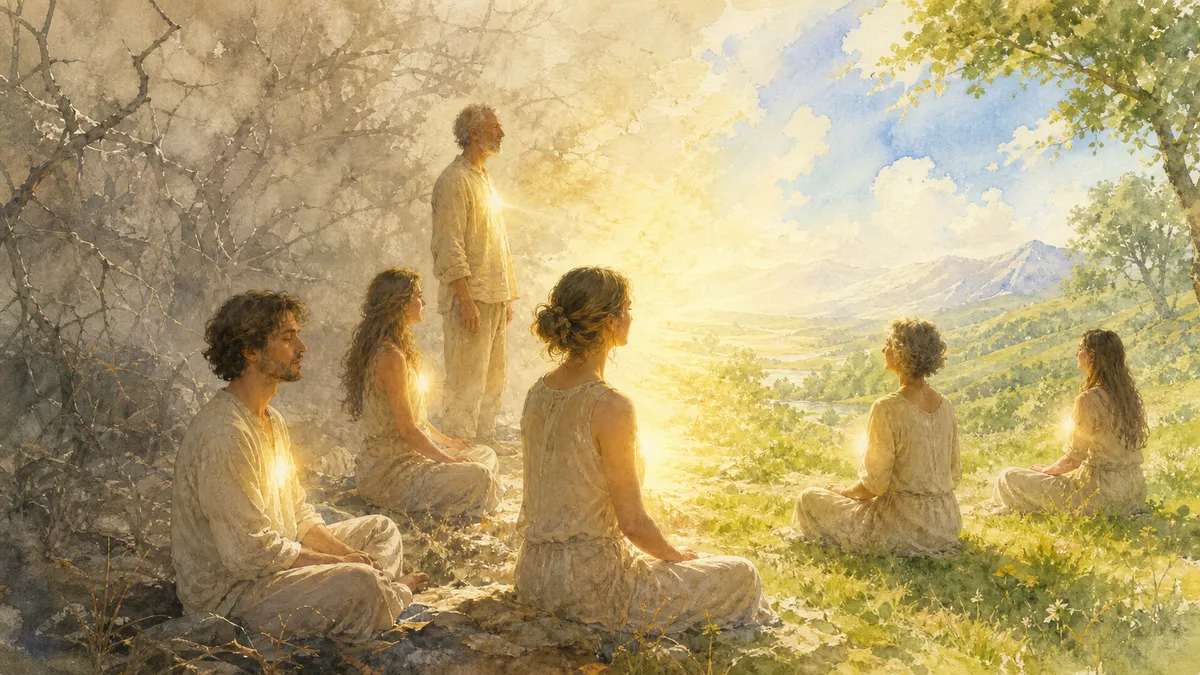
Ordinary samsaric beings are immersed in karma, the law of cause and effect; external objects are separate from them. Those who are on the other side of the “great transition” are free from karma; they are in a state of play, lila; they operate not within subjective-objective linear connections, but through the concepts of eternity, infinity, globality, multidimensionality, ambiguity, play, and paradox.
