


Commentary on the text “Kunjed Gyalpo. The Root Tantra”
“Other yogas do not truly know the great self-originated wisdom. For this reason, they advance along the path, attain levels of enlightenment, observe vows, and contemplate the view. Accordingly, their view and conduct are ineffective for awakening knowledge of the true state.”
Here, lower views are being discussed. This does not mean that other yogas are bad; rather, it is said in order to indicate their subordinate position. If we consider the traditional classification of tantra, then kriya, charya, and yoga are subordinate to anuttara tantra. One can say that all these yogas exist within us; they correspond to our dualistic states. When you hear the words that other yogas do not know this, it does not mean that other teachings are being denigrated in order to exalt one’s own teaching. Rather, the term “other yogas” points to higher and lower approaches to practice. There is by no means any contradiction between them. These higher and lower approaches indicate our states in practice. Therefore, when it is said that lower types of yoga are connected with cause and effect, while the highest yoga is not connected with them, this means that in the beginning we practice based on future enlightenment, on the desire for fruits and results, on the desire for experiences.
In the beginning we practice lower yoga. This is normal. However, all lower approaches are a view for beginners. The highest yoga, however, says that everything is already here, everything is realized at this very moment. There is nothing to strive for, nothing to attain; one simply needs to remove the false view. To move from lower types of yoga to higher ones means to open completely to this vision, to enter into this transcendent, incredible view. This paradoxical view is the instantaneous path of awakening. It is possible to enter such an incredible view only when we completely eliminate notions of ourselves as a subject and open ourselves to the Great Source.
“By contrast, the view and conduct of the natural state are originally based on the understanding that everything is a manifestation of the Supreme Source. And thus they do not presuppose traversing the path, attaining levels of Enlightenment, observing a vow, or contemplating the view.”
The path of the natural state is, one might say, the path without a path, or the path of the fruit, when the path and the fruit are fused. This cannot be understood until we attain some degree of enlightenment. Until we have gained an understanding of the fruit, there is, of course, a path that we must traverse. It would be foolish to deny that we need to traverse the path. And there is a fruit that will manifest. Otherwise, if we think that there is nothing more to manifest, we will remain further with our illusions. There are vows that, of course, must be observed. If we merely hear out of the corner of our ear that there is no vow that should be observed and think, “All right, then the kleshas can be allowed to manifest however they want,” the karmic result ripens and prana is lost. However, simultaneously with understanding the initial stages, one must still clarify the very depth and heart of the teaching, which says that there is no path and no fruit, no vow in this great state. It is not speaking about our conditioned state, but about that great one. This is like a leap into an abyss. At the same time, tantra says that that great state is not far away, not tomorrow, not after many retreats, but right here and now. We must make efforts and practice a great deal only because our dualistic mind is too constrained to make such a leap now. Nevertheless, we must try to do this again and again.
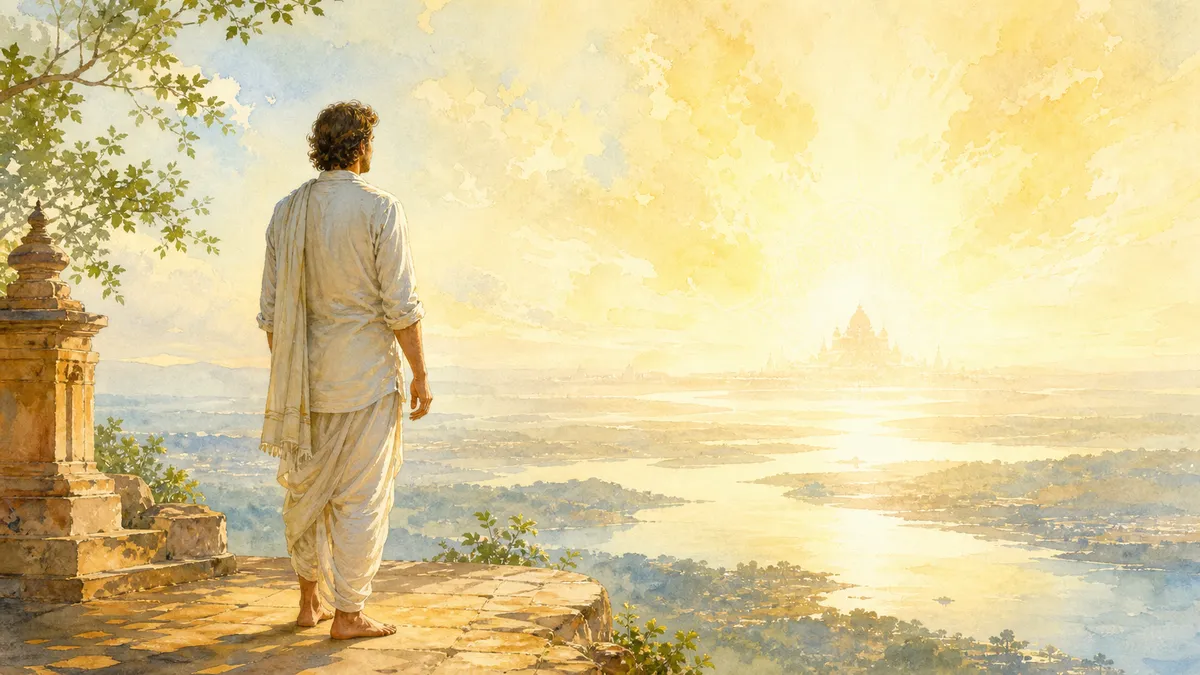
The Mind Pure and Perfect
“In reality, since everything arises from the Mind pure and perfect, the Mind pure and perfect does not need to travel a path in order to reach itself.”
We, of course, need to travel the path, but our essential Ground, the primordial “I,” does not need to travel the path, because it itself is the embodiment of all perfection.
“Since all levels of enlightenment are nothing other than the Mind pure and perfect, the Mind pure and perfect does not need to practice in order to attain itself.”
In one ocean swim tiny fish, boats, motorboats, ships, submarines, catamarans, windsurfers, huge passenger ships, aircraft carriers. In the same way, all living beings, from hell beings and pretas to gods, are immersed in this pure and perfect Mind; they have never even been separated from it. They have a concept of themselves, but these concepts are illusory, since they are only manifestations or the play of this pure and perfect Mind.
“Since the true meaning of all vows is the Mind, pure and perfect, the Mind, pure and perfect, does not need to observe itself. Since the true meaning of every contemplation is the Mind, pure and perfect, the Mind, pure and perfect, does not need to contemplate itself.”
This primordial Clear Light has not even a drop of bondage or effort, since it is self-perfect by virtue of its own nature. We, of course, need to contemplate; however, we should clarify what it is that we need to contemplate. When we direct our contemplation correctly, we understand that the object of our contemplation is primordially pure and perfect, that it is present effortlessly. When our contemplation also becomes completely natural and effortless, we will discover its identity with this Clear Light. Imagine that you are sitting not in this hall, but in the center of the Universe, in a vast empty space filled with light. From each of your pores, in this empty space, billions of Universes manifest in a single instant. This light continuously flows into you from below, from above, and from all sides; you abide in this indescribable, utterly transcendent state. If one imagines reality as it is, it is something like this. You abide not as a body, but as this boundless, infinite, inconceivable state of perfect Light. It is like a huge wall of the space of Light, or a huge volume of the space of Light—paradoxical, beyond thoughts and dimensions. This is not empty space; energy is ceaselessly playing within it. This space of Light manifests as five rainbow radiances which, endlessly intertwining, form numerous configurations and various worlds.
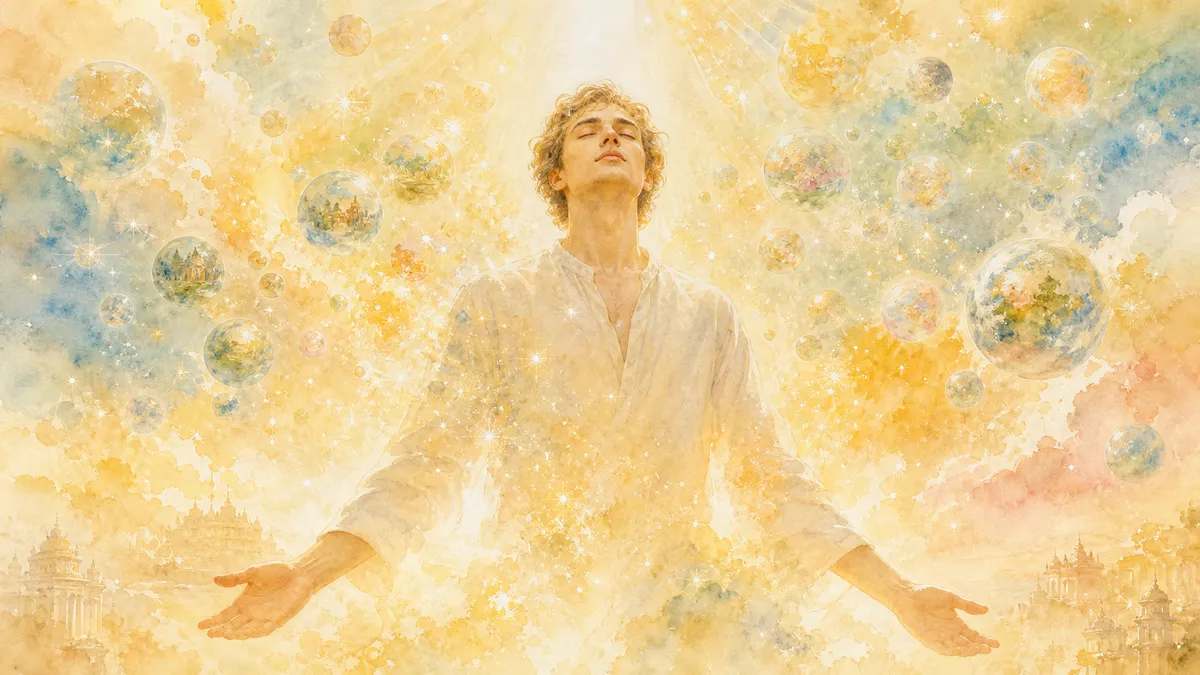
“Since the goal of all views is the Mind, pure and perfect, the Mind, pure and perfect, does not need to aim at itself. Such views and yogic conduct, knowing no effort, truly awaken the knowledge of Self-Born Wisdom. Such is the path to the deepest acquaintance with me, the Supreme Source, which lies beyond the experience of the causal vehicles.”
Gradual paths and vehicles based on causes and effects cannot grasp this great state. Although they speak much about it as the final point, nevertheless they never attain it, because a quantum leap must be made in order to reach it. One must go beyond the causal state if one plans to realize identity with the Supreme Source in a single lifetime.
The Foundation of the Foundations of All Phenomena
“Listen, O Great One! The very essence of the Mind, pure and perfect, is the foundation of the foundations of all phenomena.”
Listen very attentively. You can experience awakening simply while listening. Some may experience awakening from actual sleep in the literal sense, simply by listening. That is good too, but I am speaking of another awakening.
“Unborn, being completely pure, it knows no obstacles. Transcendent to the generation of the path, it knows no deviations. Primordially self-perfect, it need not be sought. However, when the one Mind, pure and perfect, the primordial basis of all that exists, is seen as multiplicity, deviations and obstacles arise.”
The spiritual path is difficult. One can say that many barriers, enticements, obstacles, and temptations arise on the spiritual path. No one should forget this. You must all know that a monastic kurta costs a great deal, and the attainment of enlightenment costs even more. Only one who purifies all of their subtle bodies will attain enlightenment. In the subtle bodies (etheric, astral, causal) there exist karmas; this is a fact. Until the required degree of purity of these subtle bodies has been reached, it is impossible to come into contact with the Clear Light, and therefore various barriers arise. And a yogin on the path must, like a lion, overcome these barriers and move forward.

The Deviation of Clarity
Many deviations also arise. One of the deviations among yogins may be clarity. What is clarity? For example, a monk practices mindfulness and contemplation. His mind becomes so complex, refined, and elaborate that he cannot look at a problem simply. He has very great clarity, so he can look at a problem simultaneously from seven different points of view, but he cannot accept one of them and do what is necessary. If a person seized by clarity is told that a well needs to be dug, he will think: “I need to go and order a shovel with a mahogany handle and an alloy-steel blade. A geodetic survey of the area must be carried out and exploratory work performed.” He will draw up tables for you with indicators of soil composition and other data, and will investigate every possible method. But an ordinary worker will do everything much more simply: he will just dig the well in one day without all these refinements. The goal is to dig a well, and clarity is merely a side effect. However, when subtle states arise, a monk unfamiliar with this temptation tends to grasp at his clarity. He thinks it is wisdom, but from the point of view of awakening, it is refined stupidity. Therefore we say that one must look without evaluations and judgments, one must leave everything as it is, one must simplify one’s view.
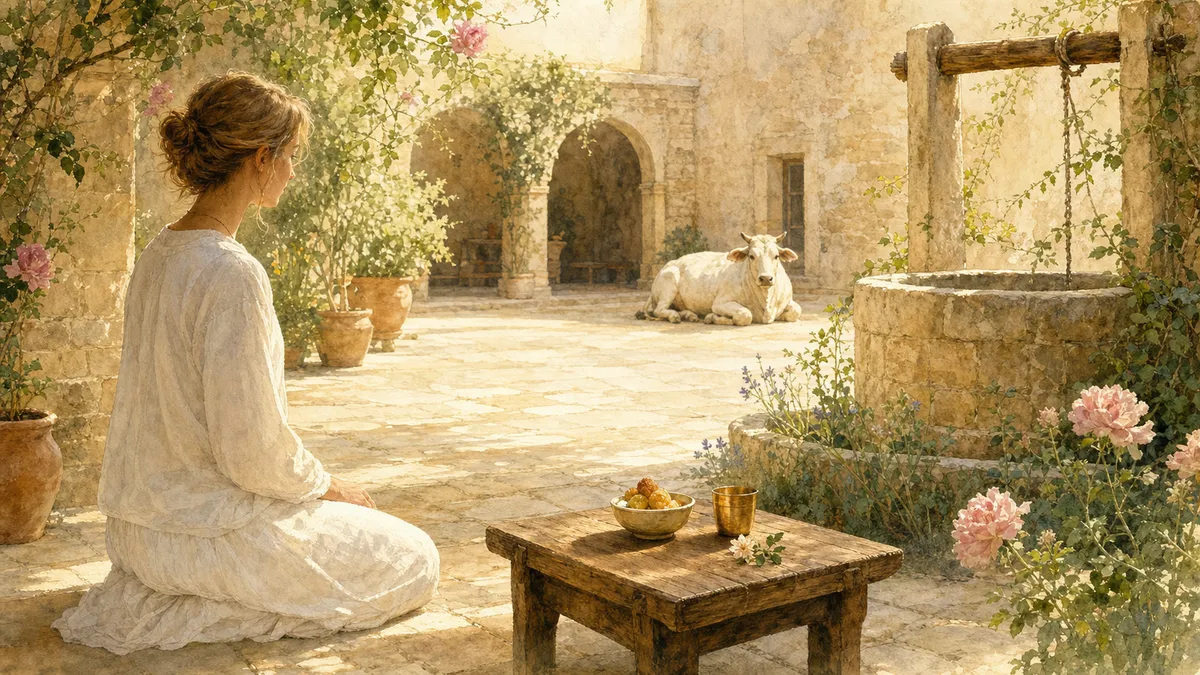
To simplify does not mean to make primitive. It means to bring it closer to the Clear Light; it means, by accepting things without mental complexities, to perceive them in the absolute aspect, because true contemplation of the Clear Light is very simple in the sense that there are no comments of our own at all. Therefore it is said: “I am so simple that it is hard to believe. I am so close that it seems unimaginably far away.” This means that we look at the world very simply. We project nothing onto it. Food, prasad, a well, or a cow—all these are wondrous, incomprehensible things. We understand the full incomprehensibility of this and do not even try to comment on or explain it in any way, knowing that it is useless. We simply marvel with reverence and delight in everything we perceive. When we live in this way, we are close to true contemplation.
Deviations of Various Paths
“To traverse a path in order to attain what cannot be attained by traversing is a deviation.”
Here it speaks of the many deviations that arise in practice. However, all obstacles and all deviations are nullified when we realize this closeness to the Clear Light, since such contemplation is the best antidote and the best panacea for all deviations.
“The striving to examine rationally that which cannot become an object of thought is an obstacle to understanding. Although in the natural state as it is everything is one, bodhisattvas believe that by practicing the cause, the ten paramitas, they will subsequently obtain the fruit—the ten bhumis. Their deviations and obstacles last for three kalpas.
Practitioners of kriya-tantra venerate the outer world, the inner world, and thoughts as the three purities, and apply enlightening powers and miraculous actions. But despite the fact that they fully observe the vows and rules, their deviations and obstacles last for another seven lives.
Practitioners of charya-tantra, for whom conduct is the cause and view is the fruit, see differences between view and conduct. Thus they deviate from nonduality, and their obstacles last for another three lives.
Practitioners of yoga-tantra, who accept and reject in relation to the single primordial basis, do not see unity but see duality. Thus their deviations and obstacles last until they free themselves from acceptance and rejection.
Practitioners of maha-yoga, contemplating the single self-born state as if it had three characteristics, deviate from the state beyond effort.”
Here the lower approaches of the various levels of tantras are analyzed, based on external purification, transformation, visualization, working with winds, causes and effects. It is said that such yogins do not manage to grasp the heart of Being from the very beginning and immediately enter the transcendent state. Of course, the best among them do achieve this; at the end of their practice they move on to a higher view.
“Practitioners of anu-yoga, not understanding that the natural state as it is is the foundation of all the phenomena of the animate and inanimate Universe, see space and wisdom as cause and effect. Since they exaggerate the existence of the cause and, conversely, underestimate the existence of the effect, their obstacles remain until certainty beyond affirmation and negation is attained.
Thus, there are six ways in all by which they seek to attain a fruit they supposedly do not possess: relying on the two truths, applying the three purities, separating view and conduct, applying conduct that requires acceptance and rejection, contemplating the three stages, and considering space and wisdom as cause and effect.
The Mind, pure and perfect, is like space. In the reality of the nature of Mind, which is like space, there is no view to contemplate, no vow to observe, no capacity for spiritual action to strive for, no wisdom to develop, no levels of enlightenment to master, and no path to traverse. There is none of that subtle thing, no duality to reunite, and no direct teaching whatsoever apart from the Mind, pure and perfect.”
The Danger of Misunderstanding
When you can analyze the initial stages of practice or view, only then can you also appreciate the greatness of your own path. Until then, you may not have such an understanding. Such a powerful view can easily mislead—for example, direct one toward nihilism. You must always remember that such a danger exists. Then the teaching, instead of liberating and saving, becomes a mara. In one of the texts I even found the concept of the “mara of the teaching.” When a great view falls into an ungreat mind, the mind misunderstands it. If we hear that there is no effort, no vow, no path to be traversed, we may think: “Oh, I really like this! After all, it is clearly stated that this is the highest path.” While yogis of the lower vehicles enter samadhi, with such an approach we will sit on the sofa and think: “There is no effort and no path. I am the highest yogin,” while remaining the most ordinary people.

It should be understood that such great statements are made in the hope of our great clarity. They presume that all the lower paths have already been traversed and realized by us. They imply great maturity in maintaining contemplation and the ability to abide at such a level of contemplation that it has truly merged with life—that is, it continues even at night, when samadhi is not interrupted (sahaja), and therefore no effort is needed to perform it.
How should we perceive such lines? We need to consider that these lines concern the most subtle essential part of our “I,” but they do not concern the external.
The View of the Great Perfection
“Since the Mind, pure and perfect, is beyond affirmation and negation, no secret teaching can compare with it. Such is the view of the great perfection—the Mind, pure and perfect.”
No secret teaching can compare with this primordial state. As soon as you discover it, you understand that it is the most hidden, the secret of secrets. The tantras say that if you have not stopped “drooling” when you hear that there are teachings that are more hidden, then it means that you have failed to understand the standpoint of this transconceptual state. If there are any hidden teachings, then they are precisely this Clear Light itself. Here teaching as such ceases to be teaching. Rather, we no longer need methods and teaching, but need clarification and understanding. It happens that we hear the same words for years, but in the fifteenth year we suddenly understand what was being spoken of, what depth stood behind these lines. When we clarify the primordial natural state, it suddenly becomes clear to us what the saints of different traditions were talking about. All uncertainties about teachings, practices, and contemplation disappear and are seen clearly, as if in the palm of one’s hand.
