The Path of King Alarka: From Attachment to Liberation
21.06.2026
0 мин. чтения
0
Share
copy
search
add
share
Commentary on the text “The Story of King Alarka’s Enlightenment”
This is the story of King Alarka’s enlightenment, connected with Dattatreya.
“It is said that even one who lives entangled in desires one day becomes free from desires. There are many such examples in the history of Lord Dattatreya. What has been said means that the Sadguru is an ocean of compassion. The methods and means that the Sadguru uses to transform his disciples exceed human imagination. And in Alarka’s case, the grace of the Sadguru acted in a strange way. Meanwhile, Madalasa’s second son, Subahu, once returned to the place of his birth during his wanderings.”
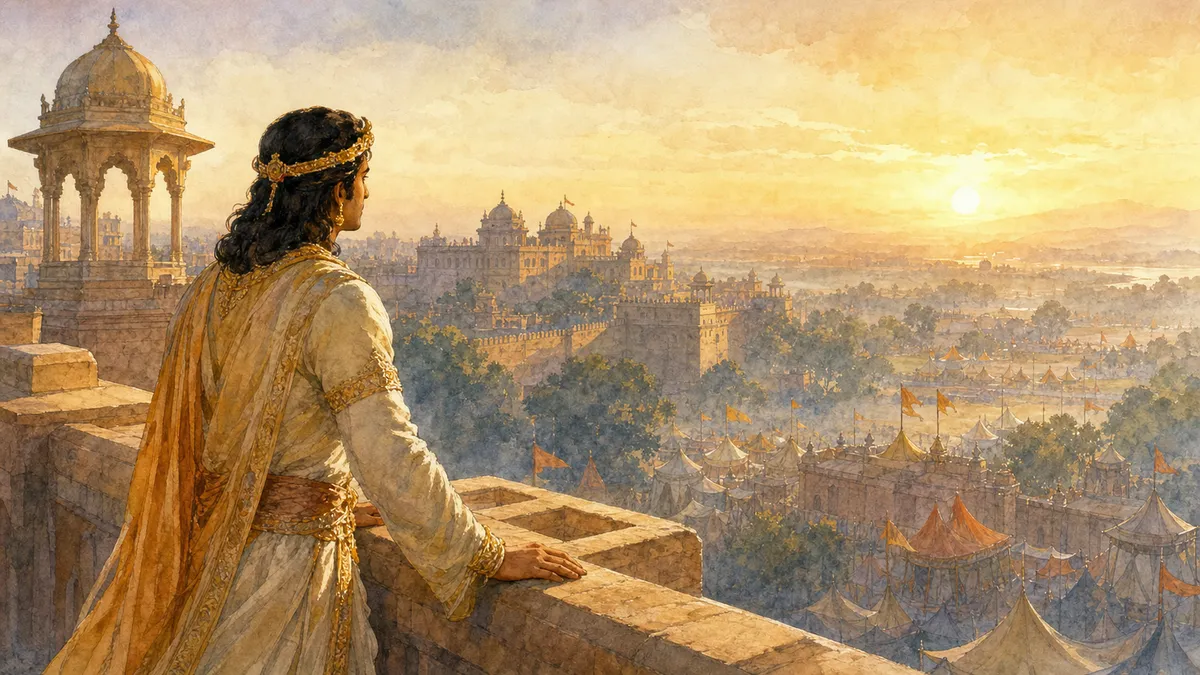
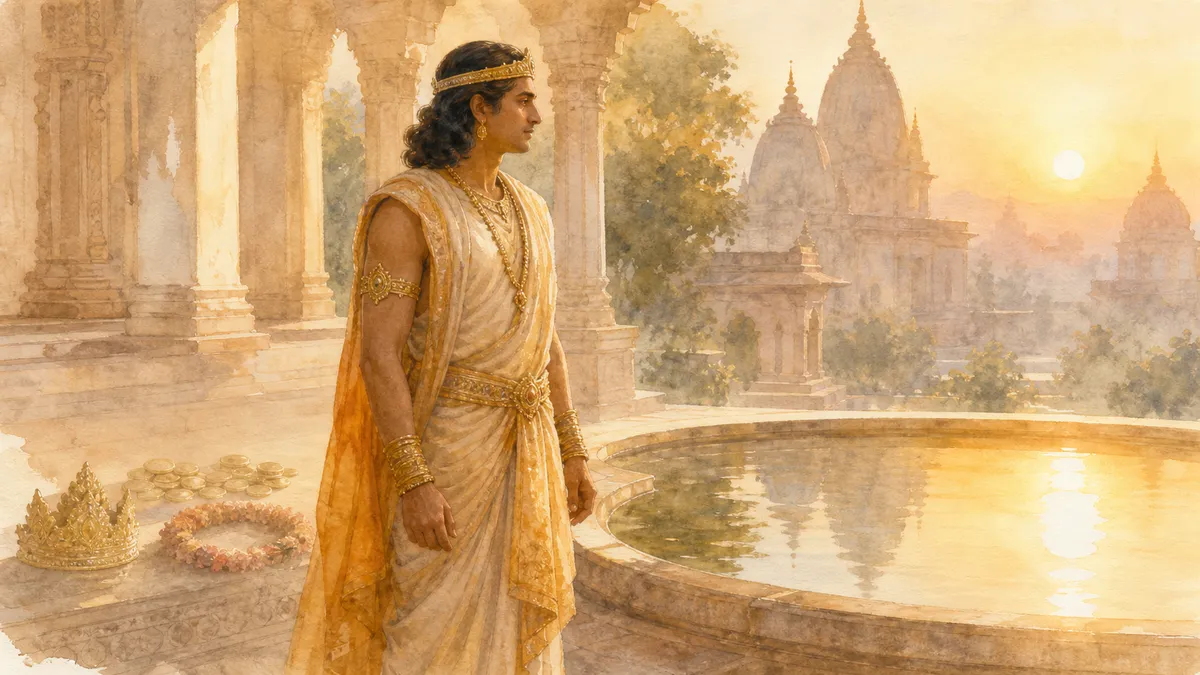
There were two sons—Alarka and Subahu. Subahu became an ascetic, while the second son ruled the kingdom and enjoyed all the delights of royal life thanks to Dattatreya’s blessing. His mother gave him a ring, but told him to open this ring only in the most desperate situations and not to touch it until then.
Subahu’s Return and the Beginning of the Conflict
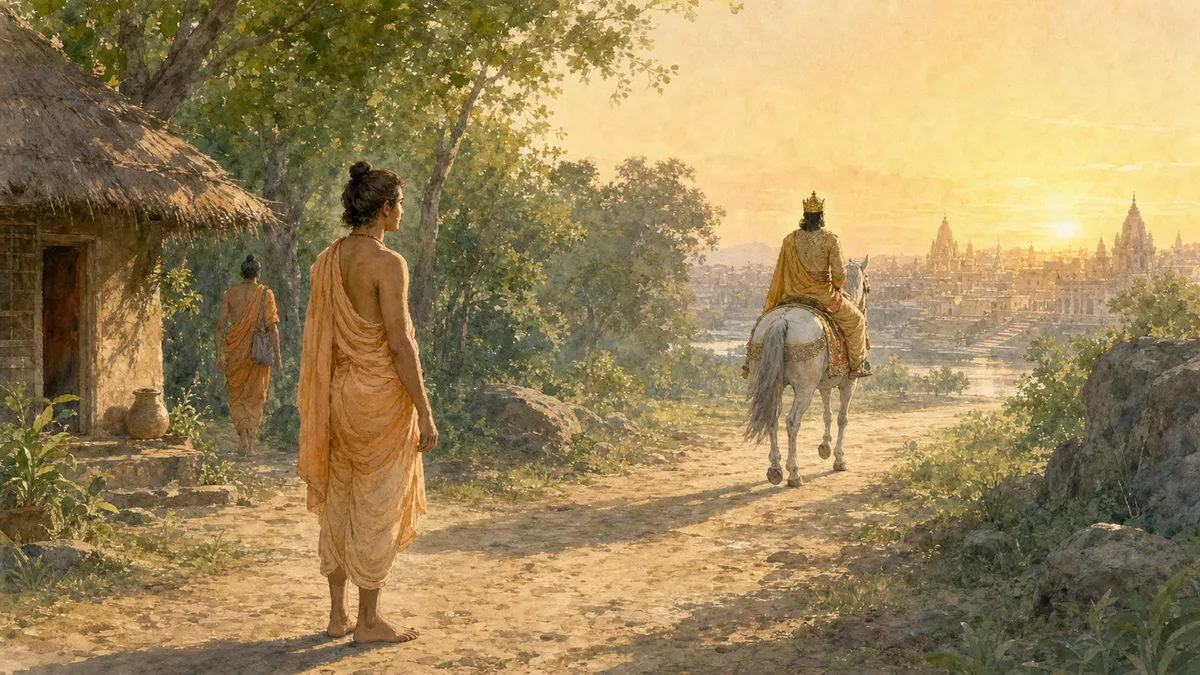
“He learned that his younger brother Alarka was now ruling the country. Then he felt an unusual agitation; he reflected on it for a long time in solitude. Having decided what to do, he went to Kashi. Although he had practiced detachment for a long time, some qualities of a king still remained in him. On the way, he acquired some beautiful garments and ornaments. When he reached the palace of the king of Kashi, he did not remove his insignia. The ruler of Kashi was known for his just rule and benevolence, and always devotedly served Lord Vishveshvara. This was a time of enmity between Alarka and the ruler of Kashi, yet both nevertheless coexisted without war. Following the dharma of the kshatriyas, the king of Kashi received Subahu, but upon learning that his guest was Alarka’s brother, he found himself faced with a choice. Subahu told his story: ‘Alarka is my younger brother. It is true that I left my home to live as an ascetic. But when I returned, not only did he fail to recognize me and offer me my share of the kingdom; on the contrary, disregarding dharma, he treated me like a beggar.’ The king of Kashi asked: ‘Why do you think badly of your brother? Perhaps he truly did not recognize you.’ But Subahu replied to him: ‘O king, I know how the secret service works in our kingdom. I do not believe that my brother failed to recognize me. Attachment to the kingdom has blinded him.’”
Subahu became an ascetic, yet he was outraged that he had been treated improperly, and he continued to think about the kingdom. He began to reproach his brother, saying that attachment to the kingdom had blinded him. But in reality he himself was blinded: being an ascetic, he could not get all of this out of his head.
This often happens with practitioners. Being monks, they cannot in any way get out of their heads everything they have left behind. Then they think that something has blinded that person, or something has blinded another person; yet if anyone was blinding anyone, it was their own karmic vision.
Therefore, when we become monks, we still have to confirm our choice many times. Again and again you will sometimes even be harshly confronted with a choice; again and again you will have to choose, confirming your choice, because you will see that the choice you once made is a choice that surpasses all understanding, even if in the beginning you made it half-unconsciously.
Escalation of the Conflict and the Siege
“I ask for refuge with you; you may act as you wish. After consulting with his advisers, the king sent a messenger to Alarka with the following message: ‘Sir, after wandering through your country, your brother has been here for some time as my guest. In his absence, you governed the kingdom as his representative. Now, since he has returned, it is proper that you come here and invite him to take possession of the state.’”
Alarka was surprised and thought: “It seems the king of Kashi has had a hand in this. He gives the impression of a righteous man, yet vice is hidden within him.” He sent a reply: “King of Kashi, let my elder brother come and ask me directly. This is, after all, a family matter. If you want to show your power, we are ready for it.”
The ruler of Kashi called Subahu and said: “It seems that Alarka misunderstands my involvement and thinks that I am interested in his kingdom. In fact, people think so too. What he says is entirely true. I will send you with due honors and an escort; we shall see what happens afterward.”
Subahu said, “What is there to see? He will kill me and send you the lifeless bodies of your soldiers. Then you will not be able to avoid war. When in this world there are people who would kill even their own parents for the sake of a kingdom, it may also happen that someone kills his own brother. I came to you, believing that you are a powerful ruler and an adherent of truth and dharma, and sought refuge for this reason. If he does not kill me, may I ask him to return to me what belongs to me? This will humiliate me, and I cannot bear the thought of it. If you help me, I will be able to conquer the kingdom by force. Otherwise, I will go wandering again.”
Once again, the ruler of Kashi faced a choice; moreover, what Subahu had said was understandable from a worldly point of view. War now seemed inevitable. Through many arguments and by other means, he won the support of many princes who were under Alarka’s rule. Alarka tried in many ways to stop this and prevent the war, but fate was not kind to him: the king of Kashi laid siege to the capital with his army.
During the battles, Alarka lost a huge part of his army. The treasury was empty, and there were no means for a prolonged war. He kept the city gates closed and fought for an entire year. The attackers regularly received provisions from other places. The city, meanwhile, suffered from a shortage of food and grain; famine reigned, and the subjects were on the verge of revolt. By now, his defeat was near. In all the years of his rule there had never been such a situation. Famine was killing his people, and soon he too might be destroyed by it. Filled with despair, he felt that he would rather be killed in battle than remain in this hopeless situation.
The Mother’s Message and the Foundations of the Spiritual Path
Suddenly he remembered the ring blessed by his mother. He immediately performed his ablutions and, after a ceremony with the brahmins, removed the golden plate of the ring, where the following words appeared:
“Renounce attachment, cast it aside. If you do not have the strength to cast it aside, constantly seek the company of wise people. Association with the wise is the cure for all illnesses and attachments. Abandon desire, cast it aside. If it is impossible to renounce desire, let only one remain—the desire for liberation. The desire for liberation is the best cure for all desires.”
The root of all instructions is: renounce attachments. It is said: “Renounce, renounce, let go of what does not belong to you, let it go.” We are like a person convulsively clinging to the body, the mind, and the ego. This convulsive clinging has arisen because of the long-standing tendency to consider ourselves to be the mind and the body.
The saints say: “You can open your mind wide right now. You can soar, be boundless in the space of freedom. Stop convulsively clinging to what you are not.” Renunciation does not mean a negative attitude toward anything; rather, it means leaving things be, emptying oneself. When we convulsively cling to our five skandhas, the mind, the body, the will, the ego, then there is no empty space within us; therefore, the state that arises as a result of leaving everything as it is cannot be recognized by us as our own. When we let go of this clinging, reality itself appears before us in its primordial form.
Someone may think: “So, one must cast everything aside, deny everything, renounce this and that.” That is so; however, one should understand how to cast aside and renounce correctly. This does not mean generating negativity toward the body or thoughts. Rather, by freeing oneself from clinging to everything, one should find within oneself the ability to leave everything as it is, to be empty and to abide in contemplation while being so empty.
The Example of Swami Dayananda Saraswati
In India there was the famous Swami Dayananda Saraswati, the founder of the Hindu society Arya Samaj. He received a certain realization from his Guru. Then he went from village to village, explaining to the brahmins that since the Absolute has no form or qualities, all mantras, rituals, practices connected with form, and images of deities should be cast aside—all of this obscures the true essence of Brahman; one must renounce them, because all of it is idolatry, characteristic of people of low understanding.
A true brahman or yogin must learn to perceive nirguna Brahman (the qualityless Absolute), while brahmans, by reciting mantras or performing various rituals, only conceal the true essence of non-dual Brahman. He was a very powerful logician; no one could withstand his arguments and immense energy. When he came to a village, all the people would flee in terror. They would say: “Swami Dayananda is coming with his disciples; none of the brahmins can defeat him. If they do not defeat him, he said they will smash all the statues and remove all the murti images from the temple,” since he teaches that one must renounce attachment to any form and any name in order to realize nirguna Brahman. All the brahmans also fled in terror when Dayananda passed from one village to another, explaining the principle of non-dual Brahman.
Dattatreya has these words:
“O Brahman, worshiping You, I considered You separate from myself, and therefore I obscured Your true essence. Speaking of Your qualities, I gave You a form in my mind, obscuring Your true essence.”
Swami Dayananda Saraswati’s approach was a negative one, or an approach of nihilism, of rejection. He continued it until he met the siddha Lahiri Mahasaya, who explained to him a higher understanding. He told him: “It is not a matter of rejection. That is only one side. Learn neither to accept nor to reject, but simply leave it without judgments and reasoning. Do not attach significance to things, and then they will cease to exist for you in the former way.”
In the same way, we generate neither clinging to reality nor negativism toward it; we generate the proper capacity for contemplation. However, this proper capacity for contemplation can arise only when we are able to let go and stop clinging to anything within ourselves or outside, and be flexible enough to accept any course of development of the situation, remain in awareness, and not fall into confusion.
Meeting with Dattatreya
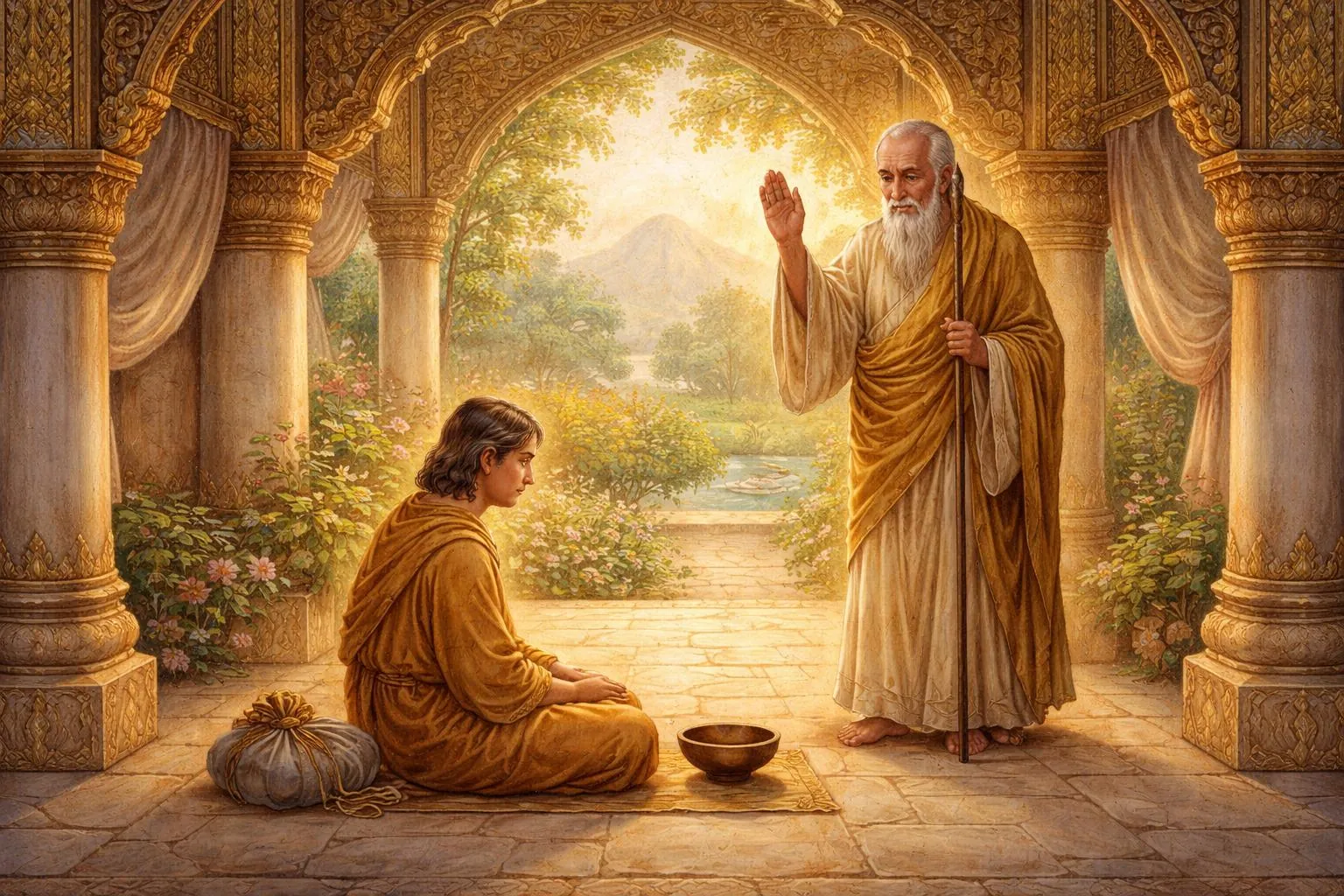
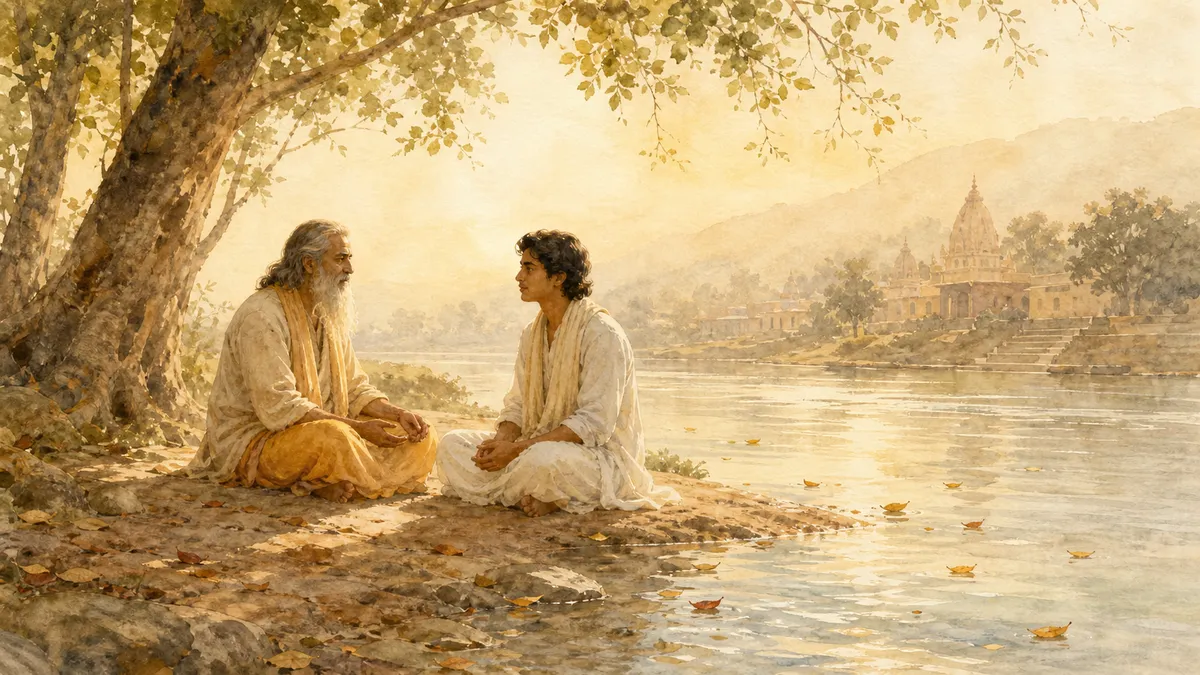
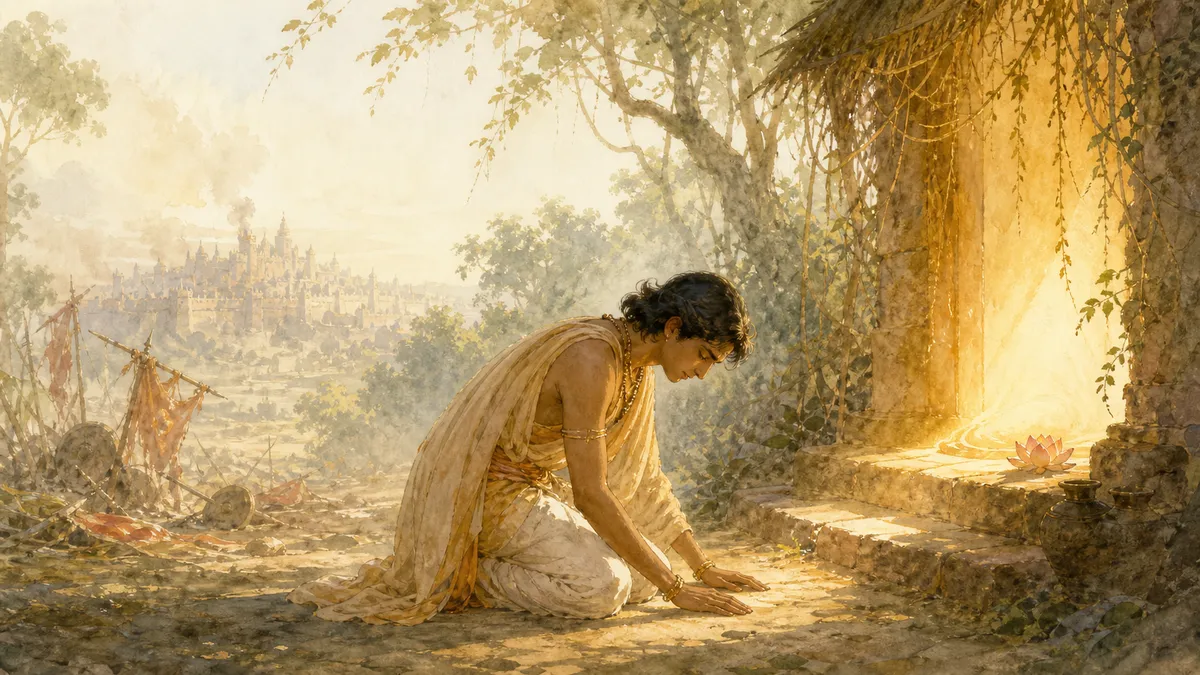
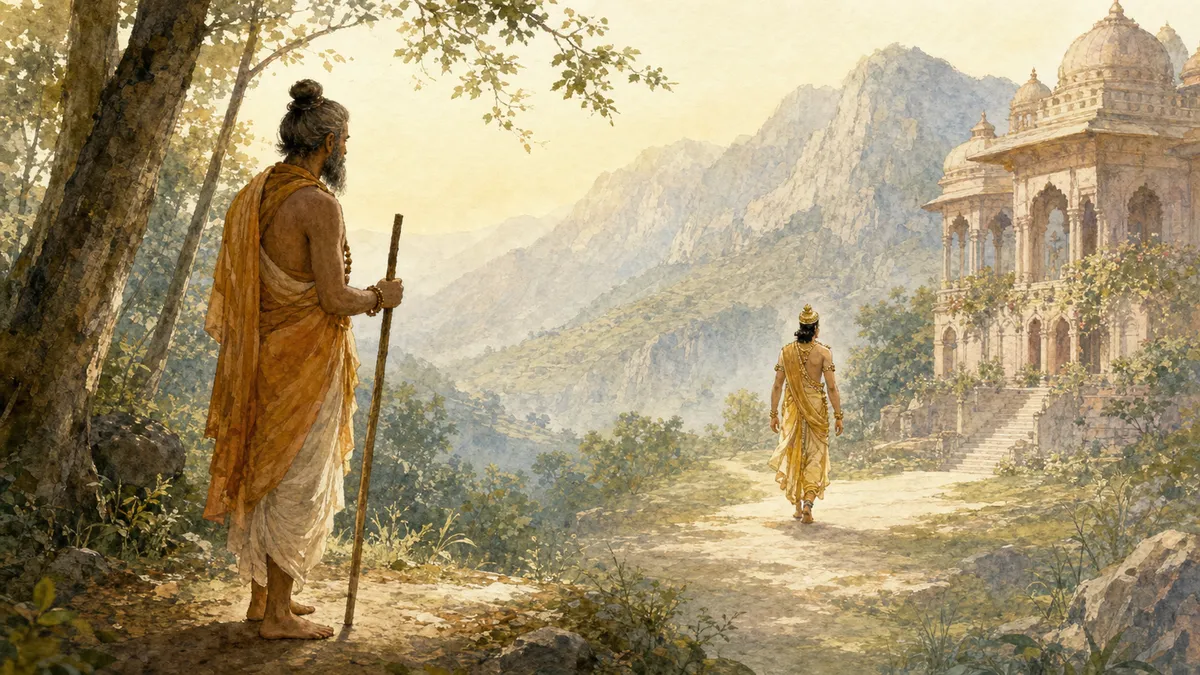
“These words were not merely a message; they were filled with power. As he read the message again and again, his mind underwent a strange change. The more he reflected on the meaning of what was written on the ring, the greater the joy he felt. Ultimately all other thoughts disappeared, merging into one fixed, single thought. Now he was convinced that true realization is attainable only through the desire for liberation and that this can be achieved only in the company of a sage. But who is this mahatma? Alarka reflected on his mother’s words. She often said that Lord Dattatreya, who dwells in the Sahyadri hills, is a great soul and Vasudeva Himself. After his mother went into the forest, he had not thought of Him at all. Now, after all these years, he remembered Him again, and his face lit up, and his heart became light. His mind, which by nature was firm, turned to Lord Dattatreya. Immediately he went out through the secret tunnel of the fortress and reached the Sahyadri hills. When he entered the ashram, Lord Datta was sitting, waiting for Alarka, completely alone, and thinking: “He is the son of Madalasa and needs no tests. There is no need to subject him to further trials. He has absorbed the nectar of wisdom from his great, chaste mother, and he himself is chaste.” In great distress, Alarka fell at the sacred feet of Lord Dattatreya and said: “Lord, I seek refuge in You; please dispel my suffering and grant me Your grace.”
The Lord remained silent. Overwhelmed with sorrow, Alarka held on to the Lord’s feet and wept bitterly, begging again and again for His grace. The Lord smiled compassionately and said: “Rise, my dear Alarka, rise; I will destroy your suffering right now!” Alarka rose with folded hands and looked at the Lord, whose gaze seemed to be telling him something. “Alarka, tell me, why does this suffering arise in you? To whom does this suffering belong? Ask yourself. Think well and tell me.”
Self-Inquiry and Alarka’s Enlightenment
The Lord’s words deeply moved him and made him close his eyes.
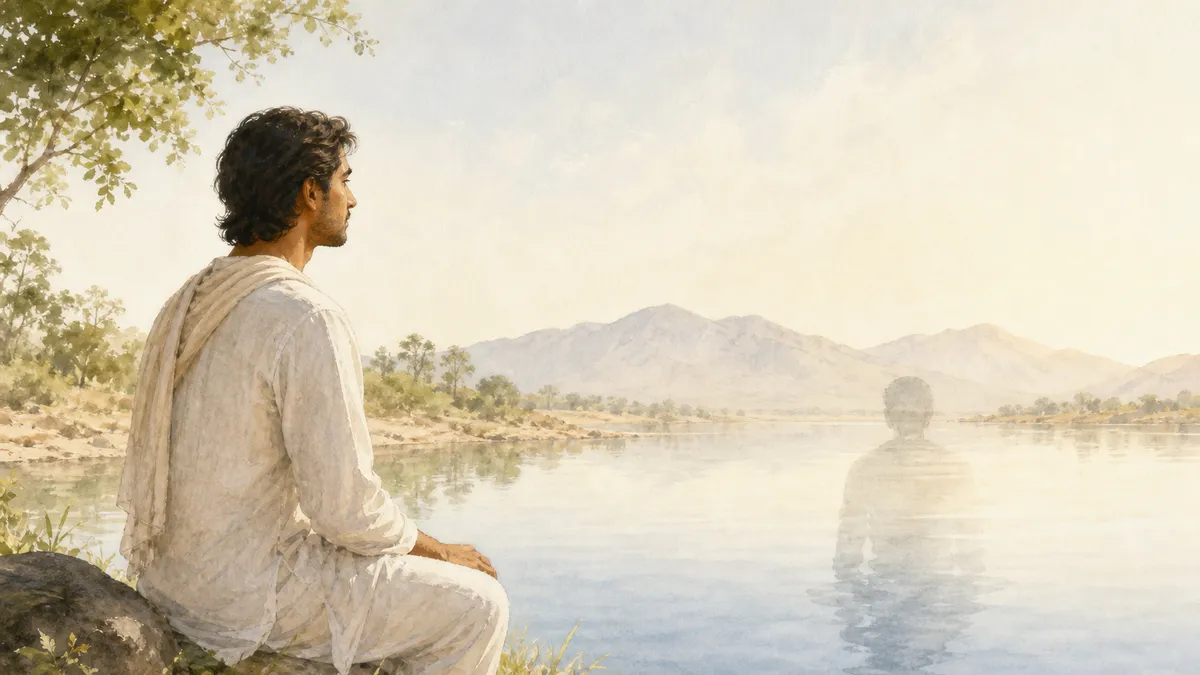
“Yes, who am I? Who is speaking? I, the body? How can inanimate matter say ‘I’? What, then, remains? There are five elements that make up the body. Do they say ‘I’? No. I am neither earth, nor space, nor fire, nor water, nor air; nor can I be prana, the life force; I am neither any one of them nor their combination. But for some reason I thought so until this moment. I believed that I was what I am not. That is why joy and sorrow, which are not truly mine, appear in me. What is this body? It consists of the five elements; it grows when food is given, otherwise it decays; at times it rejoices, at times it grieves. What do I lose or gain through these elements? Existing as distinct from them, am I not the dispassionate witness of the changes taking place in this body? I do not grow, I do not decline, I do not die, I am not born. There is no good or evil. There is no ‘mine’. In me there is neither rise nor fall, nor attachment; there is no movement, since I am eternal. Then where is sorrow? I am not this gross body at all. I am aware of the arising and development of the subtle body, containing the seventeen principles: the five organs of perception, the five organs of action, the five vital energies, the mind, and the ego. Then where is my sorrow? If one looks closely, joy and sorrow are only in the mind. That means they belong to the mind; then who am I? I am not the mind, not the intellect, nor am I the ego. If this is so, where is sorrow in me? I am distinct and separate from all of this. When I am none of this, how can wife and children be mine? Then they are not mine. The army and treasures are not mine. What connection, then, can there be between them and me? I have no place, no home, no wealth, no loss, no sorrow, no friend, and no enemy. I exist alone, I and only I. I am like the space filling a pot, or the space filling various forms, such as Alarka, the ruler of Kashi, as Subahu, as a horse, as a pig, as a dog, earth, water, and as millions of other beings and objects in the Universe. I have been deluded all these days; there is nothing like sorrow.”
Such thoughts flowed in his mind like the Ganges. All the sacred texts he had studied and the discussions he had listened to now came together in his mind. Having arrived at this conclusion, his mind now became firm and calm. Alarka opened his eyes, bowed to the sacred feet of the Lord, and said:
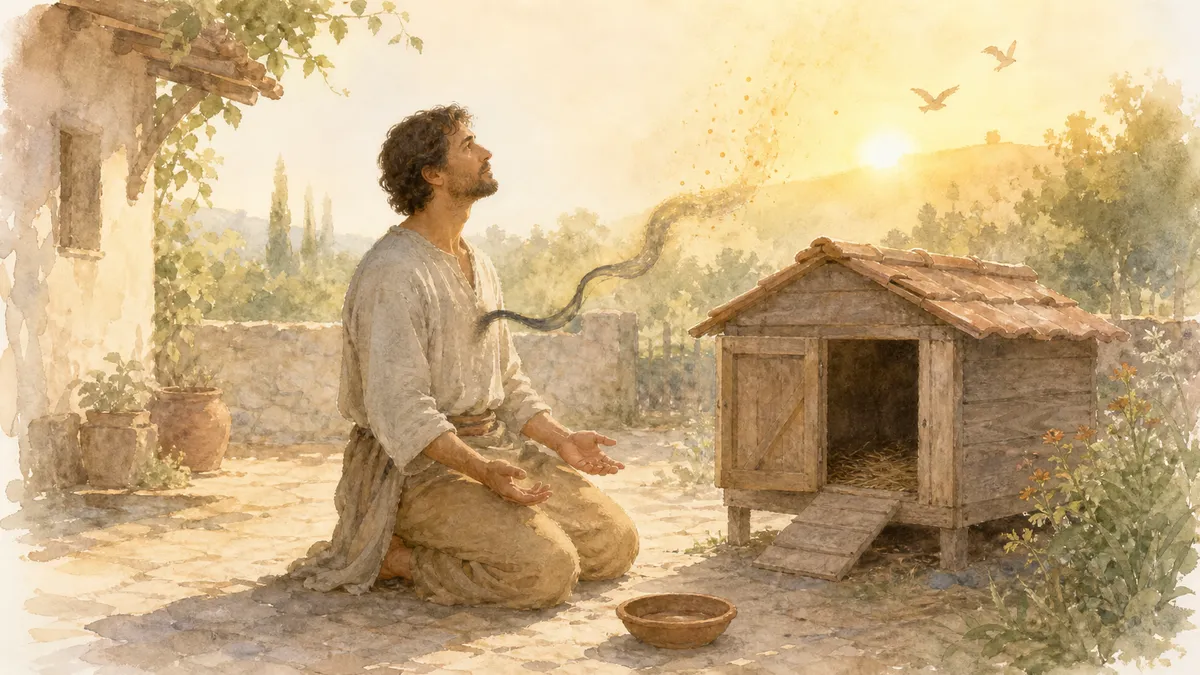
“My Lord, blinded by my ego, I did not see the truth and therefore was drowning in the sea of sorrow. By Your grace, reflection began. Now I have understood that this sorrow never belonged to me. When a cat bit through the neck of my beloved chicken, I felt misery, and when the cat bit off the head of a rat, I felt nothing; now I understand that it was my attachment that made me miserable, causing sorrow. When there is no attachment, then there is no sorrow. Now I clearly understand that sorrow exists because of ownership. Where there is no ownership, there can be no sorrow. When I attain a state beyond this, there will be neither sorrow nor happiness.”
The Teaching on Subtle Ownership
Subtle-material ownership is the “I,” attachment to personal experience, to mystical powers, to beautiful experiences associated with bliss or clarity. In general, it is outwardly easy to give up the material; each of you understands this. However, within us, when we meditate, much subtle ownership is discovered: concepts, ideas, ego, will, personal experience. The last ownership claimed by our false “I” is emptiness, the four formless states.
When we renounce all ownership, including inwardly, a genuine, complete state of non-attachment arises. The true state of realization is a state of non-possession or non-ownership; it cannot be taken away. If there is a realization that can be created, then this means it is temporary, transient; therefore it can also disappear. And so attachment to the fruits of such realization is something temporary, and when it vanishes, suffering arises again.
The Yoga of Non-Meditation and True Realization
If your meditation is conditioned by certain circumstances, by the state of prana, this meditation arises from conditions, which means it is temporary, and when the conditions disappear, the state of prana declines, the conditions are destroyed, then your meditative state will also disappear. Therefore we say that the path of contemplation is the yoga of non-meditation. The yoga of non-meditation means abiding in the subtlest contemplative presence, which does not depend on the formal rules of meditation practice. Then suddenly we see that we have no possessions, we have nothing to protect, and our meditation continues uninterruptedly.
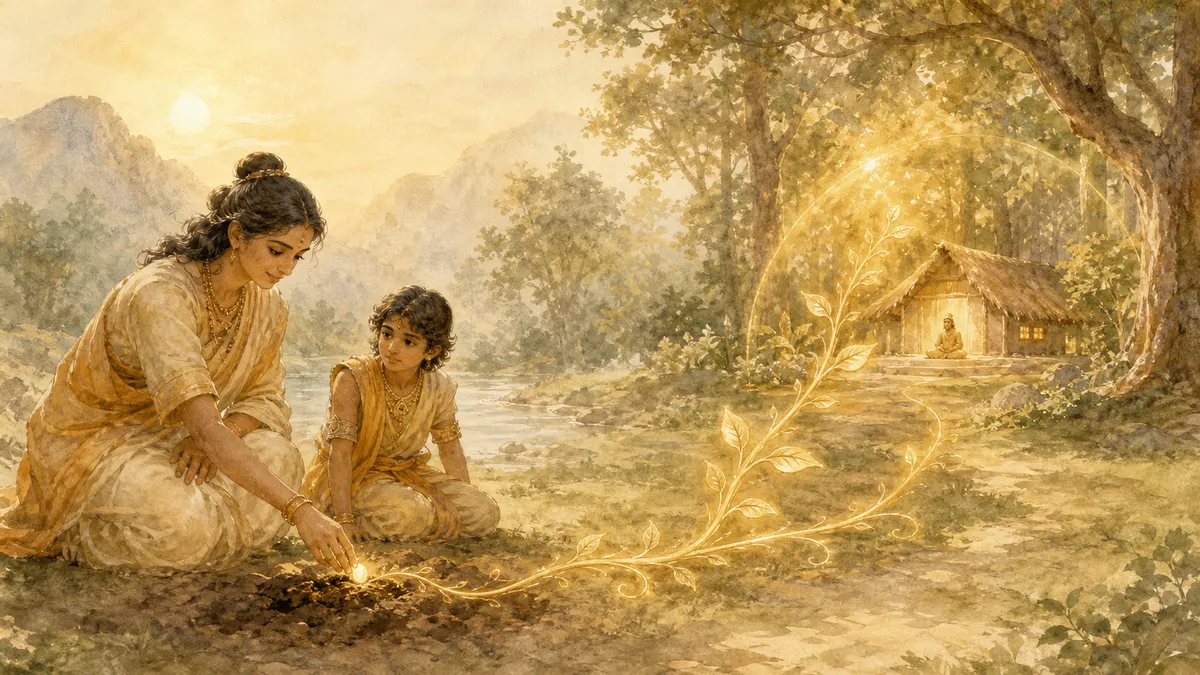
“Hearing these words of Alarka, Lord Dattatreya smiled at him and said: “Alarka, you have understood the truth that ‘mine’ means sorrow, and ‘not mine’ means happiness. You have seen through maya and destroyed it. Alarka, do you see how strange this tree of samsara is? Here the heart is the field, ignorance is the root, the ego is the young sapling growing upon it. Then attachment grows like a tree. House and possessions are the large branches. Wife, children, and wealth are its leaves. Merit and demerit are the flowers, joy and sorrow are the fruits. Ignorance is the gardener. Thus the tree grows so large that in the end it becomes an obstacle on the path to liberation. False knowledge is its shadow, which conceals reality. The ignorant person is deceived by it, wanders in the field of the senses, and seeks its shadow, believing it to be pleasant. How can such a person ever attain true happiness? Alarka, do you know what aspirants seeking constant bliss should do? They will take the axe of knowledge and sharpen it on the stone called noble society. Then they will cut down the tree of attachment at its very root. Only then will the path leading to the ultimate goal become visible, and they will be able to reach the quiet and peaceful grove called Brahman. There they will attain eternal bliss, from which there is no return. O king, you have seen that you are not this gross body, not the ‘I’. In the same way, neither you nor I are the subtle body. Then you intuitively realized the inner witness in the body, which is the Atman dwelling in the body like a fish in water. Have you understood all this?”
Alarka said with humility: “My Lord, by your grace I am able to obtain knowledge and discrimination. But since my mind is still obscured by desires, the knowledge I have acquired is not yet firmly rooted in me. I cannot realize the state of unity with the attributeless supreme Brahman. To attain it, the limitations caused by nature must be removed, and I do not know how to do this. Please teach me the means that prevent rebirths and lead to the attributeless Brahman.”
Alarka received direct introduction from Dattatreya through the explanations of jnana yoga. However, after direct introduction and the elimination of errors, nididhyasana follows—continuous maintenance. But Alarka said: “Although I have received this explanation and direct introduction, I still cannot maintain it continuously, because there are too many obscuring karmas within me. I need a method that would help me get rid of these obscuring karmas.”
The Teaching on Distraction and Discrimination
“Having heard this, Lord Dattatreya explained: “Alarka, you have understood nature and its ruler, Prakriti and Purusha. Nature is united with the supreme Brahman. This is called liberation. The limitation created by ignorance can be overcome by mastering steady discrimination. Now listen to how non-discrimination creates limitation. Through non-discrimination, possessiveness grows, and from possessiveness comes attachment; from attachment comes sorrow.”
Here the term “non-discrimination” is better translated as “distraction.” The second stage, when, having received direct introduction, the teacher explains to him how not to be distracted, or removes his doubts (manana). Dattatreya says that all troubles arise from distraction, from non-discrimination. Although you have understood the truth of contemplation beyond duality, when you become distracted, your discriminating power is lost again, and when you have no discriminating power, you confuse your true “Self” now with the will, now with the mind, now with the body. Attachments arise again, and all troubles come from this. There is no point in trying to find the cause of these troubles. The teacher says: “You have simply lost discrimination again. You became distracted, and your discriminating clarity diminished; you again began to consider yourself the body or the mind.”
Often, when monks come with some problem or other, I speak about the very first problem: “The very first problem is that you simply got distracted. Because if you had been attentive from the moment you received the direct introduction, you would have no questions. Perhaps you would have questions about the subtleties of the method, but as for problems, you would no longer have any questions at all. You simply got distracted; you need to remember and return, to begin again to distinguish the subtle from the gross.”
The Path of Liberation Through Renunciation of Attachment
“Therefore, attachment must be abandoned first. One who has renounced attachment attains perfection in yoga. Through perfection in yoga, the unstable, wavering mind about which you have just complained will automatically be calmed, and then liberation can be attained. When attachment is abandoned, possessiveness also departs and dispassion increases. Through the attainment of dispassion, the seeker will be able to understand the maya of sense objects. The more the seeker sees their flaws and dangers, the more he loses interest in them, and their charm disappears. For a yogi who possesses this wisdom, the place where he is, his home, and any food will satisfy him. Such a wise person will come to know his prarabdha karma through life experience, performing actions without desires. Such is the path to attaining freedom from births.”
At first, the yogi receives the highest transmission or direct introduction to nonduality and may be very inspired by the fact that the most transcendent and supreme Truth has opened before him. After some time, his own situation suddenly begins to become clear to him: although the supreme Truth has been heard and transmitted to him, and seemingly understood, his own karmas do not allow him to remain in this truth; it constantly slips away from him. He will have to make tremendous efforts to become accustomed to practicing contemplation and not allow it to slip away. Then such a yogi gains a certain humility with regard to himself. Then he understands that he needs a method that will help quickly release all his accumulated karmas in the mind and body, in order to fully realize this supreme Truth that has been transmitted. Finally, having learned to contemplate continuously and to use the methods, the yogi becomes established in transcendent nonduality, when distractions are already minor, almost all obstacles have been eliminated, and there is clarity. Then he comprehends his own prarabdha; he deeply analyzes which tendencies are hidden in his mind, how they manifest in this life, and learns to integrate them with the natural state.
The Teaching on Yoga and Pranayama
“O king, listen to the teaching of yoga, which bestows steady jnana. Yoga is the subjugation of the mind and the senses. This is not an easy task, and you must work hard. However, there is an easier path — pranayama. Pranayama must be practiced under the guidance of a mentor. Through a certain practice of yoga, one proceeds from pranayama to pratyahara (control and restraint of the senses), from pratyahara to dharana (concentration), and from dharana to dhyana (deep meditation). The final step is from dhyana to samadhi (the highest ecstatic state).”
Control and restraint of the senses means that you cannot consider yourselves yogis until you acquire an iron will to constantly restrain your senses. Although it is said that there are pranayamas and esoteric methods, by this time, before you engage deeply in pranayama, your senses must be restrained by a strong will. If you practice kundalini yoga, the increasing energy correspondingly intensifies the kleshas or desires, because the load on the channels and the mind increases. If through continuous practice of mindfulness, self-renunciation, and service you have learned to restrain yourselves, you will have no problems in the practice of pranayama; then, in the tantra section, each of you will begin to enter samadhi. This happens quickly and even on a mass scale, when one, another, a third, ten people attain the samadhi of light during a retreat. But before this happens, your own attachments and karmas must be completely conquered. Otherwise, those who fail in kundalini yoga step back and ask to accumulate merit again.
Patience and Constancy in Practice
“Details should be obtained only from the mentor. Such a yoga practitioner may attain supernatural powers (siddhis); however, if he succumbs to the allure of these powers, he falls from the path of yoga. Therefore, the yogi must be very careful. Freedom from any anxiety should be a natural trait of a yogi. If any harm is done to his present body, he should remain calm. He also should not worry about when he will obtain siddhis. Daily practice will lead to great attainments. It is difficult for us to see tiny ants, yet how great their anthill is. In the same way, constant and regular effort will bring a result in direct proportion.”
At first, when we begin to practice, spiritual practice or the monastery seems to us like a ranger training center. We think: “Now I will definitely take up twenty-four-hour practice. I will practice day and night and quickly attain liberation.” Or it seems like something akin to sport, when you exhaust yourself for many hours a day, working for results. However, such notions are naive, because spiritual practice is a much subtler thing. There are certain processes that cannot be forced, as is done in sport or in training at Marine Corps centers. In Marine Corps centers, a person can be turned into a cutthroat in a year. In sport, in three years a person can achieve great success in martial arts, for example in the Kyokushin karate style. However, in spiritual life this is impossible, since the processes of transformation that take place within you are much more subtle. Many karmas are opened up that you did not suspect, and this cannot be done very quickly; time and patience are needed.
Therefore, sometimes you may practice patience or service; you may be given tasks that are not directly connected with practice. At this time, your various subtle dualistic states, which prevent you from regarding any things as practice, are being washed away. All actions in a yogin’s life are practice, only perceived from different sides. If something is not integrated into the understanding of practice and is perceived not as practice but as something ordinary, such a view contradicts the principle of training. This means that somewhere your dualistic perceptions do not allow you to introduce all your actions into contemplation.
“Suppose there is a plant, and people pluck its leaves and flowers. Yet the plant continues to grow. In the same way, if a yogi leaves the present body, his yoga will continue in the next body. What is necessary is continuous, devoted effort. Look at the herdsmen who carry pots of milk and curd on their heads. Balancing carefully, they climb the hill gently and skillfully. In exactly the same way, the yogi should practice pranayama and dharana with constancy, regularity, and faith, and then he will attain progress. Using his senses as servants, he will attain his goal.”
Dattatreya taught Alarka many secrets of yoga and looked at him with compassion, asking: “My son, has your sorrow disappeared, and is your mind firm now?”
Alarka bowed to the Lord and piously praised him: “O Lord, the siege by enemies, the loss of the army, and even the danger to my very life—all this, as I now understand, ultimately turned out to be good for me. Darshan at your sacred feet and the perception of your sacred teachings would have been impossible without the accumulation of virtues over many births. I am truly blessed; by your grace fear and sorrow have been destroyed, and their return is impossible. Without doubt, the lowest of men will become the greatest by your grace. I am grateful to the king of Kashi and to Subahu, who prompted me to come to you. Lord, by your grace my ignorance has been burned away, and the vine of yoga has sent forth shoots. Lord, the life of a householder is an impenetrable jungle of suffering. Please allow me to reject the world.”
The Lord replied with a merciful smile: “My son, you may do so; this will make you virtuous.”
When Alarka heard these words, his joy knew no bounds, and he joyfully praised the Lord. With the Lord’s permission, Alarka returned to face the enemy forces in his fortress.”
By this time the king of Kashi had assembled large armies, hoping to wage war against Alarka.
The Fulfillment of Friendship
The King of Kashi wanted to send a message offering Alarka the chance to surrender, but Alarka could not be found. Being a just man, the King of Kashi did not want to attack the fort and destroy it in the king’s absence. Now he was astonished to suddenly see Alarka standing before him. Bowing to his elder brother Subahu, he smiled at the King of Kashi and said: “King of Kashi, take my kingdom and rule it, or hand it over to my brother; you may do as you please.” The King of Kashi could not believe it and said: “Do you not know the rules of conduct befitting the kshatriya class? I agree that your defeat was certain, but how can you, out of fear for your life...” Without letting him finish the sentence, Alarka laughed: “O king, until yesterday I would have agreed with you; today my mind has completely changed by the grace of Sadguru Dattatreya. While you were attacking the fort here, I sought solace from Lord Dattatreya, who lit the light of knowledge in my heart. In this light, the entire universe of animate and inanimate objects appears as Sat-Chit-Ananda and the supreme Brahman, one without a second. So who now is my friend and who is my enemy? Furthermore, I have renounced all duties, and, subduing the senses, I shall undertake the passage into the empire of the supreme Brahman. This will be the greatest victory of my life. My brother and you have created a favorable opportunity for this; therefore you are my benefactors, not my enemies. O brave king, if you still wish to fight, go and find another enemy. You may take my kingdom.”
According to the kshatriya code of honor, one cannot refuse battle in this way. This is a disgrace for a kshatriya and a disqualification within one’s caste. Alarka, having received darshan, says: “All these games are no longer for me. One who is bound by subject and object, whose eyes are veiled, who abides in a dream, may consider himself a kshatriya and fight or do something else. But I am gaining a great victory by entering the path of Dharma.”
In the same way, if asuric aspects manifest in you and the desire arises to fight with someone within the walls of the monastery, you must say to yourself: “All these games are no longer for me.” Let the one whose eyes are veiled, who abides in a dream, fight for power, for status, for which place to sleep is better or which slippers are more comfortable. If the ego wants to fight, it will find a pretext; it is simply energy from within that comes out, and the object does not matter. It may be the Universe, a sheet of paper, or a tuket on retreat, as in the story of two monks who left the whole world but found a pretext to fight in a tuket. You must say to yourself: “All these games are no longer for me. Let the one who sleeps fight. I am winning a great victory; it is victory over maya, over my own illusion.”
Earlier, our monks were very fond of fighting. In the year ninety-seven, ninety-eight, they had many different temptations—cars, computers, leading groups, external service. Each of them felt like a little king, and therefore various forms of opposition arose between groups, leaders, those who possessed resources, and authority. However, the Guru looked at all this and simply chuckled, thinking: “If you want to play with this, you may play.” But when time passed, the monks themselves began to laugh at it. Those who wanted to continue fighting did not remain, and maya swallowed them up again. Because if you want to fight for some property, there is a vast field of activity for that, and it is called samsara.
When the King of Kashi listened to Alarka’s words, he wondered whether Alarka was in his right mind. Meanwhile, Subahu, who was sitting to the side, rose, approached his younger brother, and, embracing him, said: “My brother, you have chosen the path of Dharma; I am very happy for you.” Then he turned to the King of Kashi, bowed to him, and spoke.
From the point of view of the world of people, religion is madness. From the point of view of saints, people’s attachment is madness. The question is: which madness do you choose?
“My friend, you have done my work for me. With your help, the purpose for which I found refuge with you has been achieved. Now I am leaving you.” The King of Kashi now felt that Subahu, too, had gone mad. What was the reason for such illogical behavior by the two brothers? The younger brother voluntarily admits defeat, while the elder is about to leave, leaving everything to him, after congratulating his younger brother. The King of Kashi was bewildered. Taking Subahu by the hand, he said: “My friend, what does all this mean? You said that your younger brother did not wish to give you the kingdom, and that you had to take it from him by force. Having achieved this, you say that your work is complete and decide to leave.”
“Lord, am I not a wandering ascetic? I will tell you why I came, and how my work was completed. You know, our mother, Madalasa, is yoga-mata herself. When we, four brothers, were born to her, she fed the first three of us with her breast milk, which was mixed with the nectar of wisdom. Therefore, when we became youths, three of us renounced worldly affairs and the path of kingship and attained divine bliss. When the youngest was born, my mother, bound by her husband’s instructions, taught and instructed Alarka in the affairs of the world and the governance of the state, so it was impossible for him to choose the spiritual quest, and he took upon himself responsibility for worldly affairs. During my voluntary wanderings, I happened to come here and, learning of Alarka’s condition, felt troubled. Being born from the womb of such a great soul as yoga-mata Madalasa, who was the embodiment of wisdom, and nourished by her, he was immersed in sensual pleasures in the company of women. Seeing this, my heart felt despair. It is like traveling together, and if some calamity befalls one of us, the others cannot remain completely impartial as they look on. If he who is so close to me is destroying himself, is it possible to impartially allow him to do so without intervening? Therefore I wanted to return him to the righteous path. In order to become spiritually ready, he first had to become dispassionate; in order to become dispassionate, he had to be subjected to endless suffering.”
In fact, all this was a lila initiated by Dattatreya. Subahu did not want the kingdom, he did not want to leave the life of an ascetic and return to kingship, but he saw that his brother was very attached to the kingdom and demanded his share, provoking this conflict between the kingdoms; but all of this was needed only in order to awaken Alarka. Subahu says: “He had to suffer in order to renounce his illusions.” Sometimes we cling so tightly to our illusions that we need a certain measure of suffering to realize it.
“In order to experience suffering, he must be deprived of power, physical strength, and wealth. With this intention, I sought your help. Now my plan has reached its goal. My brother has fallen at the sacred feet of Lord Dattatreya. My work is finished. To you alone belongs the honor of such a good turn of fate. Rule this kingdom; allow me to leave.”
Hearing these words of Subahu, the king of Kashi felt a noise in his head. Thanks to having previously performed a great many actions in accordance with dharma, his intellect had been purified. This turn of events awakened good inclinations in him. Addressing Subahu, the king of Kashi said: “My dear friend, are you not giving the best to your younger brother and the useless to your friend? Is this the rule of friendship?”
Yes, suddenly the king of Kashi thought: “So that is the matter! The best, the wisest become ascetics, yogis, while I remain a fool, continuing here to be a king.” Something happened in him as well, because when people begin to see clearly, it spreads like an epidemic, and many people also begin to realize the path of dharma.
“Having shown the right path to your younger brother, why do you push your friend toward the harmful one? I too am suffering in the mire of samsara. Whatever my shortcomings may be, now I am benefiting from association with you. Satsang will not be wasted; please give me the alms of spiritual knowledge.”
Instructions on the Four Goals of Life and Self-Knowledge
Subahu’s heart was filled with compassion.
“Lord, you have a chaste soul, and you helped me just as you helped my younger brother. The merits of these actions will elevate you. You have already attained three goals in life: dharma, artha, and kama, that is, righteousness, wealth, and the desire for fulfillment. In addition, you have ardently worshiped Vishveshvara. Moreover, you are blessed with the fortune of being the ruler of Kashi; only the fourth goal in life, called moksha, remains to be attained. I will tell you about it briefly. Actions of dharma always depend on the one who performs them. Therefore, who performs them is more important, while the performance is secondary. He must abandon unimportant and impermanent matters and turn only to the important and eternal. ‘I’ and ‘mine’ must be discarded; the Atman at their foundation must be found.”
To renounce unimportant and impermanent questions means to stop paying attention to the mental chatter that constantly moves in the stream of the mind, and to plunge one’s mind into contemplation. Sometimes we may speak about ordinary things as well; nevertheless, this should be accompanied by the continuous maintenance of attentiveness and contemplation. If this is not present, it is better to remain silent. A true yogin abides in contemplation regardless of what he speaks about. He may speak of holy things and remain in the natural state. He may speak about ordinary things (about cows, about prasada, and so on), yet he still remains in the natural state. This is merely the play of the intellect on the surface of the natural state. And since in the mind there is neither high nor low, he can unite natural presence with ordinary speech. The unification of all actions with the natural state is the root of practice. However, until such unification has occurred, even at the level of speech one should not distract the mind with unnecessary mental activity.
“If you focus all your attention on the Atman, then you will attain the highest degree of true knowledge. Who is the true ‘I’? Is this ‘I’ outside, or is it within? Reflect for yourself. The unmanifest is the cause, and the manifest is the effect, the result. Then, who is the one who calls himself ‘I’? Such reflection and self-observation must continue uninterrupted until you know the answer, and then everything will become known. O king, because of ignorance people take the not-‘I’ to be the true ‘I’. When you realize the ‘I’ as all-pervading, then you too will become the ‘I’. Since you have asked me, I have explained to you this tradition of self-knowledge. If you follow this practice, you will certainly attain realization. Now allow me to depart.”
The king of Kashi set off for his sacred kingdom of Kashi, pondering the advice given to him again and again until it became his conviction. Alarka heartily thanked his brother and prepared to become a monk. Subahu was happy that Alarka had the opportunity to receive the grace of Lord Dattatreya, and went back to the forest.
Alarka-gita
Alarka handed over the rule of the kingdom to his son and, renouncing everything, became a mendicant ascetic. Later, through severe austerity, he attained perfection in yoga and reached the state of nirvana. After this completion in yoga, one day in a dream he had a vision of the Universe. The whole world appeared filled with bonds such as kinship, friendship, enmity, desires, anger, and so on, and with dualities such as love and sorrow, and with all kinds of disorder. The world was immersed in the mire of ignorance. Alarka remembered the wondrous songs of his mother, which she had sung to him in childhood. He began to sing as she had, and in this way expressed his state of bliss. These verses later became known as the “Alarka-gita”:
“Joy, joy, there is nothing, only joy and joy! Everything is joy alone! Once I was like a dog, but by the grace of Sadguru Datta I made my wavering mind steady. What are worldly pleasures before the joy of yoga? Desires destroyed, forgetfulness of oneself, the ‘I’ is consciousness. Thanks to my former merits, my mother gave me a ring. My brother first gave me sorrow, Lord Datta gave everything. Joy, joy, there is nothing, only joy! Through Datta’s compassion I merged with the supreme Brahman. Truth-knowledge-bliss. Everything is joy alone!”
Thanks to the blessing of Sadguru Mahayoga Datta, Alarka was in a state of constant bliss. Singing such songs, he spent the rest of his life in accordance with the force of past impressions, and, free from desires, he attained liberation after the death of the body.
The story of Alarka illustrates how, as a result of the divine seed sown by the great yogini Madalasa, Alarka ultimately received the grace of Sadguru Dattatreya.
When worshipped with devotion, Lord Dattatreya protects his devotees and their descendants as an eyelid protects the eye, and raises them to the highest state.
The story of the enlightenment of King Alarka is completed.
Read 15 times
Articles
Vidya AI
Search
Lectures
November 5, 2026
Mantra of the day
ОМ ЭКАЙА НАМАХ ОМ Единому – поклонение!
Auspicious Times(Rome)
Brahma Muhurta:
04:56 - 05:51
Abhijit Muhurta:
11:33 - 12:14
Sayam Sandhya:
16:40 - 17:21
Mokshada Ekadashi (6 November)
Ekadashi of liberation. Helps to achieve spiritual enlightenment.