

Commentary on the text “Moksha Dharma,” Chapter 272
One brahmin was very poor. He observed dharma not so much for the sake of liberation as for the sake of observing it. Desiring wealth, he once decided to offer the deities, as a sacrifice, an ascetic practice—terrifying mortification of the flesh. Having made this decision, he performed worship of the gods, honored them through devotion, but still did not attain wealth.
Then he began to think: “Surely the gods are overwhelmed with human requests; one cannot get through to them. I should find some merciful god who has not yet been ‘deafened’ by human pleas and turn to him for protection.” And he found a servant of the gods—the holder of clouds, Kundadhara. That is, he was not a great god, but their servant, yet still a divine being.
The brahmin thought: “Clearly, he is less overwhelmed by requests from people, and it will be possible to approach him.”
When Kundadhara appeared to him in a vision, devotion to this god awakened in the brahmin. He thought: “This god is so beautiful! Surely, as a result of honoring him, he will grant me a blessing similar to his beauty. This god is not besieged by requests from other people and is close to the higher gods. He will certainly grant me great wealth quickly if I worship him.”
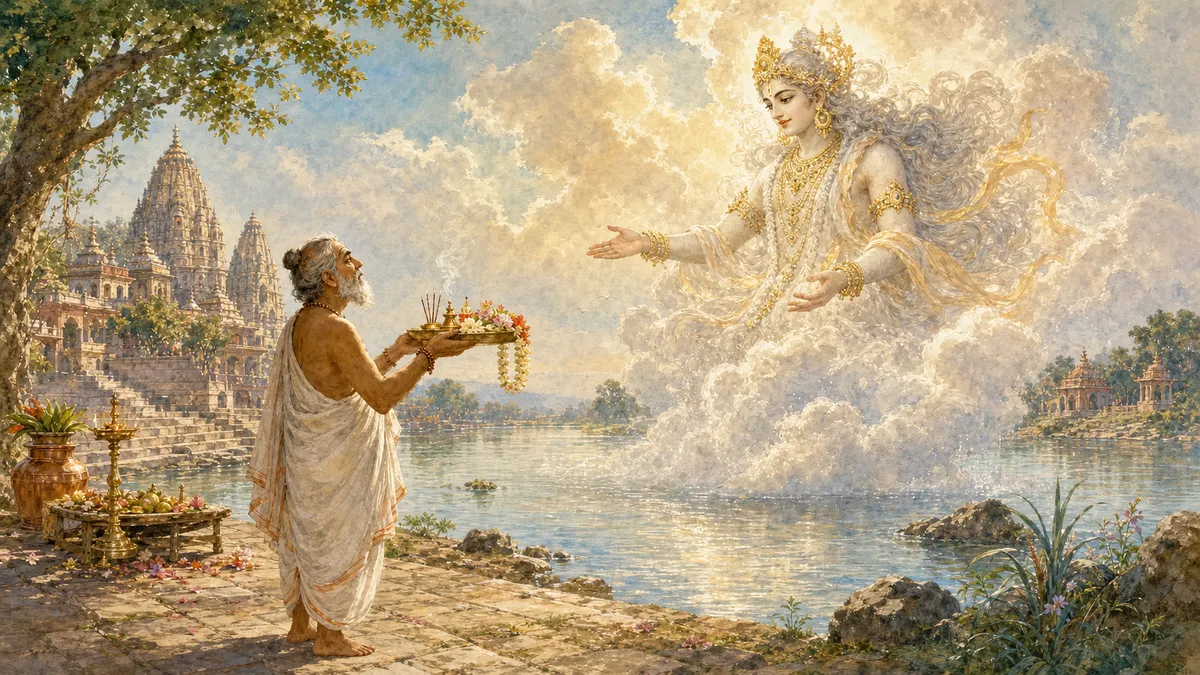
Then this brahmin performed rituals of invocation and worship of Kundadhara using incense, garlands, and various offerings.
Since Kundadhara, the holder of clouds, occupied a more modest position, after some time he was pleased with these offerings and thought:
“For the killer of a brahmin, the treacherous, the drunkard, the thief, the holy ones have indicated a path of atonement. But for one who is ungrateful, there is no atonement. Injustice is considered the daughter of desire, anger the son of complaint, greed the daughter of baseness, but the ungrateful person does not even have such offspring.”
Reasoning thus, this god decided to repay the brahmin for having worshiped him so diligently. When the brahmin, lying on kusha grass, entered the subtle body in samadhi, by the magical powers of Kundadhara he saw various beings in a dream.
Since he had purified himself through peace, devotion, and asceticism, in a vision he was able to see the highly revered Manibhadra standing among the deities—one of the manifestations of the higher gods. He saw this great soul giving orders to other gods. Here the gods decided the fates of people and distributed various kingdoms among them. For good deeds they gave kingdoms, and for bad deeds they took away even what already existed.
The greatly radiant Kundadhara, before the eyes of the yakshas, landed by his magical power right in this assembly of the gods.
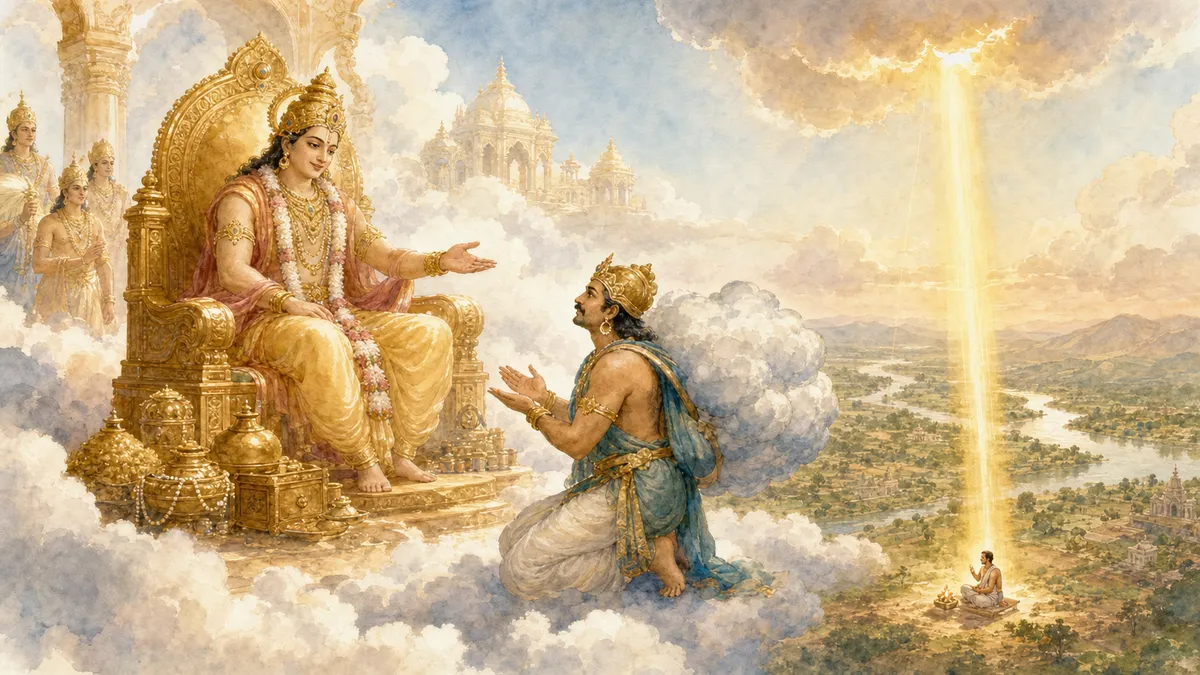
Prompted by the gods, Manibhadra—the lord of this assembly of deities—asked Kundadhara, who had fallen to the ground:
“What do you want?”
Kundadhara said:
“You gods are favorable to me. Then here is my devoted worshiper. For him I ask a great favor—let something be done that is conducive to his happiness.”
The lord of the gods, Manibhadra, prompted by the other gods, spoke these words to him:
“Rise; may it be well with you! Everything necessary that you ask for will come to pass. If the brahmin, singer of the Vedas, desires wealth, we shall grant him this gift. Since your friend, the brahmin, has earned such protection from you and wants wealth, by the decision of the gods I now grant him immeasurable wealth.”
But Kundadhara, after reflecting, thought that human happiness is unstable and fragile. He decided to direct the brahmin’s thought toward spiritual feats, thinking that from the blessing the gods would give, the brahmin would gain little benefit.
And he said to the gods:
“I do not desire wealth for the brahmin, O giver of treasures. I want a different favor to be shown to my devotee. I want neither land full of treasures nor a huge hoard of precious stones for my worshiper, but let him be righteous and holy. May he live by dharma; may his mind rejoice in dharma. Let dharma become the highest law for him—this was the gift I had in mind.”
Then Manibhadra said:
“But the fruit of dharma is always pleasures and enjoyments as well. Why should he not taste these fruits, being free from the sufferings of the body?”
But Kundadhara still insisted, saying that his request was precisely only for the blessing of dharma for his worshiper.
Manibhadra said:
“All the gods are pleased with you and with this brahmin. Let him become a righteous man and devote himself in thought to dharma.”
The guardian of the clouds, Kundadhara, was pleased with this promise. He paid due reverence to these gods, and then, having received such grace, difficult for others to attain, he rejoiced and left those heavens.
After Kundadhara received such a promise, the Brahmin suddenly saw beside him the finest garments, which had been placed near him during meditation, but he felt no satisfaction from this.
He thought to himself: “If even this god of no great rank, Kundadhara, from whom I have earned mercy, does not take account of my merit, asceticism, and practice, and does not wish to bestow his blessings upon me, then who else will value what has been done? It would be better for me to go to the forest and choose a life according to the law of dharma.”
He saw that fine divine garments had been placed beside him, but he did not even understand what they were for. Wealth did not come to him as a result of the blessings he had received, and therefore he was deeply disappointed. By the power of such revulsion toward worldly vanity, by the grace of the gods and thanks to Kundadhara’s intercession, the Brahmin went to the forest and there devoted himself to great tapas—a strong, powerful spiritual practice.
He fed on the remnants of offerings to the gods, on roots and fruits. His mind became very firmly established in meditation and in samadhi. After some time, he began to eat only leaves, giving up fruits and roots, and then he stopped eating even leaves, sustaining himself only on water. Then for very many years he lived only on air, on prana, yet his life force did not diminish; this was a miracle.
He became very diligent and devoted to dharma, performing his terrifying austerity. Then he himself assumed a divine form; his body began to transform.
When much time had passed, he thought: “If someone now satisfies and propitiates me, if I promise him wealth and give a blessing for wealth, then my word will come true, my blessing will materialize.”
Rejoicing at this thought, he began to exert himself even more in ascetic practice. Having, after some time, attained an even greater perfection, he thought: “If someone satisfies me and I am pleased with him, then I will promise him a kingdom or bless him with a kingdom. And my word will not be empty—such a person will immediately become a king.”
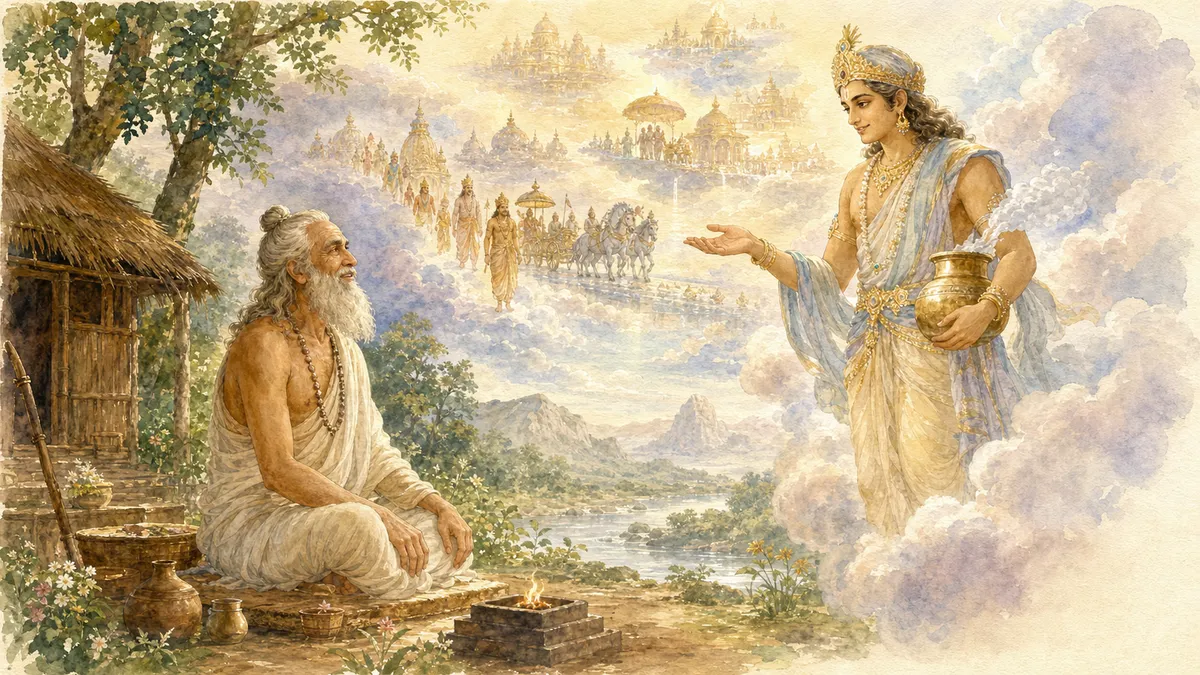
When he thought this, Kundadhara appeared before him, drawn by the power of his spiritual feat and by their old karmic connection. According to the law of dharma, the Brahmin performed worship; he was filled with delight that his patron Kundadhara had appeared to him again.
Then Kundadhara said: “Now you have the highest divine vision, so look at the path of the kings of the worlds and the rishis.”
When the Brahmin looked using his divine vision, he saw thousands of kings sinking into the netherworld.
Kundadhara said: “You revered me with great devotion, and I thought that if you were to fall into suffering and misfortune like these rajas, what could I do for you? What mercy could I bestow upon you? Look, gaze more closely at what happens to a person who seeks worldly desire. For the gates of heaven are especially closed to such people.”
When the Brahmin looked more closely, there appeared before him people who in life had given themselves over to pride, anger, sleepiness, slowness, negligence, lust, greed, and fear. All these people appeared as those going to the lower worlds.
Kundadhara said: “Look, all these properties and qualities block the road to the higher worlds. The gods are horrified by such people and keep away from them. Such qualities create all kinds of obstacles for people. Not without the consent of the gods do people become righteous in dharma. Look: thanks to your practice, to tapas, you are able to grant another a kingdom and wealth.”
Then the Brahmin understood what Kundadhara’s intention had been: that he had saved him from bad births, changed his fate, giving him not what he had asked for, but giving him the knowledge of dharma.
He bowed down to Kundadhara to the ground and said: “Yes, you have shown me great mercy, for in the bonds of greed and lust I even once murmured against you and was dissatisfied with your blessings. I did not understand your love, so forgive me for having been so ignorant then, and bless me.”
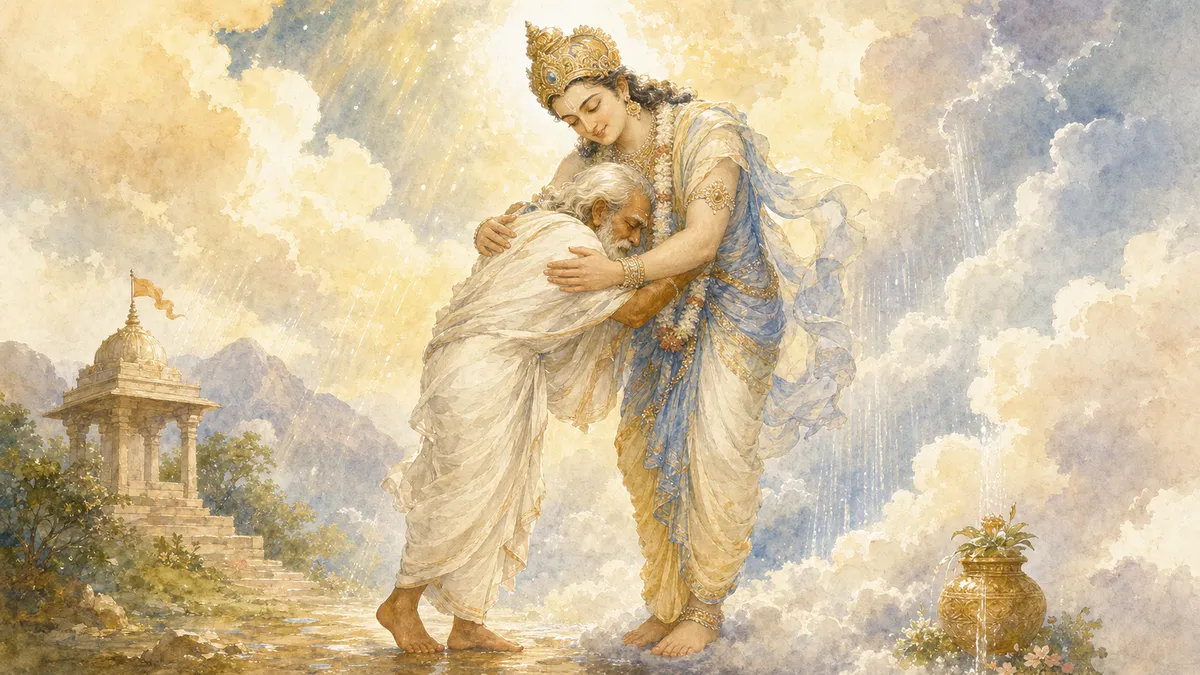
Kundadhara said: “I have forgiven you.” Then he embraced him firmly with both arms and disappeared.
This Brahmin later surpassed all worlds and attained the highest perfection by the grace of Kundadhara and by the power of his tapas.
Further, at the end of this chapter, it is said:
“Walking through the air, the fulfillment of all desires, and the supreme path are attained through the power of dharma and yoga.
The gods, brahmins, celestial wanderers, and yakshas (demigods) honor the holy and the righteous, not the wealthy and passionate.
The gods are very gracious to you, because you rejoice in the law, in dharma.
In dharma lies the highest happiness.”
Invisible Patrons and Observers
Perhaps we are not fully aware of this, but various classes of beings are always watching over each of us, for example the spirits of our ancestors. Although you do not see them, the departed spirits of your ancestors see you, since spirits, unlike people, naturally possess clairvoyance; they do not need to engage in practice for this.
Your long-departed relatives, having become spirits, have a connection with you and observe your destinies just as they might have taken an interest during their lifetime: “How is that one doing, and how is this one doing?” Although their understanding of happiness and dharma may differ, nevertheless they always rejoice if you direct your mind toward dharma, and they worry if you direct your mind toward wrong thoughts, dullness, unawareness, or bad deeds.
In addition to ancestral spirits, various deities, patrons, and guardian angels watch over you. They always rejoice when you decide to move along the spiritual path, work on yourself, reveal subtle states of mind, and they are saddened when you do something wrong, fall into obscuration, make wrong choices, act angrily, selfishly, or simply fail to use your potential.
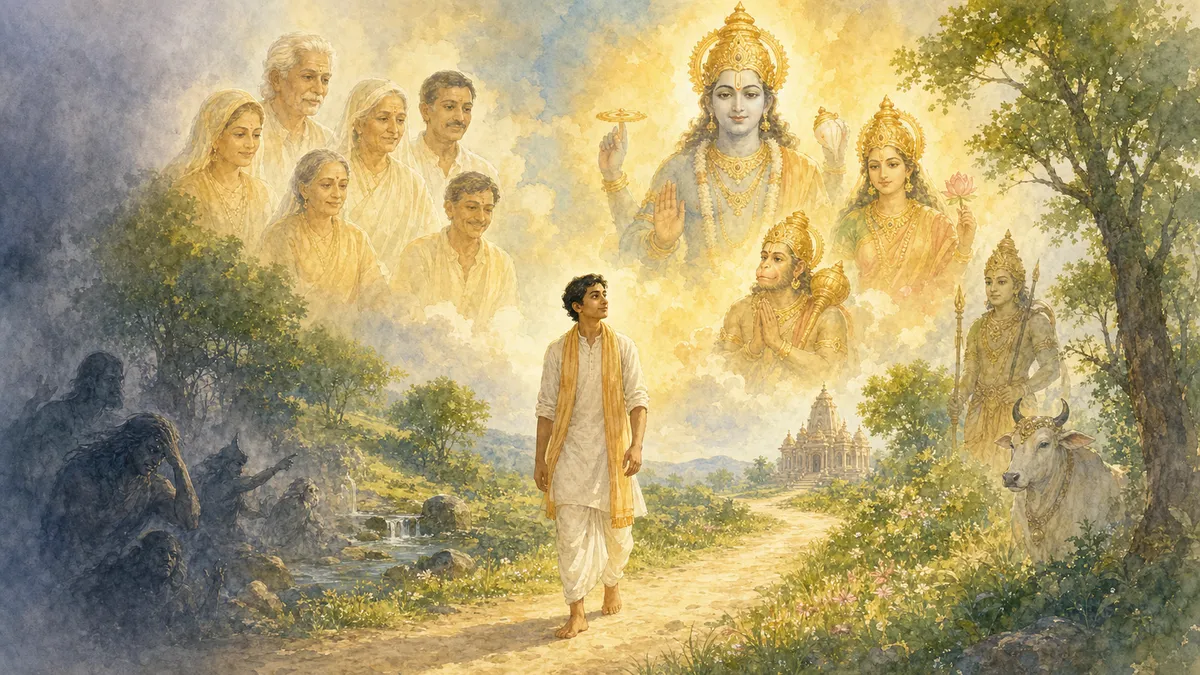
As a rule, the gods always encourage and bestow blessings upon those who strive for dharma. On the contrary, those who cultivate obscured states and move forward with selfish desires and goals always have various paths blocked; restrictions are placed upon them by the command of the gods or governing spirits.
In other words, we cannot think that we have shut ourselves away in isolation and that no living beings can see us. Living beings do see us very well, even if we are in a completely sealed retreat room, even when we are entirely alone.
These beings observe our behavior, our observance of vows, our qualities, and each of them evaluates according to their own understanding.
- If they are enlightened beings, of course, they wish us spiritual realization
- If they are worldly gods, they are capable of bestowing worldly happiness and understanding
- If they are ordinary spirits, then they may be able to understand in their own way
- If they are guardians of certain foundations, vows, or dharmas, they zealously watch how you fulfill them
If you violate something, they punish, create obstacles, or simply close off paths in some area. They watch your character traits, your reactions, your spiritual practice. If your consciousness moves toward dharma, they empathize, rejoice, and give you the opportunity to reveal it even more. Conversely, if consciousness becomes obscured, they do not allow you to act further until this lesson has been passed.
From the point of view of Advaita, all of them are manifestations of one natural awareness; nevertheless, they have their own individuality, they can think, evaluate, and act just as you and I do, that is, like ordinary people.
There are also deities called shravanas and shravanis, who hear and see all the deeds of people and are able to reproduce any human action from any period of one’s life. They can literally reproduce all situations from our lives frame by frame. The shravanas and shravanis act as advisers during the judgment before Yama, when he asks Chitragupta to look into the records and see in the Book of Lives the good and evil deeds that one person or another has committed.
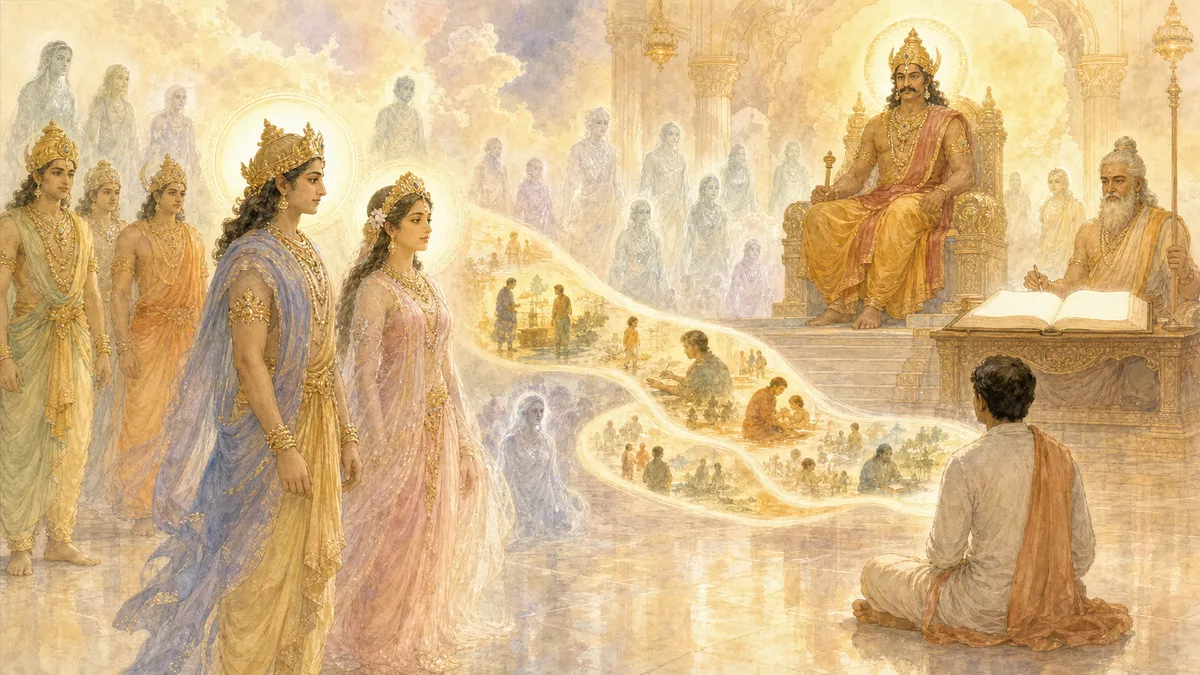
Understanding this encourages one to be more aware and to act correctly wherever you may be: alone with yourself, or in society, before the eyes of others.
Qualities of a Practitioner
Trials and Obstacles on the Path (Grahas)
Correct dharmic deeds are always deeds that flow from sattva, inner radiance, goodness, and serenity.
Wrong actions are actions undertaken under the influence of tamas and rajas. A person who is in tamas and rajas, by definition, cannot act correctly, since his mind is inert, dull, unclear; there is no light in it, it does not “burn” with the spirit of faith, devotion, clarity, and contemplation, and therefore all his actions will be mistaken, even if outwardly he tries to act correctly.
On the contrary, when sattva exists, the inner radiance, it allows one, by definition, to act correctly and clearly, since sattva illuminates all the other corners of consciousness, allows one to make decisions without error, to remember and take into account many factors, and to achieve goals. Based on this, the yogin’s task is to subdue and eradicate rajas and tamas, to bring rajas and tamas under control, and to nurture sattva within himself.
And the monastery is precisely such a place where it is not rajas and tamas that are encouraged, but sattva.
If you are in sattva, then you can meditate for a long time, receive good experiences, and achieve success in service; you are not a failure in service, because failure in service is tamas and rajas. It happens that when you give someone some task, he says: “I don’t know how, I don’t know, nothing works out for me.” You explain everything to him, but for some reason he still cannot make it work. The question is: what is hindering you? Tamas and rajas are hindering you — the feverish work of the mind, which does not allow one to approach the matter clearly. This is failure in service. On the contrary, one who is saturated with sattva has clarity and an intuitive understanding of how to achieve goals, how to realize everything. He is always and in everything successful: in practice, in service, in relationships.
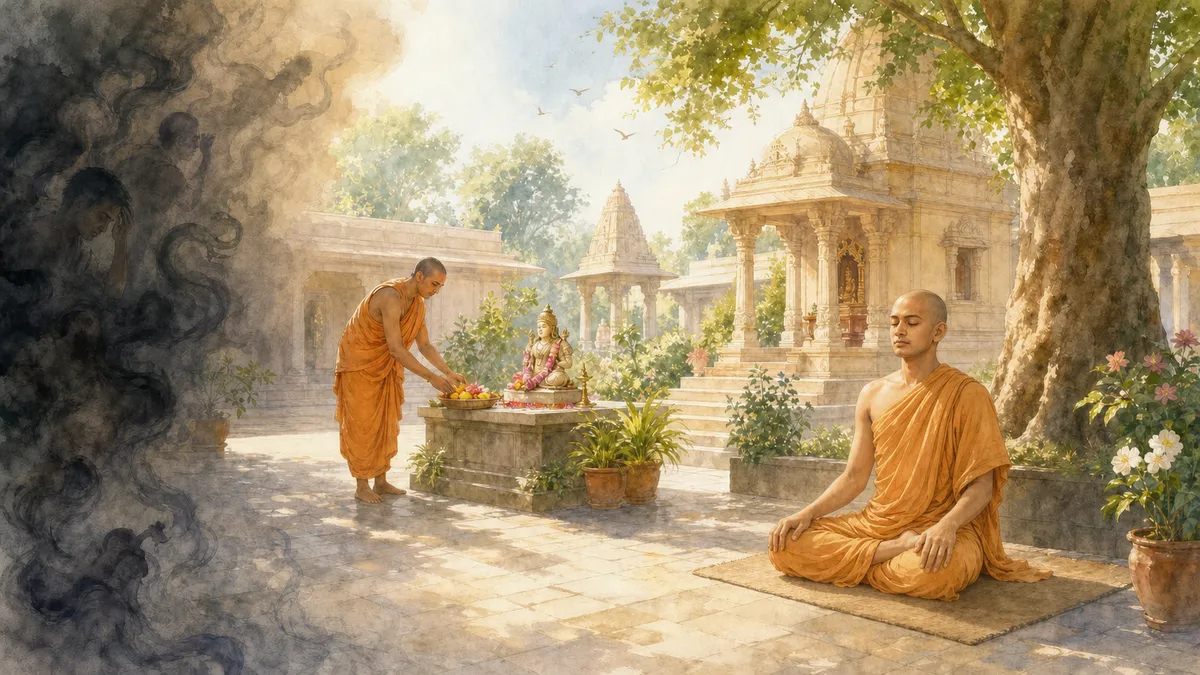
It turns out that tamas and rajas are obstacles for the yogin.
Analysis of Meditative Practice
Tamas is when we sit down in meditation and suffer defeat.
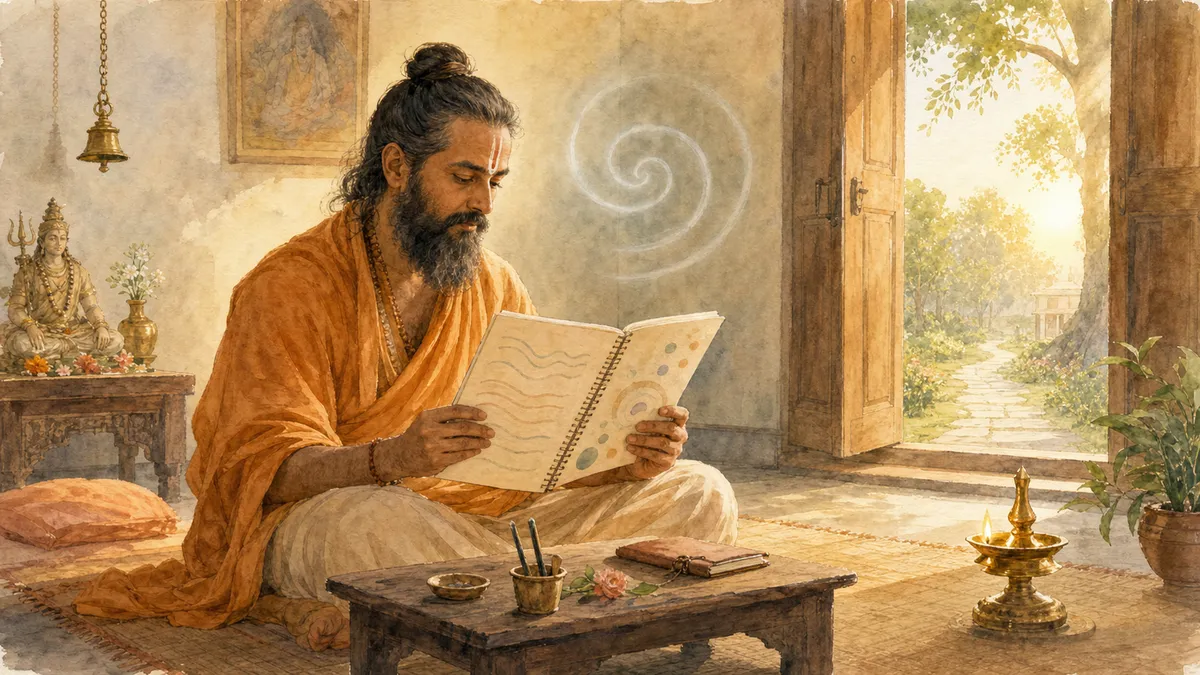
I recommend that everyone who performs meditation—and in the monastery this should be 100%—evaluate each session from 19:00 to 22:30 after you have completed it, and based on the results of the session give yourself a grade: “won a victory,” “suffered defeat,” “ended in a draw.” At least for a month, you need to keep such a diary of your meditations and calculate the results. For example: “Ten times in a month I won a victory; my mind in meditation was clear. Fifteen times in a month I ended in a draw: I fought with tamas, but it did not defeat me. Five times I suffered defeat: diffuseness and agitation did not allow me to meditate clearly; I either spun thoughts around or remained in dullness.”
Keeping such a diary is a very useful thing.
When I practiced intensively in retreats, I always tried to note even my smallest successes or, conversely, any problems in pranayamas, in the walking technique, in concentration, and meditation. I constantly kept such a diary and carried out continuous analysis.
Such analysis helps us develop a strategy for spiritual practice for the next day or the next month. But if we do not carry out such analysis, it is difficult for us to see the tendencies of our mind and develop the correct line. A yogin is one who constantly analyzes and corrects the tendency of his mind.
Three Types of Meditation Results
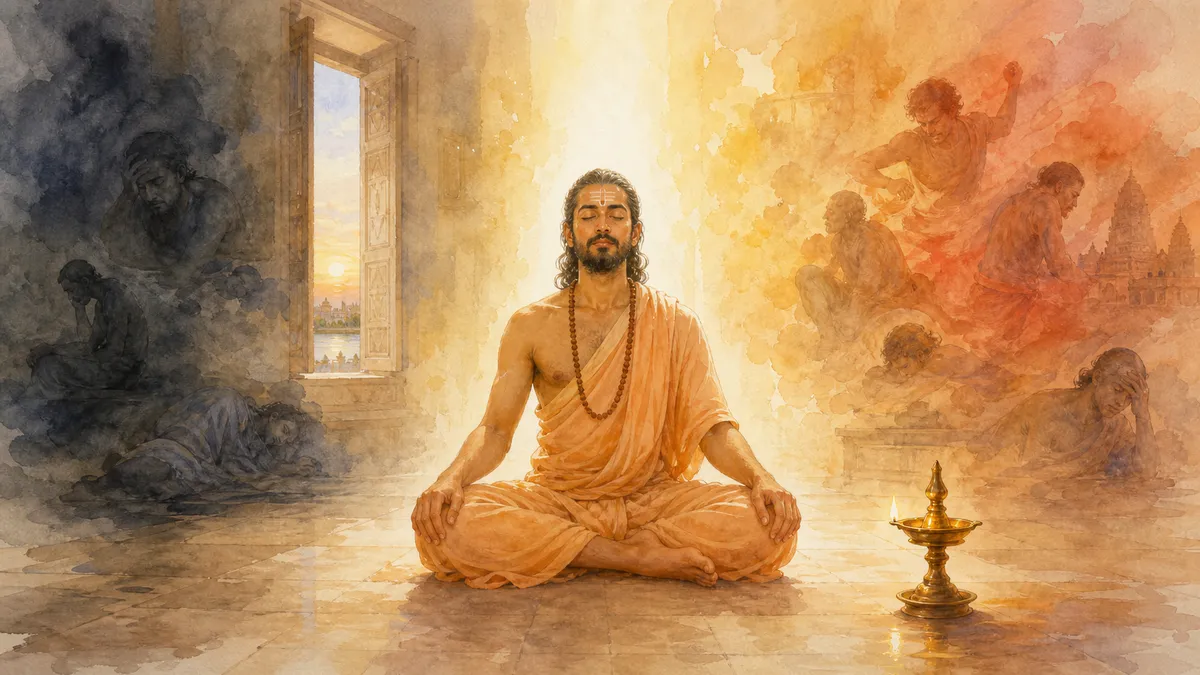
What does it mean to “suffer defeat” in meditation? It means that the meditation went badly: there was diffuseness, there was agitation, you did not hold the theme, or you sank completely into tamas—that is, an hour and a half crossed out of life. Such meditation is no good. The yogin must struggle so as not to suffer defeat during mahashanti. These one and a half hours are sacred time for practice.
What does it mean to “end in a draw”? It means that at times tamas or rajas “rolled in,” there was diffuseness and agitation, but you fought, did not allow tamas in, contrived as best you could and defeated tamas by any means, did not yield to it. Tamas tried to overcome you, but it did not succeed, although you also did not manage to overcome tamas completely. This is like a person practicing martial arts who entered the ring with a strong opponent who pressed him across the entire arena, but thanks to flexibility, evasiveness, and technical skill, he managed to stand his ground the whole time; on points he did not lose, but he did not win either.
In the same way, a yogin, even if he is being pressed by tamas and rajas, does not suffer defeat thanks to his mind, which becomes resourceful in meditation. At the very least, he holds the theme and penetrates into clarity.
“Spiritual victory” is when meditation proceeded evenly, without distractions, without blurring or agitation, when there was deep penetration, when there was progress—that is, you added a little more clarity to the stream of your consciousness.
Daily Analysis of Practice
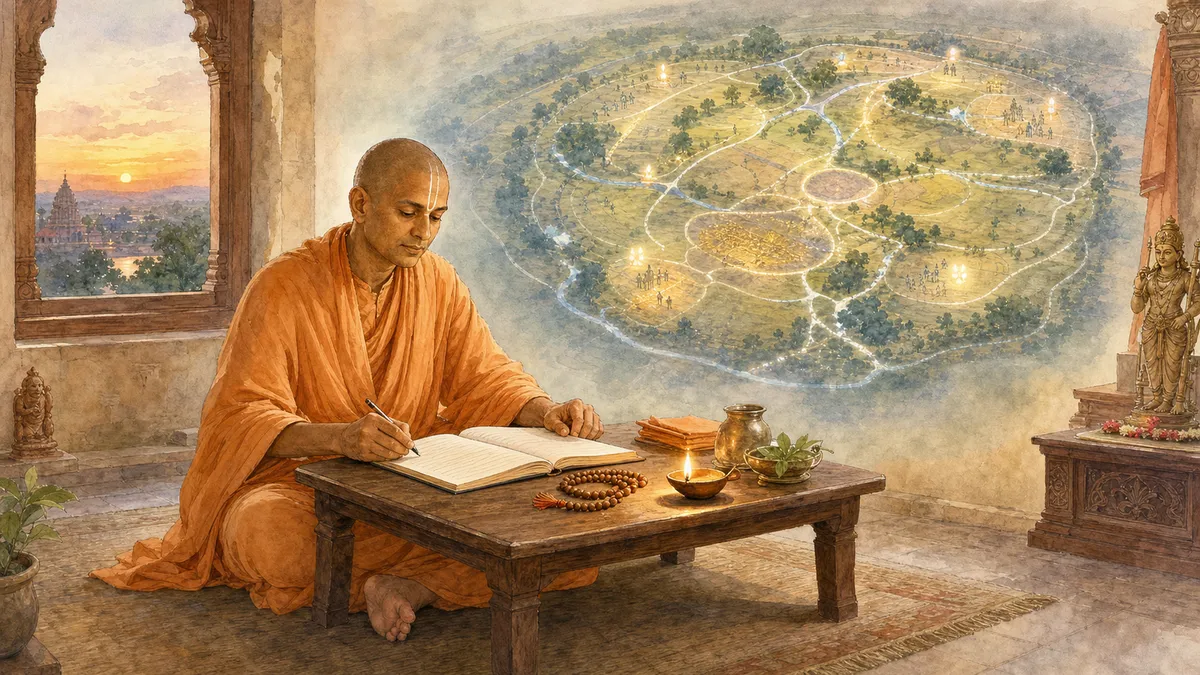
Thus, every day you can analyze the state of your practice and your consciousness. For example, if you are summing up your everyday maintaining of awareness throughout the day, you can assess the result as follows: “How did my awareness develop? How did I work with contemplation and sankalpa?”
If every day you draw such a conclusion, analyzing your practice, it is like a good coach gathering the team after a match and reviewing how the match went. He says: “The defense performed poorly, but the forwards did well. We need to focus on this.” Then he encourages the players and says: “For the next week, we have such-and-such goals before us, we have such-and-such tasks.” And the whole team answers the coach: “Yes, we will do exactly that.” In the same way, you, as the “head coach,” gather the entire “team” of your body, speech, and mind. That is, your inner clarity, your conscious mind, must give instructions to its less conscious parts. You review how your entire day went: where you failed, whether you achieved victory, or whether it was a draw.
A good monk is one who, every day at the end of the day, holds such a “meeting,” reviews the game of the day, analyzes, assesses weak and strong points, formulates conclusions, and then makes a decision about what he will do next, how he will adjust his sadhana, and so on.
If you conduct such an analysis of sadhana, then you are always moving forward, without suffering serious failures and defeats; your spiritual growth is stable. This does not mean that you should become fixated on self-reflection and constantly engage in self-examination. I would not say that this is an obsession with self-examination; it is more like the sober calculation of a professional fighter or specialist who is accustomed to constantly working on himself, moving forward, and cultivating the necessary qualities.
This is exactly what saints did: they always watched over the spirit of their consciousness, not allowing it to fall into tamas or rajas, because falling into tamas or rajas is the decay of the spirit, and for spiritual practice this is something unforgivable.
In other words, Dharma brothers or senior monks may forgive you for this; there is nothing difficult about that. They may say: “Tamas? Yes, it happens, we sympathize,” or “The state you are in is your business, your choice; everyone follows their own path.”
But this will not make it any easier for you, because it will be what closes the roads to heaven for you; the gods will not forgive such a thing. That is, what people forgive, the gods do not forgive; the gods have a completely different approach, with very high standards. If you do not observe ethics, the doors will not open; if you are not aware or you allow impurity, a violation of samaya, no one will even speak to you.
The higher the world, the greater the criterion. It is like the way an ordinary person will never simply be admitted to an elite club.
If we have not, from the very beginning, generated such a foundation, such a very mature and serious attitude toward sadhana and awareness, then sooner or later we will still have to generate it, because the absence of this foundation will make itself felt someday. It is like a rotten step on a staircase to heaven; sooner or later this rotten step will break underfoot, and such a yogin will simply hang there, clinging to it with both hands instead of taking a step forward. If there is such analysis and the yogin constantly watches over his consciousness, uproots rajas and tamas, and establishes himself in sattva, then all the steps under his feet will be whole.
Stability of Consciousness in Sattva
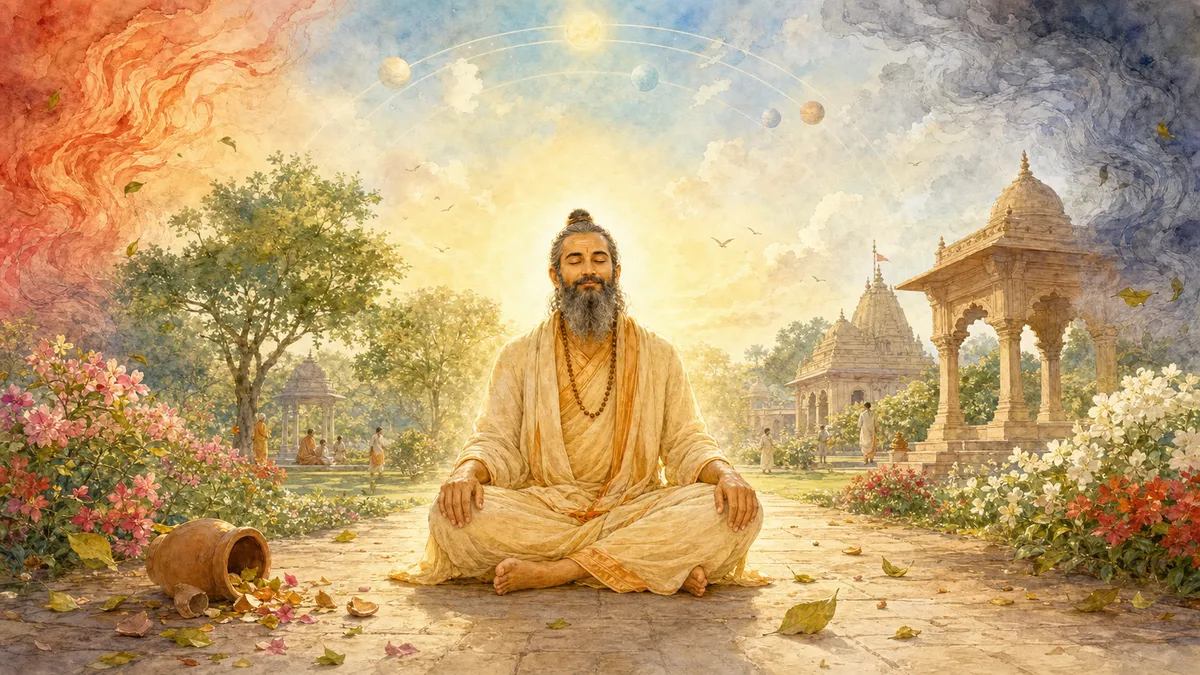
The consciousness of a yogin who has become rooted in sattva is always stable, because he draws upon spiritual joy. But the consciousness of one who is in rajas or tamas changes abruptly; it has fluctuations. He is very susceptible to the influence of planets, external impacts, and relationships. Others can easily make him lose his temper, because he thinks that the cause is not in himself but in others. Someone said something to him the wrong way or did something the wrong way, his living conditions worsened slightly, and he immediately feels as though “the sky has become barred” for him; his soul feels heavy, and he is almost in tears.
Why does this happen? Because there is no joy that is drawn from sattva, from inner radiance. In a state of obscuration, all external influences are perceived acutely; their importance appears much greater than they actually are. In the state of sattva, on the contrary, any external influences are perceived purely and favorably, and even if unfavorable influences occur, such a yogin still remains in inner joy and bhava. And when we contemplate in this way, rajas is brought under control.
But it can happen that when rajas is brought under control and extinguished by an effort of will, instead of sattva increasing, tamas may increase if consciousness is not clear enough. This is also a bad thing. For example, if tamas is cultivated for a long time in mahashanti meditation (this is especially characteristic of retreats), then one can create the prerequisites for rebirth in the world of animals, where tamas dominates. And if a yogin becomes established in one of the types of incorrect meditation or incorrect samadhi, for example in a tamasic state, then his consciousness can indeed be reborn in such a world.
This happens because consciousness is accustomed to receiving external stimuli from external objects and to being in such a rajasic state. But when it is deprived of such objects and is not yet very subtle, has not learned to draw joy through clarity and awareness, it begins to fade, falling into a tamasic state of obscurity, lack of clarity, inertia, and dullness. This should be feared just as much as rajas. The manifestation of tamas should be suppressed in every possible way.
The Spirit of a Vira-Yogin
In other words, a yogin must always look intently into his soul and be very vigilant that there is no tamas in him. Tamas occurs when we dwell in laziness and dullness, when we do not concentrate on practice, on service, when we remain in a state of compromise, when our spiritual honor, spiritual enthusiasm, faith, goodness, and sattva are replaced by lazy indifference. And such a state can be stopped if we maintain the spirit of a vira-yogin.
The spirit of a vira-yogin means not following the path of the least, but following the path of the greatest. This means always being ready to challenge one’s abilities, to do a little more and a little better, always striving to practice and engage in service more effectively. That is, it is an increased demand upon oneself, and this demand is not external, but first and foremost internal. This is antar-tapas — inner exactingness connected with the control of consciousness.
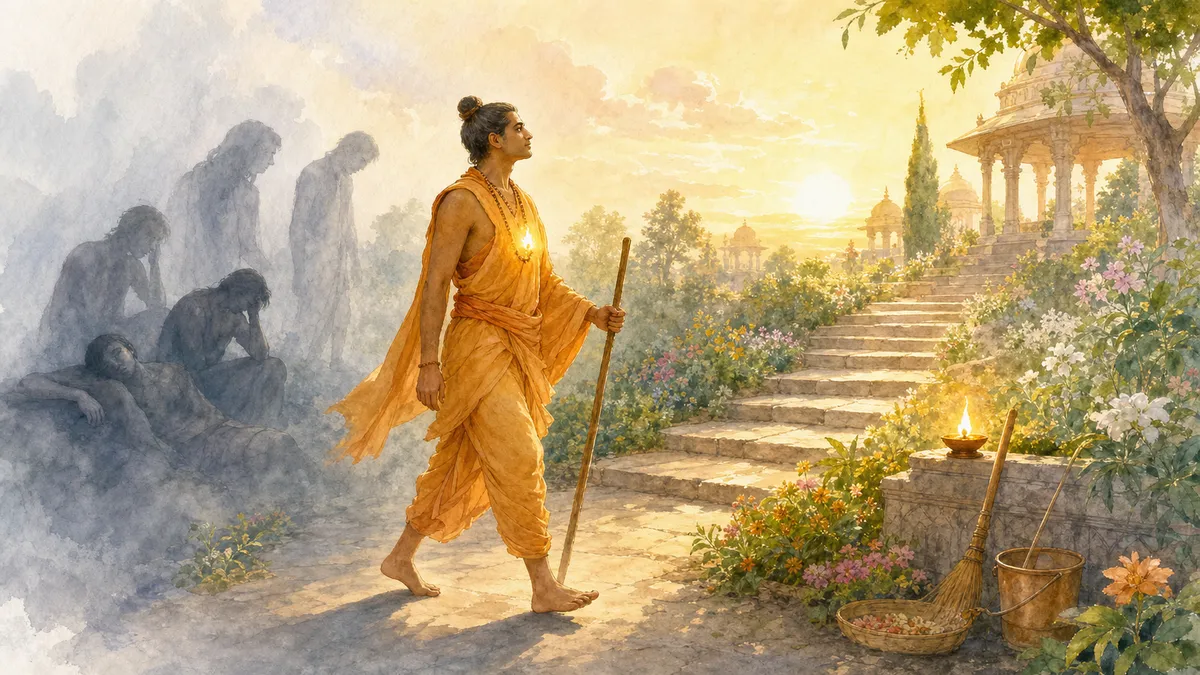
If tamas dominates in a person, he may think: “Reading sacred texts is difficult. Passing exams is difficult. It is better to take the path of least resistance and ask to be exempted from the exam, referring to the fact that I understand poorly or that something is not going well for me. Let others take them, but this is more comfortable for me, because studying texts and passing exams is hard; one has to think a lot.” This is how tamas manifests.
Sattva manifests differently. You think: “Yes, despite the fact that it is difficult, I will try to make an effort and will do this until it becomes simple for me. I will try to do what is needed and even a little more.”
During meditation, when tamas comes, we think: “My legs hurt somehow, my back has gone numb, I want to lie down or relax.” This is the whisper of tamas. But sattva says: “If I compromise now, there will be little benefit from this meditation. Therefore, I will try to meditate to a double limit: I will reach the limit, and then increase this limit once again, and through this I will make a breakthrough.”
If we accept the concept of sattva as our foundation, then practice truly bears fruit. But for this, vigilance is needed, one that would constantly pull the mind out of the state of rajas and tamas.
Perception of the World in Different States
In the state of tamas, the world is seen in darkness, in obscurity. We look at the world with the same eyes as an animal does. In the state of rajas, there is a strong distortion of reality. We see the world as if we were looking through the lens of a movie camera that is constantly jerking; we cannot focus or aim at any one thing. We cannot see the world in an integral perception, panoramically. That is, rajas is as if you were looking through a movie camera, and it were constantly jumping and jerking, so the whole image is blurred, and you cannot understand what is really going on. This is precisely why rajas and tamas are harmful to spiritual life.
The state of sattva is seeing the world through the lens of a very high-quality movie camera. This is a fundamentally different vision of the world, when you can see everything clearly down to the details and, as a result, can create masterpieces.
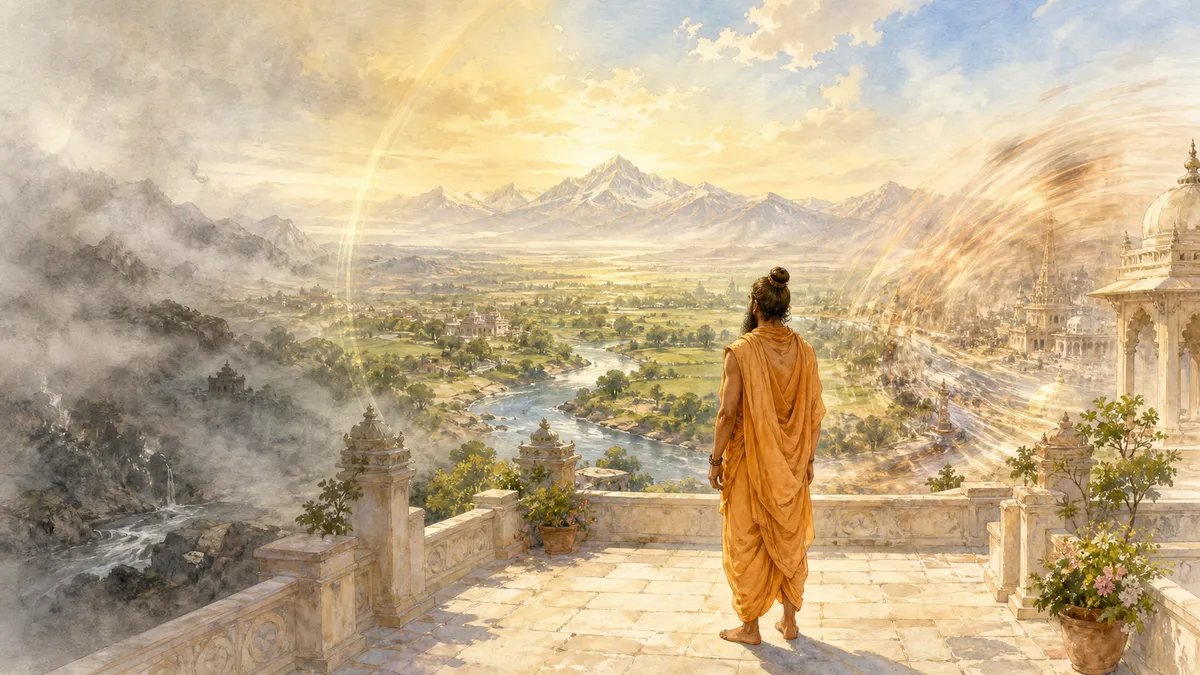
The yogin, looking into himself, always discovers where in the course of the day such moments are hidden when rajas and tamas have power over him. There are various moments associated with the functioning of the channels, the elements, and the movement of energy through the marmas, when tamas and rajas dominate most of all. And these moments in time are individual, so the yogin must identify them for himself and try to bring them under control.
