

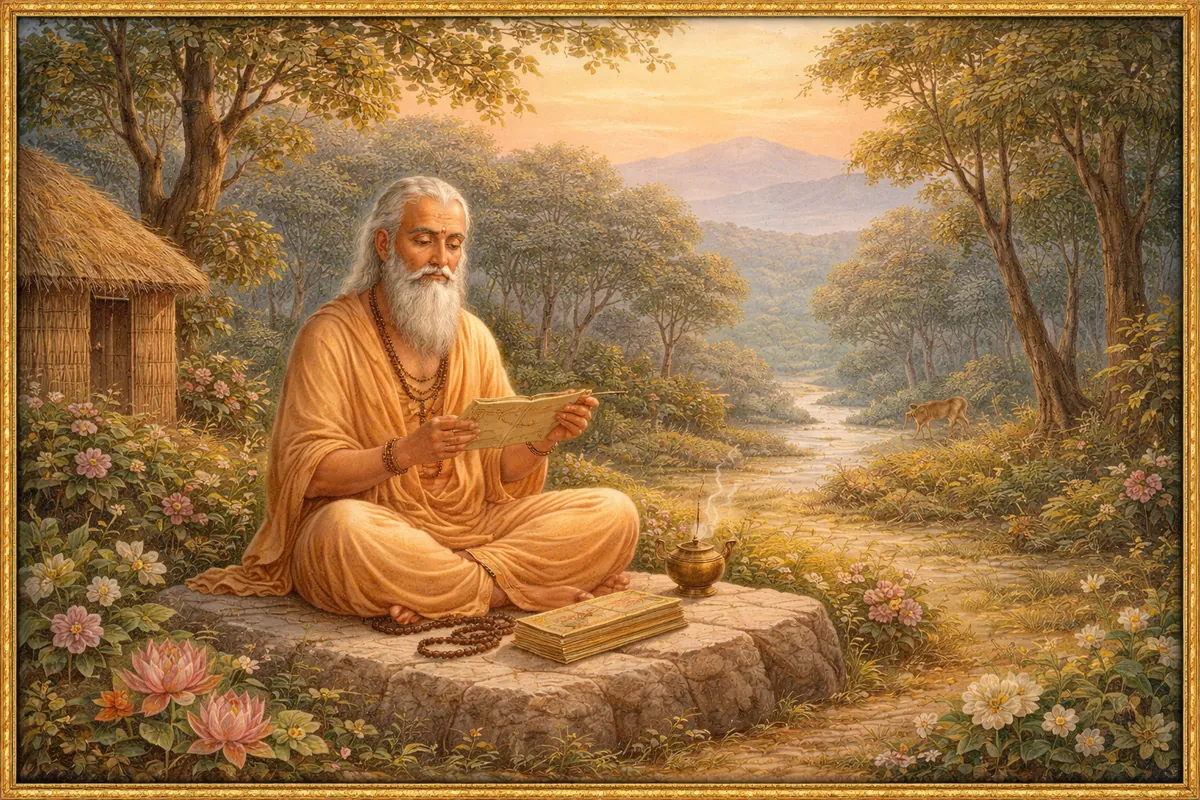
Shame for deeds committed or words spoken toward others or oneself is called the Holder of the Trident — the 40th shila.
On the one hand, shame is a fetter (limitation) that holds the soul (lajja). On the other hand, it is part of shila. In what case should shila be practiced with regard to shame, and in what case does it become a limitation (lajja)?
Question: Perhaps, as repentance, it liberates, but if it is as ego, a little poor thing, then it is a fetter.
As something, as a fixed stereotyped idea, a samskara conditioned by society and upbringing. Correct.
Question: Guruji, but after all, repentance also, as it were, proceeds from a lack of understanding of the purity of everything, therefore it is also, as it were, a certain delusion, isn’t it?
It depends on the level of awareness in repentance and on the motivation. For example, repentance is already a consequence, but what precedes repentance?
Answer from the audience: A feeling of guilt.
Yes, repentance is preceded by a feeling of guilt. Where does the feeling of guilt come from? It does not appear just like that; it appears on the basis of some fact.
Answer from the audience: An action that is interpreted as impure.
And what else?
Answer from the audience: Buddhi, as it were conscience, actions against one’s conscience.
Actions against one’s conscience, and what do they lead to? What does it mean, against one’s conscience?
Answer from the audience: Breaking a vow.
Suppose a worldly person does not take vows, yet he too sometimes repents of something. Obscuration — it is always preceded by obscuration, and we feel that darkness has appeared in the soul. When repentance is performed from clarity, awareness, when we see that darkness has appeared in the soul, then an understanding arises that one should not have acted that way, even while abiding in the view of Advaita. Such shame is encouraged by shila in the “Chandra-jnana-agama” — one of the 64 shilas.
On the contrary, shame as lajja, as a form of limiting consciousness, shrinking the mind because of being blinkered by patterns and fixed ideas — such shame should be rejected; it is an obstacle on the path of liberation. For example, in reality no obscuration occurs and should not occur, but the mind, abiding in patterns, for some reason becomes obscured anyway.
Suppose you have to speak before a large audience; you clamp down your consciousness, shrink, cannot manifest your shakti, cannot speak, and as a result you feel awkward and ashamed, and you leave the auditorium in an obscured state. There was no reason at all, because nothing of the sort happened. But the ego somehow contracted, the ego began to reflect: “How will I look?”, then hrina switched on: “I won’t be able to, I am not skilled,” and so on. It is necessary to distinguish when shame is needed for the purification of an arisen obscuration, and when it is a limitation.
The rejection of partiality toward an enemy or even toward one’s own son is called the 41st arjava-shila.
Partiality means, for example, hating an enemy, while being favorably disposed toward someone one likes. In the relative world, of course, there are friends and enemies, but in essential consciousness a sadhu takes an even position of awareness, and his partiality extends only to God. This is not partiality, but devotion. Partiality is always connected with attachment; attachment is always partial, and it can be either with a plus sign or with a minus sign. Toward enemies it is partial with a minus sign; toward friends, with a plus sign — these are different forms of attachment. When there is attachment, the subtle layer of awareness no longer obeys, and the soul acts on the basis of attachment. A sadhu, however, acts on the basis of dharma, and dharma is the understanding of how to act clearly on the basis of divine will, on the basis of awareness of God, how to act correctly from the position of dharma, and not attachment.
Faith in the agamas and nigamas and in the words of the Guru is called the 42nd shraddha-shila.
Not abandoning dharma, even if attainment is far away, is called the 43rd dhriti-shila.
Not experiencing malice toward enemies is called the 44th kshama-shila.
We must be very attentive so as to live our life in such a way that sattvic, elevated bhavas and experiences are accumulated, so that our divya-bhava blossoms over the years; and under no circumstances on the path of a sadhu, on the path of monasticism, should one find enemies for oneself — this is the worst thing one can do in monasticism. One must not give rise to impure vision, because samskaras begin to be imprinted in the unconscious mind and obscurations occur. One must not allow the mind to become fixated on impure things, on things that obscure.

You must abide in divya-bhava — this means a pure, elevated, sattvic state of devotion, of love for God, accompanied by a clear, contemplative presence, so that when you look within yourself, there is nothing inside you that would darken you, that would cause clouding, shrinking, or anger. So that you shine the flashlight of your mind into the palace of inner awareness and do not find even a speck of dirt there, so that nothing impure remains that could disturb you, frighten you, bring you into shame, bring you into confusion, so that everything is totally purified. All of this is found in our unconscious mind.
The Seven Abilities of the Mind According to Vyasa
According to Vyasa, the mind possesses seven abilities, and the first ability is shakti:
Shakti is the ability to be and to become; it is the ability necessary for carrying out tasks and achieving any goals. Shakti is the key power of the mind that fertilizes or strengthens all other powers. Shakti, for example, is the conviction of the mind that we have enough strength or ability to do something. It is the ability to be or to become someone. For example, when we believe: “I am capable of becoming a sannyasi, I am capable of becoming a monk,” and undertake something — this is a certain potential. For example, a dog does not possess such shakti; it does not believe in the ability to become a human being, to practice.
The second power is cheshta:
Cheshta is purposeful movement. Cheshta is the power of the mind that sets subtle images in motion, giving impulses toward their manifestation. Consciousness is subtle images, but they still need to be given the opportunity to manifest; if they are not given the opportunity to manifest, they will remain as they are, and so there is such a power of the mind.
The third power is jivana:
Jivana keeps the past alive in the form of samskaras. Jivana is the ability to maintain life force within oneself, to keep prana and the organism alive, including reviving vasanas, reviving samskaras.
The fourth power is parinama:
This is the ability to ensure changes when transitioning from one state to another, making the mind plastic; this is why reincarnation occurs. The mind abides in transformation, and therefore the soul was a human being, but in the next life, having left the physical body and no longer being bound by the karmas of this world and this body, it can transform, for example, into the illusory body of Dattatreya. It can transform, or, if it is a darkened mind, for example, transform into the body of an animal, into a subtle astral body.
Nirodha is the ability to stop, to cease the tossing from one state to another.
The next power, the sixth, is called samskara.
The ability to preserve subtle images, copies of our actions, or generally any information that the mind takes from everywhere, both from outside through the sense organs and in the subtle body in dreams. The mind always preserves subtle copies of our words, our thoughts, and our actions.
The Importance of Subtle Copies of Actions
Saints and divine beings say that it is not so much the actions themselves that are important as these subtle copies, and the subtle copies that preserve our actions are colored by our bhava in which we abide, by the interpretation we give to our actions. One and the same action can be interpreted differently and yield different copies, and it is precisely on the basis of our copies in the unconscious mind that karma accumulates and the decision about the next birth is made.
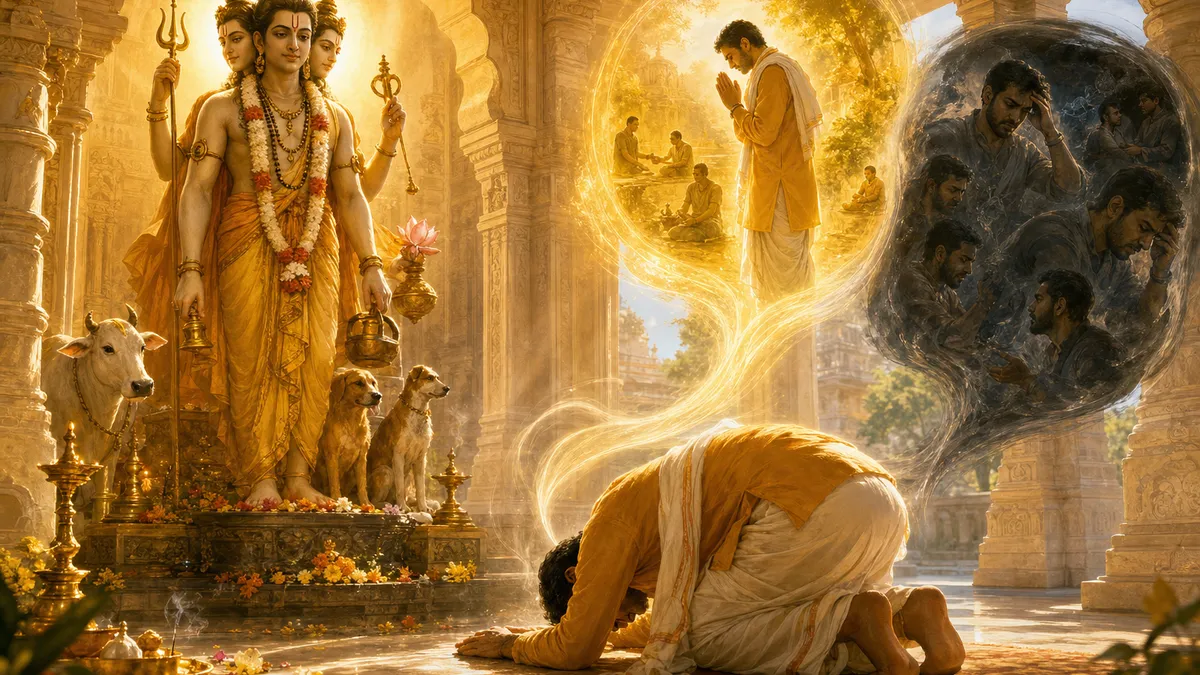
For example, after performing one and the same action, the copies may be different, and the samskaras accordingly may be different. For example, you went to the temple to prostrate, but your mood is not very good; in your soul you are mentally quarreling with someone, and you cannot calm the mind, and you went to prostrate; the body performs a prostration before Dattatreya, but the mind is in an offensive state — what copy went forth? The action ended, you left the temple, your mind received a copy; what kind of copy is it? Was merit accumulated? There was a mixture: obscuration and merit. The bodily copy of prostration before a holy image is undoubtedly merit, an elevation of consciousness, but it was completely blocked by the mind’s mental attitude, and therefore it is a copy of merit with obscuration, a mutually contradictory result.
Another person entered, made a prostration in the temple; his mind was pure, empty, and clear. He truly performed the mantra, carried out dhyanam on Dattatreya, he performed the transformation as prescribed, meditating, deeply immersing himself in the key points; when he saw Dattatreya, this became the culmination, the opening wide of consciousness, and he experienced ecstasy for a second.
It was for the sake of this copy, which went into the mind, that he did all this, and the copy was sent, saturated with divya-bhava and sattvic action; and every day, every second, every hour and every minute such copies go on and on into our mind. Our unconscious mind is like such a hard drive that records everything, as they say now: “Everyone is recording.” Security systems that install video cameras record around the clock everything that happens in supermarkets, in public places, and on the streets. In the same way, the role of such a video camera is played by our mind and its ability to create copies and record.
The Tantric Principle of Transformation
What matters is not so much the action as the memory, the interpretation. For example, there are saints who worshipped Shiva with feces while performing Tantric practices of transformation, such as Trailanga Swami. From the point of view of an ordinary person, this is like an insult, because the copies that go into the mind are dark; what kind of worship is that—worship should elevate the soul. From the point of view of Trailanga Swami, it was the holiest worship, because in his vision the feces were gold or nectar, pure, since his mind, abiding in pure vision, illuminated and transformed it.
It turns out that the actions themselves seem to be obscured, while the copies that go forth are holy—this is what the Tantric principle of transformation is built upon, when kleshas are made into wisdom. When even the poisons of an impure substance are used in worship, while pure copies go into the mind. All of this is an ability of the mind called samskara.
We must live in such a way as to perform correct, pure actions that would give good copies, samskaras, in the mind, and at the same time interpret our actions in such a way that our actions also are pure, and thanks to this the samskaras that are deposited are only pure. Over time, when samskaras are deposited over years, they become a powerful force that pushes the soul into higher worlds.
For example, you do upasana for twenty years—this is a very powerful set of samskaras that you create. You completely reformat yourself, your life, your subtle body and destiny—this is a powerful force that establishes an irresistible connection with the gods, with higher dimensions. Simply, when you sing, make prostrations, look at the deities, the mind records this—this means that, just like a video camera, if one were to review your actions, there are gods, gods, upasana, upasana. If you also perform the eight stages of Tantric upasana, visualizations, generate devotion, contemplation, transformation—these are even subtler copies, motivations, interpretations. All of this is samskara—the power of the mind.
Finally, there is dharma—this is the power of the mind’s natural impulse toward liberation, attraction to the Atman, service to God. This is a natural force that is present, but which we must strengthen.
Not showing desire for pleasures even in the mind is called 45 bhogasaktichyuti-shila.
Not expressing, even in the mind, desire for pleasures—why? Because when we perform actions of body, speech, or thought, these copies go forth all the same. Copies, imprints, go forth during actions of the body, during actions of speech, and during actions of the mind. Practically speaking, for consciousness it does not matter whether the action was an action of the body or an action of the mind. Doctors, neurologists, those who deal with problems of the brain, say that in general the brain does not care whether the action was performed physically or virtually—the same neural networks, neural circuits are engaged. Although an action may sometimes be interpreted more vividly when actions of the body are performed, in general everything is determined by those copies, imprints, that go into the subconscious and unconscious mind.
The Nine Self-Liberations
It is precisely for this reason that we say one must master the nine self-liberations. Can anyone say what the nine self-liberations are from the point of view of this theory?
Answer from the audience: From the point of view of this theory, three actions of the body, three actions of speech, and three actions of the mind. Accordingly, the three are sattvic, rajasic, and tamasic.
Only nine, and then? So, the essence of this teaching is to unite contemplative presence and divya-bhava with all actions. When we unite them, then whatever we do with body, speech, and mind, what goes into the unconscious mind, what copies are made—contemplative, pure ones. When we have learned to unite contemplative presence with all nine actions, this means that whatever we do with body, speech, and mind, our actions always create contemplative imprints, pure imprints; they always lead to a pure, correct result if we have perfectly mastered the nine self-liberations. We can no longer do anything that would obscure us. The sign that you have perfectly mastered the nine self-liberations is that every action of yours is sacred, illuminated; it is like a ritual, like an offering to God. It is always pure, it sacralizes and illuminates; you cannot do anything wrong even in a dream, in thoughts, words, or actions. Tamasic actions, rajasic, or sattvic—all of them are illuminated, sacred, playful, empty, self-liberated, inseparable from the natural state. But until we have attained this, it is very important to adhere to right actions in order to create only right copies and not accumulate bad ones.
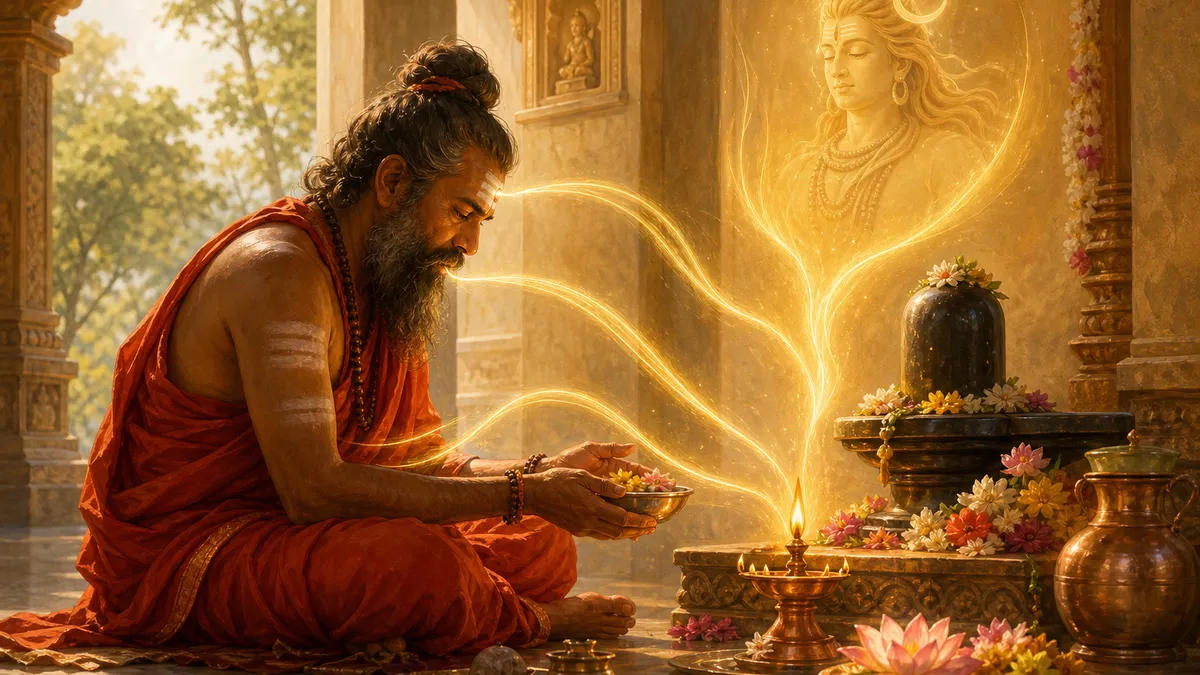
The steadfast rejection of pride in actions and speech is called the 46th dhi-shila.
So, the steadfast rejection of pride—what does it imply? A state of humility and the subsequent self-surrender to God, since pride is the manifestation of respect toward that which should not be shown respect. For example, showing excessive respect for one’s own mind, one’s ego, one’s patterns and ideas. Expressing respect for such things automatically terminates the capacity for self-surrender. By showing respect, we enlarge something, we strengthen it, and those who have stepped onto the path of liberation but at the same time wear a proud mask contradict themselves. They strive to free themselves from karma, but at the same time they are proud of their karma—is this not foolish? They want to cast it out of themselves, yet at the same time they are proud and want to keep it with them. It is like wanting to go to the toilet, but at the same time wanting to keep all of it with you simultaneously, and being proud of it. Here one must somehow decide: do you want to keep it, or do you want to throw it away, or do you want to be proud of it—this is what pride is. There is nothing good in pride if it has not been purified.
There is a category of divine pride, also called aspiration toward divine greatness, described in the tantras and important in certain tantric sadhanas of transformation, for example in transfiguration. But this is something entirely different; here we are not proud of the contents of our karma. To confuse divine pride with worldly pride is a fatal mistake that must never be made. Here we take pride in the greatness of Dattatreya, attuning ourselves to him in the state of transfiguration, to his pure qualities—this does not pertain to our karmas.
The rejection of any thoughts about objects other than Shiva is called the 47th dama-shila.
So, a sadhu rejects any thoughts other than Shiva—this is the sign of a wise, experienced sadhu. How does he reject them? There is an idea that a saint rejects other thoughts through the cessation of thoughts, the cessation of conversations, and control of the mind—such an idea corresponds to the initial level, through silence, for example, through mauna or through not maintaining conversations outside the Dharma. This exists, and at the initial stage it is especially important—not to engage in idle talk, to control the mind, to turn away worldly objects of reflection, and instead of all this to direct the mind toward Shiva. For example, you feel like talking about some worldly things; at that moment the sadhu within you should activate, give the command: “If you want to think about other worldly things—think of Shiva, think of Brahman, think of God.” At the very least, direct the mind toward a holy, sacred object.
At a higher level, reflection on Shiva ceases to be reflection in the form of analysis or visualization, and becomes the natural state of awareness, which engages the subtlest layer of the mind. At the same time, on the relative level, whatever manifests in speech or in thoughts ceases to matter, because the subtlest layer of the mind is activated with extraordinary intensity, becomes saturated with your attention, and awakens. Then always thinking of Shiva already looks different. It is not reflection on scriptures expounding the qualities of Shiva; it is not reflection on his image or attributes, such as the snake around his neck, the blue throat, the trident—although this is good for other layers of the mind at the initial stage—but what is meant is something else, and these are not concepts.
Always reflecting on Shiva means abiding in naked awareness, in the natural state, in non-conceptual awareness, and directly perceiving the non-dual space of the nature of the Mind — this is called sahaja-nishtha — establishment in nididhyasana, in the natural state of Brahman. When thoughts and words are neither accepted nor rejected, and the yogin’s mind abides in choiceless, ever-youthful, living awareness and is wide open, like the sky, it perceives divya-bhava from the state of shunya; and thoughts, words, images — what happens to them? Yes, they naturally dissolve through such abiding.
Non-acceptance of others’ belongings, except for what is lacking for the practice of dharma, is called the 48th asteya-shila.
This applies especially to sannyasis.
Abiding in contentment with things that come of themselves, and not striving for things that are absent, is called the 49th samtushti-shila.
This applies more to sannyasis, but also to karma-sannyasis. When a person becomes a karma-sannyasi, he must limit his worldly desires and needs. Not to desire more than is needed for service to the dharma, for sadhana — and that is enough.
Remembrance of the name and form of Parameshvara is called the 50th shila, which grants liberation while alive.
This shila is the practice of the yoga of the illusory body. Remembrance of the name and form is the path of transformation. It is a very profound path, and over time you will discover more and more different facets of the practice of the illusory body. This remembrance must penetrate the channels, the chakras, the mind, the unconscious mind, and transform it. The yogin must become fully convinced that his mind is like the mind of the chosen deity, that his body is the body of the chosen deity, and that his speech is the mantra of the chosen deity.
The yoga of the illusory body basically consists of two stages — the stage of creating the illusory body and the stage of dissolution. But if we take more intermediate stages, they are:
Srishti-krama (the stage of creation), when we transform into the illusory body.
Sthiti-krama — the stage of maintenance, when, meditating on the key points, we stabilize it and become established in it.
Laya-krama — when we model the process of the dissolution of the winds in the central channel and the processes of the arising of the three gunas: the white radiance, the red increase, and the black near-attainment, and then prabhasvara (clear light). We fully imagine how our illusory body and physical body dissolve in the radiance of clear light. We model these processes, which are experienced every night before sleep or especially powerfully at the moment of death. We model how our mind and winds enter the sushumna, and the karmas are folded up, the clear light is laid bare — this is laya-krama (the stage of dissolution).
Siddhi-krama — this is the stage of re-manifestation, emergence in reverse order, when the trigunas and the three lights, the three emptinesses, arise in reverse order. When from the clear light there arises the darkness of the black color of near-attainment, then redness arises, increase — this is also called the red radiance, the red outpouring. This is how rajas-guna is seen; and when the white radiance arises — sattva-guna. Then, when the illusory body arises simultaneously with tamas-guna, with the first light that arises in reverse order, with blackness, from the seed syllable we manifest like a fish leaping out of water in the form of the deity surrounded by the retinue. The five-colored radiance that begins to move at this moment is the subtlest vyana-vayu, acting from the level of turiya, and the pure state of prabhasvara, the pure clear light of the Atman, is the basis from which such an illusory body (maya-kaya) will arise; it is created from their union.
Shakti-krama — when we meditate on the powers hidden within the illusory body and cultivate them by meditating on the attributes.
Such are the five sections of the yoga of the illusory body. During this time the mantra is recited, it is maintained through visualization, the key points, very subtle work with the winds and channels is performed, and all of this is included in the program of mastering the six yogas. This is what it means to continuously maintain remembrance of the name and form of the deity.
Continuous contemplation of the name and qualities of Shambhu is called the 51st shila, which removes fetters.
Constant worship, with invocation and the like, of the feet of Shambhu is the 52nd pada-sevana-shila.
Pada-sevana means constant worship of the feet of God through upasana, through Guru Yoga, through honoring the sadhu, through honoring the Refuge. Such a spirit permeates the entire life of a sadhu — such is this shila.
Mental worship, with salutation and the like, of Shambhu is the 53rd shila, O Brihaspati.
Constant mental worship (manasik-puja), transformation, visualization during mantra recitation. This is also called the yoga of everyday life, when the elements of the illusory body accompany eating, bathing, walking, the various needs of the body, and the diverse actions that we perform.
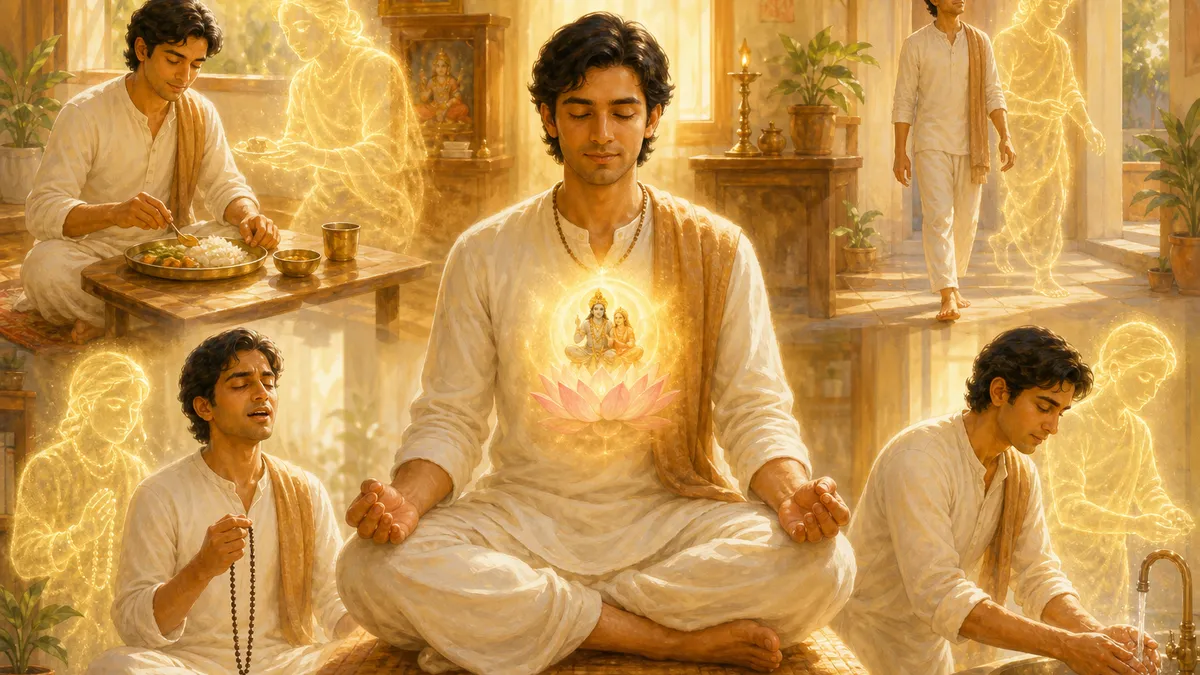
Constant mental worship of the lotus feet of Shambhu is called the 54th shila.
Constant involvement of the mind in service to Shambhu is called the 55th dasya-shila.
Dasya-shila means constantly attuning oneself to the divine will, feeling oneself to be a conduit of God. When a yogin performs sadhana, mantras, the sadhana of transformation, transforming into the illusory body of Shiva and Dattatreya, it is also very important not merely to transform, but to subordinate one’s will to the divine will. The awareness of all one’s actions as entirely directed by the divine will, the union of personal iccha-shakti with divine iccha-shakti — such is this shila. When, from morning till evening, the yogin does not reflect, but feels that at this very moment he is worshiping the divine will and conducting the divine will.
Contemplation with an intimate feeling of the beautiful image of Shambhu is called the 56th sakhya-shila.
Offering everything to the Lord is called the 57th atmarpana-shila.
Constant utterance of the mula-mantra in the mind is the 58th shila.
All these are different parts of the same yoga-sadhana, where bhakti-yoga and the yoga of the illusory body are united here.
Constant contemplation in the heart of the divine image of Shambhu is called the 59th dhyana-shila.
Contemplation of Shiva inseparably, like butter and milk, is dharana-shila.
The abiding of the mind in contemplation, like a lamp in a windless place, is called the 61st samadhi-shila.
The sixty-first shila is very important for us; samadhi-shila is nothing other than the aspiration toward sahaja-samadhi. The abiding of the mind in a silent state, an unmoving state, in contemplation, like a lamp in a windless place. First we train in mahashanti while sitting, then we train in fullness of attention, then we train in the contemplative state in movement. Inner asceticism means always keeping the mind in nididhyasana, in contemplation of Brahman, in the presence of Shiva. To accustom oneself to living in the presence of Shiva, in the natural state (sahaja-nishtha), is the main art of laya-yoga, praised ten million times by the laya-yogin. Whether you walk, stand, eat, or sleep — always contemplate the nondual king. Thus the Upanishads speak of this practice.
We are moving toward mastery of this art by mastering various stages of skill. After some time, results should come; we must correctly assess ourselves according to these stages and know various nuances. For example, what the six main errors in contemplation are, what the thirty-five deviations from the natural state are, what the sixteen stages of the development of contemplation are, and much else. In this sense, we must have complete confidence regarding shravana, manana, nididhyasana, the methods of contemplation, what the twelve Shiva-sankalpas are, and what the fourteen Shakti-sankalpas are. Over time, we must become so imbued with this that it becomes our ordinary, habitual way of life. What shambhavi-mudra is, how it differs from krama-mudra, from akasha-dharana, what the three sections of contemplative practices are: contemplation based on sankalpa, divine pride, and the path of space. We must master all of this. These are the greatest practices, firmly establishing the mind of the yogin in nididhyasana. How contemplation develops on the path of the seven lands of wisdom, what the sixteen levels of consciousness are: jagrat, svapna, sushupti, and turiya, and how, through contemplation, we advance through these stages.
Contemplation of the Lord of the universe in the state: “I am He; whatever is being done is performed by Him” — this is the 62nd shila.
Thus, after the contemplative 61st shila, the 62nd shila is the shila of pratyabhijna (self-recognition), the shila of “Shivoham.” This is precisely what is called divine greatness or the pride of the deity. The further the shilas go, the more they increase in the degree of importance and depth of practice. The conviction “I am Shiva,” “Aham Brahmasmi,” “Shivoham” is nurtured by the yogin for years. The mind of the yogin has been accustomed for a very long time to considering itself something else, and even when on the mental level we repeat the formula “Aham Brahmasmi” or sing “Shivoham,” the mind abides in its habitual bhava, and this is pashu-bhava, manushya-bhava — the human bhava. This awareness at the unconscious level is aham-dehasmi; we need to raise it to the state of “Aham Brahmasmi,” and from pashu-bhava to divya-bhava.
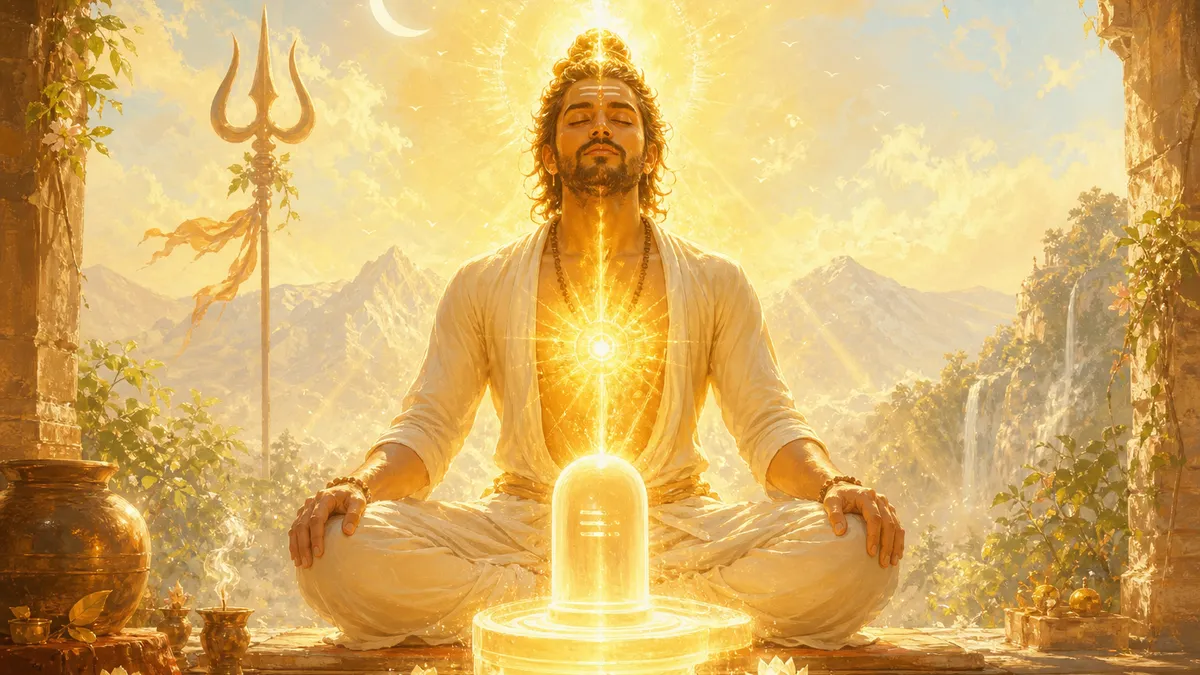
Self-recognition is preceded by being filled with Shiva — Shiva-samavesha. Being filled with Shiva is preceded by the descent of grace — Shiva-anugraha.
When these conditions come together: Shiva-dhyana, Shiva-dharana, Shiva-anugraha, Shiva-samavesha, then prapatti also occurs; then, after Shiva-samavesha, self-surrender; and when all these conditions come together, the 62nd shila occurs — the state of “I am Shiva” (“Shivoham”). But it will not come just like that; it will come only when all these conditions have been gathered. If these conditions have not been gathered, it will not be able to come, because the mind will tune itself and repeat: “I am Shiva,” while the unconscious, full of karmic copies of various karmic images, will repeat: “I am a jiva.” The unconscious will not believe what the mind says, and the jiva is subject to karma, acts according to the law of samskaras, and is drawn to karmic things. Only when all these processes take place, when Shiva-dharana and Shiva-dhyana arise in the unconscious mind, and the streams of samskaras are moved aside and a strong, positive samskara is generated — concentration on God — grace (Anugraha) will descend as a result of this, and fullness with this grace (Shiva-samavesha) will arise. From this fullness, self-surrender will naturally be born; everything that was unconscious will be dissolved in the pure light of the Absolute, and only then will self-recognition come, not before.
Contemplation of the boundless image of the Great Lord, O Teacher of the gods, is the 63rd shila.
The sixty-third shila is sahaja-samadhi. The higher the shilas, the more global our duties become. Shilas are norms of conduct, duties, rules, and all the higher rules are connected with nondual consciousness, with abiding in Brahman.
Contemplation of the infinite image of Shiva as one’s own form, the essence of the Universe, not forgetting the bliss of Shiva even for a moment — such steadfast abiding is called the 64th shila.
Thus, the 64th shila is the highest. All the last four or five shilas are the shilas of Anuttara Tantra, the shilas of Laya Yoga, and they are the subject of careful practice precisely in Laya Yoga and in Anuttara Tantra. From the lower shilas we move toward the highest, and then toward the greatest shilas.
