Commentary on the text “The Instructions of Saint Jigme Lingpa”
Constantly keep only three things in mind: the Dharma, your Teacher, and living beings. Do not practice or think about anything else. Do not compete or vie with various monks or realized practitioners. Keep your mind under control and your mouth shut. This is very important, so “do not fool around.” If you hold forth about the Dharma while thinking only of personal gain in future lives, then this Dharma must first of all be practiced by you yourself. You may, of course, hope that after your death others will help you through virtuous practices, but it is by no means certain that you will benefit from this. Therefore, engage in inner work on yourself. First of all, develop deep renunciation in your mind, consciously equate life with practice, and form a basis of great diligence. In the main part of the practice, concentrate on the key principles of the profound view and meditation. In addition to this, conduct yourself in accordance with the vows and samayas you have taken, without becoming confused about what should be adopted and what should be rejected.
If you have the spirit of retreat practice, then you do not need strict external rules; you generate the impeccable spirit directed toward awakening.
Obstacles on the Path
Then all enlightened qualities will inevitably arise within you from the inside. Laya Yoga is a path on which even sinners irrevocably attain enlightenment. Because of the extraordinary depth of this teaching, you must be prepared for obstacles, which should be understood as a great risk accompanying great profit. They are explained by the fact that the negative karma you accumulated in the past is activated by the power of the profound instructions, and as a sign of this, external demonic obstacles and ghosts arise. For example, spirits and samsaric gods will appear in the place of your practice; they will call you by name. They will assume the forms of buddhas and give you prophecies. Various terrifying visions will occur in your dreams and experiences. You may be attacked, robbed, or plundered by other people. You may fall ill or get into all sorts of adventures. In your mind, you will grieve without any particular reason, and also fall into depression to the point of tears. You will be overwhelmed by turbulent emotions. Your devotion, compassion, and bodhichitta will diminish; your thoughts will rebel against you, driving you to madness. You will misunderstand helpful advice. You will become sick of being in retreat and will want to break your vow. Erroneous thoughts about the Teacher will arise in you. You will be assailed by doubts about the Dharma. You may be accused of others’ sins; people may slander you. Your friends may turn into enemies. Various undesirable circumstances, both external and internal, may arise for you. Thus, you must understand these obstacles as a test for yourself.
Some of this, obviously, each of you has already had time to experience. If you are an experienced practitioner, for you this is merely a test to see how deep your exercise in contemplation is, and how unwavering your mind is. If you are a beginner, you will look pale, and your mind will be in confusion.
This is the very threshold at which you either win or lose. If you cope with these obstacles by means of the key points of practice, they will turn into your accomplishment. If, however, you fall under their influence, they will become an insurmountable barrier to progress in your practice. In all these situations, observe your samayas impeccably, and direct all your faith and thoughts toward your Teacher, praying to him with complete dedication from the depths of your heart and believing that he knows all your trials. If you regard adverse circumstances as desirable and practice with full diligence, then after some time these circumstances will spontaneously lose their force, and your practice will improve significantly along with this.
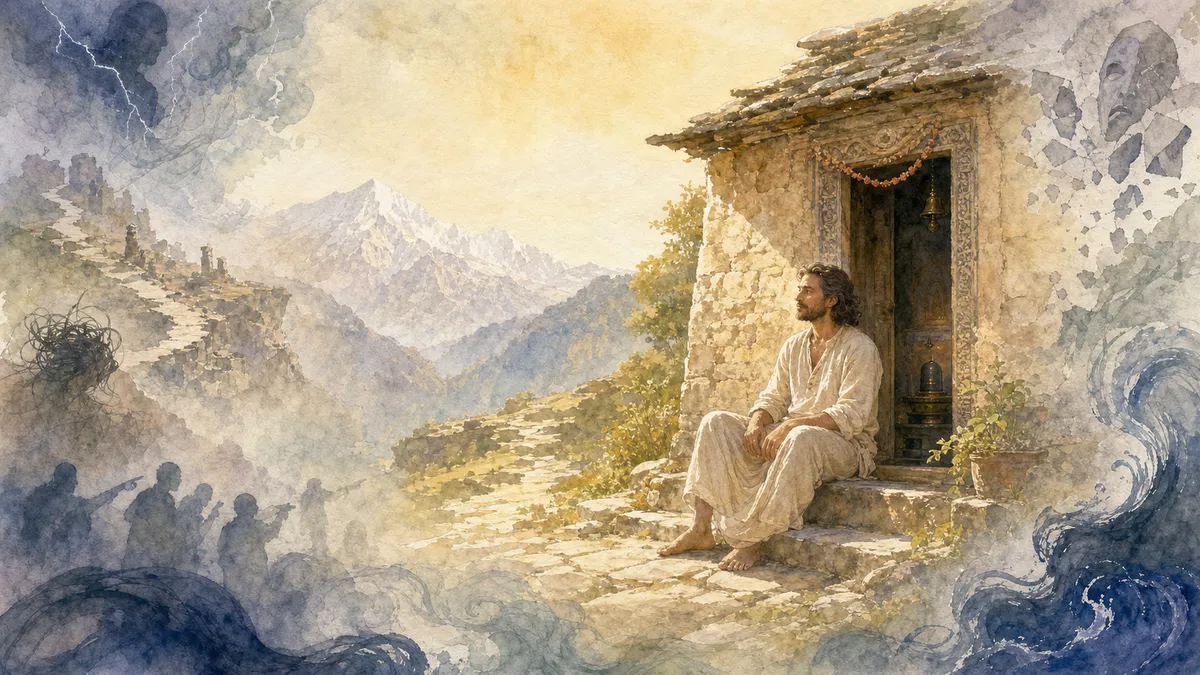
Since many of you continuously receive instructions and live in the sangha, perhaps not all of these things will manifest vividly. Nevertheless, they may occur in a subtle way and intensify during retreat. Therefore, a true yogin never considers himself an experienced practitioner, but always maintains a spirit like that of a lion or tiger before a leap.
Personally, I did not experience obstacles in practice, due to the merits of past lives. To read a sutra was, for me, the same as to realize it. However, I encountered many obstacles when I had disciples, when the karma of other people influenced my mind. But because consciousness was already in an unshakable natural state, these obstacles could not cause me even the slightest suffering. And although at times my practice was on the verge of life and death, it was perceived as yet another game, as a way of training, and even awakened still greater clarity and awareness.

Phenomena will appear scattered and fragmented, and you will develop even greater confidence in your Guru and his instructions. Even if such trials befall you in the future, you will maintain confidence and peace of mind, thinking: “What problems? Everything is all right.” This is the only way out of all situations. If you are able to use any circumstances on the path of practice, then you know the way out of all trials. How wonderful.
As long as devotion to the light of contemplation has not been revealed and there is clinging to the ego, such problems may be taken seriously. But once this has been accomplished, most of these obstacles disappear by themselves, and the rest are simply not seen as obstacles. Therefore, a truly experienced practitioner unwaveringly maintains his samayas, the chief of which is the single samaya of contemplation. He unwaveringly maintains pure vision. Thanks to this, everything that was samsara and rose up against him turns into his helpers on the path. Apart from purity and light, he sees nothing. Such a yogin practices playfully, without even the slightest problems.
Forms of Egoism and Their Overcoming
As for clinging to the “I,” you postpone practice because of attachment to your country, home, wealth, and possessions. When you find a needle and thread, you praise God, but if you lose a pen or shoelaces, you immediately lose heart. Such are the external manifestations of egoism. The internal manifestations include perceiving the masters of one’s own tradition as deities and all others as demons, as well as thoughts such as “how am I worse than Buddha Shakyamuni?”, which are the result of a lack of self-criticism. The secret forms of egoism include material clinging during the development stage, the conceptual framing of the completion stage, bias in the practice of compassion, or assertions that all things are empty and devoid of independent nature, accompanied by clinging to the nature of emptiness itself, similar to the way a beautiful woman with clouded perception is obsessed with her body, as well as thoughts such as “hardly anyone has reached my level of meditation, therefore I should not consult anyone...”. If this is so, then your life will pass in vain. I will give you one piece of advice: if you decisively cast aside attachments to your country, wealth, and property, then half of the Dharma will be realized automatically.
Create a firm foundation of preliminary practices and do not neglect them by saying that everything is empty, losing conduct in view. As for the main part of the practice, it should be carried out in a secluded, unfamiliar place, where you will be accompanied only by awareness and the vow to maintain the continuous flow of the natural state. If good or bad news reaches you, provoking fears and hopes, do not take it seriously, do not reject it, and do not accept it as truth. Be like a dead person to whom anything can be said.
Instructions of the Saint Jigme Lingpa
Whatever hour I woke up, I did not fall into drowsiness; I focused my attention single-pointedly, thanks to which I was able to make progress in practice. In short, during these three years, I always ate the same amount of food and covered myself with only one cotton cloak. Not a single word seeped through the inner door. And even my retreat assistants did not step over the threshold of the inner door. By virtue of my renunciation, aversion to samsara, and clear understanding of the unpredictability of death, I never allowed myself to gossip or engage in idle talk. You, my students, merely hang retreat signs on the door, while your thoughts wander wherever they please. When sounds are heard outside, you turn into watchmen and listen to every rustle. If you meet someone at the inner door, you discuss the news in China, Tibet, Mongolia, or anywhere else. Your six senses wander outside, and you lose the entire effect of your retreat. You follow external objects and perceptions, while your attainments disappear outside, inviting obstacles inward. If you follow such habits, the time of your retreat will expire, and your mind will remain unchanged. You must not leave retreat the same as you were before it; be resolute in this. Whatever you do in retreat—meditation, reading prayers, daily practices, writing, being sick, ailing, or dying—you must always maintain the inexpressible nature of your Mind, which lies beyond conceptual reason. Without overexerting or slackening, without meditating or being distracted, without correcting or affirming, without improving or worsening, you must not be separated from this present awareness.
If you look at the Teacher, he often appears absorbed in ordinary affairs or engaged in carefree conversation. However, this is accompanied by uninterrupted immersion in contemplation, the right to which he has won through his own practice in retreat. If you have the capacity for such contemplation, you do not need any special retreat, and your very state will be a retreat. If this is not the case, then you should diligently take care of your own awareness.
Our retreat rules are quite powerful. I think that even ordinary monks, after coming out of a three-month retreat, will spend about ten or fifteen days in retreat each month. Many laypeople initially take up retreats with great zeal. Having received some experiences, they come out of them and continue doing their old affairs. This is the worst kind of retreat practice, because they have not cut off egoism or undergone long training alongside the Teacher. They are accustomed to following whatever comes into their heads. By contrast, in our practice we enter slowly, prepare thoroughly, and then go for a very long time and in depth. Therefore, twelve years of preparation is not much at all, considering that you can spend the remaining eighty in retreat, in complete seclusion. Many think the opposite: they immediately want to sit in a long retreat, after which they will again manifest their subconscious and play out their old karmas.
The Dangers of Breaking Samaya
If you part from awareness, various thoughts will begin to arise in you, increasing your vanity regarding realization. You will think: “I know the Dharma and am acquainted with many teachers.” You will begin discussing the shortcomings of your Dharma friends, accumulating wealth, creating unpleasant situations, and wasting your time on many things, not one of which will be right. In addition, if you tell people who do not have the same samaya about your experiences, realizations, dreams, practical information, and difficulties of practice in retreat, as well as the shortcomings of practitioners in your lineage, then your attainments will disappear, while shortcomings, on the contrary, will come to light. Therefore, be humbler, maintain harmonious relations with everyone, wear tattered clothing, and do not trouble yourself with worldly ambitions. Within, you should have no fear even of the lord of death. Outwardly, you should create a pleasant impression by being peaceful.
When you do a retreat, never break your vows; be like a stake firmly driven into the ground. If bad news reaches you or an unpleasant situation occurs, do not panic, but be like a reckless madman. When you are among many people and lose awareness because of ordinary things, you must train in the boundless pure perception of all conditioned phenomena. When you do practices with prana, you must not lose concentration, like a person threading a needle; even if death suddenly descends upon you, you should have no melancholy or regrets, like an eagle soaring in the sky, and nothing should remain unfinished in your mind.
With these most important principles, you will be able to attain the absolute accomplishment of the enlightened ones of the past and will also fulfill all wishes. Thus your life will gain meaning. Having entered the gates of the supreme teaching, you will attain the ultimate fruit.
The merit of practicing in the sangha also lies in the fact that you can refine your contemplation in a variety of situations. When you come out of retreat, you find yourself in various circumstances where the awareness you have attained is tested for strength. If you do not experience such diverse situations, then most likely, even after spending many years in retreat, you will be like a good plant that has grown in a greenhouse but does not know what the scorching sun or a strong wind is. Therefore, you may have illusions or illusory notions regarding the strength of your own awareness if you do not find yourself in the various circumstances that the teaching provides you. When you practice by alternating retreat and ordinary practice in roughly a fifty-fifty ratio, and sometimes retreat takes up even more time, then you have such an opportunity. This means the fullness or completeness of spiritual training.
Principles of Retreat
The external aspect or principle of retreat means that no one is allowed to cross the territorial boundary and intrude into the place of retreat. (Except those who have been appointed). The person who is in seclusion, in turn, cannot leave the territory of the retreat, remaining there as if rooted to the spot. Inner retreat means the cessation of all worldly activities of body, speech, and mind—that is, everyday affairs, ordinary conversations, and non-religious thoughts. While in seclusion, you should not engage in such matters. Secret retreat implies non-distraction from awareness of the nature of Mind. The meaning of seclusion consists in eliminating distractions and gaining the opportunity to devote body, speech, and mind wholly and completely to the attainment of enlightenment. Buddha Shakyamuni spent six years in retreat in the jungles of Bodhgaya. The mahasiddhas of India spent many years in seclusion. Many great masters of Tibet lived their whole lives in retreat. Our practice of meditation and conduct suffers from various distractions. Even if you have not realized the nature of Mind, nevertheless you need to spend a great deal of time in retreat in order to achieve stability in this awareness. Attaining complete enlightenment in one lifetime without retreat is simply impossible.
The true place of retreat is a deeply meaningful understanding of impermanence. The thought “I may die at any moment” must pierce the heart, and it is precisely this thought that should become your true retreat hut. If you have such a strong sense of impermanence, then your renunciation will develop spontaneously; you will detach yourself from attachment to samsara, seeing how meaningless and futile all samsaric activities are. You will reject attachment to samsara in the same way as if you had vomited. After you have vomited, you do not go back to swallow all the vomit. Only dogs can eat vomit. This is the true attitude of a yogin. Having detached from samsaric activities, a yogin does not turn back.
A true yogin thinks this way: “If I die, that is all right; if I fall ill, that is also all right. Whatever happens to me is simply wonderful. I will only practice. I have no time to waste. There is nothing left for me but to sit and practice.” It is in this way that he or she draws the boundary, leaving behind all the concerns of this life.
Qualities of a True Practitioner
A practitioner is not someone who counts the months or years of their retreat, but someone who sits with the mind fully focused on practice. It was only through such aspiration that the siddhas of the past attained enlightenment. You too need such determination if you want to attain enlightenment in a single lifetime. If you practice in this way, you will not be harmed by worldly concerns, namely: gain and loss, fame and disgrace, praise and blame, pleasure and suffering.
True renunciation, which arises as a result of reflecting on impermanence, should lead to absolute devotion, absolute self-surrender to this boundless Source. That is, reflecting on impermanence does not mean falling into a state of oppression, depression, and constantly thinking: “How terrible, I could die at any moment, since everyone dies.” Thinking this way is useful, but the ultimate goal is not this; it is to cut off all your own illusions that distract you from contemplation of the Source. When you have immersed your mind in the boundless Source, thrown the ego into its furnace and melted it down, then neither life nor death, and certainly no samsaric concerns, selfishness, illusions, and so on, have any significance for you. In your soul you have already become a dancing madman, driven mad by God.
Set your mind on the Dharma.
Set the practice of Dharma on poverty.
Set poverty all the way to death.
Set death in an empty cave.
Leave the society of people, join the company of dogs, attain the level of the gods.
These are the instructions of the saint Atisha. “Join the company of dogs” does not mean living together with Seva and other dogs or cows. In tantric terminology, “dogs” and “pigs” are practitioners who have gone beyond duality, beyond all samsaric conventions. That is, join this inconceivable consciousness of those who do not distinguish between tasty and tasteless, pure and impure, good and evil, who have completely released their mind into nonduality.
The Danger of False Renunciation
A beginning practitioner is full of enthusiasm, thinking: “Everything is impermanent, I may die soon. What use are gold, money, and wealth? I would rather give them to others.” After a couple of years, he realizes that he has not developed true renunciation; he feels that no shift has occurred in his practice and decides to return to worldly pursuits. Since he has had a lot of time for reflection, he becomes more resourceful and practical in earning money than before. He turns into a so-called “old practitioner.” Such an old practitioner thinks: “This piece of leather lying by the roadside could still be used for something. Perhaps I will pick it up, put it into proper shape, and sell it at a profit.” Such practitioners pick up even what dogs will not touch. Unfortunately, this happens to many. Such practitioners do not progress on the path because they have not developed deep renunciation, do not feel revulsion toward samsara, and have not generated within themselves an understanding of impermanence. From the very beginning of Dharma practice, a true practitioner must have a strong and unwavering intention not to end up being commemorated in the repose prayers. This intention must be unchanging, like a vajra. Develop renunciation and revulsion toward samsara; accept into your heart the feeling of impermanence.
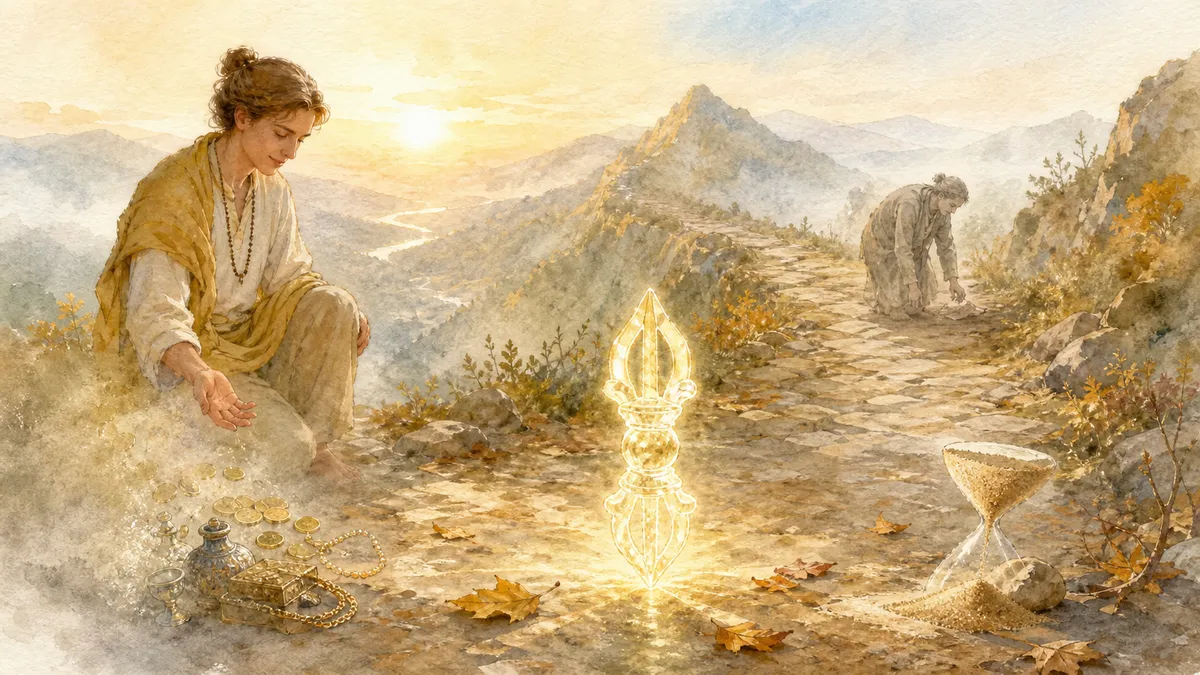
Set your mind on the Dharma
Since you have attained a precious human body, devote all your strength and interest to the Teacher. Do not waste your energy and time on other things. Resolve that you will practice your whole life. Never abandon Dharma practice, no matter what happens.
Set the practice of Dharma on poverty
Do not become wealthy people; do not burn up your time accumulating money, protecting and increasing capital. Do not become slaves to your wealth. If you servilely worship money and wealth, you will never have a chance to attain realization in practice. This is an argument in favor of a poor way of life, which supports practice without many distractions. Poverty in this context means that you have a place for retreat, clothing to cover yourself, enough food and drink. No more, no less.
It seems that these instructions do not concern monks, since one can hardly become rich with twenty-one items, and even if one tried, one’s monasticism would immediately be called into question. Yet how did two monks in retreat manage to fail to share the space and almost get into a fight over ten centimeters of a tuket? Having renounced much, they could not renounce ten centimeters. This is delightful. Therefore, there is something to think about.
Resolve to remain poor until death
Remain poor practitioners throughout your entire life. Do not turn into businessmen, do not return to a distracting way of life. Be simple and humble to the end.
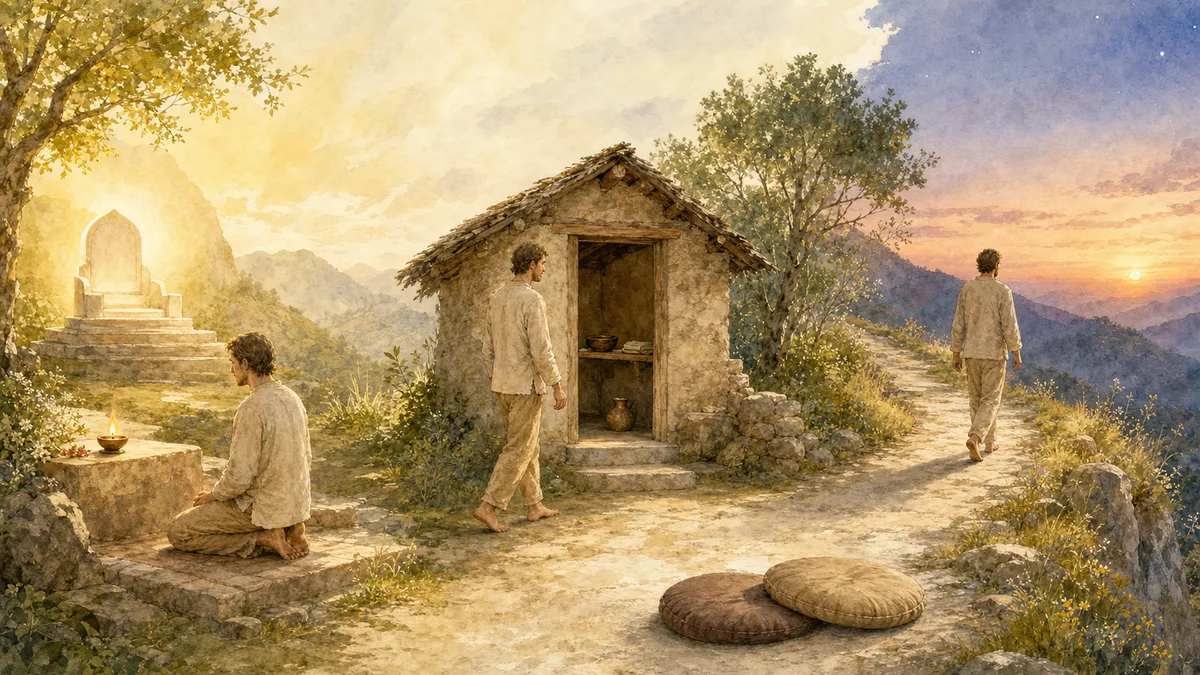
Resolve to die in an empty cave
Die alone in a cave, in a gorge, on a mountain ridge, or in another similar place where true yogins die. The place of a yogi’s or yogini’s death is not an object of construction, it does not require maintenance, and it does not need real estate ownership rights. Therefore a yogi or yogini has no worries such as: “What will happen to my body after death? What will happen to my wealth when I die? To whom should I pass on my property?” No one gives anything to yogins, and no one receives anything from yogins. They are completely free and independent. The time of death is the most important moment in life, and at that moment it is essentially important to be independent, since any attachment or anxiety can cause harm.
If attachments, relatives, and the like remain in your soul and they pull at you, then wish your relatives happiness and forget about them; let go of these attachments, while at the same time experiencing toward them the four immeasurable states of consciousness. Think as follows: “My enlightenment is the best gift I can give to my father and mother, because through the karmic connection they will receive phowa. If I do not attain enlightenment, how will I perform phowa for them? And whom will all these sentiments help?”
Leave human society
Such yogins are no longer regarded as normal people. Milarepa once said: “When I look at people, it seems to me that they are insane, and when people look at me, they think that I am the one who has gone mad.” Do not maintain ties. A yogi prefers to leave human society.
Join the company of dogs
Such a yogi has abandoned all notions of pure and impure; he can eat together with dogs. He does not rejoice when people speak to him politely. If he is ignored, he does not become upset. He keeps to the lowest position, wearing ragged clothes and begging for alms to sustain himself. He is indifferent to what others think of him, and he regards worldly success, fine clothes, delicious food, and reputation as vices. He has gone beyond hopes and fears; he has realized the view of equality.
Attain the level of the gods
This yogi has cast aside the eight worldly concerns. And although he has the body of an ordinary person, his mind is already awakened. He has attained the level of the gods.
These teachings, given for true practitioners, set the standards for attaining enlightenment within a single lifetime.
The Transition from Sutra to Tantra
These teachings are especially important at the level of sutra practice. For the practice of tantra can be undertaken only when you have already gained all such realization, when a profound transformation has taken place within you and great renunciation has arisen, when samsaric fluctuations and thoughts cannot approach you even to the slightest degree.
The approach of sutra is renunciation. After it comes the approach of tantra and anuttara tantra. We have already thrown everything superfluous out of our consciousness, and therefore we direct our mind toward attachment. This is not attachment to the worldly, but to the absolute. We enter into such meditation on the Absolute that we are completely absorbed by it, as if we burn up without remainder in this self-offering and in the fire of contemplation. We think of the absolute, live, eat, and sleep in the absolute. We are like a child who does not know that his mother fed him during the night. Something happens, but it does not interest us. We are completely absorbed in the great Source. This light of great awareness is the only thing we have.
The Danger of Premature Teaching
Anticipation and hopes of becoming a teacher inherently contain the eight worldly concerns. Some practitioners, having spent several years in retreat, suddenly become excited about their diligence and knowledge. They think: “Now I should pass my knowledge on to others and become a teacher. I have something to teach, and people will probably want to listen. I should leave seclusion and do something for the benefit of others.” Such thoughts arise when true renunciation is absent from the heart. One does not become a true yogi or yogini by the number of years spent in retreat. No matter how long the retreat lasts, something is still missing if progress in awareness has not been achieved, if true devotion and compassion have not appeared, if renunciation and aversion to samsara have not arisen.

Examining Your Mind
Examine your mind. Is there a deep sense of renunciation in it? Have you realized in your heart the futility of all samsaric activities? Do you still harbor attachment to them? Do you always remember impermanence? Do you treat every minute as if it were the last in your life? Do you have genuine aversion to samsara? Do you feel in your heart that all beings are in fact like your father and your mother? Do tears well up in your eyes the moment you remember your root Guru? Are you always present in wakefulness and awareness without distractions? Do you have pure perception of everything around you?
When stability in the awareness of the nature of Mind is attained, wisdom, love, and enlightened activities manifest spontaneously and effortlessly. This is the meaning of the phrase: “Knowing the One liberates everything.” This state is beyond hopes and fears, appropriation and rejection. One who has attained stability will not fight with other people, see impurity, or indulge the eight worldly dharmas; this is simply impossible.
Criteria of a True Yogi
A hidden yogi, following the example of the masters of the past, will not teach at all until he has attained stability and the wakefulness of awareness. Even if he is asked before that moment, he will refuse to give teachings. When he is no longer distracted from awareness even for a moment, his activities for the benefit of others unfold spontaneously. The great danger lies in abandoning the yogic way of life before the path has been completed.
The level of certainty in the natural state implies the ability to unite the practice of awareness with everyday activities. At this stage, the practitioner is not subject to either negative or positive circumstances and does not lose awareness even in extreme situations. All doubts regarding awareness have completely disappeared, and all circumstances only support the practice of the natural state. At this level, a single, continuous, effortless presence in naked awareness lasts at least twenty minutes, during which there is not the slightest distraction. In this case, the yogi has truly realized the unchanging nature of the wakefulness of awareness. Even if he were to be distracted, the essence would still remain unchanged. Although there are no distractions, you are free from orientations and concentration. A true yogi maintains awareness of the essence while engaged in everyday activities. The expression of awareness is capable of functioning fully in any situation without losing awareness of its essence. By maintaining awareness of the essence, there is no concentration or orientation whatsoever. When you reach this level in your practice, then you will bear the name yogi.

The Wandering Yogi
A wandering yogin is one who has abandoned all worldly occupations. He never travels either on horseback, by car, or by any other means of transport. He wanders on foot, using a long staff for walking. He carries his meager belongings on his back. He lives on what people offer him. He does not accumulate wealth; he has neither a judge nor an assistant. He prepares his own food. Having no home, he does not stay long in any one place. If he comes across a small hut, he may live in it for some time, or he may spend several months in a cave or at the foot of a mountain. He moves from one secluded place to another and makes no plans about where he will be or for how long. If you ask such a yogi where he will be in a month, he will have no schedule for you. He wanders unpredictably like a soaring bird. A true wandering yogin is outwardly free from the stereotypes of worldly behavior and inwardly devoid of thoughts connected with the eight worldly concerns. A wandering yogin is also called a hidden yogin, since he never reveals his meditative experiences and realization, and keeps secret his root Guru and personal practice. A wandering yogin is also called a yogin of simplicity, for he wanders without religious paraphernalia, carrying with him prayer beads and a couple of texts. Nothing more.
Although in India this style remains popular to this day, in Russia it is better to be a samana than a wandering yogin, because the point is not to roam here or there, but to attain realization. There are many wandering yogis in India because India has many saints and a high level of training that comes from ancient times. Many join the wandering yogis simply by imitating them. There are wandering people who resemble yogis. They choose such a way of life because in India people readily give alms to wandering yogis and make offerings. But the true meaning of practice is realization.
For some time I was such a wandering yogin. After the retreat, my experiences progressed well, largely thanks to my Guru, thanks to the fact that I received two shaktipats from him. You were not so fortunate. However, you have a powerful system of practice, so I think you are even more fortunate. Even when I preached, I continued to live the lifestyle of such a yogin. Because of this, many people sometimes even gossiped about me. They were used to important lamas coming from Tibet or from the West, so they thought I was some kind of impostor. I mentioned nothing about myself or about what I had been doing. In general, I led a very hidden way of life. However, such a state is the highest yogic practice.
Therefore, a true monk always maintains such depth of realization; he is both open and not open. This means that he knows when, to whom, and what can be said, and what cannot be said. In the sangha he has neither close friends nor, all the more, enemies; he is like a soaring eagle who values his sangha and has a connection with the Guru and the Dharma. But now, when the Guru has acquired a respectable appearance and his books are being published, people write from everywhere: “We admire your books; you are a professional in spiritual practice,” and ask for advice. However, both when people gossiped about me and when they praised me, it was absolutely all the same to me, because I know the value of both praise and slander from ordinary people. It is the same. Only a complete fool can take it seriously. In both cases we simply perceive it with irony.
The Example of the Great Masters
Great masters such as Milarepa, Longchenpa, Jigme Lingpa, or Patrul Rinpoche did not consider relationships, friendship, wealth, clothing, or food important at all. They did not go to parties, did not please friends with gifts, did not care about how society would think of them. They were not separated from their practice, since they did not depend on others. They relied only on the practice of awareness. They had no other interest besides attaining enlightenment within one lifetime.
Outwardly, avoid distracting samsaric activities; inwardly, do not allow your mind to be distracted from practice. If you rid yourself of outer and inner distractions, your mind will become very clear. In such a clear mind, the qualities of renunciation, compassion, devotion, and meditation will easily arise. To achieve this, remain in retreat. It is better to loosen up in true awareness for one minute than to spend a year in relative meditation. Therefore it is very important to be beyond any doubt with regard to the true view. If you have truly realized the nature of Mind, be confident in the instructions of your root Guru and do not run after every teacher and every teaching. Live on your own and practice. Practice until you attain stability. At first you need to realize the essence, then perfect the strength of this realization, and in the end attain stability in it. Stability means the absence of the slightest distraction even for a second. When stability in awareness has been attained, that is full enlightenment. And the inconceivable qualities of wisdom, loving simplicity, and enlightened activities will arise spontaneously and simultaneously with this. Do not rush to teach until you have reached this level. Do not take modern teachers as an example.
The Proper Distance from the Guru
Until you have fully determined the view, while you still have subtle doubts, do only short retreats. Meet with your root Guru again and again. Examine your mind: “Do I have any anticipations or fears? Are there clinging and attachments in my view?” You must reach the level called “certainty in the natural state.” This is the level of substantial stability in awareness of the nature of Mind. When all doubts disappear, your devotion to the root Guru will become boundless.
Nevertheless, do not stay too close to your root Guru. The saying goes: “The Guru is like fire; do not come too close.” If you are too close to him, you may develop perverse ideas and begin to doubt him, thereby spoiling your samayas.
Why does this happen? Often in various traditions, for example in Vaishnava tantra, it is said: “Being near the Guru, one can accumulate great merit, but one can also accumulate great aparadhas.” The point is that we are not yet conscious enough to continuously see only light in the Guru. Since his body is seen more clearly than the light, we may tend to pay attention to the activity of his body and mind, while the light recedes into the background. If we do not have proper self-liberation, after some time we become attached to the activities of the body and mind, and then we begin to judge and pass verdicts left and right. This is what samayas exist for.
The samayas unequivocally prescribe perceiving the Guru as light and seeing the activities of the Guru’s body and mind precisely as the activity of such light. And in no other way. Why else is it important not to be constantly near the Guru? Not because the Guru has any problems, but because, being near you, out of compassion he conceals the full activity of his self-realization, taking into account your limitations and fearing that he might bring you distress. If he were to directly manifest his transcendent realization, it would be overwhelming for you. And since he conceals it, he behaves according to the circumstances, your own limitations and karmas, or according to monastic rules. Seeing only this side of the Guru, you may develop some incorrect views regarding him. The samayas always protect you from such things. Therefore, keeping the samayas pure is a way never to be mistaken.
If, however, you are away from him for some time, doing retreat, your devotion and pure perception of the Guru will only increase. If you truly comprehend the naked state of awareness, you will perceive your root Guru as a Buddha. The nature of Buddha can be realized only thanks to the kindness of the root Guru. Therefore it is said: “The kindness of the Guru is greater than the kindness of the Buddha.”
Transmission of the Enlightened Mind
Once, the Master said to his disciple: “A time will come when, through the power of your great devotion, you will see the true Buddha in me. At that moment, true realization will dawn in your mind.” When the blessing of the Guru touches the disciple’s mind, the disciple discovers naked awareness within himself. Such transmission depends entirely and completely on the disciple’s devotion. If a disciple with pure devotion meets a qualified master, the transmission of enlightened mind will undoubtedly take place. But if there is no stable and pure faith, the result of the transmission will be in question. This is the key point. For this to happen, the disciple must have boundless devotion and pure vision of the Guru.
Recognizing the essence, perfecting the power of awareness, and attaining stability occur only through the blessing of the Guru. Through the power of sincere devotion, you gather accumulations and purify obscurations. If merit and wisdom have not been accumulated and obscurations have not been purified, true awareness of the nature of Mind is impossible. The tantras say: “It is better to remember your Guru for a second than to meditate for a hundred thousand kalpas.”
As one practices, one should clarify the state of the Guru into the primordial Clear Light of awareness, eliminating other dualistic ideas about the Guru.
Types of Devotion
If you are filled with a delight you have never experienced before upon learning of the inconceivable qualities of your root Guru, this is called admiring devotion. If you strive to be free from the sufferings of the lower realms and wish to emulate the qualities of enlightened masters, this is called aspiring devotion. Understand that your wanderings in samsara for countless kalpas occur only because of ignorance of the naked state of awareness. Through the power of the Guru’s blessing and instructions, you must now realize your enlightened essence beyond doubt. Awareness is also called the self-sufficient king and the single knowledge that liberates everything. The true root Guru is the one who introduced you to the naked state of awareness, after which no doubts remained in you. If you have truly realized the genuine, naked nature of Mind, you will never lose devotion to your root Guru and will not limit yourself in your practice. If you have deeply comprehended the unfathomable kindness of your root Guru, irreversible faith will arise in you.
Everyone has Buddha-nature, but one still needs to learn to recognize it. Even if you have an idea of how to recognize it, such knowledge alone will get you nowhere. You must become certain of it, and for this you need a root Guru who will help deepen your confidence in the enlightened nature. He will explain to you the difference between the subconscious, the distinction between the dualistic mind and awareness, as well as the difference between consciousness and wakefulness. Without the blessings and instructions of a true Master, you will never recognize this or become certain of it. That is why everyone needs a Guru.
Serve your Guru with body, speech, and mind, following his commands without deception. Never allow evil intentions or bad thoughts toward him. Never harm him, insult him, or oppose his instructions even in the slightest. Value the Master more than your parents and more dearly than your own eyes. Serve him and please him with the three delights: best of all through your practice, then through service, and after that through material offerings.
Since the Guru has very few desires, and in fact none at all, the best way to please him is to practice well, and the rest of the time to serve others so that they can practice well.
The Guru as the Embodiment of All Masters
Perceive your root Guru as the embodiment of all the Masters of the lineage. When thousands of stars are reflected on the surface of a single lake, there is no need to entice each one of them separately. In this example, the lake symbolizes the root Guru, while all the Masters of the lineage are compared to stars. Maintain pure vision and devotion to your root Guru at all times. The more you practice, the more faith in the root Guru will grow. When you reach the level where you see the Guru as the Buddha himself in person, such thoughts will arise in you: “He has bestowed upon me the most profound instructions, which I must put into practice and gain experience and realization.”
From the point of view of nonduality, when you see the Guru as the Buddha in person, at that very moment you will begin to see yourself as a fully awakened being. This moment is almost indistinguishable in time. This is what is called self-recognition. Because when we attain enlightenment, everything is seen as fully awakened.
“He transmitted the enlightened mind to me, and there is simply no greater kindness. Only through the blessing and kindness of the Guru was I able to realize the enlightened mind. This realization cannot be given by parents, friends, money, or power. In the entire Universe there is no greater kindness and no deeper instructions.” When you think in this way about the root Guru, tears of devotion should flow by themselves.
When great masters announce the name of their root Guru at the beginning of an initiation, they sometimes cannot continue the recitation; they sit and weep before the disciples, thinking of the root Guru. Such an initiation is very precious, since such a transmission is a royal initiation.
Devotion as a Path to Realization
“At the moment of strong devotion and great compassion, you must realize your awareness.” At that moment awareness is absolutely pure—this is what one of the masters meant. In the moment of love, the empty essence rises in nakedness. Here the word love means both devotion and compassion. Moment means the time when your devotion meets the Guru’s blessing. Not even the subtlest concepts remain. All mental movements completely disappear. At that moment only naked emptiness remains, without errors or obscurations, like a completely pure sky. Devotion and compassion are the best means for improving practice. “Devotion is the only panacea,” the ancient masters said.
It happens that when you practice for a long time, you immerse yourself in the inner state and then experience this or that. In an imperceptible, subtle way, we become involved in the most delicate game with ourselves. It is as if we are walking through the labyrinths of the cocoon of individual perception, curiously looking at what is inside us. Previously all this was hidden, but now it comes to the surface. We can wander for months inside the cocoon of individual perception like a monkey locked in a cage, curiously exploring the corners of that cage. Then, when we become bored with this, our mind becomes restless, and we feel that in this way we have not gotten out of this cage.
However, self-transcendence or devotion is what immediately leads us beyond this cage. We know that the principle of non-“I” is operating here, and we do not need to examine the corners of this cage; we need to break open the cocoon of individual perception, and this is always self-transcendence, the surpassing of the “I.” This means that for this we need to direct the mind toward an object that surpasses our “I.” When the mind is seized by the “tiger” of devotion, the false ego no longer has any chance to wander in the cocoon of individual perception. And then we suddenly awaken a deep understanding beyond duality.

Mindfulness and Vigilance in Meditation
Question: before a thought appears, an intention appears in awareness. Could you explain?
The intention of what?
To analyze.
To analyze thoughts?
A klesha arises, a very subtle intention appears, and then suddenly a thought appears again.
To analyze the kleshas for the purpose of dissolving them, or for the purpose of enjoying them?
Enjoyment, if you become carried away by them. But if you remain at a distance, they self-liberate.
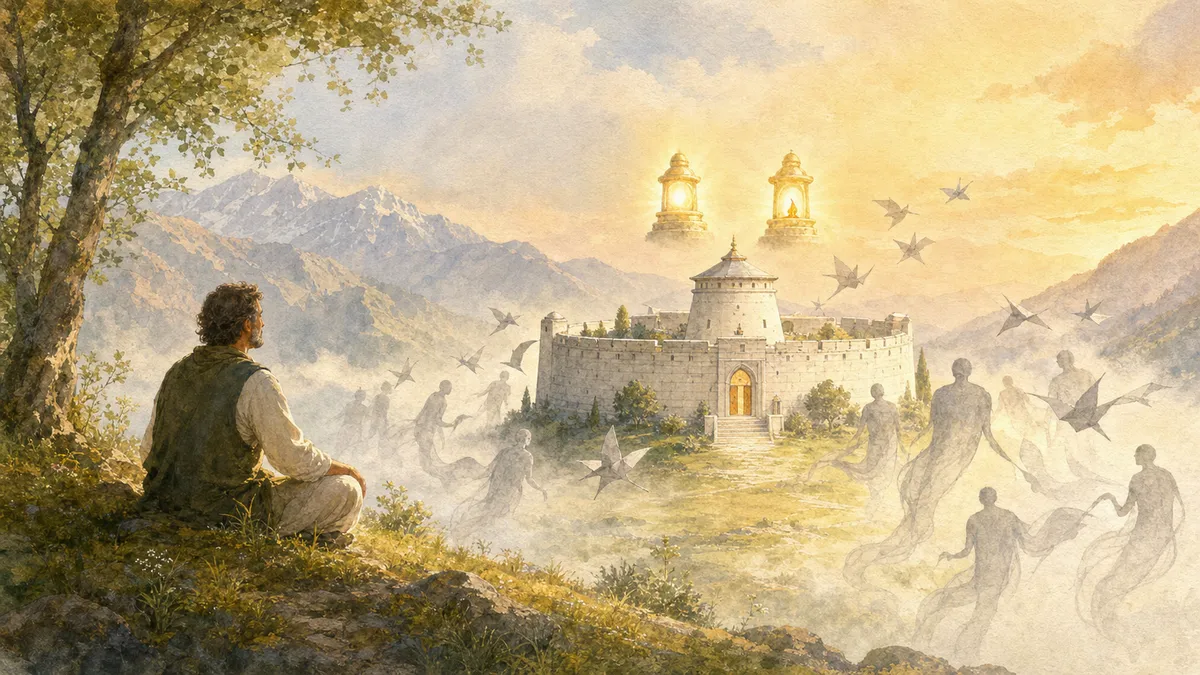
When you practice mahashanti, then with thoughts the conversation is short, because there must be one intention. Your space without thoughts is a fortress, and thoughts are enemies. All arising thoughts are beaten with a club until they stop besieging the fortress, so as to leave the space of awareness. However, this method sometimes does not work if your mind is too agitated. Even more enemies may appear if you fight them intensely. This war becomes prolonged, so it is unknown when it will end. Then you should simply leave thoughts alone and distance yourself from them, becoming an outside observer.
As for intention, there should be only one intention—to maintain the status of awareness. It consists of two things. The first is mindfulness, the second is vigilance.
Mindfulness is an intention directed toward the very object of meditation. If you practice mahashanti, then it is such mindfulness of mahashanti, when you are interested only in the screen without thoughts and nothing else, when you direct your mind to this screen with great attentiveness. If it is niralambha meditation, then you are interested only in the sensation when you meditate on the mahavakya.
Vigilance is a guard, a sentinel who checks how mindful you are. One could say that mindfulness is in the middle, and vigilance is at the side. If distractions are too strong, the check can be done once every three seconds, and if they are not too strong, then once every seven seconds or even less often. It is like a bell, and you ask yourself again: “Where is my mind?” This is the intention that prevents mindfulness from drifting away.
If you have no vigilance, then you may lose mindfulness and, without checking yourself, come to your senses about thirty minutes later, remembering: “Oh, I’m supposed to be meditating! What am I even doing? What a nightmare, I’m sitting away this precious time in retreat.” This means that a mistake was made: the intention, the vigilance, did not work; that is, this bell or guard did not perform its functions. Mindfulness went out, and the guard did not awaken it again. If you understand what vigilance is, then even if your mindfulness constantly goes out, vigilance will awaken it. Then the mind will not become involved in kleshas and in the desire to derive enjoyment from them. If you understand these two things (mindfulness and vigilance), then you have understood eighty percent of mahashanti.