The Yogi’s Path: Cultivating Sattva as the Foundation of Spiritual Transformation
23.10.2026
0 мин. чтения
0
Share
copy
search
add
share
Commentary on the text of the “Devībhāgavata Purāṇa,” Book 3, Chapter 4
Lord Vishnu said:
“Worship to the Goddess, prakriti, the creatress—constant worship!
To the Beautiful One, who fulfills desires, brings success, and increases prosperity—worship, worship!
To Her whose nature is consciousness, existence, and bliss, who abides beyond samsara—worship!
To the Creatress who performs the five acts, to Bhuvaneshvari—worship, worship!
To Her who possesses all powers and stands at the summit—worship, worship!
To Her who abides in the form of Arthamatra, Hrillekha—worship, worship!
I now know, O Mother, that existence rests upon You, and that creation and dissolution of the world proceed from You; Your boundless power, filling all the worlds, manifests itself in these deeds. At the time of creation, having spread everything throughout, including the existent and the nonexistent, You reveal it all to Purusha for his enjoyment—with the sixteen tattvas and the seven tattvas, appearing to us like a mirage.
If it were not for You, no object would be visible. Having filled everything completely, You abide.
The wise say that even Purusha is incapable of action without Shakti. You constantly delight the universe; solely through Your power and brilliance, You make everything manifest. And You, O Goddess, swiftly absorb everything at the end of the kalpa. Who, O Goddess, can know the workings of Your power?
You saved us, O Mother, from Madhu and Kaitabha, showed us the vast worlds, and brought us to Your abode, O Bhavani, where we attained the highest degree of happiness and beheld Your great might.
Neither I, nor Bhava, nor Virinchi know Your inconceivable deeds. Who else, then, can know them, O Mother? How many worlds, O Bhavani, therefore exist in creation, seen by us here at Your feet and created by Your great power?
Here, in the universe, we saw another Hari, another Shiva, and another Lotus-Born One, endowed with vast power. And who knows, O Goddess, how many of them exist in other worlds? And who knows Your boundless and auspicious greatness?
I beseech You, bowing before Your lotus feet: may Your form always dwell in my heart! May Your name constantly be upon my lips, and may I always behold Your lotus feet! May You constantly regard me as Your servant, and may I regard You as my mistress. And even more—may there be an unbroken bond between us, as between mother and son!
You know everything in the manifest world, because You are omniscient. And what can a lowly man tell You, O Mother of the world, O Bhavani? Do whatever You wish.
Brahma creates, Vishnu protects, and the Consort of Uma brings about destruction—so people understand it. But is this really true? For, O Goddess, it is only by Your will that we are able to act, O Unborn One, endowed with Your power!
The Earth, O Daughter of the Mountains, does not bear this world; rather, Your shakti serves as the support for everything.
The sun is visible, O Benevolent One, only because it is endowed with brilliance by You. Being pure, You manifest as this entire universe.
Brahma, I, and the greatest of the Ishvaras, through Your power, all have consorts and are subject to death. How, then, could other gods, headed by Shamadha, be immortal?
You are the Mother, the ancient prakriti. You, O Bhavani, bestow knowledge upon the ancient Purusha—I know this, being close to You; otherwise, immersed in tamas, he would think that he is the Unborn Lord, the Master, the Ruler of the world.
You are the knowledge of the wise, and You are the strength of the strong!
You are glory, beauty, wealth, contentment, and dispassion leading to liberation in the human world.
You are Gayatri, the mother of the Vedas!
You are Svaha and Svadha!
You are Bhagavati, endowed with qualities, and You are Arthamatra!
You bestowed the sacred tradition and scriptures to sustain the lives of the gods and Brahmins.
You create the entire visible universe for the liberation of the jivas, which are parts of the unborn, immortal, sinless, infinite ocean, spread out like its waves!
When the jiva realizes that everything is created and destroyed by you, that all of this is false, like an actor’s performance, then you bring this performance to an end, O You who are endowed with great power!
You are my savior from this ocean of existence filled with delusion, and to you, O Mother, I constantly turn, O destroyer of great difficulties!
Protect me at the time of my death, at a time filled with all kinds of suffering, falsehoods arising from attachment and aversion.
Worship to you, O Goddess!
O Mahavidya, I fall at your feet! Grant me illuminating knowledge, O bestower of all blessings, O Benevolent One!”
The Two Stages of the Spiritual Path
There are two main parts to the spiritual path. The first is human, the second divine. The first is connected with the purification of karma, the second with transcending karma and manifesting the play.
By the logic of things, the ultimate goal of every yogin is to become a deity and merge with Brahman. Just as a caterpillar transforms into a butterfly, so too does a yogin transform into something higher.
When we begin engaging in spiritual practice, we do not possess the necessary qualities, so we need to develop them. During the first years, the yogin practices in order to develop concentration, purify the pranas, eradicate negative character traits, and learn to free himself from egoism. He learns to be at least an ordinary person (in the best sense of the word), develops concentration and flexibility, and enhances clarity, intellect, and more. One cannot become a deity without passing through this stage, and even less can one attain liberation. All of this is called the accumulation of merit and the purification of karma.
If we are very impatient and immediately want to attain liberation, this is unrealistic. It is fundamentally impossible, since we must eradicate tamas, subdue rajas, accumulate sattva, establish ourselves in sattva, and move from sattva to that which is beyond the three gunas.
Working with the Three Gunas
Conquering tamas, calming rajas, and accumulating sattva are the first tasks for a yogin.
If tamas predominates in a yogin, he cannot practice at all; his spirit is weak, he cannot concentrate or engage in service, and his intellect is dulled. He remains in a passive, lethargic, tamasic despondency.
If a yogin’s mind is in rajas, he cannot contemplate, concentrate, or sit in meditation, and his relationships are disharmonious.
Finally, when a yogin’s mind is in sattva, he is harmonious, contemplative, attentive, and possesses clarity; hidden talents begin to unfold within him.
During the first years of monastic life, one should at least attain sattva. If sattva has been attained, it provides the necessary foundation for further advancement.
At the stage of sattva, pure vision and an understanding of divya-bhava naturally begin to arise.
The Importance of Developing Sattva
A person who has not developed sattva within himself but is nevertheless trying to practice diligently creates problems both for himself and for others. That is precisely why we so often emphasize: “Be attentive! Practice pure vision! Observe the principles!” All of these are different forms of sattva that we cultivate within ourselves.
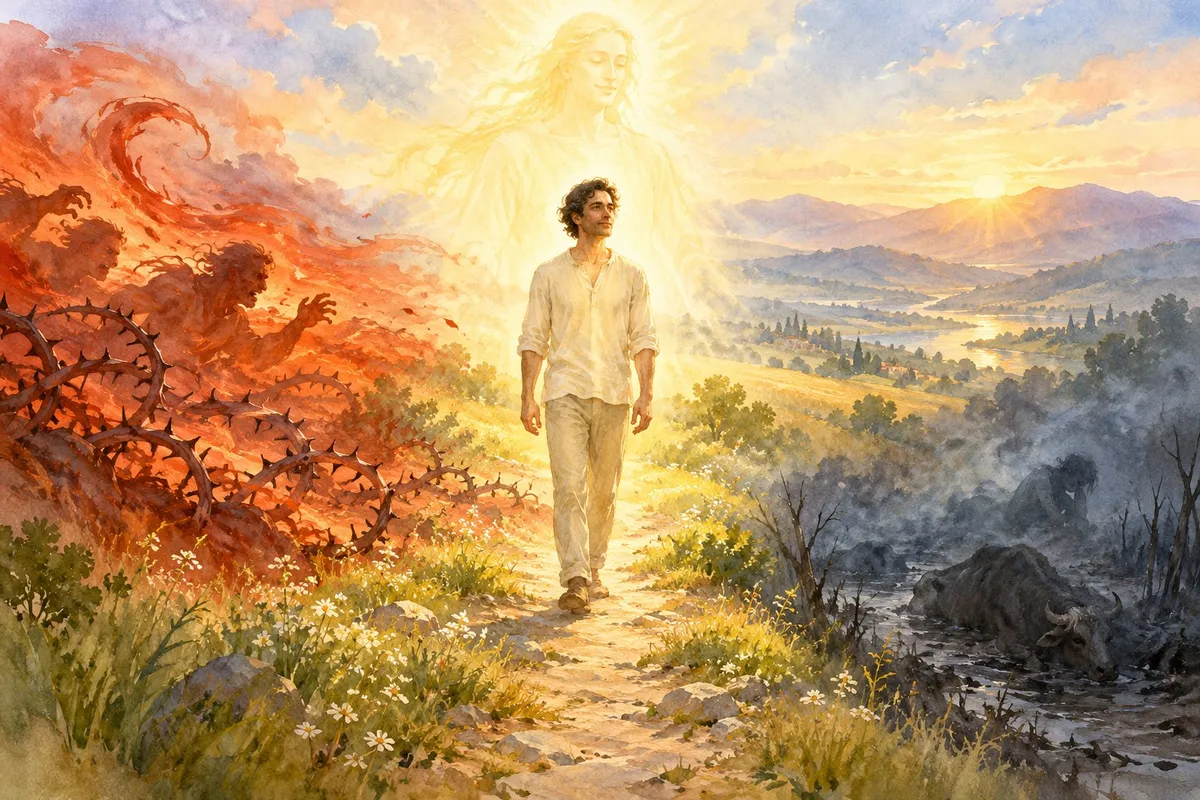
When sattva predominates, a person becomes a deity in terms of his qualities—at the very least, a samsaric deity—and then, from the state of a samsaric deity, proceeds to a higher state. If rajas-influenced qualities are present, a person manifests the characteristics of asuras, while if tamas predominates, he becomes a demon or an animal.
In the first years of practice, even if you have not attained samadhi and your kumbhaka lasts not three minutes, it is not a problem; the main thing is for you to have developed sattva. But if you do not have sattva, even a five-minute kumbhaka will not help you, because it will be an asuric form of sadhana. Therefore, a monk must always cultivate sattva. In Christian terminology, this is called “the acquisition of the Holy Spirit.”
Pure vision
Liberation
Karma
Shakti
Purusha and Prakriti
Sattva
Tamas
Rajas
Devibhagavata Purana
Author Гуру
Read 17 times
Articles
Vidya AI
Search
Lectures
November 4, 2026
Mantra of the day
ОМ СИДДХАЙА НАМАХ ОМ Совершенному – поклонение!
Auspicious Times(Rome)
Brahma Muhurta:
04:55 - 05:50
Abhijit Muhurta:
11:33 - 12:14
Sayam Sandhya:
16:41 - 17:23
Mokshada Ekadashi (6 November)
Ekadashi of liberation. Helps to achieve spiritual enlightenment.