

Commentary on Longchen Rabjampa’s text “The Precious Treasury of the Dharmadhatu”
“The nature of the basic space, spontaneously present from time immemorial, fills everything, without division into outer and inner.”
Laya Yoga begins when we awaken to this nature of the great space of the Absolute. To be in the practice of Laya Yoga means to remember and think of the Absolute day and night, to listen about It, to sing Its praises, to contemplate It, to serve It, to surrender oneself to It without reserve, and to reunite any actions with It. And when our impure karmas resist and try to break free from submission to the Absolute, we must see them with discriminating wisdom and again and again bring them into submission to the Light of the Absolute.
At the beginning of practice, thousands of attachments, unconscious petty “little minds” (chaitasika) in our consciousness constantly try to lead us out of submission to the absolute nature. A yogin is often tempted by various demonic influences of his own lower “I,” and therefore it is not easy to attain enlightenment. It is preceded by purification, that is, we must purify and purify ourselves. As we practice, we become skillful spiritual warriors and know how, in any situation, to subordinate our nature to the Absolute.
When such submission takes place, we suddenly realize that we have reunited with the great Source, that our great “I” has shone forth, that now we are inseparable from it, that this connection is continuous and will never again be lost. At first, through inexperience, we lost it many times. Even when the spiritual Teacher slightly revealed it, our old unreasonable nature still pulled us in its own direction. As the saying goes, “no matter how much you feed a wolf...” However, there comes a moment when we can tame this wolf, put a collar and a muzzle on it, and instead of making us lose the vision of the Absolute, this wolf becomes our faithful dog, an obedient servant. Now it is no longer dangerous; it too reunites with the Clear Light. When we restore this unbreakable connection, we continuously contemplate the great Clear Light, similar to space.
The Hierarchy of Spiritual Worlds
“It has neither limit, nor top, nor bottom, nor directions, nor breadth, nor length. Sky-pure awareness is that very space, devoid of mental projections and reference points.”
Then the entire task comes down to how to give our consciousness ever more fully to the continuous contemplation of this great Light. As in the world of human beings, in the spiritual world of the gods there is a hierarchy. This hierarchy is based on the degree of the gods’ meditative absorption. In the world of human beings, hierarchy can be false; it can depend on many secondary causes, and therefore a person occupying a high position may not possess spirit. But in the world above human beings, it is impossible to fabricate anything, because the radiance of light emanating from a deity depends on the degree of its meditative absorption.
Gods whose connection with the Absolute is weak have a weak radiance. But gods who are in deep absorption in the Absolute possess a body of light that emits strong light for several miles, and therefore other gods see this, honor them, and praise them. However, above these gods there are still greater souls, who come even to the world of the gods very rarely. These are great mahasiddhas and saints, who possess not merely a single radiant body; they are one vast space of Light. When they descend, this Light covers all the other gods. For all the others, this is a great celebration and darshan.
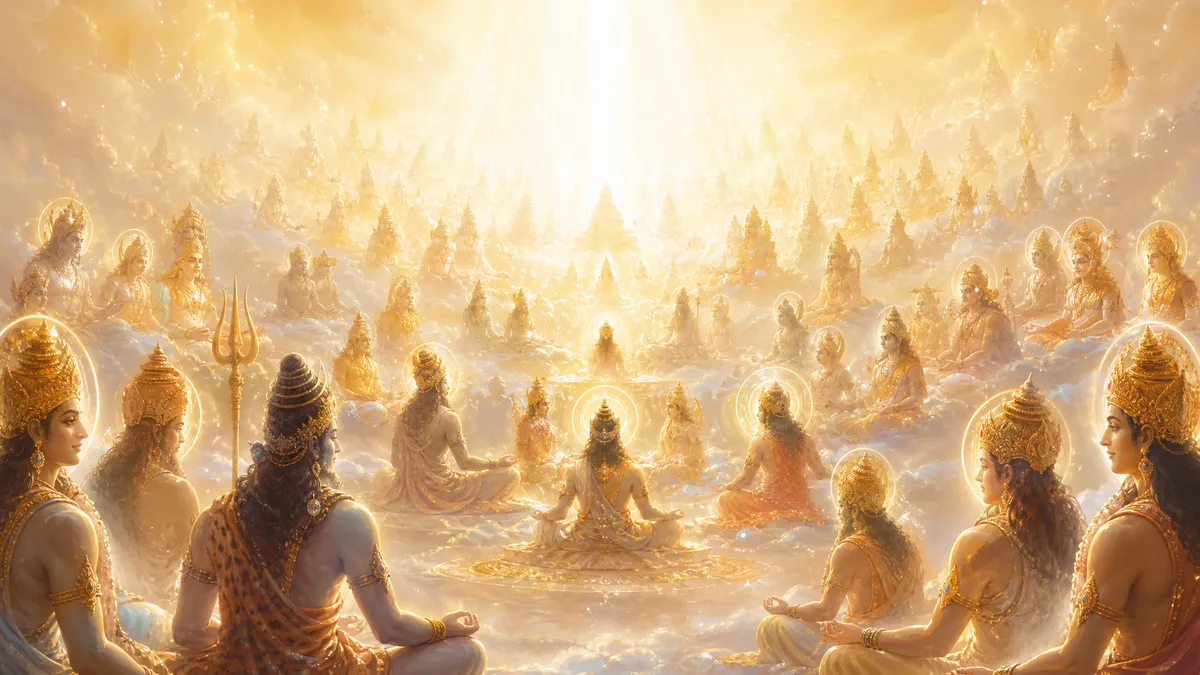
The degree of depth of the mahasiddhas’ absorption is far deeper even than that of the gods of the upper world of forms; it is simply astounding. When they come into this world, other gods gather to listen to their teachings and to express reverence and praise to them. The radiance of living beings in the lower worlds grows ever dimmer. Attachments of the lower material nature cause the great space of the Clear Light to fade.
The Illusory Nature of the World
“All illusory things arising from unborn space are absolutely undefined and limited by nothing.”
Again and again we must remind ourselves: “This world is an illusion.” Imagine that you are dreaming something, for example, that you are a man or a woman, that you have a house and relatives. But upon awakening, as your eyelids open, all of this disappears instantly. This is how one should relate to this world as well.
Marpa had a son, Dadaibum. One day a family came to Marpa for instructions. They too had a son, who had died. He had been a robber, but they still grieved for him. Marpa said to them: “In fact, you should look at the world as an illusion. Imagine that you dream you had a son and that he died. All connections in this world are illusory, so do not be upset.” Some time later, according to Naropa’s prediction, Marpa’s son Dadaibum, who was supposed to continue the lineage of succession, was returning on horseback from a festive procession, fell from the horse, and was killed. Marpa grieved deeply. Then the parents of that son came to him and said: “You told us that everything is an illusion, but, as we see, you yourself are very upset by the death of your son.” Marpa replied: “Yes, I truly understand that all this is an illusion, and my grief is not like yours. Your son was an ordinary person; you had a simple attachment to him, and he would have brought you misfortune. But my son was a jewel. He could have continued the lineage of succession and brought benefit to thousands of people. My bitterness is not from the loss of my son and not from attachment to him, but because many living beings will not receive the benefit he could have brought them. This is the sadness of a bodhisattva.”
Awakened Mind and the Importance of Spiritual Communication
“They cannot be defined as something of this kind, for they have neither substance nor characteristic signs. The unborn nature of all things, vast as the sky, is spontaneously present without beginning or end, beyond past and future time.”
It is very important to continuously listen to teachings about the Absolute, to remember It, and to associate only with those who meditate on the Absolute, because such communication is like nectar. For an unstable beginning yogin, association with those who meditate on worldly desires and the illusions of this world is like poison. Whether we want it or not, this is so. If you want to progress in spiritual practice, your company is extremely important. A true yogin takes great care to ensure that his spiritual life takes place in favorable conditions.
“Awakened Mind is the essence of all samsara and Nirvana. Beyond birth and appearance, it is spontaneously present, without coming or going anywhere.”
We seek the awakened Mind and strive for it, but it always exists. It is said: “It is no farther than our own palm.” The whole point is that our ignorance covers it. First, we have coarse material attachments. It is considered, for example, that if a person has not transcended sexual desire, he will not rise higher than the gods of the world of passion. If attachment to the material and to the body is not cast off in samadhi, it is impossible to enter the world of form. If concepts and mental activity are not transcended in self-liberation, the formless world will remain closed. If inner emptiness and thoughtlessness are not transcended, one will not advance beyond the formless world. If there is inflexibility and some fixation in the mind, then upon rebirth this fixation will become decisive, and because of it you will enter the world that corresponds to this fixation.
“The space of awakened Mind, indivisible into past and future, extends to everything, without arising and without disappearing.”
We often say that when we practice, we must bring any life situations into our practice. This is so. Thanks to this, the mind must acquire true flexibility. The true state of the Absolute is beyond thoughts, beyond acceptance and rejection.
Absolute and Relative Truth
“True suchness has neither beginning, middle, nor end. Its all-encompassing nature—pure as the sky—is beyond past and future, beginning and completion. It is devoid of substances, qualities, birth, and cessation. It does not come and does not go; it cannot be designated as something of this or that kind. It has no need of attainment, effort, or any actions.”
When we hear about our true nature, we must understand that what is being spoken of is precisely our true absolute nature. But the Dharma always has two aspects. Truth can be absolute and relative (conditional). We must necessarily distinguish these two aspects. When we begin to confuse the relative and the absolute, problems and misunderstanding begin. Although our nature is absolutely pure and spontaneous without effort, nevertheless there exists a relative dimension on which we need to work a great deal. Milarepa said it this way: “The Natural Mind does not need correction or practice; however, the kleshas must be corrected.”
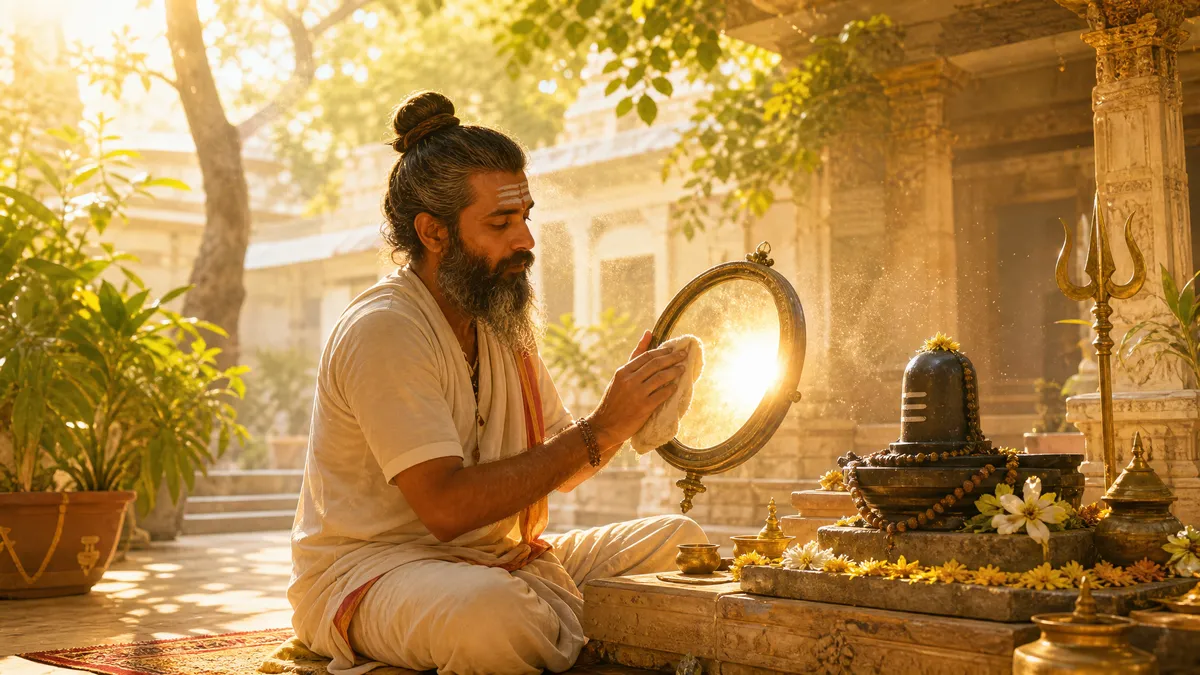
The great clarity of the absolute “I” is always pure. However, the mind, desires, and attachments must be purified in the same way that a mirror is carefully cleaned of dust. The primordial, original, radiant Clear Light of the Absolute is beyond acceptance or rejection; however, in a relative sense, in practice, a yogin should avoid being captured by the worldly, by bliss, clarity, and emptiness. When we become completely free from worldly attachments, there are many other attachments that only a yogin knows about. That is, when we have freed ourselves from some attachments, others emerge—only more subtle ones.
Three subtle attachments on the spiritual path
One of the first subtle attachments is self-satisfaction, bliss. When we first receive a certain experience of the Absolute, it seems to us: “That’s it, I have arrived, nothing else is needed.” This is like a person who was looking for some object and finally found it. If he stops there, then instead of liberation he will attain the worlds of the gods of passion or the first dhyana, becoming Brahma or one of Brahma’s companions. Sometimes bliss can be so strong that one wants to sing or cry, and sometimes, if a yogin practices intensively and experiences bliss, day and night can become confused. This happens because the pranas enter the central channel, and therefore we come into contact with our great “I” for the first time. Whoever gets lost in this bliss, remains in it all his life, and becomes attached to it will not be able to rise to another level. But whoever frees himself from it and continues to apply the practice will be able to deepen contemplation and experience clarity.
Clarity is the second subtle attachment. It is the experience of transcendental wisdom inherent in the gods of the world of form. It may be connected with visions or simply with pure perception. At this time, tremendous pride appears: “I know everything myself; there is nothing more for me to know. All the mysteries of the world are before me, as if in the palm of my hand. I perceive the great mysteries and will investigate them all my life.” But if a saint looks at this consciousness, he will only laugh. Whoever becomes bogged down in this experience will be born as a god of the world of form. He will receive a subtle mental luminous body, and throughout his life in the world of the gods he will listen to different shades of divine music, build divine temples, contemplate yantras, construct mandalas, or explore various meditative states. He will be enchanted by these forms throughout his divine life, lasting several thousand years. And when the power of his samadhi is exhausted, he will be born again as a human being in order to suffer, seek the path of enlightenment, become a monk, and meditate again. In other words, his task was not fulfilled; he did not become liberated, but only healed a little for a time. Such are the beings who are seized by clarity. They are like a kite launched into the sky. Now it flies high, but later it will fall.
One who has been able to transcend attachment to clarity and practices further will encounter the experience of emptiness. This is the deepest experience that can possibly be. Emptiness will fascinate and hypnotize. A desire will arise to be completely absorbed by it and to forget this entire world and the whole Universe altogether. Only emptiness will seem to be truth, and everything else falsehood and something that obstructs. A strong desire will appear not to see, not to hear, to withdraw completely, and to spend one’s whole life in emptiness, abiding in thoughtlessness, being within oneself. Because this is such bliss that even the gods of form and the gods of passion have never dreamed of. Form itself evokes aversion. Such people are truly holy, yet their holiness is not deep. If they grasp at this experience, their path, as the saints say, is mistaken. One who does not understand this must understand it someday. Although even reaching this level is already good. Many of those who were captured by emptiness are born in the formless world and live in a static state for thousands of years, until some holy mahasiddha enters their world and transmits the Light to them. This Light will be so deep that it will lead them out of this inert state of emptiness, and then they will again wish to incarnate on earth in order to continue practice and realize a higher state.
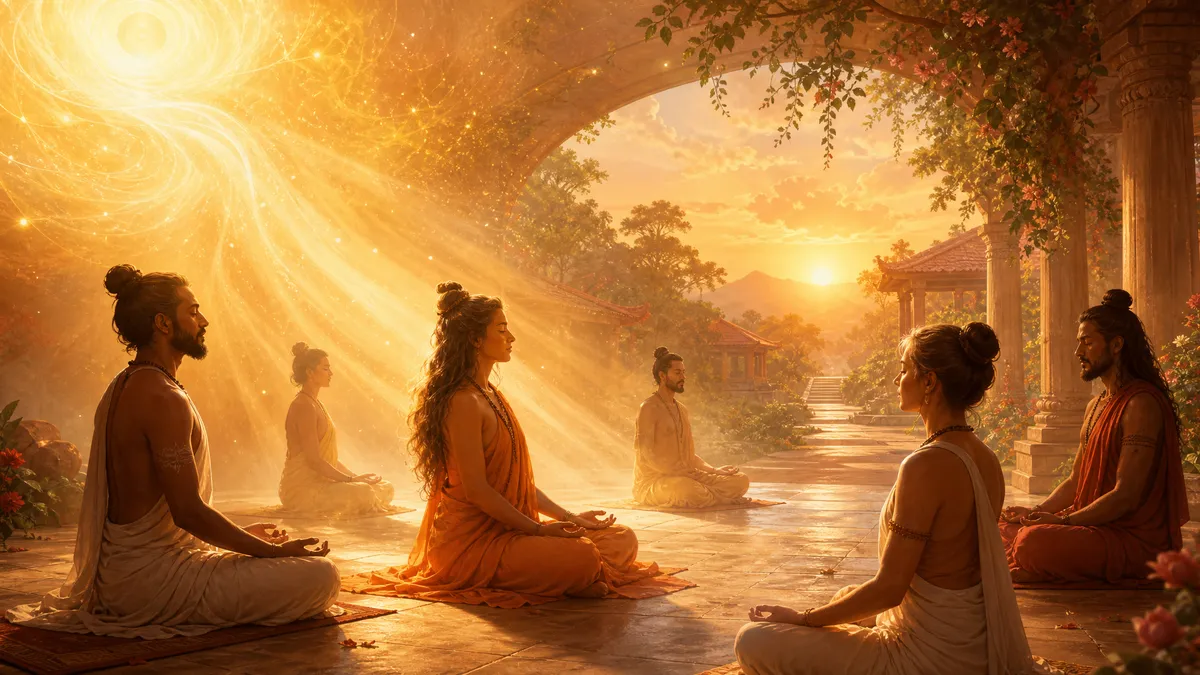
Finally, the one who has passed through these three subtle temptations realizes the supreme state of non-dual Brahman.
The Unified Sphere of Equanimity
“At the basis of true Suchness there is no center, no sides, and no dimensions. This unified sphere of equanimity is continuous and devoid of orientation.”
Day after day, the yogin thinks about, listens to, practices, and serves the great absolute Truth. Then his mind becomes permeated and saturated with it, becoming inseparable from it. This is precisely how spiritual purification takes place.
