

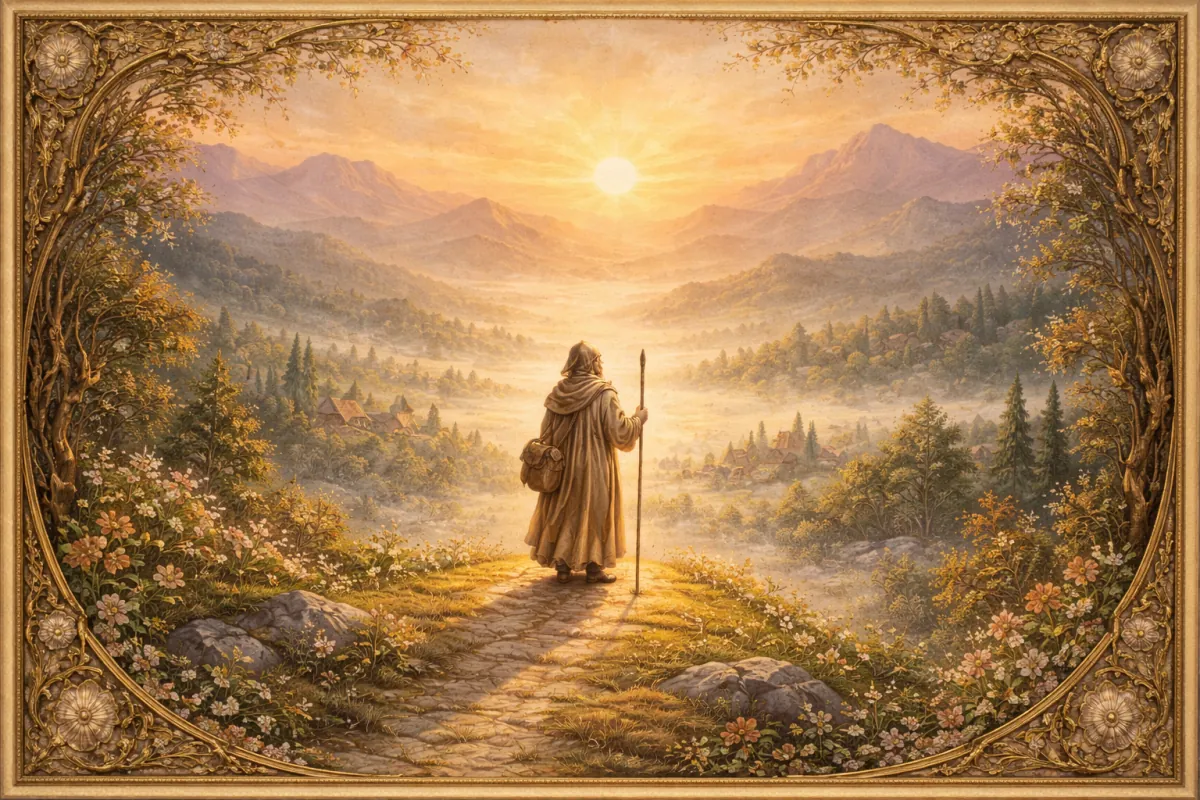
We were greeted by people dressed in deva costumes. We may reflect on the fact that human reality is not the only possible reality. There is another reality—the divine one. It is just as real as our human reality. It is simply inaccessible to us, perhaps for now. Any spiritual teaching, any religious philosophy, is a teaching on how to transcend the human condition and enter another dimension of life, the divine dimension.
Vedic philosophy teaches that the world is divine. The world is originally divine, whether we want it or not, whether we like it or not, whether we know it or not. It is so because it is so. The world is divine because it is divine. The divinity of the world is inherent in creation itself, in its nature. Sooner or later, we become convinced of this ourselves.
At first, when materialistic, atheistic consciousness dominates us, we cannot penetrate the secret structure of life, the secret structure of the universe. This is similar to how a person first studies the laws of Newtonian primitive mechanics, fifth-grade physics. But then, when they grow older, they are taught Einstein’s theory of relativity. They are told that Newtonian mechanics does not describe everything in the Universe. There are higher laws. And when they enter university, they are told that Einstein’s theory is not the highest either. There is quantum physics. There is fuzzy logic, there is probability, and in general, the Universe is not a linear structure; it is something stochastic. Thus, the human mind grows from a simple, linear, primitively ordered vision of the world toward a higher, transcendent one.
Advaita Vedanta, the Teaching of Laya Yoga—this is quantum physics in the spiritual world. Any religious philosophy is, ultimately, something transcendent, surpassing the human vision. To understand it, one must grow beyond Newtonian mechanics, progress to Einsteinian physics, and penetrate the quantum nature of life. The philosophy of Advaita Vedanta is described by the saints in the “Yoga Vasistha” and the “Tripura Rahasya”; it is an understanding of the secret principles of life. We call this divinity. This means an extraordinarily complex, self-organizing self-awareness, an awareness that stands beyond all phenomena, within every phenomenon in this Universe.
Transcending the Human Condition
Our future is divinity. Our future must always be connected with growth, evolution, increasing complexity, and enhanced self-organization. “Man is something that shall be overcome,” Nietzsche once said. But millions of philosophers in the Vedic tradition had said this long before him. He said nothing new. Billions of saints and sadhus described this in sacred texts and offered their own philosophy and vision based on divine revelations.
Man is not the pinnacle of evolution; he is one of its lower links. We ourselves can see how many problems modern humanity faces. Man cannot solve these problems. He is powerless before the forces of nature, aging, old age, illness, and death. He tries to grow, but that old man is powerless. A new human being must grow; that old human being—the materialistic, atheistic, primitive, limited one—is, in business terms, an unprofitable project. Problems cannot be solved with him. It is impossible to respond adequately with him to the challenges existing in today’s world—to the challenges of our time, climatic, geopolitical, and any others. His speed of thought is insufficient; his depth and logic do not correspond to the new realities.
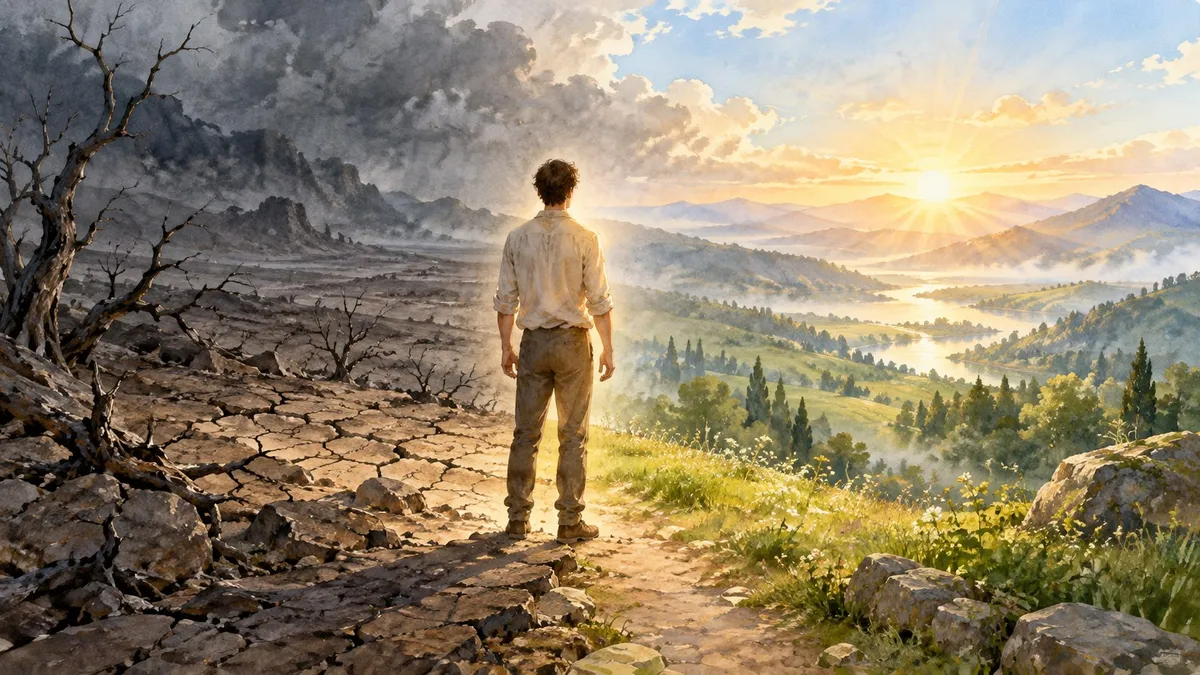
The world is currently in crisis, a specific crisis between vision and capabilities. This crisis cannot be overcome unless human beings change inwardly, unless transformations—global transformations—take place, unless a new paradigm is developed in science, philosophy, culture, vision, and in the very concept of the evolutionary development of humanity. Those who do not understand this will eventually be pushed by history onto the withering branches of evolution. But those who understand it will change themselves, continue to develop, and form the new, next stage of God-humanity, the next stage in the development of humanity.
Divya Loka as a Symbol of a New Life
Today is Divya Loka Day. I would say that it is not exactly a celebration, but an offering to a particular intention, a particular vision. It is a time when we set an intention and take stock to some extent. Because Divya Loka is not only a place where monks study, learn, and practice; it is a symbol, a call to a new life, a call to build a new world never seen before, a call to create a new humanity, a call to change, a call to create a new civilization, a new race, a divine humanity that will live in the third millennium.
Any religion, the path of yoga, the path of Liberation, Enlightenment, Advaita Vedanta, as bequeathed by saints and siddhas—this is not a dogma, this is not some archaic culture; it is a path to a new life, a transition into a new world. Christ also taught the path to a new life. He did not say, “You will live the old way. Continue living as you do”; no, he said that we must create a new vision, a new way of thinking. Any religion is transformation; it is a path that shows that a person must continue to grow, must evolve, must transcend their limited state, and must not remain where they are.
A human being is a creature limited by karma, but Advaita Vedanta, tantra, and yoga teach how to become a divine human being, a superbeing. Our path of evolution is the path of evolution of all living beings, regardless of religious, national, or cultural affiliation: people, sadhus, siddhas, jnanis, devatas. That is, people, then people of the path, then the awakened, then the perfected, then gods, and then great gods. This is the path of all living beings. Only by moving along the path of evolution can a person develop.
Divya Loka is a new concept of life; it is a particular challenge to old stereotypes and values. Perhaps in India there is nothing new about this; it is normal and accepted there. It is normal in Vedic culture. But in Russia, this is definitely a particular challenge to existing values, goals, and meanings. We say that there are other meanings of life, other values in life, and other goals in life. One can live at a higher level, more harmoniously and more wisely, and set more global goals. It is inherent in human beings to think more globally, on a larger scale, and strategically.

Therefore, Divya Loka as a new concept of life means high ethics, high culture, high spirituality, high science, high technology, high philosophy—everything elevated. We laid down these great principles when Divya Loka was created. We invested a particular intention, a sankalpa, and reinforced it with a particular tapasya, sadhana, spiritual practice, and austerity. Therefore, there is every reason to believe that these sankalpas and intentions will continue to move forward; they will not weaken, but will only grow stronger.
Even as a child, when I was twelve, perhaps thirteen years old, I had a vision of a monastery, a forest, and so on. I told my friends. They replied, “What are you even talking about?” But I insisted: “I know what I am talking about.” There is a particular sankalpa, a particular intention, and they manifest and become embodied.
A Story About Overcoming the Impossible
Once I heard an interesting story. In America, when the first manned flight to the Moon took place, the American Neil Armstrong and the second astronaut landed on the Moon and took their first steps. The American said, “That’s one small step for man, but one giant leap for all mankind.” Then, looking into the camera, he said, “Good luck, Mr. Gorsky.” All the journalists wondered what he had said and what it was about. For twenty or thirty years, no one knew the meaning of this mysterious phrase.
Then one day, in front of journalists, this astronaut who had been to the Moon explained why he had said that. It turned out that when he was a boy, he was about eight, perhaps nine years old. He lived in his house, and there was a neighboring house nearby. There were neighbors there who sometimes quarreled and argued. Once, he witnessed an argument between a husband and wife. After having some kind of quarrel with her husband, the wife said: “The neighbor’s boy will walk on the Moon sooner than I will ever love you.” This lodged itself in his consciousness and became a major subject for reflection. It became a definite challenge. She had said it as though it were impossible, unbelievable, something that could not happen in principle. But inwardly, he perceived it as a particular challenge. His entire life became the fulfillment of that challenge. He entered flight school, became an astronaut, and eventually walked on the Moon. When he walked on the Moon, he said: “Good luck, Mr. Gorsky.” He had accomplished the most incredible thing. It became his dream, a fanatical idea toward which he strove all his life. His childhood consciousness received a certain darshan—to overcome the impossible, that which seemed unbelievable.

Sometimes I feel like that same boy who is trying to do something incredible, to change the world and humanity, and to give them new meanings and new goals. But I believe that if one does this and moves toward one’s goal fanatically—in the positive sense of the word—it is possible. There is a great deal of evil, ugliness, problems, and disasters in the world; this is the result of human selfishness, confused thinking, narrowness, and lack of clarity. But all problems can be solved; an entirely different vision can be established; one can live differently if one manifests a deeper and stronger consciousness.
Therefore, I would like to say: let us, in the best sense of the word, be fanatics of goodness, beauty, divinity, mastery, art, and a high-level vision of life in everything. Because only those who are devoted to their goal can truly accomplish something. Just like that boy who believed that he could do something incredible and impossible—walk on the Moon—and disprove that statement; his entire life was a struggle against that statement. He proved it.
The People of the Future and the Civilization of the Future
What will they be like, the people of the future and the civilization of the future? I believe that the people of the future will be immortal. They will possess many bodies; they will live in a personal tunnel of reality, in a personal universe created by their consciousness, their mandala. All of this is described in Sanskrit. In spiritual life, in the Vedic tradition, and in the Tantric tradition, this is nothing new. I am not inventing anything; I am selecting words suited to modern Western people.
The people of the future will live in multireality, not only on Earth but also in space and in other dimensions. The people of the future will live in a personal, consciousness-controlled history—a psychohistory—having become megapassionaries. History will be governed by reason; the future and the past will be formed and modeled. The people of the future will control reality through the power of their will. The era of uncontrolled history and uncontrolled reality will recede into the past and become archaic.

The people of the future will possess paradoxical, intuitive thinking, a quantum quality of consciousness, and fuzzy logic. Thanks to this, they will all be like one—geniuses endowed with mega-abilities. The people of the future will not dwell in karma, in causal consequences, or in linear sequences of events; they will dwell in play, in a probabilistic, stochastic state. The people of the future will form a single collective megamind—that is, they will practically realize in their consciousness the truth of Advaita: everything is Parabrahman, everything is One.
A Call to Build the Civilization of the Future
In Divya Loka, we are currently practicing yoga, philosophy, service, education, and the dissemination of the dharma of art. But this is only the beginning. It may be half a percent of what has been done. I would like to call on everyone gathered here: let us awaken and build the civilization of the future together, beginning right now. Everything is possible if we work diligently. This work must take place both within and without—two aspects. Within, it is sadhana and tapasya; without, it is service and the goals and objectives we set for ourselves.
