

Commentary on the text “Moksha Dharma,” “Narayaniya”
Of all the books of the “Mahabharata,” some are important to us, for example “Moksha Dharma” and “Narayaniya.” “Moksha Dharma” sets forth the philosophy of Samkhya, which is the universal philosophy of yoga, while “Narayaniya” describes the heavenly land of Shvetadvipa—the place where yogins can be reborn.
In addition to the physical Divya-loka, there are subtle realms of Divya-loka. One of them is the pure land of Divya-loka, the second is the heavenly Divya-loka. The heavenly Divya-loka is the realm of Shvetadvipa. Shvetadvipa is associated with the deity Narayana (or Vishnu) and Dattatreya; that is, it is the pure land of Dattatreya.
A yogin who has not become immortal in the physical body, who has not managed to realize the body of light or attain the position of Brahma the Creator and already create his own mandalas, meditates so as to be reborn in a future life in one of the pure lands or in the heavenly pure land.
In the pure land of Divya-loka, which is in the world of samsara, one can be reborn thanks to the power of merit. If you meditate a little, accumulate merit by engaging in service, work with the mind, practice contemplation while renouncing coarse desires, then by the power of one-pointed intention one can be reborn there after life on Earth is completed.
But in the heavenly Divya-loka, which is connected with the world of Shvetadvipa, the radiant White Island, the island of the rishis, it is extraordinarily difficult to be reborn, since for this, in addition to service, a little practice, and observance of the principles of yoga, exceedingly deep contemplation, ascetic practice (tapas), and the attainment of a high level of samadhi are required.
The Journey of the Rishis to the Deity Narayana
The text “Narayaniya” describes an episode when the brahmin Brihaspati made offerings to the gods. When the deity to whom he was making the offering, the god Narayana, did not appear, he became very angry, began to wave the sacrificial spoon rapidly and beat the air. Then, out of vexation, he began to cry and said: “I have performed the sacrifice, but the deity did not appear and did not accept it. Usually here the gods truly accept the offering; why then did Narayana not appear in his form and accept my offering?”
He was very upset. Then the other brahmins and rishis who were around said to him: “You should not be angry (this was in the era of the Krita Yuga). In the era of the Krita Yuga it is not fitting to have such an unstable consciousness and fall into rage. You, Brihaspati, are not yet worthy to behold this deity, just as we are not.”
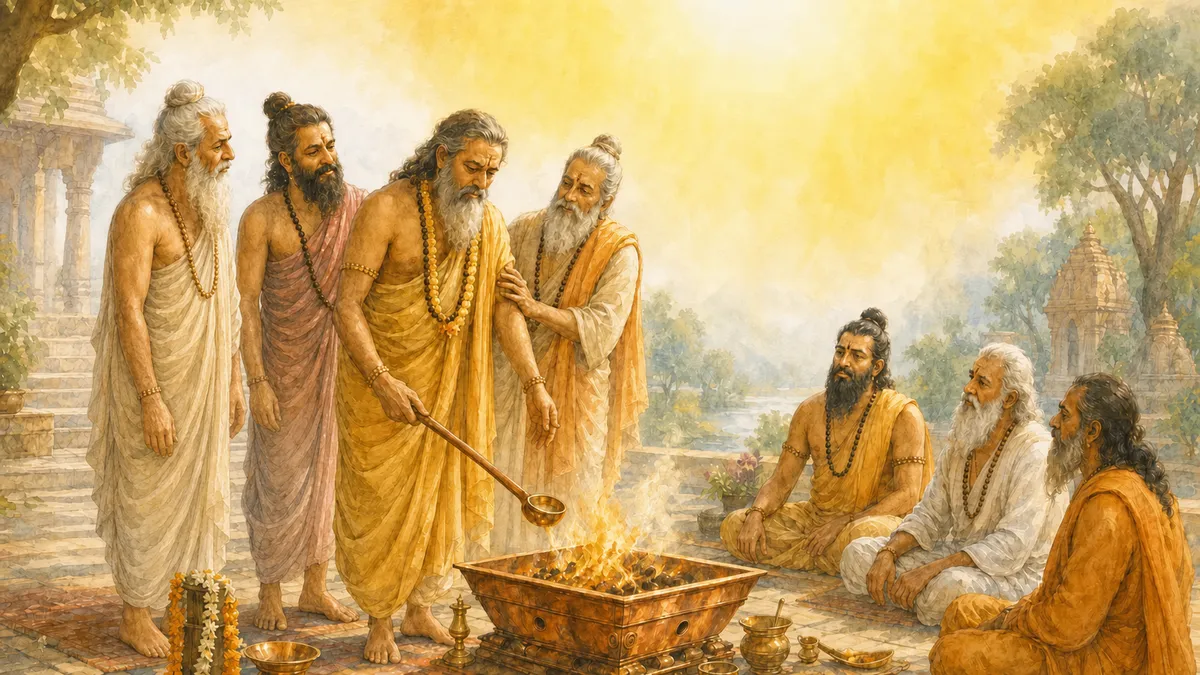
Then the rishis—the first, second, and third (Ekata, Dvita, and Trita)—said: “Once we set out northward and for a thousand years performed an austerity—immersed in ourselves, we stood like ‘pillars’ on one leg.” This took place on the northern slope of Mount Meru, on the shore of the Milk Ocean. There they performed severe mortification of the flesh in order to see the deity Narayana.
When they had performed such an ascetic feat for a very long time, during the rite of ablution a bodiless voice was heard, which said that it was pleased with their feat, that they had satisfied it with their ascetic practice. Then this voice said to them: “To the north of the Milk Ocean there is the radiant White Island—Shvetadvipa. There, beings shining like the moon, devotees of Narayana, have completely surrendered themselves to contemplation of the supreme Source. They enter the thousand-rayed eternal God, free from the senses, fragrant, casting no shadow, not partaking of food. These beings are devoted to the One. They are inhabitants of the radiant island. You, too, will appear there, and then I will appear to you there and grant you my darshan.”
Attainment of the Radiant White Island
Then the three rishis set out for that land along the indicated road and reached the great White Island. Having reached it, they lost sight of all external objects, but they did not see the deity, because his radiance deprived them of sight. Then an inner realization of strong devotion to the Absolute arose in them. They understood that he cannot be seen without first having performed tapas, austerity.
Then on this White Island they again performed ascetic practice for a hundred years: they observed vows, fasted, and meditated. When a hundred years had passed by the measure of the gods, they saw beautiful beings around them: people with bodies of light, marked with the signs of merit, bright and shining. All of them were of the brahmin caste and faced northeast; with folded hands, they constantly whispered mantras, while they themselves were in samadhi—in a very deep state of concentration.
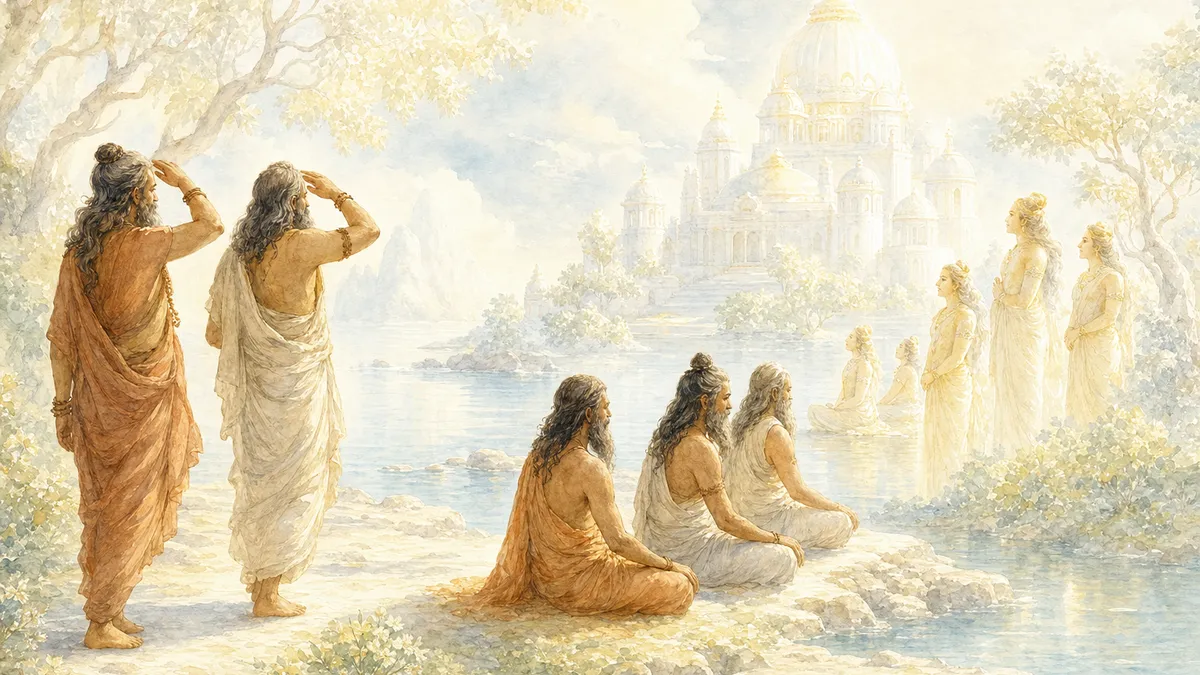
Each of these people had an enormous radiant aura; that is, they themselves were like gods. The rishis thought that this entire island was an abode of radiance, and that this was precisely why it was called the luminous White Island. There, no one differed in brilliance; all shone equally. They were on this island as if among a thousand suns blazing at once, amid these sages.
When the rishis regained their sight, they saw that all these people had turned in one direction and, with palms folded in prayer, were joyfully repeating: “Reverence.” This was the worship that these people offered to the deity of that mandala. The rishis saw the manifestation of Vishnu, the manifestation of Dattatreya; they were enraptured by this manifestation and entered deep samadhi, because the radiance was so powerful that they lost their sight and other senses and could perceive only sound.
Everyone around was repeating prayers and praises, saying: “Reverence to You, O Being of the universe. Reverence to You, Hrishikesha. You are the great Person, the great Firstborn.”
At that time, a pure wind filled with fragrances brought (itself materialized) flowers and other attributes suitable for offering. Thus, these people, shining like deities, were making their offering to the principal deity. Wherever such an offering was made, the deity manifested itself. But the rishis themselves still could not see it (they could only hear); because of its blinding radiance, they were completely blinded.
Because of this, their minds were restless; they understood that they were not worthy of seeing this deity. Although the rishis themselves considered themselves ascetic heroes and were extremely tired and exhausted by their austerity, the others did not even greet them, did not speak with them, and offered them nothing as guests—neither in thought nor by glance—because all were absorbed within themselves and completely immersed in bhava.
Then a certain bodiless entity appeared from space and said:
“You have seen radiant liberated people. These people contemplated the Lord of the gods Himself. But you, sages, quickly go back to where you came from. You are not yet allowed to see God, since He is realized only through the power of absolute devotion and self-surrender, only after prolonged concentration on nonduality. Only then can one see this Bhagavan, who is difficult to behold because of his intense radiance. You still have many great deeds to fulfill and great tapas to perform. Only when this yuga passes and another comes—the Treta Yuga—then, under the rule of another Manu, the son of Vaivasvata, will you become His helpers for the success of the gods.”
By the power of this voice, the rishis again reached the sphere of the gods of the world of desires, from which they themselves had come. These rishis said to the brahman Brihaspati, who during the sacrifice had become greatly angered: “If we, after so many years of tapas and sacrifices to the gods, were unable to contemplate God, then how could you see Him with your own eyes? Therefore you should not enter a state of anger. Narayana is the great Essence, the Creator of the universe, the enjoyer of sacrifices to the gods and ancestors, revered by gods and danavas. He is the Unmanifest, the Beginningless and Endless.”
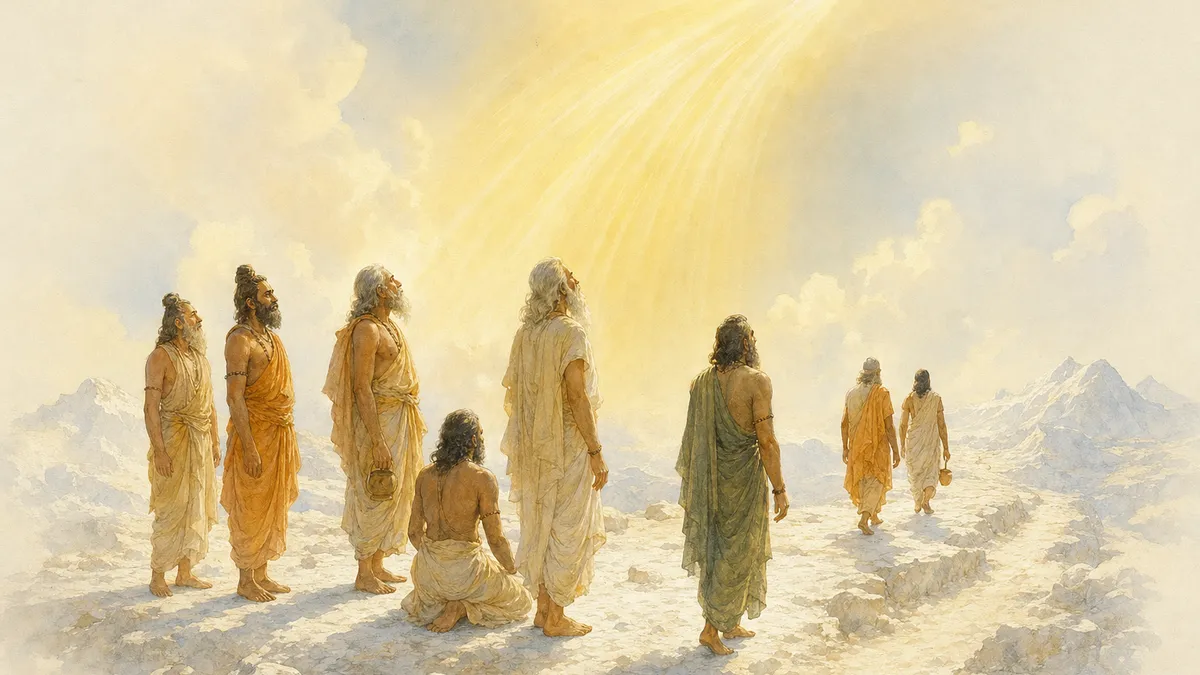
Thus the brahman Brihaspati was pacified by the words of Ekata, Dvita, Trita, and his other companions.
Narada’s Journey to Shvetadvipa
It is further said that this narrative should not be transmitted to those who do not honor the Supreme and the dharma of nonduality, and that this narrative (that is, the narrative of the “Narayaniya”) has absorbed into itself all the nectar from hundreds of other narratives that are handed down. Just as the gods and asuras gathered the nectar that had been churned, so here the unsurpassed amrita has been gathered by various rishis.
It is also said that there is no doubt that a person who constantly reads or listens to this narrative in an undivided state of devotion to Narayana (in this case, Dattatreya) and nondual awareness of the supreme Source, who through this devotion constantly abides in the state of supreme guru yoga, himself becomes, upon reaching the great White Island, such a radiant person—that is, he acquires a body of light and enters the radiant God.
Having listened to the narration of this text from beginning to end, the suffering person is freed from illnesses, the one who desires knowledge will receive what is desired, and the devotee will follow the path of devotion.
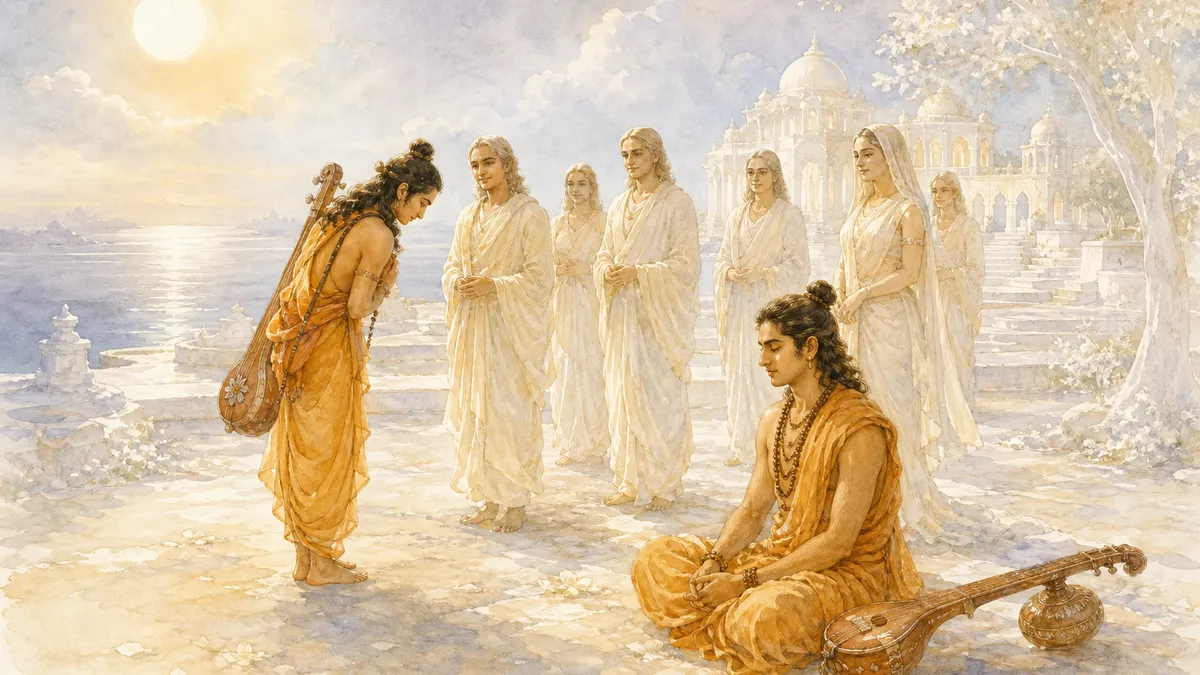
Hearing this story, Narada too desired to set out for the White Island, Shvetadvipa, in order to see Narayana. Having come to Shvetadvipa, he saw there people shining like the moon. He honored them by bowing his head, and he himself was mentally honored by them. Wishing to behold God, he too passed through all ascetic practices, continuously whispering prayers. Steadfast, focused on one thing, with arms uplifted and immersed in samadhi, he began a hymn of praise to the infinite, attributeless, and omnipresent Absolute:
“Obeisance to You, God, Lord of the gods. Inactive, Attributeless, Eye of the world. Knower of the field, Purushottama, great Purusha, supreme Purusha. Of all forms, Great in form, beloved. I am Your devotee, desiring to behold You if only for a moment. Obeisance to You, obeisance.”
Bhagavan’s Manifestation to Narada
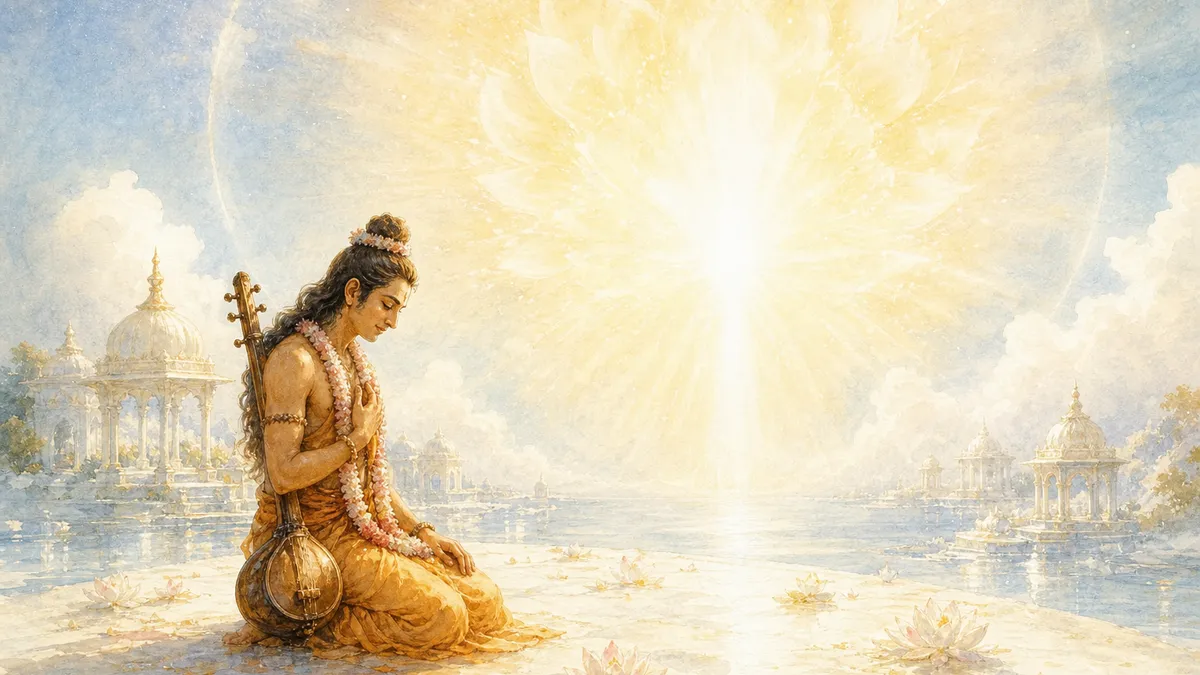
Then Bhagavan, praised by all these secret names invoked by the rishi Narada, visible in the universal form, the Vishva-rupa, appeared to him:
“As if like the moon, spiritually pure, and at the same time as if utterly different from the moon; as if fire-colored, and as if the radiance of stars flashing in the mind; as if the rainbow of a parrot’s wing, and as if the sparkle of crystal; as if a deep blue-black stroke, and as if heaps of gold. Now the color of a branch of coral, now as if a white gleam; here golden-hued, and there like beryl. As if the blue of sapphire, in places like emerald; there the color of a peacock’s neck, in places like a string of pearls. Thus the Eternal, Holy One, the Hundred-headed, Thousand-headed, Thousand-footed, Thousand-eyed, Thousand-bellied, Thousand-armed, and in places the Unseen, assumed many diverse colors and forms. The syllable AUM sounded from His mouths, and Sarasvati followed that sound. From His other mouths many hymns resounded, and the four Vedas and the Aranyakas were proclaimed by God Narayana, the mighty Hari. The King of the gods, the Lord of sacrifices, held in His hands the altar, the cup, pure jewels, sandals, kusha grass, the radiant devourer of offerings, the skin of a doe, and a staff. Him, the gratified and pacified One, Narada, the best of brahmanas, bowing down, silently glorified Him, the Supreme Lord.”
To Narada, whose head was bowed, the Source of the gods, the Imperishable, spoke. Sri Bhagavan said:
“Ekata, Dvita, and Trita—the great rishis—came to this land desiring to behold Me. But they did not see Me, and no one can see Me except those who are wholly devoted to Me. And you are the highest among those wholly devoted. Those excellent forms of Mine were born in the house of Dharma, O twice-born one. Honor them constantly. Now go there from where you came. Choose a boon, rishi—I shall give you whatever you wish. I, Of All Forms, the Imperishable, am pleased with you.”
Narada said:
“I have already obtained the fruit of my feat, self-restraint, and tapas, for I have beheld You. For me this is the highest boon—to behold You, Bhagavan, Of All Forms, great Lion, omnipresent, great Lord.”
The Teaching on the Nature of the Absolute
Then, having appeared to Narada, He said:
“Go, Narada, and do not delay. These are My devotees of contemplation, free from the organs of sense, not partaking of food, shining like the moon. They must meditate on Me in a state of non-duality, without breaking away, and may there never be any hindrance to them. These perfected beings have always been focused only on the One, and they are free from rajas and tamas. Without doubt, they will reunite with Me.
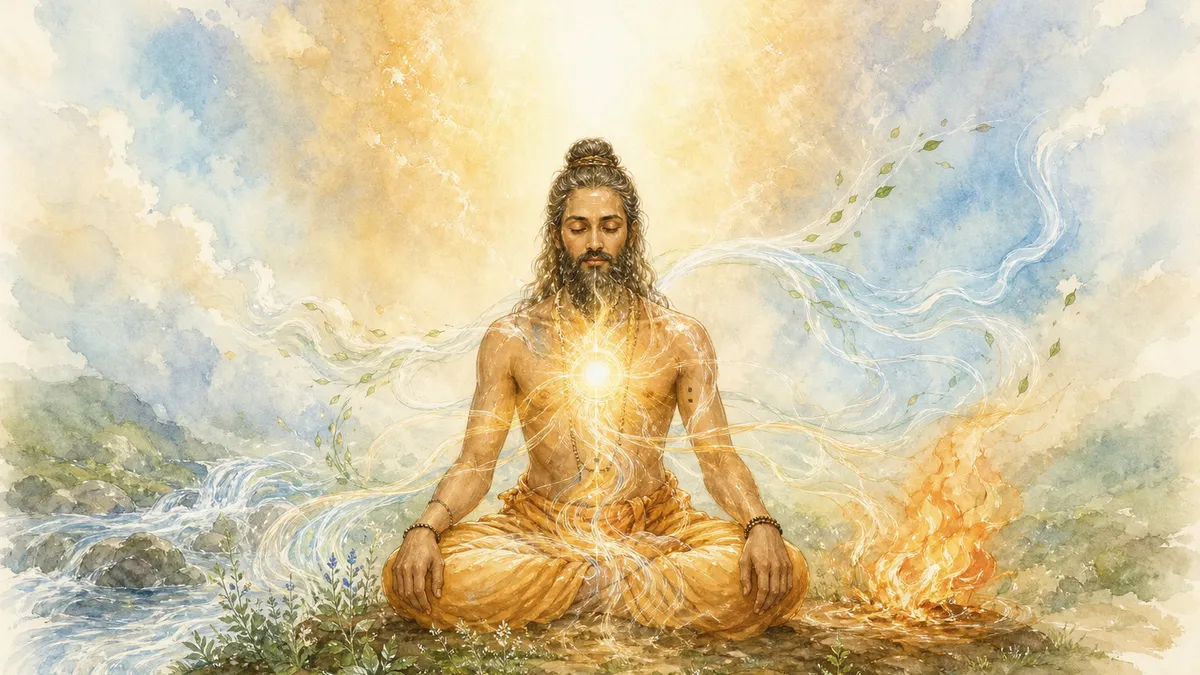
Invisible to the eye, imperceptible to touch, unsmelled by smell, inaccessible to taste, uninvolved with the qualities of sattva, rajas, and tamas, the Omnipresent Witness is called the Atman of the World, the Soul of Being. When the bodies of many, many beings perish, He does not perish with them—the Unborn, Constant, Eternal, Infinite, and Indivisible. He transcends the twenty-four tattvas and is the twenty-fifth tattva. He is called the inactive Purusha, who beholds all by the power of wisdom, jnana. Having entered into Him, the excellent brahmanas are liberated. He is known as Vasudeva, as the Supreme Eternal Atman.
O Narada. Behold the Greatness of the Spirit of the Absolute, His great Glory. He is never stained by either good or bad deeds. Sattva, rajas, and tamas are called qualities, gunas; it is they that act, abiding in every body. The Knower of the field enjoys the gunas, but the gunas do not enjoy Him. He, devoid of all qualities, partakes of the gunas, produces the gunas, and transcends the gunas.
O divine rishi. The Earth, which supports the transient world, dissolves into water; water flows into fire; fire dissolves into wind; wind dissolves into space; space enters Consciousness; Consciousness—the Supreme Essence—flows into unmanifest Nature; unmanifest Nature—Brahman—dissolves into the inactive, motionless Purusha. Therefore there is nothing higher than the Mahapurusha, for there is no eternal Being, moving or unmoving, in the transient world apart from that Eternal, One Purusha. The Atman of all beings is that Mighty, All-pervading Vasudeva.
Earth, wind, space, water, and fire—the fifth. The union of these elements is known as the body. Then, O Brahmin, He, the Unseen One, enters the body. Having been born, this Lord becomes the mover of the body. Without the combination of the elements there can be no body, and without the soul (jiva), the winds (pranas) do not move the body.
O Narada, the eternal and the perishable, Being and non-Being, arise from Me—this entire transient world, moving and unmoving. The Munis who enter into Me, devoted to Me, are liberated. I am known as Purusha, inactive, the twenty-fifth element, without duality, without selfhood, without qualities, indivisible. But you cannot comprehend this; therefore I appear to you as though having assumed a form. If I wish, I shall vanish in an instant, for I am the Lord, the Teacher of the entire transient world. It is indeed only maya created by Me, Narada, that makes you see Me. Like all beings, you are bound up with the gunas and therefore are incapable of knowing Me. But I have told you fully of My fourfold form.
The soul is immersed in Me; therefore I am comprehended as the jiva, but your consciousness has not yet reached the ability to say: “I have seen the jiva.” I am omnipresent, O Brahmin, and I am the inner Essence of multitudes of beings. When bodies—the aggregate of the elements—perish, I do not perish. Those perfected ones, focused on the One, endowed with a great share, free from tamas and rajas, darkness and passion, enter into Me, O sage.
The Cosmic Manifestation of the Deity
The golden seed, Hiranyagarbha, the ineffable, four-faced one, the beginning of the world, the eternal god Brahma, always contemplates My purposes. From My brow, from My wrath, Rudra came forth. Look: here are the eleven Rudras standing to My right. And here are the twelve gods, the Adityas, standing to My left. Before Me, look, are the eight Vasus, excellent gods. Look: behind stand the two healers—Nasatya and Dasra.
Look upon the lords of all beings; behold the seven rishis, the Vedas and hundreds of sacrifices; behold nectar (amrita), medicinal roots, various kinds of tapas, self-restraint, austerities and spiritual practices, abstinence. Behold the eightfold divine power (that is, the eight siddhis) in Me alone, having assumed form; behold the earth with its peaks, bliss, beauty and glory. Behold beside Me the goddess Sarasvati—the mother of the Vedas that abide in Me. Behold, Narada, the northern star—the best of the stars in the firmament. Behold reservoirs, oceans, seas, lakes, rivers. Behold the four hosts of the ancestors—spirits embodied in Me. Look: all qualities abide in Me without forms.
Sacrifices to the gods and the sacrifice to the ancestors are different. Yet I am the Ancestor of the gods and the ancestors; I alone am Primordial. Once I brought forth Brahma, and he honored Me with sacrifice. I gave him excellent gifts, honored by him: “You are My son and, from the beginning of the kalpa, the guardian of the world.” I said to him: “Become the Basis of personality; henceforth you shall be called by this word—ahamkara. No one may transgress the boundaries set by you. For those who yearn for gifts, you, Brahma, are the giver of gifts. Rakshasas, serpents (nagas), gods, O great ascetic, ancestors, O long-armed one who constantly observes vows, and various beings will pay you homage.”
Then Brahma said: “I am the path of Your Manifestation in the sacrifices to the gods; I am Your servant; guide me as Your son.” These, as well as other gifts, I bestowed upon the immortal, splendid, radiant Brahma and, content, entered supreme peace, withdrawing into the unmanifest.
Nirvana is the removal of all foundations of the Dharmas and is considered transcendent. Therefore, one devoted to the withdrawal of the senses should wander, withdrawing the activity of all the limbs. The sage Kapila—who took knowledge as his helper, was self-absorbed, abiding in the sun, and firmly established in Sankhya—is called Teacher. This is Bhagavan Hiranyagarbha, rightly praised in the Vedic hymns. I am the One who rejoices in yoga, the Brahman spoken of in the scriptures of yoga. I am the One who has attained manifestation. Eternal, I abide in the sky.
Cycles of Creation and Dissolution
Then, at the end of a thousand yugas, I again draw the transient world into Myself. When the period of all beings, moving and unmoving, abiding in Me is completed, I again create the entire transient world by the power of My knowledge. Such here is the origin, from the beginning of the kalpa, of the universe, repeating again and again, like the rising and setting of the sun here in the firmament. When the time is exhausted, He, immeasurably radiant, again draws the world into Himself by His own power. Then, for the welfare of beings, exerting My powers, I set the earth back in its place, in all its parts filled with beings, having disappeared into the encircling ocean.”
Further, Narayana describes His incarnations in various forms on Earth. After this Narayana said to Narada:
“Such contemplation of Me as you have attained, O twice-born one, having fixed your mind on one thing, no brahmin has yet been able to attain. Therefore, to you, O pious brahmin, I have told everything—the past and the excellent future, together with their mystery.”
Thus that God, bearing the universal form, the Eternal Bhagavan, having spoken these words, disappeared instantly.

“And Narada, having received the desired boon, the mighty one, hastened to the abode of Badari, wishing to behold Nara-Narayana. And this great Upanishad, corresponding to the four Vedas, composed according to sandhya-yoga, He called ‘Pancharatra.’ The word that came from the mouth of Narayana, Narada proclaimed again in the abode of Brahma, just as he had seen and heard it. A person who constantly reads or listens to this narration, wholly devoted with all his being to Narayana and wholly united with devotion, having reached the great White Island, becomes a moon-colored person, that is, with a radiance like the moon, and enters into the Radiant God—of this there is no doubt. Having listened to this narration from beginning to end, the afflicted is freed from illness, the one desiring knowledge will receive what is desired, and the reverent one will follow the path of devotion.”
Contemplation of Narayana as a Path of Purification
What does it mean to contemplate Narayana? It means, while purifying one’s consciousness and pranas from kleshas and desires, to continuously direct one’s mind into the nature of Mind. You should not live by momentary concerns; you should constantly live in such a way as to remember the Supreme Essence, since all momentary, vain concerns are transient, and after some time not a trace of them will remain. Only the purity of your reason, however, will indicate the place of your next rebirth.
To contemplate Narayana is to perform guru-yoga with Bhagavan Dattatreya. And what does this mean? Above all, it means to continuously gaze into your own essence, to abide in complete devotion to contemplation, and to continuously surrender to this essence.
As long as the mind is clouded and identified with the gunas of material nature, it abides in strong identifications with kleshas, qualities, worldly desires, and thinks in dualistic categories. But when the mind is purified, it is freed from all ignorance and understands that its main task is the contemplation of the inner Narayana and continuous purification.

The Experience of Contemplating the Heavenly Shvetadvipa
Until we attain true holiness, the path to the heavenly Shvetadvipa is closed to us; so strong is the radiance there that we cannot even approach it. Only truly holy souls who have purified themselves can approach it.
When I was about twenty, I had an experience in which I saw from afar the radiance of one heavenly land while abiding in the samadhi of the subtle body. There was a powerful radiance, dome-shaped buildings, and music resembling symphonic music. This music was very sublime, but at the same time terrifying, because it was too mighty in its power. There was immense shakti in it; these vibrations surpassed the human world.
In the subtle body I approached this land to a certain distance and contemplated it only from afar, not daring to come closer, because an exceedingly terrifying power of light and sound emanated from this realm. There were magnificent dome-shaped buildings, temples, and so forth. But at that time I did not have enough clarity, contemplation, or spiritual strength to approach even within a kilometer of it. I felt that I clearly lacked holiness, that I needed to purify myself greatly.
After several years I managed to enter this world again, that is, directly inside it. Thus, if you lack holiness, in the subtle world you clearly feel it; you cannot even approach a holy realm.
The Nature of True Holiness
Holiness is something that is cultivated through genuine renunciation, contemplation, and purification. There, nonduality manifests as the energy of sattva; there, your words have power; there, there is no falsehood. You cannot say as simply as in the human world: “This is all illusion” or “This is all nondual.” That is, you may think it there, but you still will not be able to draw near. You must truly be accountable for your words in the subtle world. Therefore it is said that in the subtle worlds there is no falsehood, because there to say, to think, and to manifest are one and the same.
Genuine holiness consists in constantly freeing yourself from the worldly, regardless of what status you are in, constantly purifying your mind, and, while practicing Advaita, always remaining humble.

The Dangers of Spiritual Pride
Often, while practicing Advaita, we forget this; we begin to think too highly of ourselves. Having superficially absorbed the philosophy of Advaita, we begin to think: “I must manifest divine pride” — and we try to flaunt this pride left and right. But if we were to stand beside truly holy souls, we would simply feel ashamed that, compared with these holy souls, we are dirtier than a dog.
Of course, we should not absorb the idea: “I am dirty like a dog.” This does not belong to the teaching of Advaita. It is absolutely necessary to nurture pure vision and divine pride, since in the teaching of Anuttara Tantra the feeling of guilt, the feeling of self-obscuration, is never welcomed — this is not something one should establish oneself in.
On the other hand, one should always soberly assess one’s spiritual level and truly have a humble and modest consciousness. For what purpose? In order to be able to move further, to go forward, to constantly challenge one’s limitations, not to make peace with the limitations that exist right now, at this moment, thinking: “Perhaps I have already attained everything. I have already understood everything. It is unlikely that anyone can teach me anything.”
Mara, the “Son of the Celestials”
This also happens. When you think this way, it is the first sign that the mara “son of the celestials” is creeping a little into your soul; that is, this is a subtle mara connected with siddhis, with merits, with exalted qualities, with arts, with wisdom, if they are applied incorrectly.
If you have certain abilities but attribute them to yourself, take egoistic pride in them, and begin to think highly of yourself, it means that you are straying onto the wrong path, and this mara is gradually “recruiting” you; you are already becoming a candidate for his world rather than for liberation. Therefore a yogin always looks very carefully into his soul and tries to analyze: “Are there such tendencies in me?”
The best way is constant self-liberation, offering all one’s qualities to the Absolute, and the practice of modesty and humility. When practicing divine pride, there are many such temptations. But divine pride is connected more precisely with devotion and humility than with arrogance and haughtiness. This too should be understood.
Conditions for Attaining Holiness
Only one who has cultivated strong holiness during life can enter worlds like this. Strong, deep, genuine, true holiness is attained through:
- Antar-tapasya (inner asceticism)
- Humbling of the ego
- Obedience to the higher “Self”
- Service
- Guru yoga
- Establishment in pure vision, the single “taste,” and divine pride
- Immersion in contemplation
- Freedom from desires and kleshas
- Unwavering observance of the prescriptions of yoga
If your channels are not purified, your mind is agitated, and there are many unsatisfied worldly desires that trouble your heart, holiness will not be seen. Holiness is the result of very deep refinement and establishment in divya-bhava, of control over prana and desires.
If there is unpacified tamas, unpacified rajas, and you are not sufficiently established in sattva, then holiness will not be seen either, since holiness begins with pure sattva, with the pacification of tamas and rajas.
This means that life must be lived in such a way as to constantly refine and polish one’s mind and prana, to burn out tamas and rajas with the “red-hot iron” of natural contemplation, yogic tapas, and the yoga of observing vows. When tamas and rajas are burned out with the “red-hot iron” of the natural state and pure sattva remains, then, relying on sattva, one can make the leap to that which is beyond the gunas—to the true clear light of the supreme Source, to the clear light of the ground.
Comparisons with Others
When we meditate, perform practice or service, we can often look at one another with human eyes. Sometimes, seeing shortcomings in another person, we may become proud, thinking: “I don’t have such shortcomings.” Or, seeing that someone else is sleeping during meditation while we are meditating diligently, we may also become proud, thinking: “This person certainly won’t reach any pure lands, but I will.”
Or, seeing how someone else stumbles over the simplest things in service, we think: “But I am intelligent, flexible, and clear in service. Whatever I am given, I will do it all. Wonderful. I am ahead of everyone. I am better than others. I can be entrusted with management and any complex service—I will master everything. But another person, frankly speaking, cannot do what I can.”
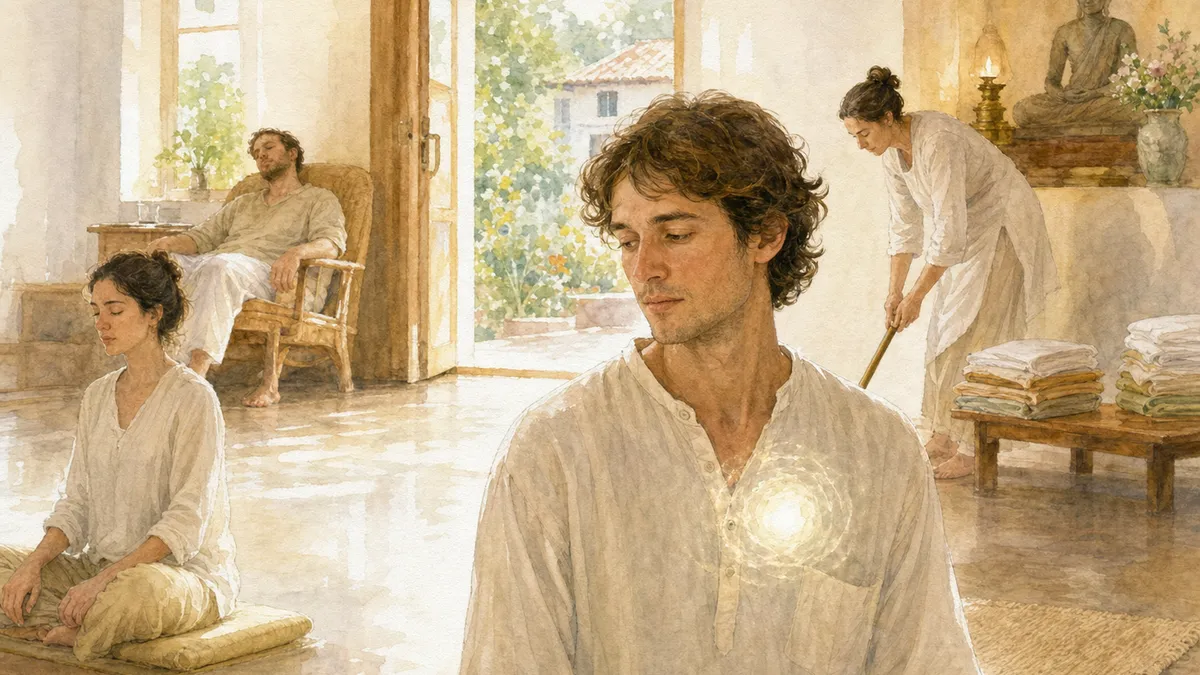
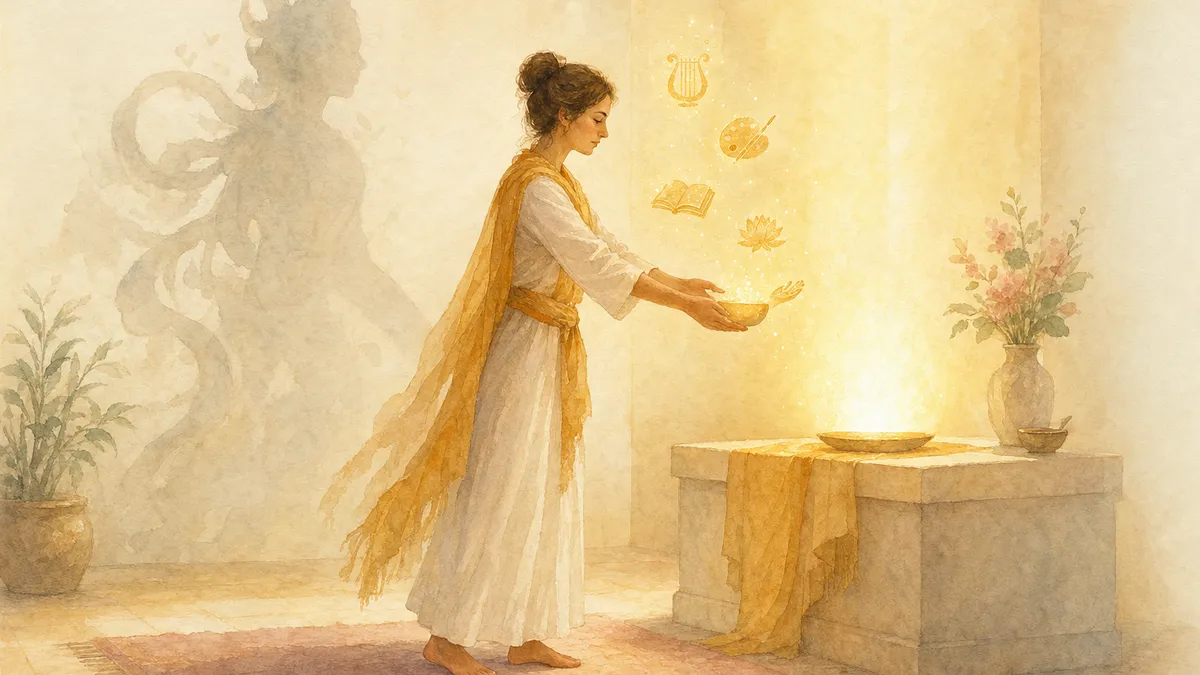
Or we may think: “I have talent. I can play, draw, compose poetry, while another is slow-witted; whatever you give him, everything slips from his hands. What kind of celestial being could he be?”
That is, comparing ourselves with others, we may think that we are higher, smarter, and purer than they are. But such thoughts are a cause for pride, for great self-importance, for the growth of the ego. On this basis, the ego can put down deep roots and fall into what is called the “sin of conceit.”
Therefore, always compare yourself with saints, instead of thinking about others and comparing yourself with them in this way. For example, recall the story of the three rishis who performed severe tapas for a hundred years in order to reach Shvetadvipa, but got there only for a few seconds and were not even able to behold Narayana. Remember the great rishis and saints, and think: “How holy and pure am I compared with them? How many kalpas must I perform sadhana before I reach their level?”
Such reflections always sober one up. These rishis say: “I am Brahman,” and you also say: “I am Brahman.” On the level of the view, everything is the same, but on the level of energy and the relative dimension, it is samsara and nirvana. And all that remains for us is to purify ourselves daily, constantly strive to raise our level, and diligently and without laziness follow the path of our tapas.
